fbpx

November 5, 2017

Larry David Creates Firestorm After Saturday Night Live Jokes on Holocaust and Weinstein

In a controversial opening monologue, Saturday Night Live host Larry David ignited a firestorm with controversial jokes connected to the Holocaust and accused sexual harasser Harvey Weinstein.

David, of “Seinfeld” and “Curb Your Enthusiasm” fame, noted the discomfiting pattern that many of the alleged sexual harassers who have been in the news are Jewish. “I don’t like it when Jews are in the headlines for notorious reasons,” he said in the monologue. “I want ‘Einstein Discovers Theory of Relativity,’ “Salk Cures Polio.’ What I don’t want? ‘Weinstein Took it Out.'”

This sent him on a tangential riff, musing about his “obsession with women,” wondering what it might have been like had he been in the concentration camps during the Holocaust. Would he still be checking out women in the camp? He comes up with some conversation starters a person in a camp might use, to highlight the absurdity of trying to think of pickup lines in a concentration camp.

The reaction was immediate.

Many deride the joke as disrespectful, while others strongly hold that we should be focusing our anger on the people who oppress others, not those who joke about that oppression.

See the video here:

https://www.hulu.com/watch/1168345

https://twitter.com/DavidKlion/status/927228062323892225

https://twitter.com/kathbarbadoro/status/927238130213715968


Larry David Creates Firestorm After Saturday Night Live Jokes on Holocaust and Weinstein Read More »

Larry David Goes One Cringe Too Far

With his appearance on Saturday Night Live this past weekend, Larry David, the undisputed king of cringe-comedy, may have finally crossed a line. It is a symbolic line, admittedly, one that artists draw for themselves both morally and aesthetically.  But it is a line nonetheless.

Of course, it’s not a line David would ever hesitate crossing again.  He’s taken that same devilish step many times in the past—all for laughs.

His monologue on SNL, however, doubled down on a theme that properly deserves to be forever buried and left alone.  That’s what we do with the dead, especially the victims of mass murder.  A certain amount of piety is expected, and one never dreams of desecration with such nightmarish events.

David pivoted from the recently disclosed sexual predations of certain men in the entertainment industry, making the unpleasant association that many of them happened to be Jews, to his own unseemly wolfish behavior.  Apparently, so indiscrete are his sexual urges that he can imagine checking out Jewish women in a concentration camp.  In fact, he gave a national audience a glimpse of David hypothetically approaching an attractive woman with death in her immediate future, and testing out pick-up lines.

Appalling, but perhaps not surprising.  David has been flirting with the Holocaust for many years.  And he keeps coming back, not taking no for an answer, a nebbish with a libido for bad taste.  Except the Holocaust is not a love interest.  It is an unsightly atrocity, incapable of attraction of any kind, and on any human scale.

This is the same man who conceived a Seinfeld episode in which Jerry was making out with a girl during a screening of Schindler’s List.  And another in which a disagreeable fast-food proprietor was renamed “The Soup Nazi.”  An episode of Curb Your Enthusiasm riffed on the Reality TV show, The Survivor, in which a winning contestant squared off at a dinner party with an actual survivor of a death camp, comparing their relative suffering.  In still yet another, a man with numbers tattooed on his forearm turns out not to be a Holocaust survivor, but rather just someone who temporarily inks his lotto ticket number each week so as not to forget.

So much for Never Again.

Yes, David’s entire act is predicated on projecting discomfort in his audience, forcing them to watch characters disgraced beyond redemption.  George Costanza, David’s doppelganger, was an enduring fool of humiliation, placed in recurring, squirming situations.  David took the Borsht Belt and twisted it into a straightjacket of Jewish self-loathing.

In France, the comedian Dieudonne M’bala M’bala has incorporated crude concentration camp humor (and jokes about gassing Jews) into his act.  And because of such material, he is routinely banned from performing and has been convicted for engaging in racial hatred.  In Belgium, he was imprisoned and forced to pay a $10,000 fine for inciting hatred.  In America, for expressing self-hatred, and mocking the Holocaust, David was honored with guest-hosting duties on SNL.

Of course, freedom of expression is a hallmark of American democracy.  David is merely taking extreme artistic liberties with his comedic imagination—Holocaust survivors be damned.  Moreover, unlike Dieudonne, David is himself a Jew.  Shouldn’t he be given the same leeway African-American comedians receive when their material invokes the “N-word”?  After all, concentration camp victims were known to tell jokes to each other in order to keep their spirits up and maintain their moral survival.

But those were their jokes to tell; they owned the experience, and they weren’t ribbing each other for laughs alone, one skeleton to another.  And there are still survivors living among us.  Isn’t there some gentleman’s agreement about un-ripened events “too soon” for comic exploitation?

And as for France and Belgium, they are democracies, too, with artistic licenses of their own.  They just happen to believe that common decency and a respect for the dead should not be debased for the sake of nervous laughter.

Larry David may have finally gone one cringe too far.  Surely, he didn’t violate any laws, other than the one of nature—with something as supremely unnatural as Auschwitz, go find another gag line.

But after all these years, shouldn’t the Holocaust be able to take a joke?  Actually, it can’t, and what’s more, it shouldn’t have to.


Thane Rosenbaum is a novelist, essayist and Distinguished Fellow at NYU School of Law where he directs the Forum on Law, Culture & Society.  He is the author of “The Golems of Gotham” and “Second Hand Smoke,” among other fiction and nonfiction titles.

Larry David Goes One Cringe Too Far Read More »

27 Dead in Texas Church Shooting

As many as 27 people are dead and 24 others injured in a shooting that occurred Sunday morning in a Texas church. It is the deadliest church shooting in modern U.S. history.

The gunman, identified as 26-year-old Devin Patrick Kelley, entered First Baptist Church in Sutherland Springs at 11:30 am local time and fired around 20 shots. The gunman fled the scene and was chased by a local resident into Guadalupe County. It is not known if he killed himself or was killed by the resident.

One of the victims include Annabelle Pomeroy, the 14-year-old daughter of the church’s pastor, Frank Pomeroy. Pomeroy told ABC that his daughter “was one very beautiful, special child.”

Multiple others are being treated in nearby hospitals, including three children who are in critical condition.

“My heart is broken,” Wilson County Commissioner Albert Gamez Jr. told CNN. “We never think where it can happen, and it does happen. It doesn’t matter where you’re at. In a small community, real quiet and everything, and look at this, what can happen.”

Sutherland Springs is a small town of less than 400 people that is about 30 miles southeast of San Antonio. Alena Berlanga, who lives close to Sutherland Springs, told the Associated Press that the shooting was “horrific for our tiny little tight-knit town.”

“Everybody’s going to be affected and everybody knows someone who’s affected,” said Berlanga.

President Trump gave his condolences on Twitter:

The Texas senators also issued tweets responding to the situation:

Texas Gov. Greg Abbott (R) said in a statement, “While the details of this horrific act are still under investigation, Cecilia and I want to send our sincerest thoughts and prayers to all those who have been affected by this evil act. I want to thank law enforcement for their response and ask that all Texans pray for the Sutherland Springs community during this time of mourning and loss.”

27 Dead in Texas Church Shooting Read More »

The Kotel Agreement and the Conversion Law – A Report from Jerusalem

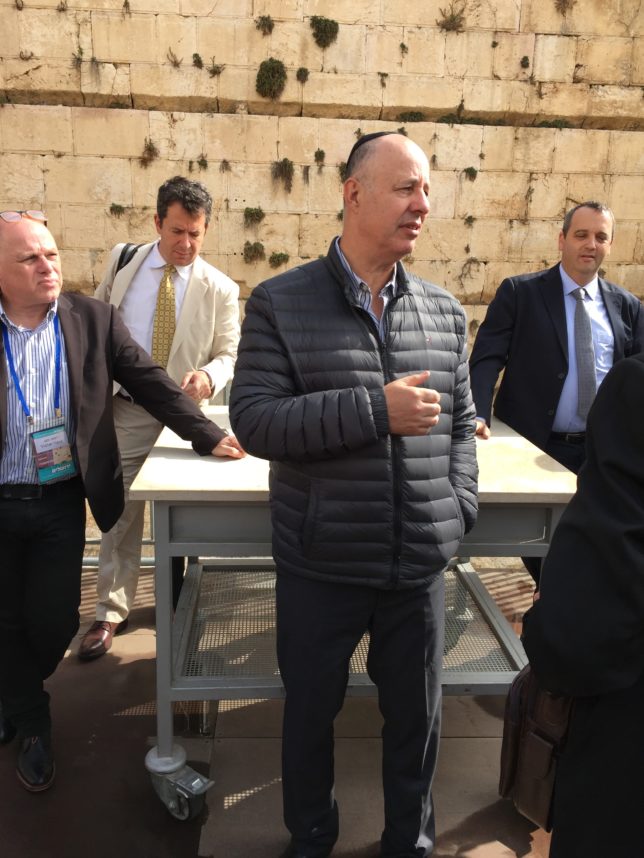
Tzachi Hanegi. Rabbi Gilad Kariv, Executive Director of the Israel Movement for Progressive Judaism is behind Hanegbi and to his left. My photo.

I just returned from meetings of the Board of Governors of the Jewish Agency for Israel (BOG of JAFI) and the Zionist Council of the World Zionist Organization (Vaad HaPoel of the WZO) that met this past week in Jerusalem. (see notes below about these two national institutions of the Jewish people).

Two items were prominent on the agenda of JAFI – The Kotel Agreement compromise reached by the government of Israel in January 2016 (19 months ago) and the Conversion Law introduced before the Knesset by the ultra-Orthodox religious parties.

Re: the Kotel Agreement compromise – This agreement was reached after nearly four years of negotiations. If implemented the agreement would create an egalitarian prayer space in the southern Kotel plaza that would be equal in size and accessibility with the traditional Kotel plaza. Whereas the traditional Kotel plaza would continue to be controlled and supervised by the chief rabbinate of the Wall, the new southern Kotel plaza would be controlled and supervised by the Reform and Conservative movements, the Jewish Federations of North America, and the Women of the Wall. There would be a common entrance and both the traditional and southern plazas would be visible from that entrance. The new southern Kotel plaza would be characterized by egalitarian mixed gender prayer.

Prime Minister Netanyahu had asked Natan Sharansky in 2013 to find a compromise agreement that would eliminate the tensions that had developed as a consequence of the monthly prayer minyans observed by Women of the Wall in the back of the women’s section for the last 25 years, and would address the concerns of many Israelis that the entire Kotel plaza had been turned into an ultra-Orthodox synagogue. Non religious ceremonies had once been conducted in the plaza by the State of Israel including induction into the IDF, among others. Whereas the plaza represented the modern State of Israel as a national heritage site, it had been taken over by the most extreme religious forces in the state.

Natan Sharansky and the committee representing all interested parties including the chief administrator of the Wall succeeded in reaching a compromise. Should the agreement then be implemented as intended, it would have marked a victory for religious pluralism and democracy.

However, on June 25, 2017, the Prime Minister abandoned the agreement when the ultra-Orthodox religious parties in his ruling government coalition threatened to leave the government should the compromise agreement be implemented. This action infuriated Natan Sharansky, the Board of Governors of the Jewish Agency for Israel that Sharansky now chaired, and the leadership of non-Orthodox Jews in Israel and throughout the Diapsora.

Also on June 25, 2017, the ultra-Orthodox parties submitted a bill to the Knesset that would restrict authority over all conversions in Israel to the ultra-Orthodox Chief Rabbinate. This means that 350,000 Israeli citizens who are not Jewish according to traditional halachah (“Jewish law”) must convert according to the most rigid and strict standards as determined by the Israeli Chief Rabbinate. The 350,000 Israelis are primarily immigrants or children of immigrants from the former Soviet Union who either do not have a Jewish mother or who are spouses and family of Jews who would like to to convert to Judaism but who would prefer to study with Reform or Conservative Rabbis and to live their Jewish lives according to Reform and/or Conservative standards, or as a vast majority of Israelis practice but are not Orthodox.

These non-Jewish Israelis, by the way, serve in the Israeli Defense Forces, speak Hebrew, pay Israeli taxes, and in every way identify as Israeli citizens. But, they cannot marry in Israel unless they convert to Judaism. The Conversion Bill would make it far more difficult for them to ever convert. The ultra-Orthodox rabbinate converts only a few hundred individuals each year.

The Conversion Bill also rejects for purposes of Aliyah under the Law of Return any Jew converted in Diaspora communities by rabbis not approved by the Chief Rabbinate. This means that no Reform and Conservative rabbis, no modern orthodox rabbis, and even many Haredi rabbis are not approved by the chief rabbinate as authentically Jewish.

The Kotel Agreement and the Conversion Law dominated our meetings of the Board of Governors of the Jewish Agency this past week.

In response to the outrage of the members of JAFI, Prime Minister Netanyahu asked his close political and personal ally, Minister of Regional Cooperation Tzachi Hanegbi, to meet with us and explain the government’s position. The American Reform movement led by Rabbi Rick Jacobs, the Israeli Reform movement led by Rabbi Gilad Kariv, and the American Conservative movement led by Rabbi Steven Wernick expressed to Hanegbi emphatically our demand that the original Kotel agreement be implemented and that the Conversion Law be withdrawn from consideration permanetly. Netanyahu had tabled the Conversion Law for six months and it will be reconsidered at the end of December.

In the very week when we celebrated the hundredth anniversary of the signing of the Balfour Declaration (November 2, 1917) in which the British government declared its support for the establishment of a national home for the Jewish people in the land of Israel, it was shocking to confront the reactionary response of the Netanyahu government concerning the Kotel and conversion. These issues in and of themselves are important, but they are only the tip of the iceberg. The real issue at stake is whether Israel will remain religiously pluralistic and democratic.

By his actions, the Prime Minister created a serious rift between the government of the State of Israel and the Jewish Diaspora, so much so that for the first time in history an Israeli Prime Minister was not invited to address the Jewish Agency Board of Governors. For the first time in my memory as well, the Prime Minister will not attend nor address by video the General Assembly (GA) of Jewish Federations, the most important American Jewish body, taking place next week in Los Angeles.

We of the Board of Governors of the Jewish Agency convened at the Kotel last week in a demonstration of our support for the original Kotel agreement. It is important to note that there are those in the JAFI BOG leadership who would take whatever we can get from the government now and continue to fight for the implementation of the rest of the original compromise agreement. There are others including our Reform movement leadership who argue that the negotiated agreement reached in June, 2016 is already a compromise and should be implemented without changes.

At the Kotel, after Minister Hanegbi tried to reassure us of the Prime Minister’s good intentions, I asked an obvious question:

“It seems to much of world Jewry that Prime Minister Netanyahu is more concerned with holding his position as Prime Minister and keeping his governing coalition together than he is concerned with the best interests of klal Yisrael, the entirety of the Jewish people. How do you respond to this widely held belief?”   

Minister Hanegbi said that this was not true, that the Prime Minister has political challenges to consider and that he still believes that a compromise is achievable.

No one I know standing there at the holiest site in Judaism believed that Netanyahu would become a “profile of courage” and risk his government on this issueor, for that matter, on any issue.

What is the take-away for us?

First, it is our duty as Diaspora Jews to continue to support the State of Israel as the national home of the entire Jewish people.

And second, it is our obligation to align ourselves with progressive democratic forces in Israel that advocate for religious pluralism, democracy, and human rights.

The following day, the 120 members of the Jewish Agency Board of Governors went to the Knesset and met individually in groups of four with thirty-four MKs. Our message was simple – ‘implement the original Kotel Agreement and reject the Conversion Law.’

After our individual hour-long discussions, we met in a large Knesset Conference room and many MKs spoke to us including members of the ruling coalition Likud, the Zionist Union, Kulanu, Yesh Atid, Bayit Hayehudi, and others. To a person, each supported our agenda and said so forthrightly. We did not meet, however, with any members of the extremist ultra-Orthodox parties or the Arab List.

Notes:

JAFI and the WZO are two of the three national institutions of the Jewish people. The third is Keren Kayemet L’Yisrael (i.e. KK’L – or JNF).

Theodor Herzl, the Father of Zionism, founded the WZO in 1897 in Basel, Switzerland. It is called “the Parliament of the Jewish people” and includes representatives from every major Israeli political party and all world Zionist organizations.

David Ben Gurion founded the Jewish Agency for Israel in 1935 and served as its first Chair. He was also the chair of the WZO before the state was founded. Today, Natan Sharansky serves as chairman of the Jewish Agency Executive.

JAFI’s purpose is to “inspire Jews throughout the world to connect with their people, heritage, and land, and empower them to build a thriving Jewish future and a strong Israel.”

The WZO’s purpose “… aims at establishing for the Jewish people a legally assured home in Palestine.” Today, the WZO includes the World Zionist Unions, international Zionist federations; and international organizations that define themselves as Zionist, such as WIZO, Hadassah, B’nai Brith, Maccabi, the International Sephardic Federation, the three religious streams of world Judaism (Orthodox, Conservative, Reform), a delegation from the Commonwealth of Independent States (i.e. the former Soviet Union), the World Union of Jewish Students (WUJS), and more.

Both national institutions bring the State of Israel and the Jewish Diaspora together to debate the great issues facing the Jewish people, to promote the Jewish people’s general welfare, and to fund programs and projects that support world Zionism and the connections of world Jewry to the State of Israel.



The Kotel Agreement and the Conversion Law – A Report from Jerusalem Read More »

Sunday Reads: 100 years to the Balfour declaration, Iran’s relationship with al-Qaeda, Making America small again

U.S.

Following John Kelly’s recent Civil War remarks, Anne Applebaum points out that totalitarian ideologies never die, not even in America:

For a long time, Americans thought they were immune to this sort of thing. But are we really? In the United States of my childhood, there seemed no more settled question than the Civil War. In school I was taught that slavery had been defeated, that Lincoln was a hero and that the remaining wrongs were at least partly righted by the civil rights movement. Even the Old South/“Gone With the Wind” nostalgia had faded and shrunk to a small group of battlefield-visiting enthusiasts… But it never faded away altogether — and now it’s back.

According to Josef Joffe, Trump’s foreign policy is making America “small again” in global affairs: 

So as Trump is putting the axe to the U.S.-made global order, he will make America small again. China just loves Trumpism, which allows this expansionist to posture as guardian of global goodness. Trump has killed the Pacific Trade Partnership. So China offers a home in its Asian Infrastructure Investment Bank. Putin smiles when Trump alienates his European allies, which increases his opportunities. Moscow and Beijing are the two most egotistical players on the world stage. Yet with the United States slinking off, America’s rivals will shape a post-American world. As old alliances succumb, new ones will arise that exclude the United States.

Israel

Maj. Gen. (Res.) Shlomo ‘Sami’ Turjeman analyzes Israel’s recent demolition of a Palestinian terror tunnel:

Operation Protective Edge brought Israeli deterrence in Gaza to an all-time high, resulting in a long period of relative calm. Israel has used this hiatus wisely, developing new technology of the sort that proved its effectiveness this week.

At the same time, this Israeli success could push Palestinian terrorist organizations into a corner and spur them to escalate — despite the post-2014 deterrence, despite Gaza’s growing internal crises, and despite the sensitive Palestinian reconciliation process. Yet one way or another, Operation Protective Edge served Israel’s interests by giving it the time needed to take initiative in defending its southern border.

Lawrence Haas thinks that the 100 year anniversary of the Balfour declaration is a good time to celebrate Israel:

Most importantly, the Balfour Declaration has never stood in the way of Palestinian statehood, neither in its language nor in the global community’s response to it. “[N]othing,” it states, “shall be done which may prejudice the civil and religious rights of existing non-Jewish communities in Palestine” – and, arguably, nothing has been.

(Gil Troy and Bernard Avishai have different takes on the matter)

Middle East

Eli Lake writes about what new declassified documents show about the Iran-al Qaeda “frenemy” relationship: 

In the coming days and weeks, outside analysts and experts will be able to see for themselves the extent of Iran’s cooperation with al-Qaeda. What’s already emerging though is a more complex relationship than ideologues on either side of this issue would care to admit. Al-Qaeda and Iran were not exactly allies. They were not enemies either.

The Economist has some interesting stats in its piece about secularization in the Arab world:

According to Arab Barometer, a pollster, much of the region is growing less religious. Voters who backed Islamists after the upheaval of the Arab spring in 2011 have grown disillusioned with their performance and changed their minds. In Egypt support for imposing sharia (Islamic law) fell from 84% in 2011 to 34% in 2016. Egyptians are praying less, too (see chart). In places such as Lebanon and Morocco only half as many Muslims listen to recitals of the Koran today, compared with 2011. Gender equality in education and the workplace, long hindered by Muslim tradition, is widely accepted. “Society is driving change,” says Michael Robbins, an American who heads Barometer.

Jewish World

Larry Cohler Esses profiles the Jewish Holocaust activist who has been warning Poland about Jews:

In Poland these days, the head of the country’s highest-profile Holocaust remembrance group is warning Poles that attacks on their country are coming from the “leftist Jewish media.”

He says that the stories of Poles who actually helped Jews during World War II were not told until he arrived, despite decades of work in this field by institutions as significant as Yad VaShem in Jerusalem.

Dr. Harry Freedman examines Martin Luther’s anti-Semitism and his unacknowledged debt to the Jews:

It was this need to detach himself from the Jewish understanding of the Bible which led Luther to the virulent antisemitism for which Jews remember him today, an antisemitism which, it has been argued, foreshadowed the Shoah. Unable to acknowledge any element of truth in Judaism, he turned against the religion with a viciousness of language that has rarely been recorded, even in the utterings of the most unpleasant antisemites.

Hebrew was one of several essential ingredients of the reformation. Sadly, in using the language for his own ends, Martin Luther was unwilling to acknowledge his debt to the Jews.

Sunday Reads: 100 years to the Balfour declaration, Iran’s relationship with al-Qaeda, Making America small again Read More »

The Different Categories of Lending Services Offered by Banks

All bank loans are either secured or unsecured no matter what they are. There are numerous types of bank loans, each bearing their own purpose. It is useful to know the differences in order to better understand how bank loans work and what is expected when applying for one either as a business or individual. Herein is a brief but comprehensive overview identifying and explaining the different types of bank loans.

Secured Loans


A secured loan refers to a loan that relies on an asset, such as the vehicle or real estate property, as collateral for the loan. The bank can take possession of the asset (repossess a car or foreclose a home) in the event that the borrower fails to pay the loan. The bank can sell the asset to recover the sum of money loaned.

As such, the interest rates on secured loans are usually lower than those exhibited in unsecured loans. In many instances, such as in the purchase of real estate, the asset to be set as the collateral has to be appraised before the terms of the bank loan can be set. Examples of the secured loans include car, boat, construction and home equity loans as well as mortgages.

Unsecured Loans


Unsecured loans do not require the borrower to set forth an asset as collateral. The bank, in this case, relies solely on a borrower’s credit history and income as well the credit history as qualification criteria for the loan. The bank has to try and collect the unpaid balance through various means in case the borrower defaults. These can include freezing accounts, lawsuits, garnishing wages and collection agencies.

Due to the significantly higher assumption of risk on the bank’s end with unsecured loans, the interest rates are often much higher as compared to secured loans. It is much more difficult to obtain unsecured bank loans and the amounts loaned are lower than for secured loans. Examples of the unsecured loans are such as personal loans, student loans, credit cards or department store cards.

Mortgages


Mortgages are among the most complicated types of bank loans and generally have the most variations, the first being who is guaranteeing or underwriting the loan. They have mostly secured bank loans but can also be unsecured, albeit much harder to obtain. On the basic level, a mortgage is a debt structure, secured by specified real estate property collateral that a borrower is obliged to repay under a predetermined set of payments.

They are utilized by businesses or individuals to purchase real estate without paying the full amount of the purchase up front. The borrower repays the loan and interest over a time period until sufficient to own the property. They are also referred to as claims on property or liens against the property. The various types of mortgage bank loans include:

  • Fixed rate mortgages – In a fixed rate mortgage, the interest rate remains constant throughout the term of the loan. The borrower makes a set payment, often monthly, for a predetermined number of years until the loan is paid off.
    The payments usually are amortized. This means that as time goes by, more of the set payment is applied to the principal than to the interest. The most common types of fixed-rate mortgages are 15 year and 30-year mortgages.
  • Adjustable rate mortgages – An ARM is one where the interest rate fluctuates. It can increase or decrease annually, semi-annually or monthly. It is crucial to note how the rate can adjust as well as the margins and index used to set new rates with any ARM.
  • Interest only mortgages – Interest-only mortgages have an option of making an interest-only payment. This option is available for a certain period of time. However, there are some mortgages that are fully interest-only. Interest-only mortgages are less common and are recommendable only to sophisticated borrowers.

There are other types of bank loans most of which are less common and new on the scene including but not limited to balloon mortgages, reverse mortgages, debt consolidation, interim, installment, and inventory and payday loans.


The Different Categories of Lending Services Offered by Banks Read More »