Bianna Golodryga’s son came to her with a problem.
The Emmy-Award-winning CNN news anchor said her son’s world was rocked when a couple of high-profile celebrities made blatant antisemitic posts online.
“There were no real consequences or apologies by them,” Golodryga told The Journal. “My son is a big sports fan, and he was taken aback and asked, ‘why do they hate us?’”
She decided to see what resources his school had but there was no real response, and she realized there weren’t children’s books that dealt with antisemitism. After the Hamas attack on Oct. 7, 2023, she would text her friend Yonit Levi, news anchor for Israel’s Keshet 12.
They both realized there was a void they could fill as children. She knew that her son and many other children get their news from social media and friends; her son had a sense of hero worship when it comes to celebrities and it can be difficult when they disappoint.
“We said, ‘let’s write the book we can’t find,’” Golodryga said. “It was ambitious. We’d never written a book and live 5,000 miles apart. It was a cathartic experience.”
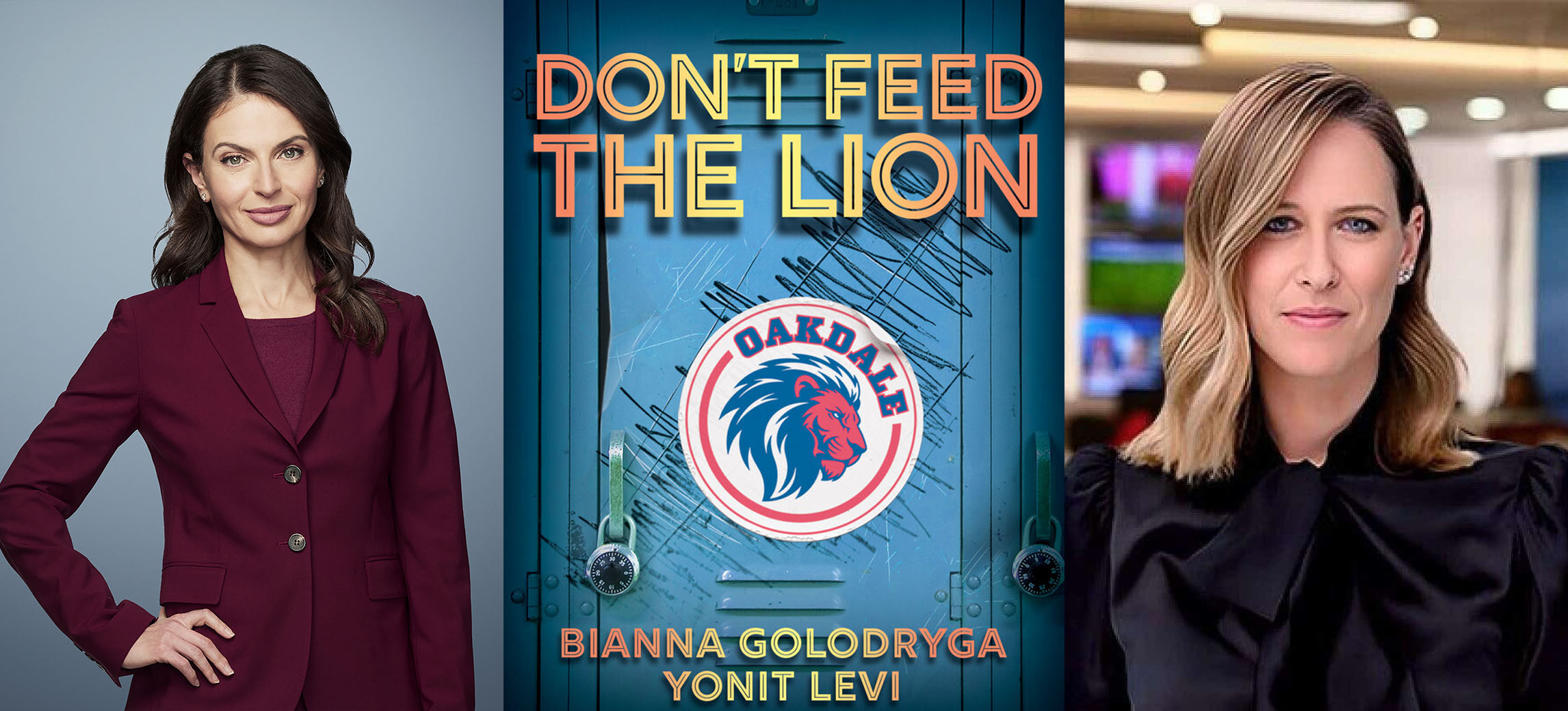
Based in New York, Golodryga would text Levi in Israel; they mapped put the plot and characters for their book “Don’t Feed the Lion.” The educational, entertaining and crisply written novel, geared to students eight to 12, is timely book that would make a great Hanukkah present.
Why The Book Will Hook You
“Don’t Feed the Lion” is about a young boy named Theo Kaplan, who plays soccer and getting ready for his bar mitzvah. He is confused when a video shows a player he idolizes, Wes Mitchell, makes a comment about Jews being untrustworthy, and also calls COVID a hoax.
Things get worse when a swastika is discovered on Theo’s gym locker at Oakdale Middle School, where is co-captain of the soccer team. Theo writes a letter to the principal demanding an investigation, but the head of the school wants to sweep it under the rug, saying if paperwork is filed, it could cost the soccer team a chance to play in the state tournament.
Annie gets bullied online and is told she is too sensitive and wouldn’t care if something happened against a different minority group. She’s called a “self-centered Yid.” But she has the chutzpah to clap back with some witty retorts.
Theo is pushed to his limit, and has to decide whether to fight with words or fists. The book gets its title from advice his grandpa gives him, not to feed the lion, meaning he should not let things overcome him and that he should feed his heart instead. For his bar mitzvah speech, Theo expands upon the meaning of “Don’t Feed the Lion.”
The book, with each chapter told from the perspective of a different character, including Theo, his younger sister, Annie and friend, Gabe, perfectly captures the voices and concerns of Jewish children. They speak with conviction, some anxiety and at times, humor.
As someone who studies history, Golodryga is aware there have been ebbs and flows when it comes to antisemitism. She said she knows of people who were afraid when ordering an Uber because their last name was identifiably Jewish or are worried about wearing a Magen David necklace. But she didn’t think it would get this pervasive so quickly.
Golodryga won the Emmy Award for Outstanding Morning Program for anchoring “Good Morning America” can be seen on “One World with Zain Asher and Bianna Golodryga” on CNN International.
While the book is not a panacea, Golodryga called it a resource that can help parents who may be unsure of how to react in a tense time, especially when there is an incentive to be quiet and ignore antisemitism.
“For so many kids, they don’t want attention, they just want to be like everyone else,” she said, adding that it is important to have allies. “As adults, it is incumbent upon us to give it the same sense of urgency as any other kind of hate. When you hear someone say something antisemitic, they heard it before from a friend or a child heard it from a parent. When something is a five-alarm fire, I can understand how some people might think, well antisemitism is not that big a deal, there aren’t many resources for it, surely it can’t be that big of a deal.’’
“As adults, it is incumbent upon us to give it the same sense of urgency as any other kind of hate. When you hear someone say something antisemitic, they heard it before from a friend or a child heard it from a parent.”
It should be clear, she said, that excuses for antisemitism are unacceptable.
“Dismissing it because they say it’s due to the war or a government action, I think that’s a cop-out,” she said. “I came to this country as a Jewish political refugee from the Soviet Union where antisemitism was institutionalized on your library card and your driver’s license.”
In her acknowledgments, Golodryga thanks her parents, Vitaly and Zhana for bringing her to America. She was born in Moldova, then part of the Soviet Union.
In 2021, Golodryga spoke to Pakistan’s foreign minister Shah Mahmood Qureshi. The interview went viral because while she asked him about a ceasefire between Israel and Hamas. Qureshi said, ‘Israel is losing the media war, despite their connections.”
“What are their connections?” Golodryga asked.
“Deep pockets,” he said after a laugh.
“What does that mean?” she asked.
“Well, they’re very influential people,” he said. “They control media.”
Golodryga told him “I would call that an antisemitic remark.”
When asked if he should be condemning antisemitism around the world or Hamas shooting rockets, Qureshi said there was occupation, genocide, and war crimes so the extremists took advantage and there needed to be a two-state solution.
She told him that as a journalist, she was offended by his comment saying Israel controls the media.
“The onus is not on those who are being accused of things that aren’t true,” she said.
More recently, Golodryga conducted a heartfelt interview with the mothers of three released Gaza hostages. Naama Levy, who was seen with bloody sweatpants and being pulled by the hair by a terrorist on Oct. 7, Liri Albag, who tried to calm the terrorists down and Daniela Gilboa. The three were kidnapped from the Nahal Oz base and 15 of their fellow soldiers were killed by Hamas.
Levi has interviewed several presidents and recently interviewed former First Lady, Senator and Secretary of State Hillary Clinton in New York at the Temple Emanu-El Streicker Center for her podcast, “Unholy: Two Jews on The News,” which she hosts with The Guardian’s Jonathan Freedland.
On a different episode, they interviewed the parents of Hersh Goldberg Polin, who was kidnapped by Hamas from the Nova festival, held for about 11 months, murdered by Hamas. Levi asked his mother, Rachel, how she was doing as at the time, the release of the last 20 hostages was apparently about to happen.
Naturally, she said she had mixed emotions.
It is challenging and it is walking on a tight rope in high winds,” she told Levi.
She explained she felt different emotions at the same time, including joy and compassion for those to be released but also pain for her son, who was murdered.
Golodryga hopes the book can help parents examine ways to combat all types of hatred or bullying. She said there was a thought to name the book: “I think I Love You Talia Kaplan” based on a song that Theo’s grandpa Ezra wrote about his wife.
She said in the end, they thought the title might be a bit too specific and “Don’t Feed The Lion” was universal.