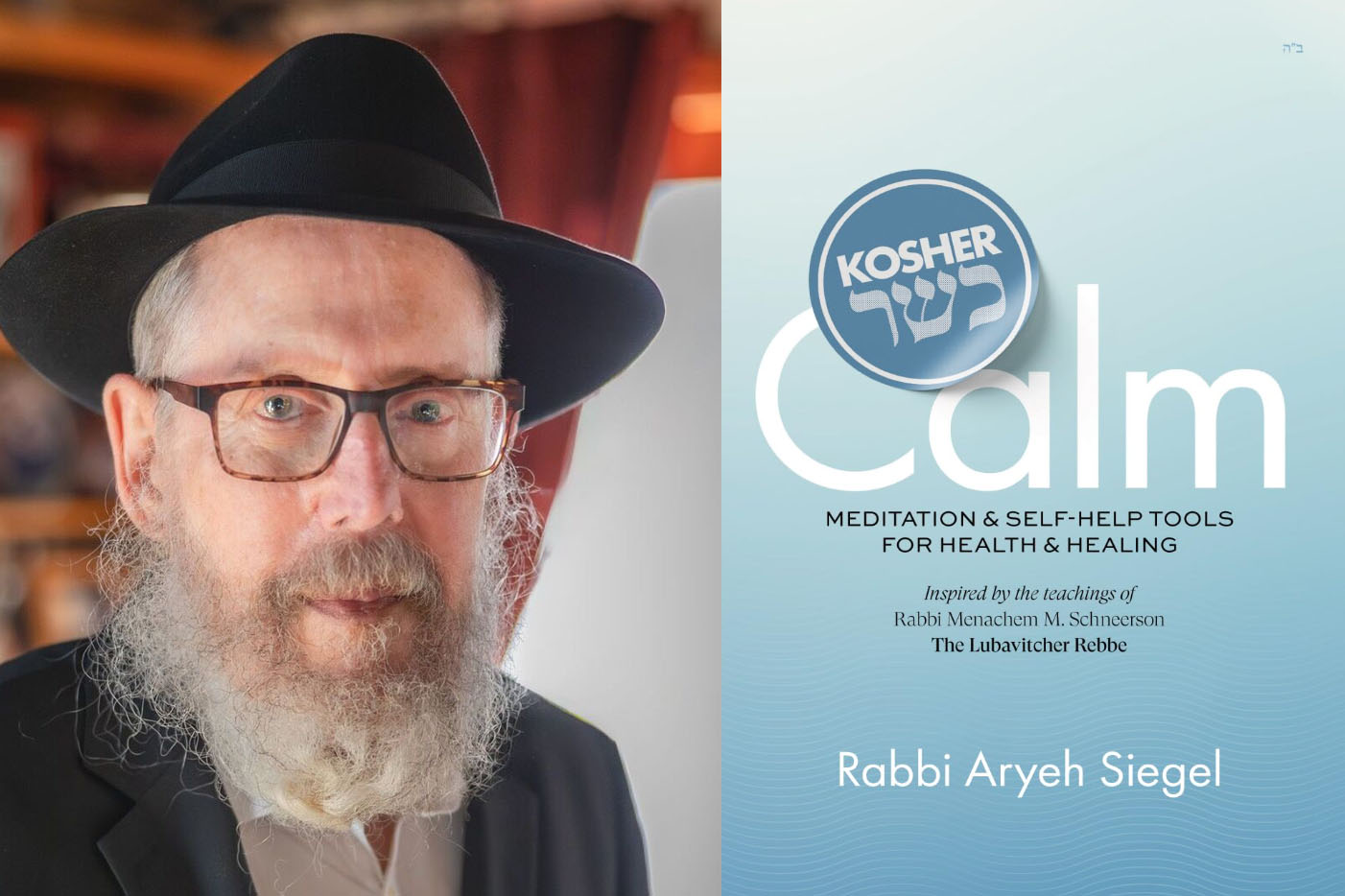
The year was 1971. Aryeh Siegel was a graduate student at Berkeley, and he had just learned about Transcendental Meditation, known as TM. Developed by Maharishi Mahesh Yogi, TM involved silently repeating a mantra in one’s head as a form of meditation, and it quickly caught on amongst young people and celebrities.
After becoming a TM teacher and a senior member of the organization, Siegel found that it was corrupt and, as he put it, a cult. He also learned that the Lubavitcher Rebbe, Menachem Mendel Schneerson, a huge spiritual leader at the time, was against Jews practicing TM and other forms of meditation with Eastern religion roots, as it was not in line with Jewish law. However, the Rebbe still saw the value in meditation in general, and how it could help people; there just had to be a kosher way to do it.
This was the inspiration for Siegel to write a book. Now, he’s released “Kosher Calm: Meditation & Self-Help Tools For Health & Healing Inspired by the Teachings of Rabbi Menachem M. Schneerson, The Lubavitcher Rebbe” to urge his fellow Jews to meditate while staying true to their values.
“Beginning in 1962, the Rebbe urged Jewish mental health professionals to create kosher meditation protocols, though those protocols never materialized,” Siegel told The Journal. “My book is my attempt to finally answer that call. Drawing on my expertise in meditation, I share a simple, yet effective, technique fully aligned with Torah law, along with additional tools for stress relief and building emotional resilience.”
“Kosher Calm” includes a curated selection of letters from the Lubavitcher Rebbe’s extensive correspondence on the critical need for therapeutic meditation. Chapters cover topics like how to prepare to meditate, managing restlessness, mind-body techniques that help with certain health conditions, and mindfulness.
In the chapter on learning how to meditate, Siegel takes readers step by step; he also posts meditation videos on his YouTube channel for visual help. After instructing readers on how to meditate, he writes, “During your session, you might have experienced moments of deep peace interspersed with periods of mental activity. Some people find that their awareness stays on the surface, dwelling on everyday thoughts. Others drift between states of calm and mental chatter. Whatever you experienced is exactly what needed to happen.”
According to Siegel, who lives in Los Angeles, meditation can not only help relieve stress but also help with preventing physical ailments. “When you’re stressed, your body’s ‘fight-or-flight’ system kicks in, releasing hormones like adrenaline and cortisol,” Siegel said. “While this helps in emergencies, constant modern stressors mean your body rarely gets a break. Chronic stress can cause health issues, weaken your immune system, disrupt sleep, impair memory, and cloud decision-making. It can even push people toward unhealthy habits. Since most stressors are beyond your control, meditation offers a way to break the stress cycle, calm your mind, and protect your health.”
So, what makes meditation kosher? Siegel said it must be strictly nonidolatrous, “free of Hindu mantras, foreign rituals, or religious symbols, any of which could potentially violate avodah zarah (prohibitions against idolatrous practices).” For example, to make meditation kosher, you could focus on a Hebrew word and approach meditation as a method for healing, not for worship.
“This therapeutic approach differs from traditional Jewish spiritual practices such as hisbonenus (contemplation) or hitbodedut (secluded prayer),” said Siegel. “Rather than serving as a path to spiritual insight, the Rebbe viewed kosher meditation as designed to restore psychological balance.”
For Siegel, meditation was life-changing. He found it at a time when he was a stressed-out grad student with a new baby, sleepless nights, academic deadlines, and financial pressures.
“That’s when meditation entered my life,” he said. “It wasn’t just a technique; it felt like a lifeline. For the first time, I experienced a sense of temporary calm that sometimes comes from fixing something, but from within.”
Siegel continued, “Meditation gave me a quiet space where I could pause, reset resulting in more clarity and resilience. It didn’t solve all my problems, but it changed how I faced them, and that, in a very real way, changed my life.”
“Kosher Calm” is available on Amazon.