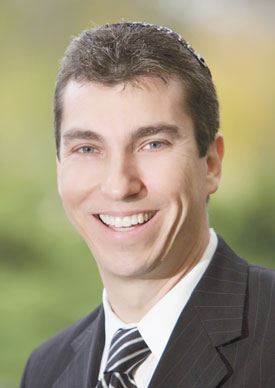
As senior director of The Jewish Hospice & Chaplaincy Network, Rabbi Joseph H. Krakoff has plenty of experience hearing what not to say when trying to console a loved one who is grieving. Now, he’s taken his wisdom and channeled it into his first book, “Never Long Enough: Finding Comfort and Hope Amidst Grief and Loss,” illustrated by Michelle Y. Sider.
The son of Label’s Table owner Bruce Krakoff, he grew up in Los Angeles and could often be found helping out at the delicatessen after school and on weekends. Now 47 and a married father of three, Krakoff lives in Michigan, where he spent 16 years as a rabbi at Congregation Shaarey Zedek in a Detroit suburb before joining The Jewish Hospice & Chaplaincy Network.
The Journal spoke with Krakoff — who will be doing a 10 a.m. book signing July 7 at Label’s Table — about the role of hospice, dealing with loss and his book.
JEWISH JOURNAL: What advice would you give to a family looking at hospice for a loved one?
RABBI JOSEPH H. KRAKOFF: My words would be, as hard as it is, to speak honestly about the fears, the concerns, the anxiety. So often we walk on eggshells around someone who is dying. To be able to open up and see if the person wants to talk about it, it creates a sense of tranquility. Also, to find out what the person who is dying believes about what is going to happen to them.
Being a rabbi puts me in a unique position to open up conversation. When the doctor says we can’t do anything else to heal the body, then what we do is go to work on healing the soul, and there’s a lot of work that can be done in terms of healing the soul.
JJ: What do you mean by “healing the soul”?
JK: It goes in part to the Jewish belief that when we are born, a soul goes into a body, and while we are alive that body and soul are together. But in the process of dying, what’s really happening is that the physical body is letting go of the soul through disease
or illness, through old age sometimes, because our bodies are not meant to last forever. It’s a vessel for the soul, which is eternal. What I really mean is getting the soul or person ready to accept the inevitability of physical death.
JJ: What are some common mistakes people make?
JK: There are people who wait too long for hospice. If people wait until the last few days, there is less we can do.
In Detroit, we bring them music, we sing with them, we treat them as if they are fully in this world because they are. We do what we can to give them the highest quality of life for whatever time is left. Hospice does not bring about the death. People come to us because they are dying.
We can life review with them. People want to talk about their values and their ethics, and especially their legacy: What do I hope I have taught my children and grandchildren? What do I hope I have stood for and modeled for them? Having these conversations is so important and healthy. It gives a sense of closure.
JJ: Why did you decide to write “Never Long Enough”?
JK: I wrote it as a rabbinical student in my senior year at the Jewish Theological Seminary in New York. One of the things I was concerned with is that well-meaning people would often say to those who are bereaved, “When will you be normal again? When will you be over your mourning?” I don’t think they were trying to be hurtful. They just wanted the person they knew before the death back.
I also heard people say things like, “At least they are in a better place.” I recoiled at that. My other concern was if someone was 80 years old, they would say, “At least you had them for 80 years.” That is where I gave birth to the concept of “never long enough.” Whether you have them for 50 years or 80 years or 100 years, it’s never long enough.
I knew people did not mean to be dismissive or insensitive. They just didn’t know what to say. When someone is ill or dying, everyone thinks they are going to come up with the most brilliant thing to say. The truth is, there are no words that are brilliant. To be there, to give a hug, to be sincere, is the only thing that’s brilliant.
JJ: Who is the audience for the book?
JK: At its core, it is designed for families and loved ones of all ages to read and reflect on their feelings, and feelings of remembering and sadness and loss. But an additional piece that myself and the illustrator have discovered is that this is also useful for people who are dying and are doing their own life review. Although that was not our original intent, it has evolved that way, which is very meaningful.