Some books inspire and instruct, some tell a compelling tale, and some open a window into the innermost workings of the author’s heart and soul. Over the years, I have read and reviewed a great many books that have captured one or another of these qualities. Only rarely, however, have I encountered a book that embodies all three.
“Hope Will Find You: My Search for the Wisdom to Stop Waiting and Start Living” by Naomi Levy (Doubleday: $23) is one such book. Levy allows us to witness her own seven-year struggle to cope with the single greatest crisis any parent can endure — a threat to her own child’s health — and, along the way, she affords us the wholly remarkable experience of seeing the world through the eyes of someone whose job it is to soothe the pain of others.
“People came to me with their questions … and I would listen and offer guidance and hope. But one day, without warning, I was faced with my own personal crisis,” she confesses. “My professional life, my emotional life, my spiritual life were in a state of turmoil.”
Levy, a Conservative-ordained rabbi and the author of the national best-seller “To Begin Again” and “Talking to God,” is the founder and spiritual leader of Nashuva (“We will return”), a Los Angeles-based Jewish community that focuses on joyous religious observance and earnest social action. To participate in a prayer service with Rabbi Levy at the pulpit, as I know from personal experience, is an uplifting and unforgettable experience. She is often frank and forthcoming when she addresses the congregation, but nothing quite prepared me for the confession that she offers in her latest book.
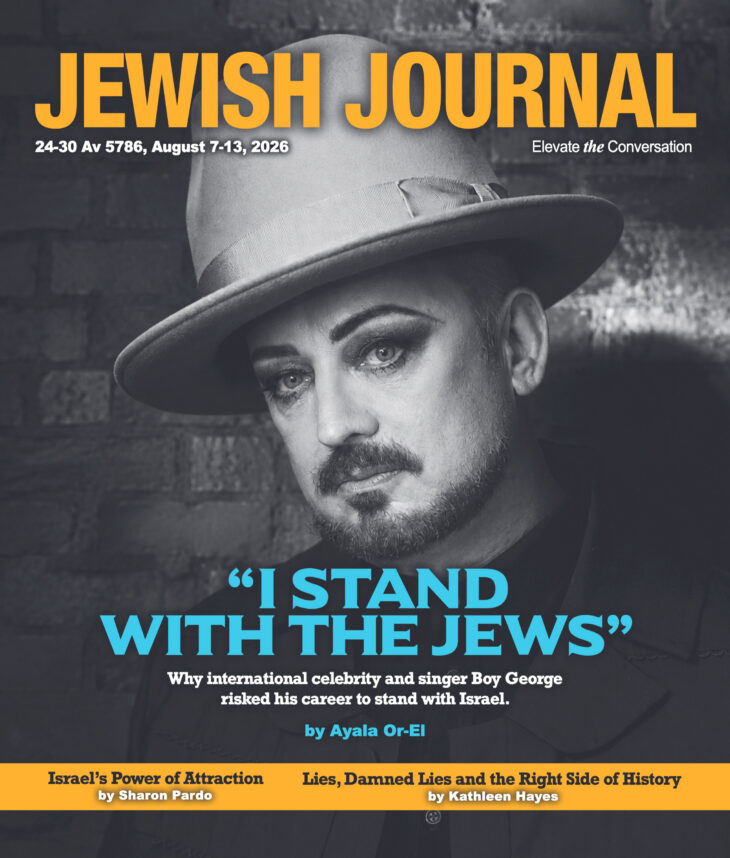
The book begins with a shattering moment in the life of the author and her husband, Rob Eshman, editor-in-chief of The Jewish Journal. (For the sake of full disclosure, I should also note that I was privileged to read the book in manuscript form, and my name appears in the author’s acknowlegments.) Their daughter, Noa, was diagnosed with a serious disease. Suddenly, all of Levy’s rabbinical training fell away, and she was reduced to the primal state of a mother whose child was at risk.
“I was a rabbi and God was no comfort to me,” she writes with a brutal honesty that will shock some readers. “Did I believe God would miraculously undo what nature and genes had done? No. Not exactly.” But something else, something arguably more powerful, was stirring in her heart: “I had only one ambition: I will fix her, as God is my witness, I will fix her. The rest was a blur.”
Once she steps out from behind the pulpit, Levy allows us to see intimate moments that most rabbis would never dare to reveal. The demands of attending to an ailing child take a toll on every aspect of her family life and her professional career: “What happened to you?” another woman rabbi asks her. “You used to be a rising star.” She suffers perhaps the most shattering experience that can befall a rabbi: “I was angry,” she writes. “I felt abandoned by God.” When one of Noa’s childhood dreams strikes her as an augury that God intends to take her child, Levy “gave God a piece of [her] mind.” “Just stay away from her,” the rabbi admonished the Almighty. “You don’t know who you’re messing with.”
Yet I hasten to say that “Hope Will Find You” is, perhaps surprisingly, an uplifting book. At some passages, I laughed out loud — look for the story about an angel in toilet paper — and at others, tears of joy came to my eyes. Like life itself, Levy’s book holds out the prospect of a happy ending. The best measure of Levy’s gift is that we feel every emotion she does — her fears and doubts, her dreams and yearnings, her pleasures and rewards.
“Life is exhilarating, breathtaking and beautiful,” she affirms. “And life is unfair and cruel, and I’d officiated over enough funerals to understand that the most important question we must ask is not what a person did for a living but what he or she did for a life.”
Levy’s account of her own self-reinvention as a rabbi, which inspired her to create Nashuva, is kind of a parallel narrative in “Hope Will Find You,” and it’s just as affecting and enlightening as the one about her daughter’s health. What other rabbi, I wonder, is willing to talk so openly about the special challenges that a woman in the rabbinate may be called upon to face? Levy, for example, tells us about a colleague who was criticized by her senior rabbi for a particular aspect of her anatomy. “I have to mention that God happens to have blessed my friend with very large breasts,” Levy writes. “Okay, they’re huge breasts.” Said the senior rabbi: “I think it’s distracting to people to have to see such large breasts on the pulpit.”
Sometimes the two narratives intersect in unexpected ways. Stressed by the challenges to her daughter’s life and health, and afflicted by her own dark night of the soul, Levy seeks the assistance of a psychotherapist — another disclosure that shows the author’s refreshing candor. During one session, Levy noticed that the therapist has fallen fast asleep. “I thought to myself, I can’t even hold a therapist’s attention,” she writes, “how can I expect to hold God’s attention?”
Perhaps the highest compliment I can bestow on “Hope Will Find You” is to say that it’s quite unlike any of the other books by pulpit rabbis that I’ve read and reviewed over these many years. To be sure, Levy draws on Jewish texts and traditions, and her book is ornamented with gems from the Talmud and the Torah, the teachings of the Sages, the tales of Chasidic masters. “The rabbi in me would like to offer a prayer for you,” she writes in a characteristic aside to the reader. But her book is something different — and something more — than the kind of inspirational prose that many other rabbis have put between covers.
“Hope Will Find You” is an act of courage by an author who happens to be a charismatic rabbi, but, perhaps more to the point, is also a gifted storyteller, an uncompromising truth-teller, a fiercely protective mother and, above all, an authentic visionary.
Jonathan Kirsch, author and publishing attorney, is book editor of The Jewish Journal and can be reached at {encode=”books@jewishjournal.com” title=”books@jewishjournal.com”}. His next book is a biography of an early figure in the Jewish resistance to Nazi Germany.