Long before Joan Alexandra Molinsky — better known as the legendary Joan Rivers — died in September 2014 at age 81, a week after sustaining complications while undergoing a scheduled minor throat procedure, she jokingly left instructions as to what should happen upon her demise:
“At my funeral, I want Meryl Streep crying in five different accents.”
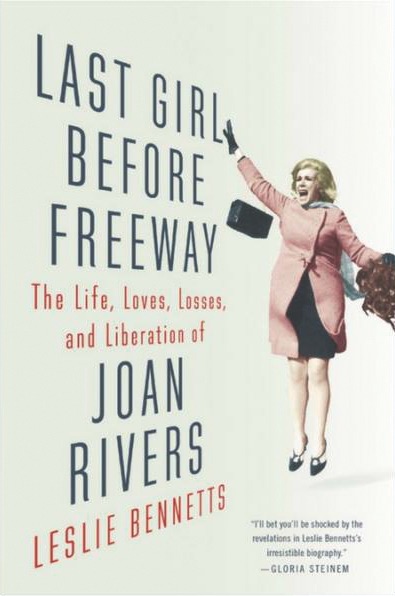
Along with her humor, Rivers lives on in an entertaining and revealing new biography by Leslie Bennetts, titled “Last Girl Before Freeway: The Life, Loves, Losses, and Liberation of Joan Rivers.”
Bennetts, who wrote “The Feminine Mistake” and is a longtime Vanity Fair writer and former New York Times reporter, provided glimpses into Rivers’ life at a recent event at the American Jewish University, hosted by the Whizin Center for Continuing Education.
“Although Rivers is given credit for breaking down the relentless boys club barriers of comedy, she refused to call herself a feminist as she thought that would lose her ticket sales,” Bennetts told the audience. She also revealed that Rivers used her husband’s surname and referred to herself as Mrs. Rosenberg in her private life.
Bennetts also spoke about Rivers’ hard-fought efforts to become successful, noting, “Before making it, she endured 10 agonizing years of struggle. She was turned down by ‘The Tonight Show’ many times before they put her on.”
“Although Rivers is given credit for breaking down the relentless boys club barriers of comedy, she refused to call herself a feminist as she thought that would lose her ticket sales.” — Leslie Bennetts
Despite her ability to make everyone laugh, it was fear that drove Rivers, Bennetts said. “She had a fear of being obsolete, which was one reason she was always working on new jokes that were up-to-date with the changing culture.”
Rivers’ biggest fear?
“A blank calendar page on her schedule,” Bennetts revealed. “And she was always furious that she was not prettier. This led to her obsession with plastic surgery.”
Despite her fears, Rivers did find some solace in the financial rewards her success brought her. “It allowed her to purchase and furnish her elaborate homes in her preferred rococo style,” Bennetts said. Rivers described her home décor as, “What Marie Antoinette would have done if she’d had the money.”
Although most fans know how close Rivers was to her husband, Edgar Rosenberg, Bennetts’ biography reveals “Edgar ruined her life. He rode her coattails, blighted her career.” Still, said Bennetts, Rivers always deferred to him. However, after Rosenberg’s suicide in 1987, Rivers had a triumphant second act, which included hosting the television show “Fashion Police” on E!, as well as her winning appearance on Donald Trump’s “Celebrity Apprentice,” which resurrected her career.
As do we all, Rivers had her flaws and quirks. “She often fat-shamed and slut-shamed other women. But she could also be an incredibly giving and loving friend,” Bennetts said. “She had an obsession with the occult and with ghosts and claimed she saw them. And some of her friends claim that her ghost has appeared before them. Rivers also made use of exorcists.”
Above all, Bennetts portrays Rivers as a performer whose iconic career was born out of a desire to make people laugh, so that she could feel loved.
Mark Miller is a humorist, stand-up comic and has written for various sitcoms. His first book is “500 Dates: Dispatches From the Front Lines of the Online Dating Wars.”