fbpx

May 2, 2018

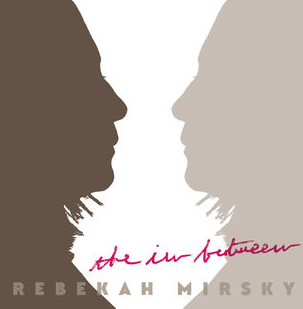
Album Review: A praise of Cantor Rebekah Mirsky’s ‘The in Between’

Cantor Rebekah Mirsky’s goal is to make Judaism relevant to the human struggle- the struggle of accepting our brokenness and our nuances. She believes there is great wisdom in the Jewish texts that inform our lives and teach us how to navigate the grey areas, or how to live in the “in-between” areas. These areas just need to be brought to light.

Cantor Mirsky weaves Judaism’s powerful relevance into her most recent album, The in Between. Sung in both English and Hebrew with beautiful and catchy melodies reminiscent of an Old Testament version of “Godspell”, the songs address the themes of the human condition on a personal as well as universal level. Many of them are based on Jewish prayers, with the ancient sentiments brought forward to the present as filtered through Rebekah’s personal experiences with people in recovery, both in her personal and work life. However, the meanings can also be laid over the current political/world climate, offering hope to all of us.

Mirsky’s songwriting has taken a leap from amazing to stellar in “The In Between”, her 2nd Jewish album (7 total). Several songs are just itching to become popular anthems: “Prayer For Rain”, “We Are All Welcome Here”, “Between” have simple hooks with powerful, clear messages that reach out to all of us. One need not be Jewish, or even affected by addiction, to deeply understand the themes of inclusion, compassion, and equality. “We Are All Welcome Here”, is probably the best illustration of this, a moving and beautiful antidote to the recent rise of racism and hatred in the U.S.

The production is clean but not overly polished, organic without being cloying – balanced nicely between acoustic and rock – some of the most satisfying work she’s done in recent memory.

Don’t miss out on an exciting opportunity to hear Cantor Mirsky perform songs from her latest album, in collaboration with BCC’s Cantor Juval Porat. He will also be performing songs from his own recent album, theology- a transportive collage of liturgical personal music.

Sunday, May 13 at 3pm
Beth Chayim Chadashim
6090 West Pico Blvd.
Los Angeles, CA 90035

You can download The in Between {HERE}

Album Review: A praise of Cantor Rebekah Mirsky’s ‘The in Between’ Read More »

Aging in Prime Time

Is television reflective of society? And if not, what can be done about it?

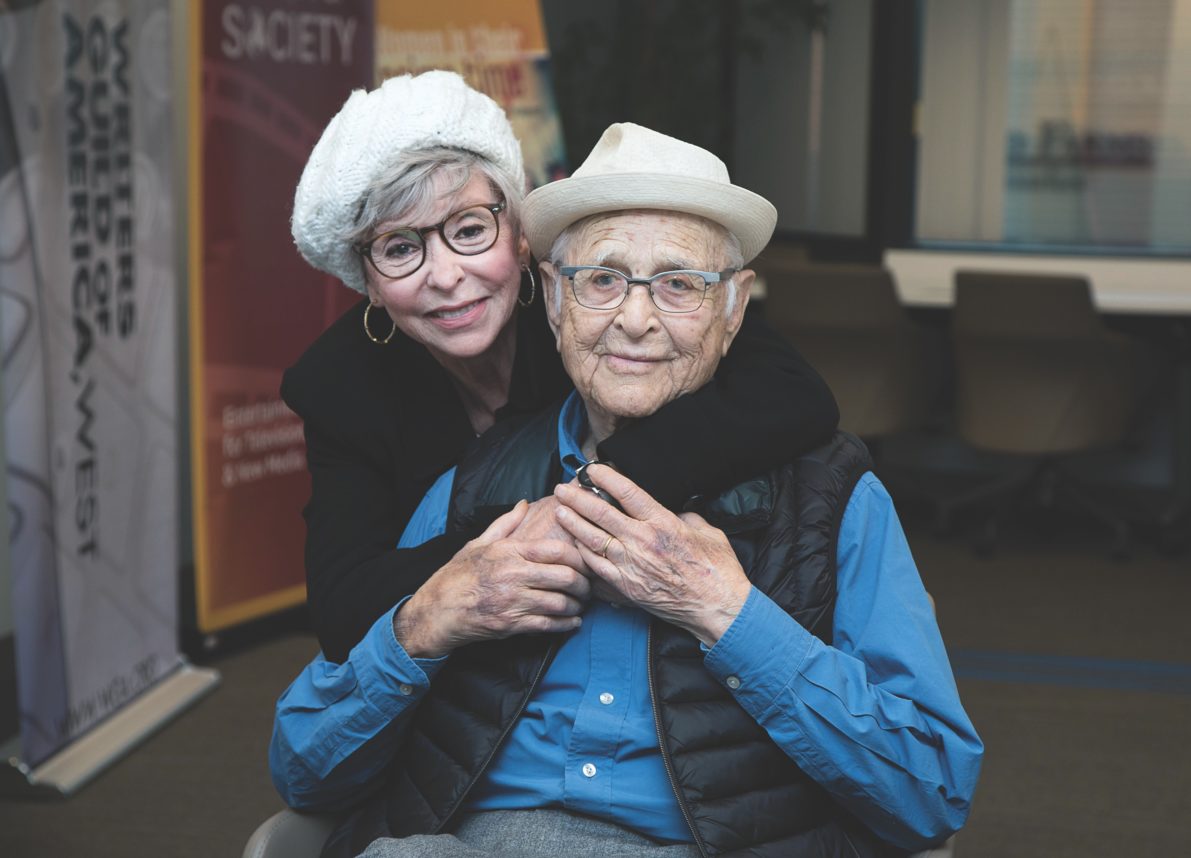
These were just two of the questions posited at a recent discussion entitled “Women in Their Prime Time: Aging In (and Out of) Hollywood,” hosted by the Writers Guild of America West.

Entertainment legends Norman Lear and Rita Moreno were the star power for the event. Lear is probably best known for producing a slew of iconic television shows, including “All in the Family” and “Sanford and Son.” Moreno belongs to an elite group of only 12 performers who have won an Academy Award, a Grammy, a Tony and an Emmy.

Lear and Moreno were joined by Alexa Junge, executive producer of “Grace and Frankie”;, Dr. Zoanne Clack, executive producer of “Grey’s Anatomy”; Dr. Bruce Chernof, president of the SCAN Foundation for older adults; and Chia Chia Sun, a clinician and genetic cancer researcher.

Lear acknowledged that there has always been a paucity of older adults on television. He said typical responses he received when pitching shows featuring older characters were, ‘It’s funny, but it’s not our demographic.’

Said Lear, “I like to think that if something’s funny, it’s everybody’s demographic.” He proved that with characters in “All in the Family,” “Maude,” “Sanford and Son” and “The Jeffersons.”

“I’d love to see someone my age playing just a person, not a grandmother.” — Rita Moreno

The 95-year-old Lear currently is producing “Guess Who Died,” a sitcom pilot starring 81-year-old Hector Elizondo, Christopher Lloyd, 79, and Holland Taylor, 75.

Another issue for older actors is the complexity of the roles they undertake, or the lack thereof.

“We need to tell a broader set of stories that reflect today,” Moreno, 86, said. “And those roles should go beyond the stereotypes. I’d love to see someone my age playing just a person, not a grandmother.”

Junge added, “Even though age is a time of nuance and complication, the roles [being offered to older performers] become simpler.” Chernof agreed, noting, “People are living longer, have much more to offer, and that should be celebrated.”

During the discussion, panelists referred to a 2017 USC Annenberg School of Communication and Journalism study that revealed between 2016 and 2017, there were 1,609 speaking characters on network television, and less than 10 percent of those characters were over the age of 60, stereotypical, ageist language was prevalent in many of the shows, and only 5 percent of the 126 shows had writers who were over the age of 60.

Nonetheless, Junge said she believed the future for older performers is looking up. “Cable TV and streaming shows are all looking for stories of older women,” she said. “Seek out upper-level people and make yourself available. People can’t get by with what they did before. There’s an accountability now; it’s a time of change.”

Mark Miller is a humorist, stand-up comic and has written for various sitcoms. His first book is “500 Dates: Dispatches From the Front Lines of the Online Dating Wars.”

Aging in Prime Time Read More »

Biography Lovingly Recalls Joan Rivers

Long before Joan Alexandra Molinsky — better known as the legendary Joan Rivers — died in September 2014 at age 81, a week after sustaining complications while undergoing a scheduled minor throat procedure, she jokingly left instructions as to what should happen upon her demise:

“At my funeral, I want Meryl Streep crying in five different accents.”

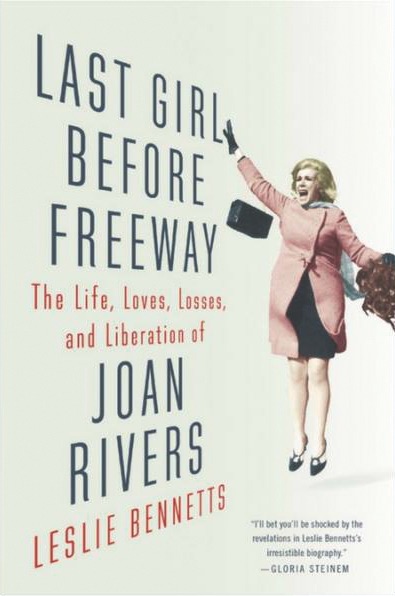
Along with her humor, Rivers lives on in an entertaining and revealing new biography by Leslie Bennetts, titled “Last Girl Before Freeway: The Life, Loves, Losses, and Liberation of Joan Rivers.”

Bennetts, who wrote “The Feminine Mistake” and is a longtime Vanity Fair writer and former New York Times reporter, provided glimpses into Rivers’ life at a recent event at the American Jewish University, hosted by the Whizin Center for Continuing Education.

“Although Rivers is given credit for breaking down the relentless boys club barriers of comedy, she refused to call herself a feminist as she thought that would lose her ticket sales,” Bennetts told the audience. She also revealed that Rivers used her husband’s surname and referred to herself as Mrs. Rosenberg in her private life.

Bennetts also spoke about Rivers’ hard-fought efforts to become successful, noting, “Before making it, she endured 10 agonizing years of struggle. She was turned down by ‘The Tonight Show’ many times before they put her on.”

“Although Rivers is given credit for breaking down the relentless boys club barriers of comedy, she refused to call herself a feminist as she thought that would lose her ticket sales.” — Leslie Bennetts

Despite her ability to make everyone laugh, it was fear that drove Rivers, Bennetts said. “She had a fear of being obsolete, which was one reason she was always working on new jokes that were up-to-date with the changing culture.”

Rivers’ biggest fear?

“A blank calendar page on her schedule,” Bennetts revealed. “And she was always furious that she was not prettier. This led to her obsession with plastic surgery.”

Despite her fears, Rivers did find some solace in the financial rewards her success brought her. “It allowed her to purchase and furnish her elaborate homes in her preferred rococo style,” Bennetts said. Rivers described her home décor as, “What Marie Antoinette would have done if she’d had the money.”

Although most fans know how close Rivers was to her husband, Edgar Rosenberg, Bennetts’ biography reveals “Edgar ruined her life. He rode her coattails, blighted her career.” Still, said Bennetts, Rivers always deferred to him. However, after Rosenberg’s suicide in 1987, Rivers had a triumphant second act, which included hosting the television show “Fashion Police” on E!, as well as her winning appearance on Donald Trump’s “Celebrity Apprentice,” which resurrected her career.

As do we all, Rivers had her flaws and quirks. “She often fat-shamed and slut-shamed other women. But she could also be an incredibly giving and loving friend,” Bennetts said. “She had an obsession with the occult and with ghosts and claimed she saw them. And some of her friends claim that her ghost has appeared before them. Rivers also made use of exorcists.”

Above all, Bennetts portrays Rivers as a performer whose iconic career was born out of a desire to make people laugh, so that she could feel loved.

Mark Miller is a humorist, stand-up comic and has written for various sitcoms. His first book is “500 Dates: Dispatches From the Front Lines of the Online Dating Wars.”

Biography Lovingly Recalls Joan Rivers Read More »

Filmmaker Explores Shoah’s Aftermath

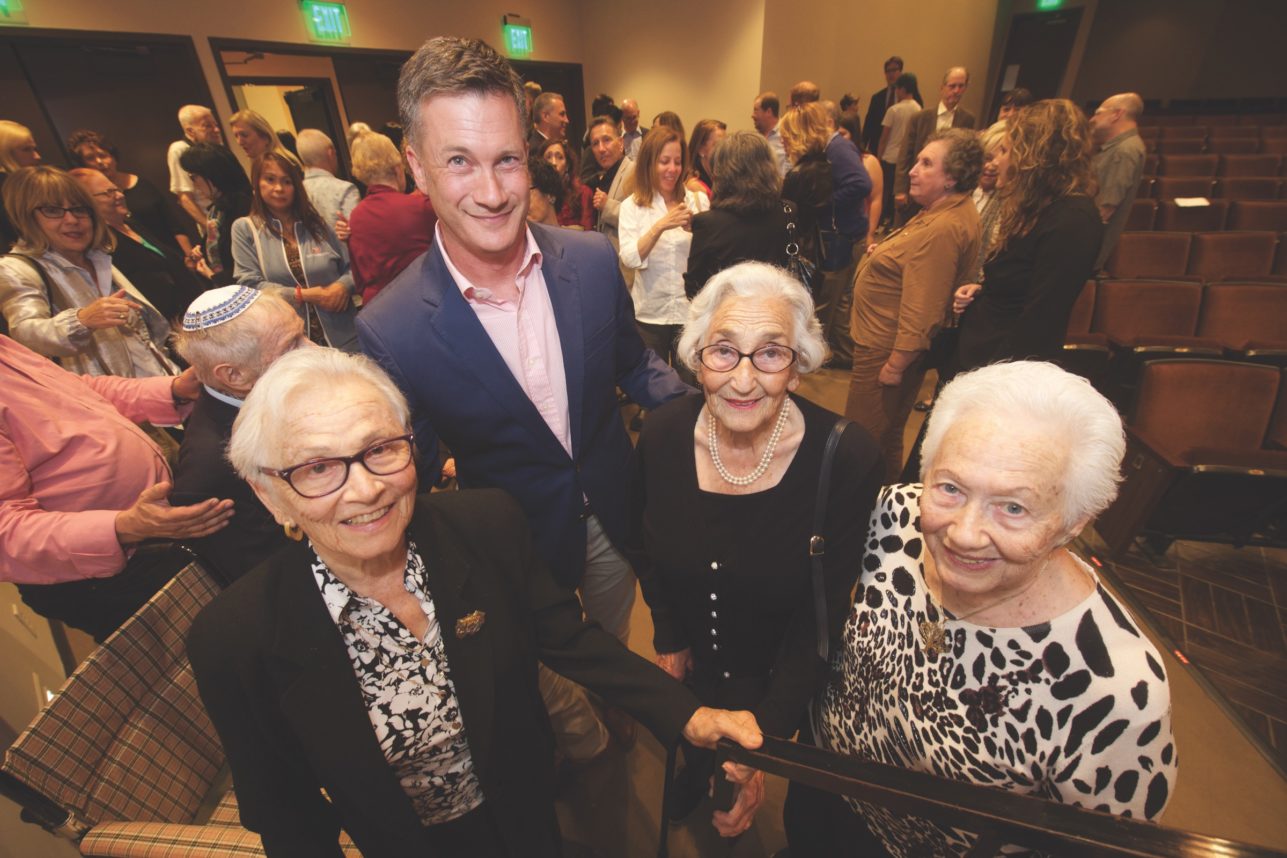
Writer-director Jon Kean documented the harrowing experiences of six female Holocaust survivors in his 2007 documentary, “Swimming in Auschwitz.” A decade later, his sequel “After Auschwitz” focuses on the aftermath of liberation, emigration and ultimately, how the same six women rebuilt their lives in Los Angeles.

“I’d never thought of liberation as being a sad day, that’s how naïve I was,” Kean told the Journal. “Liberation was awful for these women. That’s what drove me to make this film. I wanted to see the world through survivors’ eyes. When you’ve seen such tragedy and trauma you’d be forgiven if you gave up. But it’s the exact opposite with these women.”

After interviewing his subjects for the second time, Kean had 30 hours of emotional testimony to condense into 80 minutes. “I knew them so well that we could get to the core of things so quickly. They trusted me,” he said.

The finished product tells “an emotional story that covers history, sociology, psychology and Los Angeles in the 20th century — how Angelenos welcomed these survivors and either made life easier for them or more difficult,” he said.

Kean partnered with the Los Angeles Museum of the Holocaust to raise funds for the film, promote it and get it screened for young people who might not be familiar with the story. “They know the Holocaust happened but don’t know the facts,” he said. “I’m putting together a curriculum guide with the museum for the next school year. That’s where we can really affect people.”

Growing up in Philadelphia in a family with “a very strong Jewish identity but not as strong religiously,” Kean, 50, became interested in the Holocaust early on.

“In another five years, the eyewitnesses to the greatest horror of mankind will be gone.” — Jon Kean

“The father of one of my best friends was an Auschwitz survivor, and I remember him coming to our Hebrew school and talking with us. The ‘Holocaust’ miniseries came out when I was 11, and it was so powerful to me. I was transfixed by it,” he said. “My bar mitzvah speech was about Simon Wiesenthal and hunting for Nazi war criminals. I got to meet Simon 10 years ago in Vienna.”

Kean earned a degree in economics from the University of Pennsylvania but joined a friend in an acting class on a whim, moved to Hollywood, and landed roles on TV shows, including “Beverly Hills, 90210” and “Clueless.” Moving behind the camera, he co-wrote and co-directed the 1999 comedy “Kill the Man,” but failed to get subsequent scripts produced. “I wanted to do something that was more meaningful,” he said.

Kean is considering Rwandan genocide survivors as his next subject. “There is an urgency right now,” he said. “It’s not just people forgetting the Holocaust, it’s people forgetting what’s happening right now.”

That urgency exists on another level, with the Shoah generation disappearing. Three of “After Auschwitz’s” six subjects have died.

“In another five years, the eyewitnesses to the greatest horror of mankind will be gone,” Kean said, noting that Renee Firestone, 94, “travels all over the United States and speaks almost every day because she knows she has to do it now. Erika Jacoby [age 90] does the same.”

Kean said he knows “there are a lot of people who won’t see the film because of the word ‘Auschwitz.’ But to me this is a post-Holocaust story, a story about overcoming trauma. Everybody can relate to that.”

“After Auschwitz” opens May 4 at the Laemmle Music Hall and Laemmle Town Center 5 theaters. Some screenings will feature a Q-and-A session.

Filmmaker Explores Shoah’s Aftermath Read More »

Celebrating Bernstein With Cherished Items

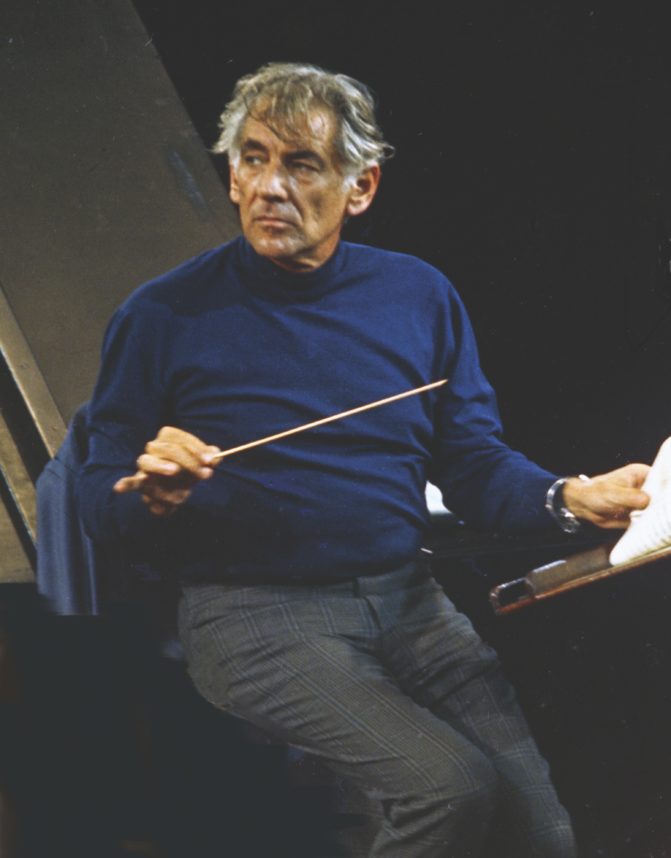
“Leonard Bernstein at 100,” a traveling exhibition celebrating the life and career of renowned American composer and conductor Leonard Bernstein, is now on view at the Skirball Museum, coinciding with the 100th year of the maestro’s birth. More than 150 artifacts, many accompanied by audio, are included in the interactive show. Robert Santelli, the founding executive director of the Grammy Museum and curator of the exhibition, gave the Journal a guided tour.

“There were a couple of key points we wanted to emphasize,” Santelli said. “[Bernstein] had the charisma of a rock star, a conductor, composer, great pianist and was a great ambassador for classical music. He was an exceedingly complex man, in front of a symphony, and at home. But we focus on the music.”

Asked to curate the exhibition in 2014, Santelli researched for a year and began collecting artifacts from sources, including the New York Philharmonic archives, the New York Performing Arts Library and Indiana University, to which Bernstein had donated many items from his Fairfield, Conn., home.

Santelli borrowed musical scores and letters from the Library of Congress, caricature sketches from artist Al Hirschfeld’s family, and Bernstein’s first piano from Brandeis University, which “didn’t want to part with it,” Santelli said. “We pleaded and begged.”

Other items on view include the cufflinks Bernstein wore to conduct every concert. (they previously belonged to Bernstein’s mentor Serge Koussevitzky), the baton he used to conduct the New York Philharmonic in his 1943 debut, and the Harvard University grade transcript on which he received a C in music. Showcases display sheet music and album covers from Bernstein’s classical and popular works, including “West Side Story,” some of his Grammy and Emmy Awards, and less expected items, such as an FBI dossier, prompted by Bernstein’s support of the Black Panthers.

“I suspect Bernstein would have told me the exhibition should be much larger and should be traveling forever.” –Robert Santelli

There are also several items that reflect Bernstein’s Jewish heritage and connection to Israel, including his Hebrew school diploma and a program from the Israel Philharmonic 1951. In an email interview, Alexander Bernstein said that his father grew up with a religious father but “was not the most devout Jew. He was deeply spiritual and had a life-long personal conversation with God. It is there in his music: ‘Jeremiah Symphony,’ ‘Kaddish Symphony,’ ‘MASS.’ ”

Alexander added, “I believe his commitment to social justice came, in great part, from his Jewish roots. Most important to him, I think, was the Jewish tradition of asking questions. As an educator, he saw all learning as a process of asking questions, leading to further questions, creating a life-long love of learning, of curiosity. That is at the heart of his living education legacy: Artful Learning (artfullearning.org).”

Growing up with his famous father “was mostly a joy,” Alexander said. “Our home was filled with lots of people and lots of laughter. My father enjoyed being famous. He loved meeting new people, so he didn’t mind being noticed wherever we went. I don’t remember ever feeling at all bitter about sharing him with the rest of the world.”

Alexander said he believes that Leonard Bernstein “would have been absolutely thrilled” with the exhibition, “particularly with the way it is curated to reflect the many equally important and inter-related facets of his life: composer, conductor, educator, social activist and family man. And it shows also the enormous variety of styles and genres in his composing life. He broke barriers in so many ways: jazz and Latin music in the concert hall, symphonic music on Broadway.”

Although Santelli agrees that Bernstein would have loved the exhibition, he said, “I suspect that he’d tell me it should be much larger and should be traveling forever.”

Santelli is especially eager for school groups to discover Bernstein through the displays and said, “I judge the exhibit’s success by the amount of young people we can reach and impact.”

“Leonard Bernstein at 100” runs through September 2 at the Skirball Museum.

Celebrating Bernstein With Cherished Items Read More »

Jaglom’s ‘Train’ Ride Into Love and Hatred

One of the more pervasive fantasies of Jewish boys and young men growing up amidst the anti-Semitism of Europe and the United States in the first half of the last century ran as follows:

He would meet a beautiful blonde — a gentile, an Aryan, a shiksa — who fell hard for him but enlivened her comments with a compendium of anti-Semitic clichés, topped by the boast that she could smell a Jew a mile away. Our hero would never reveal his own heritage until the climactic moment, dramatically and physically, when during an ardent bedroom scene the boy tells the panting girl that he is a Jew.

Actor Kirk Douglas recalled a very similar scenario in his 1988 autobiography, “The Ragman’s Son.” However, Henry Jaglom does him one better in his film “Train to Zakopané.”

Jaglom, a triple threat as actor, writer and director, didn’t have to invent the script. It was passed to him by his father, Simon (Semyon) Jaglom.

In 1928, Semyon was a young businessman, traveling through Poland by train. Sharing the compartment with him was Katia, an attractive Polish army nurse, her female friend and a Catholic priest.

Katia, portrayed by Tanna Frederick, Jaglom’s favorite actress and wife, is obviously taken with Semyon (Mike Falkow), a sharply dressed young businessman, who is given to bowing and kissing a lady’s hand by way of introduction.

As the foursome get to know one another, the chatter flows easily, focusing first on the changes wrought by World War I, though punctuated by Katia’s favorite topic, the greed, slyness and all-around evilness of Jews.

Semyon occasionally tries to defend his (secret) co-religionists, but without much success. The priest chimes in that he can’t forgive the Jews for “rejecting our Lord,” and adds that “good Jews are the exception, not the rule.”

The two-hour movie draws a comparison between the almost universal, open and deeply-rooted anti-Semitism of the first half of the last century and the less open and respectable form it generally takes today.

Nevertheless, Katia and Semyon keep getting closer over wine and dinner at the train’s buffet while marveling at the star-lit sky as the train hurls through the rural Polish countryside toward the winter sport resort of Zakopané. Will passion triumph over prejudice? Will Semyon acknowledge his heritage? Will Katia see the errors of her ways and join a kibbutz?

“Train to Zakopané” draws a comparison between the deeply rooted anti-Semitism of the first half of the last century and the respectable form it generally takes today.

As writer and director, Henry Jaglom is not of the “aw, shucks, ma’am” school of cowboy dialogue. His characters talk volubly, which may overwhelm viewers at the beginning but adds depth as the plot accelerates toward its climax.

Jaglom is one of the more intriguing Hollywood personalities. His resume includes 21 films as director and writer, 11 as actor, and six theater productions as playwright. He is also one of the entertainment industry’s more controversial figures. Some critics laud him as one of Hollywood’s most original’s directors, while other assign him to the lowest level of his profession.

Born in London 80 years ago, his Russian-born father and German-born mother immigrated to America when he was a year old, beating the outbreak of World War II by a few months.

Though raised in a family strongly involved in Jewish causes and schooled in heavily Jewish Manhattan, Jaglom evinced little interest in his heritage until, at 21, he visited Yad Vashem, Israel’s Holocaust memorial museum, for the first time.

Now he is in the midst of writing “The Third Stone on the Second Row — A Family Memoir and a Brief History of the Jewish People.” He has completed the first 500 pages and in a phone interview said that his Jewishness is evolving with each additional page.

“There is an endless fascination in being Jewish,” he said.

“Train to Zakopané” opens May 5 at Laemmle’s Monica in Santa Monica, Playhouse 7 in Pasadena and Town Center in Encino. It opens May 11 at the Music Hall in Beverly Hills.

Jaglom’s ‘Train’ Ride Into Love and Hatred Read More »

‘RBG’ Tells Remarkable Story of Justice Ginsburg

Her childhood friends call her Kiki. To her grandchildren, she’s Bubbe. And among social media-immersed millennials, she’s achieved pop icon status as the Notorious RBG. But most people know Ruth Bader Ginsburg as Justice Ginsburg, the venerable liberal voice and first Jewish woman on the Supreme Court of the United States.

In their enlightening documentary “RBG,” filmmakers Betsy West and Julie Cohen highlight the many accomplishments of Ginsburg’s illustrious legal career and her work as a lifelong defender of civil rights and equality for women, while revealing the often-surprising details of her personal life.

“We want people to learn more about her history, but we also want them to see her as a human being, and we think that comes through in this film,” Cohen said when she and West met with the Journal.

Among the revelations: Ginsburg is a night owl, a terrible cook, is passionate about the opera and has quite the collection of fancy white collars to wear with her black robes. The 85-year-old justice works out regularly with a trainer, lifting weights and doing planks and pushups while wearing a “Super Diva” sweatshirt.

Ginsburg’s exercise regimen is “a great symbol of the determination she has shown throughout her life,” West said. “Whenever she’s met a challenge, she attacks it headlong and figures out a way. Her challenge as an older woman is to keep herself in shape to do the job that she loves.”

It took West and Cohen two years to secure the justice’s participation, but once she was on board, they were granted access to Ginsburg in the gym, at home, in her office and at public appearances and social occasions. In the end, they had 100 hours of archival audio and video, home movies, and newly shot interview footage with Ginsburg, her associates, friends, family members and notables, including Gloria Steinem and Bill Clinton, who nominated Ginsburg for the Supreme Court during his presidency.

“The idea of a quiet little Jewish grandma as a rock star is a little ridiculous and crazy. The unexpectedness is a big part of it.” — Julie Cohen

The filmmakers included never-before-seen footage of Ginsburg and her late husband, Marty, who was her greatest champion, and video clips of her with the late Justice Antonin Scalia. The two justices “had interests in the law and opera in common, and on the basis of IQ, they were kindred spirits even though their positions were different on legal issues,” Cohen said. Scalia and Marty had something in common, West noted: “They made her laugh.”

In “RBG,” Ginsburg is seen cracking up while watching Kate McKinnon’s impersonation of her in a clip from “Saturday Night Live.”

“She’s a serious, reserved person who does have a sense of humor,” Cohen said. “She can have fun at her own expense.”

Ginsburg was also quite amused by the internet-fueled Notorious RBG phenomenon, which went viral because “people were galvanized by her words, her ideas and by her speaking truth to power by these powerful dissents that she issued. It just happened organically,” West said. “It mushroomed because people loved it. [The idea of] a quiet little Jewish grandma as a rock star is a little ridiculous and crazy,” Cohen added. “The unexpectedness is a big part of it.”

“RBG” traces Ginsburg’s roots to her childhood in New York, as the only child of Russian-Jewish immigrants. “She grew up in Manhattan, but her parents were from the tenements of the Lower East Side and they would bring her there to show her where they’d worked so hard to leave,” Cohen said. “Her story is a Jewish story. She’s from immigrant stock, and education was everything. Her family wanted her to succeed in the professional world and she took that to heart. The fact that she was a girl didn’t stand in the way.”

Cohen added that Ginsburg’s Jewish identity “means a lot to her, and it’s grown stronger in recent years. She speaks at temples and at JCCs frequently. She’s a great role model for Jewish women.” A Jewish New Yorker herself, Cohen said she “can relate to [Ginsburg’s] ambitions and aspirations. I see the reflection of my own family in her.”

“RBG” premiered at the Sundance Film Festival in January, where Ginsburg saw it for the first time.

“We had the great experience of sitting across the aisle from her and were able to watch her watching it. She was extremely engaged in the film,” Cohen said. At the post-screening Q&A session, the justice “said she had high expectations and they were exceeded,” West added. “We were speechless.”

Ginsburg, who battled cancer twice, in 1999 and 2009, appears to be in good health now and “keeps up a very vigorous travel schedule. She has a lot of energy,” West said.

The film’s theatrical release will be followed by its debut on CNN and streaming services this fall.

“I hope the audience gets an appreciation for the role she’s played in American history, from fighting for and winning rights for women as a young lawyer in the 1970s to her scathing dissents as a Supreme Court justice,” West said.

“I also hope they get some insight into her strategy, how she figured out how to appeal to the male justices and make them understand that discrimination actually exists,” she added. “You may admire the notorious RBG, but there’s probably a lot you don’t know about her. There’s so much more to her surprising, romantic and inspiring story, and that’s the story we wanted to tell.”

“RBG” opens May 4 at the Laemmle Music Hall and Town Center 5 theaters.

‘RBG’ Tells Remarkable Story of Justice Ginsburg Read More »

Sale of Nazi-Era Pass Recalls Hero Wallenberg

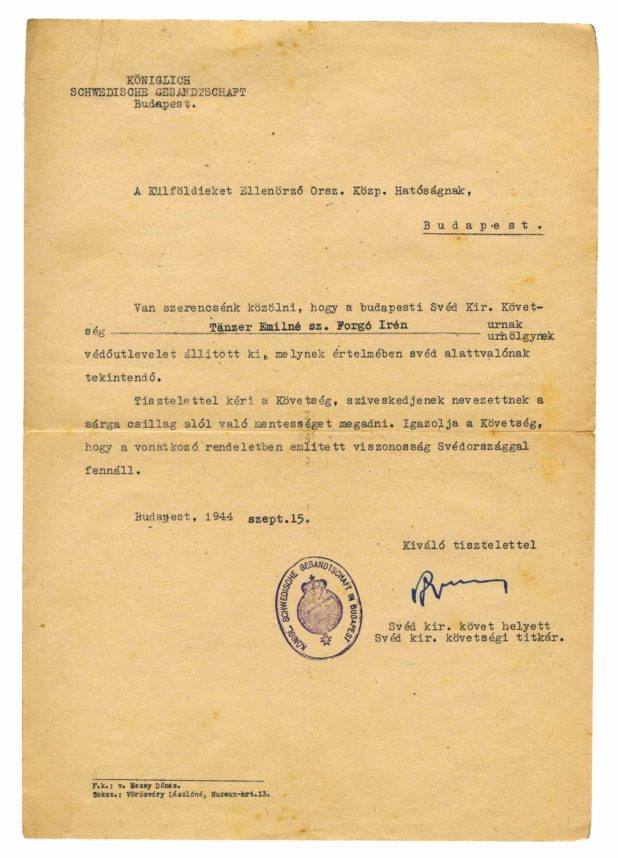
A life-saving document for two Hungarian Jews, signed by the late Swedish diplomat Raoul Wallenberg, has been sold for $13,750, according to a spokesman for Nate D. Sanders Auction of Los Angeles.

The sale brings renewed attention to one of the most elaborate and effective acts by a Christian, backed by his government, to foil the Nazi death machine.

The so-called “protective pass” conferred Swedish citizenship on Jewish siblings Emilne Tanzer and Iren Forgo. The passes spared them the fate of more than 300,000 Hungarian Jews killed by the SS, mainly at Auschwitz.

Specifically, the passes exempted the Jewish bearers from wearing the yellow Jewish star patch,by declaring that they were Swedish citizens awaiting reparation to their homeland.

Though the passes had no actual legal standing, the ruse worked well enough to be accepted by German and Hungarian officials most of the time.

Wallenberg disappeared in early 1945, and it is generally believed that he was arrested when Russian troops wrested Budapest from the German army, and that he died in a Russian labor camp.

In line with its policy, Sanders Auction did not identify the seller or buyer of the historical document.

In addition to issuing “protective passes,” Wallenberg used American and Swedish funds to establish hospitals, nurseries and a soup kitchen for the Jews of Budapest.

According to the Holocaust Encyclopedia, published by the U.S. Holocaust Memorial Museum, Wallenberg was born in Stockholm in 1912, studied in the United States, and in June 1944 was recruited by the U.S. War Refugee Board to travel to Hungary. Given status as a diplomat by the Swedish delegation, Wallenberg’s assignment was to assist and rescue as many Hungarian Jews as he could.

Although completely inexperienced in diplomacy and clandestine operations, Wallenberg led one of the most extensive and successful rescue efforts during the Holocaust.

In addition to issuing “protective passes,” Wallenberg used American and Swedish funds to establish hospitals, nurseries and a soup kitchen. In addition, he designated more than 30 “safe” houses that together formed the core of the “international” ghetto in Budapest, which was reserved for Jews and their families holding certificates of protection from a neutral country.

Spurred by Wallenberg’s example, diplomats from other neutral countries joined in the rescue effort. Swiss Consul General Carl Lutz issued certificates of emigration to some potential emigrants to Palestine.

Italian businessman Giorgio Perlasca, posing as a Spanish diplomat, established safe houses, including one for Jewish children.

Wallenberg’s decision to put his own life at risk to help save Jews was summed up by a friend many years ago who reportedly told Wallenberg that he should worry about his own safety. Wallenberg reportedly responded, “For me, there’s no choice. I’ve taken on this assignment, and I’d never be able to go back to Stockholm without knowing inside myself I’d done all a man could do to save as many Jews as possible.”

Sale of Nazi-Era Pass Recalls Hero Wallenberg Read More »

Factor’s Famous Deli Celebrates Turning 70

“If you take care of this place, it will always take care of you.”

Those are the words the late Herman Markowitz used to say to his family about his beloved business, Factor’s Famous Deli. His philosophy continues to resonate among his descendants and staff.

On May 15, the West Los Angeles dining institution on Pico Boulevard will mark its 70th anniversary with a dinner at The Mark for Events in the Pico-Robertson neighborhood.

Abe and Esther Factor opened the delicatessen in May 1948 in “just one little room,” Herman’s daughter Suzee Markowitz told the Journal. When the Factors decided to retire in 1969, Herman, who until that point had worked at Nate’n Al’s in Beverly Hills, purchased the deli. He died four years later.

Herman and his wife, Lili, were both Holocaust survivors and immigrated to the United States in 1947. They originally settled in Cleveland but moved to Los Angeles in 1963. “[Dad] thought there was more opportunity in California for his five children,” said Suzee, who manages the deli’s front of house operations. Lili, 92, is still very much involved in the business to this day. “She’s our queen,” Suzee said.

Suzee’s sister, Debbie Ullman, runs the full-service catering arm of the deli, and their brother Marvin, who has overseen the expansion of Factor’s over the years, “is our visionary,” Suzee said.

Renowned Hollywood emcee Billy Harris will host the 70th anniversary bash as part of his Billy Harris Dinner Series, and proceeds from the live auction portion of the evening will benefit the Simon Wiesenthal Center.

“Factor’s is more than a restaurant. It represents community.” — Suzee Markowitz

All the chefs participating in the (nonkosher) $218-a-plate dinner are Jewish. Offerings will include canapés by Factor’s, including mini Reubens and latkes with smoked salmon. Josiah Citrin of the Michelin-starred Santa Monica restaurant Melisse and the Charcoal restaurant in Venice, will apply his classic techniques to gefilte fish, while Micah Wexler and Michael Kassar of Wexler’s Deli will craft a refined take on borscht with short ribs.

Other chefs participating include Bruce Kalman of Union and Knead & Co. Pasta Bar + Market in Pasadena; Jonathan Waxman, who will open a new restaurant at the Westfield Century City mall; and Nancy Silverton of Pizzeria and Osteria Mozza and Chi Spacca restaurants.

Chef Adam Perry Lang, who will be opening a steakhouse in Hollywood, plans to serve his Passover brisket with farfel. “I love everything about cooking and eating Jewish food,” Lang said in an email.

For dessert, sweets maven Hedy Goldsmith will serve a Babka Napoleon.

“It’s an honor to do what we do,” Suzee said. “[Factor’s] is more than a restaurant. It represents community.”

To purchase tickets, visit billyharris.com/dinner-series.

Factor’s Famous Deli Celebrates Turning 70 Read More »

Jewish Leader Finds Harmony in LACO Role

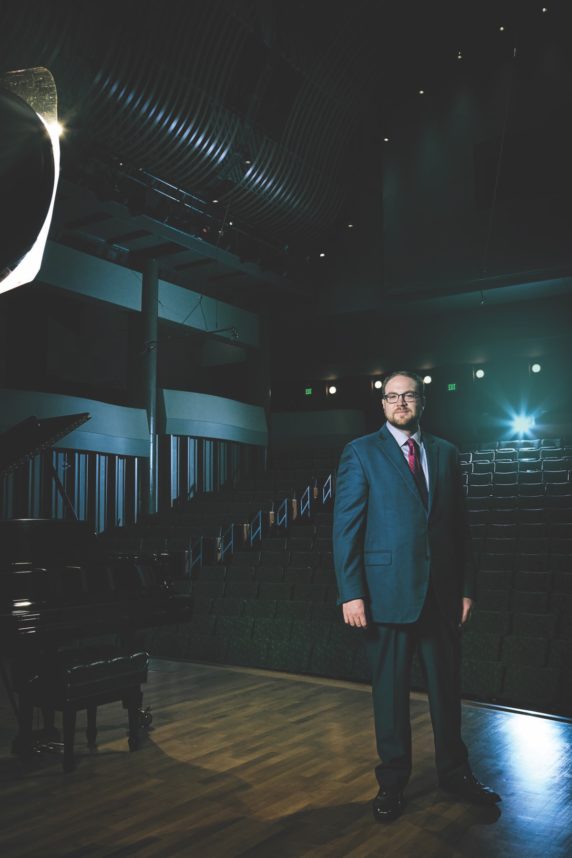
There’s a harmony between a city and its culture, and Scott Harrison fuses the two in his role as executive director of the Los Angeles Chamber Orchestra (LACO), currently celebrating its 50th anniversary season.

Harrison, 37, took on the position in the fall of 2015, replacing Rachel Fine, who is now managing director of the Wallis Annenberg Center for the Performing Arts.

“The orchestra is just fantastic,” Harrison told the Journal. “There’s such chemistry and a magnetism in the way they make music.”

Unlike most orchestras that perform in one space, LACO travels to venues throughout Los Angeles. It has longtime partnerships with UCLA’s Royce Hall, Glendale’s Alex Theatre, Santa Monica’s Moss Theatre, and the Colburn School’s Zipper Hall. Harrison significantly expanded LACO’s community reach to include new partnerships with the Valley Performing Arts Center (VPAC) in Northridge, San Marino’s Huntington Library, Downtown Los Angeles’ Grand Performances, the Colburn School and Santa Monica’s St. Monica Church.

LACO prides itself on presenting a diversity of works, Harrison said, with up to 30 programs per season. Its repertoire covers everything from classical music (well known Mozart or Beethoven symphonies), to composers like Kurt Weill, whose music reflected his experiences escaping Nazi Germany, resettling in the United States and becoming part of the vanguard of artists speaking out about civil rights issues in this country.

“Music is a tool for sparking tolerance, confronting oppression and creating spaces where people of different backgrounds can unite.” — Scott Harrison

Harrison said that while music can be an equalizing force, it also can raise questions. “Can our music put an idea out there or make a suggestion for what a better world or a better society might look like? Music is a tool for sparking tolerance, confronting oppression and creating spaces where people of different backgrounds can unite.”

Harrison, who grew up on Long Island and went to Hebrew school and services at reform Temple Judea, was drawn to music at a young age. “I remember loving all the songs and the sounds of the services,” he said. “Music was just part of how we connected with our Jewish identity. The songs stay with you, whether from the services or from Hebrew school or various holiday celebrations.”

Harrison said he has “no doubt the way I approach my work and my connection to music is fully a reflection of my own Jewish identity and upbringing.”

He joined both his public school’s choir and band. His first instrument was the clarinet, followed by the saxophone. He eventually settled on the bassoon and studied bassoon and political science at Northwestern University before attending graduate school at Southern Methodist University. Before embarking on his administrative career, he played the bassoon professionally.

Of his eventual decision to follow a path in arts administration, Harrison said, “The truth is, to make it as a professional musician, [it’s] not unlike making it as a professional sports player. You can be incredibly talented and have a lot of desire, but the spots are very limited. The chances to make it are few and far between.”

As an administrator, Harrison saw the opportunity to serve the arts community and fulfill his passion for music by driving an organization, helping bring concerts together, and bringing people together through music events.

“I love the fact that LA has so many different opportunities,” he said. “I love being transformed and taken away. And it’s also an extension of my job. It’s a chance to see different programs and expand my mind, think [differently] and meet different artists.”

Jewish Leader Finds Harmony in LACO Role Read More »