fbpx

May 2, 2018

WHAT HAPPENS NOW: Comments On Netanyahu’s Iran Speech

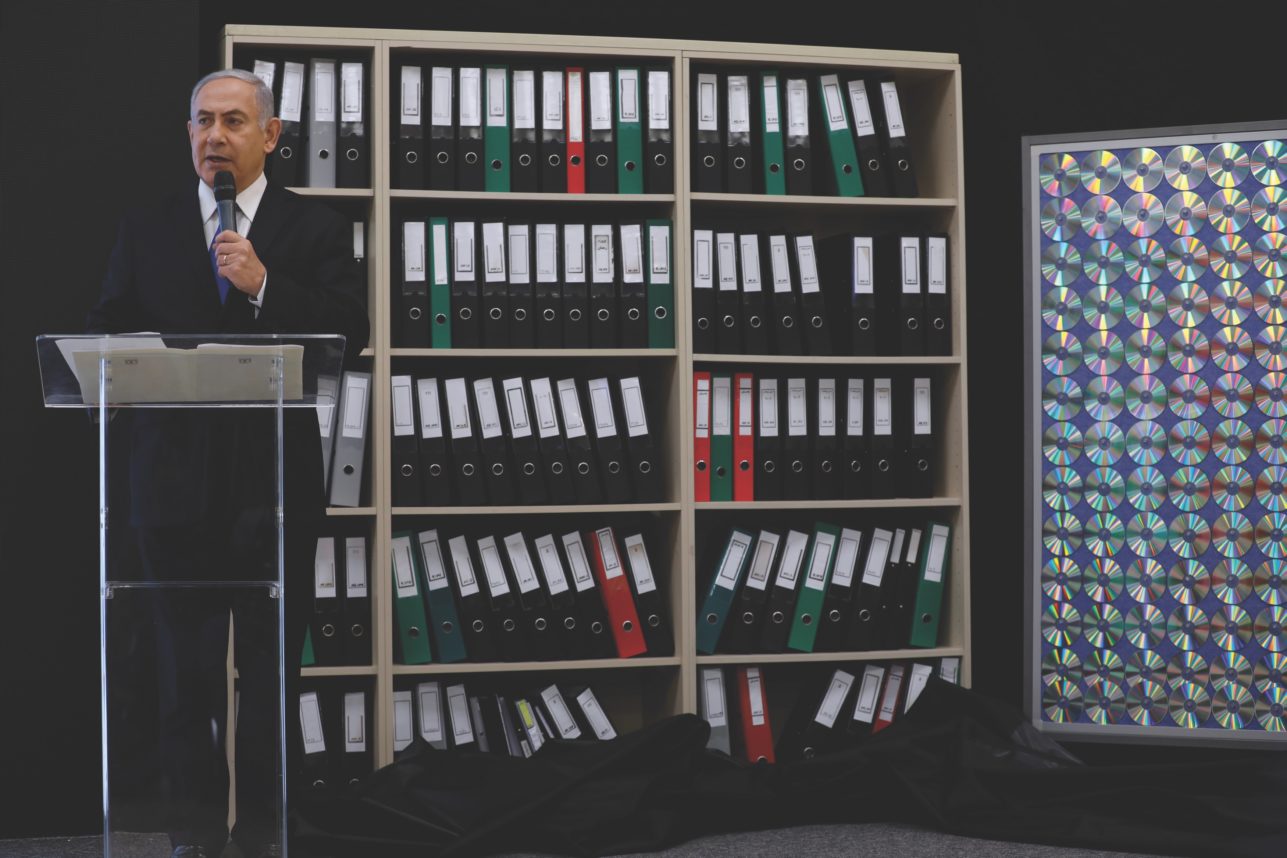
On April 30, less than two weeks before President Donald Trump was to decide whether to pull out of the Iran nuclear deal, Israeli Prime Minister Benjamin Netanyahu stood in front of a huge cache of files, computer discs and a large screen of graphics at a news conference in Tel Aviv, and accused Iran of lying for years about its efforts to build a nuclear weapon.

You must admire the people in charge of gathering information for Israel. You must admire the fact that they can show you thousands of documents from within the Iranian archives. And as you admire these creative, bold and daring intelligence gatherers, you also must consider the fact that they say they have documents that you don’t. They say they have information that no one else could gather. They know Iran well enough to obtain half a ton of copied secret documents from inside Iran and ship them to Tel Aviv. Maybe this also means that their sense of what Iran was doing, where it might be going, what its ambitions are like, are better than yours and mine. If these people tell you that Iran is cheating, if they tell you that the nuclear deal doesn’t work, you ought to listen. Agree or disagree, but listen carefully and humbly. There is very little chance that you know better than they do.

Timing is everything. Netanyahu tried and failed to prevent the Iran nuclear deal by addressing Congress in early 2015. It was a controversial move. Many of the speech’s opponents alleged that the prime minister’s main motive was political, that his true audience was Israelis (the election in Israel was held a few weeks after that speech). In a phone conversation I had with the prime minister not long after that speech, he defended his decision to go to Washington, D.C. This was an important enough issue in Israel for him to utilize all possible means, he said, and if that made then-president of the United States Barack Obama unhappy, then so be it.

The timing was off. Obama had no intention of giving up. Perhaps he thought he had a deal worthy of a second Noble Peace Prize. Then-Secretary of State John Kerry perhaps hoped to earn his first. Netanyahu gave a strong speech, but not strong enough. One could only speculate: Would Netanyahu have be more successful had he showed Congress then what he revealed this week?

What did you think about Netanyahu’s presentation on Iran? Most likely, this depends less on the material shown (shocking intelligence, but no evidence that Iran is violating the current nuclear pact), and more on your established opinion about Netanyahu and the Iran deal.
Search the internet and try to guess in advance what each person, pundit or leader is going to say about the presentation. In most cases, if you are familiar with the views of these pundits and leaders, you can skip the comment or the article. You know what they’re going to say (I assume some readers might say the same about this article).

Would more evidence of Iranian malfeasance make a difference? Sure, if Israel had rock-solid proof of recent Iranian violations (if it has such information, Netanyahu did not reveal it). But even then, people always could argue that there’s no proof the documents are real, that Netanyahu’s word isn’t worth a dime, that Israel — and most other countries — were wrong on Iraq’s WMD.

So did Netanyahu change many minds? He surely achieved two objectives: showing Israel’s intelligence prowess, and making Iran a main topic of conversation, for at least a day or two.

If these people tell you that Iran is cheating, if they tell you that the nuclear deal doesn’t work, you ought to listen.

He also annoyed some leaders, but then, many leaders are easily annoyed by him. Some of them were quick to point out that the information discussed by Netanyahu on April 30 didn’t include anything that wasn’t previously known about Iran. The question is: Known to whom? Netanyahu’s presentation clarified things that experts already knew but that politicians didn’t always know and that the public might not have been aware of.

Reportedly, the files concerned an Iranian nuclear weapons program called Project Amad, launched in 1999 and shelved in 2003.

The question remains: Can you alter the opinions of world leaders by showing them information — whether it is old, new, repackaged or re-explained? Are world leaders capable of admitting an error?

The deal with Iran was a mistake made in haste. But let’s be realistic: Do you think Obama changed his mind this week if he watched Netanyahu’s news conference? Do you think Kerry did? Timing is everything. Information — evidence — is hardly as important. Many Americans blame President Trump for bringing about the age of fake news, yet what Netanyahu showed us earlier this week is proof that the Iran deal was fake news. It was fake news produced by people more sophisticated than Trump, and thus more successful in selling their make-believe diplomatic achievement to a receptive audience.

It will take time to assess the impact of Netanyahu’s dramatic revelation. But some things are clear:

Netanyahu was well coordinated with the Trump administration when he staged his news event. He spoke on the phone with Trump two days before the presentation. He met with the newly confirmed Secretary of State Mike Pompeo the day before the presentation. The Trump administration was not taken by surprise. It was well informed, and it was ready to respond — as Trump did half an hour after Netanyahu went off the air.

What was the exact plan? Maybe Trump told him: Give me something to work with; give me something with which to pressure the Europeans. Maybe Trump told him: I can’t convince the Europeans — you try. Maybe Trump told him: I am going to do what’s right; it would be helpful if you can give me some more ammunition.

Can the Europeans, Russians and Chinese, all of which signed the agreement with Iran, be convinced?

I am skeptical and here is why: They knew all along that Iran cannot be trusted. They knew its leaders were lying. They knew it had an earlier, established nuclear weapons program. They were cynical when they hailed the deal, and there’s no reason for me to think that they aren’t cynical now. They decided to compromise with Iran not because they think it is a country of great values and respected leadership. They decided to compromise with Iran because they see economic potential and because they think Iran — and its belligerent behavior — is not really their problem.

I’d like to think that Trump is going to change all this, but this is far from assured. Trump can dump the deal and then lose interest — which isn’t a good outcome. He can maintain the deal — possibly with cosmetic changes to save face — which isn’t a good outcome. He can begin a process of pressuring Iran, and then lose the 2020 election and be replaced by a less vigilant leader — which isn’t a good outcome. The battle against Iran is long, and to win it, the United States or Israel must be persistent and must have a strategy. News conferences, speeches, statements, impressive intelligence achievements — all these have a role in this long battle. But no speech can win this battle.

Do you think Barack Obama changed his mind this week about the Iran deal if he watched Netanyahu’s news conference?

To Israel’s credit — if one believes the unconfirmed reports by the non-Israeli media — it is not merely talking. The same day as Netanyahu’s news conference, suspected Israeli strikes hit Iranian targets in Syria. This was not the first, second or third time Iran was the recipient of a clear message: Its military presence in Syria will not be tolerated.

Israel has made that clear in public statements and to foreign dignitaries including, in recent days, European leaders who were trying to understand why Syria is suddenly becoming such a hot potato. Israel told even the Russians that it is dead serious about not allowing an Iranian presence in Syria. A senior diplomat told his counterpart: We will not let Syria become a second Lebanon. In Lebanon, Iran’s proxy, Hezbollah, has thousands of rockets ready for use against Israel. This is hardly convenient, but since the war of 2006, the Israel-Lebanese border has been relatively stable and quiet. Israel has no interest in having to watch a second front to the east, this time not held by Iran’s proxies but rather by Iran.

Again, only time will tell if the Iranians got the message and decided that the benefit does not justify the cost — or maybe it’s the other way around: They got the message and are getting ready to up the ante.

What will Iran do if Trump scraps the deal? What will Israel do in response to Iran’s response?

What Netanyahu revealed was amazing, and also somewhat disappointing.

He told us that Iran is lying.

He proved that the official Iranian position was based on a pile of untruths.

Did we not know?

Netanyahu did not have a smoking gun. It’s disappointing but should be acknowledged. So, if you are still in the business of believing the Iranians — oh, they lied for three decades, they lied up until mid-2015, but now they are telling the truth and nothing but the truth — I would urge you to stay away from banks, insurance companies and flea markets. You are clearly easy prey for con artists. Still, Netanyahu can’t show you evidence that they are lying now. Or maybe he can:

Netanyahu did prove that Iran is still lying about its dishonest past. What he didn’t prove is that it’s lying about the present.

Israeli Prime minister Benjamin Netanyahu speaks during a news conference at the Ministry of Defence in Tel Aviv, Israel, April 30, 2018. REUTERS/ Amir Cohen

What Netanyahu revealed was amazing, and also somewhat disappointing.

If one wants to be suspicious of Netanyahu’s motive, it’s not impossible to do. The speech was made on the first day of the summer session of the Knesset, the Israeli parliament. Netanyahu stole the show. While other politicians were dealing with petty maneuvers, he presented himself as a man of action, determination and big things.

If he has no choice but to call for early elections — because the coalition can’t compromise on issues such as drafting the ultra-Orthodox, or the conversion bill, or the Supreme Court bill — he now will do it as statesman. If his coalition partners were toying with idea of testing his power, they now will have to reconsider.

These are tense days in Israel. Pundits and politicians rush to the microphones to calm down the public, which of course has the opposite effect. If times were truly calm, there would be no need for such appearances.

Remember Israel Independence Day? It was just a week ago. Remember Passover? Four weeks ago. May is here, and with it a mountain of worries:

Will moving the U.S. Embassy to Jerusalem, a positive and welcome decision by Trump, ignite protest and violence?

Is Israel ready for the main show in Gaza on Nakba (Palestinians’ Day of Catastrophe) in mid-May, when thousands likely will again attempt to cross the border?

What will the president decide to do with the Iran deal, and what will be the repercussions of his decision?

How will Tehran and Damascus respond to attacks on sites in Syria? What will Iran do if Trump scraps the deal? What will Israel do in response to Iran’s response?

If you are just an observer, you should fasten a metaphorical seat belt as you prepare to watch a possibly dramatic show. If you live in Israel, fastening a seat belt is less an expression and more a statement of sober fact: Fastening a seat belt is what you do to save lives.

Shmuel Rosner is senior political editor. For more analysis of Israeli and international politics, visit Rosner’s Domain at jewishjournal.com/rosnersdomain.

WHAT HAPPENS NOW: Comments On Netanyahu’s Iran Speech Read More »

Lies and More Lies

So, the Iranians lied.

So did the Obama administration.

On April 30, Israeli Prime Minister Benjamin Netanyahu revealed that in a stunning intelligence coup, the Israelis had somehow obtained 100,000 files from Iran’s secret atomic archive in Tehran. The files showed that Iran had ardently pursued nuclear weapons for years, lying about it all the while; that they had then failed to turn over the information showing the extent of their program during negotiations over the Barack Obama administration-pushed Iran deal; and that they had hidden those files in a secret warehouse with the obvious intent of reviving their nuclear program the minute they can get away with it.

According to Netanyahu, Iran “is brazenly lying when it says it never had a nuclear weapons program.” Furthermore, Netanyahu claimed that nuclear development “continued … in a series of organizations over the years, and today, in 2018, this work is carried out by SPND, that’s an organization inside Iran’s Defense Ministry.” The head of Iran’s earlier nuclear program currently heads the SPND.

Advocates for the Obama administration have come forward to contend that there’s nothing new here — that everyone knew Iran had been lying about its nuclear program. But when the deal was signed, Secretary of State John Kerry stated that Iran would have to disclose past military-related nuclear activities: “If there’s going to be a deal, it will be done. … It will be part of a final agreement.”

Other advocates say that Israel’s intelligence would be damaging to the Iran deal — but those nefarious Jews made it up. According to Tommy Vietor, former Obama National Security Council spokesman, “After years of bashing U.S. intelligence agencies for getting Iraq wrong, [Donald] Trump is now cooking up intel with the Israelis to push us closer to a conflict with Iran. A scandal hiding in plain sight.”

The Obama administration played propagandists for the Iranian government.

So, to get this straight, Vietor is claiming that Israel “cooked up” the intelligence information to bluff America into war — as always, it’s the devious Jews. Furthermore, Vietor is claiming that Trump went along with this Israeli manipulation. Also, the Iranians are complying with the terms of the awful deal. This from a key member of the same administration that admitted in print to having deceived the American public about the Iran deal. Former Obama national security guru and professional fiction writer Ben Rhodes bragged openly about lying to Americans regarding the supposedly more “moderate” Iranian leadership seeking a deal.

Here’s the reality: The Obama administration, desperate to cut a deal with the Iranian government, played propagandists for the Iranian government. They fibbed that the Iranians had gone moderate; they lied that the only alternative to their rotten deal was war; they signed a deal that gave Iran enormous quantities of cash to use for terrorism, and that did nothing to rein in Iran’s ballistic missile program. Finally, they looked the other way as Iran lied about its maintenance of secret nuclear information.

And yet we’re supposed to believe their protestations now?

The Iran deal was garbage from the start. It was a way for Obama to declare triumph in the region even as the world’s worst terror sponsor pursued utter carnage from Tehran to Beirut. Whether Trump kills the deal at this point is of secondary import — the Trump administration knows that the deal is dead, and it’s just a question of whether to declare it so. The real question is why the same international community that accepted Iran’s word should be trusted to verify Iran’s compliance.

The simple answer: They shouldn’t. The Iran deal was an outgrowth of motivated thinking, not evidence-based policymaking. The only question now is whether it’s too late to stop the Iranians from finally achieving their dream of placing Israel and Saudi Arabia within the radius of Iranian nukes.

Ben Shapiro is an author, editor-in-chief at The Daily Wire and host of “The Ben Shapiro Show” podcast.

Lies and More Lies Read More »

5 Key Facts from the ADL’s Islamist Extremism Report

The Anti-Defamation League (ADL) released its yearly report on Islamic extremism on May 1, analyzing 98 Islamist terror plots over the past 15 years. Its findings are worth an examination as the world deals with the barbaric ideology of ISIS, al-Qaeda, Hezbollah and its adherents.

Here are five key facts from the ADL’s report.

1. Most Islamic terror plots in the United States are homegrown. The ADL’s report found that between 2002 and 2017, there were 127 individuals involved in 98 terror plots. Ninety percent of those individuals were either U.S. citizens or legal immigrants; 52 percent were born in the U.S.

There are two possible ways to look at this. The ADL is arguing that these findings show that the Trump administration is wrong to suggest “that immigrants and foreign born individuals post the greatest threat to our national security.” The flipside to that argument is that 48 percent of that 90 percent figure came into the U.S. legally, meaning that the immigration system need to be improved to ensure that the U.S. isn’t allowing terrorists to slip through its borders.

2. Recent terror plots seemed to focus on areas that weren’t fortified with armed security. The report states that ISIS and al-Qaeda propaganda explicitly encourages its adherents “to look towards soft targets, which typically have less security and are more accessible than symbolic targets” in order to murder as many people as possible. The report cites six terror plots in 2017 that honed in on soft targets, including a plot targeting a mall in Miami and San Francisco’s Pier 39.

These findings would suggest that having an armed presence in public areas would discourage acts of terrorism.

3. Islamist terror organizations have recently been disseminating their propaganda through a social media app called Telegram. Telegram, an encrypted instant messaging app, has become the preferred app for Islamic terror groups after Facebook, YouTube and Twitter began cracking down on such propaganda on their respective platforms. According to the report, apps like Telegram provide terrorists the ability “to distribute information more freely.” For instance, the report goes explains how Everitt Aaron Jameson, who was arrested for plotting a terror attack in San Francisco, was likely influenced by ISIS propaganda on Telegram urging its followers to launch terror attacks during Christmas at around that time.

4. Most of the individuals who were arrested in 2017 for plotting Islamic terror attacks were ISIS supporters. There were 29 people arrested for plotting Islamic terror attacks, 24 of which were ISIS adherents. The rest were either adherents to Hezbollah or Jabhat al-Nusra, al-Qaeda’s former affiliate.

5. The average age of those arrested for Islamic terror attacks was 30.3. The report noted that the average age of these individuals has increased since 2012 and the number of women arrested for Islamic terror attacks has declined from 40 percent in 2014 to less than 7 percent in 2017.

Read the full report here.

5 Key Facts from the ADL’s Islamist Extremism Report Read More »