
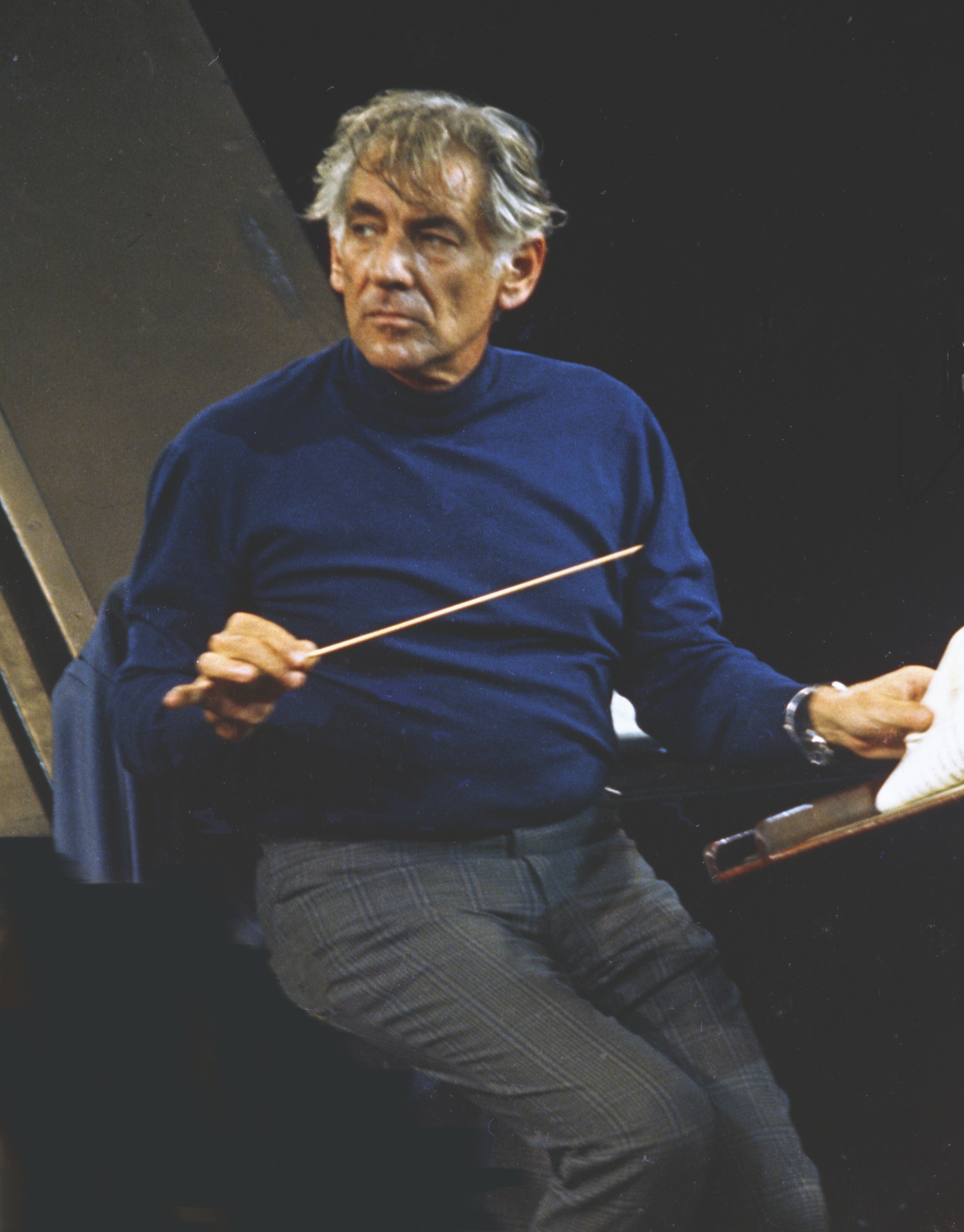
 Leonard Bernstein Photo by Allan Warner.
 “Leonard Bernstein at 100,” a traveling exhibition celebrating the life and career of renowned American composer and conductor Leonard Bernstein, is now on view at the Skirball Museum, coinciding with the 100th year of the maestro’s birth. More than 150 artifacts, many accompanied by audio, are included in the interactive show. Robert Santelli, the founding executive director of the Grammy Museum and curator of the exhibition, gave the Journal a guided tour.
“There were a couple of key points we wanted to emphasize,” Santelli said. “[Bernstein] had the charisma of a rock star, a conductor, composer, great pianist and was a great ambassador for classical music. He was an exceedingly complex man, in front of a symphony, and at home. But we focus on the music.”
Asked to curate the exhibition in 2014, Santelli researched for a year and began collecting artifacts from sources, including the New York Philharmonic archives, the New York Performing Arts Library and Indiana University, to which Bernstein had donated many items from his Fairfield, Conn., home.
Santelli borrowed musical scores and letters from the Library of Congress, caricature sketches from artist Al Hirschfeld’s family, and Bernstein’s first piano from Brandeis University, which “didn’t want to part with it,” Santelli said. “We pleaded and begged.”
Other items on view include the cufflinks Bernstein wore to conduct every concert. (they previously belonged to Bernstein’s mentor Serge Koussevitzky), the baton he used to conduct the New York Philharmonic in his 1943 debut, and the Harvard University grade transcript on which he received a C in music. Showcases display sheet music and album covers from Bernstein’s classical and popular works, including “West Side Story,” some of his Grammy and Emmy Awards, and less expected items, such as an FBI dossier, prompted by Bernstein’s support of the Black Panthers.
“I suspect Bernstein would have told me the exhibition should be much larger and should be traveling forever.” –Robert Santelli
There are also several items that reflect Bernstein’s Jewish heritage and connection to Israel, including his Hebrew school diploma and a program from the Israel Philharmonic 1951. In an email interview, Alexander Bernstein said that his father grew up with a religious father but “was not the most devout Jew. He was deeply spiritual and had a life-long personal conversation with God. It is there in his music: ‘Jeremiah Symphony,’ ‘Kaddish Symphony,’ ‘MASS.’ ”
Alexander added, “I believe his commitment to social justice came, in great part, from his Jewish roots. Most important to him, I think, was the Jewish tradition of asking questions. As an educator, he saw all learning as a process of asking questions, leading to further questions, creating a life-long love of learning, of curiosity. That is at the heart of his living education legacy: Artful Learning (artfullearning.org).”
Growing up with his famous father “was mostly a joy,” Alexander said. “Our home was filled with lots of people and lots of laughter. My father enjoyed being famous. He loved meeting new people, so he didn’t mind being noticed wherever we went. I don’t remember ever feeling at all bitter about sharing him with the rest of the world.”
Alexander said he believes that Leonard Bernstein “would have been absolutely thrilled” with the exhibition, “particularly with the way it is curated to reflect the many equally important and inter-related facets of his life: composer, conductor, educator, social activist and family man. And it shows also the enormous variety of styles and genres in his composing life. He broke barriers in so many ways: jazz and Latin music in the concert hall, symphonic music on Broadway.”
Although Santelli agrees that Bernstein would have loved the exhibition, he said, “I suspect that he’d tell me it should be much larger and should be traveling forever.”
Santelli is especially eager for school groups to discover Bernstein through the displays and said, “I judge the exhibit’s success by the amount of young people we can reach and impact.”
“Leonard Bernstein at 100” runs through September 2 at the Skirball Museum.
















 More news and opinions than at a Shabbat dinner, right in your inbox.