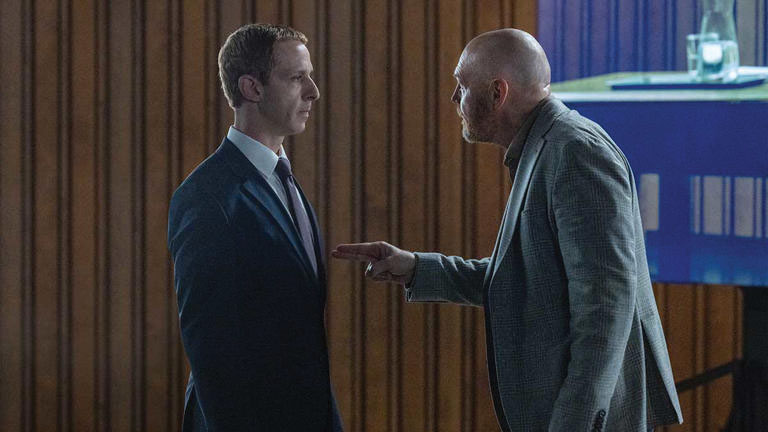
Austria’s “Counterfeiters,” one of five foreign-language films vying for Oscar honors, probes the moral dilemmas facing a special group of Jewish concentration camp inmates in one of the more remarkable episodes of World War II.
In 1943, as the Nazis realize that the war is going against them, they try one more ploy — to wreck the economies of Britain, and then the United States, with massive amounts of perfectly counterfeited pounds sterling and dollars.
Under the codename “Operation Bernard,” the Germans comb concentration camps and put together a team of more than 100 skilled Jewish printers, photographers and engravers.
In Sachsenhausen, the prisoners are placed in two completely isolated barracks, dubbed “The Golden Cage,” given soft beds, good food, civilian clothes, first-class equipment and piped-in music.
Heading the team is Salomon Sorowitch, a character based on one Salomon Smolianoff, a Russian-born Jew nicknamed “Sally,” who lived high in the Berlin of the 1920s and early 1930s as “The King of the Counterfeiters.”
Sorowitch/Smolianoff is a natural-born survivor, who passed four previous years at the Mauthausen concentration camp in relative comfort by painting flattering portraits of SS officers.
Faced with the choice of producing pound notes so perfect that even the Bank of England accepts them as real, or instant death, Sorowitch does the Nazis’ bidding.
By the end of the war, the Sachsenhausen team had turned out 134 million pounds, three times the amount of British currency reserves, and was getting close to producing equally perfect dollar bills.
Yet, director Stefan Ruzowitzky does not draw Sorowitch, portrayed by Karl Markovics, as just a craven collaborator. Sorowitch protects a fellow prisoner who is trying to sabotage the operation and uses his skills to get medicine for an ill inmate.
“Counterfeiters” retains the tension of a top thriller, but it goes deeper than that. It probes a haunting moral question — given a chance at life, even temporary life, at the price of aiding the enemy, as against certain immediate death, what path will a man choose?
The actual Smolianoff survived the war and soon resumed his old occupation, adding the “rediscovery” of Old Master paintings to his repertoire. He died in Argentina in the 1960s.
The film’s ending, building on hearsay evidence, has Sorowitch after liberation toting a suitcase full of fake currency and heading for Monte Carlo, where he purposely loses the entire fortune at the gaming tables.
Director-writer Ruzowitzky’s background and motivation is as interesting as the movie itself.
The trailer
The Viennese filmmaker’s grandparents on both sides were Nazis, or Nazi sympathizers, who, like most Austrians of the war and postwar generation, saw themselves more as victims than perpetrators of the German atrocities.
“My grandparents would acknowledge to me the facts of the Holocaust, but considered it a collateral damage to the war,” said Ruzowitzky during a phone interview.
Given his background and nationality, the director felt he had a responsibility to deal with the Holocaust era, but an equal duty not to exercise moral judgment on the Jews who collaborated in Operation Bernard.
One reason he closed the film with the scene at a Monte Carlo casino “was to give Sally some redemption, or atonement, at the end,” Ruzowitzky .
From his considerable research on concentration camps, he concluded that “the system was designed so that the inmates would harm each other.” He cites one survivor, a doctor, as saying, “If you tried to do anything good, it would lead to catastrophe.”
In its Oscar quest, “Counterfeiters” is up against Israel’s “Beaufort,” Poland’s “Katyn,” Kazakhstan’s “Mongol” and Russia’s “12.”
“Counterfeiters” opens Feb. 22 at Laemmle’s Royal in West Los Angeles, Playhouse 7 in Pasadena, and Town Center 5 in Encino, and on March 7 at the Claremont 5 in Claremont.