
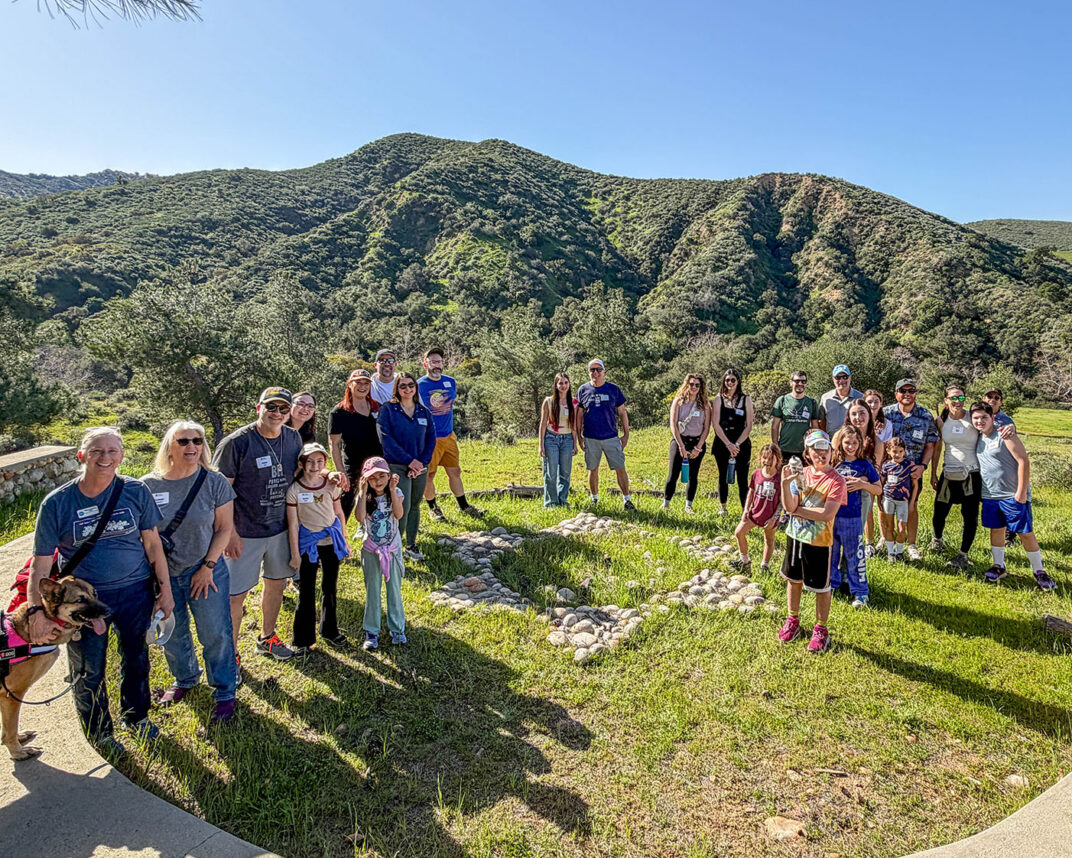
Celebrating Tu Bishvat – Jewish “Earth Day” – more than 250 people of all ages gathered on Sunday at Camp Alonim, on American Jewish University’s Brandeis-Bardin Campus, the university’s sprawling 2,700-acre campus in Simi Valley. The Feb. 1 event, open exclusively to Camp Alonim alumni, brought together generations of campers to hike, plant trees, sing, dance, and participate in a Tu Bishvat seder—among them Harriet Scharf, who first attended Camp Alonim in the 1950s, and Jonathan Boyer, who fondly recalled “overnights” sleeping under the stars as a young camper.
Those who arrived at 10:30 a.m. kicked off the daylong community event with a morning hike. The trek finished at the grave site of Dr. Shlomo Bardin, the late Jewish educator who founded the Brandeis Bardin Institute in 1947 on the grounds of what today houses Camp Alonim and AJU’s Brandeis Camp Institute (BCI).
A visit to Bardin’s resting place to start the day was appropriate: the event honored Bardin’s decades-long tradition of planting trees at the Simi Valley site.
Midday, everyone gathered at Terry Field to plant eight young mulberry trees beneath the scoreboard. Children and their parents grabbed shovels and worked together to scoop soil around the saplings, setting new roots in place. Alissa David, director of alumni engagement at American Jewish University, told everyone they were “planting the legacy of this living laboratory, referring to Camp Alonim and BCI.
“As alumni, you guys are our past and our future,” David added. “This is a day celebrating Jewish values, community, and continuity—and what better way to spend the holiday of Tu Bishvat than outdoors!”
Other Jewish leaders in attendance included Camp Alonim Director Aaron Goldberg. “The trees remember you being here,” Goldberg, dressed in jeans and a Camp Alonim T-shirt, said to the group that assembled before the tree-planting.
Mishkon Tephilo Senior Rabbi Joshua Katzan also attended. Prior to the tree-planting, Katzan, an acoustic guitar strapped to his body, led the group in a brief sing-along. Later in the day, Katzan, an Alonim and BCI alum who was ordained at AJU’s Ziegler School of Rabbinic Studies, facilitated a Tu Bishvat seder as the event’s attendees gathered in the camp’s dining hall, drank grape juice—both the classic and white grape versions—and enjoyed ritual Tu Bishvat foods such as olives and figs.
Immediately following the seder, AJU President Jay Sanderson addressed the group, outlining his vision for Camp Alonim for the near future. That includes constructing a new welcome center and new camp bunks. A $28 million capital campaign is currently raising funds to support the construction of new facilities at the camp.
The event concluded with Israeli dancing, led by Orly Star—a Shabbat tradition for Alonim campers. Though it had been years since folks like Scharf and Boyer had done the steps, they had no problem picking them up as if those Friday nights at Alonim were only just yesterday.
David let those in attendance know of plenty of Alonim-related programming in the works, from a performance with an all-star Alonim “garage band” to sign-up parties.
But on Sunday, the event was just as much about nostalgia as it was about looking forward. More than anything, the families there were content to enjoy the simple pleasures of being in rustic, scenic surroundings, from the surrounding foothills still green and lush from recent rains to the shade of the camp’s many trees.
On the holiday of Tu Bishvat—the Jewish new year for the trees—what could’ve been more appropriate?
Ryan Torok is director of public relations at American Jewish University.