On the second day of the Los Angeles wildfires, Jan. 8, Emily Kane Miller, her husband Nate Miller and their three children lost their Pacific Palisades home. While Emily was grateful her family made it to safety, she kept thinking about the mementos she’d lost – in particular, her great-grandmother Eidleh Istrin’s chopped liver bowl, which her aunt had given Emily when she got married.
“It was one of the only treasured heirlooms from Europe that I owned,” she said. “Both my paternal grandparents survived the horrors of the Holocaust and came to Los Angeles as refugees. We have very few physical objects – but so much spiritual wealth – from that side of my family. I was gutted at the thought of the bowl being reduced to ash – more than anything else in the house.”
The Millers’ home was also full of Judaica — kiddush cups, challah plates and candlesticks — which came out every Friday night for Shabbat. After the fire, Emily started to contemplate what those things meant to her and her family.
“It made me think of the power of touch and how physical objects can hold history because of who has touched them, who has blessed them and the stories they carry,” she said. “While a chopped liver bowl isn’t ‘Judaica’ per se, in my home, it was. My husband and I had built a treasure trove of Judaica in our home. Some items were old, some new, [and] all were imbued with stories about who gave it to us, who else had used it, where it had traveled from and the ways we had lovingly used them since they came to be ours.”
“It made me think of the power of touch and how physical objects can hold history because of who has touched them, who has blessed them and the stories they carry.” -Emily Miller
A few days after the fire, Emily and her friend, who also lost everything in the fire, were invited to a woman’s home. She’s in her 80s, and she wanted to share treasures with the two.
“One of these treasures was a set of beautiful Shabbat candlesticks — the kind that look like they are from ‘the old country,’” Emily said. “My friend accepted them with such joy. They looked like a pair she’d lost. In that moment, I felt her repair just a little bit. Now, when she lights candles on Shabbat, she has the story of receiving these from someone who received them from her Bubbe who wanted her and her family to have them.”
This got Emily thinking: Wouldn’t it be nice if others could give back to the Jews who lost their Judaica in the fire? That’s how her initiative Heart and Hamsa came to be.
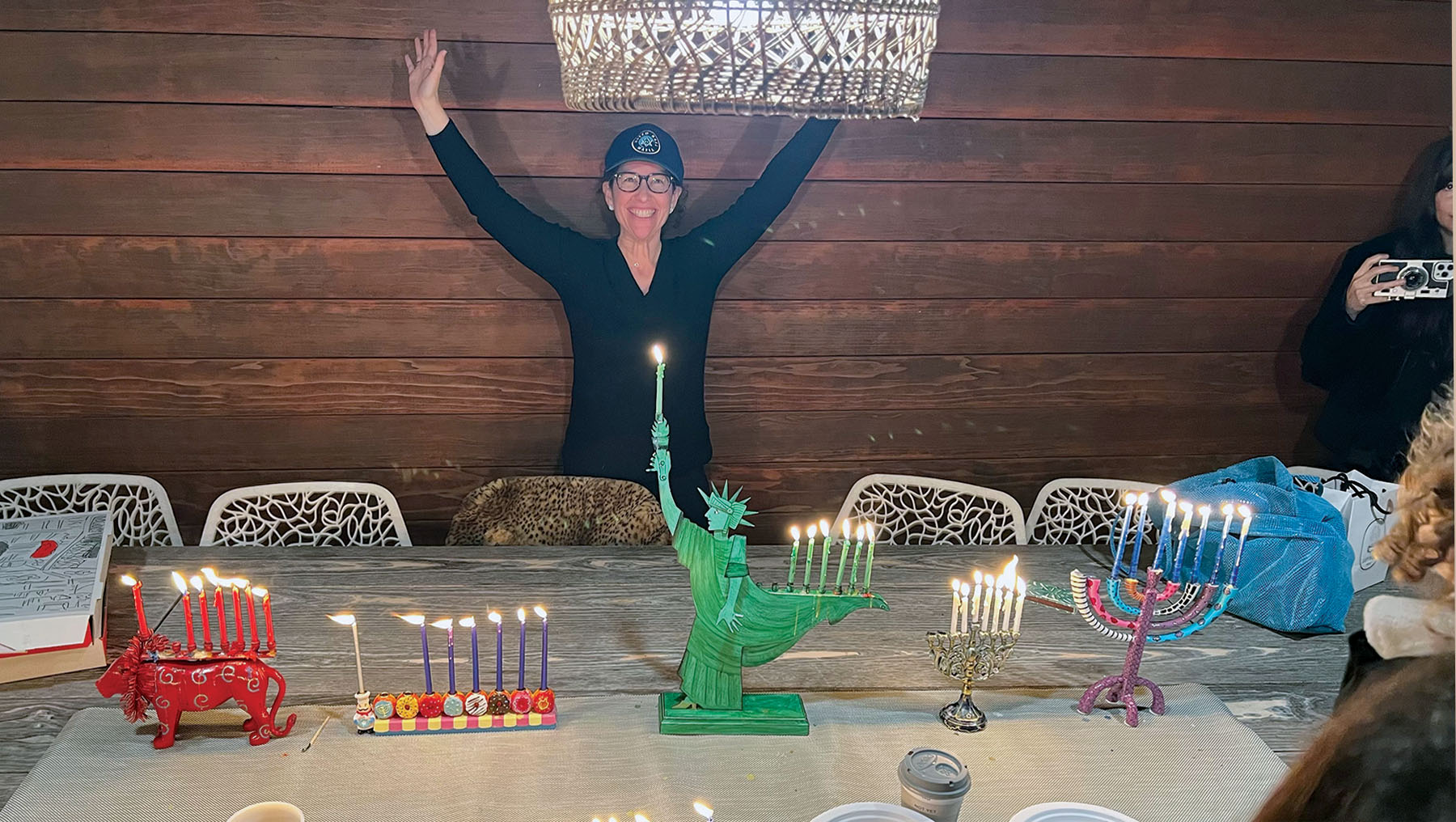
Emily, who is the CEO and founder of Ethos Giving, a philanthropic services company, and a member of Kehillat Israel, which survived the fire, started Heart and Hamsa on Feb. 28. It’s a website where people can list their Judaica during the month of March, and in April, those in need can choose the items they want. The Judaica is coming not only from Jews in LA, but from those all around the world. Some of the items include a kiddush cup from New Jersey, a dreidel menorah in Connecticut and glass Shabbat candle holders in Beverlywood. Now, Noa Tishby is partnering with Emily on this initiative to get the word out.

“Hearing about how the community rallied together in places like Kehillat Israel, the Pacific Palisades synagogue I visited, I was inspired by the strength and resilience that the Jewish people have once again shown,” Tishby said. “Thinking about all the Judaica lost, items that were passed down dor l’dor — from generation to generation — some that survived the Holocaust, is so painful. But this is the story of Jewish peoplehood, and Heart and Hamsa provides the opportunity to step up to not only restore objects but make meaningful connections.”
Tishby, an LA resident for the past two decades, evacuated her home, but it was fine. However, some of her friends, like Emily, lost everything. “Seeing the destruction, seeing people digging through ash and rubble, it broke my heart,” she said. “It reminded me of some of the worst times in history when people lost everything. But the people of Los Angeles are resilient.”
What Heart and Hamsa is doing is not just physical recovery, Tishby said. It’s about spiritual and emotional recovery, too.
“Traditions are a part of who the Jewish people are — our songs, our stories, our rituals,” she said. “Donating menorahs, kiddush cups and mezuzahs, along with their stories, helps families rebuild and maintain their connection to our traditions, even in the face of disaster.”
“Traditions are a part of who the Jewish people are — our songs, our stories, our rituals.” – Noa Tishby
According to Emily, Heart and Hamsa needs as much Judaica as possible to help those in need. “We don’t expect anyone to give anything away that would be uncomfortable for them,” she said. “But if you are ready to share anything because you have too many, or it’s not your personal style or it’s not something that your family really uses, then we’d love to share it with someone who is missing theirs.”
By giving Judaica to wildfire evacuees, the entire community has the opportunity to come together and support one another. “We are bringing a new treasured piece of Judaica, weighted with the story of its history, but also with the story of the gift,” Emily said. “Somebody loved this item and wanted our family to have it. What a blessing.”