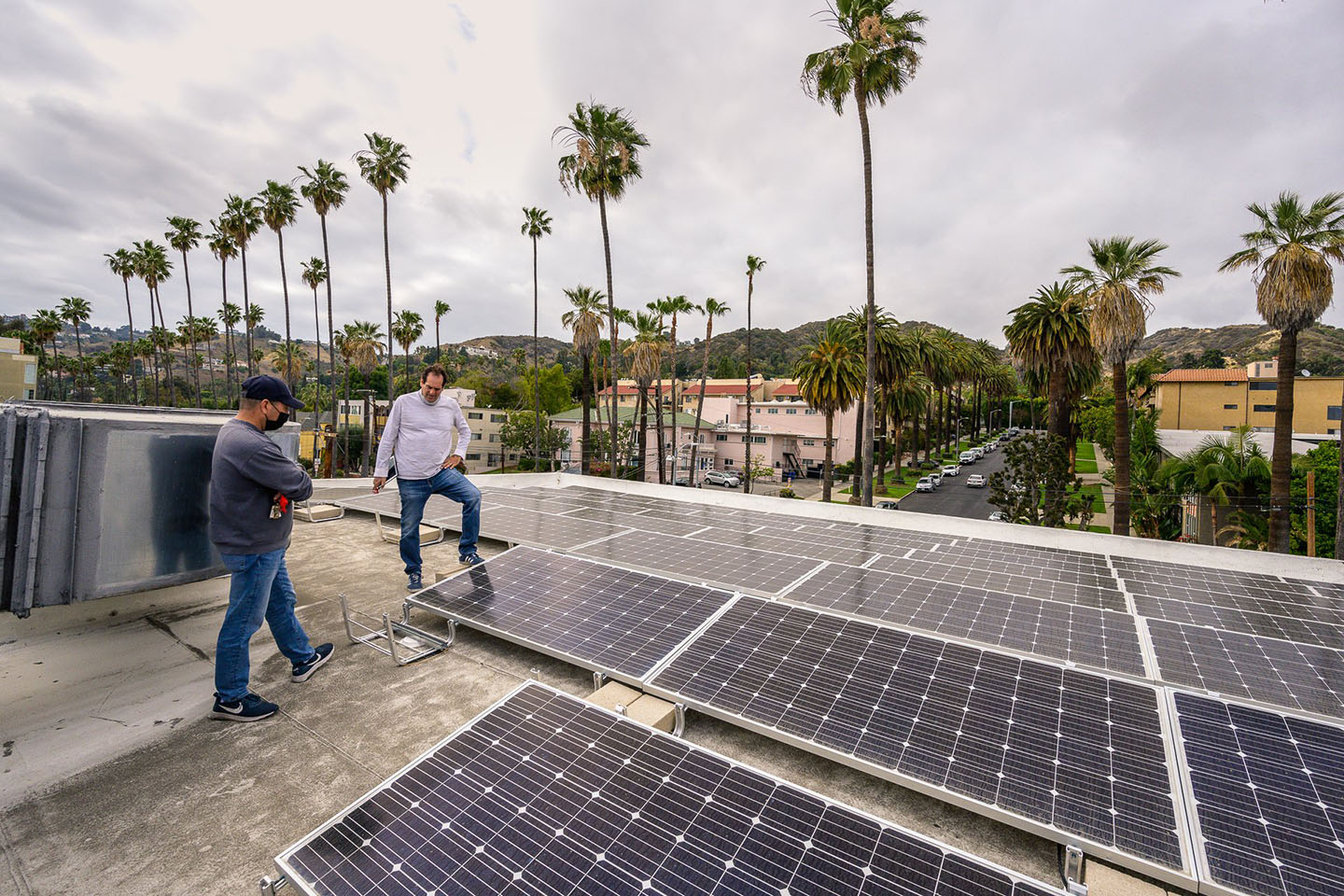
Mitchell Schwartz has a dream: to see solar panels on every Jewish institution. In 2022, the veteran communications executive and environmentalist set out to turn that vision into reality by founding the Jewish Solar Challenge (JSC) in Los Angeles.
The biggest obstacle for these institutions was funding. Determined to remove this barrier, Schwartz recognized that financial incentives could make a difference. He offered matching grants of up to $50,000 to institutions that pledged to go solar, reducing the payback time to less than three years. What excites Schwartz even more are the environmental benefits, as the program helps lower emissions.
“During COVID, I took on a small project to understand why more progressive and Jewish organizations hadn’t adopted solar energy,” Schwartz said. “The two main reasons were apathy—no one took the time to follow through—and financial concerns, as people felt the eight-to-10-year payback period was too long, even though the system would eventually pay for itself.”
As an active member of Temple Israel of Hollywood, Schwartz had tried multiple times to convince the congregation to install solar panels, but his efforts were unsuccessful. Finally, with the launch of JSC, the temple became the first recipient of a JSC grant and installed 136 panels. The project reduced an estimated 282,326 lbs. of CO₂—equivalent to planting over 13,000 trees or taking five cars off the road.
Berkeley Hillel installed a 36.4 kWh array of panels with a 13.5 kWh Tesla Powerwall Battery in March 2022, reaping additional benefits beyond cost savings. During a power outage at the Berkeley Hillel building, the solar panels ensured that students could still come in and study while the rest of the campus remained in darkness.
“Our goal is to go beyond just solar.”
“Our goal is to go beyond just solar: reducing costs and emissions instantly while encouraging institutions to adopt other sustainable practices,” said Schwartz.
In its first year, JSC helped a dozen organizations install solar panels. This year, they plan to support seven more: four in California and the rest in Rhode Island, Pittsburgh and Uganda. In the most recent round of grants, JSC awarded $318,000, bringing total funding to approximately $900,000.
“We quickly realized we could use these grants— for lack of a better term—as leverage to encourage applicants to take additional steps,” Schwartz said. “It’s great that they’re putting up their own money to match our grants, which ensures they have real skin in the game. But beyond just installing solar panels, we want organizations to take broader action.”
Schwartz pointed to UCLA Hillel as a strong example, as they were already implementing green initiatives.
Daniel Gold, executive director at UCLA Hillel, one of this year’s grant winners, said the high cost had been the main obstacle to installing solar panels. The $50,000 grant will help offset the $180,000 expense.
“We’re incredibly grateful to Mitchell and the Jewish Solar Challenge. Without built-in revenue systems like those at state schools or synagogues, a costly project like this would have been almost impossible for us to consider,” said Gold. “While solar panels pay for themselves in the long run, our yearly financial needs made it too challenging to invest in them without this grant.”
For now, UCLA Hillel is focused on fixing its aging roof. Once that work is completed, they will begin the solar installation. When fully operational, the system is expected to reduce electricity use by 80–90%, translating to annual savings of $15,000–$20,000.
“It was a huge incentive for these organizations,” Schwartz said. “It was a win-win. Our grants lowered costs and with federal incentives like the 30% rebate under the Inflation Reduction Act, the financial benefits became even greater.”
JSC’s ultimate goal is to bring solar energy to every Jewish nonprofit in the country. “It’s a big job,” Schwartz said, “but it’s absolutely achievable.”
For more information and to apply, visit: jewishsolarchallenge.com