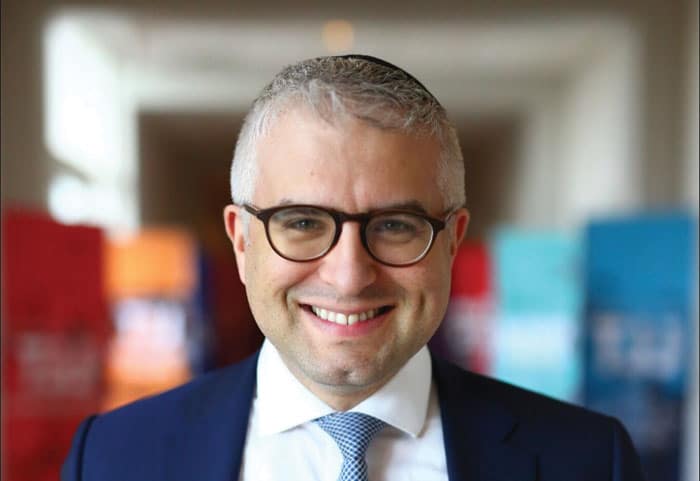
Frum Twitter? Yes, it’s very much a thing – and Dovid Bashevkin is one of the most prominent voices on it.
The director of education for National Conference of Synagogue Youth (NCSY), Yeshiva University (YU) instructor and host of the podcast 18Forty joined Twitter in August of 2010, and now has nearly 12,000 followers.
He goes by the handle @DBashIdeas not only because his last name is a mouthful, but also because he said he, “made a commitment early on to share ideas — sometimes silly, sometimes serious. I really try to avoid feuds [and] dunking on people, and whenever possible [I] try to approach others with the same graciousness that I would want them to approach me [with].”
In his posts, Bashevkin shares his thoughts on what it’s like living as an observant Jew, recommends Jewish books for people to read and sprinkles in pictures with funny captions. A recent post featured a baby duck floating on a piece of pizza with the caption, “Thursday night pizza cause you done cooking and ready to cruise into Shabbos.”
Bashevkin, a Five Towns, New York native who now lives in Teaneck, New Jersey, will bring up issues that are prevalent in the frum community, like the importance of voting in local elections, creating relationships with local public school boards, loneliness before the Jewish holidays and mental health.
In a recent video he shared of himself, he talks about gvir culture, or giving wealthy people elevated status simply because they have money. In it, he says, “You have kids in their 20s, who, I don’t know, I’m nervous. Can they name more gedolim or gevirim? Or even worse: Have our gevirim become our gedolim?” Just a few posts later, he shares a picture of a rabbi on a stationary bike captioned, “The Real SoulCyle.”
“A healthy mix of narishkeit and serious matters allow people to have kind of inhale and exhale moments on social media.”
– Dovid Bashevkin
“A healthy mix of narishkeit and serious matters allow people to have kind of inhale and exhale moments on social media,” Bashevkin said. “The balance helps avoid the feeling like it’s just empty calories, so to speak, like a bag of potato chips, but also not a super heavy deli sandwich that leaves them gasping for breath every time they scroll through my feed.”
That very Jewish analogy is perfect for the platform, which can cause people to feel anxious, outraged and overwhelmed. It’s become a place where negative news and tweets get the most attention and users feud daily about their differing political ideologies.
Instead of feeding into that, Bashevkin, a self-proclaimed centrist, said he avoids the most serious issues on Twitter because he believes that not every issue is suitable to be discussed on social media.
“Social media can bring out the worst in people,” he said. “So, in order to be positive on Twitter, it requires intentional commitment and also frequent breaks when you see it is getting under your skin. The moment I see that the negativity I ingest overwhelms the positivity I am able to share is the moment that my relationship with social media is sunk. I am happy to say that moment has not arrived and I think it is mostly a credit to the people I interact with most.”
Being an Orthodox Jew on social media, Bashevkin is shattering stereotypes, showing that they can be fully engaged in modern culture, share interesting ideas and have a lightheartedness to them – just like anyone else.
“It’s a good thing for those who may harbor some preconceived notions about the Orthodox community to see Orthodox Jews just sharing ideas, silliness, jokes etc.,” he said. “Social media allows us to organize in a more organic way, like at a shul kiddush, rather than be seen exclusively as some political demographic or statistic on a Pew report.”
When Bashevkin isn’t tweeting or working on 18Forty, he teaches at YU and comes up with new ways to engage younger Jews through NCSY programming. “Working with the next generation of Jews is exactly what you think it would be — chaotic, joyful, exhausting, meaningful and never boring,” he said.
With his work at NCSY, YU and on Twitter, Bashevkin said he follows the lead of Rav Tzadok of Lublin.
“He has a line where [he] says that the job of every Jewish leader in each generation is to build new doorways and entrances for Jewish engagement. I try to build entrances for people, no matter what room or experiences they are exiting, to find joy and meaning in their Jewish lives.”