fbpx

January 6, 2022

It’s Not About the Money

It was a hostile, divisive debate that fractured the State of Israel. The West German Chancellor, Konrad Adenauer, had offered to pay Holocaust reparations, and David Ben Gurion dispatched his Foreign Minister, Moshe Sharret, to meet with the German government. Adenauer called these payments “wiedergutmachung,” “repairing an injustice.” In a speech to the Bundestag, Adenauer claimed that “the vast majority of the German people abhorred the crimes committed against the Jews and did not participate in them.” In January 1952, Ben Gurion announced there would be a Knesset vote to authorize final negotiations. This shocked many in the worldwide Jewish community where Germany was abhorred. Menachem Begin, who had semi-retired from politics, returned to the public arena in order to oppose reparations. This was more than a political issue for Begin; his parents and brother had been murdered by the Nazis.

On January 7, the date of the Knesset vote, Begin organized a rally in Jerusalem attended by tens of thousands. In an angry, impassioned speech, Begin challenged Ben Gurion directly and said:

“That is why I say to Mr. Ben-Gurion: There will be no negotiations with Germany; and for that we are all ready to sacrifice our lives … Mr. Ben-Gurion has sent policemen, and in their hands—according to information we have just received—they have tear gas grenades made in Germany, the same gas that suffocated our ancestors … And so I declare: Evil now stands against justice—and will shatter like glass against a rock. So too this ugly attempt will shatter in the face of popular opposition.”

The crowd followed Begin up the street to the Knesset, and threw stones through the Knesset windows. The police fired tear gas to disperse the crowd, and the odors of the gas wafted onto the Knesset floor.

In the end, the Knesset voted 61 to 50 to negotiate an agreement. In September 1952, Israel and Germany signed the Luxembourg Agreement. Germany agreed to pay reparations to the State of Israel, and establish a Claims Conference to distribute reparations to Holocaust survivors.

Ben Gurion argued that the Germany of 1952 was now part of the family of nations and needed to be treated differently. Furthermore, not to take the money offered would allow the Germans to benefit financially from their crimes. Justice demanded that the Jewish people receive payment for Jewish property seized during the Holocaust; practicality demanded that the new Jewish State pursue all avenues of economic development.

Justice demanded that the Jewish people receive payment for Jewish property seized during the Holocaust; practicality demanded that the new Jewish State pursue all avenues of economic development.

Begin saw reparations as a betrayal of the six million. To allow Germany to pay its way out of guilt was nearly as horrible as the Holocaust itself. He mocked the argument that this was a new Germany, led by “good Germans.” (Parenthetically, Begin was correct. Only 5% of Germans at the time felt any sense of guilt for the Holocaust). Begin declared that reparations were blood money that violated the memory of the six million. In his opinion, Israel needed to be a proud and independent state, and Ben Gurion was selling Jewish self-respect for “money, money, money.”

Prominent rabbis debated the reparations agreement as well. At the time, Rav Joseph Ber Soloveitchik publicly opposed the reparations agreement. This was “ransom money,” a violation of the Biblical commandment not to accept a payment from a murderer to escape guilt. How could one take money from Amalek? Most of the rabbinic establishment agreed with Rav Soloveitchik. However, Rav Yoseph Eliyahu Henkin was very critical of Begin’s stance, and supportive of the reparations agreement.

Germany’s offer of reparations forced the State of Israel to make a choice between Ben Gurion’s realpolitik and Begin’s idealism. But the debate about reparations is ages old, and goes back to the Torah. God informs Moshe that the Exodus is imminent, and immediately instructs him: “Speak now in the ears of the people, and let every man borrow from his neighbor and every woman from her neighbor, articles of silver and articles of gold.”

When the Jews leave, they take the Egyptian gold and silver with them, and the borrowed items are never returned. Since ancient times, antisemitic polemicists have used this text to question the morality of the Jewish people. The Talmud tells that the Egyptian leadership brought a claim against the Jews before Alexander the Great, and demanded that the Jews return all of the borrowed silver and gold. This passage has clear historical roots. As Peter Schaffer points out in “Judeophobia: Attitudes Toward the Jews in the Ancient World,” ancient Egyptian antisemites often focused their attention on the Exodus narrative. Josephus cites the claims of an Egyptian priest, Manetho, who lived in the 3rd century BCE. Manetho concocts a revisionist version of the Exodus, in which the Jews are marauders and lepers who were expelled from Egypt; the story in the Talmud probably has a similar context. Over 2,000 years ago, the borrowing of valuables during the Exodus caught the attention of antisemites.

This trend continues into the Middle Ages. The Rashbam, writing in the 12th century, notes that Christian polemicists used this passage to portray Jews as cheats who swindle their neighbors.

However, a serious ethical question stands at the center of this slander: how could the Jews abscond with the borrowed silver and gold when they left the country? In response, many medieval and modern commentaries focus on the meaning of the Hebrew word “sha’al,” which is usually interpreted as “borrow.”  Many commentaries offer a new definition of “sha’al.” The root of the word actually means to request; and these interpreters explain that in this instance, the request was for a permanent gift, not a temporary loan. Therefore, the Jews never cheated their neighbors; they had actually asked for the items to be gifted to them.

There are multiple theories to explain why the Egyptians would offer the Jews gifts. Josephus says the Egyptians offered the gifts on the night of the Exodus, “some in order to get them to depart quickly; and others on account of neighbourly friendship they had with the Jews.” Saadiah Gaon says the gift was a partial repayment for unpaid wages. Chizkunni says it was offered as compensation for property the Jews were leaving behind in Egypt. (For a comprehensive review of the commentaries on this issue, visit this page). All of these commentaries are concerned about preserving the ethical reputation of the Jewish people.

But not everyone worries about the morality of this text. Some commentaries embrace deception and theft as a form of vigilante justice; after 400 years of slavery, the Jews had every right to claim what was rightfully theirs. Ibn Ezra believes that this deception was ultimately meant to lead the Egyptians to their deaths. When it became clear that the Jews were fleeing with the borrowed gold and silver, the Egyptians gave chase; and that chase ended at the bottom of the Red Sea. The former slaves were standing up for themselves and righting 400 years of wrongs; they shouldn’t have any ethical concerns about lying to their tormentors.

In reading these commentaries, we can once again hear the push and pull between pragmatism and idealism. What is more important—ethical perfection or self-determination? Do we prioritize political and economic challenges, or communal virtue? Reparations from a despised enemy force one to consider serious moral dilemmas, whether they are seized or offered willingly.

All of the discussions about ethics of reparations still leave one question unanswered: Why were these reparations so important?  The Torah makes it clear they are not a mere afterthought. When God informs Avraham that his descendants will be in a 400-year exile, He immediately adds: “and in the end they shall go free with great wealth.” Reparations were part of the original plan of exile. One has to wonder how this seemingly small detail stands at the foundation of the entire Exodus.

He explains the Jews were anxious to leave Egypt immediately, and had no interest in obtaining wealth; a slave wants only freedom, and nothing more.

Rav Avraham Yitzchak Kook offers a fascinating answer to this question in his commentary to the Talmud. He explains the Jews were anxious to leave Egypt immediately, and had no interest in obtaining wealth; a slave wants only freedom, and nothing more. But this is a barren freedom, unable to nurture any dreams. Requesting gold and silver would transform the perspective of the former slaves, training them to pursue their aspirations and hopes. The reparations in Egypt weren’t about money; they were about ambition.

Ambition can be beaten out of a man. Last Shabbat, a congregant mentioned to me the Y.L. Peretz character Bontshe Shvayg. Bontshe is a man who lives a life filled with abuse, uncared for and unnoticed. When he arrives in the heavenly court, he is received as a holy man, lauded for his faith and forbearance in the face of suffering. When Bontshe is asked to name his own eternal reward, he meekly answers: “What I’d like most of all is a warm roll with fresh butter every morning.” Brutal life experiences had beaten the ambition out of Bontshe, and now he couldn’t even appreciate the heavenly award that awaited him. Bontshe teaches us why leaving Egypt with material wealth was so important: These slaves had been beaten for 400 years, and had consequently lost all ambition. Now, they needed to learn how to dream again; a warm roll with fresh butter would not suffice.

All of the opinions regarding reparations, ancient and modern, share a common motivation: greatness. Despite sharp differences, these rabbis and politicians advocated for important goals: economic development, Jewish pride, ethical refinement, and self-determination. These debates are evidence of spiritual vitality, and that’s precisely the point. Reparations are not about the money, they are about ambitions. A mediocre freedom is not enough. One must always aspire to something greater, even if it’s just a silver platter.


Rabbi Chaim Steinmetz is the Senior Rabbi of Congregation Kehilath Jeshurun in New York.

It’s Not About the Money Read More »

San Jose Chabad Burned Down, Vandalized

A Chabad in San Jose burned down on December 22 and was subsequently vandalized a few days later.

Rabbi Mendel Weinfeld of The Chabad House-Almaden Valley synagogue told the Journal in a phone interview that footage showed that an unidentified male started the fire at around 1 a.m. on the morning of December 22 in the carport under the building. “You don’t see what he’s doing, but you see a fire starting and smoke coming out of that,” he said. The male leaves after half an hour; 10 minutes later, another individual can be seen trying to put out the fire with a water bottle. He appeared to think that he was successful and left, but the fire subsequently started back up again a couple minutes later and burned until 7 a.m.

“Thank God we were able to save the Sifrei Torah [Torah Scrolls],” Weinfeld said, adding that a non-Jewish person had seen the fire and texted a friend about what was happening to his synagogue. The friend, identified in The Jewish News of Northern California (The J) as Jacob Cohen, ran over to the synagogue and convinced the firefighters to save the Torah scrolls.

“Unfortunately, the fire took over the building,” Weinfeld said. “It ruined the Hebrew school room … every room in the building was torched.” Three days later, the synagogue was vandalized and various items remaining from the fire were stolen.

Initially, investigators had determined that the fire was not the result of a hate crime. But the subsequent vandalism has muddied that conclusion, Weinfeld said, adding that it was unclear if the fire and the vandalism were connected. The investigation is currently ongoing.

The Chabad had just moved to a new renovated building in time for Rosh Hashanah in 2021. Weinfeld has been in San Jose for the past couple of years and was living in Brooklyn prior to that.

Weinfeld said that the community’s support has been “unprecedented.” “The entire community, whether they have reform, conservative [beliefs], everyone came together to support [us]. Somebody in the community started a GoFundMe. People have been donating, people have been calling trying to help in every way possible, which is really, really beautiful. Somebody started over a campaign to light Shabbos candles … we had a fire of destruction, and we’re going to light a fire of light.”

As of this writing, the GoFundMe currently has reached $149,352 in donations, with a goal of reaching $250,000. Those who want to donate can do so at https://www.gofundme.com/f/rebuildchabad. A separate fundraising effort was also started at The Chesed Fund. The Chabad House’s Facebook page stated in a January 5 post that Weinfeld “will use the funds to find a new space for the time being and then build a much larger building to serve as a warm community center.”

“Our response is very simple: we’re going to use this opportunity to build something even bigger … it’s going to burn a lot longer than the fire that took down our building,” Weinfeld told the Journal.

San Jose Chabad Burned Down, Vandalized Read More »

Unscrolled: Israel Past and Future

This week’s Torah portion is called “Bo.” In Biblical Hebrew, it means “to come/to enter,” as in the first line of the portion when God tells Moses to come into Pharoah’s presence in order to, once again, demand that the Israelites be set free.

In modern Hebrew, it is a verb in the imperative. “Come!” An invitation to draw close—such as a parent might call to a child, gathering them in to listen to a story.

Indeed, Parashat Bo is the story of a story. “I have hardened [Pharoah’s] heart and the hearts of his courtiers, in order that I may display these My signs among them, and that you may recount in the hearing of your child and of your child’s child how I made a mockery of the Egyptians and how I displayed My signs among them—in order that you may know that I am the LORD” (Exodus 10:1-2).

Even as the events of the exodus unfold in real time, God’s main focus is on the creation of a narrative that will be told to future generations.

We think of stories as a sort of trace—not reality itself, but rather the impression that reality leaves behind, like the delicate vascular system of a leaf pressed into the stone of an ancient fossil. For God, however, this is reversed. It is the story that has greater reality. The event is merely the material with which the story is crafted.

A perfect illustration of this is the matter of the matzah. If asked why we eat matzah on Pesach, any Jewish child will be able to tell you that this is because the Israelites fled from Egypt in such a terrible hurry that they had no time to let their bread rise. This, however, is only half correct. God decrees that the Israelites will eat matzah on Pesach before the flight from Egypt even takes place. “Seven days you shall eat unleavened bread; on the very first day you shall remove leaven from your houses, for whoever eats leavened bread from the first day to the seventh day, that person shall be cut off from Israel” (12:15). It is only later that we learn, “And they baked unleavened cakes of the dough that they had taken out of Egypt, for it was not leavened, since they had been driven out of Egypt and could not delay” (12:39). That they were in too much of a rush to let the bread rise has been revealed as a contrivance of God. The matzah was a story first and a story last. The actual event, then, served only to grant an imprimatur to this story.

Again and again, God’s focus is on what shall be told to the future sons and daughters of Israel. As readers of the text, we realize with awe that the referent of these commandments is none other than ourselves. Though we didn’t yet exist when it was written, the text sees us, addresses us, and commands us.

Though we didn’t yet exist when it was written, the text sees us, addresses us, and commands us.

“This is how you shall eat it,” God says of the Passover sacrifice, “your loins girded, your sandals on your feet, and your staff in your hand; and you shall eat it hurriedly” (12:11).

In other words, they are being told that the sacrifice will be eaten in costume—and that the costume is that of an Israelite fleeing Egyptian bondage. This commandment, however, is being addressed to actual Israelites as they flee Egyptian bondage. They are thus being commanded to pitch themselves forward to a time in the future when they will be looking back at the exodus as a story. We, on the other hand, are commanded each year at Pesach to pitch ourselves backward, imagining that it was us who fled Egypt to freedom.

Think of that for a moment. The generation of the exodus is commanded to imagine that their lives are part of a story. In so doing, they cast their eyes forward to the generations of the distant future: to us.

We are commanded to imagine that the story we are telling is our life. In so doing, we cast our eyes backward to the generations of the distant past: to them.

All of this is accomplished through the workings of narrative and through the faculty of imagination. Here, in this imaginative space, Israel yearns toward itself across the chasm of time. Within the eternal present of the great story of the exodus, we meet.


Matthew Schultz is the author of the essay collection “What Came Before” (2020). He is a rabbinical student at Hebrew College in Newton, Massachusetts.

Unscrolled: Israel Past and Future Read More »

My Own Personal Egypt – A poem for Parsha Bo

But if the household is too small for a lamb, then he and his neighbor who is nearest to his house shall take [one] according to the number of people, each one according to one’s ability to eat, shall you be counted for the lamb.
Exodus 12:4

Did I mention I grew up poor?
It was just the two of us, my mother and I.
Too small of a household to be given a lamb,
though I’m sure my mother would have taken it.

It was before I was a vegetarian so I would
have eaten anything put on a plate in front of me.
Except liver. A tween has to have his standards.
And I’m still conceptually against mayonnaise.

I had to be given so much by my neighbors.
Rides. Lunch. Occasionally new apartments.
One woman, the mother of my friend, wanted
to adopt me but mine wouldn’t hear of it.

Hold on to what is yours and expect that
riches are coming was not my mother’s motto,
verbatim, but I could read between her lines.
Lottery tickets and cigarettes were her treasures.

She never realized Las Vegas was her Egypt.
It’s different now. I’d say of course but I still
get nervous when the paycheck people call.
They’re going to take it all away my first thought.

I’m cautious and careful and frugal.
I’ve figured ways to apply lamb’s blood
to the door without it leaving a stain.
So far it’s working. Everyone is okay.

I’m able to donate to the lamb people like a
spiritual carbon offset. We juggle our morals
and do what we can. I know the difference
between Egypt and everywhere else.


God Wrestler: a poem for every Torah Portion by Rick LupertLos Angeles poet Rick Lupert created the Poetry Super Highway (an online publication and resource for poets), and hosted the Cobalt Cafe weekly poetry reading for almost 21 years. He’s authored 25 collections of poetry, including “God Wrestler: A Poem for Every Torah Portion“, “I’m a Jew, Are You” (Jewish themed poems) and “Feeding Holy Cats” (Poetry written while a staff member on the first Birthright Israel trip), and most recently “The Tokyo-Van Nuys Express” (Poems written in Japan – Ain’t Got No Press, August 2020) and edited the anthologies “Ekphrastia Gone Wild”, “A Poet’s Haggadah”, and “The Night Goes on All Night.” He writes the daily web comic “Cat and Banana” with fellow Los Angeles poet Brendan Constantine. He’s widely published and reads his poetry wherever they let him.

My Own Personal Egypt – A poem for Parsha Bo Read More »

Why is No One Talking About the Security Failure on January 6?

There are bad people in this world who do bad things. Sometimes they’ll blow up buildings or shoot people in schools or burn down a police precinct or even violently riot at the U.S. Capitol.

When these horrible crimes are committed, some of the questions we ask, especially with assaults on public buildings, are: How could we have prevented it? Was our security sufficient? Did we take the proper precautions?

And yet, no one seems to be mentioning any of these crucial concerns as we review and analyze the January 6, 2021 riots at the Capitol by Trump supporters.

I’ve read countless commentaries on this subject and all the focus seems to be on the bad guys and their threat to our democracy. No kidding! Assaulting a federal building while votes are being counted to certify a presidential election is indeed a terrible violation of our democracy. We must locate and prosecute all the criminals and make sure that such unspeakable acts never happen again.

But what about the obvious question: Where was the security to prevent the breach of the Capitol—especially since we had plenty of advance warning that trouble was brewing?

In fact, according to a report in The Washington Post, “The U.S. Capitol Police had specific intelligence that supporters of President Donald Trump planned to mount an armed invasion of the Capitol at least two weeks before the Jan. 6 riot.” This was based on the findings of a bipartisan Senate investigation released last June.

Security is a bipartisan issue. No matter which party we support, we all have an interest in securing our public spaces.

Why is no one talking about that?

One reason is that both Democrats and Republicans are too busy exploiting the assault on the Capitol for political purposes. Vice President Kamala Harris likened the events of January 6 to the attacks on Pearl Harbor and the tragedy of 9/11. But an attack from a foreign country or non-citizens is not the same as an attack from within. It’s easy to see that Harris wants us to connect the dots: It was Trump supporters who attacked our Capitol, and therefore all Trump supporters, and perhaps all Republicans, are the enemy. In other words, next time elections roll around, don’t vote for the enemy.

Many Republicans, on the other hand, continue to minimize what happened that day, arguing that we did not see what we saw—that it was only an innocent protest that got a little too carried away.

Both sides are wrong, and it’s clear that the focus of each is about retaining or grabbing political power. Isn’t that how it always is? Control the narrative—shape and re-shape it to fit your political agenda—and you control the outcome.

The constant manipulation of the narrative for political purposes means that no one cares to focus on the security component, which is something worthy of our outrage.

NPR reported last January that the former chief of U.S. Capitol Police says “security officials at the House and Senate rebuffed his early requests to call in the National Guard ahead of a demonstration in support of President Trump that turned into a deadly attack on Congress.” Why is the media not making more noise and asking more questions about such an epic security breakdown?

We’re experiencing a media orgy over the horrific crime that occurred on this day last year. But why can’t we devote equal attention to how we could have prevented that crime in the first place? Security is a bipartisan issue. No matter which party we support, we all have an interest in securing our public spaces.

Flawed, sloppy security is also a threat to our democracy. Failure to treat it as such is something we should all be concerned about.

Why is No One Talking About the Security Failure on January 6? Read More »

New Year Resolutions That Go Beyond Ourselves

Benjamin Disraeli wrote: “I am prepared for the worst, but hope for the best.”

Mel Brooks sang: “Hope for the best, expect the worst.”

In slightly different ways and from very different platforms, both the statesman and the comedian identified the same precarious mix of optimism and pessimism inherent in their shared Jewish faith.  Since one of the foundations of Judaism is a trust in God, it’s understandable that we would find these conflicting impulses within ourselves, recognizing the challenges of adversity while maintaining positive beliefs about the ultimate outcome. We’ve come to expect misfortune over the millennia, but we’ve also learned to rely on our faith to get us through.

This combination of discordant attitudes is not unique to Jews, but is characteristic of peoples who have suffered from a history of subjugation. Black poet Maya Angelou addressed the same apparent contradiction, when she said, “If I insist on being pessimistic, there is always tomorrow.” 

As did Irish author George Bernard Shaw, who observed: “Both optimists and pessimists contribute to society. The optimist invents the aeroplane, the pessimist the parachute.”

When a historically oppressed group perseveres, it’s because that blend of optimism, determination and hope keeps us going. That’s why recent polls showing a sizable drop in the number of Americans who made a New Year’s resolution for 2022 are so disconcerting. A New Year’s resolution is a sign of personal optimism, reflecting an individual commitment to self-improvement. And even for those who are less hopeful about future prospects for their community, their country or their world, a resolution to improve an aspect of one’s own life suggests a belief that it’s worth the effort to achieve that progress.

A New Year’s resolution could make a difference in someone else’s life — and help restore a sense of optimism to ours. 

But a CBS News poll taken last week shows that only 29 percent of Americans plan to make a New Year’s resolution this year, down from the 43 percent who made that commitment at the end of 2020. A similar survey taken by The Economist and YouGov demonstrated that those who are more optimistic about the future are more likely to make resolutions. It appears that a growing number of us simply believe that it is no longer necessary to demonstrate such resolve – even to ourselves.

Even those who rely on the Almighty to help us overcome difficult obstacles also understand that God helps those who help themselves. So, the lack of motivation to make a New Year’s resolution may indicate a loss not only of optimism but a loss of hope as well. Most of us are not able to eliminate COVID, to remake the American political landscape in a manner more to our liking, or to magically resolve long-festering crises in the Middle East and other global hot spots. But individual initiative and determination can be the first steps toward broader change. 

Even though we’re already several days into January, even a belated New Years’ resolution can signify an important step toward the type of progress we desire. So here’s hoping that at least some who have read this far will still consider that type of personal commitment. In addition to the more standard promises to lose weight, read more, change jobs, etc, there are other types of outward-facing resolutions that can make a difference in the lives of others, should we care to attempt them.

Participating in a neighborhood park cleanup won’t solve climate change. Mentoring an at-risk youth won’t eliminate income inequality. Writing a small check to a worthwhile community group won’t end homelessness. And having coffee with someone from the other political party won’t heal the intense polarization that has infected our politics. But such individual efforts can add up to larger change, and small steps forward can make the bigger challenges seem a little less overwhelming.

For most of the year, we’ll spend our time discussing problems of national and global import. These conversations are necessary, but they can also make us feel somewhat helpless … and pessimistic. But a New Year’s resolution could make a difference in someone else’s life — and help restore a sense of optimism to ours. 


Dan Schnur is a Professor at the University of California – Berkeley, USC and Pepperdine. Join Dan for his weekly webinar “Politics in the Time of Coronavirus” (www/lawac.org) on Tuesdays at 5 PM.

New Year Resolutions That Go Beyond Ourselves Read More »

Making Twitter a More Positive Place

Frum Twitter? Yes, it’s very much a thing – and Dovid Bashevkin is one of the most prominent voices on it.  

The director of education for National Conference of Synagogue Youth (NCSY), Yeshiva University (YU) instructor and host of the podcast 18Forty joined Twitter in August of 2010, and now has nearly 12,000 followers. 

He goes by the handle @DBashIdeas not only because his last name is a mouthful, but also because he said he, “made a commitment early on to share ideas — sometimes silly, sometimes serious. I really try to avoid feuds [and] dunking on people, and whenever possible [I] try to approach others with the same graciousness that I would want them to approach me [with].” 

In his posts, Bashevkin shares his thoughts on what it’s like living as an observant Jew, recommends Jewish books for people to read and sprinkles in pictures with funny captions. A recent post featured a baby duck floating on a piece of pizza with the caption, “Thursday night pizza cause you done cooking and ready to cruise into Shabbos.”

Bashevkin, a Five Towns, New York native who now lives in Teaneck, New Jersey, will bring up issues that are prevalent in the frum community, like the importance of voting in local elections, creating relationships with local public school boards, loneliness before the Jewish holidays and mental health. 

In a recent video he shared of himself, he talks about gvir culture, or giving wealthy people elevated status simply because they have money. In it, he says, “You have kids in their 20s, who, I don’t know, I’m nervous. Can they name more gedolim or gevirim?  Or even worse: Have our gevirim become our gedolim?” Just a few posts later, he shares a picture of a rabbi on a stationary bike captioned, “The Real SoulCyle.”

“A healthy mix of narishkeit and serious matters allow people to have kind of inhale and exhale moments on social media.”
– Dovid Bashevkin

“A healthy mix of narishkeit and serious matters allow people to have kind of inhale and exhale moments on social media,” Bashevkin said. “The balance helps avoid the feeling like it’s just empty calories, so to speak, like a bag of potato chips, but also not a super heavy deli sandwich that leaves them gasping for breath every time they scroll through my feed.”

That very Jewish analogy is perfect for the platform, which can cause people to feel anxious, outraged and overwhelmed. It’s become a place where negative news and tweets get the most attention and users feud daily about their differing political ideologies. 

Instead of feeding into that, Bashevkin, a self-proclaimed centrist, said he avoids the most serious issues on Twitter because he believes that not every issue is suitable to be discussed on social media. 

“Social media can bring out the worst in people,” he said. “So, in order to be positive on Twitter, it requires intentional commitment and also frequent breaks when you see it is getting under your skin. The moment I see that the negativity I ingest overwhelms the positivity I am able to share is the moment that my relationship with social media is sunk. I am happy to say that moment has not arrived and I think it is mostly a credit to the people I interact with most.”

Being an Orthodox Jew on social media, Bashevkin is shattering stereotypes, showing that they can be fully engaged in modern culture, share interesting ideas and have a lightheartedness to them – just like anyone else. 

“It’s a good thing for those who may harbor some preconceived notions about the Orthodox community to see Orthodox Jews just sharing ideas, silliness, jokes etc.,” he said. “Social media allows us to organize in a more organic way, like at a shul kiddush, rather than be seen exclusively as some political demographic or statistic on a Pew report.”

When Bashevkin isn’t tweeting or working on 18Forty, he teaches at YU and comes up with new ways to engage younger Jews through NCSY programming. “Working with the next generation of Jews is exactly what you think it would be — chaotic, joyful, exhausting, meaningful and never boring,” he said. 

With his work at NCSY, YU and on Twitter, Bashevkin said he follows the lead of Rav Tzadok of Lublin. 

“He has a line where [he] says that the job of every Jewish leader in each generation is to build new doorways and entrances for Jewish engagement. I try to build entrances for people, no matter what room or experiences they are exiting, to find joy and meaning in their Jewish lives.”

Making Twitter a More Positive Place Read More »

Faced with Vision Loss, She Created an Opportunity

When Leba Sherman got pregnant with her daughter, she noticed that her vision was starting to change. It looked like the lanes were colliding into each other on the highway, she couldn’t read subtitles in movies anymore and she was mixing people up. 

“I didn’t think anything of it,” she told the Journal. “They say that in pregnancy, your eyes change. I ignored it.”

Then, once she had her daughter and was still experiencing issues, her husband advised her to get an eye test done. After undergoing an eye exam at Costco, she wore low prescription glasses for a year and started getting headaches. This time, her husband told her she needed to see an ophthalmologist. 

The doctor took photos of Sherman’s eyes and found two holes in them. 

“He said he wasn’t sure what was going on but that I needed to clear my schedule and see a specialist the next day,” she said. 

From there, Sherman, who lives in Beverlywood with her husband and three children, went through extensive testing. The doctor came back with a devastating diagnosis: She had Stargardt disease, a rare genetic eye disease that typically shows up in children and young adults. Often referred to as juvenile macular dystrophy, it can cause someone to lose central vision but still have good side vision. 

“This was something I never could have anticipated,” said Sherman. “It was the worst-case scenario.”

Since Sherman had 20/20 vision her entire life, she was stunned. Her doctor said something comforting to her, though.

“It was my waking moment and shifted my perspective.”
– Leba SHERMAN

“I was sitting in a chair in his office and I literally lost it,” she said. “He said, ‘Let me tell you something. I treat patients with this who are nine years old, 12 years old, 20 years old. I have to tell them they are handicapped and going blind. You’re 33. You’re married and you have three kids. You have a graduate degree. You have accomplished what 90% of the people with this diagnosis have yet to accomplish.’ And that’s how it changed my mind. I thought I have to be grateful how lucky I was that this happened after I did all that. It was my waking moment and shifted my perspective.”

Now, four years after learning she had Stargard, she’s created Touched By Elle, a fashion patches company, and donates a percentage of the proceeds to finding the cure for Stargardt. Just recently, she trademarked Braille patches, which are not only for those who read Braille but also for those who want to show their support for people with a lack and total loss of vision.
“I want to raise awareness because this is a rare disease that people don’t know about,” she said. “I want to make others aware of low vision in general because nobody pays attention to people who have it. It’s a struggle so many of us have to deal with.”

The Braille patches are inspirational in nature and contain phrases like, “love,” “vision,” “hope,” “fighter” and Sherman’s signature phrase, “You don’t need sight to have vision.” 

Today, Sherman can still drive – except for on the highway – and she has trouble reading books, watching TV and looking at her phone. She will never go fully blind, though.

“My central vision is going,” she said. “You lose your central vision over time and develop blind spots, but thank God, I’m not there. I will have my peripheral vision for the rest of my life. I will probably go legally blind.”

With Touched By Elle, Sherman, who was previously a behavioral therapist, hopes to demonstrate that you can have bad cards dealt to you and still make something good come out of it. “I could have easily been depressed, but I decided I wanted to make a difference and show my words of affirmation that have helped me through these struggles,” she said. 

Along with relying on words of affirmation throughout her difficult journey, Sherman has also turned to her faith for comfort. 

“I’m such a strong believer,” she said. “My faith in God is above and beyond. I believe that whatever is meant to be will be. God will never let me get worse. He’s given this to me as a present. This is a gift for me to help others, and I have a lot of power. I believe that.” 

Faced with Vision Loss, She Created an Opportunity Read More »

“Dancing in a Cage” Show Highlights Strong Women Who Struggle

When Jill Moray was a child, she’d turn on the TV and watch go-go dancers. She was awestruck; when you danced in a cage, no one could bump into you, she thought. 

What she never realized was how the cage was actually a restrictive and oppressive place. When she was stuck in an abusive marriage years later, she recalled those dancers.

“The dancers looked free and joyful,” she said. “I was productive and successful, so nobody knew my situation and how oppressed my life really was. No one knew that I was really dancing in a cage.”

“I was productive and successful, so nobody knew my situation and how oppressed my life really was.”- Jill Moray

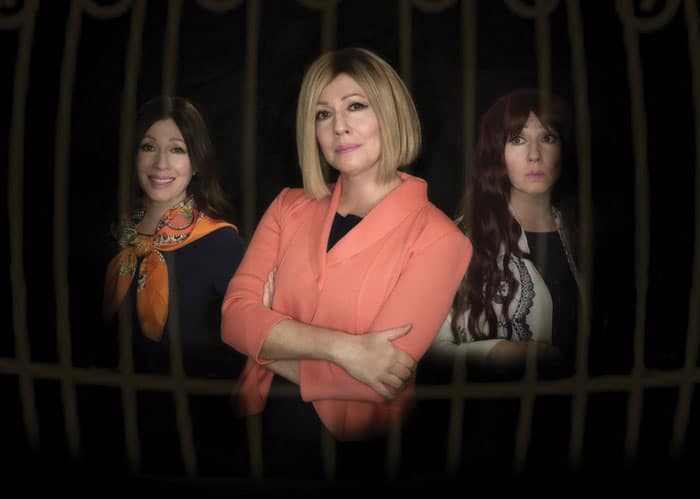
That’s how the Pico-Robertson-based actress and writer came up with the title and theme of her new one-woman show, “Dancing in a Cage,” which features Moray as three different women from various backgrounds and situations who talk about their lives through stories and music. 

Throughout her life, Moray said she had negative experiences with men – including her tumultuous marriage and a relationship with a boyfriend who cleaned out her bank account – and she’d meet women who went through similar circumstances. When she called the credit card company to tell them about her swindling boyfriend, the customer service representative on the other end of the line said a man did the same thing to her. In the show, Moray highlights these women and their struggles. 

“I’d like audiences to realize that women who appear entertaining, effervescent and successful can actually be suffering on the inside,” said Moray. “I also hope the audiences will be entertained and moved, as they participate in this live theater experience.”

In her personal life, Moray thankfully found her happy ending. When she lived in New York City, she was invited to a Shabbat dinner at the home of a Chabad rabbi in her building. She sat next to an Orthodox man who was a writer and director, and “the funniest person I had ever met,” she said. “We fell in love and I was ready to live a Torah-centric life. We were married eight months later at a movie studio in Brooklyn and then moved to L.A.”

Even though “Dancing in a Cage” deals with tough subjects, Moray, who is also a comedian, isn’t afraid to interject humor into her work. “Laughter has helped people – Jews in particular  – surmount the most unbearable situations,” she said. “It gives us a chance to breathe and take a break from overwhelming stress; it helps us reset. Science has also confirmed that laughter releases positive hormones that heal us and help us stay healthy.”

Moray took her own difficult circumstances in life and made them into something she hopes the world will enjoy – which is how she came to finally write her show as well.  

During the pandemic, her agent dropped the voiceover department, which was the only area of show business where Moray could work from home. As everyone else scrambled to find another agent, she took the time to complete the script for “Dancing in a Cage” that she had been working on for more than 20 years.  

“Then I got hit with COVID and was in bed for close to 12 weeks,” she said. “Because I didn’t know if I would ever return to normal, I worried that I had blown the chance to ever perform my play. So, I promised myself that if and when my health returned, I wouldn’t wait any longer to tell my stories for a live theater audience. And here we are.”

You can purchase tickets to “Dancing in a Cage” at dancinginacage.eventbrite.com. Shows are January 18, 19 and 20 at 8 p.m. at The Zephyr Theatre, 7456 Melrose Ave. n

“Dancing in a Cage” Show Highlights Strong Women Who Struggle Read More »

COVID-19 Pandemic Unmasks American Antisemitism

For more stories from The Media Line, click here.

On a Sunday morning in early December, Austin resident Charles Kaufman received a small plastic bag containing some rocks and a folded document on his doorstep, a few feet away from the bundled-up newspaper usually delivered. The document was a flyer blaming Jews for the new surge of COVID-19, the same one that hundreds of homes across the country received over the past month.

Charles Kaufman at the United States Holocaust Memorial Museum in Washington, DC. (Courtesy)

“Maybe 100 or so people received it on my street, Jewish and non-Jewish,” Kaufman told The Media Line on Monday. “I was very familiar with that characterization and very well aware of it long before this flyer came out, so it was nothing new, but equally absurd.”

Distributed by a group called the Goyim Defense League, the flyers state that “every single aspect of the COVID agenda is Jewish” and include a list of Jewish COVID-19 response leaders in various institutions. The nationwide antisemitic campaign has appeared on the doorsteps of communities in California, Texas, North Carolina, Maryland, and others. According to the Anti-Defamation League, the group, whose red and black logo mimics a swastika, is a “loose network of individuals connected by their virulent antisemitism” and includes five or six primary organizers, dozens of supporters, and thousands of online followers. Founded in 2020, they also operate a video platform that streams antisemitic content. The ADL’s online resources on the group also add that its “most zealous and visible actors” are in California, Colorado, Florida and New York.

The antisemitic flyer Charles Kaufman received, blaming Jews for the new surge of COVID-19. (Courtesy)

‘It doesn’t have to make sense’

Since he received the flyer, Kaufman has been working to put together an educational campaign “explaining antisemitism and its various forms.”

“One of the things I think is really important is for the next generation of Jews to understand that these kinds of stereotypes have been around for millennia from the bubonic plague, and you can go back a long way,” he said. “This falls under the category of scapegoating and there are countless examples.”

According to Deputy Regional Director of New York/New Jersey at the Anti-Defamation League Alex Rosemberg, scapegoating has been a significant manifestation of antisemitism when it comes to the COVID-19 pandemic.

“It’s either the idea that the Jews generated the virus so that they can then generate the vaccine and create the profit as a result,” he said, “or the other aspect of this is extremist groups using symbology from the Holocaust to protest mandates.”

(Courtesy ADL)

This duality, he said, has historically been a recurring issue.

“If you are a white supremacist, then Jews are a weak-link group of people that don’t deserve to be a part of general, strong society,” he continued. “Or on the flip side, if you are more of a left-wing individual, then Jews are this all-powerful group controlling the universe.”

“Somehow antisemitism is always at the end of the scapegoat route,” Rosenberg added.

Eli Steinberg, an Orthodox Jew living in Lakewood in New Jersey, echoed Rosemberg in saying that “anything that can be exploited to hate Jews will be used to hate Jews at this point.”

Lakewood is home to a growing Orthodox Jewish population with its Beth Medrash Govoha yeshiva, the biggest in the United States. Many in this community have encountered antisemitism from their neighbors in person and online.

“You get the people who are busy saying, ‘Everybody [in the Orthodox Jewish community] is on welfare’ and then they say at the same time, ‘They have huge, beautiful houses and they’re so privileged,’” he said. “They say this at the same time, in the same breath, because [antisemitism] doesn’t have to make sense.”

Evan Bernstein, who serves as the CEO of the Community Security Service, which trains volunteers to help protect their Jewish institutions and events, has been monitoring the flyers incidents across the country. According to him, although they seem to aim at creating fear, “the fact that they are sent shows serious intent by the perpetrators.”

Community Security Service CEO Evan Bernstein (R), alongside then-Brooklyn Borough President Eric Adams, now the mayor of New York (L), after a hate crime in Brooklyn in 2019. (Courtesy)

“Without a doubt, historically we have seen that whenever a society goes through a difficult period, we as Jews tend to be more vulnerable for hatred and scapegoating,” Bernstein said. “We saw it with the measles outbreak a few years ago.”

“We need to continue to be extra vigilant,” he added.

An antisemitism pandemic

As the world went into lockdowns and restrictions in 2020, the ADL recorded 2,024 reported antisemitic incidents throughout the United States. While this is a 4% decrease from 2019, the number still represents the third-highest year on record since the organization began tracking antisemitic incidents in 1979 and as Rosemberg points out the decrease is minor, “in a year when you would have expected things to drop significantly.”

“In 2020, we saw situations at both the regional and local levels in which Jews were blamed for the spread of the virus,” the 2020 audit states. “This led to expressions of hostility and antisemitism on social media and, in some cases, real-world harassment of Jews.”

(Courtesy ADL)

In the online world, a surge in antisemitic posts was almost immediately observed. It also gave rise to a new form of harassment in the form of “Zoombombings,” in which individuals disrupted webinars with antisemitic messages and images. In 2020 ADL recorded 196 Zoombombings, some accompanied by racist and pornographic imagery. Most Zoombombing incidents appear to have been conducted by individuals without a history of notable antisemitism.

“COVID-19 has certainly not put a stop to antisemitism and the volume, nature, and scope of incidents that have struck Jewish communities and Jewish institutions since March 2020 still remains at a level that warrants us to take this very seriously,” Bernstein added. “It’s critical that we understand the stark reality of potential threats to our community so that we are in the best position to mitigate any harm.”

At the ADL, Rosenberg said it is too early to tell the effects of the surge of the omicron variant on manifestations of antisemitism, but one could expect to see more scapegoating, particularly online.

The recent flyers like the one delivered to Kaufman, he said, are “just another manifestation of something we see over and over and over again.”

Chaskel Bennett, an Orthodox Jewish community leader in New York, said dealing with antisemitism is “nothing new” year after year, but perhaps its impact is more direct today.

“Throughout history, Jews have always found themselves cast as evil villains especially at times of unrest and uncertainty,” he said. “Social media is a continuous nonstop unchecked cesspool of hate and antisemitism, where any racist misfit can propagate their anti-Semitic conspiracy theories at will with zero pushback.”

“The latest COVID variant is just a continuing trend of this ugly time,” he added.

Bennett also said he believes antisemites are “the proverbial hammer in search of a nail”: “Be it economic difficulties or a pandemic, haters will always find any pretext to imprint and disseminate their hateful ideology on the more than willing masses.”

Orthodox Jews on the front lines

In the early stages of the COVID-19 pandemic, many in the Orthodox Jewish community experienced a sort of déjà vu, a return of the same hateful rhetoric they had experienced during the 2019 measles outbreak in their communities.

Despite prominent rabbis and community leaders instructing community members to follow health guidelines, Orthodox Jews felt the media and society in general disproportionately focused on those in the community who did not respect the restrictions.

Among patterns that the ADL found on social media during those months, Orthodox Jews were the main targets of antisemitic remarks related to COVID-19. Some of the comments blamed the entire Orthodox Jewish community for spreading the virus; others suggested that Orthodox Jews should be forcibly “contained” or even denied medical treatment if they get sick.

“Why are we wasting tests and medical supplies on a community that refuses to follow the rules?” the ADL quoted from one Facebook post.

“It’s been very illuminating,” Steinberg said. He pointed out that right before the pandemic, in December and January 2019, in the aftermath of deadly attacks in a kosher market in Jersey City, New Jersey and a rabbi’s Hanukkah party in Monsey, New York, there was “an outpouring of sympathy for the Orthodox Jewish community.”

“That seemed to evaporate the second we got targeted during COVID,” he said. “It’s easy for people to pay lip service to this, and to oppose antisemitism in theory and when it’s other people who feel justified by their bigotry, but more complicated when you need to deal with your own conflicted feelings.”

“Otherwise, we are saying bigotry is justified as long the bigot feels justified,” Steinberg went on.

Bennett echoed Steinberg, saying that Orthodox Jews are not just more vulnerable to antisemitism because they are visibly Jewish, but because they also experience “extreme intolerance” from inside the Jewish community itself.

“[Other Jews] make no pretenses on just how much they dislike us and our way of life,” he said. “Danger lurks in alleyways and chat rooms alike for the lonely identifiable Jew trying to peacefully live his unassuming life in the midst of a seemingly never-ending pandemic.”

At the ADL, Rosemberg and his colleagues recorded many incidents of Orthodox Jews being blamed for “spreading the virus or not conforming to the measures that have been put in place” throughout the pandemic.

“That has contributed to things like people getting kicked out of planes for taking their masks off while eating or being discriminated against even on international flights, or multiple parties who are not related to each other, but who just happen to be wearing Orthodox garb, being all kicked off planes together because one of them was an offender,” he said.

Orthodox community members, he said, are simply “easily identifiable targets.”

“I’m going to go out and do my job and try to protect Jews regardless of whether they’re wearing long skirts and black hats or not,” Rosemberg said. “And I think everybody can come together on that idea.”

COVID-19 Pandemic Unmasks American Antisemitism Read More »