

Reading newspaper articles about Israel’s new government can be misleading. Newspapers love drama and need controversy. If there’s no controversy, there are no clicks on social media. So, the newspapers are telling you a story about an Israeli leader that decided to betray his voters to join the government of his arch-rival. Benny Gantz is that leader. And the Blue and White party is the one that broke its promise against the wishes of its electorate.
Here is one: “In fact, it feels as if Gantz used the Arab vote and support as spare parts in his political game. But his Jewish voters feel pretty much the same. The words ‘betrayal’ and ‘traitor’ are the most popular ones on social media to describe Gantz’s breach of faith.”
Here is another: “The squalid new Israeli ‘coalition’ – in which Benny Gantz betrayed his own supporters and voters by agreeing to a musical chairs premiership with Benjamin Netanyahu – merely provides the mechanism through which the Israeli leadership can enact the ultimate execution of the Palestinian-Israeli two-state solution.”
And another: “For the Israeli left, or whatever is left of it, the Netanyahu-Gantz agreement is an abomination, however, and not because it could perpetuate the occupation.”
You can easily find dozens of these stories on the web. And note the language: Betrayal, treason, abomination. You’d assume that strong words describe a clear and undebatable reality – but your assumption would be wrong. These strong words cover what many of the above-quoted writers dislike. Maybe because it ruins a good story. Maybe because it goes against their own political wishes.
The reality is a majority of Israelis support the new government. Of course, those who voted for Gantz and feel betrayed by him still have a right to those feelings. He vowed not to sit with Netanyahu. And yet, even a majority of Blue and White voters support the new government. In other words, Gantz did not betray his voters. He made a choice that some of his voters rejected, and most of his voters accepted. They accepted it because they realized that Gantz had no choice but to break at least one promise. He vowed not to have a coalition based on the support of the Arab Joint List. He vowed not to sit with Netanyahu. He vowed not to allow a fourth election. He ended up having to choose which promise to break. And he made the choice that most of his own voters would make.
Here’s the proof, based on three public opinion polls from last week. The public in general, voted for and against unity. Center-left voters voted for and against unity. Blue and White voters voted for and against unity. Even among center-left voters there was a tie, and that among Blue and White voters aclear majority supports the government.

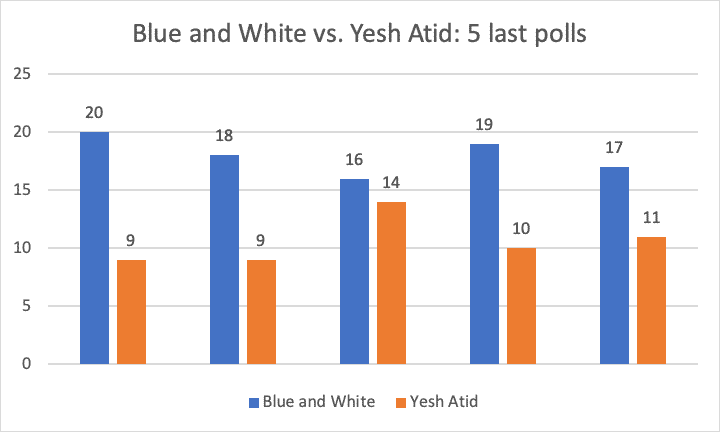
In addition, when Gantz decided to go for unity his party split: Blue and White under him joined the government. Yesh Atid under Yair Lapid became the main opposition. If most voters were against unity, you’d assume that they’d go with Lapid and abandon Gantz. But when voters were asked how they would vote if elections were held today, more voters chose Gantz.
What’s the bottom line? Read all reports about political developments with caution.