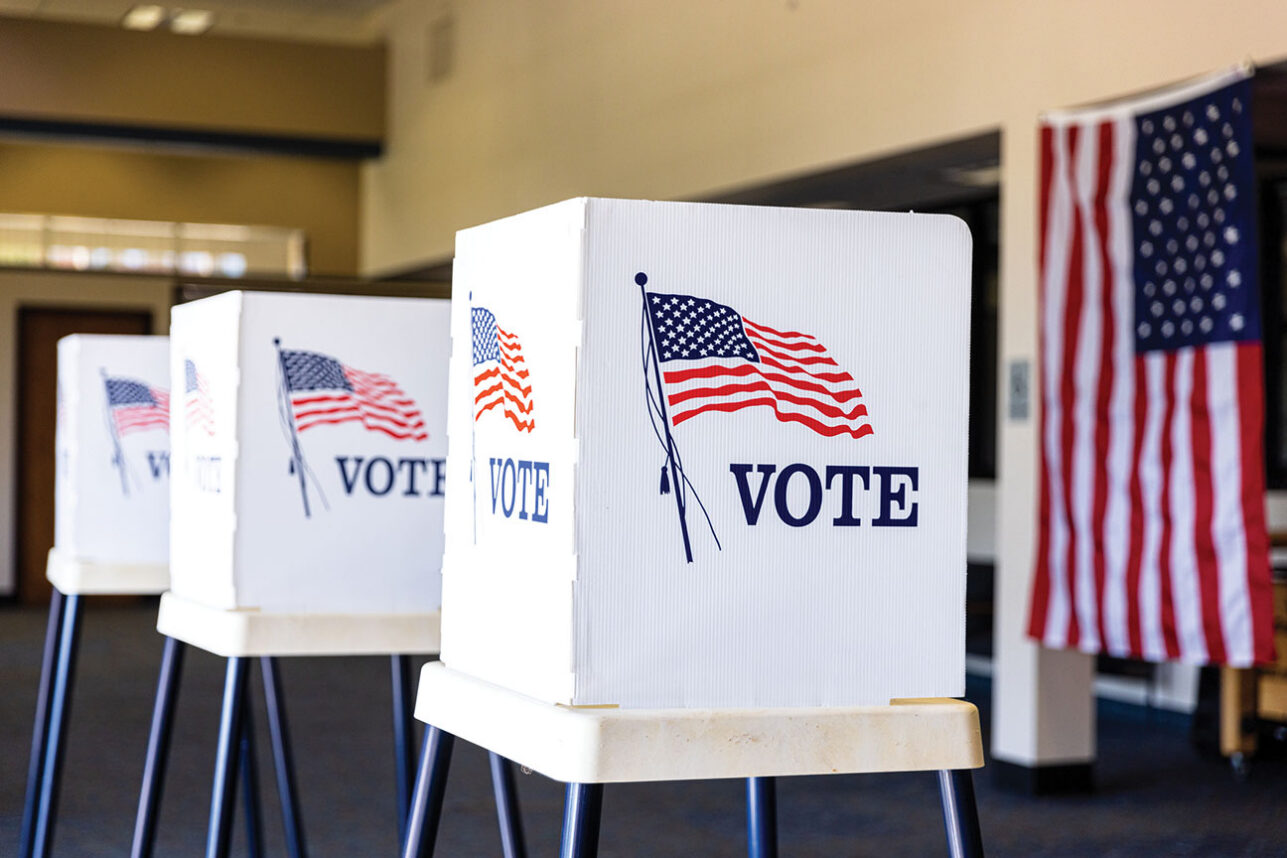

When we talk about political freedoms, we usually talk about the essential freedom to vote. In recent years especially, we’ve heard a lot about “voting rights” and “electoral integrity” as the foundations of democracy.
This powerful right to vote typically refers to the ballot box. But there is another, perhaps even more powerful and democratic way to vote—and that is with our feet. This is our freedom to move to a place, usually another state, that better suits our needs.
Most of us know people who have voted with their feet and moved to another city or state or even country, having lost patience with things like rising crime, high taxes, homelessness, poor education, unaffordable housing and congestion.
Because “voting with our feet” gets so little media attention as a legitimate political choice, it has the stigma of being the atypical, rebellious choice– what people and companies do when they “can’t take it any more” and escape to a friendlier state.
But as more and more people vote with their feet and as this becomes more widespread and mainstream, individual states will have no choice but to aggressively compete for residents. And that will be a good day for our democracy, not least for the poor and disadvantaged.
Yes, it’s our civic duty to vote at the ballot box, but let’s face it: The hard reality is that such individual votes have limited impact.
Ballot box voting has “two severe limitations,” writes George Mason University Professor Ilya Somin, in his book “Free to Move: Foot Voting, Migration and Political Freedom.” One is “the very low odds that an individual vote will make a difference,” and two is “the resulting incentive to make poorly informed decisions.”
In a presidential election, he writes, “the average voter has only about a 1 in 60 million chance of affecting the outcome… in state and local elections, the odds are higher but still generally very low.”
Foot voting is the antidote to this lack of individual impact at the ballot box.
When we do vote at the ballot box, we often vote on emotion or party loyalty. We’re not inclined to do our homework on the many issues. Our decisions are based, as much as anything, on the images we inhale from the media ecosystem. Everything gets slotted into our predisposed binary of good/bad, right/wrong, love/hate.
When we vote with our feet, we’re dealing with a consequential decision that will have a major impact on our lives. So we must do serious homework and seek out more information. This puts us in control. We feel empowered.
Foot voting is especially relevant for the poor and the disadvantaged. Somin quotes research showing that “moving to an area with lower poverty rates can have particularly large benefits for the life prospects of poor children, substantially increasing their incomes and college attendance rates.”
The problem is that our governmental system does little to nourish this fundamental right. If anything, Somin argues, “the enormous size and complexity of modern government” is taking us in the other direction, where “federal regulation now extends to cover almost every major aspect of the economy and society, including health care, education, pensions, consumer regulations, on down to shower head and toilet flows.”
The ironic result is that foot voting becomes most difficult for those who have the most to gain—the working class.
A classic example of an obstacle is the rise of exclusionary zoning, which makes it extremely difficult to build new housing in response to demand. And yet, building affordable housing should be a nonpartisan issue. As Somin notes, this is an area “where there is a strong, even if often unrecognized, common interest between the increasingly Republican white working class and their mostly Democratic Black and Hispanic counterparts.”
Indeed, if foot voting is to be elevated as a prominent democratic right, the working class must be put at the center of the movement.
A crucial step is for the federal government to devolve control over more issues to state and local governments. But our government doesn’t give up control that easily; it prefers to control and regulate the states through its power of the purse.
“Government increasingly regulates through conditions on its largess rather than through law,” Columbia Law School Professor Philip Hamburger writes in his book, “Purchasing Submission: Conditions, Power and Freedom.”
Hamburger’s main thesis is that by using funding as a lever, the federal government implicitly imposes regulations and policies on all states, a process he argues is “unconstitutional” and “threatens people’s freedoms.”
Among those compromised freedoms is the freedom to vote with our feet, which is, ultimately, the quintessential American freedom—that ability to hit the road in search of a better life.
This search for a more hopeful future lies at the heart of the American experience, and it often includes moving to another state. Even with an overbearing federal government, the states must not wait to start competing for residents. There are already many that do. They understand that foot voting is in keeping with the great capitalist notion that competition benefits the consumer– that when states compete with other states for residents, the people invariably win.
I want to know, for instance, that the leaders of my own state are doing everything they can not just to keep me here but also to attract more people here. Are they?
I often wonder to what extent the leaders of declining states like New York and California, which have lost countless residents to other states, are worried about such things. We can only hope that as foot voting grows and gets more media attention, smarter leaders, both nationally and locally, will wake up and honor this democratic right. We’ll know we’ve made progress when state leaders of both political parties include this commitment at the top of their platforms: “We will make our state more attractive to foot voters.”
That platform would be worthy of support at the ballot box.