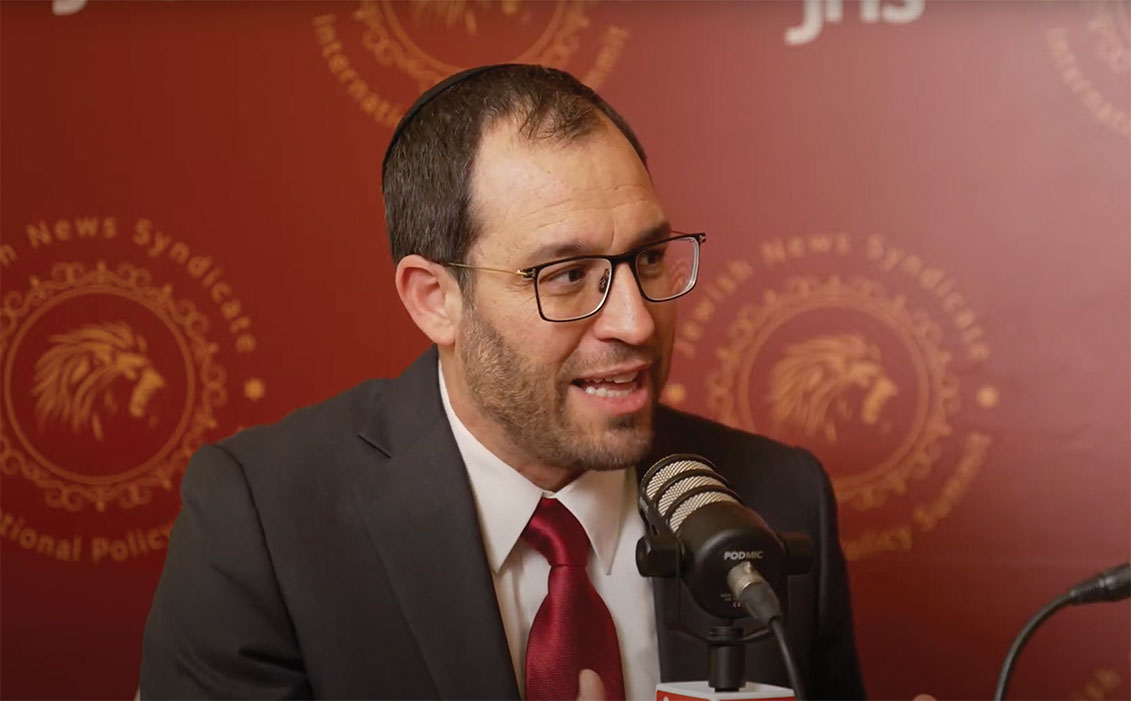
“It was the first night of Pesach. I was a secular kibbutznik for whom the exodus from Egypt didn’t mean all that much. And yet there I was, nearly alone in the sky, defending the nation’s airspace. A strange feeling overtook me — a sense of awe I had no words to describe.”
Israeli Air Force Major Shay Kallach, 43, recalled the night 20 years ago that his Israeli identity met his Jewish identity. As a young F-16 pilot, one of his first intercept missions involved scrambling toward an Egyptian civilian airliner headed toward Israeli airspace. The plane had crossed the 80-mile line, and his mission was to divert it.
“Suddenly, I felt like I was part of a historical chain that stretched back to ancient times. It was the ultimate realization of the Zionist dream: protecting the skies of Israel on a holiday centered around Jewish freedom. I did not yet grasp the full meaning of ‘2,000 years of exile,’ but at that moment, I felt it ending — with undeniable force. It wasn’t an abstract idea. It was a solid fact. I saw myself, a ninth generation Israeli, embodying the aspirations of all previous generations.”
Upon landing the F-16, Kallach said he had a new awareness for his Jewish heritage and felt compelled to explore what that meant to him. “I had to figure out my identity again; my roots, my heritage, my tradition,” he said. The young pilot then decided to study at Yeshivat Eli, embarking on a spiritual and ideological journey.
Twenty years later he founded Netzach Israel, a grassroots movement focused on restoring Zionist values and bringing hope back to the country. Netzach means eternity in Hebrew: “The eternity of the people of Israel.”
Identity struggle
Kallach attributed his lack of connection to Judaism prior to this experience as an inherent part of Israeli culture. Most secular Israelis feel deeply connected not to Judaism or Zionism but to leftist ideology. “Secular Jews were the role models for the country, but as a kibbutznik, I felt like Zionism was stolen from me in a way,” Kallach said.
Kallach said this identity struggle runs deep throughout Israeli society, and leftist groups have taken advantage of this divide.
Kallach described two looming threats: “The global progressive movement, which is sweeping through Western culture and seeks to erase our identity, and the widening rift between the general public and entrenched elites who dominate Israel’s security, judicial, economic and academic spheres.”
Kallach said that these may appear to be two fronts, but they are driven by one worldview: “that the very existence of the State of Israel as a Jewish state is a moral injustice that needs to be undone.” Leftist ideology and the ruling elites will continue to undermine Israel’s Jewish identity — until it is transformed into “a state of all its nationalities,” Kallach said.
But a Zionist backlash is already happening. “There are people … who want to lead with values, to correct this break from our identity dating back 4,000 years.”
Zionist Values
Netash Israel was born “as a barrier to block the tide, a movement of renewal committed to safeguarding the promise that has emerged in the wake of the war.”
It’s both a moral and intellectual revolution: reviving identity, inspiring courage, and restoring national spirit as well as the freedom to speak the truth: “where our future is grounded in both timeless identity and renewed nationhood.”
“The struggle we face today is between the Jewish state and the state for the Jews,” Kallach said. “We have a destiny and a mission to reestablish a sovereign nation in Zion. This is beyond Herzl’s vision of a ‘safe shelter’ for Jews — it is our destiny as a people to be a light unto the nations.”
Kallach believes that Israel has emerged from the war with Iran not merely as a regional power — but as a moral and spiritual beacon. “Our strength does not lie in numbers but in spirit: the valor of our soldiers, the resilience of our civilians, our resolve, and our sacrifices.”
“The stage is now set to answer a fundamental question: what is the purpose of the State of Israel?”
Israeli society is already undergoing a shift in consciousness: Post-Oct 7, Gen Z Israelis are discovering both Judaism and Zionism. “You see young IDF soldiers with their tzitzit out, even though they don’t even know what it is. This is symbolic of a greater movement that is happening right now.”
Through 40 local chapters throughout the country, with the goal of reaching 150 by 2026, Netzach is working to reinvigorate the foundational principles and hope that he believes are essential to Israel’s continued strength and unity. The movement focuses on bridging divides within Israeli society and reinforcing the ideological foundations that underpin the Jewish state, essentially strengthening Israel’s national character from within.
“If I could sum up the leftist perspective in one sentence, it would be, ‘From the river to the sea, we will have peace and love and be free.’ The only way to mitigate that belief is by regaining our tradition, regaining our roots, and regaining our identity.”
Netzach Israel “seeks to bring dignity to our nation, to bring confidence to the people and to restore freedom of speech and thought back to the citizens,” Kallach said.
Ultimately, Kallach’s goal for Netzach Israel — and for the entire nation — is clear: to restart the Jewish state. “Our mission is to save the Jewish state, not the state of the Jews, and there’s a difference. We need to change our mindset and make sure that we can never eradicate Jewish identity from the Jewish state.”
This transformation will eventually impact the education system, the universities, the media, the judiciary, and even the army. “It is no coincidence that people are already demanding we establish a party — they’re yearning to see a fundamental transformation of the political landscape.”
And of course one hopes — prays — that this new movement will eventually influence Jews in the Diaspora, so that the term anti-Zionist Jew returns to being an oxymoron. Leftist Jews who refused to condemn Hamas after Oct. 7 led directly to a pro-Hamas candidate for mayor of NYC — and to the NYPD now having to carry assault rifles to protect synagogues.
Our sacred identity as a people — an eternal nation — should have been taught in every synagogue after the Holocaust. The diaspora too needs a restart—both to stop the now incessant attempts to erase our identity and to renourish our eternal light.
Karen Lehrman Bloch is editor in chief of White Rose Magazine.