
Dear all,
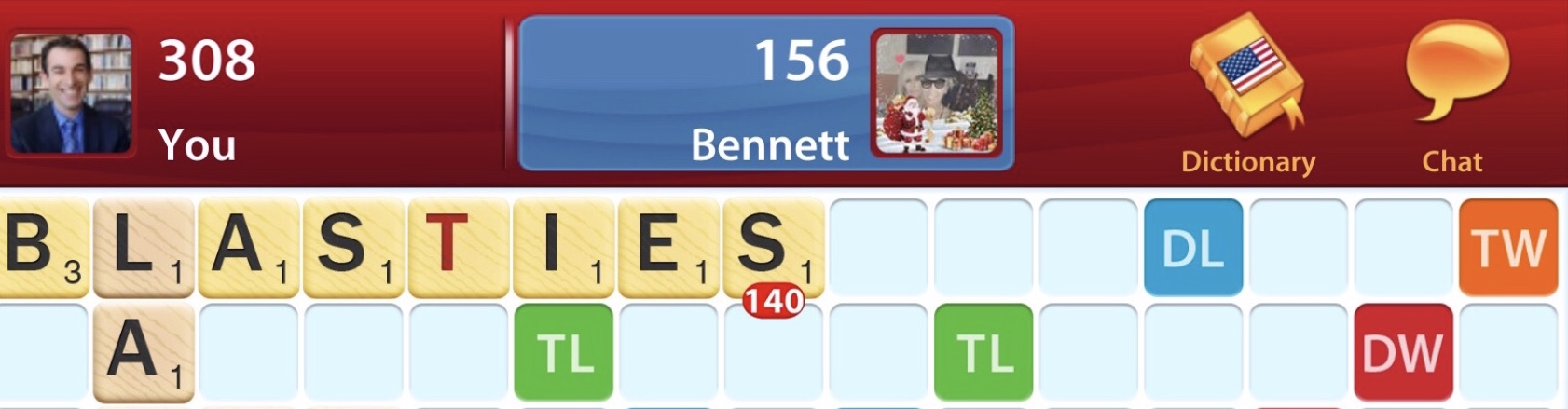
“Blasties.” It earned me 140 points in Scrabble. I had to look the meaning up: “wretched creatures.” Playing that word boosted my score. It made a difference. And it made me think a lot about life.
In the 18th century, the Chassidic Master, the Baal Shem Tov, taught that each person is allotted a fixed number of words, determined from birth. Once we use up our quota, we must depart from the world.
We don’t have to agree with the teaching. But it still gives us pause. Are we using our words wisely? Do we take to heart that our words matter? Knowledge includes having a good vocabulary. But wisdom is about understanding how to speak, when to speak, and what to say.
I ended up losing the Scrabble game! But for a moment in time, I chose a word that made a difference. Now, it’s once thing to do that in a game. The real question is: what word will we use today that make a difference in life?
With love and shalom,
Rabbi Zach Shapiro
A change in perspective can shift the focus of our day – and even our lives. We have an opportunity to harness “a moment in time,” allowing our souls to be both grounded and lifted. This blog shows how the simplest of daily experiences can become the most meaningful of life’s blessings. All it takes is a moment in time.
Rabbi Zach Shapiro is the Spiritual Leader of Temple Akiba, a Reform Jewish Congregation in Culver City, CA. He earned his B.A. in Spanish from Colby College in 1992, and his M.A.H.L. from HUC-JIR in 1996. He was ordained from HUC-JIR – Cincinnati, in 1997.