


If you’ve ever wondered how curb cuts became a familiar feature of American sidewalks, or how public buildings, offices, schools and other spaces became more accessible to people with disabilities, part of the answer lies in the disability-rights movement that took shape some 50 years ago. One of its most influential leaders was a Jewish woman from Brooklyn: Judy (Judith) Heumann.
Heumann was born to German Jewish parents who had immigrated to the United States before World War II. She contracted polio at 18 months old and used a wheelchair for most of her life.
Her fight began with a personal injustice. After completing her education and passing the written and oral examinations required to become a teacher, she was denied a teaching license by the New York City Board of Education. Officials argued that, because she used a wheelchair, she might not be able to evacuate herself or her students in the event of a fire. They considered her a “fire hazard.” Heumann sued the board and won, becoming the first teacher in New York State to use a wheelchair.
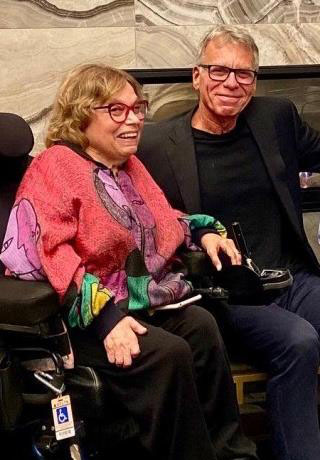
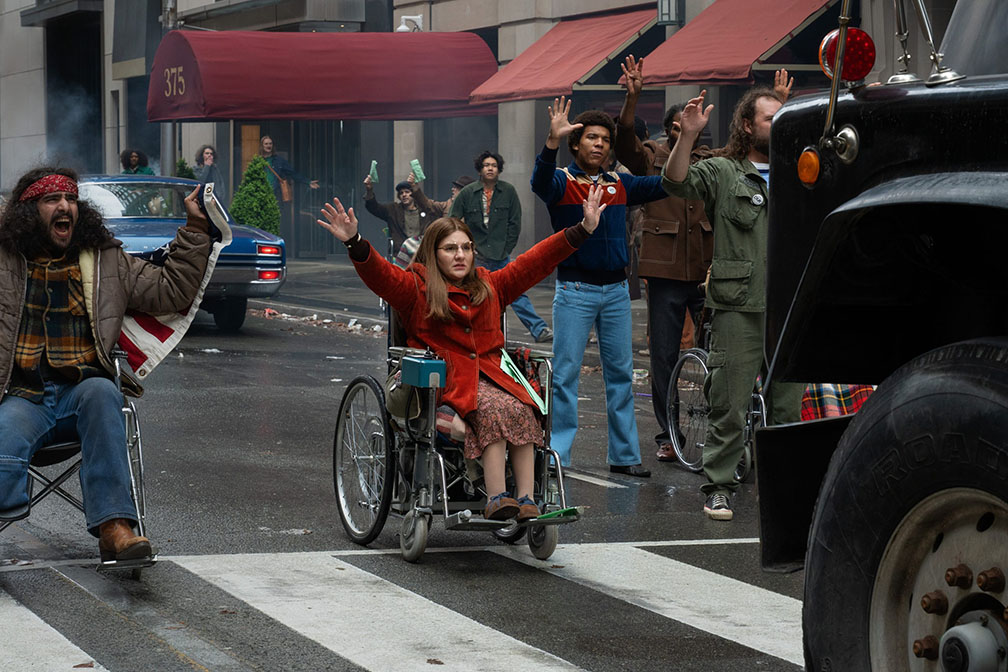
Years later, after moving to California, Heumann became a leading organizer of the disability-rights movement. Working with fellow activists, she helped mobilize a broad coalition to demand equal rights. In April 1977, she helped lead more than 100 people with various disabilities in a peaceful occupation of the federal building in San Francisco. They were demanding that the government enforce Section 504 of the Rehabilitation Act of 1973, which prohibited discrimination against people with disabilities in federally funded programs. Although the law had passed four years earlier, its implementing regulations had still not been signed. The protesters remained inside for 26 days, in a demonstration that became a defining moment in the disability-rights movement.
The film was brought to the screen by veteran Jewish producer David Permut, whose credits include Mel Gibson’s “Hacksaw Ridge” and Olivia Wilde’s “The Invite,” starring Seth Rogen, Penélope Cruz, Edward Norton and Wilde, released earlier this year.
In an interview with the Journal, Permut said he had never heard of Heumann until 2020. “I attend film festivals religiously. At a typical festival, I watch five movies a day for 10 days. I’ve been doing it for decades,” he said. “I wanted to watch the documentary ‘Crip Camp,’ but missed it.”
Back home in March, during the pandemic lockdown, he finally watched the documentary, which tells the story of Camp Jened, a summer camp in the New York’s Catskill Mountains where Heumann spent her summers with other teenagers with disabilities in the late 1960s and early 1970s.
Permut immediately sought out her memoir, “Being Heumann,” and fell in love with the story and the woman behind it. He saw the potential for a feature film: an underdog story about a woman who challenged the system, fought for the rights of people with disabilities and won.
He contacted Heumann’s representatives, John W. Beach and Kevin Cleary, to ask about acquiring the film rights. He soon learned that he was not the only one interested. Several prominent filmmakers were already pursuing the project.
Permut eventually arranged a Zoom meeting with Heumann that lasted two-and-a-half hours.
“We got to know each other,” he recalled. “She was very impressed with some of the work I had done in the past and I think she understood my passion for wanting to tell her story,” he said.
“The next day Kevin and John called me and said, ‘Congratulations David you’re the producer.”
Permut then approached writer-director Siân Heder. He felt that a woman should direct a film centered on Heumann’s life. “She had such passion for this project. I loved her first movie, “Tallulah,” and I knew I had found the right person for this film.”
Getting the film made proved far from easy. When Permut and Heder presented the project to studios and streamers during the pandemic, they initially faced rejection. “We zoomed with a few buyers’ studios and streamers and they all passed on it.”
Permut, however, says rejection has never discouraged him. In fact, it often makes him more determined. “As a producer, you need to be impervious to rejection, because some of my greatest films are projects people passed on,” he said. “When I hear no, I get excited because I’ve got something provocative, distinctive or daring.”
Some of his previous films also faced rejection before finding success. “Hacksaw Ridge,” the Mel Gibson-directed war drama, took 17 years to make, and received six Academy Award nominations, while “Rustin,” starring Colman Domingo, took 12 years and went on to earn critical acclaim and an Oscar nomination for Domingo.
“It’s challenging to get anything made. They’re all miracles,” he said.
An unexpected turning point came with Heder’s success on “CODA,” which premiered at the 2021 Sundance Film Festival. The film sparked a bidding war, and Apple acquired it for a reported $25 million. Heder went on to win the Academy Award for Best Adapted Screenplay, while “CODA” won Best Picture. In July 2021, Apple also announced that it had acquired the rights to “Being Heumann.”
Ruth Madeley, a British actress who uses a wheelchair herself, was cast as Judy Heumann, while Mark Ruffalo portrays Joseph Califano, the U.S. Secretary of Health, Education and Welfare, whose refusal to sign the Section 504 regulations became a turning point in the disability rights movement.
Permut’s path to Hollywood began when he was a teenager. Born in New York, he moved with his family to Los Angeles at 14, when his father relocated for business. Already passionate about movies, he was making films with an 8mm camera and knew he wanted to work in the entertainment industry.
At 15, he found an unusual way to get acquainted with Hollywood: selling maps of celebrities’ homes to tourists. “Everyone knew me as the kid on the corner,” he recalled in a 2016 interview with The Los Angeles Times.
He began working for independent producer Roger Corman as a production assistant. His big break came in 1975, at age 21, when he produced a filmed stage performance of the play “Give ’Em Hell, Harry!” starring James Whitmore as President Harry S. Truman. Shot in one night in Seattle with six cameras, the film was initially rejected by studios because of its poor image quality. Permut and his producing partner, Bill Sargent, took it directly to theater owners and arranged its release themselves.
“It looked terrible technologically, but the actor on stage was brilliant,” Permut recalled. The gamble paid off: the film grossed approximately $11.5 million and earned Whitmore an Academy Award nomination for Best Actor.
Looking back on Heumann, who passed away in 2023, Permut remembers not only her activism but also her sense of humor. He recalled that she always carried a silver pen. When he asked why, she explained that it wasn’t a pen, but a tool to let the air out of the tires of cars illegally parked in handicap spaces. “I learned a lot from Judy,” he said.
He also remembered something she told him: “The likelihood is that when we all get older, we’re all going to be members of the disabled community.” Her words underscored the importance of her activism not only for people with disabilities, but for anyone who might face disability as they grow older.
Permut believes Heumann story is precisely the kind of project that reflects the philosophy guiding his choices as a producer: “Educate, enlighten and entertain. That’s the power of what we do.”
“Being Heumann” opened in select theaters on Nov. 6, 2026, and began streaming globally on Apple TV on Nov. 13.































