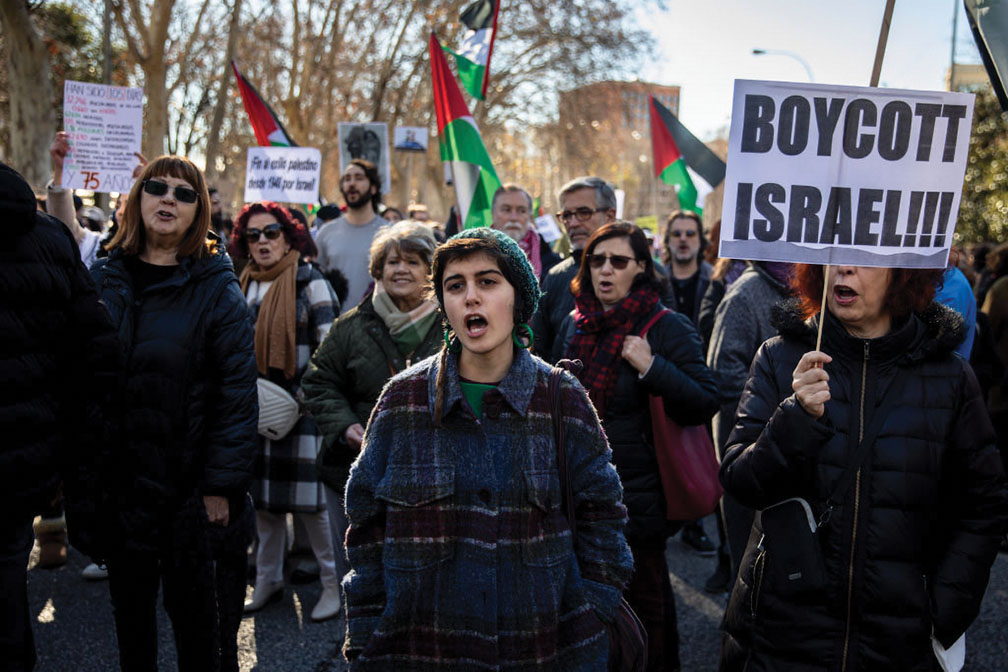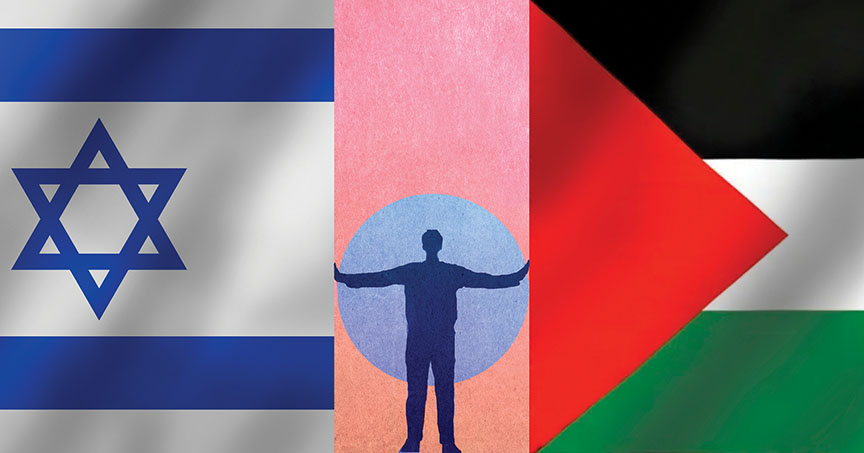

A half century ago, President Richard Nixon was recorded telling his National Security Advisor Henry Kissinger that “professors are the enemy.” In light of the ever-expanding culture wars and the sickening accounts of faculty flouting local laws and campus rules in celebrating the savagery of Hamas, I bet that view is even more widely held today, especially within the Jewish community.
But it is important to distinguish between a small number of nut-jobs, and the broader population of 1.5 million professors employed at U.S. colleges and universities. While only one-in-10 faculty describe themselves as having political beliefs that are “strongly conservative,” this by no means suggests that the remaining 90% embrace anarchy, terrorism, or Jew-hating.
First, a brief review of the data on faculty ideology.
Leading up to the 2020 election, the Harvard Crimson surveyed 260 professors about their presidential preferences. Three said that they backed President Trump. At a Northwestern University alumni event, an audience member asked me if I was surprised by that information. “Surprised?” I replied. “I was shocked – who would have guessed that there were so many Trump-supporters on the Harvard faculty!”
The numbers at Harvard are indeed striking: a 2021 survey found that 30% of its faculty described themselves as very liberal; 48% as liberal; 20% as moderate; and 3% as either conservative or very conservative. While the degree of imbalance within the Harvard faculty seems extreme, it is not unique. At Yale, a 2017 survey discovered that 7% of its professors identified as conservatives.
There has been a leftward drift in higher education over time. According to Claremont McKenna College professor Jon Shields, 27% of faculty in the late 1960s were politically conservative, a percentage that has subsequently declined. Their places have not been taken by moderates, whose ranks also shrunk, but by liberals.
Shields shows that there are some academic disciplines where ideological balance has been maintained. Economics professors, for example, divide up almost evenly among Republicans, Independents, and Democrats. And I suspect that there is considerable political diversity in fields such as engineering and the sciences. But good luck finding a conservative faculty member in the humanities or in many of the social sciences. According to Shields, only between 2 and 8% of professors in sociology, literature, history, political science, and philosophy identify as conservatives.
How did we get here? There is some evidence of discrimination based on political views both in PhD program admissions and in faculty hiring, but that doesn’t appear to explain much of the ideological imbalance. There is stronger support for the notion that conservatives self-select out of the academy. Perhaps they feel that their beliefs will clash with the liberal culture prevailing on most college campuses. Or maybe there is a simpler explanation: compensation. Former Harvard President Larry Summers has mused that conservatives are less willing to forego lucrative job opportunities in investment banking, consulting, law and medicine than their more liberal peers, especially when the alternative would be faculty positions in academic disciplines that pay relatively poorly compared to economics departments and the sciences. Whatever the reason, it seems likely that we will be living with the ideological imbalance among the faculty well into the future.
Fortunately, after spending over four decades in academe, I am convinced that this is less of a problem than it might appear.
Don’t misunderstand me. I wish there were more conservative-minded professors to provide different perspectives on Israel and other topics, and to act as mentors and role models. However, although I have encountered professors who allowed their politics to enter the classroom, a large majority teach their subjects with the utmost integrity. And those who seek to indoctrinate, generally fail. My experience as an advisor, teacher and administrator suggests that while students might be willing to repeat whatever it takes to get a good grade, attempts to brainwash tend to backfire.
Although I have encountered professors who allowed their politics to enter the classroom, a large majority teach their subjects with the utmost integrity.
Let’s not pretend that the political views of faculty mirror that of society. They don’t come close. But disparaging the professorate due to the disgraceful actions of a few is just plain wrong.
Most professors fully understand that teaching is a sacred trust.
Morton Schapiro is the former president of Williams College and Northwestern University. His most recent book (with Gary Saul Morson) is “Minds Wide Shut: How the New Fundamentalisms Divide Us.”