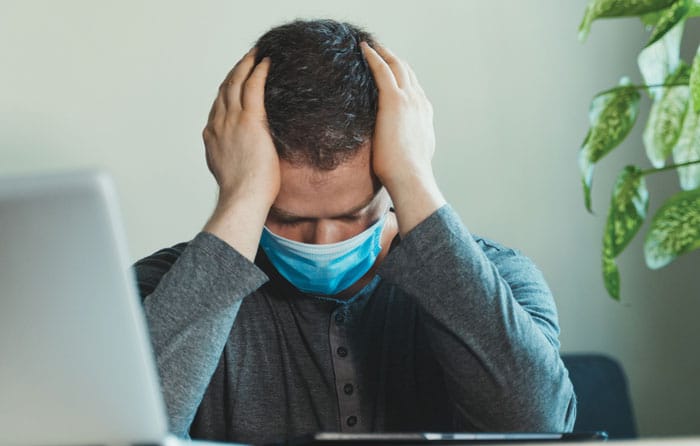
Many of us are approaching the COVID exhaustion phase. We’re numb. Every time we start to see daylight, we get slapped by reality. Six months ago, it was the Delta variant. Now it’s Omicron. When will this pandemic nightmare be over?
It’s humbling. We’re supposed to be the most advanced species on the planet, and here are these trillions of miniscule viruses telling us, “Hey, this is our planet, too. This is what we do—we invade your bodies and go after your lungs. That is our mission.”
So far, humanity has put up a pretty good fight. The virus has killed more than five million people, but despite all the false starts, mistakes and controversies, life is still chugging along as every nation fights the battle. If we licked polio and other pandemics, eventually we’ll lick this one.
But until then, we need help.
Humans do have one big advantage over other species—we can think. Human thought is so powerful it can influence how we experience reality. On that note, I heard a thoughtful idea the other day that may ameliorate how we experience the pandemic.
Imagine three buckets. In the first one, put the things you lost because of COVID that you don’t want to get back. In the second, put the things you gained that you want to keep. And in the third, put the things you lost that you want to get back.
Imagine three buckets. In the first one, put the things you lost because of COVID that you don’t want to get back. In the second, put the things you gained that you want to keep. And in the third, put the things you lost that you want to get back.
What’s in your first bucket? What did you lose that you’re happy to lose? Schlepping in traffic? Attending events you didn’t want to attend or seeing people you didn’t want to see? A job you hated? Too many flights?
The second bucket is my favorite—what did I gain that I want to keep? Because of COVID, I’ve developed weekly rituals with close friends and family that I definitely want to keep. I’ve also had a lot more time to think and spent more time at the ocean. What’s on your list of things to keep? New healthy habits? New attitude of gratitude? Casual clothing?
The third bucket is the most painful one—what did we lose that we want to get back? Obviously, I’m not including the tragedy of lost lives, which is horrible enough. This bucket is for things we miss that we hope to get back. Lively Shabbat dinners? Praying without masks? Traveling overseas without PCR tests? Entering venues without proof of vaccine?
Because the pandemic has been so disruptive to our lives, the third bucket is probably the heaviest.
But beyond what we actually include in these buckets, what is most important is their very existence. Every time I bring it up with friends, I get the same reaction, “That’s a really good way of looking at it.”
That is the power we have as human beings—by changing how we see things, by framing them differently, we can influence how we experience the things themselves.
That is the power we have as human beings—by changing how we see things, by framing them differently, we can influence how we experience the things themselves.
When I’m exhausted by the relentlessness of the pandemic, I go to the second bucket and remind myself that because of COVID, I now talk to my mother six days a week, which has brought a lot of joy to both of us.
It’s natural that much of our anxiety leads us to the third bucket. If your restaurant or synagogue or museum is half empty because of COVID, you’re certainly eager to get the good old days back. The problem is that we can’t really know what these “good old days” might look like or when they may return, if ever. Things are too uncertain.
At this point, all we know is that we can find immediate nourishment in the first and second buckets, because they include things we can control. The third bucket is more of a “hope and dream” one. We hope to get back the things we miss, even as our patience is wearing thin.
Perhaps we could use a fourth bucket, to include a list of ideas to adapt to whatever the future throws at us. That requires not just a change of attitude but also hard work and innovation.
In the meantime, when we need a morale boost, we can take out the first two buckets and be grateful that they even exist.