fbpx

December 8, 2021

A Moment in Time: Tipping the Scale

Dear all,

Watching the twins on a see-saw recently, I thought of a teaching of the Rambam, who shared that the entire world is evenly balanced between positive and negative acts. But if we can tip the scale by doing just one additional good thing, we can save the entire world. (Mishna Torah, Laws of Teshuva 3:4).

I know we all want balance. But I think we all could use a little tipping of the scale in favor of a better world.

What is the ONE purposeful act we can do, today, to tip the scale?

Your act can be comprehensive:
What organization needs your support?
What institution needs your donation?
What foundation needs your partnership?

Your act can be simple:
Who needs a meal?
Who needs a phone call?
Who needs a hug?

Go out and tip the scale! Saving the world depends on your taking just a moment in time to make a difference!

With love and shalom,

Rabbi Zach Shapiro

A Moment in Time: Tipping the Scale Read More »

What Losing Means for the Jewish Team

“Losing means that you at least were in the race,”
about himself, not Jews, said Robert Dole.

We never would have lost the race if we had never run in it.
The race between the Christians and the Jews
is one I’m sorely sorry that the Jews would lose.
Perhaps the most important reason that we didn’t win it
is that to win was not our Jewish goal,
but it could be! Front runners tend to lose their place.

Religion is a relay race which Jews
love like good sports to run in, though they lose.

I think this is because it’s one
we generally choose to run,
even if we’re less believers
than Hail Mary’d wide receivers,
with a believer’s black hat on
our heads, which we’re inclined to bend.
This surely is why we Jews tend,
while on the track, to drop the baton.


Robert Dole framed his crushing defeat by President George H.W. Bush by writing in his memoir:

“Losing means that at least you were in the race. “It means that when the whistle sounded, life did not find you watching from the sidelines.”


Gershon Hepner is a poet who has written over 25,000 poems on subjects ranging from music to literature, politics to Torah. He grew up in England and moved to Los Angeles in 1976. Using his varied interests and experiences, he has authored dozens of papers in medical and academic journals, and authored “Legal Friction: Law, Narrative, and Identity Politics in Biblical Israel.” He can be reached at gershonhepner@gmail.com.

What Losing Means for the Jewish Team Read More »

david suissa shanni suissa podcast

New York is Back– Sort Of

David calls in from New York and discusses how the Big Apple is coming back from the pandemic, the rise in crime in Los Angeles and this week’s Jewish Journal cover story featuring Aomar Boum.
Follow David Suissa on FacebookTwitter and Instagram & Shanni Suissa on InstagramTwitter and TikTok


example one
example two
example two

New York is Back– Sort Of Read More »

Should We Bother with Tanach?

Does one need to study Tanach? That’s a strange question. First of all, what does “need” mean? “Need” in the sense of must? In Israel, the factual answer is yes. It is obligatory to study Tanach in Jewish schools. “Need” in the sense of ‘it’s impossible to do without?’ That’s a difficult position to defend. Quite a few people in the world get along without studying the Bible. “Need” in the sense of ‘this is our book?’ Israel’s founder, David Ben-Gurion, certainly thought so. Ben-Gurion believed that Jews are special, and that the source of their otherness could be found in the Bible. This book is the key to their past and future. Ben-Gurion devoted many hours to examining the political and ideological ramifications of Bible stories.

In a survey published last week, we discovered that many Israeli parents see no value or very little value in what Ben Gurion considered a guidebook for the nation.   

Does one need to study the Bible? When we move from the Ben-Gurion generation to the current generation of Israelis, we find a clear decline in the status of the Bible. In a survey published last week, we discovered that many Israeli parents – presented with a question of whether Bible studies ought to be mandatory in high-schools – see no value or very little value in what Ben-Gurion considered a guidebook for the nation.   

Obviously, the Bible isn’t just a “subject”, and this is where the challenge begins. Is it a religious text? In that case, it’s clear why mainly religious Israelis demand the allocation of many hours to study it. Is this book a basic national-cultural text? Early Zionists essentially thought that the Jewish People ought to go back to the Bible, and sort of ditch everything that happened in between the end of ancient-times Jewish independence and modern-times Jewish independence. They thought that studying Halacha is unnecessary – but not the Bible. If you follow their advice, then every Jewish Israeli should study Tanach, and some would even say: especially secularists, because they are less interested in later books. 

That’s the basic position of the state. Tanach is an obligatory subject. But many parents have their own position. The Shenhar Committee, appointed by an Education Minister of the early 1990s, tried to figure out how to deal with the decline in the status of Jewish subjects at schools. It described reasons that haven’t changed much between then and now, almost thirty years later. Reasons such as “the rise of consumer society,” and such as “the importance of science and technology,” and such as “the growing politicization of religion.”

The Shenhar Committee recommended strengthening Jewish studies, arguing that “familiarity with the history of the people of Israel and its culture is an essential element in building the identity and spiritual and value world of the young Israeli.” Undoubtedly, this recognition is important for achieving the goals of the committee. But the goals of the committee are not necessarily the goals of the parents. They do not always think of the theoretical identity of a theoretical young Israeli but rather about their very specific offspring, with her specific ambitions and goals. Maybe it’s good for Israel to have Jewish subjects strengthened, but the question of every parent is “is it good for my kid?” Would another hour of Tanach help her or him achieve their goals? 

Of course, even what the committee calls “values” varies from parent to parent. There are those who believe, like the committee, that the value world of young people requires familiarity with the history of Israel and its culture, and there are those who are less inclined to have such belief. You will not be surprised to learn that religious Israelis agree with the committee’s conclusions, and secular Israelis less so. That’s because Tanach, for whatever reason, is still seen by many Jews as a religious subject (maybe it’s because Tanach stories have God as a main character?).

More than a third of Israeli secularists do not want even one compulsory hour of Tanach in high school. More than a third say one hour would be enough. Upon hearing these numbers, a leading promoter of Tanach education called me with the following comment: “I’m not sure if this is bad or good. On the one hand, I can tell the minister ‘See? We must act’. On the other hand the minister might tell me ‘I have no use for you, as you’re promoting something that people don’t really want’”. 

And the challenge of making Tanach seem less like  something that interests only the religious sectors is just the first layer of obstacles to strengthening this subject. When we look into the responses of seculars we also see that the more left wing they are, the less inclined they are to support Tanach studies. Right-wing secularists would still teach some Bible at school. Left-wing secularists would teach almost none. Why? Here I must send you to reread my article from last week. I assume you have better things to remember, so let me recall its topic: the decision by President of Israel, Isaac Herzog, to light a Hanukkah candle in the Cave of the Patriarchs, where the forefathers of the nation are buried. 

This is all part of the same story, and same challenge. The Tanach teaches us about God, whether we still believe in him or not. It also teaches us about our historic ties to Hebron and Jerusalem and Shiloh (today a settlement) and Shechem (today modern Nablus). Religiously charged, politically charged – and not at all beneficial for advancing our careers. Maybe that’s exactly why we must study Tanach.

Something I wrote in Hebrew

In most polls, former PM Netanyahu is at 45% support and current PM Bennett is at 20%-30%. I explained why that’s a misleading picture: 

In a country where there is no election for prime minister at all, but elections for parties, comparing Bennett’s position, with his five seats, to Netanyahu’s, who has closer to 35 seats in the polls, is a kind of chutzpah. Bennett doesn’t really have a chance of defeating Netanyahu in the next election. On the other hand, the numbers are not insignificant. They teach something about Netanyahu’s condition. He has a ceiling. He is very popular with his constituents, the voters of the right wing bloc. But he is also intolerable in the eyes of those who are not its voters. This is what we see in the numbers. Labor, Meretz, and Lapid voters – if they have no choice but to decide between Netanyahu and Bennett, they will vote for Bennett, even if they are devout leftists.

A week’s numbers

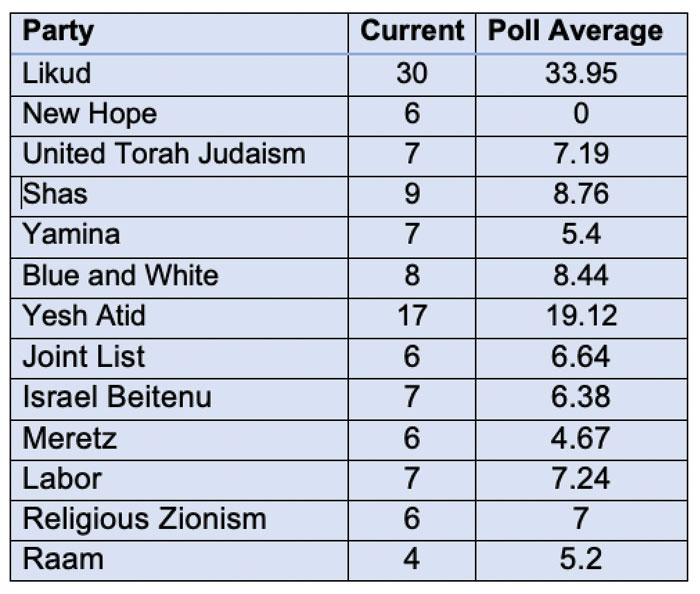
Exactly half a year after the Israeli government was established, the poll tracker of themadad.com gives the following average mandates to each party:


A reader’s response:

Sharon Weiss sent a question: “do you think Israel is going to attack Iran?”. My answer: if Israel has a way of doing it and get good results, I have no doubt that it would. But I don’t know if Israel has such capability.  


Shmuel Rosner is senior political editor. For more analysis of Israeli and international politics, visit Rosner’s Domain at jewishjournal.com/rosnersdomain.

Should We Bother with Tanach? Read More »

The Upside of Struggling

Every time I swipe my debit card, I hold my breath until I see that magic word: “Approved.” 

For years, I never knew if my card was going to get approved whenever I used it at the store. If it got declined, my face would turn flush in the checkout line and I would hurriedly try the other cards in my wallet, hoping one would go through so I could get out of there. As someone who cares deeply what other people – even strangers – think, I was incredibly embarrassed. 

Today, thankfully, I’m in a better position with my finances. And now, I can appreciate when my card works. Or when my car starts, because I’m no longer driving a 1995 Ford Escort with a busted engine. Or how I don’t have to work a part-time job selling high-end doggy sweaters made of real animal fur to rich Manhattanites while making $8 an hour. Or how I don’t have to live with roommates, which my husband and I had to do for the first nine years of our relationship in order to afford our rent. Or, for that matter, how I don’t need to live next to a crack-addicted violent gangster because we couldn’t afford to leave our rent-controlled apartment in Brooklyn. 

I’m not complaining about my past. In fact, I am grateful for everything I’ve been through. If I hadn’t struggled so much in my formative adult years, I wouldn’t appreciate what I have today. I see struggle as a good thing. 

Unfortunately, I believe that many people today will do whatever they can to avoid struggle. They don’t want to experience any pain. Instead, they feel entitled that they should just be able to skip all the hardships and get ahead. 

They think they shouldn’t have to work those terrible minimum wage jobs and climb up the ladder. They shouldn’t have to adapt and change in order to make it work with their partner; if they’re truly meant to be together, they’ll never have their issues. They should be able to still put themselves first, even when they have a kid. 

All of this is unrealistic and harmful thinking.   

Real life is supposed to be full of challenges. It’s what makes us stronger and able to be grateful for what we have.

When you are in the middle of a struggle, it can get dark, lonely and depressing. But when you emerge from it, it’s such a relief. You’ll probably even feel accomplished for getting through those tough times. 

When you are in the middle of a struggle, it can get dark, lonely and depressing. But when you emerge from it, it’s such a relief. You’ll probably even feel accomplished for getting through those tough times. 

These days, I still have my struggles financially. But with so much practice, I’ve learned to handle them much better. When I have a big bill I have to pay and not enough money in the bank, instead of stressing out and worrying, I pray that the money comes in. Like clockwork, I receive a check almost immediately every single time. 

When I got a horrible case of COVID during my first trimester earlier this year, and I was in and out of urgent care multiple times with different health issues, I just kept thinking, “Hey, at least I’ll have the antibodies” and “This is only temporary.” It’s that kind of thinking that got me through such a physically and emotionally distressing time.  

As I’ve gotten older, I’ve learned that everything good in life involves some sort of struggle. Marriage isn’t easy, but it is rewarding. Having a child has its rough moments, but overall it’s wonderful. Being an observant Jew comes with its costs, but the upsides greatly outweigh the downsides. 

When there is something difficult coming your way, I say you should embrace it as a learning opportunity and a test. As a person of faith, I believe everything happens for a reason, and even the bad can be good.

If you can’t change your circumstances, then fight through them. Change your perspective. Know that it’s all for the good, or as we say, gam zu l’tovah.


Kylie Ora Lobell is the Community and Arts Editor at the Jewish Journal.

The Upside of Struggling Read More »

Five Food-Related Habits That Are Not That Great for Jews

I don’t make it a practice to tell readers what to do. In fact, I’m famous for offering unsolicited advice to friends and family only. But in light of recent food-centric holidays such as Thanksgiving and Hanukkah, in addition to weekly Shabbat meals, I feel compelled to extend my benevolent, unsolicited advice to readers as well. 

Over the years, I’ve observed that Jews worldwide partake in certain food-related practices that are unhealthy, if not downright dangerous. Here are five that are particularly ubiquitous:

The Dreaded Washing Cup

Jews love to use communal washing cups at kosher restaurants, synagogues and at home. You know the kind—they’re usually made of silver, however rusted, or plastic, and used before one consumes bread. The water is poured three times over each hand, and a blessing (“Netilat Yadayim”) is recited. What lives on the handles or at the bottom of those washing cups is anyone’s guess. In preparation for a future column, I’m going to swab washing cups from half a dozen local kosher restaurants and drop them off to a friend who works in a laboratory at UCLA. I can’t wait to discover what exciting specimens to which local Jews expose their hands before eating a nice, juicy burger.

I don’t know if it’s halachically permissible, but I reason that I can be of more service to God if I’m not sick every other week. 

The solution? At home, always wash the inside and outside of the washing cup with soap and water at least once a week. I always ask restaurants for a disposable cup. If you’re too shy to ask a host for a different cup, wash your hands with soap after using the washing cup. If nothing disposable is available, I simply put my hands under the faucet. I don’t know if it’s halachically permissible, but I reason that I can be of more service to God if I’m not sick every other week. 

The Slow-Cooked Plastic Bag

When it comes to cooking for Shabbat, Jews love to use the slow cooker. It’s equally true for Ashkenazim and their cholent as it is for Sephardim or Mizrahim and their hamin or dafina. I love North African dafina, complete with chunks of tender meat, eggs, bulgur, rice and potatoes. The bulgur or rice, however, are almost always cooked overnight in a plastic bag. How is any plastic safe for a slow cooker that basically boils food at a low temperature for nearly 15 hours? Ashkenazim love their plastic bags in slow cookers as well. In most synagogues that serve a giant pot of cholent for the Shabbat kiddush meal following morning services, the bottom of the slow cooker is entirely wrapped in a huge plastic liner to make clean-up as easy as possible. 

The problem is that most plastics contain BPA (bisphenol A), and those that claim to be made from heat-resistant nylon resins, such as Crock-Pot liners, can still leak chemicals into food. A report from the U.S. National Library of Medicine revealed that nylon liners can leak many substances, including cyclopentanone, octadecane, heptadecane and 2-cyclopentyl cyclopentanone. Synagogues in particular need to be more careful. Nothing says “Love your Jewish brothers and sisters” like adding boiled plastic to their diet once a week. 

The solution? Either skip whatever individual item is inside the plastic bag, whether bulgur, rice, or kishka, or, dare I say it, have a little less cholent. Yes, it’s a painful thought, but it’s better than ingesting cyclopentanone, octadecane, heptadecane and 2-cyclopentyl cyclopentanone. 

The Melted Serving Spoon

Along the same lines as slowly cooking plastic, I cringe each time a Shabbat host or synagogue offers a delicious bowl of boiling-hot food, complete with a cheap, plastic serving spoon that’s no doubt been immersed in the hot food for hours. It happens most at the hot foods section of kosher supermarkets, where the same large, plastic serving spoons are kept inside boiling hot containers of everything from stews to rice and vegetables from the time the market opens until the time it closes. 

“Plastic serving utensils should not be used in hot foods, particularly above 158°F,” Michael Tanenbaum, a nutritional health writer and editor-in-chief of ConsciouslyKosher.com, told the Journal. “At that temperature, their chemical components, called oligomers, start to break down, releasing their toxins into your food. Unfortunately, these substances are dangerous even in small amounts.”

The solution? Use wood or stainless steel serving spoons at home. It’s difficult to tell your host what to do, unless you buy him or her a lovely set of metal serving spoons. Even then, there’s no guarantee that they’ll be used. As for the synagogue, you may actually have to purchase wood utensils and offer them as a gift to the kitchen staff. The hardest sell will be to the good people behind the hot foods section of supermarkets. You’re better off arriving at the store with your own small pitchfork, though I can’t guarantee that you won’t be stopped by suspicious security guards who might notice something pointy in your purse or pocket. Either way, you’ll have a good story to tell over Shabbat. 

I’ll Take My Aluminum Well-Cooked

Have you ever noticed how aluminum foil, when exposed to enough heat, starts turning a healthy shade of black? If Jews are obsessed with anything, especially during Shabbat, it’s aluminum, whether aluminum pans or wrapping everything—and I mean everything—in aluminum foil. I get it. Aluminum pans are so much easier because they’re disposable and stackable, and nothing seals food better than foil. 

“The aluminum may leach into the food it’s cooked in. The more acidic the food, the bigger the leaching problem,” said Tanenbaum. “The worst foods to wrap in foil are those that contain lemon, juice, tomato sauce, vinegar or citric acid. Furthermore, the longer the foods are exposed to the aluminum, the more leaching occurs.”

The solution to aluminum is easy: wrap food (or cover serving dishes) in several layers of unbleached parchment paper—the brown kind—and then, if still needed, cover with foil. “Be sure to look for unbleached parchment paper, as the bleached version contains toxic dioxins as part of the bleaching process,” added Tanenbaum. Unbleached parchment paper can easily be found online or at most stores, including Target. 

Tea for Two, with Petroleum

Jews love to make “l’chaims,” or toasts, whether at engagement parties, Torah classes, brit milahs, weddings, Shabbat meals, or even post-Shabbat meals. And nothing is easier than using wax or styrofoam cups, whether for whiskey shots or boiling hot tea or coffee. Styrofoam is a petrochemical. That’s the last thing we want in our bodies when we make a “L’Chaim!” to life. Similarly, wax melts into hot liquids, even if we can’t see it. A study from the Indian Institute of Technology found that 25,000 micron-sized particles are released into hot beverages that are poured into such cups.

If you really want to make a name for yourself, travel with your own mug.

The solution to the cup conundrum is not so simple. Synagogues and events spaces can’t switch to healthier options, such as compostable cups or BPA-free ones, because they’re much more expensive. The best thing to do is to avoid hot beverages in wax, plastic or styrofoam cups. If you really want to make a name for yourself, travel with your own mug. Happily, it can double as a clean alternative to a communal washing cup if you’re going to eat bread and need to rinse water over your hands. No one ever said Jews weren’t innovative.


Tabby Refael is a Los Angeles-based writer, speaker, and civic action activist. Follow her on Twitter @RefaelTabby


Five Food-Related Habits That Are Not That Great for Jews Read More »

Fabulous Freekeh

Move over quinoa. There’s a new grain in the kitchen. 

Freekeh is the new (rather ancient) grain darling of the foodie scene!

Called carmel in ancient Hebrew, it is mentioned in the Bible as aviv kaluyi ba’esh (spring burnt by fire) and was part of the first “fruits” offering brought to the Holy Temple in Jerusalem for the holiday of Shavuot. 

In Biblical Israel, wheat was the most valuable crop. But it was vulnerable to hamsin or sharav, the hot, dry, sandy winds that blow in from the Egyptian Sahara that could destroy crops and lead to famine. As a form of insurance, farmers in Israel and the Mediterranean Basin would harvest the unripe green wheat and toast the stalks on open fires. Then they would rub away the burned chaff to reveal the wheat kernels. These grains were stored until the winter, then cooked into porridges and stews. 

The name Freekeh derives from the Arabic word farik, which means rubbed and so the name refers to the way the grain is processed 

Freekeh is still common in the cuisines of the Middle East and Mediterranean. In Egypt it is used to stuff pigeons and in Syria and Jordan it is prepared with lamb. In Turkey, it is served as a pilaf with chickpeas, herbs and spices. In Tunisia and Algeria, it is the main ingredient in a popular tomato-based soup called “shorbat frik.”

This ancient harvesting practice has been preserved for generations in the Arab villages in the Galilee. Nowadays Freekeh is commercially produced and widely available.

Freekeh is considered a nutritional superfood, like quinoa, spelt, amaranth and farro. High in protein and fiber, vitamins and minerals, Freekeh is low on the glycemic index. 

Freekeh is considered a nutritional superfood, like quinoa, spelt, amaranth and farro. High in protein and fiber, vitamins and minerals, Freekeh is low on the glycemic index. 

Freekeh has a rich, nutty flavor and can be cooked like rice and barley. It makes an excellent addition to soups, stews and pilafs. We recommend Pereg’s Cracked Freekeh, which needs a shorter cooking time and tastes great. 

In the late summer, we had a Sephardic Spice Girls potluck dinner with some of our close friends. Molly Jalali (catch her with comedian Elon Gold on the hysterically funny Saturday night live Instagram show, “The Bachor”) brought a delicious Freekeh Salad. She included cherry tomatoes, cucumbers, peppers and parsley with a lemon and olive oil dressing which gave her salad a fresh, tangy flavor. Everyone raved. 

Reminiscing about that fun evening and the food we ate inspired us to create a winter version of that salad. Our Fabulous Freekeh Salad includes sweet roasted butternut squash, crunchy carrots, crispy celery, herby fresh mint and Italian parsley and slivered almonds. Classic fresh lemon and extra virgin olive oil dressing contrasts with the Freekeh and veggies for the perfect citrusy, peppery flavor.

Freekeh salad recipe

1 cup cracked Freekeh
1 pound butternut squash, diced
1 small red onion, finely diced
2 celery stalks
1 cup carrots, finely diced
1 cup chopped Italian parsley
1 cup chopped mint
1 cup slivered almonds
1 cup pomegranate arils, for garnish
Cook one cup Freekeh according to package directions, then set aside and let cool.
Roast butternut squash until fork tender and let cool.
In a large bowl, combine the Freekeh with the butternut squash, purple onion, celery, carrots, parsley, mint and slivered almonds.
Add the dressing and toss gently.
Garnish with pomegranate.

Dressing
1/3 cup olive oil
2 lemons, juiced
Salt and pepper to taste

Whisk ingredients until mixed well.


Rachel Sheff and Sharon Gomperts have been friends since high school. They love cooking and sharing recipes. They have collaborated on Sephardic Educational Center projects and community cooking classes. Follow them on Instagram @sephardicspicegirls and on Facebook at Sephardic Spice SEC Food. Website: sephardicspicegirls.com/full-recipes

Fabulous Freekeh Read More »

CAIR SF Head Says “Zionist Organizations” Are the Enemy, Warns of “Zionist Synagogues”

Zahra Billoo, Executive Director of the Council on American-Islamic Relations (CAIR)’s San Francisco Bay Area (CAIR-SFBA) affiliate, accused “Zionist organizations” of being “enemies” and warned of “Zionist synagogues,” The Jerusalem Post reported.

Speaking at the American Muslims for Palestine (AMP) in Chicago on November 27, Billoo said there was a “connection between Islamophobia and Zionism.” “The organizations that promote Zionist agendas, materials, marketing and legislation are the same ones that want to ban Muslims, are the same ones that want to ban anti-Sharia legislation.” Sharia is a reference to Islamic law.

Billoo went on to allege that U.S. police officers “who kill unarmed Black men, women and children are trained by the Israeli military. The technology that is used at the U.S-Mexico border is the same technology used at the apartheid wall.” The “apartheid wall” is an apparent reference to the security barrier on the border of Israel and the West Bank; it was built in 2002 in response to the Second Intifada.

Billoo said that when it comes to Islamophobia, more attention needs to be given to the “polite Zionists, the ones that say, ‘Let’s just break bread together. We oppose a Muslim ban in the United States, but we cannot support Palestinian human rights.’” Examples of such “polite Zionists” are the Anti-Defamation League (ADL), Jewish Federation, Hillel and “Zionist synagogues,” according to Billoo. “Just because they’re your friend today doesn’t mean that they have your back when it comes to human rights,” she said.

The CAIR-SF head then advised the crowd to “know your enemies,” which she said are “Zionists organizations” and “foreign policy organizations who say they’re not Zionists but want a two-state solution.” Billoo called a two-state solution “laughable.” She concluded her speech by saying that “Allah promises us victory.”


David Lange, the Executive Director of Israellycool Israel Advocacy who unearthed Billoo’s remarks, argued in a blog post that her AMP speech “should be considered dangerous incitement against the US Jewish community.”

ADL CEO Jonathan Greenblatt tweeted that Billoo’s speech was “textbook vile, #antisemitic, conspiracy-laden garbage attacking the mainstream US Jewish community. It sounds like something you would expect from white supremacists.” Greenblatt urged CAIR’s national office to denounce Billoo. “Any [organization] that claims to fight for social justice should cut ties with anyone who spouts such hate,” he added.

Associate Dean and Director of Global Social Action Agenda at the Simon Wiesenthal Center Rabbi Abraham Cooper said in a statement to the Journal that Billoo’s comments were “venomous antisemitism from professional Israel and Jew-haters using non-existent dots to create phony link between Israel and U.S. social crises wrapping their bigotry in mantle of social justice. The goal is demonizing [the] Jewish state and [to[ silence Israel’s supporters on campus and Capitol Hill.”

StandWithUs CEO and Co-Founder Roz Rothstein also said in a statement, “Billoo’s explicit language of Jewish conspiracy, which she blatantly connected to powerful money interests and behind the scenes manipulation, echoes a long history of similar bigotry against Jews. This includes the infamous Protocols of the Elders of Zion, a forged document alleging a conspiracy by ‘powerful’ Jews to dominate the world. This is dangerous hate that has led to violence far too many times before.”

Jewish Community Relations Council (JCRC) – San Francisco said in a statement, “Replacing the word ‘Zionists’ with the word ‘Jews’ in her remarks reveals the dog whistle used in a poor attempt to obscure classic antisemitic conspiracy theories. Half of the world’s Jewish population lives in Israel, and opinion polls consistently show 80-90 percent of Jewish Americans hold an affinity with Israel, even as they hold wide ranging and often critical views of its political leadership. ‘Zionism’ is an umbrella term referencing Jewish self-determination and sovereignty in our ancient homeland of Israel—not an ideological or prescriptive position on the Israeli-Palestinian conflict. Put simply, the identities of an overwhelming majority of Jewish Americans and global Jewry include attributes of Zionism in meaningful ways.”

They concluded their statement by saying: “We will not let ugly rhetoric and efforts to separate and divide our communities or destroy our cooperative efforts, which are needed today more than ever.”

Lawfare Project Executive Director Brooke Goldstein, who also founded the End Jew Hatred grassroots movement, argued in a December 6 Fox News appearance that Billoo was essentially saying that “Jews are the enemy.” “This is coming from someone in the United States right now in a position of power,” she said.

CAIR-SFBA and CAIR National did not respond to the Journal’s requests for comment.

Billoo was previously ousted from the Women’s March, Inc. board in September 2019 after her tweets equating Israel to the Nazis and ISIS, calling Zionists “racists” and stating, “From the river to the sea, Palestine will be free” came to light. Billoo defended the tweets as simply “telling the truth as my community and I have lived it” and alleged that she was subjected to an “Islamophobic smear campaign.”

CAIR SF Head Says “Zionist Organizations” Are the Enemy, Warns of “Zionist Synagogues” Read More »

Candice Night on Blackmore’s Night’s “Winter Carols” album, her Jewish roots, husband Ritchie’s nicknames, and more

Blackmore’s Night – as comprised of Candice Night and Deep Purple co-founder Ritchie Blackmore – recently released a deluxe version of their album “Winter Carols.” Now available as a high-quality 2CD Digipak Edition and digital album via earMUSIC, the 2021 version of the 2006 release was carefully-remastered and contains 4 bonus tracks. And yes, the new version of “Winter Carols” still includes Blackmore’s Night take on “Ma-O-Tzur.”

Since starting up in 1997, Blackmore’s Night has released 11 studio albums. Its most recent studio full-length is 2021’s “Nature’s Light,” which charted high throughout Europe, like 2015’s “All Our Yesterdays.” Prior to co-founding Blackmore’s Night, vocalist Candice Night had contributed to Blackmore’s previous bands Deep Purple and Rainbow. In the years since, Night has also been part of recordings with Helloween, Avantasia and Nightwish’s Tarja Turunen, beyond releasing a pair of her own solo albums.

On December 7, 2021, I had the pleasure of speaking with Candice Night via Zoom, as embedded below. Among the topics we discussed:

  • Why she and Ritchie Blackmore live on Long Island
  • Recording “Ma-O-Tzur” for “Winter Carols,” and home recording as a whole
  • Raising her children with Jewish culture
  • Future plans for her and Blackmore’s Night

More on Candice Night and Blackmore’s Night can be found by clicking here, here and here.

Candice Night on Blackmore’s Night’s “Winter Carols” album, her Jewish roots, husband Ritchie’s nicknames, and more Read More »

Why America Needs a Sabbatical Year

Over the coming months, Americans will begin to benefit from the sweeping and historic infrastructure law. Aiming to improve how citizens access effective public transportation and clean drinking water, ship goods, utilize the internet, and cope with climate change, the legislation’s reach will extend across the entirety of the country. The measure’s millions of beneficiaries would be wise to consider how an ancient biblical national project of renewal, observed this year in Israel, might shape the cultural impact of the changes to come.

Having left Egypt and with their sights set on the promised land, the ancient Israelites were given divine orders to observe a shmita, or sabbatical, year once every seven years. “Six years you shall sow your land,” God instructs in the book of Exodus’s 23rd chapter, “and you shall gather in its produce. And the seventh year ye shall release it from work and abandon it, and the poor among your people eat. And what they leave, the beast of the field shall eat. So you shall deal with your vineyard and your olive grove.” The book of Deuteronomy adds an additional commandment during this time—the remission of debts. It is in the context of the cycle of the sabbatical year occurring every seven years, culminating in the 50th, or jubilee year, from which the Liberty Bell’s inscription to “proclaim liberty throughout the land” was first articulated.

In a measure meant to mirror the commandment of the Sabbath as the week’s day of rest, the sabbatical year put a pause on the country’s usual agricultural endeavors and inspired a collective concentration on bridging economic and social divides. The poor were invited to enjoy the fruits planted by the wealthy, who quite literally flung open the gates in welcome. Fields were given a much needed rest, allowing the replenishment of natural resources for the years ahead. The country’s citizenry, in turn, was challenged to consider how to positively spend the extra time that had been gained by the cessation of agricultural labor and by making the fruits of the land accessible to all. Rabbi Abraham Isaac Kook, the first Chief Rabbi of British Mandate Palestine during the 1920s and early-1930s, taught that the year was to be focused on individuals utilizing this time to realize their “inner desire for goodness and justice, equality and calm, which God has planted within the nation.”

In contemporary Israel, political, legal and cultural collaboration seeks to achieve ancient ideals. Since the start of the Jewish new year in the early fall, farmers, government agencies and educators have sought to balance restrictive traditional mandates with the maintenance of productivity and economic sustainability of the country’s agricultural industry. In one remarkable example, known as otsar beit din, or “the storage of the court,” a group of farmers receive salaries and have their expenses covered (no profit is made) through sales of their produce organized by the country’s rabbinical authority. Various segments of society—religious and non-religious, including students from across the country—are invited to assist in this farming process, from physically working the land to distributing its products to the poor and homebound elderly. The impact of a nationally transformative project initiated from on high is taken as an opportunity to increase societal cohesion and address economic equality.

As Americans are soon to experience their own national rejuvenation project, the sabbatical year might serve as a guide.

As Americans are soon to experience their own national rejuvenation project, the sabbatical year might serve as a guide. Improved commuting time, faster shipping and shorter downloading time will no doubt improve individual lives. How the new mandates, and liberated time gained, can be leveraged for bridging societal divides remains subject to the imagination and the responsibility of those who dwell beneath the heavens. When we all gain our own small portion of a sabbatical year—those few extra minutes or hours—the challenge will be maximizing the newfound free time for positive social change.

Commenting on the infrastructure bill’s bipartisan support, Senate Republican leader Mitch McConnell remarked, “I think it was good for the country and I’m glad it passed.” While the country’s divided political leadership can find a measure of unity in the law’s promise, it is up to its citizens to manifest its full potential. Ultimately, while the reform’s success might officially be measured in bridges repaired, low-emission busses purchased and electric charging stations designed, its true transformative realization lies in how it inspires Americans of all affiliations to consider larger questions of national purpose. What it means to care for a land, how most sustainably to delight in its fecundity, and how greater efficiency can bridge economic and cultural divides—questions raised by the sabbatical year—prove to be both timeless and timely.


Rabbi Dr. Stu Halpern is Senior Advisor to the Provost and Deputy Director of the Straus Center for Torah and Western Thought at Yeshiva University

Rabbi Dr. Ari Bergmann is CEO of Penso Advisors, LLC and the founder of Shenat HaSheva, which aims to bring the ideals of the ancient biblical sabbatical year to Israeli society.

Why America Needs a Sabbatical Year Read More »