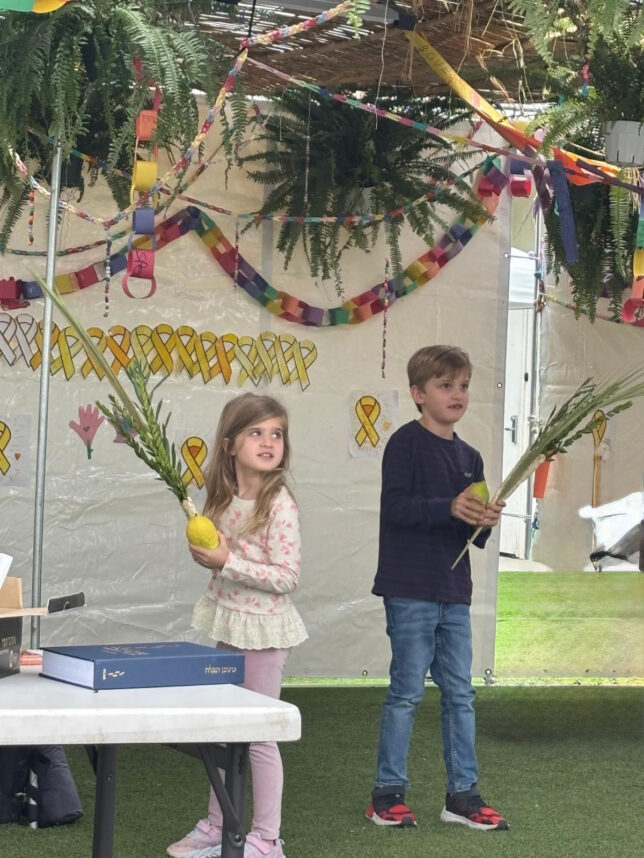
During the Festival, everyone will find something for themselves, even kids. Parents can organise time for their kids in a nice way by enrolling them to workshops. Children learn most quickly through playing, which I experienced during yesterday’s workshop. Its theme was related to the Jewish house. First, the children gathered by a table which was a mini-exhibition of the most important every day life objects for a Jewish household. Among them one could see a mezuzah, a menorah, a kippah, a Chanukah candle, a wine goblet and more.
Additionally, a short multimedia presentation allowed further understanding. The children learned what a real Jewish kosher kitchen looks like, which dishes are neutral, meat or milk, what preparations the woman of the house does before the Sabbath and Passover. Amidst children shouting, as a volunteer, I watched over the order of art works and the general atmosphere of the workshops. I did it with pleasure, especially because I have a pedagogical background. The kids’ task was to draw a Jewish house and place a blessing inside, usually on a wall or in a window. The exhibition of over thirty pictures was impressive and each of them was really original. The workshops finished with a common singing and dancing to Israeli music. Popper’s synagogue, currently closed, is a vital cultural centre and during the year it often hosts similar workshops. When I was passing it a few days ago, I saw that in the temple’s garden a cycle of art workshops dedicated to Janusz Korczak took place. Both the children reading Kaytek the Wizard and the parents analysing his pedagogical benefited.
These meetings allowed the participants to learn innovative art techniques such as cottage, frottage or dripping. I can say that children bring me happiness and cheer me up like a bar of chocolate. The endorphins level increased significantly and the bad luck which haunted me for the last two days finally disappeared. I considered attending an interesting lecture. This time Paweł Smoleński, dr Stanisław Krajewski, Konstanty Gebert and prof. Shlomo Avineri discussed in the Center for Jewish Culture about Israel’s expectations of the diaspora and the diaspora’s of Israel. However, I did not stay for the discussion as I wanted to watch the workshop of Yemeni jewelry, especially because it took place at a barge moored at Bulwar Kurlandzki. Through the whole week of the “festival fever” an outstanding Israeli artist, Ben Zion Davis, has been presenting precisely the process of manufacturing particular elements of the jewellery. On the barge, the jewelry is available to buy as well.
I must admit, however, that it is not one of the cheapest souvenirs for purchase. Each madame who possesses it will attract jealous looks of other women. On my way to Tempel Synagogue for the concert of the Miller family I tried to look for a replica of such jewelry in our local Indian shop. Unfortunately I had no luck, at least in Poland. India is quite far from Yemen… So I contented myself with purchasing a nice tangle of turquoise beads in a promotional price which I will exchange one day for a Yemeni gem.