Sim Shalom, the prayer for peace traditionally recited at the end of the Amidah in most Jewish prayer services, will get a new interpretation when it is performed at St. Ambrose Catholic Church in West Hollywood on Dec. 4 during the Hollywood Master Chorale’s annual holiday concert, “Anticipate!”
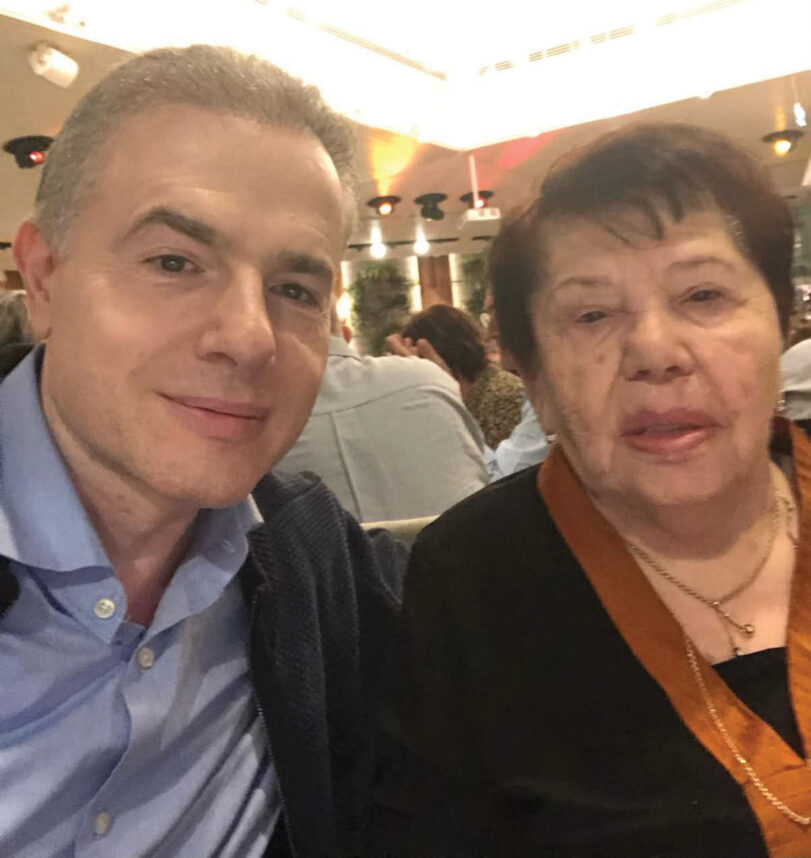
This “Sim Shalom” was composed by Michelle Green Willner, musical director of the Jewish Community Children’s Choir. “It’s a beautiful prayer for peace which is not only universal but also necessary right now,” she told the Journal. Green Willner wrote the music for “Sim Shalom” when she was an 18-year-old undergraduate at the University of Toronto.
“It sparkles with chromaticism. It sparkles with syncopated rhythm,” said Stephen Pu, artistic director of the Hollywood Master Chorale, a nondenominational choir of about 30 members. “I am very thrilled to be presenting it.”
He added, “I really think it fits the theme of ‘Anticipate!,’ the concert itself, because we are anticipating, looking forward to the time that we get to pause and create those peaceful environments for ourselves.”
The concert also will include Morten Lauridsen’s “Lux Aeterna” and Michael Isaacson’s “Light the Legend.”
Pu, who said he’s more familiar with Christmas music due to his Lutheran upbringing, admitted that Green Willner’s composition “makes me focus a little bit differently on the Chanukah repertoire, especially when we are dealing with Hebrew text. It makes me a little bit more aware, a little bit more conscientious about getting it right.”
Translating the words and getting the correct pronunciations has just been one aspect of connecting with the music, “so we don’t misunderstand anything that is critical,” Pu said. For many of the chorale members, this is the first time they are interacting with Hebrew text.
“Sim Shalom reflects all the values we need today,” Pu said. “ ‘Shalom’ is peace, but it’s more than just peace or just one kind of peace. It’s world peace, it’s inner peace, it’s peace with oneself and it’s peace with others.”
The late Rabbi Herschel Matt once tried to translate the word “shalom” to no avail. “Shalom means ‘peace,’ of course, but it means so much more, as well,” he wrote before compiling a prolific list of alternative translations. “And even all of these together do not spell out sufficiently the meaning of shalom. But though we cannot accurately translate or adequately define shalom, we can experience it.”
It’s up to the music, then, to translate that experience.
“It’s very danceable and I can’t help but move my body when I hear it,” Pu said of Green Willner’s “Sim Shalom.” “It’s very rhythmically driven and melodically driven … it’s even jazzy in that way.”
Green Willner’s piece gets off to a big, unapologetic start and continues for about five toe-tapping minutes. It has moments of reflection, but overall it’s a celebration. “When I wrote it, I wanted it to be fun for my peers to perform,” Green Willner said.
On the night of the concert, Green Willner will be in Philadelphia for Shalshelet’s Sixth International Festival of New Jewish Liturgical Music, where her version of “Maoz Tsur” will be performed.
On Dec. 18, her arrangements will be performed (including “Maoz Tsur”) at Sinai Temple’s annual “Hanukkah in Song”
concert. Recently, she composed an original piece of music for the anniversary of Kristallnacht, which was performed on Nov. 6 at the Museum of Tolerance.
“It’s so nice to know that your music is being performed here and there,” she said.
It seems fitting that her “Sim Shalom” should be performed at such an eclectic venue — in a Catholic church by a nondenominational choir.
“The text refers to values that we, as human beings, have held dear for ages and ages and ages,” Pu said. “Even just in the title of ‘Sim Shalom,’ you get a wish for goodness and wellness.”