Yesterday was the Ushpizin of Yitzchak….so let’s talk about Yitzchak.
I just finished reading a disturbing article by an Israeli Rabbinic Scholar that suggesting that the main charter trait of Yitzchak was passivity animated by complete faith in God. After all, when Avimelech tell Yizchak to leave, instead of putting up a fight he moves on and when the shepherds of Gerar claimed the wells Yitzchak had dug as their own, again, instead of defending his rights, he moves on to dig wells elsewhere.
As opposed to Avraham who argued with Avimelech in defense of the wells that he had dug, Yitzchak is passive.
The author also suggests that the reason the binding of Yitzchak is considered a test for Avraham and not a test for Yitzchak is because Yitzchak was so committed to God that he exhibited complete selflessness.
After all, since God is ruler of the world and is constantly directing everything that happens here on earth, how dare a humkan being step in to try and change God’s reality.
The author paints a picture of Yizchak who seemingly is willing to accept every aspect of this world without any initiative. The author praises this approach as one that should be emulated.
Most Morethodox Jews do not live their lives in accordance with this approach. Most do not simply acceot the worlkd as it is and most do not live in accordance with the view that God comtral everything all the time.
What gives us the right to think and live this way?
While much has been written on this subject, I will share with you the view of the Maharal.
While he does not address Yitzchak directly, you will see his fundamental disagreement with the passive approach.
The Maharal is chapter 61 of Gevurot Hashem offers an explanation as to why the Gemara likens a person who says Hallel everyday to a blasphemer.
The Maharal explains that Hallel is a praise of God in recognition of his direct and obvious involvement in the world. The problem is that evil exists in the world. If God were consistently “pulling the strings” then the existence of evil would lead one to conclude that God cannot overcome evil. Such a conclusion is indeed blasphemous.
The Maharal is left to conclude that world runs in according to convention and that God only steps in to do the miraculous at certain times.
The fallout of the approach suggested by our anonymous author is disastrous. If we all lived in accordance with his vision of Yitzchak we would simply accept the world as we see it. After all, if each event that happened to Yitzchak was ordained by God then how dare Yitzchak fight it? On the other hand, if the world operates according without the direct and constant providence of God then when something is perceived as wrong, I am obligated to make it right.
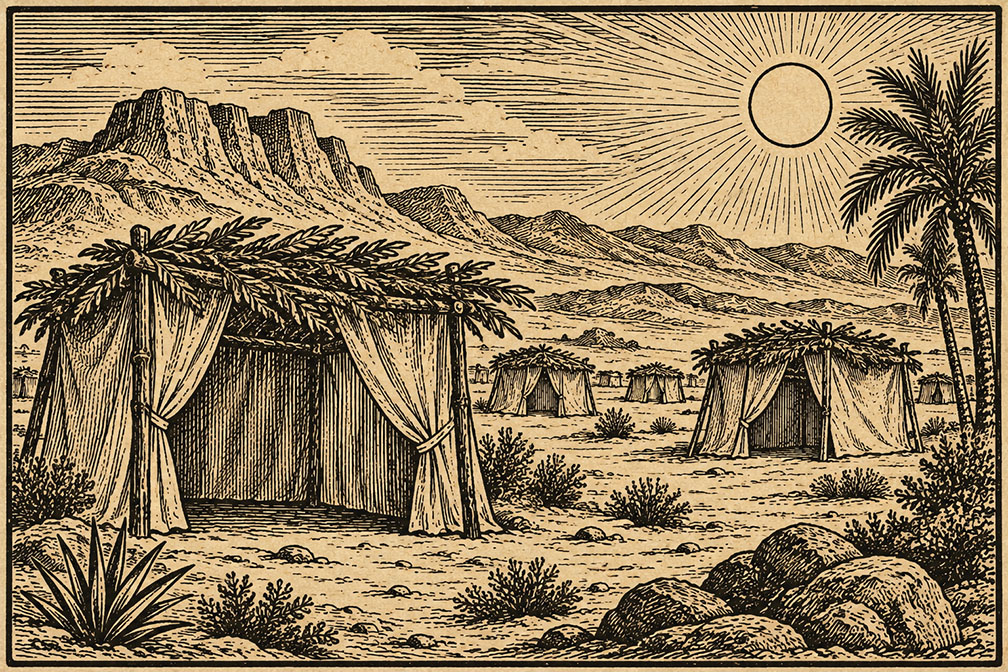
We say Hallel on Sukkot because we are celebrating a time in our history that cording to our tradition, God did step in (Exodus from Egypt and Clouds of Glory) to directly control events. Next week we will not say Hallel in recognition of our responsibility to pick up where God left off.
Perhaps this is one of the messages of Sukkot – we are to leave our homes and go out into the world to see what is wrong so that we can spend the rest of the year fixing it.