America’s most iconic highway is celebrating its centennial, and the adventure starts in Chicago. From a historic Art Deco hotel to a new presidential center, an immersive magic experience and the open road beyond the city, there are plenty of reasons to make this fall the time to explore.
In America, the road trip is more than a way to get somewhere. It is a promise: a highway stretching toward the horizon, a town you didn’t plan to visit, a roadside sign that makes you pull over and a story you couldn’t have found by staying home.
In 2026, one of America’s most famous highways turns 100. Route 66 has carried generations of travelers from Chicago toward the Pacific, earning its nickname, the Mother Road, along the way. You don’t have to drive all 2,448 miles to celebrate. Start in Chicago this fall, explore the history behind the highway and discover a city with plenty of reasons to stay awhile before heading west.
I’ve enjoyed visiting Chicago, including when I spoke at the Travel & Adventure Show, but there is still so much more of this great city I want to explore. As I work toward my goal of 60 new experiences before turning 60, the Route 66 centennial feels like the perfect reason to return. I can’t wait to stay at Pendry Chicago, visit the Obama Presidential Center, experience The Hand & The Eye and discover more of the city before driving a stretch of the legendary Mother Road myself.
A road trip doesn’t have to mean weeks away or thousands of miles behind the wheel. Sometimes the best adventure begins with a long weekend, a great hotel and a list of places you’ve been meaning to see. Chicago offers all that and more, with the added excitement of celebrating a century of American travel.
Why Route 66 Is Called the Mother Road
To understand the fascination with Route 66, go back to the 1920s, when America was falling in love with the automobile. Cars were changing how people lived, worked and traveled, but the nation’s roads were still a patchwork of local and state routes. A connected highway system promised to make longer journeys easier and bring new opportunities to communities along the way.
Route 66 was officially designated on November 11, 1926. It brought together existing roads into a route of roughly 2,448 miles from Chicago to Los Angeles, later celebrated at Santa Monica’s Pacific Coast endpoint. Its diagonal path connected the Midwest with the Great Plains and the Southwest, passing through eight states. The road was not fully paved until 1938.
The highway offered more than a route west. For towns that had been far from major transportation corridors, it brought the possibility of new customers and commerce. Gas stations, restaurants, motor courts and roadside attractions sprang up to serve the people traveling through.
Then history gave the road a much deeper meaning.
During the Dust Bowl and the Great Depression, families left devastated farms and struggling communities to search for work and a better future in the West. Many traveled Route 66 toward California. John Steinbeck’s 1939 novel The Grapes of Wrath helped cement the highway’s place in the American imagination, using the nickname “Mother Road.”
The name captures the road’s complicated history. For some travelers, Route 66 was a road of escape and survival. For others, it became a road of family vacations, freedom and discovery. After World War II, as car ownership and leisure travel grew, its motels, diners and roadside attractions became symbols of a new era of American mobility.
Eventually, the Interstate Highway System diverted traffic away from much of the original route. Route 66 was officially decommissioned as a U.S. highway in 1985, but its story was far from over. Preservation efforts, historic businesses, popular culture and generations of road trippers kept the Mother Road alive.
A hundred years after its designation, Route 66 still speaks to something many of us want: the chance to explore at our own pace, find the unexpected and make a journey our own.
Chicago: Where the Journey Begins
Chicago was a natural starting point for Route 66. In the 1920s, it was a major transportation crossroads, connecting railways, waterways, industry and the expanding automobile network. Travelers heading west could leave the city and follow a route linking urban centers with rural communities across the country.
For the traditional Route 66 photo, head to the historic starting-point sign near Adams Street and Michigan Avenue, across from the Art Institute of Chicago. This is the familiar downtown location associated with the route’s beginning for generations of travelers.
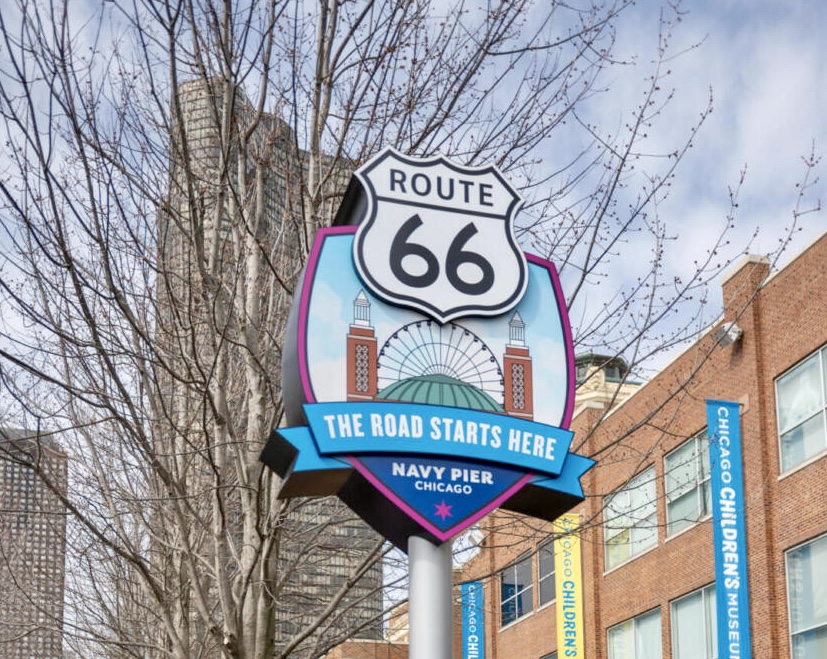
For the centennial, Chicago is also celebrating a new ceremonial starting point at Navy Pier, which stretches out into Lake Michigan. The pier’s Route 66 marker creates a symbolic “pier-to-pier” connection with Santa Monica Pier at the western end of the journey. Visiting both downtown and Navy Pier offers two different ways to mark the beginning of the Mother Road’s next century.
At Navy Pier, walk along the lakefront, enjoy the skyline and explore the attractions. The views of Lake Michigan offer a reminder that Chicago’s identity is tied as much to its waterfront as to its highways and railways. The city is both a destination and a gateway to a much longer adventure.
But don’t rush off to the highway just yet. Chicago deserves more than a quick photograph before you leave town.
Art, Architecture and a Little Chicago Wonder
Start downtown with a visit to the Art Institute of Chicago, one of the city’s great cultural treasures. While you’re there, look for Edward Hopper’s Nighthawks. The painting’s late-night diner scene evokes a familiar American landscape: the glow of a restaurant after dark, strangers sharing the same space and the feeling that the road outside might lead anywhere.
It’s an especially fitting image to encounter before a Route 66 adventure. The highway’s story has always included the places where travelers stop, eat, rest and watch the world go by.
Chicago’s architecture deserves time of its own. Take an architecture cruise on the Chicago River to see the city’s extraordinary skyline from the water and hear how its buildings reflect changing ideas about design, engineering and urban life. Or look down on the city from the Skydeck at Willis Tower, where the scale of Chicago’s streets and skyscrapers comes into focus.
For another perspective, explore parts of the original Route 66 corridor and seek out the city’s Route 66 murals and public art. The highway was never just a line connecting two distant points. It passed through neighborhoods where people lived and worked, and where local culture shaped the road’s identity.
And if your idea of a perfect travel day includes an unexpected twist, save an evening for The Hand & The Eye.
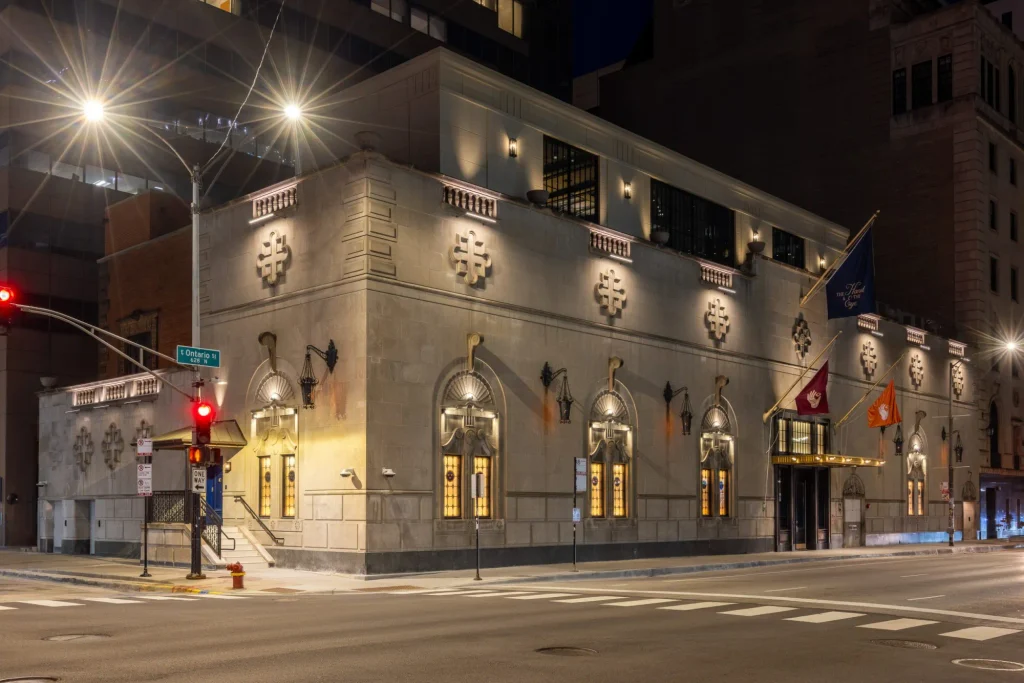
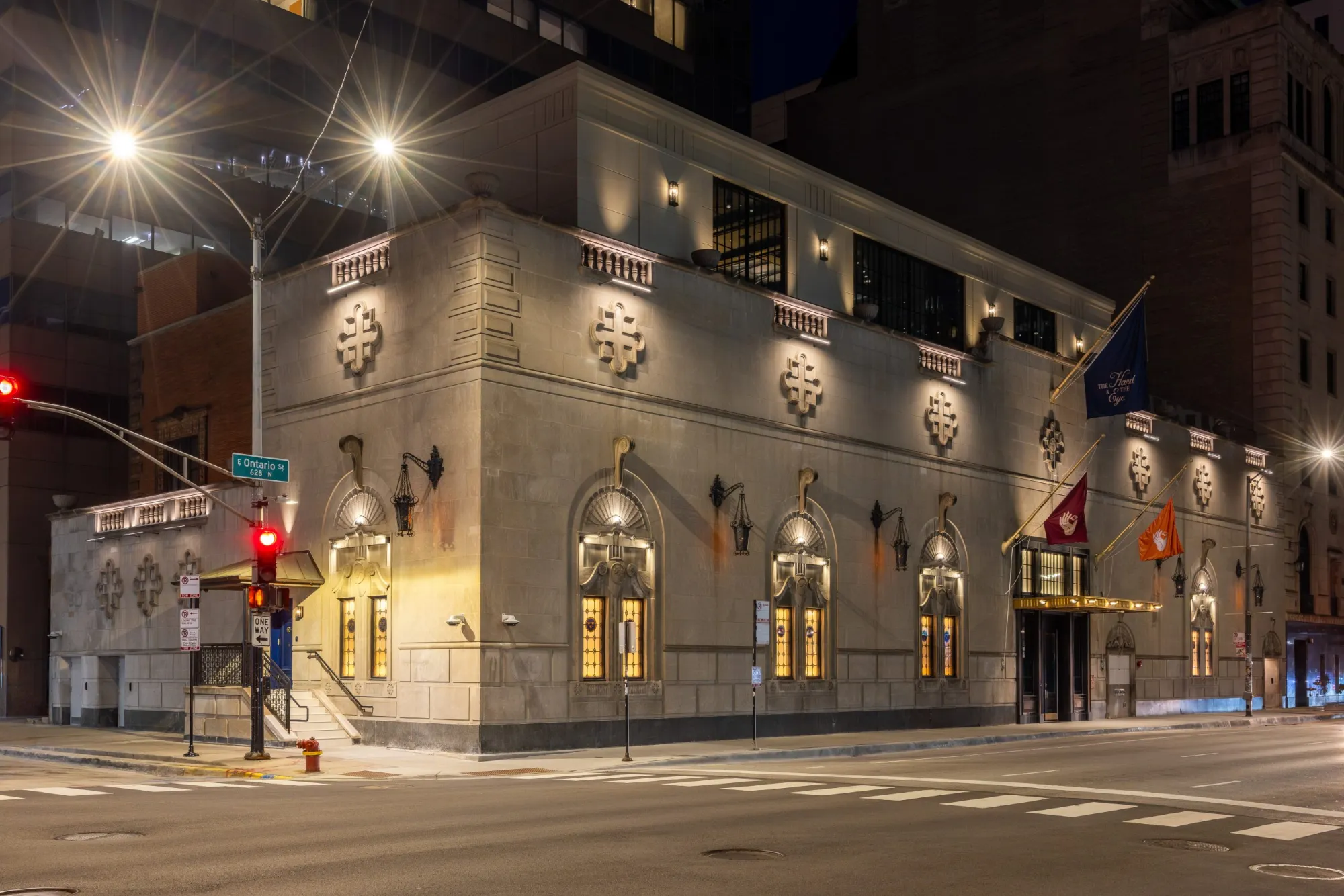
Exterior of The Hand The Eye Photo by Matthew ReevesA Historic Mansion Where Magic Happens
One of Chicago’s intriguing newer experiences is The Hand & The Eye, a destination for live magic inside the historic McCormick Mansion.
Rather than a conventional theater where everyone watches a performance from the same seat, the experience brings magic into intimate spaces throughout the mansion. The setting combines historic architecture, live performances and the thrill of not quite knowing what will happen next.
Why include a magic mansion in a story about Route 66? Because the best trips need a little wonder. Road trips are full of moments that cannot be planned: an unexpected view, a hidden gem or a stop that turns out to be the highlight of the day. The Hand & The Eye brings that spirit of discovery to an evening in Chicago. It’s on my list for my next visit, and I can’t wait to experience it for myself. Adventure doesn’t always require a long drive. Sometimes it begins when you step through an unfamiliar door.
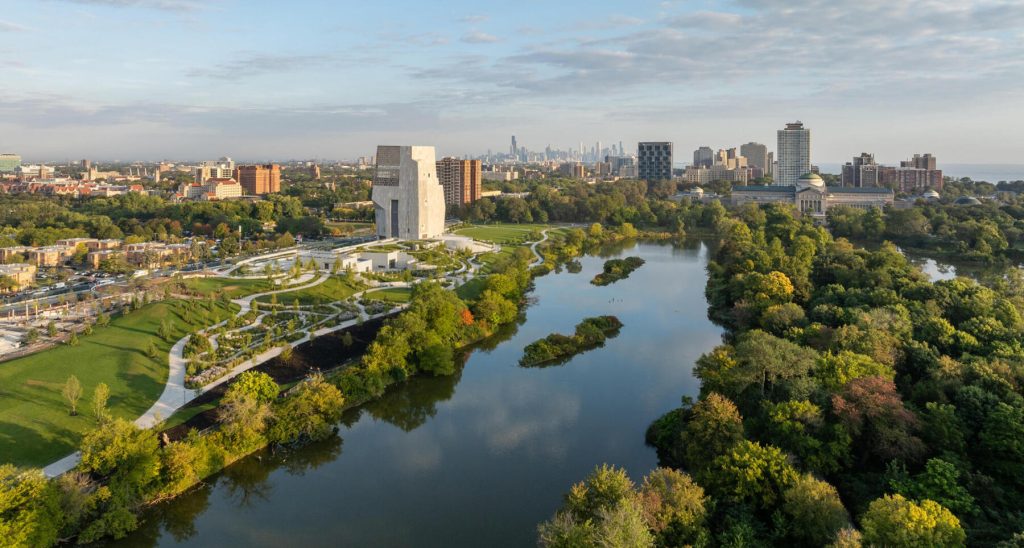
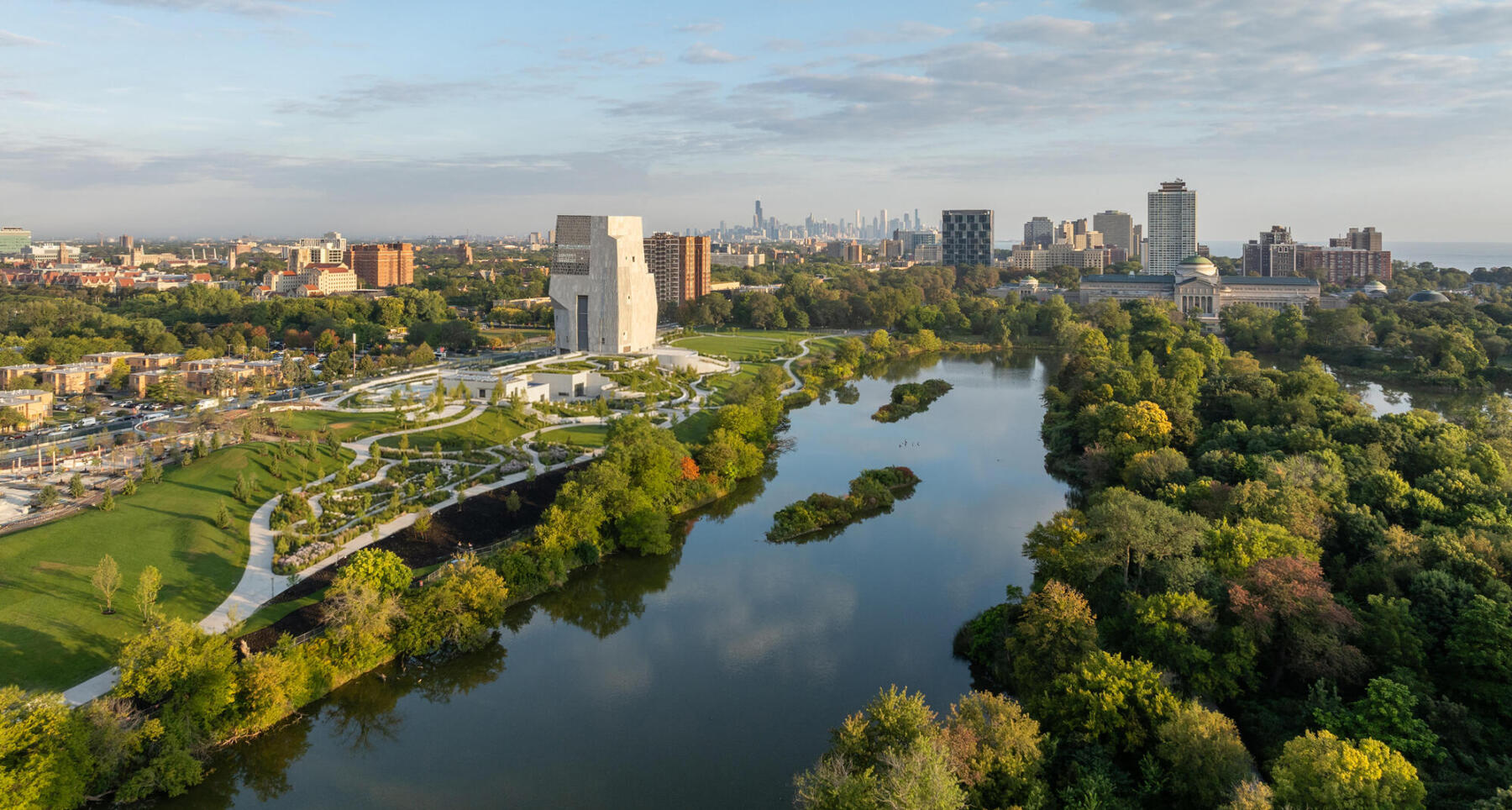
Obama Presidential Center, Photo credit: Angie McMonigalAdd a New Chapter at the Obama Presidential Center
For travelers interested in American history and contemporary culture, the Obama Presidential Center offers another reason to explore beyond downtown.
The campus in Jackson Park on Chicago’s South Side opened to the public in June 2026. Its grounds include gardens, public art, walking paths and community spaces. The museum offers a deeper look at the Obama presidency and the issues that shaped it.
The visit adds a different dimension to a Route 66-inspired trip. The Mother Road connects stories of migration, work, community and the pursuit of opportunity. The presidential center offers another place to reflect on the people and events that continue to shape the country. I cannot wait to go.
Check In Somewhere with a Story: Pendry Chicago
For a trip celebrating a century of American travel, why not choose a hotel with a history of its own?
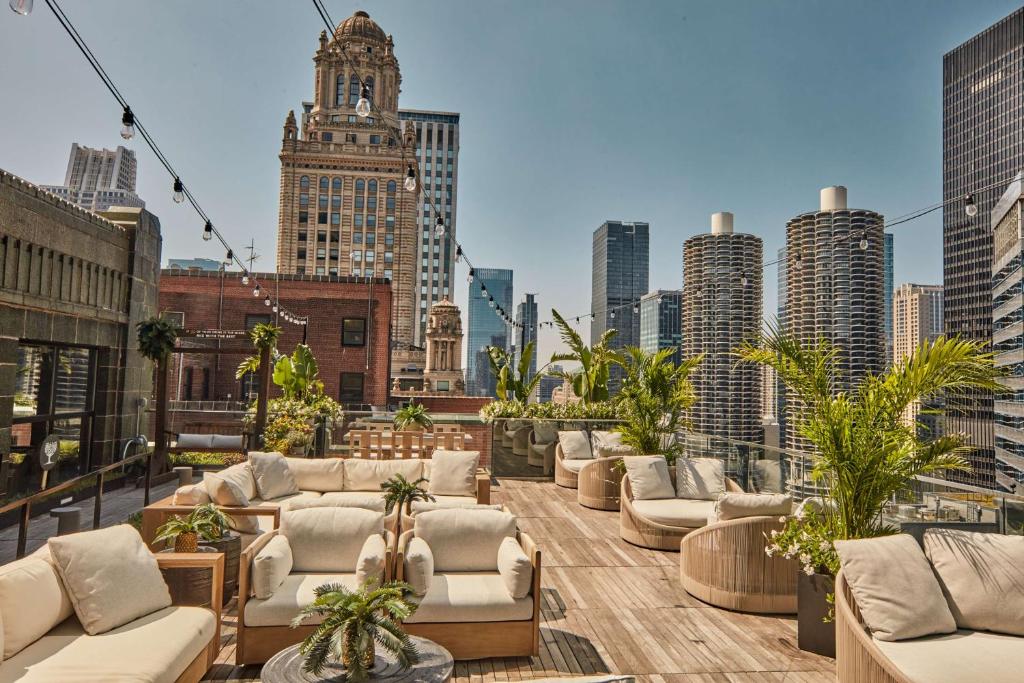
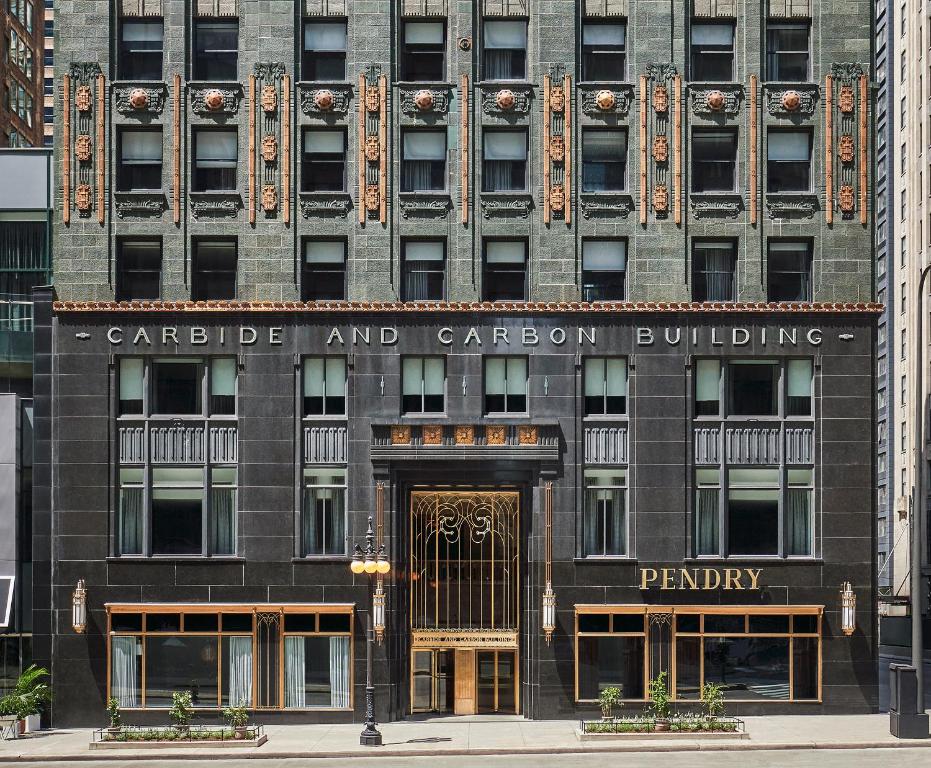
Pendry Chicago occupies the landmark Carbide & Carbon Building, a striking Art Deco skyscraper completed in 1929. Its dark-green exterior and gold accents make it one of downtown’s distinctive architectural landmarks. Designed by the Burnham Brothers, the building originally housed the regional offices of Union Carbide and Carbon Co. It was designated a Chicago landmark in 1996 and became home to Pendry Chicago in 2021.
The timing feels especially fitting: Route 66 was designated in 1926, and this architectural landmark followed just three years later. Both belong to an era when America was looking ahead, embracing new technology and imagining new ways to live and travel.
Today, Pendry Chicago combines the building’s historic character with contemporary guest rooms, dining and cocktail venues. Its downtown location on Michigan Avenue makes it a convenient base for exploring the Route 66 starting point, Millennium Park, the Art Institute and the Chicago River.
I’m looking forward to staying at Pendry Chicago and experiencing the building for myself. I love discovering the stories behind the places where I stay, and this one has a particularly fitting connection to the Route 66 centennial. The hotel itself is part of the city’s architectural story.
Travelers can compare dates, room types and rates on Booking.com, or explore other Chicago accommodations to find a stay that fits their style and budget.
Start Planning Your Route 66 Centennial Getaway
You don’t have to wait for the perfect summer road-trip window to start exploring. Fall is an opportunity to plan a Chicago city break, enjoy the city’s architecture and cultural attractions, then decide whether to extend the adventure along historic Route 66.
I’m already thinking about how I’d put the trip together: a stay at Pendry Chicago, time to explore the Obama Presidential Center, an evening at The Hand & The Eye and visits to both Route 66 starting-point landmarks. I am going to rent a car and follow the Mother Road, stopping along the way rather than rushing toward the next destination.
Booking.com was named the Official Travel Partner of the Route 66 Centennial in 2026, spotlighting the highway and the stays and experiences that make a road trip memorable. Its platform offers travelers a way to compare accommodations, car rentals and travel options while putting together an itinerary.
Here are four ways to get started.
Find your stay. Compare hotels in downtown Chicago, considering location, amenities and how much time you want to spend exploring on foot. Pendry Chicago is one option for travelers drawn to historic architecture and a central base. Browse Pendry Chicago on Booking.com or search for other stays to compare your options.
Book your flight. Chicago is served by O’Hare International Airport and Midway International Airport. Compare arrival times and fares, then choose the airport that works best for your itinerary and budget. If you’re staying downtown, consider the transportation options from the airport before deciding whether you’ll need a car immediately.
Choose your experiences. Reserve timed-entry attractions in advance, especially if visiting the Obama Presidential Center museum or The Hand & The Eye. Consider an architecture cruise, a museum visit and a walk along the lakefront, leaving some unplanned time for discoveries. Check official attraction websites for current schedules and ticket availability.
Rent a car when you need one. If your trip is focused on Chicago, you may not need a vehicle for the whole visit. The city’s downtown attractions are close enough to explore on foot in many cases, and public transportation and rideshares can help with longer trips. If you’re continuing along historic Route 66, compare rental options and consider picking up a car when you’re ready to leave the city.
Booking.com announced its centennial partnership in February 2026, making the milestone an especially timely opportunity to plan a trip around the Mother Road. You can read more in the company’s Route 66 Centennial announcement.
The most important part of planning is leaving room for spontaneity. Make reservations for the experiences you don’t want to miss, but don’t fill every hour. The unexpected stop is often the one that becomes your favorite memory.
How Far Will You Go?
The beauty of Route 66 is that you can make it your own.
Maybe you’ll spend three days in Chicago, take photographs at both starting points, discover a new favorite painting, look out over the city from a skyscraper and spend an evening watching magic unfold in a historic mansion. Perhaps you’ll rent a car and follow the original route through Illinois, stopping in communities that still celebrate their place in the Mother Road’s story.
Or maybe Chicago will be the beginning of a much longer journey, one that takes you across the plains, through the Southwest and toward the Pacific.
You don’t have to complete all 2,448 miles to understand why this highway has inspired travelers for 100 years. You just have to experience a little of its history and imagine the journeys that began before yours.
Route 66 has carried families searching for a fresh start, vacationers chasing summer, musicians and artists, curious travelers and people who simply wanted to see what lay beyond the next bend. Its meaning has changed over the decades, but its invitation remains the same: get out there and explore.
I’m ready to start planning my own Chicago adventure as part of my 60 Before 60 journey. Between the history of the Mother Road, the architecture of Pendry Chicago, the Obama Presidential Center and the promise of an evening filled with magic, there is plenty to look forward to before even getting behind the wheel.
A hundred years after Route 66 first appeared on the map, the invitation still stands. Start in Chicago, follow the stories, take the detour and see where the road leads. You can travel all the way to California or simply begin with a fall weekend in the city where the journey starts.
The first mile is waiting.
Read more in Route 66 Gets a Hollywood Rewrite
Israeli President Isaac Herzog awarded the Presidential Medal of Honor to Israel Bonds at a ceremony on Oct. 12 at the president’s residence in Jerusalem. Andrew Hutter, Israel Bonds’ U.S. and international chairman of the board of directors, and Dani Naveh, Israel Bonds’ global president and CEO, accepted the honor on behalf of the organization.
More than 100 members of Israel Bonds’ global leadership attended the ceremony, including representatives from the United States, Mexico, Canada, the United Kingdom, Germany and Brazil.
“The proceeds from Israel Bonds have been used to build and develop our economy, to promote advancements in science and technology and to provide a vital network of support during times of crisis,” Herzog said. “This has never been more evident than during the past few years of uncertainty, loss, and courage, here in Israel, since Oct. 7.”
Hutter, an orthopedic surgeon in New Jersey, was elected chairman in February 2024, following more than two decades of involvement with Israel Bonds. He began in leadership roles in metro New Jersey, later co-founded the organization’s national medical division and led medical delegations to Israel. Before becoming chairman, he served as vice chairman and treasurer of the board. He has also chaired Israel Bonds’ Mentorship Program, helping develop its next generation of leaders.
Naveh is a former Israeli cabinet minister, a member of the Knesset and a prominent figure in the Israeli business and financial community.
Since 1951, Israel Bonds and its worldwide affiliates have raised capital for the State of Israel through the sale of Israel bonds, serving as a bridge between global investors and Israel.
Individuals and institutions around the world invest in Israel bonds to support Israel’s economic development.
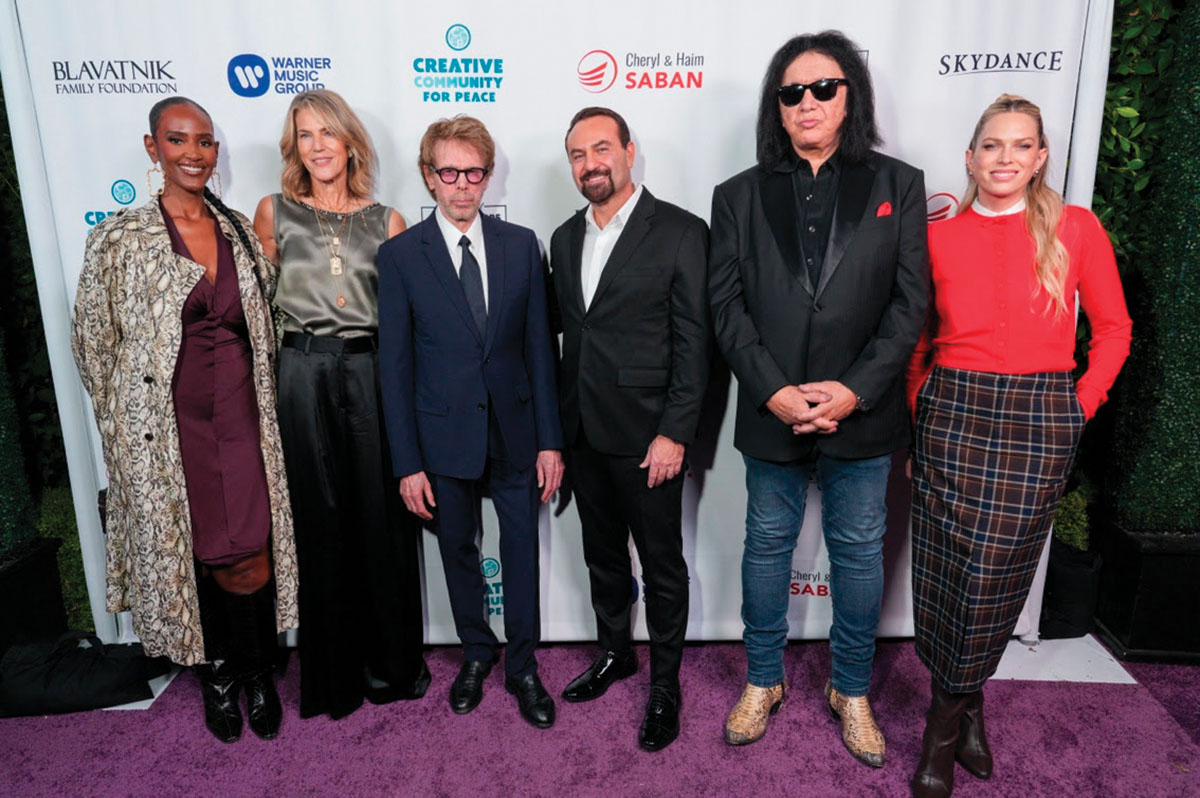
Ethiopia Habtemariam, Lynn Harris, Jerry Bruckheimer, Kevin Weaver, Gene Simmons and Erin Foster. Photo by Presley Ann, Courtesy of Creative Community for Peace
Creative Community for Peace (CCFP), an entertainment industry non-profit, held its eighth annual “Ambassadors of Peace” (AOP) event, which honored industry leaders for their commitment to speaking out against hate and using arts and culture to bring people together.
This year’s honorees were rock icon and Kiss co-founder Gene Simmons; producer Erin Foster (“Nobody Wants This”); Kevin Weaver, president of Atlantic Music Group; producer Lynn Harris (“Clayface,” “Se7en”) and music executive Ethiopia Habtemariam.
The event was held at the Beverly Hills residence of Aton Ben-Horin, executive vice president of A&R at Warner Music Group, and CEO of Plush Management.
Artists and entertainment leaders from across the industry were in attendance, including Jerry Bruckheimer, David Foster, Haim Saban, Jody Gerson, Harvey Mason Jr., Elliot Grainge, Gary Barber, Perry Farrell, Lawrence Bender, Emmanuelle Chriqui, Tom Corson, Val Blavatnik, Michael Rotenberg, Mark Beaven and David Zedeck, among many others.
Previous “Ambassadors of Peace” honorees include Eugene Levy, Diane Warren, Liev Schreiber and Scooter Braun. Many previous honorees were in attendance this year.
Among those paying tribute to this year’s honorees were actress Shannon Tweed-Simmons, Kiss co-founder Paul Stanley; producer Jerry Bruckheimer; and CCFP Chairman and Co-Founder David Renzer.
“Slogans are not solutions and we have to remember that they have real consequences,” Renzer said. “We must emphasize facts over misinformation, context over caricatures, debate over demonization, human dignity over hatred.”
“The strength of CCFP comes from the members of the entertainment industry who care about standing against hate,” CCFP Executive Director Ari Ingel said. “In an industry that celebrates diversity we cannot stay silent when Jewish and Israeli creatives are being excluded.”
The evening also featured heartfelt speeches from the honorees.
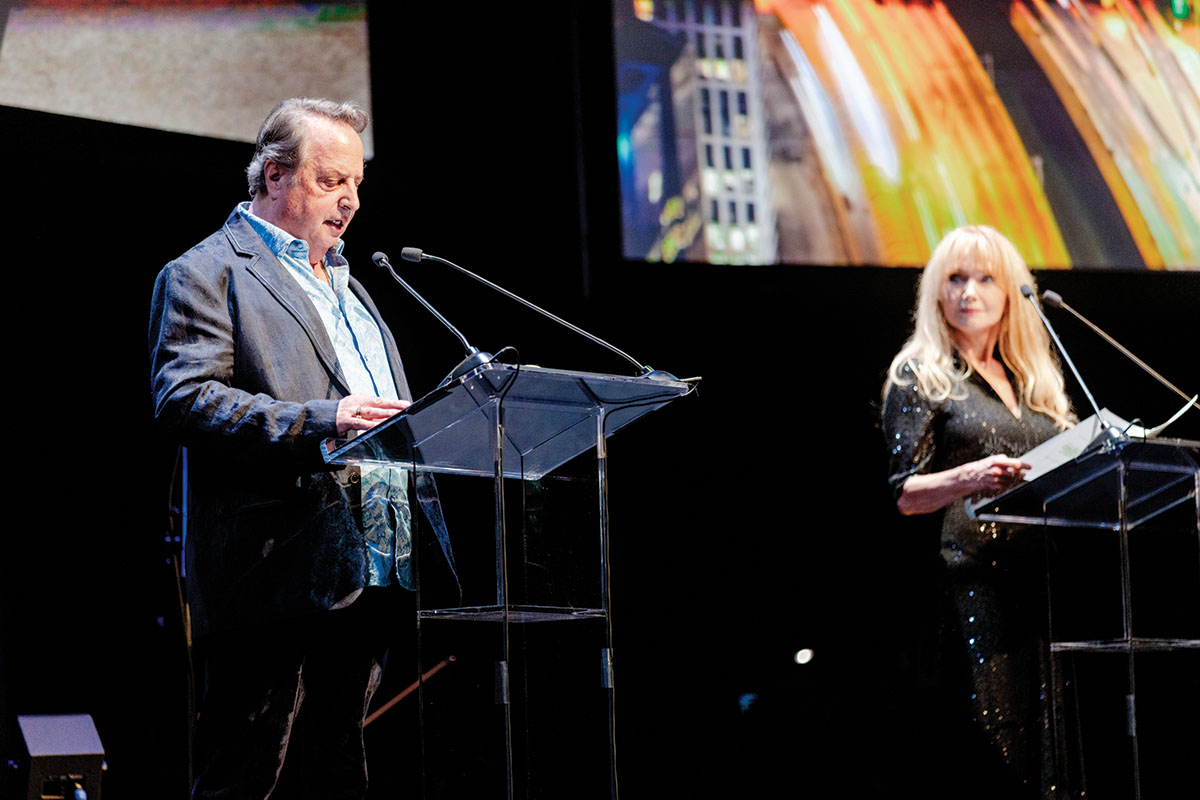
Jon Lovitz and Rebecca De Mornay Photos by @tatsu.cinema
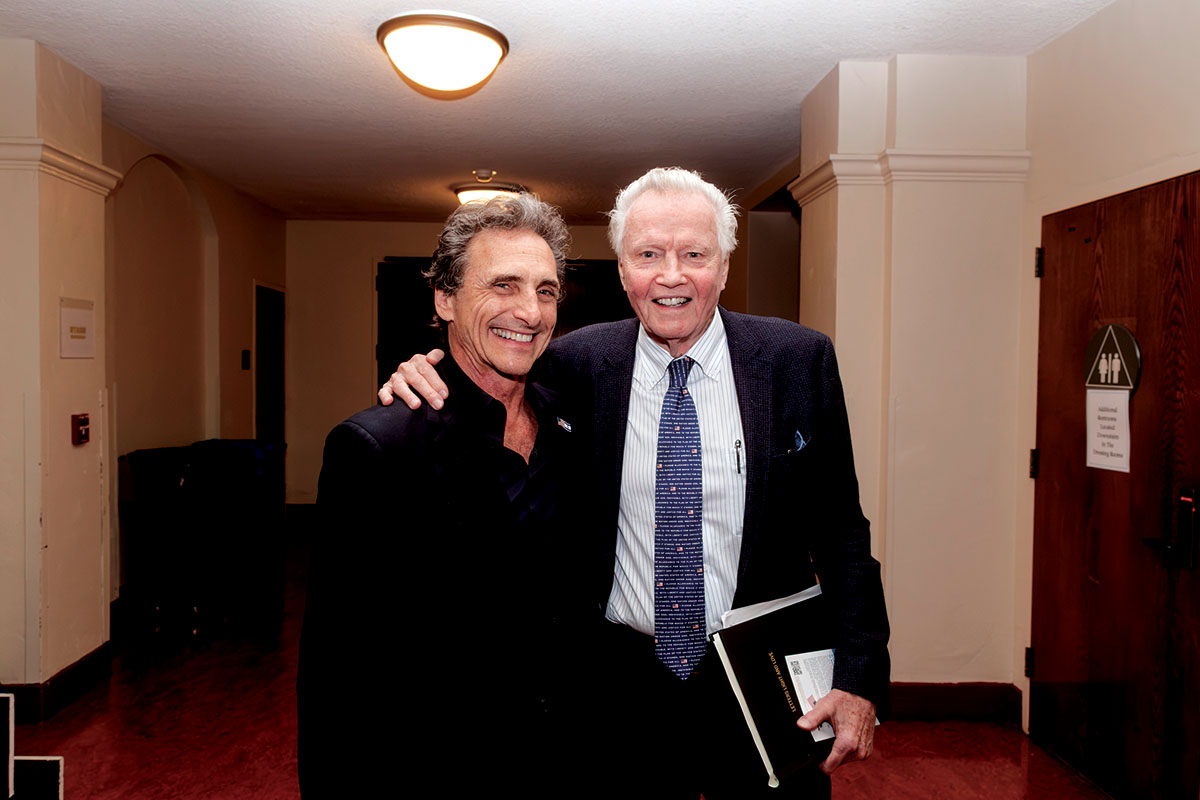
On Oct. 19, Hollywood celebrities participated in “Letters, Light and Love,” a stage production underscoring the centuries-old connection between Jews and the land of Israel. The event featured actors, musicians and others reading letters authored by historical figures as well as ordinary people that tell stories of Zionism and Jewish self-determination.
The star-studded cast at the event — held at UCLA’s Royce Hall—included actors Dustin Hoffman, Bob Odenkirk, Jon Lovitz, Jon Voight, Marlee Matlin and Emmanuelle Chriqui; musicians Gene Simmons and David Foster; producer Sherry Lansing; comedian Elon Gold; and UCLA Chancellor Julio Frenk.
Former hostage Eliya Cohen, who was held in captivity by Hamas for 505 days, and his wife, Ziv Abud, also turned out, garnering a standing ovation from the sold-out crowd.
The event raised funds for the Sha’ar HaNegev Resilience Center, an Israel-based organization. The center provides emotional and therapeutic support for those whose lives were forever impacted by the Oct. 7 attacks.
Michal Noe and Sarah Sultman produced the show along with producer Lawrence Bender (“Inglourious Basterds”) and L.A. County District Attorney Nathan Hochman as well as Jewish Federation Los Angeles. The show was staged with different casts in London and at Carnegie Hall in New York before coming to Los Angeles.
Sultman, who is based in the U.K., conceived of the show after visiting communities impacted by Oct. 7, 2023.
“Letters have a particular honesty,” Sultman said. “They capture people in the act of being human, hopeful, frightened, funny and loving. At a time when Jewish identity, Jewish history and even our right to tell our own story are being challenged, it feels more important than ever that we reclaim these voices and allow them to be heard.”
Lawrence Bender and Jon Voight at “Letters, Light and Love”
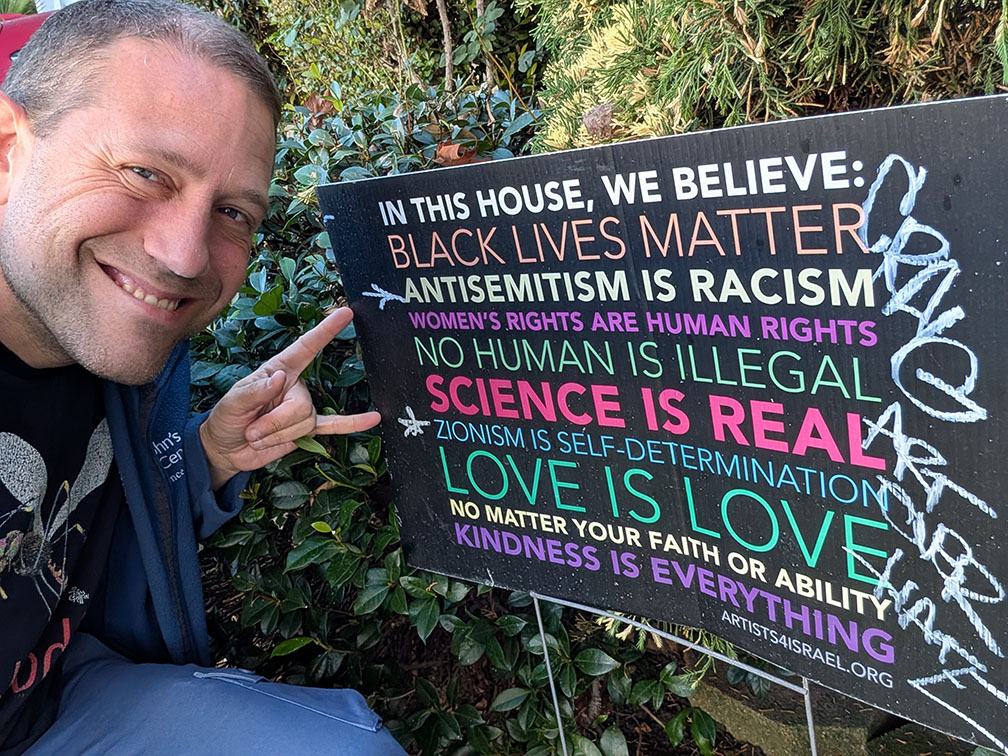
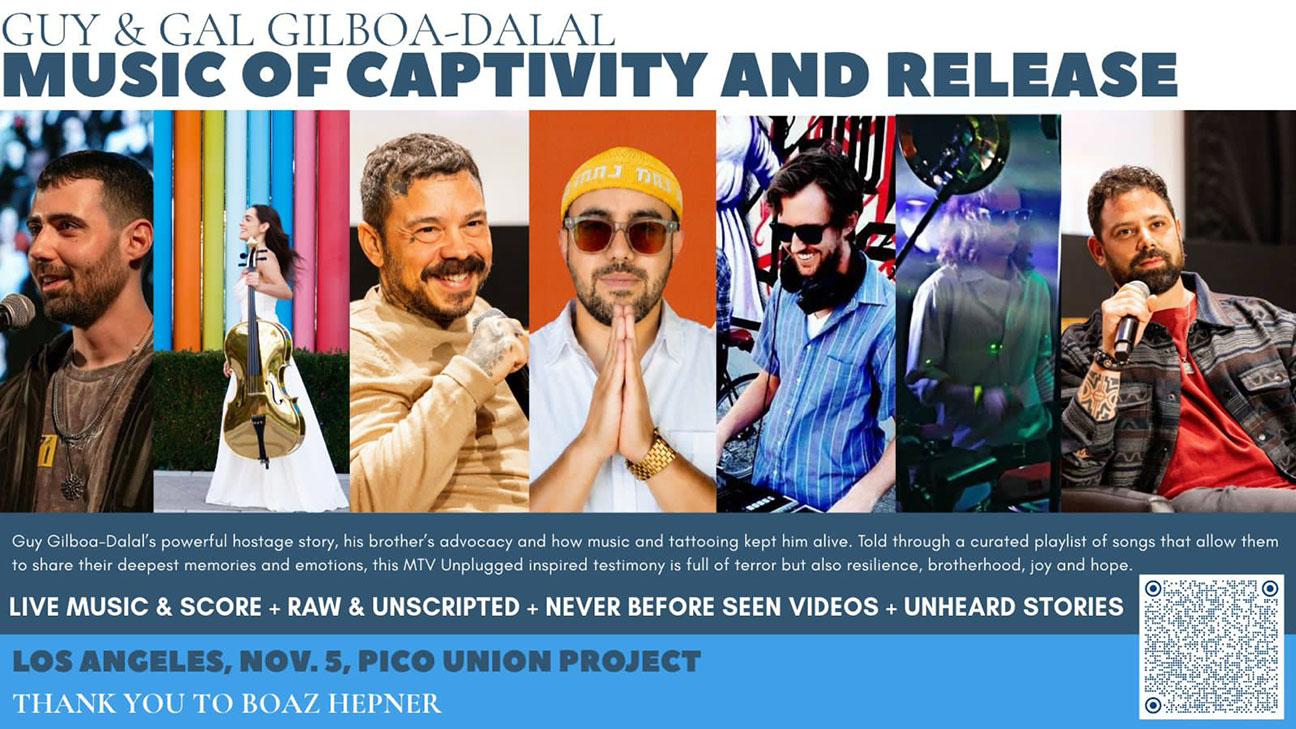
The following is a two-part spotlight of Craig Dershowitz, CEO of the Art Over Hate Collective. Part one will discuss his unique twist on familiar signage. Part two will invite the general public to a unique event with a hostage and his brother.
PART ONE
What does a musical event with a hostage, a Genizah event for posters, and the sign in front of my house have in common? This man, Craig Dershowitz.
His organization Art Over Hate Collective sets aside politics and brings people together worldwide with artwork that largely supports mental health.
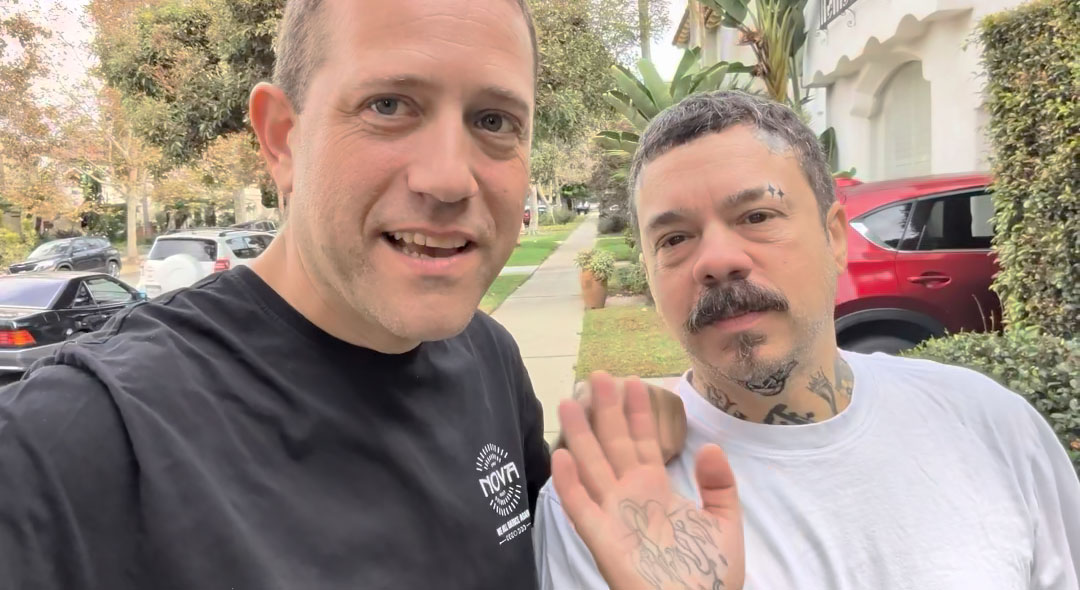
Two brothers at the Nova Festival. One taken hostage. Both survive to tell the tale; told with a DJ and music inspiring the memories.
In part two of this spotlight, Craig Dershowitz tells me about his unique events in Los Angeles, San Diego and Chicago. No politics, just humanity. And I have the comp to get you in for free.
If you would like to attend the event in Los Angeles, San Diego or Chicago, please use the QR code above, or visit: https://www.artoverhate.org/survival
Boaz Hepner works as a Registered Nurse in Saint John’s Health Center. He moonlights as a podcaster, leading a large, friendly, bipartisan gathering on Zoom, allowing everyone to speak freely, just as if they were at a Shabbat table. He is a Pico/Robertson native, where he has led an annual neighborhood cleanup since 2009. He enjoys spending time with his wife Adi and children Natalia and Liam, and pursuing his passions of movies, poker and traveling.
And his concubine, whose name was Reumah, had also given birth to Tebah and Gaham and Tahash and Maacah. ~ Genesis 22:23
We want the best for our children –
a life well lived and accomplishments
greater than our own.
Does any of it matter if none of it
is written down? The twelve sons of Nahor,
born from a wife and a concubine
(it was a different time) are never heard from
again after their listing here. They must have
had lives and wives and possessions
and things they were proud of. They could
have been the backup twelve if Jacob’s sons
didn’t get a musical written about them.
Only Bethuel gets some credit for branching
three matriarchs on our family tree. I have
a vague memory of his name in a song.
That’s what I want for my son – for his name
to appear in songs. Maybe that’s already happened. Maybe is a deceptive word here.
Let the written archives that people
pull out of electronic caves in two millennia
tell his stories. We’ll skip the concubines
next time down. We’ll make detailed notes
on all the comings and goings. We’ll mention
everyone by name.
Rick Lupert, a poet, songleader and graphic designer, is the author of 30 books including “Begin the Beget” and “God Wrestler: A Poem for Every Torah Portion.” Visit him at www.JewishPoetry.net
Advancing up the Thames the Saracens
might well have circumcised the Brits,
quite helpless in their island garrisons,
defeated in this battle of the wits.
As Edward Gibbon wittily declared,
if that had happened Oxford would be teaching
Quran, not science, PPE and Greats,
and clerics in the mosques would all be preaching
about the virgins at the Pearly Gates
who welcome those who self-destruct on missions
that Allah and his Prophet see with favor,
establishing their fashions and traditions,
forbidding trimming of a beard with any shaver,
although perhaps allowing girls to use
this instrument for armpits and the legs.
If this had happened we would all refuse
today to order bacon with our eggs,
to Jews and Muslim pork forbidden,
Muslims being Abrahamic Sarah’s kin,
of Saracens a root long hidden,
although the calendars of both begin
with exodus commemoration, Israel’s first month recalling the Israelite
exodus from Egypt echoing the hegira
when Muhammad escaped from the might
of Mecca, Hagar’s hegira the inspirer
of the eras by Muslims who by recalling Hagar’s hegira are by her hegira as enthused
as Israelites whose eras commemorate their escape from Egypt. Hagar’s escape
from Sarah’s house in Canaan was a hegira that cannot be excused
by lack of evidence such as a videotape,
since many Torah verses link their ancestors’ oppression.
Hagar’s flight from Sarah foreshadows Israelites’ flight from Egypt. When Sarah oppressed her,
she did so not only by means of slavery, Hagar’s profession,
but sexual service, like performed for King Ahasuerus in his harem Esther.
Links of the term “hegira,” the term for Muslim eras, causes a connection
between the calendars of the Muslims to that used by Jews , both biblically based
on the release from an oppression of their founders, opposing the rejection
which founders of both faiths historically faced,
Islam when Hagar fled from Sarah, who would hate her,
after enabling her to give birth to the Muslims’ founder, Ishmael,
the son who’d Isaaced Isaac, having encouraged Abraham to mate her,
causing her to flee oppression in Hagar’s hegira which precedes Israel’s from Egypt in a later Bible tale.
Although the term “hegira” is commonly based on a flight to Mecca made by Mohammed from Medina,
this verse reflects the fact that on the way the term recalls Hagar’s flight from Sarah and Abraham keener.
Gen. 16:6 states:
וַיֹּ֨אמֶר אַבְרָ֜ם אֶל־שָׂרַ֗י הִנֵּ֤ה שִׁפְחָתֵךְ֙ בְּיָדֵ֔ךְ עֲשִׂי־לָ֖הּ הַטּ֣וֹב בְּעֵינָ֑יִךְ וַתְּעַנֶּ֣הָ שָׂרַ֔י וַתִּבְרַ֖ח מִפָּנֶֽיהָ׃
וַיֹּ֨אמֶר אַבְרָ֜ם אֶל־שָׂרַ֗י הִנֵּ֤ה שִׁפְחָתֵךְ֙ בְּיָדֵ֔ךְ עֲשִׂי־לָ֖הּ הַטּ֣וֹב בְּעֵינָ֑יִךְ וַתְּעַנֶּ֣הָ שָׂרַ֔י וַתִּבְרַ֖ח מִפָּנֶֽיהָ׃
And Abram said to Sarai, “Your maid is in your hands. Deal with her as you think right.” Then Sarai oppressed her, and she fled from her.
Sarah’s oppression of Hagar, which Abraham does not oppose, explains the oppression of the Israelites in Egypt which God predicts to Abraham in Gen. 15:13:
וַיֹּ֣אמֶר לְאַבְרָ֗ם יָדֹ֨עַ תֵּדַ֜ע כִּי־גֵ֣ר ׀ יִהְיֶ֣ה זַרְעֲךָ֗ בְּאֶ֙רֶץ֙ לֹ֣א לָהֶ֔ם וַעֲבָד֖וּם וְעִנּ֣וּ אֹתָ֑ם אַרְבַּ֥ע מֵא֖וֹת שָׁנָֽה׃
And [God] said to Abram, “Know well that your offspring shall be strangers in a land not theirs, and they shall be enslaved and oppressed four hundred years;
Gen. 21:9 states that Sarah saw Ishmael making fun of Isaac, describing this as a bad joke that alludes to the name of Isaac:
ט וַתֵּרֶא שָׂרָה אֶת-בֶּן-הָגָר הַמִּצְרִית, אֲשֶׁר-יָלְדָה לְאַבְרָהָם–מְצַחֵק. 9 And Sarah saw the son of
Hagar the Egyptian, whom she had borne unto Abraham, metsaheq, Isaacing, making fun of him.
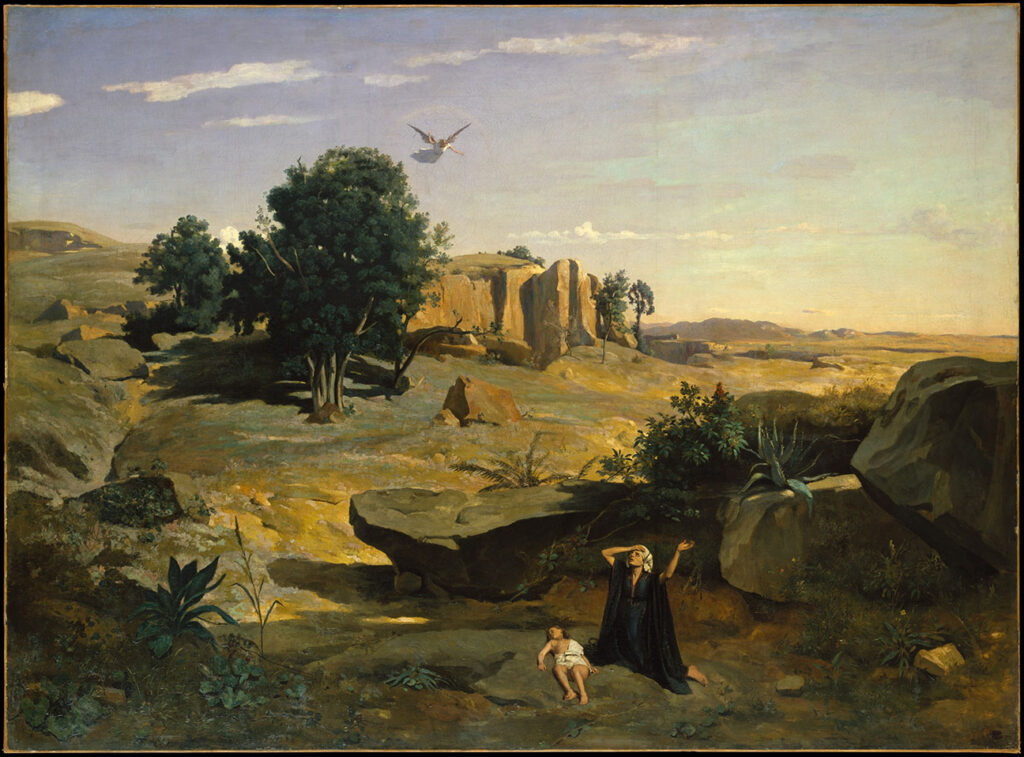
Gen. 21:15-26 describes how, in a narrative that describes what would become the origin of the Islamic calendar, the hegira, an Egyptian woman called Hagar abandons her son Ishmael, not trying to preserve his life in the way that Moses’ mother and sister tried to preserve the life of the baby whom an Egyptian princess would name Moses:
וַיִּכְל֥וּ הַמַּ֖יִם מִן־הַחֵ֑מֶת וַתַּשְׁלֵ֣ךְ אֶת־הַיֶּ֔לֶד תַּ֖חַת אַחַ֥ד הַשִּׂיחִֽם׃ And when the water was gone from the skin, she left the child under one of the bushes,
וַתֵּ֩לֶךְ֩ וַתֵּ֨שֶׁב לָ֜הּ מִנֶּ֗גֶד הַרְחֵק֙ כִּמְטַחֲוֵ֣י קֶ֔שֶׁת כִּ֣י אָֽמְרָ֔ה אַל־אֶרְאֶ֖ה בְּמ֣וֹת הַיָּ֑לֶד וַתֵּ֣שֶׁב מִנֶּ֔גֶד וַתִּשָּׂ֥א אֶת־קֹלָ֖הּ וַתֵּֽבְךְּ׃
and went and sat down at a distance, a bowshot away; for she thought, “Let me not look on as the child dies.” And sitting thus afar, she burst into tears.
Gershon Hepner is a poet who has written over 25,000 poems on subjects ranging from music to literature, politics to Torah. He grew up in England and moved to Los Angeles in 1976. Using his varied interests and experiences, he has authored dozens of papers in medical and academic journals, and authored “Legal Friction: Law, Narrative, and Identity Politics in Biblical Israel.” He can be reached at gershonhepner@gmail.com.
Abraham sits at the entrance of his tent, God appears and then, Abraham is compelled to look up. Three strangers approach, supposedly angels of God. Abraham runs towards them.
However, later in the story, when Abraham is about to take his son’s life, it takes God shouting at Abraham: Not once, but twice for Abraham to stop and pay attention.
Why are we less likely to notice those who are most important? Whether it’s when our loved ones need our intervention or when they’re trying to guide us in a positive way, often, attention is reserved for moments that just matter less. Work, entertainment, and trivial distractions get more of our time than the human beings with whom we are deeply connected.
Perhaps we’re less mindful because we think there’s more time to offer. Or we’re less careful because we assume forgiveness is inherent in our close relationships. But why would we take any chances with those we cherish the most?
God wants us to pay attention to ways we’re meant to make an impact on their lives. Let’s not make our loved ones call our names twice.
Shabbat Shalom
Rabbi Nicole Guzik is senior rabbi at Sinai Temple. She can be reached at her Facebook page at Rabbi Nicole Guzik or on Instagram @rabbiguzik. For more writings, visit Rabbi Guzik’s blog section from Sinai Temple’s website.
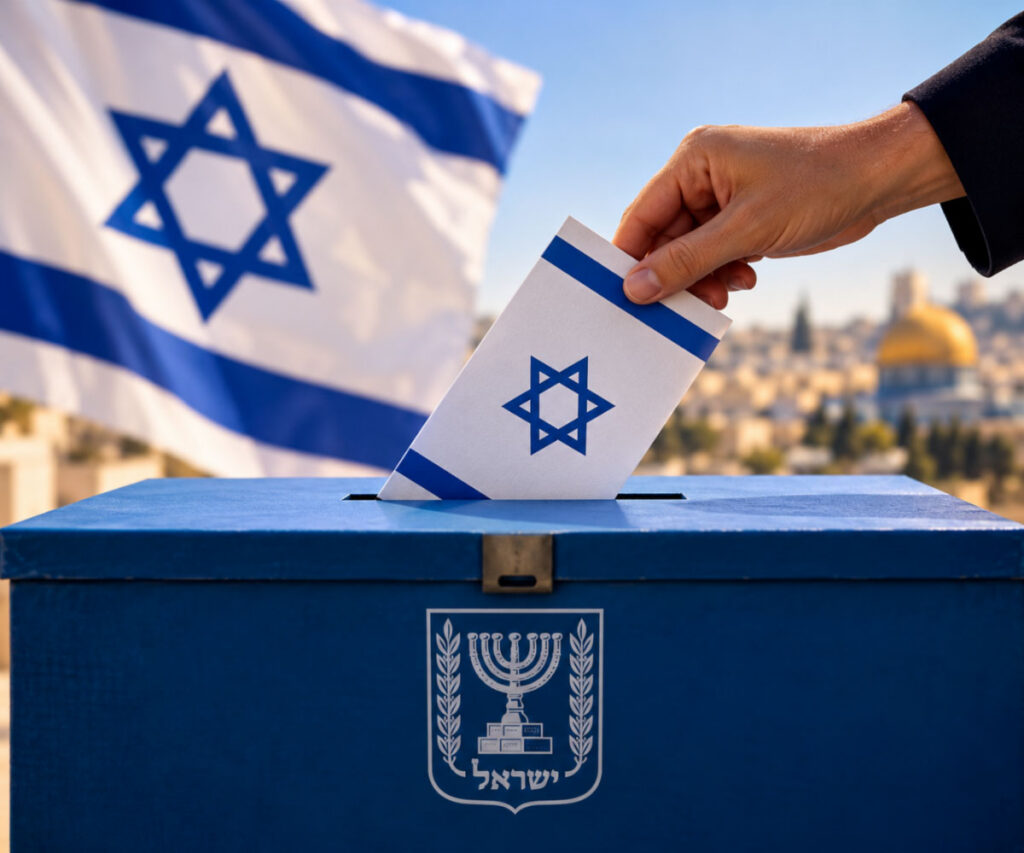
As you read this, the results of Israel’s election remain uncertain. Unlike in the United States, Israel has a parliamentary system. To govern, a party leader must assemble a coalition that commands at least 61 of the Knesset’s 120 seats. At this writing, Netanyahu’s bloc holds 53 seats, while Eisenkot’s holds 48.
Neither has a majority, leaving both dependent on negotiations with other parties.
Nearly 78% of eligible Israelis cast ballots—the highest turnout in more than a quarter century.
I know people who traveled to Israel specifically to vote.
I know secular Jews and religious Jews.
I know a Palestinian man and his wife, who grew up Orthodox Jewish.
I know Christians with family in Jerusalem.
Different backgrounds. Different beliefs. Different visions for Israel’s future.
All Israeli citizens. All wanting their voices to count.
We do not yet know the outcome of this election. But we do know that Israelis are living through a moment in time of profound division, exhaustion, aspiration, and hope. They are yearning for security, stability, and a better future.
And perhaps the greatest challenge ahead will not be counting the votes.
It will be making the votes count.
Because democracy is not simply about who wins an election. It is about what those who win choose to do with the power entrusted to them.
May that power be used not to deepen divisions, but to bridge them. Not merely to govern, but to unite. And not simply to win the future, but to build one worthy of all Israel’s citizens.
Last April, Rabbi Joel Rembaumlost Fredi, his wife of 61 years, to cancer. How does one recover? “There’s no secret, no single answer,” the retired longtime leader of Temple Beth Am said. “Relationships take different forms, operate differently, according to individuals’ own characteristics.
“It’s hard,” the rabbi said. “I can talk about elements that helped me. But thatdoesn’t mean it will work for others.” In a soft voice, he explained, “we are talking about a real long marriage. One can assume with a long marriage that a relationship was very powerful. Otherwise, it doesn’t last that long.”
Rabbi Rembaum began this way “because people start drawing conclusions,” and he doesn’t pretend to speak for anyone. “We should be careful not to say ‘Here are the secrets for everybody.’Having been a congregational rabbi for many decades, you learn.Beyond myself, I have learned that many times when I meet with families before a funeral, and we would talk about the deceased, I would ask them to tell stories. I say to family members, ‘Remind yourself of times, of stories.’”
In such circumstances, people begin to open up, to remember stories, the rabbi said. “One will say ‘Oh, I forgot about that.’ The wonderful, the memorable things. That process of dialogue. In the end people are thankful for that because it reminds them of something they may have forgotten. And they were able to share memories. This cushions the shock of the loss. That is one good thing that this process brings out.”
“I would say, basically, that is what happened to us as a family,” the rabbi noted. “And with Fredi as an individual, the key thing here is, we are moving beyond the family. Fredi was a community person. She served the Jewish community in different ways for decades.” She worked for the Jewish Federation and she worked for Hebrew Union College. “These were long commitments. In both instances, she did amazing things. She worked with and she touched the lives of all different kinds of people. And they remembered these things.”
Rabbi Rembaum remembered the moment when their lives changed. “What happened was, when we heard of the cancer, it was out of the blue. It was a form of cancer that is very rare. It leaves few traces when it is developing. By the time Fredi had it, it was stage four. Liver cancer. We suddenly realized that we needed to be very careful.” This was late August, early September last year. “We realized we can’t shout to the whole world ‘Fredi has cancer’ because it would totally overwhelm us,” the rabbi said. “In the beginning, we kept it in the family. The circle of knowledge began to open up. It spread to the point Fredi said, ‘We need to organize this.’
“Turns out a dear friend of ours – the now-retired Miriam Prum Hess of the Bureau of Jewish Education – (along with Miriam Heller Stern of the Bureau) were uncommonly helpful. Prum Hess said, ‘Let me be your intermediary. I will organize this for you.’”
After Fredi Rembaum was diagnosed last year, “it happened that a lot of different people were able to come to the house and meet and call on the phone. Gradually, more people found out about it. By the time things began to turn, the amount of interaction Fredi had with people and people with her – and I am witness to all of this stuff – I am suddenly seeing the image of Fredi I had – a super one – of our children and grandchildren, the Federation from years ago and, more recently, from Hebrew Union College – the point is, she was a person who was able to move things along in a manner that people respected. That was one of Fredi’s big secrets. In terms of dealing with people, she was expert from a young age. Fredi was president of the student body in the eighth grade.
“We also had the years we were in Germany from 2015 to 2020 for five or six months a year, where I was teaching rabbinical students. She got involved on a volunteer basis to be a mentor to the administrator and assistant administrator. She was deeply involved in the process while the Ziegler School here [the University of Judaism] was, too. All of these people were touched by her – our own personal friends here and elsewhere.
“I was witnessing, verifying, my own image of her. It was unbelievable. Our relationship was beautiful because, basically, we were on the same page all of the time. We were on the same page all along. From the beginning. Literally, even before we were married.Even during those years of our growing together, we had to start making decisions of great significance.
“Life-shaping experiences develop over a long period of time. We were on the same page constantly from the beginning. We shared our perspective on how to shape our lives – as Jews, as people, as parents and about children. All of these decisions. It was not a case of one imposing on the other.It always was a consensus.”
What were the most important commonalities you shared?
“Everything – job-related, family-related, housing-related. Changing jobs. We both made major changes.”
Fast Takes with Rabbi Rembaum
Jewish Journal: What was Fredi’s favorite meal?
Rabbi Rembaum: A complicated gourmet meal that she produces.
J.J.: Your favorite travel destination?
R.R.: One place on our bucket list – Israel. We loved going to Berlin, a great city. We loved to travel, to see the great trees up north. We just took a trip to the Northwest.
In 2026, you don’t expect anAmerican movie – even a documentary – to include an almost Talmudic discussion focusing on the meaning of the word “can.” But it’s a critical scene in “You Can See Everything,” the hit documentary (co-directed by Jewish filmmakers Nathan Fielder and Lance Oppenheim) that follows Elizabeth Holmes, the creator of Theranos – a machine she claimed could perform multiple tests using just a single drop of blood – and her family over the 36 days before she was to report to prison and serve an 11-year sentence for fraud.
Holmes and her husband, Billy Evans, decided to allow the filmmakers complete access to their lives as an exercise in “radical transparency.” Fielder, a writer and performer best known for his HBO shows “Nathan for You” and “The Rehearsal,” is both a strange and inspired choice to take on the project. His previous work marked him as the foremost practitioner of cringe reality. In “Nathan for You,” he offers to help troubled businesses turn themselves around, usually with suggestions so far “out of the box,” they’re either genius or idiotic; think “Kitchen Nightmares,” only with less cursing and food. As an observer, he’s the kind of kid who probably pulled the wings off of flies, not out of cruelty, but because he wanted to give them newer, prettier wings. If those new wings are too heavy and keep the fly grounded…
For “The Rehearsal,” he helps people who are in tough situations – an uncomfortable conversation,breaking up with someone, a family intervention, etc. – by meticulously recreating the place they will have the conversation and gaming out all the possible (and some less than possible) variations. In season 2, he built a replica of Houston’s George W. Bush International Airport on a soundstage so precise and true-to-life, it was repurposed to help neurodivergent people navigate the stresses of air travel.
His superpower is his deadpan delivery; he can make even the most bonkers suggestion sound reasonable. He’s not a journalist; his questions can sometimes seem so blunt and haltingly asked his interlocutors can’t decide if he’s inept, or just dense. Don’t expect him to craft incisive follow-up questions, but he’s not afraid to ask the obvious question that’s on everyone’s mind. In one of his first meetings with Holmes and Evans, she’s beating eggs for breakfast. Evans brusquely grabs the bowl from her. Instead of letting it slide, he stops his line of questioning to ask why he grabbed the bowl. In “Everything,” he is low-key but persistent, repeatedly drilling down on a point until it throws off the person being asked, and they give up more information than they intended.
Fielder takes the idea of “radical transparency” to its limit, even following Evans into the shower for some full-frontal nudity. It’s a very claustrophobic film; much of it is shot in extreme close-ups, a single face filling the screen. Shot in the old, squarish Academy aspect ratio of 1.375 to 1, the couple’s rented beach house feels uncomfortably close even when the camera pulls back.
Holmes claims the reason they agreed to do the documentary (she confesses she had never heard of Fielder before they met) was to correct the way she’s been misrepresented in the press. She’s especially incensed over a New York Times profile where she was quoted saying, “They’re not playing me. They’re playing a character I created.” She never said that; Holmes and Evans claim they have a tape of the interview that proves their point, but never let Fielder hear it. (During post-production, Fielder interviewed the story’s author, who stood by their reporting, but could not produce any definitive proof.)
But Holmes remains an impenetrable figure. She is innocent, she repeatedly tells Fielder. She did nothing wrong and no one was defrauded. And about midway through the nearly three-hour movie, after being repeatedly told that Theranos can perform hundreds of tests, Fielder tries to pin down what exactly Holmes and Evans mean when they say “can.” Does that mean it can perform the tests now, or does it have the (as yet, still unfulfilled) potential of performing hundreds of tests? And do they see how people could be misled by their claim?
To help make his point, Fielder turns, not to Hillel and Shammai, but Abbott and Costello … specifically their classic “Who’s on First?” routine. He plays the clip for Holmes and Evans, then asks Holmes why the skit is funny. It’s because they’re yelling past each other, she tells him. She doesn’t understand that the joke is that the names of the players could also be questions. Fielder looks perplexed; he can’t believe she missed the entire point of the gag. He won’t let the subject drop until Evans tells him that “her brain works different.”
That might very well be true, but not in the way Evans intended. With her saucer eyes and perma-grin, Holmes could be a cult member.
Evans comes off as the villain of the story. It’s obvious from the start he did not have the same enthusiasm about inviting the filmmakersas Holmes and doesn’t do much to mask his distaste. Aggressive, controlling and acting as if he’s the smartest guy in the room, he’s an almost stereotypical tech bro. You hear him on the phone trying to entice investors in what he calls “Theranos Two-point-oh” with vacuous Silicon Valley-talk. He even manages to get a rise from the usually even-keeled Fielder, telling the filmmaker “I know how you feel.” Fielder snaps back, “No, you don’t!”
Evans also sets off the film’s most audacious move. Before Holmes heads to jail, he insists on meeting Fielder and executives of producer A24 Films, demanding some compensation for their appearing in the film, even though he’s told it’s ethically dubious. (There’s an unanswered question of how much Holmes knew and if she approved his demand.) He also discovers that Evans has licensed Holmes’ image (the famous photo of her in a black turtleneck holding a small vial of blood, which Holmes hates), is creating an AI avatar of Holmes, and is posting as Holmes to her X account. He has, he tells Fielder, power of attorney.
Disturbed by this, he recruits Amanda Seyfried, who played Holmes in Hulu’s limited series about Theranos, “The Dropout,” to get her opinion. He then “casts” Seyfried to play Holmes in recreated conversations. In a brilliant coup de theatre, he shows Seyfried video of Holmes watching Seyfried as Holmes in “The Dropout.” They discuss Holmes’ and Evans’ relationship, asking if it’s a smart idea for a woman who blamed her previous business and romantic partner, Sunny Balwani, for the problems with Theranos, to trust a man like Evans. Seyfried asks Fielder if he’s falling for Holmes. He might have; he certainly became more protective of her, as she got closer to reporting to prison.
Is Holmes guilty of fraud? Did Evans act with her approval? And what is the meaning of “can”? None of the questions are definitively answered by “You Can See Everything” but the movie is a funny, disquietingand, even with a three-hour running time, absorbing story that will leave you questioning if it is possible to ever know everything about anyone.