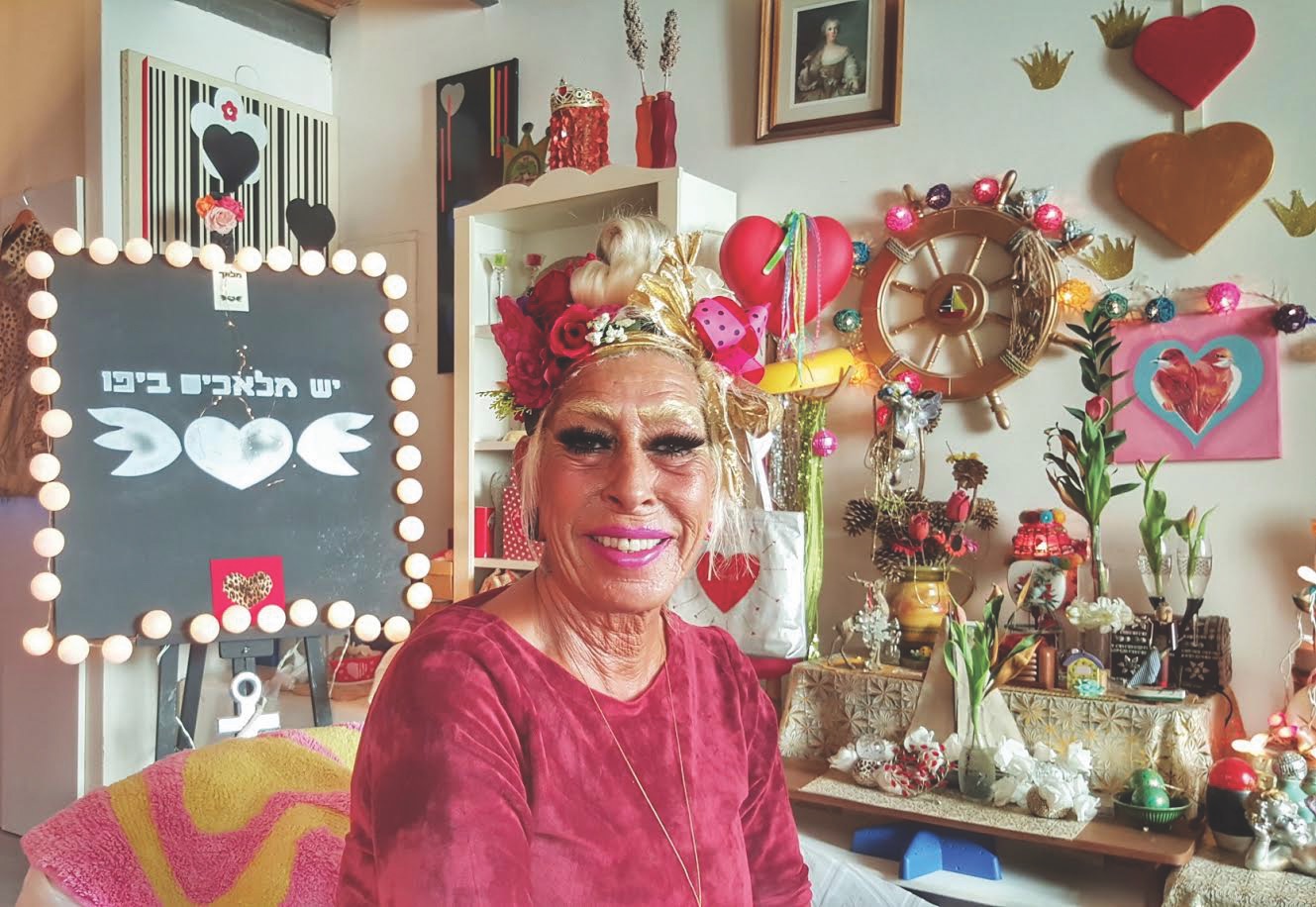
Anyone who has toured the ancient streets of Jaffa has seen the graffiti stenciled indiscriminately on crumbling archways and fancy residential blocks alike: a heart nestled between two wings and the declaration, “There are angels in Jaffa.”
According to the aptly named Gabriel Rosenthal, a self-proclaimed “human angel,” the inspiration behind the street art is the idea that everyone has the potential to become an angel.
“The way to become an angel is to be enlightened,” she said, taking a deep drag of her Marlboro.
Rosenthal lives in a tiny, narrow studio a stone’s throw from Jaffa’s famed clock tower, its walls adorned with hundreds of fairy lights, crystals and the ubiquitous angel stencils. There also are images of crowns and lighthouses, homages to Rosenthal’s previous “incarnations.”
“I was a queen, but wouldn’t you agree it’s better to be a human angel?” she deadpanned.
As for the lighthouse, Rosenthal, 65, still considers herself to be one. “Every person is a ship and needs to reach the shore. One lighthouse can save many ships that have gotten lost,” she said.
A woman with a larger-than-life personality, Rosenthal sports umpteen ribbons and flowers that compete for the front row of her peroxide tresses while her neck tattoo of a crown ripples in the folds of leathery skin that has seen too much sun.
There’s a magnetism to Rosenthal that draws people to her, as attested during the interview when two women passed by her window and hollered, “Angel! Are you there?” Later, both women confided that Rosenthal saved their lives.
“I’m a mirror,” Rosenthal said. “I see where the problem is in people and tell them how to fix it.”
Her bumper-sticker philosophies are delivered with such earnestness one cannot help but take them to heart as if they were novel ideas. “It is our natural right to be happy all our lives,” she said. “The past doesn’t matter; life starts now.”
Living in the now is a recurrent theme for Rosenthal, who says that if there were a contest for being in the present, “I get first prize. First, first, first.”
Of the 18 careers she claims to have — mentor, mystic, spiritual healer, producer, hairdresser and more — being a revolutionary is the standout. So perhaps it’s no accident that Rosenthal was born in Cairo on the day that King Farouk was deposed in 1952 and the Egyptian Revolution kicked off. A year later, her parents moved with her to Tel Aviv. At 13, she became engaged, marrying five years later — and divorcing four years after that, taking with her two sons and a new Ashkenazi last name.
“It is our natural right to be happy all our lives.” — Gabriel Rosenthal
It was to be another 42 years before Rosenthal would return to her birthplace. By then, she’d visited some 64 countries — not a single trip planned in advance, she said. And when she finally made an impromptu excursion into Sinai, it was with the vague idea of lying on a secluded beach for just a couple of weeks. That stretched into two months — and then into half a decade after she met a man named Mustafa while waiting for her taxi back to the Israeli border.
Mustafa owned a stretch of beach close to Nuweiba in the eastern part of the Sinai Peninsula. He told her to live there as long as she wished and provided her with two servants to cook her meals. It was there, she said, that she became known as Aisha, a reference to one of Muhammad’s wives.
It was also there that Rosenthal learned to become a builder — another of her 18 careers. With the help of Mustafa’s staff, Rosenthal built some 60 hushot, or beach huts, and turned the Sondos (“Green Village”) camp into a luxury getaway, at least by Sinai standards. Very soon, the place was filled with the kind of Israeli backpackers who were more interested in glamping than camping.
Running Sondos camp — and overseeing the occasional sulha (dispute resolution) between warring Sinai tribes — was Rosenthal’s life before she decided to finally catch that taxi back to Israel.
Today, Rosenthal has no intention of slowing down.
“You could say I’m a modern-day messiah,” she said. “But I was brought into this world first and foremost to be happy and then to teach other people to be happy.”