Timing isn’t everything, but it’s a lot. And the timing of recent action by Israel’s coalition government is more than suspicious.
On Nov. 27, the Knesset approved — on the first vote of the necessary three — new legislation that could potentially impact the ongoing, high-profile investigations into Prime Minister Benjamin Netanyahu. The new law, if it ultimately passes, is aimed to prevent the police from making a specific recommendation as to whether to indict a suspect when an investigation has ended and leave this matter to the attorney general.
Timing isn’t everything, but it’s a lot. And supporters of the new legislation would acknowledge it — of course, not on the record. However, they will say, the law is necessary and proper, and it cuts both ways. It helps these supporters that these special times — when the party in charge has an interest in passing it — also make it viable.
Indeed, they have a point, and their position raises an important question: Should a citizen be in favor of legislation he deems proper even though the timing of passing it is improper? To put it differently: Is it obligatory to oppose a law one deems necessary because of the suspicious circumstances of its passing?
If there is a reason for indictment, the new law will not save the prime minister.
For people living in the practical world, this is not an easy choice. We know from history that murky, questionable circumstances often prompt important legislation. In this case, though, one first has to accept the premise that the new legislation has merit beyond saving Netanyahu from being publically censured by the police after the investigation is over.
So, is it justified? Consider the case of Netanyahu’s chief of staff, Gil Sheffer. About a year ago, Sheffer was accused of sexual assault. The police investigated the accusation and came up with a clear recommendation: We have the evidence; Sheffer ought to be indicted. For almost a year, Sheffer walked around crowned with this wreath of thorns until a decision was made by state attorneys: There was not enough evidence to indict him — he was off the hook. But no one can compensate him for those 10 months under scrutiny.
Supporters of the new legislation will point to this case, and others, in which public humiliation over a decision by the police — who have the authority to investigate but not to indict — ended with a whimper. These supporters would like the police simply to do their job, which under the circumstances covered by this law is to investigate and hand the material to the state attorneys without recommendation.
It is thus plausible to defend this legislation on its merits. It also is not difficult to understand why Netanyahu and his political operators would see such a law as potentially beneficial for the prime minister. It can buy him time. If the police hand evidence against him to the attorney general without making any specific recommendation, the court of public opinion will have to be more patient and wait until the end of the legal process to see if the prime minister is going to stand trial.
As usual, there is a lot of political hoopla involved in the discussions surrounding this legislation. The prime minister’s associates lost all shame as they promoted this law with the urgency they should save for more crucial matters. The prime minister’s opponents refuse to acknowledge the fact that this law has reasoning and merit — beyond its highly problematic timing.
And as often happens with new legislation, too many hopes are hanging by a thin thread. If there is a reason for indictment, the new law will not save the prime minister. In fact, it will not even prevent the media and the public from getting enough information when the investigation is over to make their own determination as to whether Netanyahu should be indicted. Leaks, insinuation and speculation will be the substitute for police recommendation.
So if the law passes, Israel merely will be substituting one problematic procedure (police recommendation) for another (public speculation).
Shmuel Rosner is senior political editor. For more analysis of Israeli and international politics, visit Rosner’s Domain at jewishjournal.com/rosnersdomain.
As a Jewish girl growing up in a non-Jewish suburb, I often wondered, while reading “The Diary of Anne Frank,” which of our neighbors would have hidden me and my sisters in their attic. Recently, I find myself asking a more adult version of this question: After profound trauma, would I have been able to find my way back to eros, to a fully lived life?
One of my favorite rabbinic legends describes the ancient Israelite women seducing their husbands while in captivity in Egypt. Pharaoh oppresses the Israelite men with backbreaking labor as a subtle form of genocide: They are too exhausted to make a new generation of Israelites.
The Israelite women realize that their tribe is in danger, and according to the rabbis, they take action. Drawing their husbands out to an orchard and gently teasing them, they lift up handheld copper mirrors, saying, “I’m more beautiful than you are!”
Both Dr. Ruth and Esther Perel lack any trace of prudishness. Both emanate love and wit.
In this midrash, the ancient Israelite women are not just heroines of tribal continuation. They also are keepers of eros. They teach pleasure despite oppression — survival of both the body and the soul.
Which brings me to today. In an era when sexuality tends more toward the commodified and the alienated, who teaches us about the inner erotic life, with its vulnerability, pleasure and its ability to transform us? Who are today’s prophets of eros?
This is not a rhetorical question. I have an answer — actually two, and both are Jewish women: Ruth Westheimer and Esther Perel.
During that same era of girlhood when I wondered about my neighbors hiding me, I also listened covertly to Westheimer’s late-night radio show on a tiny AM radio I kept hidden beneath my pillow.
My most important sex education wasn’t the embarrassing biology lessons of middle school, but “Dr. Ruth’s” teachings of how pleasure, self-acceptance and joy can be accessed through the erotic.
Perel is a generation younger, a couples therapist finding rather unlikely celebrity these days. In her beautiful, moving podcast, “Where Should We Begin?,” Perel invites us into the intimate space of couples therapy as she helps people access their connection to eros after trauma.
Sometimes the trauma is past abuse. Often it is an affair. Occasionally it is simply the trauma — for women and men alike — of living under patriarchy.
I find myself now listening to Perel’s podcast with an adult version of my previous mania for Dr. Ruth’s radio show. In fact, the two women have much in common. Both lack any trace of prudishness. Both emanate love and wit. Both possess charming accents. And both are Jewish women who grew up in displaced communities profoundly traumatized by the Holocaust.
When Westheimer was a 10-year-old girl, her father was taken by the Nazis, and her mother placed her on a train out of Germany, hoping to save her life. This was the Kindertransport to Switzerland. She would never see her mother again.
Perel was born a generation later in Antwerp, Belgium. She is the daughter of two Jewish refugees, Holocaust survivors who lost their entire families in the camps. She writes beautifully about how her parents, who had lost 16 siblings between them, nonetheless taught her about joy and eros:
“Trauma was woven into the fabric of my family history (and would inspire my work for years to come). They came out of that experience wanting to charge at life with a vengeance and to make the most of each day. They both felt that they had been granted a unique gift: living life again. My parents didn’t just want to survive, they wanted to revive. They wanted to embrace vibrancy and vitality — in the mystical sense of the word, the erotic.”
I see Westheimer and Esther Perel as our modern incarnations of the ancient Israelite women in Egypt.
All of them share a prophetic Jewish women’s voice; all are guardians of eros. Their very response to trauma is finding a renewed commitment to life force, to joy — and to helping other people access their own erotic selves.
Thinking back, I remember that Anne Frank, too, wrote about finding eros. Even in her brief life, even in the very midst of tragedy.
The light and the dark intertwine. No matter how dark the past, we can recommit to finding the beating heart of eros, and remember that life can — must — still be lived in all its fullness.
Alicia Jo Rabins is a writer, musician and Torah teacher who lives in Portland, Ore.
I remember celebrating HanuKkah when growing up and being with my extended family of uncles, aunts and cousins. The highlights were lighting the Hanukkah menorah, eating lots of latkes, exchanging gifts and anticipating all the great desserts.
Potato latkes are the most popular of the Hanukkah foods. They are traditionally fried in olive oil to a delicious crispness and served with applesauce, sour cream, sugar and preserves.
This year, we are preparing recipes that include new, delicious Dessert Potato Latkes, a combination of apples and potatoes, as well as an Italian Olive Oil Cake, a recipe from chef/butcher Dario Cecchini (our adopted Italian son) that is served at his restaurant, Solo Ciccia, in Tuscany.
I also love to serve Sufganiyot, deep-fried doughnuts, usually eaten in Israel as a snack or at the conclusion of the Hanukkah dinner. The dough can be prepared in advance and fried in olive oil just before serving.
For our dessert buffet, and as an extra treat, we ask all the bakers in the family to bring their favorite, homemade Hanukkah cookies to share during our celebration.
DESSERT POTATO LATKES
2 tablespoons unsalted butter or nondairy
margarine
2 large Red Delicious apples, peeled,
seeded and diced
3 tablespoons sugar
2 teaspoons fresh lemon juice
1/4 teaspoon cinnamon
2 medium russet potatoes, peeled
and shredded
2 eggs
4 to 5 tablespoons matzo meal
Salt to taste
Oil for frying
Powdered sugar for garnish
In a nonstick skillet, melt butter and add apples, sugar, lemon juice and cinnamon. Over medium-high heat, sauté until apples are glazed, about 4 minutes. In a large bowl, combine the apple mixture, potatoes, eggs, matzo meal and salt. Mix well.
In a nonstick skillet, heat 2 to 3 tablespoons of oil. With a tablespoon, spoon the potato-apple mixture into the hot oil and flatten the latkes with the back of the spoon. Cook for 3 to 5 minutes a side, turning only once, until golden brown. Drain on paper towels. Just before serving, sprinkle with powdered sugar.
Makes about 24 latkes.
DARIO’S OLIVE OIL CAKE AT SOLO CICCIA (Solociccia Torta All’Olio)
Olive oil for baking pan
1/4 cup ground almonds for baking pan
5 eggs
2 cups sugar
2 oranges, finely chopped (pulp and peel)
1/2 cup olive oil
4 cups flour
2 teaspoons baking powder
1/2 cup raisins, plumped in Vin Santo or
a sweet wine
1/2 cup (toasted) pine nuts for garnish
Sugar for garnish
Preheat the oven to 375 F. Brush a 10- or 12-inch springform pan with olive oil and dust with ground almonds.
In the bowl of an electric mixer, beat the eggs with the sugar. Add orange peel and pulp and blend well. Slowly add the olive oil alternately with the flour and baking powder, and mix until smooth. Fold in the raisins.
Let rest for 10 minutes, stirring from time to time. The oil is light, but tends to separate from the batter; mix well.
Spoon the batter into the prepared pan, level it and dust it with sugar, a little oil and the pine nuts. Bake in preheated oven for 35 to 40 minutes.
Makes 1 large, round cake.
SUFGANIYOT (Doughnuts)
1/4 cup olive oil
1 cup sugar
2 eggs
1 egg yolk
3 1/2 cups flour
1 tablespoon baking powder
1/2 teaspoon salt
1/4 teaspoon ground nutmeg
1 cup buttermilk or nondairy creamer
Olive oil for frying
Powdered sugar for garnish
In a mixing bowl, combine 1/4 cup olive oil, sugar, eggs and egg yolk. Beat until fluffy. Sift together flour, baking powder, salt and nutmeg. Stir into egg mixture alternately with buttermilk.
Toss dough onto floured board and knead in additional flour if dough is sticky. Divide dough in half or quarters for easier handling. Pat and roll out 1/2-inch thick. Cut with doughnut cutter (round) dipped in flour.
In a heavy skillet, heat 1 to 2 inches of oil to 360 F. Drop Sufganiyot into hot oil and fry 2 to 3 minutes on each side or until golden brown. Drain on paper towels. Sprinkle with powdered sugar or dip in sugar.
Makes about 24 Sufganiyot.
Judy Zeidler is a food consultant, cooking teacher and author of 10 cookbooks, including “Italy Cooks” (Mostarda Press, 2011). Her website is judyzeidler.com.
A pop-culture roundtable at Temple Beth Am on Nov. 16, featuring five creative Jewish professionals, examined depictions of Jews in movies and television and what they say about American-Jewish life.
“Tonight, we want to talk about how the Jewish experience has changed over time,” psychologist and screenwriter Michael Berlin, the event moderator, said at the start of the evening, titled “Schmaltz, Schmendricks and Showbiz!”
During the event, comedy writer Rob Kutner (“Conan”) discussed what it was like being a pro-Israel writer at “The Daily Show” and having more pro-Israel views than then-host Jon Stewart. Kutner said he tried to bring more balance to the content of a “Daily Show” segment that portrayed pro-Israel Jews as being unwilling to listen to anything other than full-throated support for Israel.
“I didn’t want to argue too much with my boss, but I was trying to present a reasonable pro-Israel position,” Kutner said.
Michelle Fellner, a television editor whose credits include “Mad Men,” recalled how she bonded with show creator Matt Weiner over their shared Jewish heritage when she worked on the Emmy Award-winning drama.
Over the course of the evening, the panelists presented clips from films and television shows that depicted Jews in flattering and negative ways. Journal contributing writer Esther D. Kustanowitz discussed “JAP Battle,” a clip from the musical-comedy show “Crazy Ex-Girlfriend,” featuring two Jewish American princesses trading rap verses skewering each other and Jewish stereotypes.
Kustanowitz said the evening was an opportunity “for Jews to emerge beyond the stereotype.”
During a Q-and-A toward the end of the night, Temple Beth Am Rabbi Ari Lucas asked the panelists how Judaism informed their approach to their work. Andrew Wallenstein, co-editor-in-chief of Variety, said he struggles with staying true to the Jewish law prohibiting lashon harah (Hebrew for “gossip”) because almost 90 percent of the content on his newspaper’s website is gossip. Still, he said, he hopes the articles shed some light on troubling realities in society.
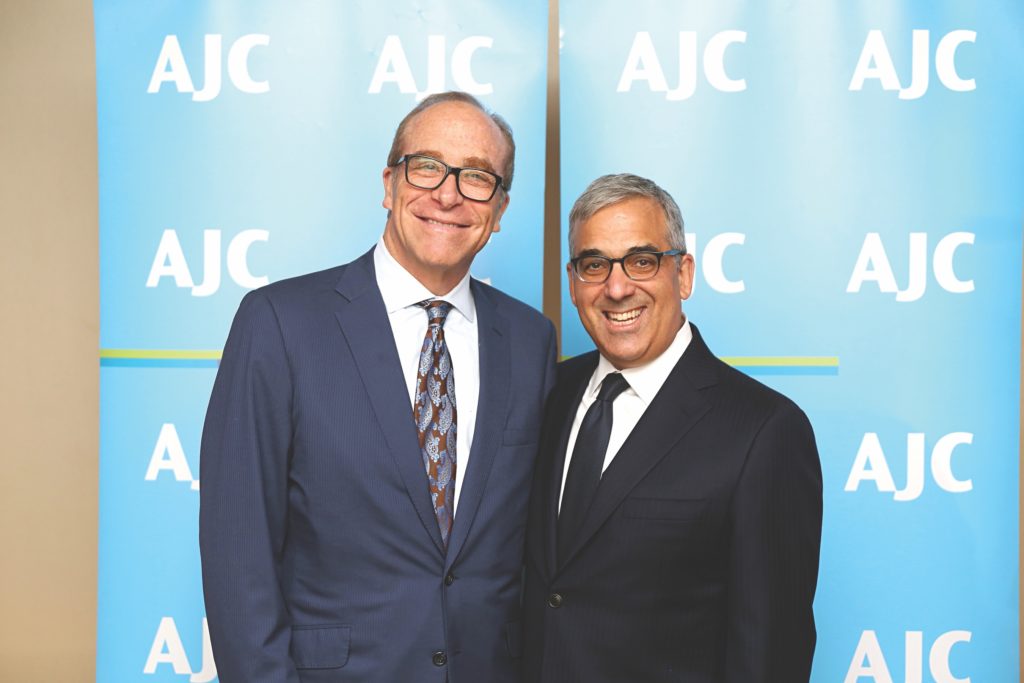
American Jewish Committee Los Angeles President Scott Edelman (left) and Learned Hand Award recipient John Rogovin. Photo by Howard Pasamanick Photography
American Jewish Committee (AJC) Los Angeles honored John Rogovin, executive vice president and general counsel at Warner Bros. Entertainment, with the AJC Learned Hand Award on Oct. 25 at the SLS Hotel in Los Angeles.
“Who better exemplifies the spirit of liberty than the American Jewish Committee, which I admire so much for their work on behalf of all of us — Jews and non-Jews — safeguarding human rights,” Rogovin said in his acceptance speech.
Michael Powell, former chairman of the Federal Communications Commission, presented Rogovin with the award.
Attendees at the ceremony honoring Rogovin included John Emerson, former United States ambassador to Germany. Emerson delivered the evening’s keynote speech on the importance of U.S.-Germany ties and the role AJC plays in that relationship.
Norman Eisen, former U.S. ambassador to the Czech Republic, and Matthew Dontzin, founding partner at Dontzin, Nagy & Fleissig, served as the masters of ceremonies.
The dinner co-chairs were Jaye Rogovin, John Rogovin’s wife; former AJC National President Bruce Ramer; AJC Los Angeles President Scott Edelman; and Latham & Watkins partner Joseph Calabrese.
AJC Los Angeles Director Dan Schnur opened the program.
AJC, an advocacy group combating anti-Semitism, supporting Israel and more, established the Learned Hand Award, the highest honor the organization bestows to an individual in the legal profession, in memory of Judge Learned Hand, a senior judge on the U.S. Court of Appeals for the Second Circuit.
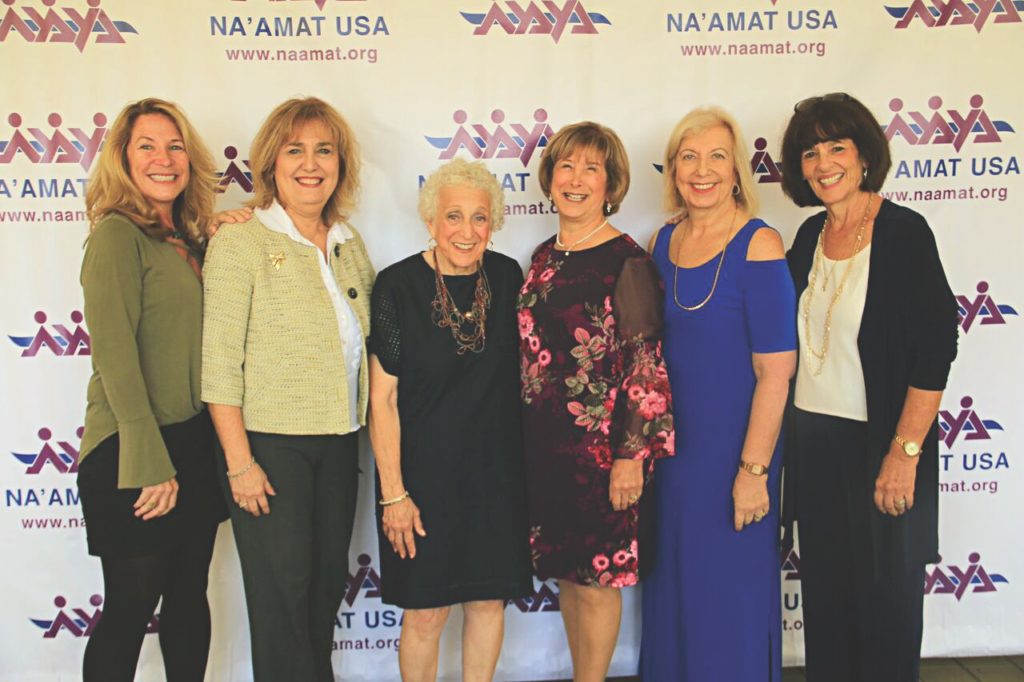
From left: Deanna Migdal, Esther Friedberg, Chellie Goldwater Wilensky, Gail Simpson, Susan Isaacs and Ivy Libeross attend the NA’AMAT USA luncheon. Photo courtesy of NA’AMAT USA
The San Fernando Valley Council of NA’AMAT USA held its annual Distinguished Community Leader Awards luncheon at American Jewish University on Oct. 29.
This year’s honorees were Dr. Fran Kaufman, a prominent figure in the treatment of pediatric diabetes; community activist Barbara Yaroslavsky, for her fight against poverty; and Gail and Myles Simpson, for their service to NA’AMAT and Conservative Judaism.
“I am very appreciative of this honor,” Gail Simpson said. “NA’AMAT has been a part of my life for the past 40 years. I’ve seen all of our accomplishments in Israel and how NA’AMAT has improved the lives of women and their families. Our programs are constantly evolving as the needs of women grow and change.”
NA’AMAT USA, a volunteer organization, partners with NA’AMAT Israel to provide educational and social services for families and individuals in need.
The luncheon included a video screening about NA’AMAT’s technological high schools for disadvantaged and at-risk teens in Israel, introduced by the organization’s national vice president of public relations and publicity, Susan Isaacs.
“It is an inspiration to recognize the achievements of our distinguished honorees,” NA’AMAT USA Executive Director Deanna Migdal said. “These leaders serve as models for us all as we work to fulfill our mission of enhancing the quality of life of women and children in Israel.”
— Virginia Isaad, Contributing Writer
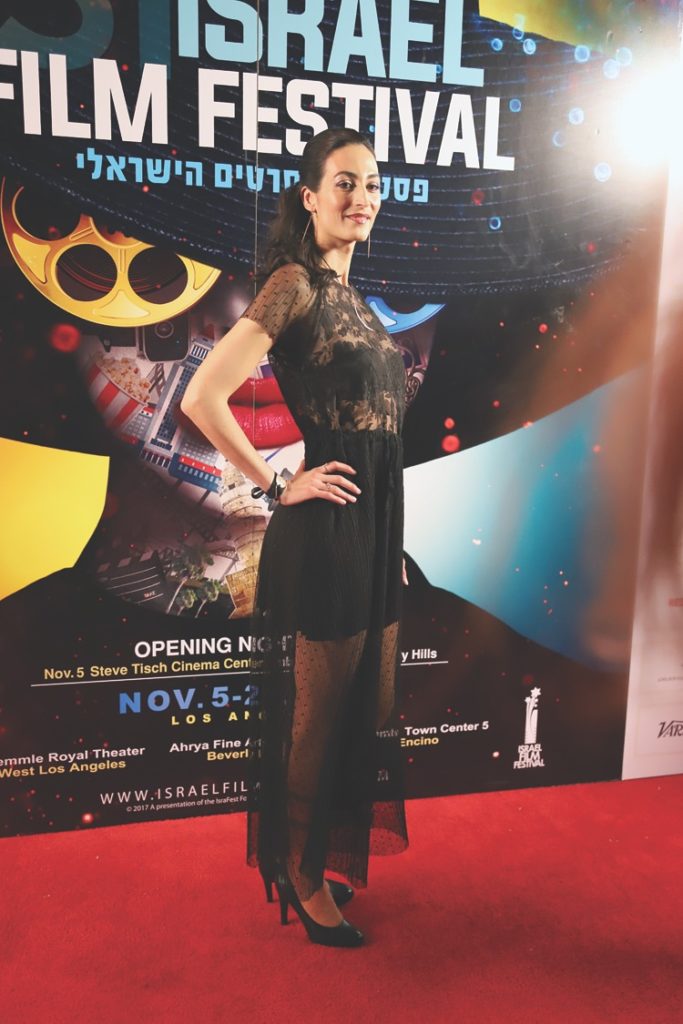
“Fauda” star Laetitia Eido poses on the red carpet at the Israel Film Festival. Photo by Alex Zamyatin
As part of the Israel Film Festival, 220 people attended a screening of a new episode from the Israeli TV hit “Mossad 101” at Laemmle’s Ahrya Fine Arts Theatre in Beverly Hills on Nov. 15. The screening was followed by a panel discussion about how to expand the impact of Israeli television. Adam Berkowitz, co-head of television at Creative Artists Agency (CAA), moderated the panel, titled “Israeli TV: An American Success Story.”
“Israeli TV is quite young — 27 years,” said Udi Segal, founding CEO of Sumayoko Films, which produced “Mossad 101.” “It can offer young and enthusiastic creators.”
Segal said Israeli creators tend to have lower budgets than their American counterparts, which is helpful for the creative process. “When you have a small box, you must think outside it,” he said.
“Israelis are innovators and entrepreneurs, and want to invent and push the envelope,” said Sharon Tal, head of drama and comedies at Amazon. “They never want to think safe. They always have something to say and they say it.” She added that Israeli writers are used to a “very honest and brutal approach,” that they’re not afraid of getting notes about their scripts, while American writers have to be “treated with kid gloves.”
“What makes a good TV show is to take reality and exaggerate it a little,” said writer David Shore (“House,” “The Good Doctor”). “That’s what Israel is — reality that’s a little more heightened and a little more focused.”
The panel also included Danna Stern, managing director of Yes Studios, and award-winning actor Tsahi Halevi. Halevi has been acting for about five years and now is enjoying recognition for his work in “Mossad 101” and “Fauda,” both of which were featured at the festival.
“The last year-and-a-half has changed the formats business,” said Michael Gordon, an agent at CAA. Gordon said Israel is particularly well positioned to export stories. It generates “organic stories, because the population isn’t homogenous,” he said.
Both “Fauda” and “Mossad 101” present diverse characters coming into conflict with one another over cultural or ideological differences.
The following night, Nov. 16, the festival hosted a red-carpet world premiere for the second season of “Fauda,” featuring two sold-out screenings and a Q-and-A panel discussion with the talent and creators of the show.
— Esther D. Kustanowitz, Contributing Writer
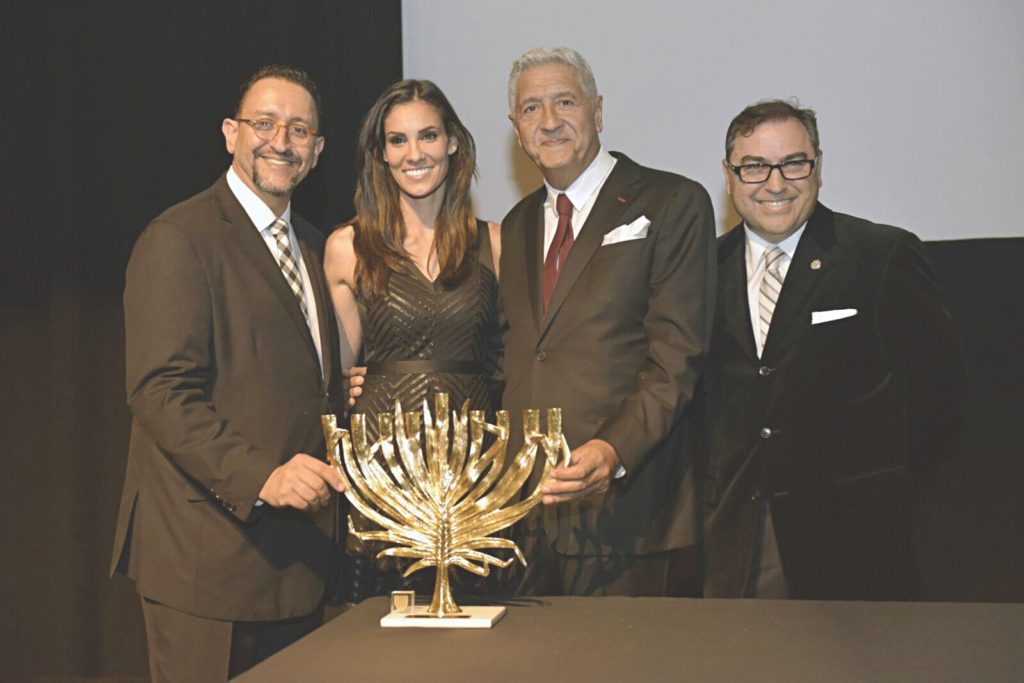
From left: Sephardic Education Center (SEC) Director Rabbi Daniel Bouskila, “NCIS: Los Angeles” actress Daniela Ruah, Sephardic Film Festival honoree Joe Ouaknine and SEC President Neil Sheff. Photo courtesy of Sephardic Educational Center
The Sephardic Educational Center (SEC) kicked off its 14th annual Los Angeles Sephardic Film Festival on Nov. 5 with a dinner under the stars at the Paramount Studios lot.
Every year, the Sephardic Film Festival showcases original stories by filmmakers around the world, while highlighting the heritage and culture of Sephardim.
This year’s opening film was actor and director Ze’ev Revach’s “Back to Casablanca.” The film follows Revach’s journey back to his homeland in search of a Moroccan actor to star alongside him in his next film, which he dreams he’ll be able to distribute around the Arab world.
SEC President Neil Sheff delivered remarks at the start of the evening.
Proceeds from the weeklong festival, which closed on Nov. 12, support SEC educational programs, including SEC Hamsa Israel, a trip to Israel for teenagers led by SEC Director Rabbi Daniel Bouskila.
The SEC presented Joe Ouaknine, co-founder of Titan Industries, a women’s fashion footwear company, with the Maimonides Leadership Award. Ouaknine was born in Morocco, immigrated to Canada, moved to Los Angeles in 1977 and is an active supporter of the Los Angeles Sephardic community, the SEC website says.
Actress Daniela Ruah (“NCIS: Los Angeles”) emceed the evening.
— Ayala Or-El, Contributing Writer
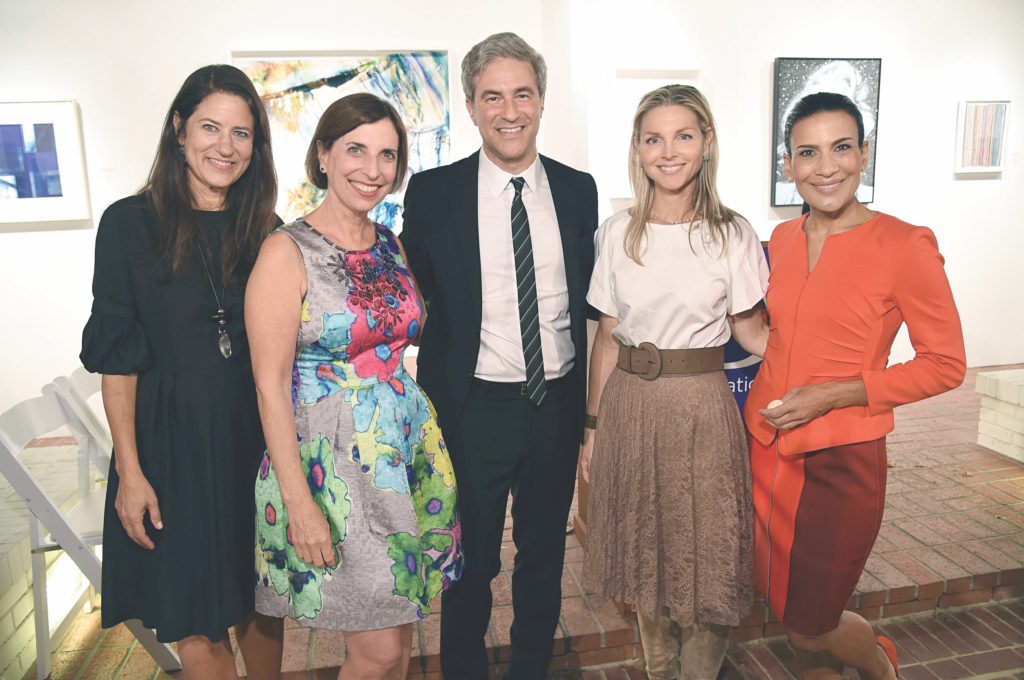
LACMA Director Michael Govan poses at “ArtWorks ADL” with (from left) his wife, fashion and luxury brand consultant Katherine Ross; Anti-Defamation League (ADL) Regional Director Amanda Susskind; ADL executive committee member Nicole Mutchnik; and Sotheby’s Executive Vice President and Chairwoman Andrea Fiuczynski. Photo courtesy of Anti-Defamation League
“ArtWorks ADL: Justice, Advocacy And Art” drew more than 400 art aficionados, philanthropists and friends of the Anti-Defamation League (ADL) to the Beverly Hills home of husband-and-wife entrepreneurs and philanthropists Lisa and Joshua Greer.
The Oct. 26 event, held in the Greers’ backyard on a balmy evening, showcased more than 40 paintings, sculptures and mixed-media works donated by Los Angeles-based artists and galleries inspired by the ADL mission and representing the Jewish, Asian-American, Latino, African-American and LGBT communities.
Andrea Fiuczynski, executive vice president and chairwoman at Sotheby’s America, conducted a live auction. The event raised $420,000 to support ADL programs combating hate and bigotry.
Attendees included the evening’s co-chairs, Los Angeles County Museum of Art Director Michael Govan and international art consultant Lauren Taschen.
Many new Hanukkah-themed illustrated children’s books are full of wit and surprises this year. Some books take on the holiday with a bit of a twist, while others comfortably rely on traditional stories, newly told. All the recommended choices here celebrate the holiday with humor — from a fractured fairy tale and a reimagining of the beloved Chelm stories, to modern-day stories of multicultural families and, surprisingly, even the vaccine controversy.
“Little Red Ruthie: A Hanukkah Tale” by Gloria Koster. Illustrated by Sue Eastland. Albert Whitman & Co.
Spunky Little Red Ruthie wears a puffy, red-hooded parka on her way to Bubbe Basha’s house on the other side of the forest. It’s snowing as she kisses her mother goodbye and leaves her comfortable, modern home with her basket filled with sour cream and applesauce. When a frightening wolf appears on the path and threatens, “Little girl … I am going to eat you up!” Ruthie stays strong and brave. Like the Maccabees of old, she “would stand up to her enemy too.” Ruthie meets up with the wolf again at Bubbe’s house and cleverly tricks him into delaying his evil plan by telling him the story of Hanukkah and frying up lots of latkes. The hungry wolf overindulges and gets too full for another bite of anything else as he is escorted out the door. The humorous illustrations enhance the well-told tale. A useful latke recipe is included.
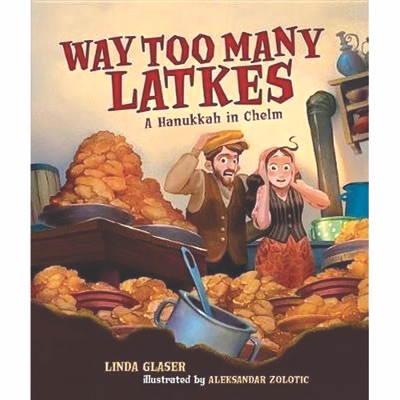
“Way Too Many Latkes: A Hanukkah in Chelm” by Linda Glaser. Illustrated by Aleksandar Zolotic. Kar-Ben.
Chelm stories are supposed to be funny, and this one will inspire giggling in any child, particularly if the reader hams up the character voices. We learn that Faigel makes the best latkes in all of Chelm, but unfortunately for everyone else, she makes only enough for herself and Shmuel, her hapless husband. One year, she inexplicably forgets the recipe and her husband must go to the rabbi (“the wisest man in Chelm”) to ask how many potatoes need to be used. The rabbi tells him to “use them all” without realizing that Shmuel and Faigel’s larder is full. The cycle is repeated with the other ingredients (eggs, onions) and silliness ensues. The comic-style illustrations capture the kitchen mayhem, idealized shtetl life and the over-the-top storyline with amusing flair. Of course, the whole town gets to partake in the deliciousness by the story’s end.
“The Missing Letters: A Dreidel Story” by Renee Londner. Illustrated by Iryna Bodnaruk. Kar-Ben.
Children will be delighted to find out that dreidels come alive at night at the dreidel factory and talk to one another. Actually, they like to argue about the fairness of the dreidel game rules. The nuns are jealous of the gimels because … who wants to get a nun, anyway? But the shins have the most legitimate complaint, since people have to add to the pot when the dreidel falls on their letter. The heys, shins and nuns band together to figure out a way to make the gimels disappear before Hanukkah begins. They come up with elaborate ways to hide the sleeping gimels in a fun and busy double-paged, purple spread that kids will enjoy deciphering. In the morning, when it is time for the dreidel makers to add on the letters, they can’t find the gimels! When the dreidel maker explains the historical importance of the dreidel, the mischievous letters feel remorseful and do the right thing to make the dreidels whole again. It is a fun and silly story with delightfully appealing cartoonish illustrations and lots of purple — everywhere.
“Queen of the Hanukkah Dosas” by Pamela Ehrenberg. Illustrated by Anjan Sarkar. Farrar, Straus and Giroux.
The family members of the boy who is this story’s narrator are preparing for Hanukkah, but something about them seems different. They stop at the Little India Market on the way home from Hebrew school, bringing along his “amma-amma” (grandma), who is clothed in traditional Indian dress. They purchase dal and rice, but our unnamed narrator’s active little sister is climbing around the store, upsetting the coconut milk display. To distract her, he makes up new words to an old song: “I had a little dosa, I made it out of dal.” We learn that his father grew up Jewish and his mother is from India, and they have a family tradition of making dosas (a type of pancake fried in coconut oil) at Hanukkah. When they are locked out of their home by mistake at a large family celebration, little Sadie saves the day by using her climbing skills. Multicultural children’s books for Jewish families are an important addition to the literature as they reflect the lives of real families where children can see themselves represented and accepted as part of their community.
“Judah Maccabee Goes to the Doctor: A Story for Hanukkah” by Ann D. Koffsky. Illustrated by Talitha Shipman. Apples & Honey Press.
Kids need books to help them through scary experiences, and getting a shot is clearly one of those times. This book connects the bravery of Judah Maccabee with the bravery of a little boy, also named Judah, as he visits the doctor for a shot. The text emphasizes how much pride he has in being a good brother to his baby sister and how much he wants to protect her, particularly by using the Maccabee shield he gets as a Hanukkah gift. When his dad explains that getting his shot actually will act as a shield to protect his sister in a different way, he sticks out his arm for the doctor and the deed is done. He is proud of his “on-the-inside” bravery and realizes that heroism can manifest itself in a variety of ways. While it is an unusual combination of two subjects, the book is an important validation of science in response to vaccine misinformation. It stands as quite a Jewish educational feat, considering that all the incensed Amazon anti-vaccine reviewers calling it propaganda from “Big Pharma” also learned a lovely lesson on the origins of the Hanukkah holiday.
Lisa Silverman is the director of the Burton Sperber Jewish Community Library at American Jewish University.
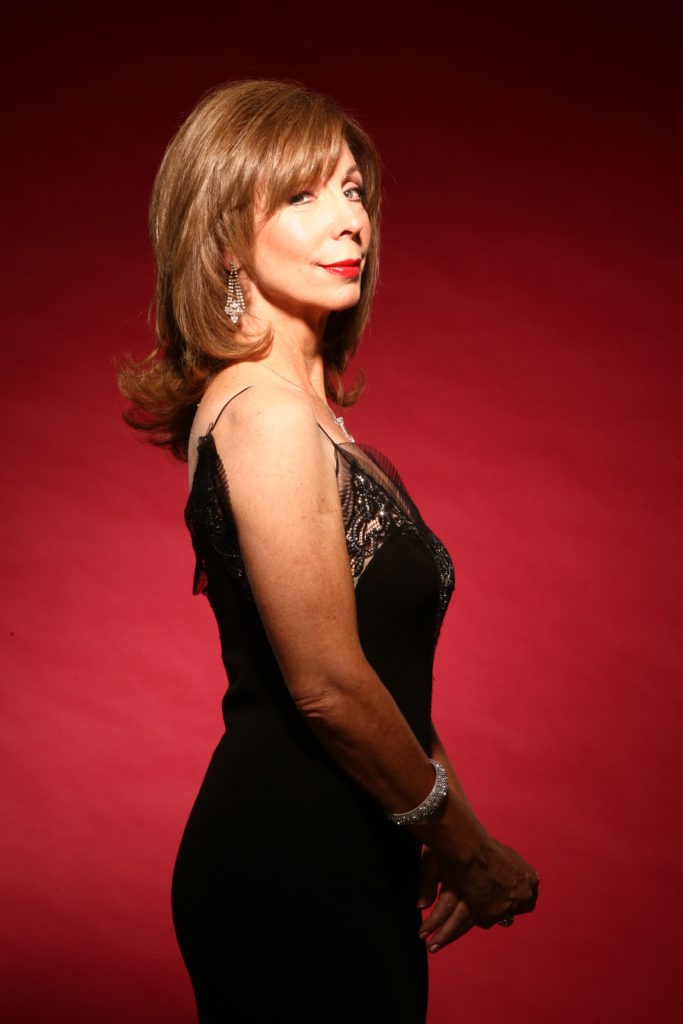
Comedian Rita Rudner wears glittering gowns onstage and bears a delicate demeanor. But by the time she gets to her biting punchlines, audiences realize she’s edgier than the breathy, shy persona she projects.
“My husband says he won’t allow me to go topless,” Rudner, 64, said in one of her recent shows. “He says he’s afraid I might poke someone’s knee out.
“I don’t know if you’ve noticed, but Vegas is becoming classier,” she said in another bit. “Can I tell you something that might just change your minds? We have a ballet company now. It’s topless, but it’s a ballet company.”
Rudner burst onto the comedy scene in the 1980s with a style different from more outspoken female comedians such as Joan Rivers and Elayne Boosler. When onstage, Rudner seems to be full of wonderment and innocence as she opens her blue eyes wide and begins her jokes. Then, out of nowhere, come those unexpected punchlines.
Rudner, who had the longest-running solo comedy show in Las Vegas history, is bringing her act to Pepperdine University’s Smothers Theatre on Dec. 7 and to the Laguna Playhouse on New Year’s Eve.
Her show “will be about being a wife and mother, and not knowing what’s going on in the electronic universe,” Rudner said in a telephone interview. “I don’t understand my phone, Siri or when I’m using Wi-Fi and when I’m using data. I can’t remember all my passwords. The usual.”
Rudner has been married to her husband and collaborator Martin Bergman for 30 years. Although they have a solid and loving relationship, she isn’t afraid to riff about him onstage. “I love being married,” she says in one of her most famous jokes. “It’s so great to find that one special person you want to annoy for the rest of your life.”
In an older set, Rudner quipped, “You know what my big downfall is? It’s clothes. I love clothes. But that old cliché is true. Men like cars, women like clothes. I only like cars ’cause they take me to clothes.”
Together, Rudner and Bergman have one daughter, Molly Bergman, who is 15. “I have a phone and it’s much smarter than I am,” Rudner said. “I get upset about it. I say, ‘Molly, please fix my phone’ when she gets home from school. She just says, ‘Mommy, tap your phone twice.’ ”
When Rudner was just starting out, her primary influences were Woody Allen and Jack Benny.
Eventually, she became a regular on “The Tonight Show” and “Late Night With David Letterman” and sold almost 2 million tickets during her run in Las Vegas, from 2000 to 2015.
“I have a phone and it’s much smarter than I am.” — Rita Rudner
In her comedy special “Live in Las Vegas,” she pokes fun at helicopter rides over the Grand Canyon: “I wasn’t afraid of the helicopter, it’s just that before you get in one, you have to tell your weight. I looked around and I thought, ‘Well, if everyone is lying like I’m lying, we’re going down.’ ”
Rudner, who comes off just as even-keeled and calm on the phone as she does onstage, said she is ready to spend more time with her family, walk her “beautiful, hairy dog,” Twinkle, and tour nationally and internationally. She’s also workshopping a new play, writing her autobiography and just shot a comedy special in Los Angeles.
Rudner grew up in a Reform household. When she was 13, her mother died of breast cancer. After that, she said, her “father was too lazy to go to temple.” Two years after her mother’s death, Rudner moved to New York City to become a Broadway dancer but transitioned into comedy when she noticed a dearth of women in the field.
Although she is not religious, she still performs for Jewish audiences. One of her jokes is about her upbringing in Miami: “I used to go to a very fancy temple. They read the Torah in French.”
On Hanukkah, Rudner displays a menorah a fan made for her. “I identify myself as a Jewish person,” she said. “I’m just not somebody who likes organized religion.”
When Rudner performs her upcoming Southland shows, Molly, a budding singer-songwriter, will open for her. “I’m going to retire in the next five or six years,” Rudner said. “Molly has to be making money by then.”
After Conching Matthews was displaced from her Riverside County home in Murrieta, she returned to the West Adams house in Los Angeles where she grew up, which had been in her family for 65 years. She and her nine children settled briefly into a new life, sharing the house with more than 10 others.
Then a man claiming to be a refinancing specialist swindled Matthews’ 75-year-old uncle, Orinio Opinaldo, out of large sums of money, forcing the house into foreclosure.
“We had to leave and gather an entire generation of family belongings and just move it all out,” Matthews said.
The story of Matthews’ uprooting is one of three short plays that make up “Pang!”, an evening of drama in which three actors, a musician and a sound engineer bring to life a trio of stories around topics of immigrant displacement, neighborhood violence and victimization of the elderly. The first segment dramatizes the experience of Matthews and Opinaldo. The second play tracks the life of a man who settled in a Cedar Rapids, Iowa, community after he was nearly shot to death fleeing war-torn Burundi as a child. In the third piece, a 7-year-old boy dreams of escaping his gritty and violent Miami neighborhood.
Working with arts and community partners in Los Angeles, Cedar Rapids and Miami, writer-director Dan Froot developed “Pang!” out of oral history interviews with three families. Although all of them have faced hunger and nutrition issues at some point in their lives, the production unites its subjects under the theme of the families being hungry for social change.
Dan Froot developed ‘Pang!” out of oral history interviews with three families.
Froot, who grew up attending a Reform synagogue in a largely agnostic family in the Bronx, was drawn to the subject in some respects because he has embraced “the social justice values” of Judaism.
“Pang!”, which will be staged at the 24th Street Theatre, is a new look at a topic the playwright has long found interesting: the bond between food and theater.
“The first pieces I made as a New York theater artist were ‘performance meals’ in which I would cook and tell stories for the audience, serve them the meal and then leave the theater,” said Froot, a professor in the Department of World Arts and Cultures at UCLA. “You bring disparate ingredients together … into this third thing that you then serve to somebody, and hopefully it nourishes them.”
“Pang!” is not meant to be conventional theater. Its segments are performed as radio plays, with performers standing at microphones and using everyday items to produce sounds such as doors opening, answering machines beeping and footsteps trudging through a muddy cornfield.
Researchers conducted 12 hours of interviews with the subject families, compiling the transcripts into book-length oral histories they gave to the families to review. The families were allowed to stop the performance from going forward if seeing their lives re-created on stage made them feel uncomfortable.
That didn’t happen, but during the research phase of the L.A. segment, the story changed. After the West Adams foreclosure, Matthews and her children relocated back to Riverside County, this time in Hemet, to where Froot followed her to complete the interviews.
“I would basically just plan to be there for an entire day and we would squeeze in interview moments when we could,” Froot said. “Otherwise, I was cooking bacon and sweeping up in the backyard and changing diapers, whatever needed to be done.”
Matthews said Froot “came out and would basically talk to us and ask us what we remembered. He made it a pleasurable experience, and when I first heard them recite the play back, I was amazed at what they were able to put together from the interviews.”
Froot hopes the play catches on and that he will be able to tour further and bring in additional families in new cities. Wherever it goes, the production will travel with a key prop: a kitchen table that appears onstage for company members and audiences to gather around and continue the discussion.
“The rules of the table are there are no empty chairs,” Froot said. “When someone leaves, somebody from the audience has to come and take their place.”
“Pang!” will be performed at 8 p.m. Dec. 2 and at 3 p.m. Dec. 3 at the 24th Street Theatre in Los Angeles. For more information, visit 24thstreet.org.
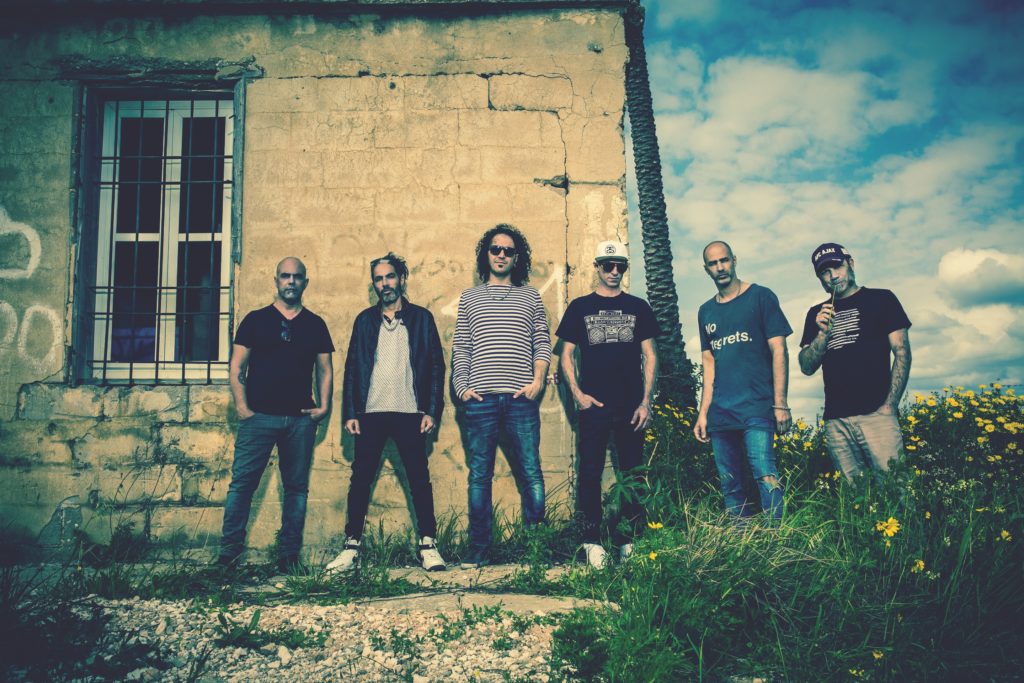
The latest single from the Israeli funk/hip-hop band Hadag Nahash, “Vote With Your Feet,” is a catchy pop song about the region’s thwarted peace process, with a chorus inspired by a quotation from American anarchist Emma Goldman: “If I can’t dance, it’s not my revolution.”
That line could be Hadag Nahash’s motto. The band burst onto the scene in the mid-1990s with a new sound in Israel: politically conscious lyrics rapped over electronic beats and a horn section, borrowing as much from the West as from the Arab world. The band’s dance floor-friendly sound made its members stars in Israel and earned them a following overseas.
They will perform Dec. 2 at American Jewish University’s (AJU’s) Gindi Auditorium, where they plan to play their hits and some new songs.
“Our goal is to move your body but also move your head,” lyricist and frontman Shaanan Streett said. “Both are equally important to us.”
The group’s name literally means “The Fish Snake,” but it’s also a play on “nahag hadash” or “new driver,” the phrase printed on a sign given to new drivers in Israel to display in their car.
One of the band’s hits, “Shirat Hasticker” (“The Sticker Song”), became a political anthem in Israel. Written by novelist David Grossman, the song takes its lyrics from bumper stickers with opposing religious and political messages, offering in their juxtaposition a whole picture of Israel’s painful divides.
“When we started I was 25, now I’m 46. So I’m not the same guy.” — Shaanan Streett
This year saw Hadag Nahash’s hit “Od Yihiye Tov” (“Things Will Get Better”), in which Streett references blockades, settlements, discrimination against minorities and the main political parties of Likud and Labor as hindrances to peace, but also includes an optimistic prediction: “Out of the strong comes forth sweetness and out of the mire will yet come forth poetry.”
Streett has had other creative outlets over the course of the band’s history. He co-founded the annual One Shekel music festival in 2001, which brings together Jewish and Arab musicians and charges concertgoers just a symbolic single shekel to attend.
“It doesn’t cover the cost but it’s a statement that everyone in this country deserves to be exposed to culture. It’s not relevant how much money they have in the bank,” he said.
Streett also co-wrote the 2013 film “The Wonders” with award-winning filmmaker Avi Nesher. The film focuses on a Jerusalem street artist and a mysterious rabbi who is being held captive in an abandoned apartment. The artist character works as a bartender, just as Streett did for years in Jerusalem. (Streett now owns a bar called “Casino de Paris” in Jerusalem’s Mahane Yehuda market).
Streett spoke to the Journal by phone as he drove from his home in Jerusalem to the band’s rehearsal space in Tel Aviv, where the other band members live. Streett said he couldn’t imagine moving his family to Tel Aviv, an expensive, predominantly Jewish city that can be insular. He said he prided himself on living with “one foot outside the bubble at all times” and preferred Jerusalem’s mix of cultures.
Streett’s sister, Tova Yael Streett, died from cancer at age 21 in 2005, after which he began to write one poem a month to deal with his pain and despair. The effort led him to record a solo concept album, “Tova: A Good Project,” on which each song is named for the month in which it was written. He also hosts an Israeli children’s television show on which well-known musicians perform and are interviewed by a panel of children.
Streett has three children who attend the Jewish-Arab bilingual Hand-in-Hand school in Jerusalem.
He said parenthood and getting older hadn’t changed the band’s approach to writing and performing.
“We’re all grown men now with families, but we still don’t believe in compromising our truths,” he said. “We’re going to sing it loud and true, and stay happy while calling out things.
“We still have weed songs and anti-establishment songs, and we still have profanity in our lyrics. That stuff doesn’t change because we have kids. But there is more of an understanding. When we started I was 25, now I’m 46. So I’m not the same guy.”
Opening for Hadag Nahash at AJU will be Hanan Ben Ari, a rising religious star in Israel who blends genres and delivers thoughtful messages about social issues. For example, in “Lama” (“Why”) he laments the rat race of modern life, asking in the chorus, “Why, why should we chase our own tails?”
“Lama” is the fifth single from his top-selling debut album, “Izun,” which was released with help from an online crowdfunding campaign that raised more than 100,000 shekels, setting a record on the Headstart site for the funding of an Israeli album.
Other singles include “Mimecha Ad Elay” (“From You to Myself”) and “Mother,” a soulful ballad about the 2005 forced expulsion by Israeli soldiers of Gush Katif settlers in the Gaza Strip. Both songs received heavy rotation on Israeli radio.
In his new song, “Wikipedia,” Ben Ari jokingly calls out all the stereotypes people have of religious people and others, in the hope that, as he sings, “We will stop with the prejudice and each one will have a chance to write his own story.”
In an interview, he said, “Before I open my mouth, they’ve already told my story. They’ve already decided who I am, what kind of music I make, who my crowd is, what I write about, etcetera.”
Ben Ari, 29, wears a yarmulke and hails from the Karnei Shomron settlement in the northwestern West Bank. He was married at 20 and has four children. His father is a synagogue cantor, and his uncle is former Knesset member Michael Ben-Ari, a co-founder of the far-right Otzma Leyisrael party.
Hanan Ben Ari. Photo by Guy Kushi
While he may have a different political perspective than Hadag Nahash, he said that performing alongside the band “was definitely one of my dreams.”
Ben Ari chooses to sing exclusively in Hebrew. “English is not a language that got me excited,” he said. “It hasn’t touched my soul like Hebrew does. And I’ve got a terrible accent. It could happen but not in the foreseeable future.”
Ben Ari recently performed at a memorial service for the 22nd anniversary of Prime Minister Yitzhak Rabin’s assassination.
“It was a big deal for me,” he said. “I was excited to be there. I decided to sing at the memorial because I’m sad from that situation that one man killed a prime minister just because he didn’t agree with [him]. And I think that [for] the Israeli nation, it was traumatic. Maybe now, 22 years after, we can heal ourselves and meet together and get to know each other from the start.”
Hadag Nahash will perform with Hanan Ben Ari at 8 p.m. Dec. 2 at American Jewish University’s Gindi Auditorium, 15600 Mulholland Drive, Los Angeles. Tickets are $45-$75 and can be purchased at teev.com.
When Rabbi Heather Miller visited a jail for the first time in February, the conditions took her by surprise.
“I saw grown men who society demonizes as villains, like in the movies, [holding] their arms inside of their shirts because they are cold,” she said.
Refrigerator space was so scarce that incarcerated mothers who were pumping breast milk had to have relatives retrieve it every other day.
Thinking additional fridge space would provide a simple solution, “I was surprised by the amount of resistance expressed over this idea,” Miller said.
Now she is working to solve such problems. Miller, 38, is one of nine members of the Sheriff Civilian Oversight Commission, a panel created by the Los Angeles County Board of Supervisors last year in the wake of a corruption scandal that led to a prison term for former L.A. County Sheriff Lee Baca.
The commission, which first met in January, aims to foster transparency and increase trust between communities and the Sheriff’s Department. It advises both the Board of Supervisors and the Sheriff’s Department but does not have subpoena power.
“She sees every person as inherently valuable.” — Priscilla Ocen
Each of the county’s five supervisors appointed one commissioner, with community groups nominating the other four. Miller was nominated by the Coalition to End Sheriff Violence in L.A. Jails, which is part of Dignity and Power Now, a group of 19 community organizations fighting jail violence and mass incarceration.
Mark-Anthony Johnson, the coalition’s director of health and wellness, said the group suggested Miller because she “has strong moral and ethical precision, ties to community organizations and a clear barometer for justice.”
A Los Angeles native, Miller is a rabbi and director of education at Beth Chayim Chadashim in L.A. She also works at Temple Israel of Hollywood as a b’nai mitzvah educator. She was ordained in 2008 at Hebrew Union College-Jewish Institute of Religion in New York. She also serves on the advisory board of the Liberty Hill Foundation — which donates to grass-roots organizations supporting social justice — and is active in the Black-Jewish Justice Alliance of CLUE-LA (Clergy and Laity United for Economic Justice).
Miller’s work on the oversight panel has earned high praise from fellow commissioner Priscilla Ocen, a Loyola Law School professor. “The way that she talks to people, the way that she sees every person as inherently valuable, I think that speaks to her religious faith in a way that quoting Scripture can’t,” Ocen said.
When the commission had open positions, Miller wanted to make sure the panel encouraged former convicts to apply. “She is concerned about having an equitable commission, top to bottom,” Ocen said, “not just in terms of our public presentations and our public positions, but in terms of how we are constituted.
Miller has long been interested in social justice issues. Before rabbinical school, she delved into peace studies, Jewish history and Africana studies at Wellesley College. She said her motivation for serving on the commission derives from the tradition of Abraham in Genesis taking a stand by uttering, “Hineini” (“Here I am”) in response to God.
“My work as a commissioner is first and foremost about being present, getting out in front of all the stakeholders involved and hearing their experiences,” she said in an email.
Miller believes it is a “sacred experience” when members of the public who have faced injustice find the strength to share their stories with the commission. She recalled listening to a woman whose son had died after allegedly hanging himself in jail. The mother brought the noose, which was made from thick bed sheets, to demonstrate that her son could not have made the noose himself without a pair of scissors.
The Sheriff’s Department “alleges that he hung himself in the noose,” said Miller, who noted that the mother asked commissioners to “question every single custody death described as a suicide.”
Miller said hearing such stories makes her feel the weight of her responsibility and the trust placed in her by the public, adding that she draws on her rabbinical training in her work for the commission. “Rabbis are trained in judicial discernment of facts, arguments and logic,” she said. “I use these skills to parse cases presented to me.”
Rabbi Donniel Hartman of the Shalom Hartman Institute in Jerusalem comes to a living room in Bel Air to make sure we know how to judge the Israelis in their fight for … survival? (“Hartman Examines How the Six-Day War Forever Changed Jews and Judaism,” Nov. 3.)
No, not so! He is helping us judge an Israel which arrogantly and accidentally won yet another war with a people who seem not to tire of the attempt to make the area “Judenrein,” helping finish Hitler’s work.
According to Hartman, Israel’s sin was in winning the ’67 war and inheriting a bunch of people no one else seems to want, in an area which no one seemed to have wanted.
The 800,000 Jews kicked out of their Arab countries were absorbed into Israel. The 800,000 Arabs who fled the area have not been able to do the same, unfortunately, and Hartman blithely blames the Jews and hangs their well-being on Israel — somehow forgetting he is now talking about hanging the welfare on the almost 5 million enemy combatants they have become. Yes, we have been forced to occupy an unwanted people, even if naysayers think we are somehow occupying our land.
Rightly so, he contends that Israel could be “an inspiration” to the world. How? By giving up the power to defend against the enemy, saying that power, to be able to defend one’s self, “undermines one’s civility.”
I have worked in the wards of many mental institutions, and there have been many conversations that made little sense in the rational world. Hartman’s convoluted logic stands up there with the best.
To Hartman, in his own words, Israel’s survival, in the face of the Arab onslaughts, has been a major contributor to worldwide anti-Semitism.
So good for you, Rabbi Hartman, and to your hosts, Debbie and Naty Saidoff — and to the Journal for giving any and every crazy idea a forum to spread narrishkayt. Those of us who are genuinely inspired by what Israel has accomplished in the face of such huge adversity will try to hope that people like you will never make sense to those “shomrei Yisrael,” the brave guardians of Israel and the Jewish people.
Steve Klein via email
‘Privilege’ and What It Means at UCLA
Gabriella Kamran learned how to spell “privilege” at UCLA; would that she had learned what it means to be a Jew at my alma mater (“Are Jewish College Students Privileged?” Nov. 17). She approvingly quotes current UCLA student leader Rafael Sands and his reasons for not attending this year’s AIPAC conference, to wit: “Inviting Donald Trump and Mike Pence to speak at AIPAC represented American Jewish complicity in the administration’s ban on Muslim immigration, animosity toward undocumented people and hostility to reproductive choice.” Sands condemns American Jews with one broad swipe and at the same time rejects the idea of listening to a speaker with views different than his own. One wonders if he was on the UCLA student council when it voted to endorse the Boycott, Divestment and Sanctions movement aimed at Israel.
Louis H. Nevell, Los Angeles, UCLA ’56
Being a baby boomer, I’m puzzled at the millennial obsession with ethnic or racial privilege, since we’re all products of our past. The civil rights movement has succeeded remarkably in leveling the playing field, but we’ll never be totally equal. People with two caring parents generally do better than those without, as do those who bathe regularly. Of course, as a group, whites are privileged, but many individual whites are not, and increasing numbers of Blacks and other ethnicities are.
Jews descend from a people who led the world in eliminating superstition, idol worship and human sacrifice. Our ancestors were the first to assert that all humans are meant to be free, and realized that this required morality, which they fostered in the Ten Commandments. Thus, our Israelite ancestors were the first to possess a conscience, and passed on this cherished gift by instituting Torah education.
Because they were attacked by one empire after another, and had to live among often hostile gentiles, only the most daring and resourceful survived. So is it any wonder many of us reflect these qualities today? Should we be ashamed of this? Of course not.
Young Jews should support others, but not at the price of abandoning Israel, which is the covenant basis for the belief system that makes us who we are. They must insist that Israel has every right to exist; her rebirth is indeed a miracle. The reason there isn’t peace is because Palestinian leadership rejected statehood and peace in 1937, 1947, 2000 and 2008, and it is they who must change.
Young Jews must decry condemnation of Zionism and reclaim its glory. If Students for Justice in Palestine, Black Lives Matter, liberal professors and other “progressives” reject this, Jews must reject them. Jews will never gain respect by abandoning Israel or betraying our heritage. We command respect when we take pride in who we are and stand tall knowing where we come from. If that’s “privilege,” so be it.
Rueben Gordon via email
College Students Are Too Coddled
It was refreshing to read Karen Lehrman Bloch’s column (“The Privilege of Gratitude,” Nov. 24) about the victimization culture toward which U.S. society has been evolving. A notable example is so-called “safe spaces” on college campuses. U.S. college students rank among the most mollycoddled and fortunate people on Earth, yet now they need safe spaces to hide in? The billions of less fortunate people who must deal with real-life problems don’t have such spaces and neither will college students once they enter the real world.
Ben Zuckerman, Los Angeles
What’s the Matter With Our Public Discourse?
Reading Philippe Assouline’s analysis (“My Rant Against Conformity,” Nov. 24), I wonder what Teddy Roosevelt might think of our public discourse: “Radical Republicans posturing as conservatives and sniveling Democrats cowering behind political correctness!”
Denouncing those expressing opposing opinions are the new fascists in our land and anti-social media inflames their half-wit intolerance. As Yeats wrote: “Things fall apart, the center cannot hold; mere anarchy is loosed upon the world.”
David Taylor Johannesen, Boston
FROM FACEBOOK …
‘A Thanksgiving Meal Haggadah’
We are Catholic with many roots and family that are Jewish. This is beautiful!! Thank you! It is indeed good to give thanks to the Lord!
Mariely Madero de Gessler
Thanks so much for this! I love Thanksgiving but I’ve always wondered how it fits into Jewish life. I might just print this for reading at our Thanksgiving gathering this year!”
Josie Mintz
Fabulous commentary. I shall read at our Thanksgiving table.
Norman Wexler
Perfect for this Thanksgiving Day ’17: Thank you and be blessed.