Fearful times: A timeline of the current Israel-Gaza conflict
A young relative of Gaza police chief Tayseer Al-Batsh mourns during the funeral of his family members, who hospital officials said were killed in an Israeli air strike.
A young relative of Gaza police chief Tayseer Al-Batsh mourns during the funeral of his family members, who hospital officials said were killed in an Israeli air strike.
Images of destruction have been flowing in since the on-going Palestinian-Israeli conflict flared up again in recent days, with Palestinian rockets being fired at Israel and Israeli air strikes hitting the Gaza Strip.
The current hostilities were triggered by the kidnap and killing of three Jewish seminary students (pictured above) and the subsequent revenge murder of a Palestinian youth.
Rising tension swiftly turned to all-out conflict.
June 30. Tel Aviv, Israel. Photo by Nir Elias/Reuters
In the image above, an Iron Dome launcher fires an interceptor rocket in the southern Israeli city of Ashdod on July 8, when cross-border fighting with Hamas-led militants surged.
After a week of fighting, Egypt proposed a ceasefire between Israel and Palestinian militants in Gaza that would start on July 15.
Israel unilaterally accepted but the dominant Palestinian Islamist group Hamas said it had not been consulted by Cairo and kept up rocket attacks while Israel held back for six hours.
With tension escalating, on July 16 Israel urged the evacuation of several Gaza Strip areas where more than 100,000 people live, threatening ground operations.
July 8. Ashdod, Israel. Photo by Baz Ratner/Reuters
Palestinians gather around the remains of a house which police said was destroyed in an Israeli air strike in Gaza City.
Gaza health officials said the death toll in the coastal enclave had risen to 202 and that most of the dead were civilians.
World powers urged calm, worried about spiralling casualties should Israel send tens of thousands of troops it has mobilised into Gaza.
It is one of the world's mostly densely populated areas, its poverty exacerbated by the collapse of public works and displacement of at least 18,000 Palestinians who the UN said have taken shelter at its Gaza City schools.
July 14. Gaza City, Palestinian Territories. Photo by Mohammed Salem/Reuters
With Palestinian fire having inflicted the first Israeli fatality of the conflict – a civilian bringing food to soldiers near Gaza – Israeli Prime Minister Benjamin Netanyahu vowed to “expand and intensify” to stop persistent rocket strikes that have made a race for shelters a daily routine for hundreds of thousands in the Jewish state.
In the image above, Israelis take cover on the side of a road as a siren warns of incoming rockets outside the northern Gaza Strip.
July 15. Gaza Border, Israel. Photo by Amir Cohen/Reuters
Jewish members are describing antisemitism within CFA itself as the union presses to weaken protections born of the post-Oct. 7 campus antisemitism crisis.
The sukkah reminds us to go out into the world, especially when the comforts of insularity beckon us closer—to explore paths we have yet to take and seek journeys ready for wandering.
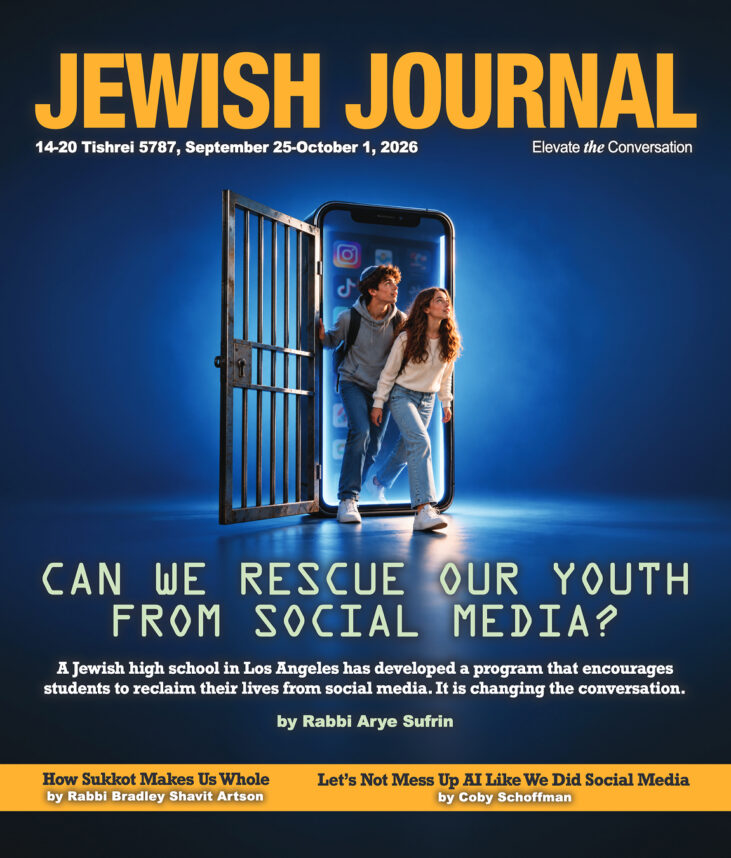
A Jewish high school in Los Angeles has developed a program that encourages students to reclaim their lives from social media. It is changing the conversation.
A Jewish high school in Los Angeles has developed a program that encourages students to reclaim their lives from social media. It is changing the conversation.
There is a difference between criticism that comes from responsibility and love, and an almost psychological need to prove to the world: I am not one of them.
Shaare Zedek Medical Center in Jerusalem said Wednesday night that after undergoing lifesaving procedures in its trauma unit, Leiter underwent complex brain surgery lasting several hours along with additional treatments.
While so much of the world seems obsessed with and consumed by its hatred of Israel and Jews, Israelis continue to build, create, work, celebrate, argue, raise families, and plan for the future.
“The biggest concern is that people now have a pathway to shut down Jewish voices through complete falsities that people will believe. … For the future of Jewish entertainment, it’s very scary.”
Mark Smith has compiled an important anthology of Jewish history using 49 works by Yiddish historians to recreate or at least open the door to a world of Jewish thought that was once almost mainstream, but which no longer exists, except in the minds of too few specialists.
Most Jews who have sung “Eitz Chaim” over the past half-century probably never knew Portnoy. They did not know when he wrote the melody or how young he was when he composed it. They simply knew the song.
The failure of the social media era was not simply that we failed to predict what would happen. It was that we continued giving technology companies the benefit of the doubt long after there were compelling reasons not to.