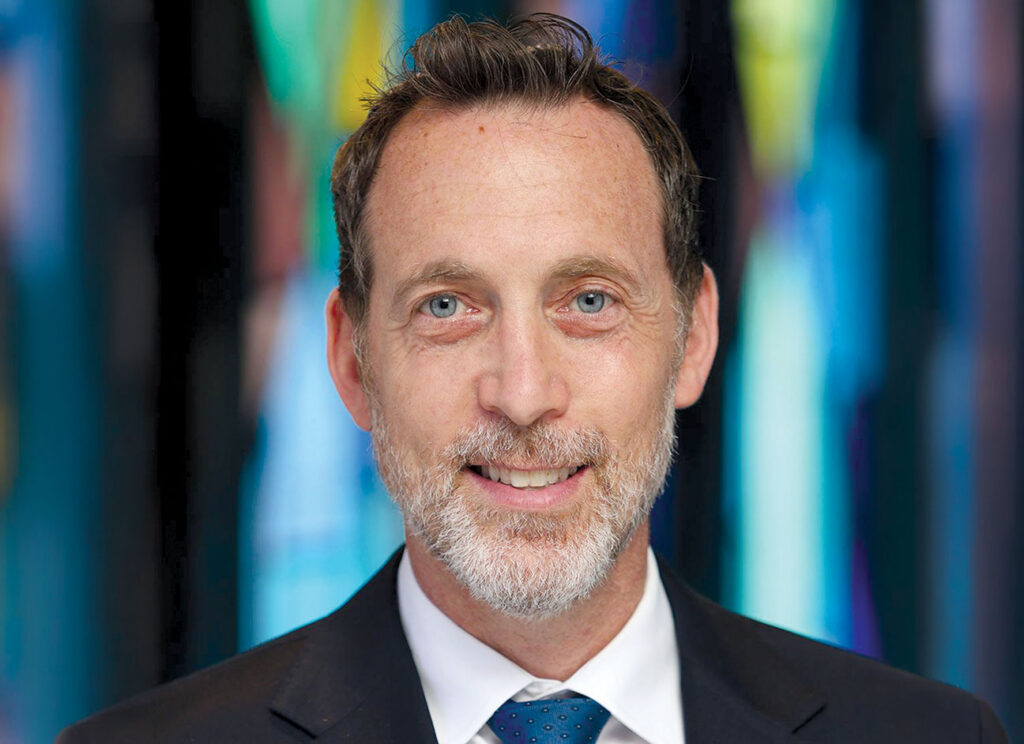
In the first part of his profile, Rabbi Avi Taff of Sinai Temple told The Journal how, during the summer, his 14-year-old daughter Eliana declared that she wanted to make aliyah. She had been recruited by Maccabi Haifa to be part of their basketball academy. Within days she announced her desire to move to Israel.“Eliana’s athletic skills and commitment to Israel form a perfect combination,” her proud father, whose family has a decades-long history of aliyah, said.
How often do they speak? “Ev-v-v-very day,” he said, elongating the word. The mere thought of his middle child being educated in the Jewish state caused him to swell with pride. “That your daughter would be mature enough to make this kind of decision,” he smiled. “It hasn’t been easy,” he said. “Eliana is working through it.”
One of the hardest things he’s ever done, the rabbi said, “was walking away from Eliana when I was leaving Israel the last time after a four-day visit. I stayed ‘til Thursday night, had to be back in the office on Friday, had a bar mitzvah on Saturday, I had a welcome-back event for the school on Sunday and a wedding Sunday night.”
But Eliana was following in her father’s footsteps. Rabbi Taff’s parents were not thrilled, at first, when the oldest of their three sons announced he was making aliyah. They didn’t want him to be so far away from them and his brothers. “I said to my parents, ‘What did you expect? You taught me to love Israel. You shared the beauty of the land and the people.’” They just didn’t want me to be so far away from them and my brothers.
Eliana is “the latest iteration, my daughter, on her own, at 14, deciding she wants to be there. As hard as it is to not be with her, I am so proud of her,” said Rabbi Taff.
As for the future, “we said we are going to take it semester-by-semester. Nothing’s in stone. If she decides to come back, I am proud of her for giving it a try. We will see how things go, and we’ll keep evaluating.”
Where did the Taff family’s love of Israel come from? “My dad is from Albany, N.Y.,” he said. “I think there’s something in the water in Albany because I know a lot of Albanians who ended up making aliyah.” His father’s whole side of the family (one by one — first, his sister, then his brother, then his parents) moved to Israel. “My dad studied for the rabbinate after they came to Israel. He was a cantor first, then he became a rabbi.” Rabbi Taff’s wife, Amy, also has a deep connection to Israel. She spent her junior year of college at Tel Aviv University and participated in Otzmah after college. Her brother and his family made aliyah 15 years ago.
The Taff family moved to Israel for three years when he was in the first grade so his father could study for the rabbinate. “That was the beginning of the love story.”
What lies ahead for Rabbi Taff? “I mean, we plan and God laughs,” he said. “So I don’t really know. My plan is to continue to teach and to foster a deep love of Israel.”
The conversation returned to Rabbi Taff’s students. “My job has evolved,” he said. “I started four years ago solely as the associate rabbi. When I came here, Sinai Akiba Academy was looking for a school rabbi. I had been a school rabbi at Valley Beth Shalom for 13 years. I was asked if I would be open to that position here. I really had missed teaching the range, from pre-school through eighth grade. I also do adult education classes. We call them learning circles, including a dads’ learning circle.”
How have kids changed over his 17 years in the classroom? “We are still feeling the effects of COVID,” he said. “In this generation, we are seeing a lot more anxiety among children.”
What can be done to counter this? He quoted from the Talmud. “We educate each child according to his or her way. We try to find the best way to meet the needs of each student.
“Going back to my daughter, Eliana, that is how my wife [Amy] and I decided to let her have the opportunity to go to Israel. We said if our only hesitation is that we are going to miss her, is it right for us to stand in her way from following her dream? It’s her derek, her way. It’s the same with the kids we teach here at Sinai. We want to reach our kids where they are.” While he doesn’t like to generalize,he said “every child, every soul, is unique. They have different ways of learning, different ways of exploring the world.”
What is Rabbi Taff’s favorite responsibility? He paused to think before answering. “So tough,” he said. “I really do look forward to coming to work every day.” After a lengthy hesitation, “I would say my – and our – responsibility here is to foster a deep sense of Jewish commitment and identity to the Jewish people and to Israel. In essence, that is what I love – helping people find their connection.”
As for Rabbi Taff’s long-range perspective, “I dream of one day returning to Israel,” he said. “I am at a point with the current state of the world, specifically of Israel, that I believe we need more North American Jews to move to Israel.
“For Israel to continue to exist as a Jewish state for all Jews – the hatred of us is so open. I also believe that we need Jews of different backgrounds to move to Israel for it to continue to be a democracy, a state for all Jews, not just for the ultra-Orthodox segment.”
Rabbi Taff noted an increase in aliyah in the last three years, since Oct.7, especially from the United States. “We have seen stronger people finding a connection to Israel,” he said. “We are seeing people more interested in exploring their Jewish identities, we are seeing a resurgence of American Jews who consider themselves secular or nonpracticing.”
At Sinai Temple, the number of conversion candidates has grown. “I will say to them, ‘Oct. 7 was not that long ago. The Beit Din, the court of Jewish law, will ask you, ‘Do you agree to bind your destiny to that of the Jewish people?’
“I can’t tell you how many people said ‘Oct. 7 made me want to be a Jew even more than before.’” The rabbi smiled broadly. He was glad to see that young professionals are choosing Judaism. “I say to them ‘If you are saying that now, we can go directly to the mikvah. I don’t need any more reassurance you are dedicated to your Jewish life.’”
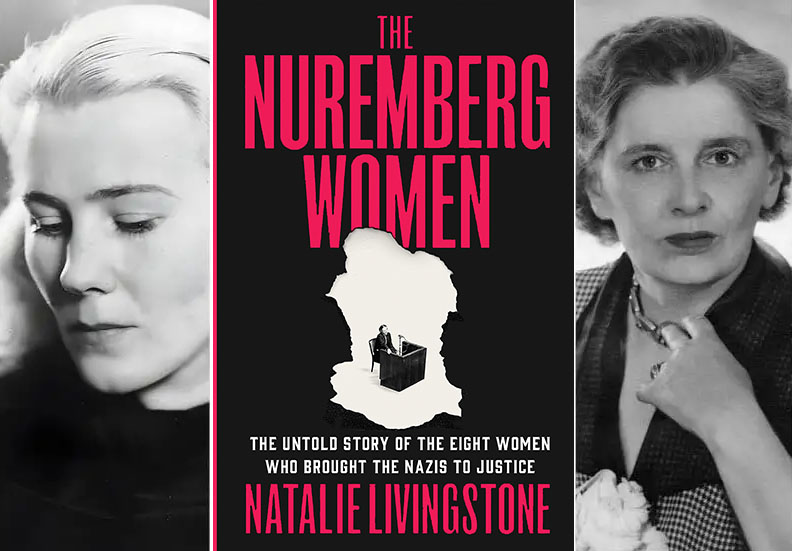
The Nuremberg trials brought Nazi leaders to justice, but the story of the women who helped expose their crimes has largely been overlooked. In her new book, “The Nuremberg Women,” British author Natalie Livingstone brings eight remarkable women into focus: a British painter, an American lawyer, a German journalist, a Russian interpreter, a British historian, a reporter with German and British ties, a French photographer who had been active in the Resistance, and a Hungarian countess who opened her home to both concentration camp survivors and former Nazi officials. Although women did not serve as judges or hold senior decision-making positions in the courtroom, each made her own contribution to documenting the trials and their aftermath. Through their individual stories, Livingstone brings to light women whose courage and determination helped illuminate the crimes of the Nazi era.
Livingstone set out to recover stories that history had pushed to the margins. Her book offers a different perspective on one of the most consequential trials of the 20th century, asking whose voices were heard, whose were excluded, and what we lose when women are left out of history.
This is Livingstone’s third book, and, like her previous works, “The Mistresses of Cliveden” and “The Women of Rothschild,” it explores the role of women in history and their influence in a male-dominated world.
The idea for Livingstone’s book took shape at London’s Imperial War Museum, where a painting by British artist Laura Knight is on permanent display. Titled “The Nuremberg Trial,” the painting is filled with men—defendants, attorneys, judges and spectators who gathered to witness one of history’s most consequential trials.
In a phone interview with The Journal from her home in London, Livingstone recalled her reaction to the painting.
“I had to really take a thorough look and it just occurred to me that in this painting there was a sea of men and you had to lean in very closely in order to see it’s actually a work of a woman who had painted herself out of history.”
The painting left Livingstone wondering who this woman was, how she had come to be in the courtroom, and what other women might be hiding in plain sight. She began researching the subject and discovered that women had played significant roles in the Nuremberg trials, yet their stories were largely absent from books and films. She set out to bring those stories to light.
“These women were pivotal to both the process and the outcome of the trial,” said Livingstone. “Yet they were marginalized on many occasions, literally reduced to footnotes. I found it absolutely fascinating to take a story I thought I knew and explore it from a completely different perspective, almost turning the picture around.”
Of the eight women featured in the book, one left a particularly deep impression on Livingstone: Marie-Claude Vaillant-Couturier, a French Resistance fighter and concentration camp survivor whose testimony at Nuremberg helped bring the horrors of the Nazi camps before the world.
“Her whole persona is sublime and extraordinary,” Livingstone said.
Vaillant-Couturier was arrested in 1942 for smuggling weapons for the French Resistance and spent nine months in solitary confinement. In 1943, she was deported to Auschwitz alongside 229 other French female Resistance fighters. Only 49 survived. After enduring a year in Auschwitz and later being transferred to Ravensbrück, she remained at the camp for three months after its liberation to care for those too ill to travel.
On January 1946, Vaillant-Couturier took the stand at the Nuremberg trials. Over the course of her testimony, she described the horrors of the camps, the massacres, the fate of women and children, including babies, and the sexual violence inflicted on prisoners. With remarkable composure and attention to detail, she gave voice to victims who had been reduced to numbers, speaking on behalf of those who had perished without resorting to self-pity.
“And then, after two hours of testimony she had this amazing stare-off to all of the Nazi defendants, where she looked each and every one of them in the eyes and said she is channeling those who lost their lives. Through her they had their moment of reckoning, with those men who had brought so much damage with so much evil,” said Livingstone.
Reading the description in her book, the reader feels like he is being transported 80 years back to this courtroom in Nuremberg.
“Her courage, resilience her bravery, honesty and strength, I don’t have enough words to describe how much she affected me,” said the author.
Another woman Livingstone chose to portray in her book is Ursula von Kardorff, a German journalist who had worked for Nazi newspapers during the war. One of 16 German journalists sent to cover the Nuremberg trials, von Kardorff offered a perspective rarely represented in accounts of the proceedings: that of the defeated nation.
“Usually, we see history from the perspective of the winners. History is written by those who won, and Ursula is one of those rare examples of history told from the perspective of the defeated.”
In her diary, von Kardorff described the painful experience of confronting Germany’s defeat, writing, “Nowhere is it more painful to be German than in Nuremberg.” Her account captured a nation coming to terms with the loss of its power, while also revealing her own attempts to distance herself from the Nazi regime and the journalism she had produced under it.
Asked about the 2025 film “Nuremberg,” starring Russell Crowe as Hermann Göring and Rami Malek as the U.S. Army psychiatrist sent to evaluate him, Livingstone criticized writer-director James Vanderbilt’s portrayal of Göring’s wife, Emmy, as a sympathetic character.
“She was anything but. She was evil. There is no evidence that she had any conscience about the actions of her husband,” Livingstone said.
The granddaughter of Hungarian Holocaust survivors, Livingstone approached the book with a profound sense of responsibility. Many members of her own family perished in Auschwitz, and she felt both proud and humbled to be in a position to chronicle the crimes committed against the Jewish people. She also felt a responsibility to ensure that every detail was accurate, recognizing the importance of facts, truth and evidence in documenting one of history’s darkest chapters.
“The Holocaust had always been very much alive for me. I learned a lot about the trials when I was younger,” said Livingstone. “My grandfather, like so many survivors of his generation, couldn’t find the words to speak about the torments he had endured, but it was very much hunched into the DNA of our family.”
Writing about these eight women has been a source of inspiration for Livingstone, particularly at a time when antisemitism is once again on the rise. “When I look at their resilience, bravery and resourcefulness, it gives me the strength to believe we can get through these difficult times,” she said.
One of the joys of being a Sephardic Spice Girl is when Rachel and I get to meet other Jewish food influencers and learn about their work. Last week, we had the honor of meeting up with Joel Haber at the new Bo•re•kas restaurant on South Beverly Drive.
In 2024, Joel hosted Rachel and me on his podcast “18 Jewish Foods” to discuss moufletta and the friendly relationship between Jews and their Arab neighbors in Morocco.
Joel, whose Instagram handle is @funjoelhaber, is famous for his amazing tours of Shuk Mach’ne Yehuda. A renowned food researcher, scholar and lecturer, he recently authored the book, “Cholent: The Most Jewish Food on Earth.”
It’s a fascinating, detailed history of Jewish Diaspora migrations and the origin of Shabbat stews, beginning with the period of the Babylonian Talmud, all the way to the meat and beans, barley and potato Cholent that we know and love today.
An ingenious solution to the uniquely Jewish problem of eating a warm meal for Shabbat lunch, the recipes for these stews adapted to the different regions that the Jews lived in. This “low-and-slow” cooking method, writes Joel, makes the “ingredients caramelize and breakdown, flavors blending and unifying, until the final product is ready to be devoured with gusto in the middle of the day on Saturday.”
The Jews of Central Asia and Iraq made their stew with a whole chicken and scented rice because chicken was more expensive than lamb and goats and rice was more luxurious than wheat and barley. In the more arid regions of North Africa, whole wheat berries serves as the primary grain of the dafina, accompanied by lamb, garbanzos and dates.
Barley, by nature of being easily grown, became “the grain of choice for European Jews” in their cholent, along with beef, beef bones and kidney beans.
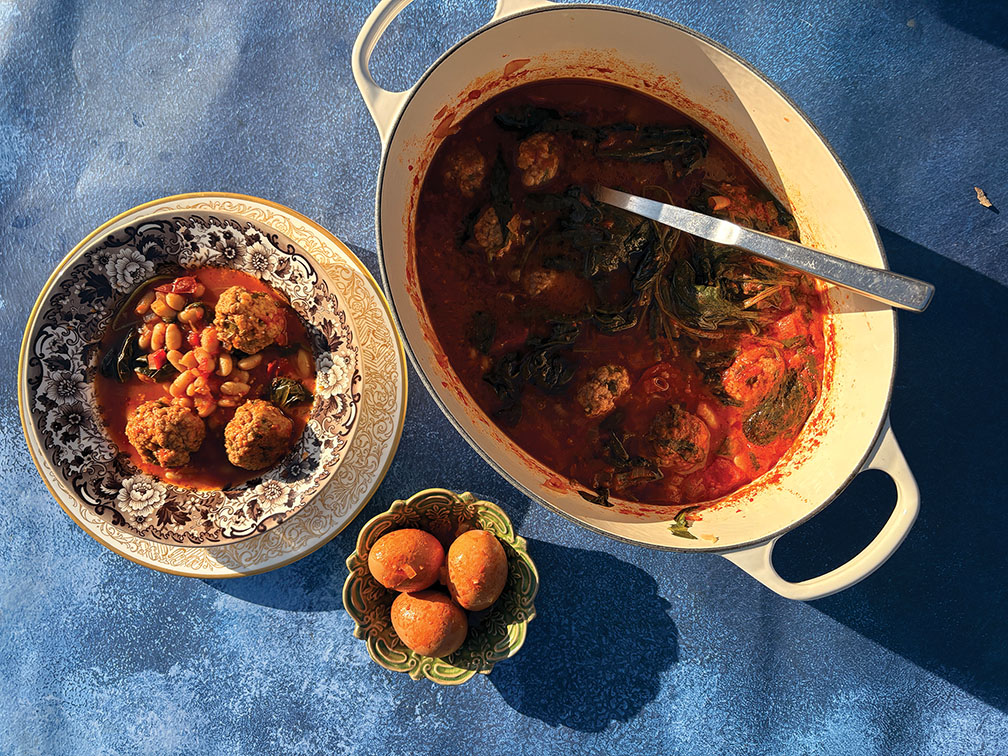
Leafing through the recipes in this book, Rachel and I were inspired by the unique Toscano Hamin, which incorporates meatballs, cannellini beans, tomatoes and lots of spinach. Interestingly enough, Joel writes that there is no tradition of long simmered stews in Southern Europe. Rather, as we have written in these pages before, the Sephardic and Ottoman Jews eat a desayuno, an elaborate meal of borekas, boyos or bulemas, salads, cold fish and huevas haminados, overnight cooked eggs.
This Hamin Toscano recipe reminded us of a Tuscan wedding soup. It was equally delicious after cooking for two hours and overnight. In the spirit of the ever evolving recipes of Shabbat stews, Rachel and I added our own unique touches to the recipe.
We hope you make this recipe. When you do, add whatever ingredients you love. Jewish cooks have been doing that for millenia.
—Sharon
In what I consider a true contemporary phenomenon, “Thursday night cholent” has become a weekly habit for many people.
After decades of Thursday night cholents, no one even thinks they’re remotely strange any more. Pop-up eateries exist throughout Israel, in Jewish areas of America from Los Angeles to Miami and in the heavily Orthodox areas of northwest London. It has even grown so popular that it created a spin-off sub-trend: gas station cholent. I know that sounds like some kind of off-color Dad joke, but it’s actually a thing. In both northern New Jersey and in Monroe, N.Y., nestled between a number of Orthodox suburbs, you can buy a bowl of your favorite Shabbat stew from a local gas station convenience store. It’s like a kosher 7-Eleven, selling cholent instead of chili dogs. (Hey . . . cholent dogs, anyone?)
Eateries at Israeli service stations are legendary, with some ranking among the most popular restaurants in the country, so finding something similar there shouldn’t surprise us. In fact, one called The Greenhouse existed for a short time in Jerusalem, at a gas station near the capital’s Botanical Garden, and a few others almost fit the bill. Bobes & Beer has two branches, both located in industrial parks. Beyond their standard cholent (which they call “chunt”), they also offer a lamb version and yapchik — a cherished combo food that sandwiches beef between layers of potato kugel.
Even more distinctively Israeli, desert pop-up Cholent Yericho sits at Almog Junction, near the Dead Sea and right outside the Palestinian city of Jericho. Though not technically a “gas station” cholent, it sits at a roadside strip-mall opposite a gas station/rest area. The owners are Orthodox Jews, but most workers are Palestinian Arabs and the atmosphere is very much of its surroundings. Low seating surrounds outdoor tables, and nargileh (hookah) water pipes wait to be smoked as you devour cholent or yapchik. A local camel oversees it all, in case you want to ride off your meal — for an extra fee, of course. With such a cross-cultural atmosphere, Cholent Yericho has been called “the first Arab cholent.”
– Excerpt from
“Cholent: The Most Jewish Food on Earth” (Green Bean Books, 2026)
Hamin Toscano
For meatballs
1 lb ground beef
1/2 cup Panko
1/4 cup potato starch
2 eggs
1/2 cup finely chopped Italian parsley
1/2 tsp ground black pepper
1 tsp garlic powder
Combine beef, panko, potato starch, eggs, parsley, pepper and garlic powder in a mixing bowl. Work all the ingredients together, being sure not to overmix.
Form ground beef mixture into 2 inch balls, then set aside.
For hamin
1/4 cup extra-virgin olive oil
1 large onion, finely chopped
6 garlic cloves, minced
2 tsp kosher salt
2 tsp sweet paprika
3 Roma tomatoes, diced
1 14 oz can chopped tomatoes
2 14 oz cans cannellini beans, drained
2 cups water
2 lbs spinach
8 eggs, in their shells
In a Dutch oven, add the olive oil, onions, garlic, salt and paprika and sauté for about five minutes. Add the fresh and canned tomatoes and the beans and stir to combine.
Place the meatballs and eggs on top of the beans, then pour water into the pot. Bring to a boil, then reduce heat.
Place the spinach leaves over the meatballs, then cover the pot.
Cook overnight in an oven set to 210°F. Or on an electric hot plate. Or in a Crock-Pot.
Sharon Gomperts and Rachel Emquies Sheff have been friends since high school. Their cooking and storytelling project has grown into a devoted following on Instagram @sephardicspicegirls and on Facebook at Sephardic Spice SEC Food. sephardicspicegirls.com/full-recipes.
By the end of Genesis chapter 13, Abram has settled peacefully and securely among the terebinths [sturdy trees] near Hebron (a region that God had designated to him). Then local rulers engage in a regional war that would not have involved Abram at all except that they captured his nephew, Lot, his family and possessions. Abram organizes his own forces, defeats the local rulers and retrieves his nephew and family. Local kings who had been threatened by the invaders offer Abram spoils of war. Abram refuses: “I will not take so much as a thread or a sandal strap of what is yours.”
At which point, our chapter opens with God’s address to Abram: “I am a shield to you; your reward shall be very great.” Abram’s response is heartbreaking: he talks about his pain at being childless, having no heir to all that he has acquired.
An element of our Five Books of Moses that always engages me is how human our biblical protagonists are.We witness their stories of despair and courage, of human weakness and growing self-awareness, their humility and their capacity to live lives of integrity in the most challenging circumstances. It is so much more powerful to read of these people week after week than saintly figures whose lives do not seem accessible or open to our emulation. How encouraging it is that our tradition offers us such truly vulnerable, fragile and ethical human beings as our role models.
Baruch C. Cohen
Civil Trial Attorney
We usually think fear comes before the battle. Sometimes the deeper fear comes afterward. Abram had just prevailed against kings. He had demonstrated extraordinary courage. And then God appeared to him with words that seem almost surprising: “Abram – Fear not.”
Perhaps courage does not eliminate fear. Sometimes courage merely postpones it. There are moments when we do what must be done because there is no time to calculate the consequences. We fight the battle. Make the decision. Walk into the hospital room. Stand beside someone we love. Say the words that cannot remain unsaid. And only afterward, when the noise subsides, does the heart begin asking its questions. What happens now? What did this cost me? What if I cannot do this again?
God does not tell Abram that there was nothing to fear. He tells him something far more profound: “I am your Shield.” A shield does not mean there will be no arrows. It means you will not face the arrows alone.
Perhaps that is why the reassurance comes after the battle. Faith is not always the confidence we carry into the darkness. Sometimes faith is what God whispers to us when we emerge from it trembling: You were brave when you had to be. Now let Me hold the fear you could not afford to feel.
Rabbi Peretz Rodman
Masorti/Conservative Rabbi, Jerusalem
“Praised are You, Adonai, Shield of Abraham.” So ends the first blessing in Judaism’s classical core liturgy. The Amidah begins with a reminder to God that we are the descendants of Abraham, Isaac and Jacob, with whom He had forged a covenantal relationship. Why is our verse cited there? Why Abraham? Why “Shield”?
Note the verse’s context: Abraham had stuck his neck out to rescue his nephew, taken hostage in a war among Canaanite kings. Victorious and even blessed by a Canaanite king, Abraham had refused to accept pillaged property. The language of our verse reflects the background of war. The term here for “reward,” sachar, often refers to the spoils of war. In Ezekiel 29:18, for example, God says of the marauding Babylonian king, “no sachar did he and his forces get for all their efforts.”
Abraham swore off any material gain; God promises him that God Himself will provide reward of another sort: a son, continuity, the fulfillment of his destiny as progenitor of a nation that will inherit the land he had been shown and promised. As we stand before the Eternal in prayer, we begin by recalling our ancestor’s selfless dedication to his family and to fulfilling God’s plan that he model “the way of the Eternal” by “doing what is just and right” (Gen. 18:18). We recall the promise made to him and his descendants, including ourselves – if we prove to be worthy heirs.
Rabbi Amy Bernstein
Senior Rabbi, Kehillat Israel Congregation
Many commentators ask what Abram fears that the Divine here comes in a vision and tells him not to be afraid. I like that Torah is not clear about Abram’s fear because it makes this assurance one each of us who carries our own private fears can relate to. It allows each of us to imagine for ourselves what it might mean to trust that God is our shield. Studying this parsha after a diagnosis of stage 1 breast cancer and while undergoing treatment with chemotherapy and radiation, I understand the power of this imagery differently than I have before. Torah does not say that Abram will not face danger or painful life experiences (the sending away of Hagar and Ishmael and the binding of Isaac have not happened yet) but that God will be a shield to Abram whatever comes. Our ancestors found this so resonant that they wrote it into the Amidah, the central collection of blessings in our liturgy. In Siddur Sefard (Yotzerot, Parashat HaChodesh) the prayer before the blessing ending with this image of God as the Shield of Abraham includes the words “li od tignon” or “shield me again.” What a beautiful recognition that though we face real danger and painful situations, we have each known what it is to be shielded during them by the love of others, their kindness and care, and by our own miraculous ability to heal from what life brings us.
Cantor Michelle Bider Stone
Temple Beth Am, Los Angeles
Have you ever had an uncomfortable feeling in your gut after what you thought was a positive experience? Maybe something didn’t feel right, even though everything went your way. This is the unease Abram seems to be experiencing.
Let’s put this verse in context. Abram has just won a major battle and saved his nephew Lot from captivity. God appears and tells him not to fear. Why would Abram be afraid? He defeated kings. He rescued his nephew. Everything seemed to have gone right. The Midrash teaches that Abram was afraid because he was concerned that, during battle, he may have killed innocent or righteous people. After his hard-won victory, Abram wasn’t celebrating or worried about revenge. He feared his own moral failing.
Abram had every reason to pat himself on the back. Instead, he stopped to wonder about who he may have hurt. Questioning ourselves in a moment of triumph is a profound form of humility. Chief Rabbi Lord Jonathan Sacks explains this moral dilemma. He writes, “Moral dilemmas are situations in which doing the right thing is not the end of the matter.”Sometimes, even when we believe we’ve done the right thing, we must live with the consequences. Abram’s greatness is not simply that he won the battle. It is his willingness to take moral responsibility. Moral commitment doesn’t mean never making difficult choices. It means having the courage to examine the consequences of our choices, even when we believe we are right.
The day before the third anniversary of the Oct. 7 massacre, I was at the Peres Center for Peace and Innovation in Jaffa, overlooking the Mediterranean Sea.
I’ve spent four months in Israel in 2026 — my first time here since 2019 and my first since starting to write at The Jewish Journal. I’d been to memorials and gatherings about Oct. 7 in Los Angeles for three years. This was my first time spending the anniversary in Israel.
Efrat Duvdevani, the Peres Center’s director general who worked with Shimon Peres for 22 years, including during his presidency, took me through an exhibition of personal belongings selected by families of people murdered or abducted on Oct. 7.
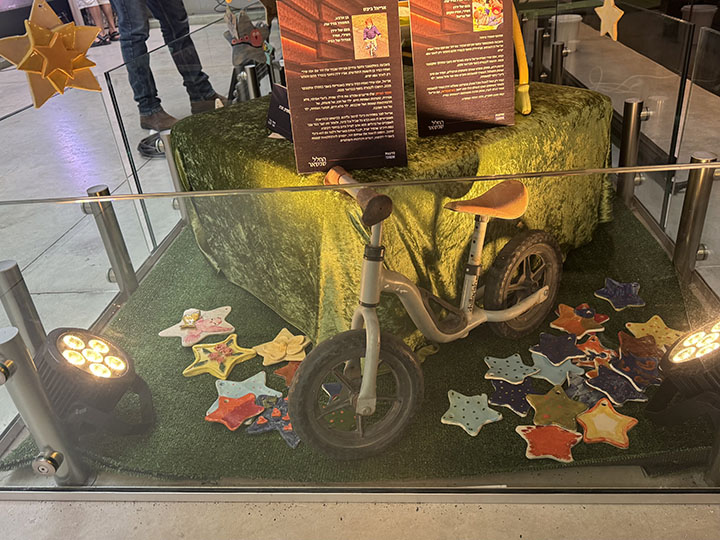
Outside was a yellow dumpster from the Nova festival site. Among the individual objects on display was a military cap fromSgt. Roni Ashel who was burned alive, and a stethoscope that was with paramedic Amit Mann when she was murdered while helping victims. There was also a tricycle and car seat belonging to the Bibas boys, Ariel (4) and Kfir (9 months), who were murdered by Hamas in Gaza. “We wanted to respect them and show the time when they’re happy,” Duvdevani told The Journal.
Items belonging to Ariel and Kfir Bibas on display at the Peres Center for Innovation in Jaffa (photo by Brian Fishbach)
Duvdevani spoke about a mother who had come to the exhibition and gave a crying hug to a football jersey belonging to her murdered son. The mother told the staff that she missed him and wanted to hug him.
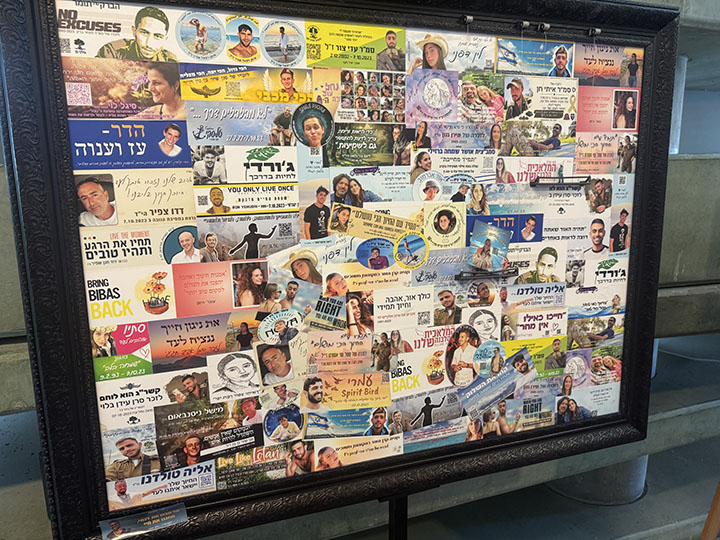
There was also a collection of memorial stickers, like the ones displayed at gas stations, checkout counters, lampposts and walls across Israel. Photographs of Israelis, their names, something they said, something they loved. These often are names of victims that we don’t hear much about in Los Angeles.
Memorial stickers at the Peres Innovation Center in Jaffa Israel (Oct. 6, 2026) (photo by Brian Fishbach)
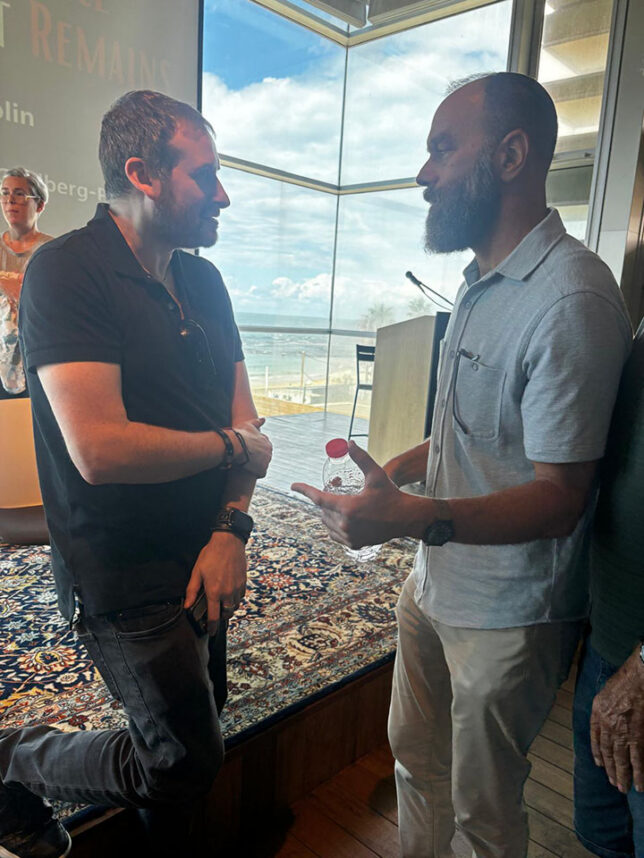
Upstairs, Jon Polin, father of murdered hostage Hersh Goldberg-Polin, spoke before an audience of approximately 150 people. Hersh was represented in the exhibition by a copy of his favorite book, Viktor Frankl’s “Man’s Search for Meaning.” Frankl’s quote, “He who has a why has a how,” is what Hersh was remembered for saying in the tunnels before he was executed in August 2024 by Hamas in a Gaza tunnel.
Polin spoke about his son’s 330 days as a hostage, the family’s experiences since his execution in Gaza and why Israel still needs an accounting of Oct. 7. Polin told The Journal about an interaction with a student describing the biblical question “Ayeka,” meaning “Where are you?,” as a demand to take responsibility. In the Book of Genesis, God asks Adam where he is after Adam and Eve disobey his command not to eat from the Tree of Knowledge of Good and Evil. Polin said told The Journal that the question was about accountability, not physical location.
“On Oct. 7, the systems meant to protect people failed, and many questions about those months and years that followed remain unanswered,” Polin said.
It wasn’t a question that concerned Polin alone. Families of people murdered on Oct. 7 have been demanding a state commission of inquiry into the security and government failures that preceded the attack, and the absence of military reinforcements in the hours after it began. Polin said the demand itself had become politicized.
“That’s a tragedy, because I don’t understand why 100% of Israelis are not calling for an inquiry as we have on our legal books since 1968 and as we’ve done for many, many instances in our history,” Polin said. Under Israel’s established state commission system, the government authorizes an inquiry and the president of the Supreme Court appoints its members. “I think we need an inquiry because we as a nation need to feel like we’ve learned something that will help us prevent such a thing from ever happening again.”
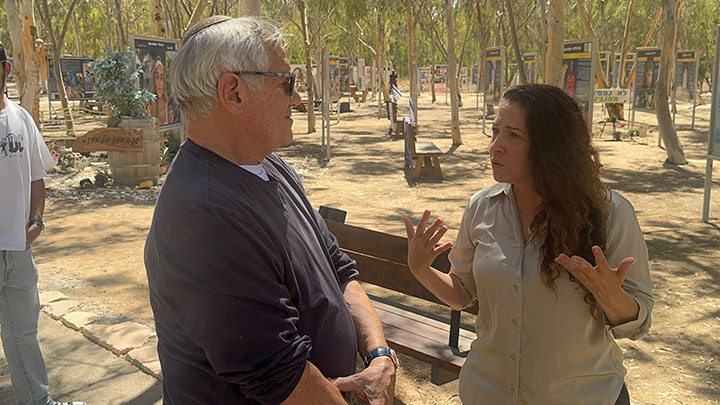
Jon Polin (right) speaking with Brian Fishbach in Jaffa.
Polin distinguished his own desire for answers from the desire to punish individuals for the negligence that led to the attacks and failure of timely response from the military. “I don’t care if anybody ever ‘pays a price,'” he said. And even if Israel finally establishes a commission, Polin questioned whether it will be possible to reconstruct everything that happened after three years of conflicting accounts. “Rachel and I and many other victims’ families have said consistently taking revenge doesn’t offer any comfort … Let’s understand what happened and learn from it and reduce the chance of it ever happening again.”
Those questions — what happened, who knew what, and why the institutions entrusted with protecting Israelis failed — would be front and center of the third anniversary. Indeed, they have been front and center in Israel for a while.
Oct.7, 2026 — 6:29 p.m., Re’im
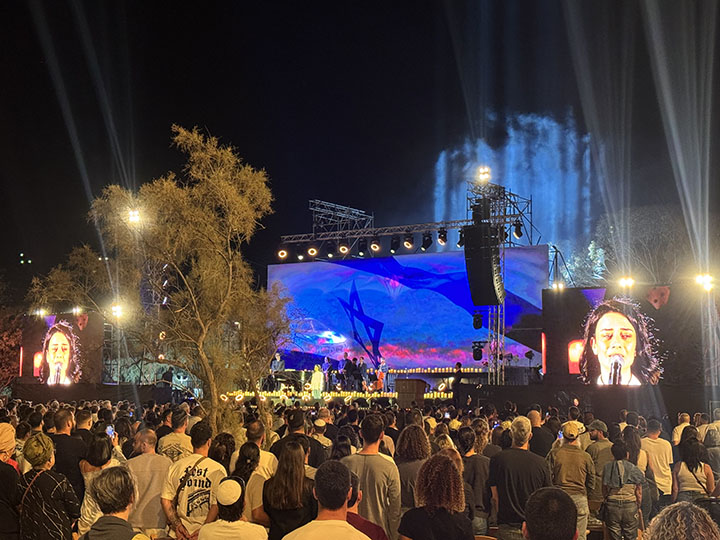
On Oct. 7, I was driving south on Route 232, on my way to the Nova memorial site near Kibbutz Re’im. At 6:29 p.m. — three years and 12 hours after Hamas terrorists began their attack on the music festival — the audience stood for a minute of silence. More than 3,500 people gathered for the ceremony organized by bereaved families and the Nova Tribe Community Association in partnership with KKL-Jewish National Fund. President Isaac Herzog was there.
“The wound you carry in your hearts will never heal,” Herzog said, addressing bereaved families.
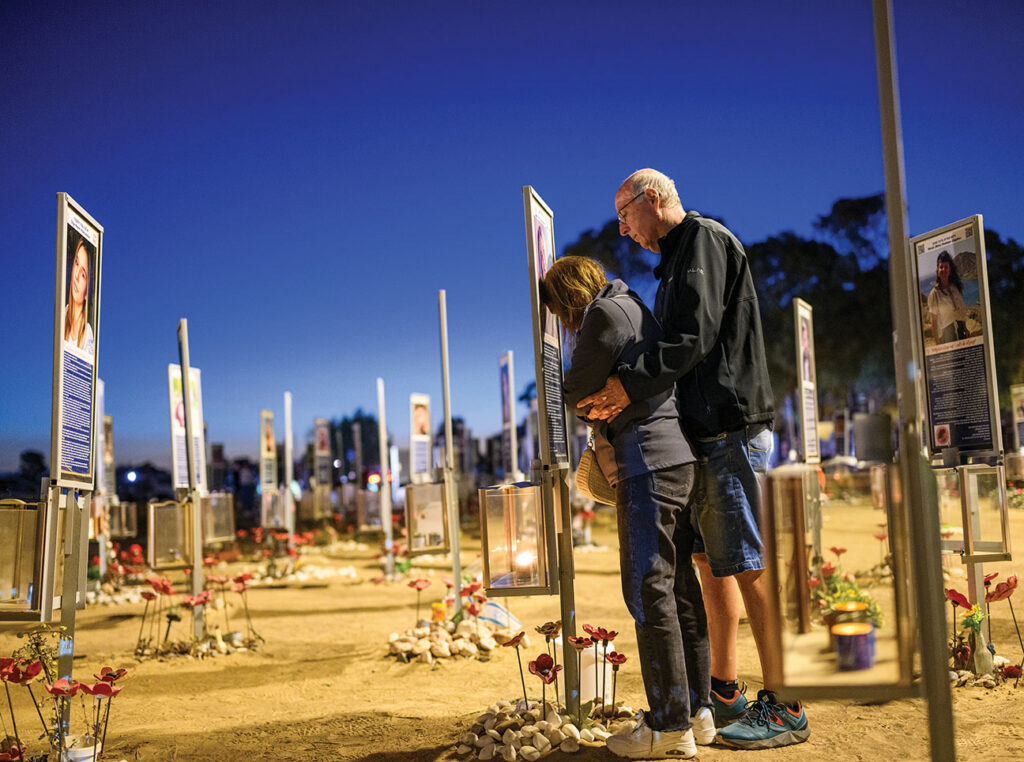
I’d been to the Nova site twice before but never at night, and certainly not when there were hundreds, if not over 1,000, cars parked in makeshift spaces and thousands of people in seats. There was no cell phone reception. The trees around individual memorial installations were lit up with reddish-orange lighting, emblematic of the red poppy flowers around the site that signify where bodies were found.
Nova Festival Memorial event in Re’im Israel on Oct. 7, 2026 (photo by Brian Fishbach)
Channel 12 journalist Tamir Steinman hosted the ceremony. Steinman lives in southern Israel and was one of the journalists reporting from the region on the morning of the massacre. He read messages he had received from people begging the news outlets and anchors through social media for help on Oct. 7, including messages he never managed to answer. “And for that, I am sorry,” Steinman said.
There was no applause from the crowd during or after any of the speeches. It’s an eerie silence that’s extra jarring when you’re used to three years of speeches, rallies and calls for unity at Jewish events in post-Oct. 7 Los Angeles.
After the ceremony at the Nova site, there was an orderly scrum for attendees to get to their cars to leave and beat traffic. It was not lost on me for a moment that a confusing bumpy road through masses of cars at the Nova site reminded me of the footage we’ve seen for three years, and the horrifying firsthand stories we’ve been told.
October 7, 2026 — 9:15 p.m., Yarkon Park
At 9:15 p.m., another event was going on in Tel Aviv’s Yarkon Park. Some 50,000 people had gathered for a national memorial organized by families affected by Oct. 7. Yarkon Park is where superstar bands and musicians appear when they come to Israel. Performances by the world’s biggest musicians have been pretty much nonexistent in Tel Aviv since October 2023. I watched it on TV, along with over an estimated 600,000 viewers (not including social media views).
On stage were more red poppies, a tree stump with exposed roots, and bullet-riddled yellow portable toilets from the Nova Festival. Former hostage Eli Sharabi hosted the ceremony with actress Shani Cohen. Sharabi, whose wife and two daughters were murdered in the massacre, spent 491 days in Hamas captivity. Since returning, Sharabi has published a book about his ordeal.
The ceremony ended with Sharabi demanding an investigation into what happened on Oct. 7. “Remember what happened. Investigate how it happened. Don’t cut corners,” Sharabi said.
Among the attendees were several opposition leaders. Prime Minister Benjamin Netanyahu and his cabinet ministers were absent. Netanyahu did attend the government’s separate memorial two days earlier at Mount Herzl in Jerusalem.
Omri Shifroni, a founder of Kumu (“Rise Up”), the movement established by Oct. 7 survivors and bereaved families that organizes the annual National Memorial Ceremony, addressed the crowd. Four of his relatives were murdered at Kibbutz Be’eri.
“To rebuild trust, we also need the truth. We must know what happened,” Shifroni said, calling for a state commission of inquiry into the failures of Oct. 7. His demand drew loud applause from the crowd.
Shifroni said the organizers had chosen their words so that people across Israel’s political divisions could feel welcome at the memorial. An investigation into what happened on Oct. 7, Shifroni argued, should remain outside partisan politics. It was an anniversary unlike the previous two in 2024 and 2025. For the first time, Israelis could commemorate Oct. 7 without any hostages in Gaza. All hostages officially listed as held in Gaza have been returned, alive or deceased.
Afterwards, bereaved relatives and other participants spoke to television reporters.
Ruby Chen, father of slain Israeli-American soldier Itay Chen, spoke immediately after the ceremony to Channel 13 about the state of the State of Israel. “I think this evening expresses the question facing us,” Chen said (translated from Hebrew). “The State of Israel is at a crossroads. The question is what values we want this country to be built upon in its next chapter.” Chen also warned against returning to the political divisions that existed before Oct. 7.
Getting to the truth was necessary to restore trust in the institutions that had failed Israelis. Here were bereaved families, former hostages and people who had spent three years trying to understand what happened to their country. On the third anniversary, their calls for an investigation were part of the national commemoration.
And the demand for answers wasn’t going away.
Oct. 7, 2026 — Around 11 p.m., Israeli television
After the post-event news reactions, the television channels moved into documentaries, news reports, films and dramatizations about Oct. 7. Channel 12 showed “First Light,” an Oct. 7 dramatization released internationally as “Red Alert.” One of the most memorable scenes from the four-part miniseries depicted the Yahalomi family’s home being invaded in Kibbutz Nir Oz.The father, Ohad Yahalomi, was outside the safe room with a handgun, trying to protect his wife, son and two daughters.
If the story were fiction, it would be appropriate to call this an action thriller. This was a horror show — one of those films where no actor looks like they’re acting.
What’s clear in the film — and after three years of testimonials and reporting — is that no reinforcements would be coming for several hours. For hours, kibbutz security, local police and residents were outnumbered by the 6,000 terrorists. For several hours after the attacks began, over 1,200 people in the south were murdered, mutilated, raped and burned alive in their homes. There were 251 that were abducted to Gaza.
There are thousands more stories like the Yahalomi family, and many more hours of footage, much of it filmed by Hamas terrorists themselves that day.
Throughout the third anniversary week, freed and rescued hostages appeared on Israeli television discussing what happened to them and how they have been trying to resume their lives. Among them was Avinatan Or, who was abducted from Nova with his then-girlfriend, Noa Argamani. Or recounted his captivity and an attempted escape through a tunnel he dug. Yosef-Chaim Ohana, who was a hostage for two years until Oct. 13, 2025, discussed the difficulties of rebuilding a life after captivity, including housing and state assistance. Segev Kalfon, released on the same day as Ohana, described this past year being tormented by hearing explosions that weren’t happening.
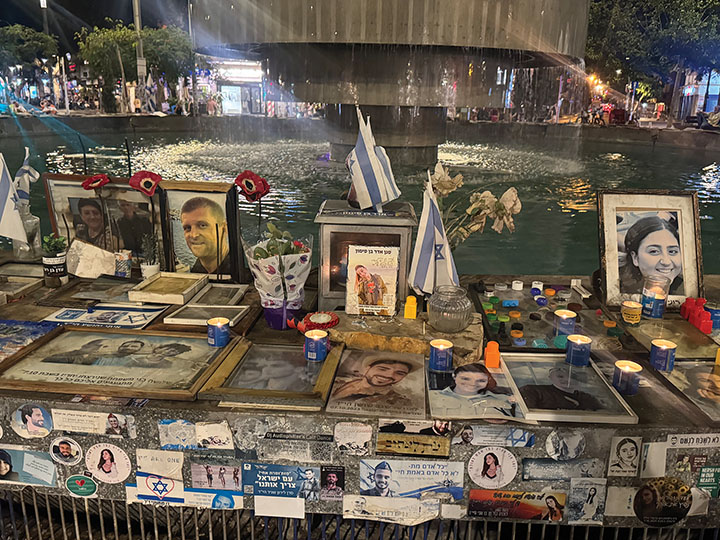
Dizengoff Square in Tel Aviv (photo by Brian Fishbach)
All three of them have made public appearances in Los Angeles since their release.
Clalit Health Services, one of Israel’s largest healthcare providers, presented data showing that one in five Israeli adults reported severe impairment in daily functioning from psychological distress, while PTSD diagnoses among children and adolescents had risen almost two-and-a-half-fold over the past three years.
All around Israel, the same burning questions were running through the memorial ceremonies and broadcasts: How did Israel miss the warning signs that Hamas was preparing an enormous invasion? Why did military reinforcements take so long to defend the communities under attack?
Oct. 8, 2026, 8:00 pm
The following evening, Israel got a new account of what had happened inside the government’s security apparatus in the hours before and during the attack. Maj. Gen. (res.) Avi Gil, who served as Prime Minister Benjamin Netanyahu’s military secretary on Oct. 7, gave an interview detailing intelligence warnings that preceded the massacre.
He appeared spent, speaking with journalists Danny Kushmaro and Yoav Limor on Israel’s Channel 12 News. With his jaw clenched and eyes looking both furious and exhausted, Gil said security officials received information about suspicious Hamas activity overnight. Gil was awakened at 6:12 a.m. and contacted Netanyahu at 6:29 a.m., as the attack began. The two spoke again on a secure line at 6:40 a.m.
Gil alleged that Netanyahu’s chief of staff, Tzachi Braverman, later instructed a stenographer to change the documented time of that second call from 6:40 a.m. to 6:29 a.m.
“This is changing a transcript, changing the truth. Factually, there was an instruction to change the time of a call,” Gil said. Braverman claims that the time in the original system log was an error. Netanyahu accused Gil of failing to wake him when the warnings arrived. Gil said he had expected to give his account to a state commission of inquiry. Three years after the massacre, one has yet to be established.
The Oct. 8 Jew
I live in Los Angeles. I’ve attended more Oct. 7-related gatherings over the last three years than I can count. Here’s what those events felt like: Hasbara. Fighting antisemitism. Raising money for mental health. Supporting Israeli businesses. Having a place to go when we feel helpless. A “third place” for Jews — the Shabbat table, the shul and now events to honor the dead or missing. The Nova exhibition that was in Los Angeles from August to November 2024 was that much-needed valve-release for so many aching to help and mourn.
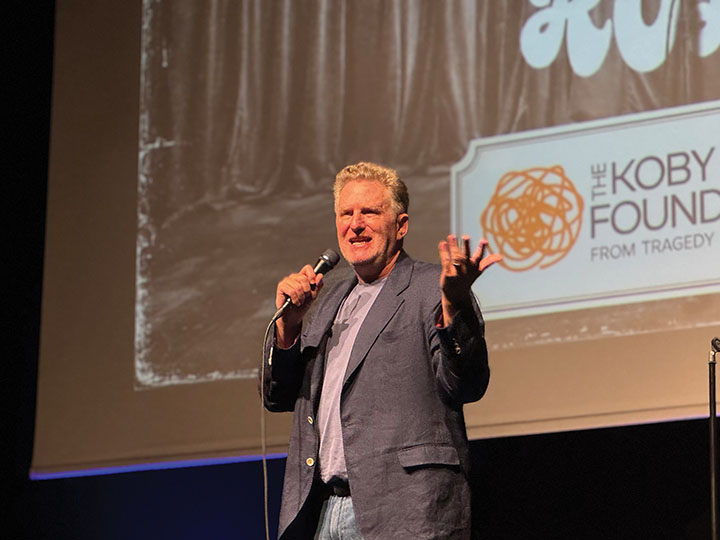
Still, there are no rockets being launched at Brentwood or Westwood. There’s no Hamas in Pico-Robertson. There is the Oct. 8 Jew. The Michael Rapaport types. “I have never felt this prideful to be Jewish in my life, Israel is not going anywhere,” the comedian and actor said to over a quarter million people at the March for Israel on the National Mall in Washington, D.C. on Nov.13, 2023. He became an Oct. 8 Jew literally on Oct. 8, 2023, when there were still Hamas terrorists rampaging in Israel. That day, Rapaport saw people celebrating in New York.
Michael Rapaport performing in Jerusalem on Sept. 30, 2026 (photo by Brian Fishbach)
He performed four shows in Israel during the lead-up to the third anniversary of the attacks. At one of his Jerusalem shows, he described the moment he became an Oct. 8 Jew:
“There’s a celebration [in New York City] of these people out there with their signs saying ‘free, free Palestine,’ they got their drums, freshly painted signs — beautiful signs,” Rapaport said. “I remember thinking, were they ready? Were they prepared for something to happen?”
He is one of the many Jews — famous or not — whose relationship with Judaism and Israel grew after Oct. 7. Another Oct. 8 Jew in Hollywood is Kevin S. Bright, a producer and co-creator of “Friends.”
Bright helped produce “The Bridge,” a documentary about 10 Israelis who came to Rock ‘n’ Roll Fantasy Camp in Los Angeles five months after the attacks. I accompanied Bright during a September visit to sites of the massacre in southern Israel, including Nova and Kibbutz Kfar Aza.
“The Seventh of October has changed my Jewish identity in that I’m prouder to be a Jew than ever before,” Bright told The Journal at the Nova site in Re’im. “Not that I wasn’t proud before, but now I’m very proud because I need to be proud. And in the face of adversity and antisemitism, it’s only a call to be stronger. It’s not a call to hide. It’s not a call to retreat.”
Producer Kevin S. Bright at Nova Memorial site with Head of the Eshkol Regional Council Michal Uziyahu (photo by Brian Fishbach)
Their experiences help explain what it means: American Jews who responded to Oct. 7 by taking a more public role in supporting Israel, confronting antisemitism and connecting with Israelis.
But the Oct. 8 Israeli is living with another set of questions.
For Israelis, the crisis was not confined to the rise of antisemitism overseas. They hear about Hollywood derisions, the musicians shouting “free Palestine” from the stage, and the random acts of violence against Jewish communities worldwide. American Jews have roles to play in supporting Israel and standing against antisemitism. Israelis themselves must decide who will govern them, and how the country’s failures will be investigated.
Israelis will vote in a national election on Oct. 27, 20 days after the third anniversary. A few quick facts: Benjamin Netanyahu returned to the premiership in December 2022, having served from 1996 to 1999 and from 2009 to 2021. Netanyahu was prime minister when Hamas carried out the Oct. 7 massacre.
His government faces criticism over the security failures and its refusal to establish the conventional independent state commission of inquiry demanded by bereaved families and much of the public. The military and security services have conducted investigations, but no comprehensive independent state commission has examined the conduct of the political and security leadership before and during Oct. 7. Netanyahu has backed an alternative model in which members of the commission would be appointed through a process involving the governing coalition and opposition. Supporters say the arrangement would provide broader public trust. Opponents say allowing politicians to select investigators compromises the inquiry’s independence.
Public opinion polls show how widespread the demand for answers has become. A February 2026 survey by the Israel Democracy Institute found that 92% of Israelis considered an investigation into the failures surrounding October 7 important, regardless of the mechanism used. A May survey by the Jewish People Policy Institute found that 63% wanted a commission of inquiry established as soon as possible. The same survey found that 46% preferred a conventional state commission, while 40% supported a commission selected through broad agreement.
Those surveys asked different questions. But the distinction is clear: Israelis are divided over the mechanism for an inquiry, with broad agreement that the events need to be investigated: Israelis are angry and looking inward.
One of the candidates running to unseat Netanyahu is Maj. Gen. (res.) Yair Golan. A former IDF deputy chief of staff and leader of the Israeli political party The Democrats, he is one of the individuals who took it upon themselves to drive in their own vehicles with their own guns to fight back against the Hamas terrorists on Oct. 7.
“We, the Jewish people, all the Jewish people should make Oct. 7 as a symbol of solidarity, of our national solidarity,” Golan told The Journal. “Oct. 7 touches everything, every corner in Israel. And I believe every corner of the Jewish people. The sad fact that this government refused to make it as a symbol of solidarity, well, it should not stop us from making this day the most prominent symbolism of Jewish solidarity. On Oct. 7, it was unbelievable Israeli solidarity with Jews, with Arabs, with Bedouins, everyone. But after Oct. 7, on Oct. 8, it was about solidarity of the Jewish people. And I saw, I watched it, the unbelievable ability of the Jewish people to forge a kind of unity.”
He criticized the Netanyahu government and called for a change in leadership. “We need the normal government and we need to readopt the values and the principles of the Declaration of Independence. This is it,” Golan said.
The Oct. 8 Israeli
In the USA, it’s generally considered a bit rude to ask people who they’re voting for in casual conversation. Not in Israel. Expect it anywhere there’s a pair of Israelis talking about the news.
During breaks on the evening news, there’s a frequent commercial for an upcoming Boy George concert in Tel Aviv, with a quick hit of the chorus to “Karma Chameleon.” During the ads, there’s a counter in the upper-left corner telling you how long until the programming returns. It’s not defamatory to call Israelis impatient people. That miniscule patience has been tested and weathered as they demand and await an official autopsy on what happened in the lead-up to Oct. 7 and why it took so many hours for military reinforcements to reach communities under attack.
There are Oct. 8 Israelis still trying to live their best life. But you don’t have to travel far to find someone being remembered. Stickers and more stickers. At gas stations, checkout counters, lampposts and walls. Photos of Israelis and fallen soldiers, their names, something they said, something they loved. Artwork and memorials all over the country. Names that you don’t hear about in Los Angeles — each with friends and family missing them.
The country has spent three years remembering its dead, bringing home its hostages, fighting wars and trying to resume ordinary life. It is also waiting for an account of what happened when the state was supposed to protect its citizens.
Soon, the Oct. 8 Israeli, along with all other Israeli citizens — Jews, Christians, Muslims, Druze and others — will have the chance to vote. Whether they love Bibi and want him back as prime minister or want someone new at the top, there are Oct. 8 Israelis who are livid and awaiting what it will mean to live in an Oct. 28 Israel.

 It’s a fascinating, detailed history of Jewish Diaspora migrations and the origin of Shabbat stews, beginning with the period of the Babylonian Talmud, all the way to the meat and beans, barley and potato Cholent that we know and love today.