fbpx

April 15, 2026

Israelis Are Winning Their War for Survival … But Are American Jews Losing It?

Beware, antizionism is spreading. Hostility to Israel keeps growing. Nevertheless, too many Mamdani Jews – and feckless Jewish institutions – are either drinking the Kool-Aid or pronouncing the poison “kosher.” They so worship “machloket” – healthy, even divisive, debate – they’re sacrificing the primary need to survive by fighting your enemies not letting them run your schools and shuls.

Call it blue-and-white washing. Antizionism is more unforgiving than ever. The perversions of Oct. 7 animated antizionists – although it should have humiliated them. Emboldened activists encourage irrational Israel-bashing, rationalize Jew-hatred and ostracize anyone remotely Zionist. Yet, targeted by the barrage, many American Jews agonize over how to help these fanatics distinguish their antizionism from antisemitism – forgetting that the burden on proof is on the haters not the hated. And too many American Jewish leaders futilely chase today’s Benedict and Becca Arnold Jews who joined this bandwagon of Hamas-appeasers.

Such pathetic, cowardly, morally-addled efforts will never work, but they risk diluting American Jewry’s core commitments to Israel, peoplehood, Jewish tradition. Raised to be accepted, addicted to being liked, worried about not being “inclusive,” many American Jews – as I have written before – are so open-minded, their brains are falling out. Meanwhile, raised on diets of settler-colonialism, Israel-apartheid, Zionism-racism, oppressed-oppressor hogwash they mistakenly call “social justice,” many antizionists are so close-minded, their brains shut down.

Watch how even some rabbis and professors blur the red lines. Haters far left and far right once shunned by polite society are now being mainstreamed – as long as they target Israel – the Jewish state – not the Jews. We read in The New York Times – then everywhere else – how that scheming, all-powerful Jew, Benjamin Netanyahu, bullied Donald Trump into attacking Iran. Yet you have to search hard to find the inconvenient fact that while publicly endorsing diplomacy, Saudi Crown Prince Mohammed bin Salman “made multiple private phone calls to Trump” in February “advocating a U.S. attack.”

We also read Ezra Klein in the Times saying the venomous, pro-Oct. 7 social influencer Hasan Piker — who once said calling yourself a liberal Zionist is like claiming you’re a “liberal Nazi,”— is “not the enemy.” Is there any other American ethnic group that raises so many appeasers, traitors and cheerleaders for those who either attack us directly or dance on our graves and perform sexual crimes?

In that spirit, 42 Jewish authors attacked the Jewish Book Council’s supposed “bias toward centering Israeli and Zionist voices”  – despite the JBC’s celebration in 2024 of an author who celebrated his “definitive rupture with the dogmatism of my Zionist upbringing.” The petitioners demand a “genuine diversity” of views on Israel and Palestine – code for “please, mainstream antizionism, platform Palestinian exterminationism!” 

Donors go wild! Bully the JBC not to cave.

Meanwhile, J Street, which rarely misses an opportunity to slam Israel whenever Israel feels compelled to defend itself militarily, “urges Senators … to vote to disapprove two sales to Israel – one of large bombs and one of bulldozers – both to demonstrate consequences for misuse of these items in Gaza and to express consistent opposition to the war in Iran.”

Now, after two and a half years of lies about genocide, starvation and Israeli aggression, sitting on decades of antizionism, 60% of American Jews oppose this most-necessary war against Iran’s Jew-hating, America-threatening and nuclear-hungry regime. And most are foolishly, prematurely, pronouncing the ongoing war “lost” – forgetting Professor Yogi Berra’s teaching: “It ain’t over till it’s over.”

Amid all this, is anyone surprised that antisemitism is soaring, and Pew finds 53% of American adults viewing Israel unfavorably, with “80% of Democrats” holding “unfavorable views”?

Clearly, many thoughtful, proud, Zionist Jews have good reasons for opposing Trump, this war, Netanyahu and various Israeli policies. I’ve spent decades endorsing a big blue-and-white tent, open, welcoming, on all sides. Nor, having fought academic cancel culture, do I advocate importing it to Israel or the Zionist world.

Nevertheless, these dangerous currents distort the American and American Jewish conversations. When I told one friend “I’d rather see Israel win this war to survive and lose the PR battle, than lose the war and win fleeting PR points,” he countered: “Israel may be winning the war – but American Jews are losing it.” (I might add mischievously, they’re both losing this war – and losing it – as in their moral compass.)

Another friend called the Pew data “a 30-alarm fire,” wondering: “Who in the community is making turning this around their mission?” All I could offer is “a VERY long list of those in the community making it WORSE.”

A full battle plan or explanations of how we created this crisis are beyond this column’s scope – although it began with Obama in 2012, not George Floyd in 2020. This column is a battle cry: the issue goes beyond supporting this war or any particular Israeli government. It’s even bigger than building a constructive identity Zionism while opposing antisemitism.

We’re fighting for American Jewry’s soul and its future.

Imagine if “un-Jews” – rabbis, Jewish Studies professors, teachers and community leaders committed to undoing American Jewry’s core consensus merging Israel, Zionism, Jewish peoplehood and tradition – triumph. What kind of flimsy, insecure, illiterate, conditional, self-absorbed American Jewish identity will they instill: drained of Zionist pride, lacking peoplehood solidarity, and reprogrammed to follow the latest Democratic – or Progressive – platform?

This fight has massive implications for Israel, ranging from whether American Jews help America keep supporting Israel, to how we stay united globally with Jews aligning with antizionists targeting almost half the Jewish world living in Israel.

A sophisticated battle plan might follow the military’s SMEAC approach:

  Situation – what’s happening, how did we get here, who’s in the tent, who’s outside, and what “conceptzias” – misconceptions – caused the crisis and must be rethought?

  Mission – what’s the goal, what does a healthy, vibrant, inviting, inspiring, American Jewish community and conversation look like?

  Execution – the “how to” – what strategic interventions will raise prouder, more defiant, proudly Zionist American Jews – while reprogramming their parents?

  Administration and Logistics – what institutions, texts and materials, what other tactics, can launch this revolution?

  Command & Signal – who will lead it, how can Israel help, which communications strategies can publicize the initiative and advance the mission?

Clearly, American Jews are deeply divided – and conflicted. We have too many Mamdani Jews, antizionists and fellow travelers. Ignore them.

Instead, fight for the soul of the majority: Obama Jews. Some remain proudly Zionist but anguished. Some support the defining Zionist idea of a Jewish-democratic Israel, but avoid the Z-word because it’s been so tarnished. And a growing group’s support for Israel is contingent on Israel’s good behavior – as they define it – and continuing popularity with liberals.

My alternative isn’t Trumpified Jews who won’t tolerate any criticism of Israel. Although far better, more loyal and Zionist than the turncoats, they can’t save us.

Ultimately, Israelis must become King David Jews, fighting when necessary while building a glittering Zion.

American Jews – and all Diaspora Jews — must become Queen Esther Jews.  Fit in. Prosper. Decipher your foreign lands’ cultural codes. But be literate, proud, brave Jews. Be ready to risk everything, if necessary, to defend yourselves, your people, your homeland – understanding that, as Esther realized, that’s also saving your adopted home from shared enemies too.


Gil Troy is an American presidential historian and Zionist activist born in Queens, living in Jerusalem. Last year he published, “To Resist the Academic Intifada: Letters to My Students on Defending the Zionist Dream” and “The Essential Guide to October 7th and its Aftermath.” His latest E-book, “The Essential Guide to Zionism, Anti-Zionism, Antisemitism and Jew-hatred” was just published and can be downloaded on the website of JPPI – the Jewish People Policy Institute.

Israelis Are Winning Their War for Survival … But Are American Jews Losing It? Read More »

We, the Israelites: Embracing Our Maccabean Spirit

No one should underestimate the difficulty of the past few years. Most of us in the Diaspora have never dealt with anything like this level of hate and violence before. But what will define us is not the level or nature of the problem but how we deal with it. So, when someone comes into your life who touches your soul by the mere fact of being both humble and humane, it can show us a way forward.

At the ADL Conference last month, I met a lovely Christian Zionist named Ruby, an adjunct lecturer at John Jay College and trauma counselor. When she told me about her work with Holocaust education, I mentioned that White Rose Magazine, named after the German White Rose student resistance group of the early 1940s, is going to be publishing an issue on Holocaust survivors, followed by a ceremony for Righteous Christians.

As I listened to her speak more about her work, I added: “Maybe we should combine testimonies from survivors with testimonies from Righteous Christians.” Her response was immediate and defiant. “Oh no. I could never do that. I would feel like I’m undermining their sacred testimonies.”

I was thrown completely off guard. Who today isn’t seeking fame? Flashing naked body parts or fabricating ridiculous theories — all for an incessant need for external validation? New York City, which used to attract the most creative visionaries, has now become a hotbed of “influencers” seeking constant attention. Even at spiritual events, the “look at me!” crowd is always there to undermine the most solemn moments.

I have called this period neo-Hellenism because of the constant need to self-promote and worship false idols. Yes, it’s fueled by social media addictions but also by a lack of decency — dignity — in general. And perhaps what’s been hardest for me personally: a hyper-conformity that our ancestors continually fought against and died for.

What Ruby reminded me is that losing our humanity in today’s fight is quite literally self-destructive. Israelis don’t try to turn tragedy into “fame.” Their focus is on preserving our beautiful homeland, which is why it remains a beacon of light.

We can use this Yom Haatzmaut to begin to move out of this terminal self-absorption by returning to the Maccabean spirit that not only established the state of Israel but secured its eternal future. Bravery is essential but it needs to be combined with an unbreakable pride. And real pride stems from the soul — in no need of external validation. In fact, it is precisely our humanity — our Judean souls — that we need to strengthen right now.

This fight is far from over, and the only path forward is truly leaning into Judean identity — our nonconformity, creativity and sacred dignity — and beginning to develop true Maccabean resilience.

The New Jew

In 1896, Theodor Herzl published “Der Judenstaat — The State of the Jews.” The Jews possessed a nationality, he dared to write. “We are a people — one people.” What we were missing was a state of our own. He knew this wouldn’t end antisemitism, but it would end our having to live in ghettos.

“I believe that a wondrous generation of Jews will spring into existence. The Maccabeans will rise again,” he wrote. “We shall live at last as free men on our own soil, and die peacefully in our own homes. … And whatever we attempt there to accomplish for our own welfare, will react powerfully and beneficially for the good of humanity.”

Two years later, at the Second Zionist Congress, Max Nordau introduced the concept of the “New Jew”—”Muscular Judaism.” It was designed to contrast with the “Diaspora Jew,” aiming to create strong, brave Israelis, in contrast to the image of “weak” Jews in the European Diaspora.

This concept was most famously stated by Prime Minister Menachem Begin in 1982 to then Senator Joe Biden (D-Del.), who had threatened to cut off aid to Israel. “I am not a Jew with trembling knees. I am a proud Jew with 3,700 years of civilized history.”

The goal of both Herzl and Nordau has been fully realized in our homeland. Israelis are strong, brave, proud, and resilient. In fact, Oct. 7, 2023 showed that this tenacity grows stronger with each generation: Gen-Z Israelis ran to the south and flew back to Israel to fight.

Their focus is on Israel — an innate understanding that while we, as Bret Stephens put it in his “State of World Jewry” speech in February, “have the honor of being hated,” we also carry the sacred responsibility of securing a safe, thriving Jewish future.

That can happen if the Diaspora embraces the Maccabean spirit. To remain decent and dignified not because it will end antisemitism — nothing will end antisemitism — but because if we continue to over-assimilate there will be nothing left to save.

Neo-Hellenism

In 2022, Michael Steinhardt, the founder of Birthright, wrote a breathtakingly honest memoir called “Jewish Pride.” “The real threat to Jewish survival is from assimilation,” he wrote. Steinhardt discussed how the nonprofit sector had degenerated into an endless cycle of galas and self-congratulation.

His book was so meaningful to me personally because the conformity and superficiality of neo-Hellenism has been a continual source of pain, especially after moving to NYC.

After Oct. 7, the first group to disappoint was what I call “silent liberals,” pro-Israel Jews in positions of power who, to maintain “status,” could not even bring themselves to publicly condemn Hamas.

Just two decades ago, those who sought fame were mocked relentlessly, but today’s intellectual class has no problem with it — as long you are not pro-Israel. Which is why we now live in a world of lies, disinformation and inverted morality.

The second group of neo-Hellenists are the “influencers.” It should be noted that some who fall in this category — people like Montana Tucker — are doing incredible work. But many are under-educated on the facts and willing to do nearly anything to get attention.

And then there’s the third group: leftist Jews who knowingly “amplify” lies about Israel to maintain status. I was at The New York Times when a particular Jerusalem correspondent began to lie about Israel. We watched as her pieces moved from inside the paper to the front page to above the fold. Rather than being ostracized, she was rewarded.

Steinhardt predicted all of this. The desire to assimilate and gain status through that assimilation became the top priority of so many Jewish Americans in the past half-century, with few noticing the irreparable consequences.

But as Bret Stephens noted in his speech, this type of conformity goes against Judaism. “The Jewish people are a countercultural nation. … It is this courage that is the central source of our inner strength as people and our endurance as a people. We must never let it go.”

“They do not hate us because of our faults and failures,” Stephens continued. “They hate us because of our virtues and successes. The more virtuous or successful we are, the more we’ll be hated by those whose animating emotions are resentment and envy.”

Decolonize the Soul

Like Steinhardt, Stephens emphasized that the response should be strengthening Jewish identity and expanding Jewish education and other institutions: building a thriving Jewish future in America.

“The proper defense against Jew hatred is not to prove the haters wrong by outdoing ourselves in feats of altruism, benevolence, and achievement,” he said. “It is to lean into our Jewishness as far as each of us can, irrespective of what anyone else thinks of it. If the price of being our fullest selves as Jews is to be the perennially unpopular kids, it’s a price well worth paying.”

“The goal of Jewish life is Jewish thriving. And by Jewish thriving, I don’t mean thriving Jews individually speaking. I mean a community in which Jewish learning, Jewish culture, Jewish ritual, Jewish concerns, Jewish aspiration and Jewish identification … are central to every member’s sense of him or herself.”

A decade ago, indigenous rights activist Ryan Bellerose said that Jews need to “decolonize” Jewish identity. “Jews need to see Jewish identity through a Jewish lens rather than a European one,” Bellerose told me. “It’s a struggle for all colonized indigenous people to see ourselves through an authentic lens of our own people.”

In 2017, Bellerose wrote in Tablet magazine, “Strengthening Jewish identity is the optimum way to fight against the perpetuation of false narratives and lies. This can be achieved only through an indigenous decolonization of Jewish identity.”

Thousands of years of persecution and colonization can never undercut the fact that we are all Israelites, indigenous to Eretz Yisrael. We are not white, colonizers or privileged; nearly all of our ancestors came here with literally nothing.

It’s a realization of who we are, where we came from, and that so much of our identity has been imposed on us. Fully embracing our true identity is empowering; it will no doubt help each of us cope not just with antisemitism but with all of the toxic missiles life sends our way.

Touched by G-d

When my grandfather and mother passed, I worked through my grief by trying to find the right words to describe them. I came up with two phrases: touched by G-d and souls of beauty. We’re all of course touched by G-d, but they were particularly blessed. My grandfather’s greatest joy was making people laugh; I have no doubt he would have used social media to do the same.

While the “activist” scene in NYC remains excruciatingly toxic — endless drama for status — we do have many Rubys: Judeans working tirelessly behind the scenes and never asking, let alone demanding, credit. For our own sanity, many of us have decided to only work with the anti-narcissists.

I often point to Eden Golan, who represented Israel in the 2024 Eurovision competition with the song “Hurricane,” as a role model for young Jews. A true soul of beauty, Golan — like nearly all Israelis — never used Oct. 7 for personal gain. Her strength comes from her creativity and beautiful soul. And I’m beginning to see young Jews here use their creative skills to create videos — not for fame, but simply to express themselves creatively.

Stephens’ emphasis on creating more of our “own tables” — in publishing, the arts, education — reinforces this focus. Jews have historically thrived through creativity, which brings out the best in each of us.

Nourishing the Maccabean Spirit

When my son was a toddler, he was fascinated with Joshua in the film “The Ten Commandments.” Already saturated with comments about “toxic masculinity” from his ignorant millennial anti-teachers, I believe he was unconsciously looking for role models.

I encouraged this by repeating what G-d said to Joshua and what Mattathias repeated to his Maccabean sons: “Be strong and courageous.” It translates directly to being strong and resolute — encouraging spiritual and mental fortitude rather than mere physical aggression.

Building the type of self-esteem that doesn’t need constant external validation begins in the home. It’s not about showering kids with constant attention; that can easily backfire. Kids who grow up with a strong inner base are taught respect, responsibility and compassion.

At the same time, synagogues need to lose the politics, return to focusing on Judean values and begin to focus on Judean ethnicity: teaching conversational Hebrew and what it means to be part of an ancient people whose DNA connects us directly to our homeland. When I discovered that Judaism is not just a religion but an ethnicity, I felt emotionally stronger. But the idea hasn’t taken hold — in large part because synagogues aren’t embracing it. Ethnicity is stronger than the vague term “peoplehood.”

None of this is to diminish how difficult the last few years have been. Most of us have never experienced anything like this, and our emotional systems remain in a state of shock. The fact that much of the world has returned to hating Jews and is currently backing a regime that gouges the eyes out of women, uses kids as human shields and murders its own civilians with more glee than the Nazis isn’t a pleasant thought.

But that isn’t an excuse for undermining precisely what makes us Judean.

As Rabbi David Wolpe has put it: “Becoming a better person is usually a climb, not a leap. A thousand decisions for decency. A hundred restraints on unkindness. We are not expected to catapult to goodness, just to stretch higher, inch by inch.”

And that is how we remain a light unto the nations, both here and in Israel. It’s well past time to fully realize Herzl’s dream of Maccabean Jews, wherever we live.


Karen Lehrman Bloch is editor in chief of White Rose Magazine.

We, the Israelites: Embracing Our Maccabean Spirit Read More »

Rosner’s Domain | Imagine There’s No Enemy …

Before Israel’s week of Remembrance and Independence, it is proper to reflect on the inherent tension between dreams and their realization.

A grand dream: “If you will it, it is no dream” (Herzl). A restrained realization: the Partition Plan (Ben-Gurion). A grand dream: “To be like every other nation” (The Declaration of Independence). A restrained realization: a war every decade, sometimes more (our reality). A grand dream: Zionism as the cure for antisemitism (Judah Leib Pinsker). A restrained realization: antisemitism is still with us (and trending upward).

When a grand dream is realized, disappointment is an inherent, inseparable byproduct. The State of Israel cannot possibly soar as high as the dream that preceded it. This does not mean we should settle for small dreams, nor does it suggest we should forgo realization simply because it will never reach the dream’s heights. Without realization, a dream is worthless. Without a dream, there’s nothing to realize.

This week, it is also a right time to reflect on this inherent tension within the very earthly, very current context of our war. After nearly three years of conflict — the end of which is not necessarily in sight — there is value in reexamining the fundamental questions regarding the “dream” of this war and its actualization.

On Oct. 7, Israel plummeted into distress. Part of it was immediate and concerned security — though Israel recovered quickly and was never in true danger of conquest or annihilation — but most of it was psychological. From that distress, an aspiration was born. Perhaps “dream” is the wrong word for it, yet it often feels like one.

Following the murderous surprise attack, the demand for more robust security became urgent. Israel concluded it would no longer tolerate Hamas on its border. It would no longer tolerate Hezbollah on its border. It would no longer tolerate a strengthening Iran, and so on. The sentiment is natural, given the trauma. The call to battle was necessary. The use of force was understandable. A clear message had to be sent: an attack on Israel must carry a staggering price in blood, property and suffering.

Then there is the Dream: We shall not rest until the murderous regime in Tehran is toppled; We shall not rest until Lebanon disarms Hezbollah; We shall not stop fighting until all our enemies are eliminated. Within the framework of a Dream, one can set any objective and claim that whoever disagrees simply hasn’t “internalized the lesson of Oct. 7.” And what is that lesson? That as long as we have enemies, we are in danger – therefore, we must decimate all enemies. If you will it …

Like all dreams, this one contains a built-in ingredient of disappointment. Because it is not certain that this dream is within our reach. In fact, it is almost certainly out of reach.

This necessitates not only an adjustment of our dreams — which we could also call “objectives” — but perhaps a more comprehensive rewriting of the “lesson” of Oct. 7. Maybe that is why it is so hard to let go. Oct. 7 seared our consciousness and led us to far-reaching conclusions, perhaps too far-reaching. To move past these conclusions, whose harm may now outweigh their benefit, we must return to the source and ask: what is the actual, practical lesson of Oct. 7? The lesson minus the trauma. The dream given the reality.

Tactical lessons are easy to derive: more soldiers on the border, less trust in intelligence assessments regarding “enemy intent,” etc. Strategic lessons are harder: Does Israel need more territory to secure itself? What price is it willing to pay — in defense spending, in soldiers’ lives, in the loss of international standing — in exchange for holding more territory? Can Israel insist on determining who governs the area bordering it? Israel doesn’t want Hamas. It doesn’t want Hezbollah. Tomorrow it might not want someone else. But Israel cannot install or topple every neighboring leadership at will.

Perhaps, as Independence Day approaches, we must conclude that like the country, the war has also moved from a “no Dream” stage to a “Partition Plan” stage. The stage where it is time to make the dream grounded. Of course, this is a difficult, complex and controversial stage. There were those who thought Ben-Gurion was settling for too little. Who knows? Maybe he was. In policy-making, we choose a path and can never truly know what would have happened had we taken the other.

So what now? No one wants to be a defeatist that kills a dream, or to be a fantasist that believes in unrealistic dreams. In practice this means that Israel must decide how much to insist on eliminating the weakened remnants of Hamas. It must decide how much it clings to the dream of disarming Hezbollah. It must decide how much of the dream — an “Imagine” world without enemies — it intends to insist upon, and how much of it – recognizing this is “the decree of our generation in all its cruelty” (a famous Moshe Dayan quote) — it must compromise.

Something I wrote in Hebrew

As the coalition passed the 2026 budget I wrote:

Of the many items we were offered for selection only two show a significant divergence between this year and last … Last year, a third of Israelis ranked the demand to “cut the number of government ministries” as one of their top three priorities. This year? Only a quarter. What happened? With elections on the horizon, Israelis realize there is no longer much point in trimming cabinet seats … Last year, roughly a quarter of respondents prioritized “adding funds for the rehabilitation of the North and the South.” This year, it is now the single most prioritized item on the list … Many Israelis have come to realize that the investment made thus far is significantly less than what they assumed would be allocated.

A week’s numbers

You have to admit, what Israel needs to do when it’s not clear what the U.S. intends to do is not easy to decide (JPPI numbers).

A reader’s response

Yuri Yoffie asks: “What’s the best way for a Jew like me in LA to support Israel?” My response: I’d surprise you with the following answer: Engage with Jewish life where you live – and the rest will follow.


Shmuel Rosner is senior political editor. For more analysis of Israeli and international politics, visit Rosner’s Domain at jewishjournal.com/rosnersdomain.

Rosner’s Domain | Imagine There’s No Enemy … Read More »

John Lennon’s Dream – And Where It Fell Short

John Lennon’s death in December 1980 shocked the world. As a member of The Beatles, he helped define the cultural upheaval of the 1960s. Their message —  simple, powerful, and deeply appealing — was that love, not power or ideology, could unite humanity.

“All You Need Is Love” was more than a beautiful song, incorporating, one can assume purposefully, “La Marseillaise,” the French revolutionary anthem calling citizens to rise against tyranny, set within musical textures spanning Bach to Brubeck as only The Beatles could. It became a creed.  If all we need is love, the Vietnam War, the other main issue of the day, could be solved. The assumption was that beneath political systems and cultural differences, people ultimately wanted the same things.

The assumption that the world could unite under these universalistic aspirations seeded themes that would shape social thought for decades. It fueled movements for women’s equality, civil rights and environmental responsibility. Noble causes all. Nixon had bravely opened the door to China and less than 30 years later Reagan convinced Gorbachev to tear down the wall that had divided East from West. Democracy’s righteousness was on the rise, geopolitics was cooperating. Maybe it wasn’t all love, but the sense was that things were bending in a favorable direction. Live and let live was at hand.

Even at the height of the inspired optimism, glitches in the path of 1967’s Summer of Love generation were easily overlooked. Headlines, often from the Middle East, were troubling but siloed. The wars of 1967 and 1973, both coordinated attacks on Israel by neighboring Arab states, along with the rise of modern terrorism, were treated as aberrations to the underlying assumptions. Such disturbances were too far from the West to get in the way of the optimism.     

Small but persistent voices cautioned that not all cultures and communities shared the West’s assumptions. They argued that appeals to shared humanity, noble as they were, would not be appreciated by the communist or increasingly radical Muslim ideologies representing large swaths of the global population. Undeterred, the West continued to proffer increasing empathy, dialogue and goodwill.  Surely, they would win the day.

It did not. Overtures of conciliation — by governments, universities and international bodies — were often interpreted not as invitations to mutual recognition, but as opportunities to advance asymmetrical aims. Wealth, particularly from oil revenues, amplified this dynamic, extending influence into political, academic and cultural institutions. Simultaneously, Israel’s repeated efforts at negotiation and compromise were frequently dismissed. Over time, segments of governments, academia and international institutions moved beyond rejecting Israel’s overtures for peace to questioning its legitimacy itself.

Concrete efforts illustrate the pattern. In 1978, Jimmy Carter brokered a peace agreement between Israel and Egypt, conditioned on Israel’s return of the Sinai Peninsula. Egypt’s Arab allies rejected the accord and diplomatically isolated Egypt.President Anwar Sadat was assassinated in 1981, in part for making that peace.

In 2000, Bill Clinton invested significant political capital in Israeli-Palestinian negotiations at Camp David. When those talks failed — failure Clinton later attributed largely to Yasser Arafat — the Second Intifada followed, resulting in over 1,000 Israeli civilian deaths.

Nearly a decade later, Barack Obama’s Cairo address again appealed to shared values and mutual respect between the West and the Muslim world. These efforts reflected a genuine belief in convergence. They did not produce the transformation many anticipated.

A harder truth emerged: universalist democratic values do not automatically resonate across all societies. In communist oligarchies as well as the Middle East, Israel has faced not merely political opposition but, in too many quarters, a sustained refusal to accept its legitimacy as a Jewish state. Repeated efforts at negotiation and compromise have not yielded acceptance and have, at times, intensified hostility. This dynamic is reflected in Iran’s cultivation of a “ring of fire” of proxy forces surrounding Israel, whose sustained attacks on civilian populations culminated in the Oct. 7, 2023 assault by Hamas.

And yet, many in the West continue to hold these cherished universalist ideals as guiding principles despite continued assaults on Israel. Indeed, Israel’s self-defense is opposed broadly in much of Western society. Pundits and even Jewish organizations offer ever broader suggestions on how Israel should conciliate in the face of terror.   

Which brings us back to John Lennon.

His message of love — hopeful, expansive, humane — inspired genuine moral progress. It fostered hope that humanity might ultimately converge toward those ideals. In too many parts of the world, that expectation collided with societies that did not share those assumptions.

Lennon is gone. His vision remains. The question is whether we have learned where it illuminates — and where it cannot.


Moshe R. Manheim is a retired clinical social worker and psychotherapist. He writes on antisemitism, Jewish identity and social issues.

John Lennon’s Dream – And Where It Fell Short Read More »

Journeys to the Promised Land

Do we have the right spiritual leaders to meet the moment?  It’s a timely question in the Jewish world, given the recent attention upon rabbinic leadership.  Right now, our hearts are yearning for steady, compassionate and healing voices to help navigate the sustained crises we witness daily. Are these the skills our leaders currently possess?

Traditional forms of leadership rely upon the will of the collective, where success is measured by mass. Such models may even diminish or deny the value of the individual for the sake of the majority. We are living in a time, though, when we are capable of accomplishing extraordinary feats all by ourselves, simply with the click of a button. It feels like there is no collective for which we would willingly diminish our individuality or that very little of what we hear is healing, compassionate or steady. Rather, we find ourselves constantly struggling to navigate through a cacophony of voices clamoring for our attention.

Spiritual leadership is defined by a different metric. Spirituality implies that the individual seeker has unique desires to connect to something purposeful and whole. For the spiritual person, any model of leadership is not easy to define. This is due, in part, because we have been raised with the responsibility to choose independently. Spiritual leadership, at best then, is the art of navigating compassionately between individuals to give focus and purpose to all in search of something more.

As Jews, the virtues of radical empathy, historical rooting, overcoming adversity and the ever-present capacity to hope are the pathways toward a responsible life. Our ultimate connection with others is built upon the value of seeing the other and recognizing their uniqueness through their struggles and their triumphs. To have faith in Judaism is to believe these values actually do make a difference when practiced as individuals seeking a better world for all. That is what we mean when we say we belong to something greater than ourselves.

This wisdom isn’t Jewish, alone. Tenzin Gyatso, the 14th Dalai Lama of Tibetan Buddhism, offers three models of spiritual leadership – the trailblazer, the ferryman, and the shepherd.  Whether a leader stands in front (the trailblazer), alongside (the ferryman), or behind (the shepherd) the seeker, the Dalai Lama suggests they are someone who practices mindfulness, selflessness and compassion. Islam similarly offers models of leadership that include concepts like amanah – sacred stewardship of the people and hikmah – wisdom to bring compassion and mercy toward those seeking guidance. In all faith traditions, we look to our leaders for these qualities as they guide us toward lives of meaning and purpose.

When we study the wisdom of Jewish tradition, the development of leadership as a concept coincides with the evolution of the people. In other words, the authority of the right way to live is all in the hands of God, yet the direction toward the human ideal is all in the hands of the people. It seems radical to suggest that to lead is to offer a direction without sustaining a tone of authority. And yet, it is time to reaffirm this approach to leadership and to guide seekers toward shleimut, toward wholeness, toward healing.

The Academy for Jewish Religion California has been investing in the training of spiritual leaders this way for over 25 years. The Academy was formed with the intent to respond to a spiritually vacuous world at a time when deep, meaningful connections were sacrificed on the altar of Jewish continuity. By reclaiming the centrality of spiritual formation and development in our leaders, the Academy has successfully trained hundreds of rabbis, cantors, chaplains and community leaders to transform the Jewish world. As AJRCA celebrates a milestone and responds to the challenges of connection and purposeful living anew, we identify key qualities leaders must possess to serve a community of seekers with individual and collective goals.

Today’s spiritual leaders possess a deep understanding of Jewish texts and traditions so they may use their emotional intelligence to support seekers through life’s challenges and celebrations. Leaders have a calling to make complex Jewish concepts accessible.  They engage diverse audiences by truly mastering the model of genuine commitment to Jewish life in their own behaviors. Spiritual leaders possess an uncommon understanding of contemporary issues, interfaith dynamics and how to make Judaism relevant to modern life so they may share timeless wisdom with others.

Above all, spiritual leaders are those who ask one question again and again, “For what purpose?” When meeting people amidst their struggles, leaders compassionately ask, “For what purpose?” When transforming one’s triumphs into lasting action, the leader steadily responds, ”For what purpose?” In the Torah, the struggles and triumphs, the deviations and the guidelines illuminate a path to wholeness. This is what we call reaching the Promised Land. Just as the Torah concludes with the people about to enter the Promised Land, leaders are successful when the connections we make reveal within us the humility to encounter the Infinite. That is what healing looks like. These are the skills the right leaders need to meet this moment, indeed to meet every moment.


Rabbi Joshua Hoffman is AJRCA President and CEO.

Journeys to the Promised Land Read More »

A Suitcase of Diamonds: Meditation on Friendship

Coming out of the holiday of Passover, which is a sojourn in itself, with a great deal of preparatory work, planning, and a wresting oneself out of the normal flow of time, I found myself thinking about my life in new ways. To say that I was thinking more freely isn’t just a pun; it’s a reality.

One thing I began to consider, in ways I hadn’t before, or at least not with the same intensity, is the value of friendship. Let me put that another way, since the word friendship, at least as many of us use it, isn’t quite the right word. I’ll call it intimacies. Unfortunately, the word intimacy has come to carry a largely sexual connotation, and as such it misses a broader and more important swath of meaning.

Intimacy, in this sense, is a particular sort of love, most often occurring within a marriage, and often obtained only after a long stretch of years, even decades, where one’s understanding of compromise, conciliation, and care takes on meanings different from what those words held at the beginning of the relationship. But now, I’m speaking more broadly, about these kinds of intimacies, including those we find in friendship, their worth, their value as we age, and perhaps especially now, when there is so much apprehension about the world.

At synagogue this week I began reading a section of a five-part work called “Likkutei Dibburim” by Yosef Yitzchak Schneersohn, the previous Lubavitcher Rebbe and father-in-law to the seventh Rebbe, Menachem Mendel Schneerson. The collection, distinct from other Hassidic works, which are often highly detailed teachings on the nature of reality, the way a transcendent God intersects with the physical world, and other esoteric understandings, is a compendium of personal reflections. The section that caught my attention begins with a kind of remorse for what friendship had come to mean, compared to his youth in Ukraine in the late 1800s.

“The current acceptance of worldly notions has indeed introduced a certain order into the conduct of people’s lives, but with it a certain frigidity, a certain absence of truth, and occasionally a lie.”

Here he reflects on the ways people, perhaps because they were less distracted, or because of the dangers present at the time, lived in a way that allowed for greater honesty, and in which the perception of love was more tangible, more necessary.

“When two friends meet and kiss each other one sees the manifestation of a greater light of love than that expressed in a handshake. A yet higher manifestation may be observed in the long conversation in which good friends love to tell each other of all their experiences.

“Beyond this there is a kind of love so intense that words are too dry to express it: two friends in this state can simply stand and gaze at each other without uttering a word.

“These, then, are various ways in which friends express their love, the bond that brings them to oneness.”

After reading this, I’ll admit, I became quite emotional. I began to feel, in a way I hadn’t fully allowed myself before, that I am fortunate to know this feeling, that I have known this close, inexpressible love with many of my friends, both old and new. And what is its worth? How could I possibly appraise it? What has it given me, and what have these relationships given to those with whom I share this intimacy?

Freedom means many things, and something different to each person. But the freedom from unspeakable, existential loneliness, that which, on some level, every person must feel, is what may be most needed now. Aside from the basics of food and shelter, which so many around the world still lack, this, I think, is the resource most urgently required.

To see someone you love and to know you are loved in return, to know that you will be heard, seen, acknowledged on the deepest level, to “simply stand and gaze at each other without uttering a word,” this is the antidote to so much of our confusion and suffering.

Making such friends, even as children, requires courage, a courage that says: I am secure enough with myself to allow others in, to shed my defenses, to reveal my flaws and insecurities, to hold another person and to sense the sanctity of their being.

Very little of this is spoken about in our culture, this sort of love. It is nothing that can be marketed or sold. It is not brash or performative. It is made of humility, forged from the understanding that even with all our strengths, we desperately need one another.

“But there is also an inward bond, a bond of thought, through which one friend senses the other. Just as a person sees his friend who stands facing him near at hand, so it is with thought, which is not limited by distance.”

Thought is not limited by distance. It cannot be trapped or contained. Thoughts of love, of an irrepressible empathy for another, have a power beyond imagination.

Think for a moment: what would it be like if there were a suitcase of perfect diamonds in front of us, with a sign that read: Take as many as you need.

In truth, the diamonds are there — take as many as you need.


Peter Himmelman is a Grammy and Emmy nominated performer, songwriter, film composer, visual artist and award-winning author.

A Suitcase of Diamonds: Meditation on Friendship Read More »

Should We Be Surprised by Right-Wing Antisemitic Conspiracy Theories?

The special character of contemporary antisemitism is that it emanates from both the right and the left. Just a few years ago, the “new antisemitism” seemed to be a strictly left-wing affair, tied to the Israel-Palestine conflict and informed by the “Red-Green Alliance” between the Western Left and Islamist groups. Right-wing Israeli and Jewish commentators emphasized that fact and added it to the advantages of identification with the Republican Party and other conservative groups.

But in the last year and a half, this picture has been fractured by the emergence of virulently antisemitic right-wing “influencers” such as Candace Owens and Nick Fuentes and the cover they are provided by political and media figures such as Vice President JD Vance and Tucker Carlson.

Many commentators have expressed surprise at this development. Yet should this really be surprising? Hadn’t xenophobia, anti-immigrant sentiment and discrimination against various groups (starting with Native peoples and African chattel slaves) been intrinsic to America, at various times and in various circumstances, since its inception? Furthermore, conspiracy theories demonizing Jews and others may be a deeply rooted byproduct of modernity.

One strong tradition in American politics, once associated with Southern Democrats but, since the 1960s, increasingly tied to the Republicans, holds that true membership in American society, with its rights and privileges, belonged to white, Protestant men, especially those who had been part of the American social fabric for generations. Such membership is not open to all people of any background who enter into the American social contract, but rather to a group with specific racial, ethnic, religious and gender characteristics.

On the margins of this restricted conception of belonging were organizations and movements that were more extremist in their racism, antisemitism and advocacy of conspiracy theories – the Ku Klux Klan in the 1880s and 1920s, Father Coughlin and the American Nazi Party in the 1930s; and Sen. Joe McCarthy (R-Wisc.) and the John Birch Society in the 1950s and ‘60s.

While these extremist actors and movements have only intermittently become significant political factors, they should not be relegated to the “lunatic fringe.” Rather, they are structurally related to the “more moderate” mainstream.

A key trait of extremist groups is that they traffic in conspiracy theories, especially those involving Jews. Since the Middle Ages, Jews and other groups, such as Freemasons and witches, have often been described as secret players in a conspiracy to take over the world and enslave, dispossess, or even kill other populations. According to these theories, Jews play this role as agents of the devil or some other principal of cosmic evil.

Such thinking seems to be a result (in one fashion or another) of anomie or anomia, a concept first advanced by Émile Durkheim, the late 19th-century “father of sociology.” It refers to a social state of normlessness, that is, when the social norms that permit social interaction are unknown (or cannot be known), unclear or unable to be implemented. Durkheim showed that in such situations where individuals are cut off from social life, they will, among other things, engage in self-destructive behavior. This situation can be caused, among other factors, by rapid change in both negative and positive directions, either rapid impoverishment or rapid enrichment.

In essence, anomia means that the social world has stopped making sense. In such a situation, one might be susceptible to the suggestion that the forces governing the social world are hidden and generally malevolent, perhaps a conspiracy brewed by witches or Jews. Some have suggested that belief in conspiracy theories grants a feeling of having privileged knowledge, together with a sense of control.

It has been hypothesized that the outbreak of one grand, hugely murderous conspiracy theory, the European witch craze (1480-1650),  which resulted in the execution of 50,000 women and men, was linked to widespread moral confusion and anomie – feelings of living in an alien and indifferent universe in which, because of the religious wars, death and destruction became ends in their own right.

The emergence of conspiratorial antisemitism around the turn of the 20th century, embodied, above all, in “The Protocols of the Elders of Zion,” also seems to be related to moral and social chaos and anomie. This arose from rapid industrialization and urbanization in Europe, especially in Germany, and later from the mass, mechanized killing of World War I.

Today, too, there appears to be a great deal of moral confusion and the widespread feeling that American society does not enable a meaningful and productive life. This is evident in the “deaths of despair” of middle-aged, lower-class white men, the epidemic of Fentanyl addiction across all classes, and the feeling of Gen-Z young adults that they will never achieve the fundamental attributes of American middle-class existence – one’s own home, good health insurance, adequate retirement savings.

We should not be surprised that conspiratorial antisemitism has reemerged in the current circumstances. But there is a deep reason that ties it specifically to the right. One of the major and recurrent generators of anomie since the end of the Middle Ages has been the clash of traditional markers of collective identity – race, ethnicity, religion – with the increasingly rationalized and technological means of production on the one hand, and the increase of social criticism based on liberal reason that traces back to the 18th-century  Enlightenment and extends to the current “progressive”  ideology.  The contemporary “woke” mindset applies the rational, liberal ideals of equality and freedom to new areas of criticism – not only to gender, but to sexual orientation and behavior. Whether such criticism has value or utility can be contested, but it has certainly contributed to a pervasive moral confusion and lack of normative clarity.

Today’s anomie and the conspiracy theories that spring from it (including about Jews) may be an ironic byproduct of modernity. We should not be surprised by them, but rather focus our energies on mitigating them as we do with other unwanted byproducts of modernity, like other various forms of pollution.


Dr. Shlomo Fischer teaches sociology in the School of Education at Hebrew University and at Ben-Gurion University of the Negev.

Should We Be Surprised by Right-Wing Antisemitic Conspiracy Theories? Read More »

Israel’s Minorities and Its National Mission: A Yom Haatzmaut Reflection

As Israel soon turns 78 years young, daily headlines debate the future of the country’s relationship with its Arab neighbors. In the meantime, four Israeli scholars offer a framework for considering how the Jewish state should treat those minorities within its midst. “That They May Live Among You: Minorities in a Jewish State,” by Yakov Nagen, Sarel Rosenblatt, Michal Tikochinsky and Assaf Malach lays out the Jewish values and laws that should guide the way. (The book was recently released in Hebrew. An English translation is in the works.)

As the authors note, “The Torah emphasizes that this value is one of the important aspects of Israel’s relationship with the resident non-Jews living among its borders: ‘And you shall love the stranger as yourself, for you were strangers in the land of Egypt’” (Deuteronomy, 10:19). This very principle is emphasized every year at the Seder, when we start our foundational story by emphasizing that we were an ostracized, mistreated minority — an annual warning not to allow others to be treated poorly in kind. Abraham, history’s first Jew, was himself a wandering resident, building into our familial history a sensitivity to looking out for those in similar situations.

The authors add that in Genesis 18, God tells Abraham that through him all nations will be blessed, a blessing that is repeated to Isaac in Genesis 26 and Jacob two chapters later — yet another articulation of the principle that Jewish behavior should serve as a model and inspiration for those non-Jews we interact with, both within Israel and beyond.

In the Book of Exodus, Moses names one of his sons Gershom, from the Hebrew word for “stranger,” in an explicit acknowledgement that he himself is a “stranger in a strange land,” before he leads the Jews to liberation from Egypt.

Looking ahead to life in the Promised Land, Leviticus 25:35 instructs, in the verse from which the book draws its title: “If any of your fellow Israelites become poor and are unable to support themselves among you, help them that they may live among you as you would a foreigner and stranger.”

Rabbinic tradition, as the authors detail, has for centuries discussed what would constitute the obligations of a minority within a Jewish country, in return for which they would receive equal rights. Of course members of such a group would not have to observe all 613 commandments, which are incumbent only upon Jews. But, many sages have argued, non-Jewish residents of Israel would have to observe the seven Noahide Laws, which include prohibitions against worshipping idols, cursing God, murder, adultery and sexual immorality, theft, eating flesh torn from a living animal, as well as the obligation to establish and abide by judicial courts. Citing the doctoral dissertation of Yeshiva University’s President Ari Berman on the topic of ger toshav (a resident of Israel who is not Jewish), “That They May Live Among You” notes that the medieval scholar Maimonides suggested that to attain such status does not require formal approval by a Jewish court, unlike formal conversion to Judaism.

With regards to the implicit obligations incumbent upon these minorities, the requirement to abide by rules of justice, the authors note, would of course preclude allowing criminal behavior and terrorist activities.

Rabbi Nagen and his co-authors are not naive. They acknowledge that there are those sympathetic to the terrorists that attacked Israel on Oct. 7, 2023, among Israel’s Arab population, and both personal and national security should not be compromised by presuming positive intentions among those who take up residence within Israel’s borders. As Israeli journalist Amit Segal reported in late November, Mansour Abbas, the Arab member of the Knesset whose party is affiliated with the Muslim Brotherhood dug himself a hole when asked on Kan Reshet Bet radio about his vision for a post-ceasefire Gaza. “We want to bring about a new governing reality in the Gaza Strip,” he said. “The Palestinian people must choose their leadership and embark on a new path that will emphasize the values of peace and reconciliation.” If you thought something was missing in his answer, you’re not alone, Segal observed. What about Hamas? Well, that’s what he was asked next: Does Hamas need to be destroyed? Abbas burst into a rage, telling his hosts that the interview “is starting to feel like some kind of interrogation.” Abbas then hung up.

On the flip side, Rabbi Nagen noted in a recent Times of Israel article: “Within Israel, following the Hamas attack on Oct. 7, many feared that the country’s nearly 2 million Muslim Arabs might join in the violence. Overwhelmingly, this did not happen. Numerous statements of solidarity with the victims and condemnations of Hamas were issued by leaders among Israel’s Muslim minority. Moreover, Israel’s Muslim minority was among both the victims of the Oct. 7 massacre and its heroes. A poignant example is Youssef Alziadana, a Bedouin minibus driver who risked his life to courageously save dozens of young people at the Nova music festival, where hundreds were massacred.”

Negotiating these complex realities is Israel’s ever-present challenge.

Throughout their explanation of topics related to the reliance on non-Jewish residents for electrical infrastructure in Israel during Shabbat and festivals so as to avoid Jews performing forbidden labors on these holidays to balancing the Jewish character of Israel with its democratic political system, the authors emphasize that a guiding principle should be kiddush Hashem. This obligation, upon us Jews as individuals and as a nation, is to sanctify God by observing His law in such a way that it will, as Deuteronomy so movingly describes, “show your wisdom and understanding to the nations, who will hear about all these commandments and say, ‘Surely this great nation is a wise and understanding people.’”

With God’s help, as Israel heads into its Independence Day celebration, the Jewish state will continue in its mission of serving as a source of wisdom and inspiration for its minority groups and nations throughout the globe. 


Rabbi Dr. Stuart Halpern is Senior Adviser to the Provost of Yeshiva University and Deputy Director of Y.U.’s Straus Center for Torah and Western Thought. His books include the newly released “Jewish Roots of American Liberty,” “The Promise of Liberty: A Passover Haggada,” “Esther in America,” “Gleanings: Reflections on Ruth” and “Proclaim Liberty Throughout the Land: The Hebrew Bible in the United States.”

Israel’s Minorities and Its National Mission: A Yom Haatzmaut Reflection Read More »

‘Laugh Through the Heartbreak’ Comedy Tour Goes National

In January, Comedian Menachem Silverstein opened a set at the Laugh Factory talking about a problem he’s experienced for his whole life.

“My name is Menachem and I support Israel,” Silverstein told the sold out crowd. “It’s not political, they’re just the only people that can pronounce my name.”

Silverstein tells the joke as part of “Laugh Through the Heartbreak,” a comedy series and tour Erez Safar created in the weeks following the attacks of Oct. 7, 2023 which Silverstein later teamed up on as co-producer and co-creator, their mission wanted to bring laughter to a community that they said “desperately needed it.”

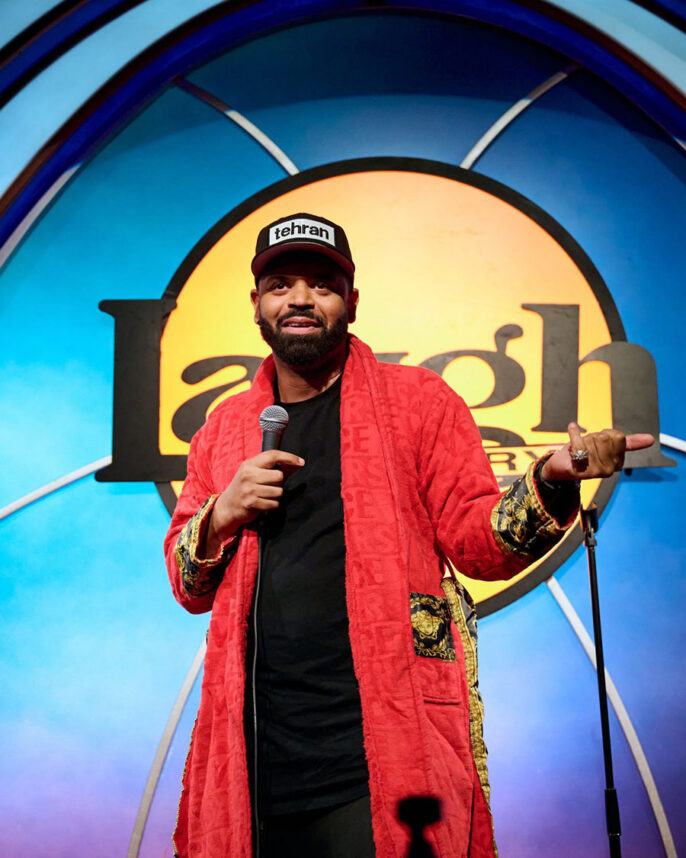
Comedian Tehran performs at the Laugh Factor for a “Laugh Through the Heartbreak” show.

The lineups have included Jewish comedians Jeremy Piven, Tiffany Haddish, Tehran, Michael Blaustein, Trevor Wallace, Matthew Broussard, T.J. Miller and L.E. Staiman. There have also been several non-Jewish comedians such as Jason Mewes, Maz Jabroni, Jo Koy, Mark Normand, Mario Adrion and Dax Flame.

Safar always opens the show as host. Once he calls on Silverstein for his set, Silverstein takes over. And whenever possible, Safar—a frequent DJ at Jewish events around Los Angeles—spins the walk-on songs for the comedians.

Erez Safar and Menachem Silverstein embrace on stage at the Laugh Factory.

Their first show was in New York on Valentine’s Day 2024. One hundred percent of the proceeds from that show were donated to two organizations: Help Up, which supports Israelis dealing with PTSD through volunteer programs, and Maim Haim, which provides support for IDF reservists on Israel’s northern front.

Over a decade ago, Safar had created the Sephardic Music Festival, which included both music and stand-up comedy. Safar and Silverstein both live in Los Angeles, and their first “Laugh Through the Heartbreak” show in LA took place at the Laugh Factory in April 2024. All 250 seats were sold, and another 100 for standing room only.

“We realized that we had something magical, and thank God, it’s only grown from there,” Silverstein said. “Somehow it always sells out, but it’s always a test of faith,” Safar said.

They played to their largest audience — 2,600 people — at Jewish National Fund Global Conference in Miami in October.

Menachem Silverstein on stage at the Laugh Factory for “Laugh Through The Heartbreak.”

Safar said that after every show, audience members approach him to say some form of, “I really needed that.”

They come up to him again and again, saying things like “yeah we lost so many people on Oct. 7, or most recently, we lost people in Bondi Beach.”  At those times, Silverstein said, “It’s hard for us to even think of laughter and then come here and laugh. When you hear the term heartbreak, you always think of the biggest things in the world.”

“Laugh Through the Heartbreak” has played to audiences who did not even expect a Jewish-focused show. Safar and Silverstein said it was a deliberate decision not to indicate that the shows are a result of Jewish community heartbreak.

“Laugh Through the Heartbreak” has played to audiences who did not even expect a Jewish-focused show. Safar and Silverstein said it was a deliberate decision not to indicate that the shows are a result of Jewish community heartbreak.

“I remember this one woman wearing a hijab, and she was dying of laughter at Menachem’s set,” Safar said. “Sometimes non-Jews get affected better than Jews do.”

Safar is the author of the “Light of the Infinite” series, where he refers to himself as “your spiritual DJ,” curating reflections on Torah and Kabbalah.

Silverstein grew up in Crown Heights, Brooklyn, in an Orthodox Jewish community and is one of seven children. He was raised in a Chabad community and later taught himself screenwriting and comedy while pursuing work in entertainment.

“I was trained in the regular comedy club world,” Silverstein said. “I didn’t do Jewish shows until I was years in. I try to use my humor to not only make people laugh, but also to unite and educate by making fun of antisemitism, poking holes at some of the ridiculousness of Judaism.”

An ordained rabbi, Silverstein described the difference between performing in comedy clubs and on the bimah.

“The weight of the mic is harder,” Silverstein said. “It doesn’t matter how nice you are, you’re funny or you’re not.”

Some “Laugh Through the Heartbreak” shows have overlapped with major news events. When it was reported in Feb. 2025 that the Bibas family, including their two young children, had been murdered by Hamas, the comedians changed the content of their sets at the last minute. Safar pointed to Zach Sage Fox breaking down while on stage between jokes, acknowledging the horrific news.

“You can be in this difficulty and hardship, but also allow yourself to be happy and celebrate life and connect to the goodness,” Safar said.

Silverstein says he is mindful of what he posts to his over 51,000 Instagram followers on particularly difficult days for the Jewish community.

“I didn’t post at all that day,” Silverstein said. “I didn’t want to undermine the moment.”

The success of the tour means the world to Silverstein, “because people showing up lets us do it again and again. If nobody showed up, the Laugh Factory wouldn’t let us do this. We’ll try to do this at least once every six weeks in Los Angeles,” he said.

The tour’s 13-show tour begins April 22 in Las Vegas. Tickets for “Laugh Through the Heartbreak” can be purchased at www.laughthru.com/tour

‘Laugh Through the Heartbreak’ Comedy Tour Goes National Read More »

United Against Hate: Why the Black and Jewish Communities in America Must Stand Together

For more articles from The Media Line, visit themedialine.org.

In the turbulent 1960s, an unbreakable bond was forged on the front lines of the American civil rights movement. Black and Jewish activists didn’t just share a history of oppression and a fight for survival; they marched side-by-side, prayed together, and literally shed blood to transform the conscience of a nation. Yet today, amid a terrifying global resurgence of antisemitism and racism, the memory of that world-changing coalition is dangerously fading — threatened by a modern era of misinformation and deliberate historical erasure.

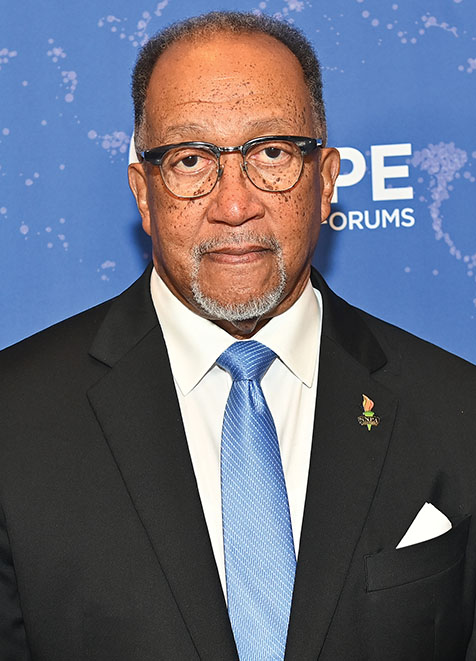
Benjamin F. Chavis, Jr. (Photo by Paras Griffin/Getty Images)

Refusing to let this legacy be forgotten, civil rights veteran and Black Jewish Action Alliance National Chairman Rev. Dr. Benjamin Franklin Chavis Jr. and documentary filmmaker Dr. Shari Rogers have launched a mission to reconnect the two communities. Their partnership began with a chance meeting in New York after the Oct. 7, 2023 Hamas attack, when Chavis was speaking about empathizing with Jews who had just been murdered. “I met him in New York; we were staying at the same hotel,” Rogers recalled. Through Rogers’ documentary “Shared Legacies” and the work of Spill the Honey, the organization she co-founded and leads with Chavis as board chairman, they are trying to bring that story back into public view.

Chavis sees the danger first as a crisis of memory. “Well, I think there’s a challenge for the African-American story. Similarly, there’s a challenge for the Jewish story,” he says. In his view, rising antisemitism and racial hatred have made both communities more vulnerable to distortion, forcing them to defend truths that should already be secure. “Unfortunately … sometimes people become ahistorical. And when you become ahistorical, you become apolitical.” For Chavis, that loss of memory weakens public morality itself, leaving people less able to “speak truth to power.”

Dr. Shari Rogers (Photo by Dimitrios Kambouris/Getty Images for Concert for America)

Rogers’ answer to the loss of memory has been witness. Her goal in making “Shared Legacies” was to preserve the voices of people who had lived the Black-Jewish coalition before those voices were gone. “My dream was that this history, one of the most important American history coalition stories, would be known to the entire country and to the world,” she says. The film became a repository of testimony from leaders whose memories now carry even greater weight because so many of them are no longer alive.

Some of those voices came to the project with a sense of urgency of their own. Rogers recalls that Congressman John Lewis (D-Ga.) “actually helped fundraise the remaining funds for this film,” while Harry Belafonte, overcome with emotion, “wanted to make sure that his voice was documented in this history.” The result is a work rooted not in abstraction, but in memory preserved before it vanished.

That shared memory, Rogers and Chavis argue, is still not widely understood. “There has not been enough sharing of our stories,” Chavis says. “It’s important for the Jewish community to know the Black narrative. It’s important for the Black community to know the Jewish narrative.” When those narratives are brought into conversation, the result is more than coexistence; it is a recognition of shared struggle and mutual responsibility. “These narratives do not just intersect; they are parallel, and they are in solidarity.”

Even religious life, according to Chavis, can become a focal point of that solidarity. He points to a growing Judeo-Christian observance of Passover in Black churches and describes the holiday as speaking to liberation, freedom, justice, and truth. From that perspective, Passover and Easter are not interchangeable traditions, but traditions that can illuminate one another for communities shaped by histories of bondage, endurance, and redemption.

For younger generations, however, history is increasingly competing with misinformation. Chavis warns that “there are Holocaust deniers” and “there are transatlantic slave trade deniers,” even in a world saturated with information. “In order to shape the future, you have to know the past,” he says. Rogers has watched that truth land with impact in classrooms, where students often encounter this shared history for the first time.

“It’s amazing how the younger generation, whether it’s in high schools or even colleges, really didn’t know this history,” she says. Yet once they do, the change can be immediate. One student told her, “If I would have known this history, you could have been my brother.” Rogers sees that as more than a moving, emotional response. It is the moment when history produces relationship, and relationship makes difficult conversations more possible.

That same idea is embedded in the name Spill the Honey. Rogers took it from the story of a Holocaust survivor whose mother gave him a cup of honey on the last day she would ever see him before he was sent to a concentration camp. Her wish for him was both simple and devastating: she wanted him “to have a sweet life and remain hopeful.” The cup broke, but the hope remained. For Rogers, that image became a kind of moral inheritance, one that points toward survival without bitterness and memory without despair.

She places Martin Luther King Jr. in that same lineage of hope. King, she says, “filled his cup up not with despair. He filled it up with love and positivity.” His voice still reaches people because it speaks to a possibility America has not fully realized but has never entirely lost.

That possibility depends on refusing to normalize hatred. Chavis is direct: “We should not allow antisemitism to become normalized. We should not allow racism to become normalized.” The answer, he believes, requires more than private agreement or symbolic support. It requires public witness.

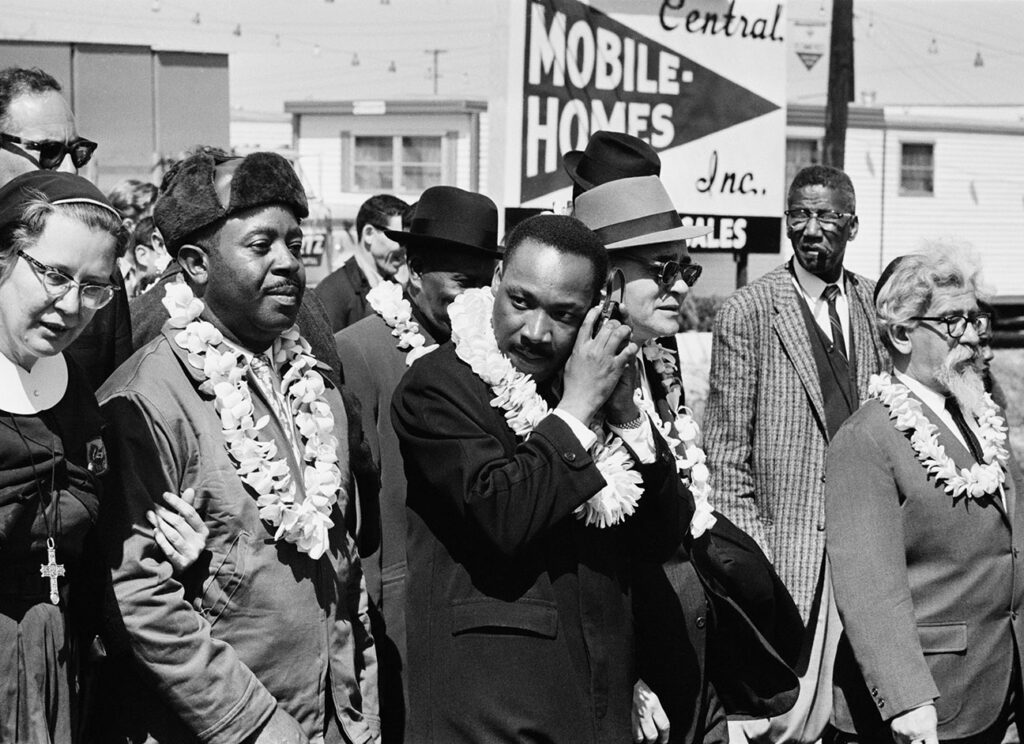
He remembers seeing Rabbi Abraham Joshua Heschel and King marching together during the civil rights movement, and what matters to him most is not simply that they stood side by side, but what that standing represented. “It wasn’t a temporary march. It was a brotherhood. It was a solidarity that was expressed in public,” he says. That remains his measure of the present. “We need more to stand together.”

Rogers sees reason for hope in places where institutions are choosing to make that history visible again. At Morehouse College, portraits of Jewish civil rights contributors now stand alongside Black civil rights leaders, ensuring that students encounter the Black-Jewish coalition not as a footnote, but as part of the school’s living inheritance. At Ebenezer Church, figures including Rabbi Heschel and Rabbi Jacob Rothschild have also been honored in connection with this shared history. Rabbi Rothschild’s temple was bombed because of his close work with King, and he helped ensure the first integrated dinner in Atlanta when King received the Nobel Peace Prize.

The story also has a wider lens. “Today we also have to talk about Jews of color and Black Jews,” Rogers says. That reminder complicates older binaries and makes the coalition more faithful to the present. Spill the Honey’s hip-hop pedagogist is Black and Jewish as well, reflecting identities that bridge categories too often treated as separate.

Education is where all of this comes together. Rogers says Spill the Honey has developed “a five-hour curriculum that supports the one-hour film on shared legacies,” and that it is already in high schools in Boston, California and Detroit. Boston University Law School made the film mandatory for new law students, and UC Davis Law School is also part of the initiative’s expansion. Her hope is for much broader reach because this story, she says, “uplifts both the Black community and the Jewish community and serves as a template and a roadmap for all communities to learn how to bridge-build and remind people of our common humanity.”

The curriculum also reflects a sharp awareness of how young people learn now. Rogers points to hip-hop pedagogy as a way of carrying history into the present, teaching students the story and then asking them to create songs about it in a language that feels native to them. If music helped move the 1960s, it can still help transmit moral memory now.

The same philosophy shapes Rogers’ understanding of Holocaust testimony. Many survivors did not begin speaking publicly right away because the trauma was too great. “It took Steven Spielberg’s film ‘Schindler’s List’ to really inspire many of the Holocaust survivors to start speaking about the horror that they witnessed,” she says. Through “Shared Legacies,” she has seen people begin speaking more openly about their own family histories as well. Testimony, in that sense, can encourage others to speak.

Chavis’ own life offers one of the clearest examples of what solidarity can look like across distance and struggle. While unjustly imprisoned as part of the Wilmington Ten, he wrote to Natan Sharansky, who was then jailed in the Soviet Union for resisting the oppression of Soviet Jewry. “I said, you know, let me write my fellow brother,” Chavis recalls. The letter was never delivered, but he kept a copy. Years later, he read the letter to Sharansky in person, turning an intercepted gesture into what he called “a great reunion, spirit of solidarity.”

For Rogers, the significance of that bond runs deeper still. Sharansky told her that one of the first places he wanted to visit in America after his release was the King Center, because King’s message about Soviet Jews had given him hope. That memory captures what Shared Legacies is trying to restore: the reality that Black freedom struggles and Jewish freedom struggles have often sustained one another in ways still insufficiently understood.

Neither Rogers nor Chavis avoids the pressures of the present. Chavis says African-Americans are deeply concerned about the wars in the Middle East and insists that “Israel not only has a right to exist,” but should “be free of acts of terrorism and violence.” He describes Oct. 7 as a world-shaking moment that horrified many in the Black community. Yet he also returns to a recurring warning that links current conflict to historical memory: “I think the same people that want to erase the Holocaust from history are the same people [who] want to erase slavery from history in the United States.”

Rogers points to social media as one reason these conversations have become harder. “I think social media preys on the young people,” she says. “They like negative stories. Negative stories sell.” Spill the Honey tries to answer that appetite not by avoiding pain, but by offering hopeful narratives strong enough to hold pain without being consumed by it. The shared history between Black and Jewish communities, she believes, creates a safer space for more difficult discussions, including the Middle East, because it begins with relationship rather than accusation.

Chavis returns, finally, to first principles. “I think there’s only one race, and that’s the human race,” he says. “And I think that we’re all part of one human family.” Against that moral vision stand what he calls “the two twin evils that divide humanity today”—antisemitism and racism.

Rogers reaches for the words of Dr. Samuel DuBois Cook to describe the same truth. After the deaths of King and Heschel, Cook brought Black and Jewish leaders together at Dillard University to rebuild the relationship, and he later wrote that “the terrible logic of antisemitism and racism is the same: the alienation of humankind from humankind.” The phrase remains striking because it names hatred not simply as prejudice, but as a break in the moral order itself.

That is why Chavis sees the Black-Jewish alliance as part of “the American story” and “the American journey.” He points to the Civil Rights Act of 1964, the Voting Rights Act of 1965 and the Fair Housing Act of 1968 as evidence of what that solidarity helped make possible. America, he argues, would not be what it is without either the Jewish community or the Black community, and its strength lies in inclusion rather than exclusion.

“The soul of America is at stake,” Chavis says. The task now is not only to honor the past, but to learn from it and build something worthy of it. “So that our shared legacies become our shared futures.”


Felice Friedson is President and CEO of The Media Line. 

United Against Hate: Why the Black and Jewish Communities in America Must Stand Together Read More »