For more stories from The Media Line, click here.
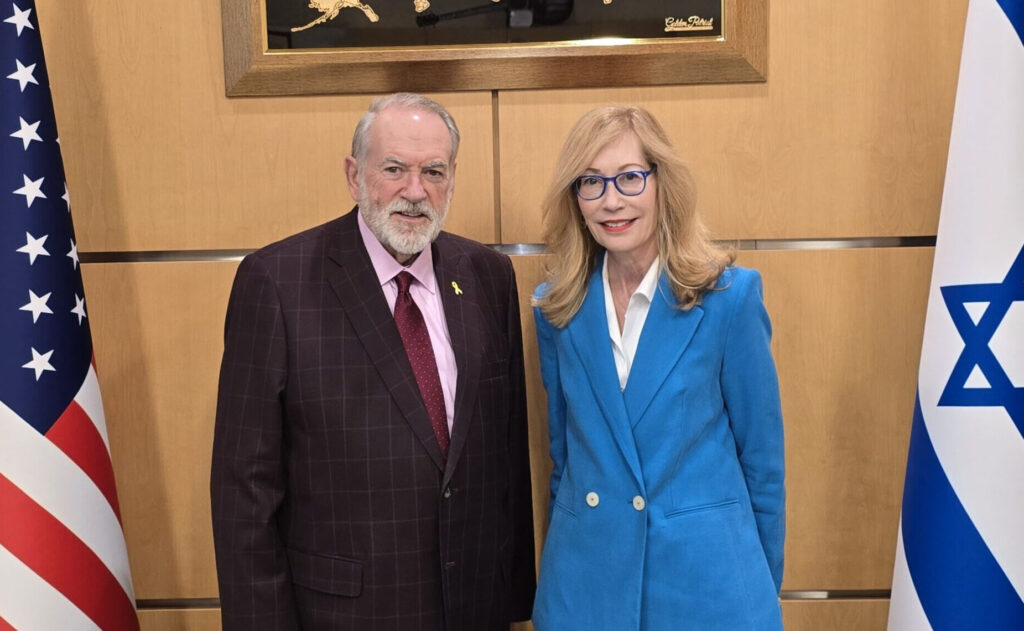
Sitting confidently in his comfortable office within the grounds of the symbolic Jerusalem Embassy, the former Arkansas governor and current US Ambassador to Israel, Mike Huckabee, is dressed meticulously for the role, confident in the position President Trump has selected for him.
The United States-Israel Ambassadorship has placed Mike Huckabee in the hot seat of international and local politics. He enjoys one of the busiest Ambassadorships, tying him to some of the most historic events with quickly turning news cycles.
With ease and warmth, the American envoy and Baptist pastor runs through the litany of historic events in an exclusive and wide-ranging interview with The Media Line’s Felice Friedson, covering the 12-day war with Iran, to the most recent ceasefire with Syria, and the pending hostage deal with Hamas.
Describing his journey to becoming an ambassador, Mike Huckabee was candid about the weight of the role. “I knew it was going to be intense,” he said. “I’ve been coming to Israel for 52 years … over 100 times. So it’s not that I’m shocked by most of what’s happened.” Still, stepping into the ambassador role during overlapping conflicts, the war in Gaza and the brief but fierce 12-day war with Iran, has been anything but symbolic. “It’s certainly not been a ceremonial position,” he added. “But I wouldn’t want to be anywhere else.”
Ambassador Huckabee recounted how the role came to him just days after the election. “The phone rang … it was President Trump. He doesn’t ask—he tells,” Ambassador Huckabee said, grinning. “He said, ‘You’re going to be my ambassador to Israel. You’re going to go. You’re going to be great.” Trump, he joked, didn’t miss the chance to say, “‘You’re not as great as your daughter (Sarah)—you’ll never be as great as her—but you’re going to go.’”
Within half an hour, the news was public. Ambassador Huckabee scrambled to reach his wife, who was volunteering in Oklahoma at the time. “I think I caught her about six minutes before it hit Fox News,” he said. “Good thing I did, or I might not have survived not telling her first.”
The discussion with The Media Line then focuses on the rapid-fire nature of Ambassador Huckabee’s role, and questions reflect the wide range of issues that have arisen and still linger.
Ambassador Huckabee emphasizes the firm partnership the United States has with Israel, citing the closeness of the leaders, but also speaks of the hurt many in the evangelical Christian community feel, burdened by the challenges Israel’s Interior Ministry poses. Teachers and pastors who want to work in the Jewish State often face exorbitant visa fees and other obstacles to secure entry.
In a strongly worded letter to Israel’s Interior Minister Moshe Arbel last week, Ambassador Huckabee expressed deep frustration that prior discussions on the issue had failed to resolve what he called a “simple” matter of restoring long-standing visa practices to Christian evangelical groups visiting Israel.
Speaking to The Media Line, Ambassador Huckabee sharply criticized the recent bureaucratic hurdles Christian organizations face in obtaining visas to Israel, expressing his deep disappointment, asking, “Why do you hurt your friends?
We weren’t asking for special treatment. Just don’t rock the boat.
“Why would Israel want to do something that was very detrimental to their best friends?… We weren’t asking for special treatment. Just don’t rock the boat.”
Ambassador Huckabee explained that before he arrived in Israel in January, the process suddenly changed. Visas were no longer approved based on the religious committee’s recommendations but were denied outright, triggering costly and bureaucratic investigations, sometimes requiring a much more expensive visa.
However, he expressed confidence that the issue would be resolved soon at higher levels of government.
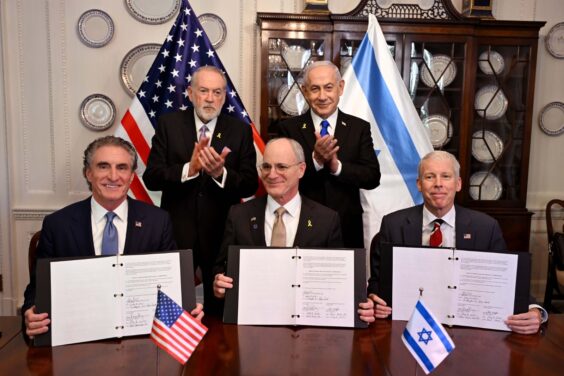
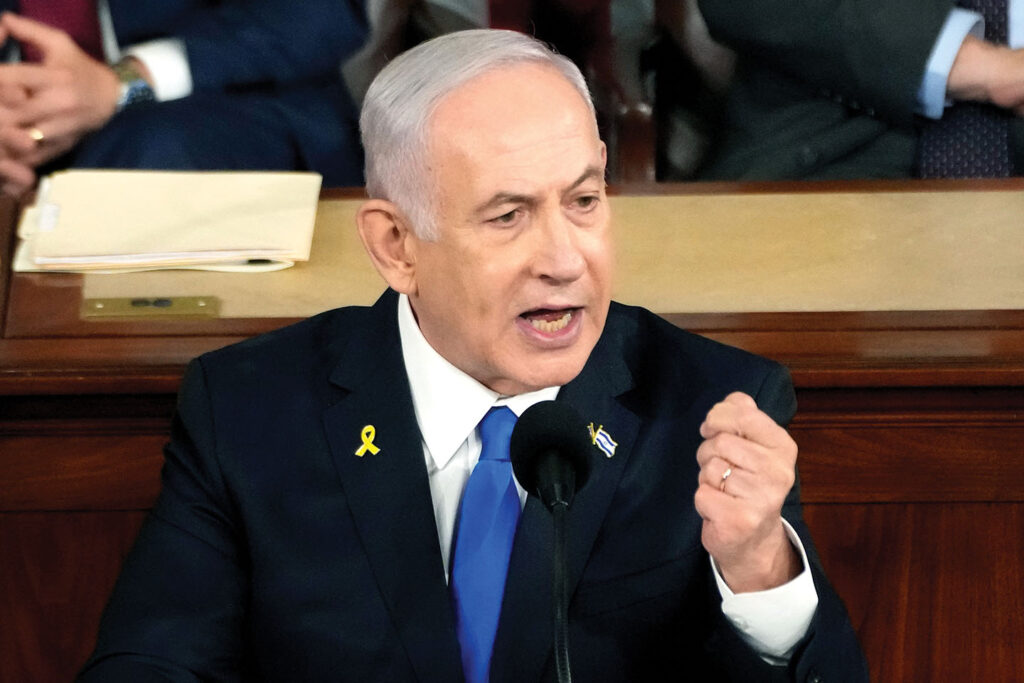
Prime Minister Benjamin Netanyahu at the Signing of an MOU on Cooperation in Energy and AI. (Itay Beit-ON (GPO))
Ambassador Huckabee has called for an investigation into violent attacks that have erupted recently in the West Bank, most notably, resulting in the killing of American Palestinian Sayfollah Musallet. The ambassador met with the family of the young man who was killed and expressed the need for an investigation into the matter.
An American citizen was murdered. It is an act of crime and terror … We need to find out what happened.
“An American citizen was murdered. It is an act of crime and terror … We need to find out what happened—for his family’s sake, but also for the sake of the relationships that exist in that part of Israel.”
Turning to the International scene, Ambassador Huckabee opened with a rare glimpse into the behind-the-scenes military coordination between the United States and Israel during the war with Iran. While he remained cautious about revealing classified details, he described the level of cooperation as historic.
Both militaries … carried out a level of precision that you just have never seen
“The extraordinary level of cooperation between the two countries is one for the books,” he said. “The relationship afterwards has only been enhanced exponentially. Both militaries … carried out a level of precision that you just have never seen.”
He emphasized the miraculous nature of the operation with no combat fatalities, no aircraft losses, and an unmatched level of operational success.
“You step back and you look at that in the context of hundreds of ballistic missiles being fired, and you simply say God must have put his hand on this whole process.”
In response to questions about negotiations with Qatar and the image of unity between President Trump and Prime Minister Netanyahu, Ambassador Huckabee was clear in countering media narratives of division.
“The cooperation is intense out of necessity, but it’s also intense out of choice,” he stressed. “These are two people who like each other.”
He laid the blame for the impasse in hostage talks squarely on Hamas.
Everybody wants it to end except Hamas
“Everybody wants it to end except Hamas,” Ambassador Huckabee stated. “To leave Hamas there rewards them …It would be the equivalent of saying to the Nazis at the end of World War II, yeah, you can stay.”
Following the onset of war, speculation swirled about Iran’s remaining military capacity and its nuclear ambitions. Ambassador Huckabee unequivocally asserted that Iran’s military had been “severely crippled.”
“They decimated Iran’s ability to defend their airspace …Even in 12 days of intense fighting, you’re not going to eliminate every threat, but they made major, major damage.”
He warned that a second round of military action was possible if Iran failed to grasp the message.
“If they didn’t get that message through these 12 days, I’m not sure they ever will.”
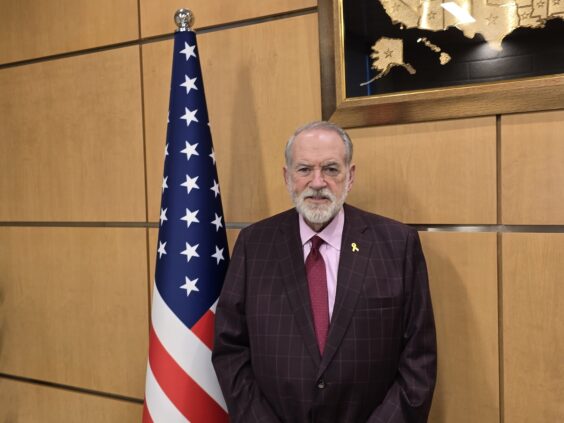
Ambassador Mike Huckabee in his office at the American Embassy in Jerusalem. (Courtesy American Embassy)
Asked about the Yemen-based Houthis’ threat in the Red Sea, Ambassador Huckabee cautioned against further provocations.
“Take a look at your sponsor … do you see a future for yourselves continuing to attack US assets?” he warned. “How does your future look if you keep sending ballistic missiles down on top of civilians?”
Ambassador Huckabee spoke passionately about the tragedy of Gaza’s squandered potential under Hamas.
Gaza could have been Singapore. Hamas turned it into Haiti … They built a tunnel system to kill Jews that’s larger than the London Underground.
“Gaza could have been Singapore. Hamas turned it into Haiti,” he told The Media Line, lamenting the misuse of billions in aid. “They built a tunnel system to kill Jews that’s larger than the London Underground.”
He explained how President Donald Trump’s provocative proposal to rebuild Gaza as a luxury resort galvanized global discussion. He emphasized that President Trump consciously employs the tactic of causing a stir to get major players to discuss and take action on urgent issues, such as a post-war plan for Gaza.
Ambassador Huckabee remarked, “That’s the genius of the president.”
He added, “I tell people all the time people don’t get it … He says something just to throw it out there but what he’s doing he’s prompting a level of discussion that would not have even started had he not thrown something out there.”
He doesn’t mind pulling the pin and rolling the grenade in the room to see who runs for the door
“He doesn’t mind pulling the pin and rolling the grenade in the room to see who runs for the door.”
Although some Gazans express discontent with both Hamas and Israel, and indicate a preference for Fatah rulers, Ambassador Huckabee expressed skepticism.
“That particular government (Fatah) is not working real well for the people in Judea and Samaria. I’m not sure why it would work in Gaza.”
The ambassador discussed the shocking killing of Druze in Syria and President Trump’s unexpected overture to President Ahmed al-Sharaa.
“He preempted Syria from joining with the Russians, the Chinese, or the Iranians …That new government wasn’t strong enough to stand up itself … and President Trump gave them a partner.”
Ambassador Huckabee saw a glimmer of hope in the regional response to the Druze massacre, praising Israel’s protective stance.
“The Druze are a very important part of Israeli society…To their credit, Israelis are not going to let them just get slaughtered.”
Ambassador Huckabee defended Prime Minister Netanyahu, drawing a parallel to former President Trump’s legal challenges.
“If you cannot defeat your political opponent at the ballot box, you try to tie him up in court and drain him … Is this really the time?”
His appearance at the Prime Minister’s court hearing, he admitted with a smile, may have disrupted proceedings slightly, but carried a message of solidarity.
Reinvigorating the Abraham Accords remains high on Huckabee’s ambassadorial agenda.
“We could see a total realignment in the Middle East … Countries that once had guns aimed at Israel now having trade deals and airplanes of tourists.”
Whether he (Trump) will ever get the Nobel Peace Prize or be respected and recognized for it, I don’t know that he even cares because he’ll have history on his side
Ambassador Huckabee continued, “Whether he (Trump) will ever get the Nobel Peace Prize or be respected and recognized for it, I don’t know that he even cares because he’ll have history on his side.”
He particularly praised the UAE for continuing flights to Israel even after October 7, describing their commitment as “remarkable.”
Ambassador Huckabee explained, “Most people don’t understand that on October 7, they were flying 17 flights between the UAE and Israel, and on October 8, they flew 17 flights, and every day since until aerospace was shut down, they continued to fly flights.”
He continued, “Now when the American carrier suspended and all the Europeans did, the one airline that continued to honor its pact of coming to Israel was the UAE. I hope every Israeli gives them a standing ovation for their cooperation and the level of commitment to the agreement and its process. I salute them.”
When asked about his “wish-list” as ambassador, Huckabee listed three goals: expanding the Abraham Accords, “advancing long-term peace in Judea and Samaria,” and—most personally—seeing all hostages returned.
“This pin I wear—I want to take it off, throw it away, and never see it again … That’s the day I’ll cherish and savor.”
When The Media Line asked Ambassador Huckabee what he thinks about when he goes home at night, and what he has taken away from his experience so far as ambassador to Israel, he responded, “Life in the Middle East is complicated, but I knew that coming in … I think what I go home with every day is a sense of satisfaction that I am blessed beyond description to have been sent by the President to be in a challenging but incredibly important role for my country that I love and cherish, and to be part of a relationship, not with a friend or an ally, but with a partner.”
We have a lot of allies. We only really have one partner
He added, “We have a lot of allies. We only really have one partner, and to be the ambassador of the United States of America, to salute that flag that’s out there on our lawn, and then to be able to represent us to our partner is an incredible honor and privilege.”
Transcript of The Media Line Interview with Ambassador Mike Huckabee
TML:
Thank you for sitting with me for The Media Line.
Ambassador Huckabee:
Thank you. Pleasure to be with you. Thank you.
TML:
You’ve been on rapid response lately to numerous matters which we’ll get into. Did you ever imagine entering this position with the multiple-front war, existential issues, and deep national crisis?
Ambassador Huckabee:
I knew it was going to be intense. I never doubted that. I’ve been coming to Israel for 52 years.
I’ve been here over 100 times prior to becoming ambassador. So it’s not that I’m shocked by most of what has happened, but to be ambassador at this particular time with two wars going on simultaneously, one in Gaza and then of course the one, the 12-day war with Iran, it’s certainly not been a ceremonial position, but I wouldn’t want to be anywhere else in the world. Thrilled, thrilled to be here.
TML:
To backtrack, Ambassador Huckabee, when did you learn that President Trump had selected you to serve as ambassador to Israel?
Ambassador Huckabee:
Just a few days after the election. One day I was sitting at my desk, and the phone rang. I had his number in my phone so it would have come up, but this was a number that I didn’t recognize and normally I don’t answer because sometimes it might be, excuse me, a reporter that I don’t want to talk to, but something said answer the phone and I did and it was President Trump on the other line and he doesn’t ask you, he tells you.
So what he said was, my Donald Trump, you’re going to be my ambassador to Israel. You’re going to go. You’re going to be great.
You’re not as great as your daughter. You’ll never be as great as her, but you’re going to go. You’re going to be ambassador, and I said, well, Mr. President, I’m kind of taken aback. I really wasn’t thinking about a federal job, and he said, well, you’re going to go. I said, well, do I have to tell my family? I mean, when’s this going to be announced?
He said, oh, you have plenty of time. Thirty minutes later it was on Fox News. I barely got a hold of my wife who was in Oklahoma for Samaritan’s Purse.
She’s a volunteer for them and has been for years and was over there doing cleanup for tornado victims and I think I caught her about six minutes before it became public and I said, good thing I did or I probably wouldn’t have survived not letting her know first. That’s how it happened.
TML:
That’s great. The situation would clearly not be business as usual during your tenure. The October 7th war was raging and Donald Trump was calling the shots for the Americans.
How was the planning of the two nations presented to you and what goals were laid out for you?
Ambassador Huckabee:
For the war? Yes. Most of it I can’t really disclose because it really is classified, you know, what happened when, who knew what when and what was the coordination.
So here’s what I can say that is not classified. The extraordinary level of cooperation between the two countries is one for the books and it was before. The relationship afterwards has only been enhanced exponentially and it is a marvel of military expertise, the likes of which probably the world would be hard pressed to find a parallel.
Both militaries, first the Israeli in the launch and then the US coming in to bring the B-2s in and using the MOP bombs was a level of precision that you just have never seen. Not a single member of either military lost in combat, not a single airplane that mechanically malfunctioned, which to think of that many sorties especially for the Israelis flying over F-16s, that they didn’t lose an airplane or a pilot. I mean you step back and you look at that in the context of hundreds of ballistic missiles being fired and you simply say God must have put his hand on this whole process and I can’t say it any other way that would be believable.
TML:
You’ve been witness to some of the most critical conversations around negotiations between the United States and Qatar regarding ending the war and the hostage negotiations. Most recently the visual of you sitting at the table with President Trump and Prime Minister Netanyahu was seen worldwide. Do you believe a ceasefire is close and does the picture look differently in private meetings than how the media is portraying it?
Ambassador Huckabee:
Well the media has always tried to portray that the US and Israel are fighting or there’s enmity between the countries or the leaders and that’s simply not true. The cooperation is intense out of necessity but it’s also intense out of choice. So it’s not just necessity.
These are two people who like each other and after the week that they had together in D.C. there were several occasions in which the two of them had one-on-one meetings with no one else in the room, which is highly unusual to have either leader alone. They were both in Ffthe room together, just the two, and there was a level of bonding that I think happened in the course of the week both from the nations as well as from the leaders that the benefits will last for years to come. As far as the negotiations for the hostages we all have hopes, we all want this to end.
The reality is the reason it hasn’t been resolved is not because Israel is reluctant to to end it and they’ve been accused of not wanting to end it and that’s that’s utterly untrue or that the US is not being as effective and that’s not true. Everybody wants it to end except Hamas. The reason that it has not been resolved is because Hamas doesn’t want it to be resolved and the president has said repeatedly Hamas can’t stay, they can’t have any role in the future of Gaza, they’re not going to rule in the future.
Prime Minister said the same thing. It’s the only logical conclusion that one can come to because to leave Hamas there rewards them. It not only rewards them but it incentivizes another October the 7th and it incentivizes more hostage taking.
It would be the equivalent of saying to the Nazis at the end of World War II, yeah you can stay. You maybe not have as big a role but you can still operate and even carry out some government functions. You may have to give Holland or somebody back Belgium but otherwise you can stay.
Nobody would say that was a rational conclusion to that war and nobody can say that Hamas can stay and the president and prime minister are on the same page there.
TML:
On June 12th you told Ynet that President Trump won’t let Iran go nuclear and that an attack by Israel alone was unlikely. The war with Iran began one day later and the US showed what an ally can do. There are concerns of where Iran will go from here both in terms of regaining nuclear capacity as well as stockpiling missiles.
Some even speak of Iran’s capability in a matter of months. Has the Iranian military been crippled?
Ambassador Huckabee:
Oh without a doubt it’s been severely crippled and the best way to just make that obvious is the fact that Israel flew that many missions and never lost a plane. They never took a direct hit from a defensive missile from Iran. They never had a dog fight with a fighter.
I mean they decimated Iran’s ability to defend their airspace. They made major, major damage on nuclear sites but also their overall military structure, their hardware, their tunnels, their storage facilities, their launchers. A country of that size with that much capability even in 12 days of intense fighting you’re not going to completely eliminate every single threat.
The question is will Iran be smart enough to recognize they don’t have a nuclear future. If they didn’t get that message through these 12 days I’m not sure they ever will and it would be unfortunate but they would find themselves on the receiving end of another round and that would be an unpleasant ending for them.
TML:
That was my next question and it really is something that’s out there in terms of the United States and Israel round two.
Ambassador Huckabee:
Nobody wants that. Everyone hopes that Iran will come to its senses and I can’t predict what either country would do or when they would do it or what the red line would be but I would say that if past is prologue to the future then take a good look at the recent past and ask yourself would Iran be smart to go and try to reconstitute a nuclear program. Does that make sense in light of what they’ve just been through and do they think that Israel and the United States would go softer or would they go harder and I’ll leave it to your listeners to determine what they imagine would be the outcome.
TML:
Let’s not forget the uranium proxy the Houthis who were attacking ships and taking hostages aside from controlling the very important Red Sea’s access to shipping. To your knowledge what is the United States going to do?
Ambassador Huckabee:
I wouldn’t be able to speak to the specifics of what we will do. I would say to the Houthis take a look at your sponsor take a look at your sugar daddy that’s provided you with weaponry and money and ask yourself do you see a future for yourselves continuing to attack US assets and if you do that’s your decision but take a good look at what both Israel and the US are capable of and ask yourself how does your future look if you keep sending ballistic missiles down on top of civilians.
TML:
The president caused a stir when he suggested his ideas for rebuilding the Gaza Strip as a luxurious seaside resort community. Has there been any movement on the part of the Arab world ready to host displaced Gazans and what do you think the ends of the war between Israel and Gaza might look like?
Ambassador Huckabee:
You know the great tragedy is that Gaza could have been Singapore Hamas turned it into Haiti which what a shame the billions and billions of dollars that were invested into Gaza to make it something where people could prosper and all they did was build a tunnel system to kill Jews that’s larger than the London underground which is mind-boggling. What Gaza could be is going to be dependent upon first of all getting this war over with and then to what level is it going to have to be completely rebuilt from ground up. When the president made the comment about you know well let’s take it over until that moment no one on the face of the planet was willing to lend a hand for the rebuilding but when he said that suddenly everybody said oh well wait a minute we don’t want you to do that well we’re going to have a hand in it.
President Trump like he always is a master at doing was able to move the discussion off high center and suddenly get people starting to talk about what they wanted to do in helping for a post-war Gaza and that’s the genius of the president. I tell people all the time people don’t get it they don’t understand it and I think he says something just to throw it out there but what he’s doing he’s prompting a level of discussion that would not have even started had he not thrown something out there. I’d say it’s like he doesn’t mind pulling the pin and rolling the grenade in the room and to see who runs for the door.
TML:
In speaking to Gazans from the media line we’re hearing that many of them are saying they don’t want Hamas, they don’t want Israel, they actually want Fatah and the current Palestinian government in. How feasible is that?
Ambassador Huckabee:
I don’t know I’m not sure that particular government’s not working real well for the people in Judea and Samaria. I’m not sure why it would work in Gaza and you know they had that government at first and then they voted Hamas in 2007 and since then it’s become an increasing hellhole because of Hamas. So I can see that people wouldn’t want Hamas anymore and they may look for their aspirations of a future beyond the immediate vicinity.
TML:
President al-Sharaa meets with President Trump, a coordinated meeting between Saudi Crown Prince Mohammed bin Salman. The world is hearing calls for normalization with Israel and suddenly an unstable Syria witnesses more than 200 Druze killed in a battle with the Bedouins and al-Shara’s army not only doesn’t defend the Druze but is seen cutting their beards a humiliating sign reminiscent of ISIS. Do you believe once a terrorist always a terrorist?
Ambassador Huckabee:
I think there’s still hope for the situation in Syria to resolve. There’s a ceasefire now, it’s calm, it’s fragile but I don’t think it’s off the table that there’s going to be normalization between Israel and Syria. It’s a delicate matter that’s going to have to be carefully worked but once again I’m going to give President Trump credit when everyone thought Syria was on the verge of a complete disaster and unstable to the point of breaking into yet another civil war.
He does something that quite frankly none of us saw coming. He embraces al-Shara and says okay we’ll be your partner but what he did he preempted Syria from joining with the Russians, the Chinese or the Iranians are some bad actor. That new government wasn’t strong enough to stand up itself militarily or economically, it needed a partner and President Trump preempted a partnership that would have been disastrous not just for Syria but for Israel, Lebanon, Turkey, everyone would have been the loser if they picked the wrong partner.
By the United States becoming a part of helping to give this government some assistance it gives us a real opportunity for a peace that otherwise wouldn’t even be on the table.
TML:
There are many factors between today and peace and as we witness news changing do you think that there’s an absolute pivotal point that’s going to mark that moment where you say there’s a possibility to create normalization?
Ambassador Huckabee:
I don’t think it’s a moment, I think it’s an incremental process of steps and some of those steps have been the last few days. Here’s one of the things that has already happened as a result of even the dust-up. It escalated because when the Syrians moved military hardware that they were not supposed to move to the south, Israel said wait why are they moving tanks and artillery so they fired in and said you can’t go south to Damascus that’s a demilitarized zone.
For whatever reason the Syrians thought they were going, whether they thought they were going to help referee the fight between the Bedouins and the Druze, it blew up because nobody had communicated as to what the intent was. Then it became obvious that there had to be direct communication, there had to be an understanding of what the red lines for Israel, Syria, for the Druze, everybody. We’re in that moment now and I think that there is a different atmosphere.
I appreciate that Israel understood that what they felt was important was no militarization of the south and the Druze cannot be slaughtered. The Druze are a very important part of Israel society and they’ve been very valuable contributors to the Israeli world, the Israeli psyche, if you will, and great citizens. I think it’s to the credit of the Israelis that they’re not going to let them just get slaughtered and stand by and say no it’s on our side of the line so good for them.
TML:
The death of an American Palestinian allegedly killed by Israelis, some say part of the Hilltop youth, caused you to demand accountability for the Criminal and Terrorist Act. We reported that the Israeli police opened a police investigation but the family did not cooperate. According to the police spokesman’s unit there was no complaint, no autopsy, and no evidence.
Sayfollah Musallet was buried so how can the Israeli side investigate without the body or basic elements which go into an investigation?
Ambassador Huckabee:
Well there’s still a capacity to investigate and that has not been completed. I’ve had a conversation with family. You know my heart goes out to them.
It’s a young man, he was just here for a couple of weeks and he is an American citizen so it’s a responsibility of mine to care deeply about who did this. We don’t know who did it. I’m not going to speculate as to who did it or to the motive or to what precipitated it because I don’t know at this point and I don’t want to lend myself to even giving affirmation to the rumors of who did it, why they did it, because I don’t know.
So as we get information I’ll try to be clear about it. The one thing I’m clear about an American citizen was murdered. It is an act of crime and terror and we need to find out what happened for his family’s sake but also for the sake of the relationships that exist in that part of Israel and to try to make sure it doesn’t happen again.
TML:
You just rebuked Israel for not granting visas to Christians, threatening reciprocal steps. Can you specify what you meant?
Ambassador Huckabee:
Well it’s a very unfortunate situation because for decades, this isn’t new, for decades there’s been a process where Christian organizations went through an approval and they were granted visas for educational purposes and they brought people in to run schools and churches and para-church organizations. Very helpful to Israel. I mean the most supported Zionist in the world are the evangelical Christians.
For some reason in January of this year, prior to my coming even to Israel, the process got changed and instead of using whatever the recommendations of the religious committee were, suddenly any visa that came was denied and then it was demanded that there would be a thorough and detailed and bureaucratic investigation that would also sometimes require a different type of visa that would be very more expensive to get the visa than the person would even make in salary to be here as a teacher professor at a school. So when I came, one of the immediate things I was confronted with was this is really causing a lot of trouble. Well it didn’t make sense to me.
Why would Israel want to do something that was very detrimental to their best friends? These are not only Americans but they’re evangelical Christian Americans who are stout supporters. We had a meeting with the interior ministry, thought it went very well, thought it was resolved, but then four different occasions later it was still going on.
Every time we would call and say here’s an issue with a visa that was denied, it’s true they would get it fixed but the process wasn’t changed and so it was requiring an every time kind of thing. That wasn’t the understanding. The understanding was not something special and I want to make very clear we never asked the Israeli government for any special treatment or different treatment.
We simply said the status quo has worked since even before 1948 in some cases. It has been a long-standing way in which these visas were granted for these kind of people. All we’re asking is let’s just don’t rock that boat.
There’s no reason to rock it unless you tell us there’s a reason and if there is and by the way there were some visas that were denied that we agree it should have been denied because for whatever reason, probably better me not to mention that, but you know some visas did not meet the test so we weren’t asking blanket visas. The letter which was made public, I didn’t make it public, wasn’t from Embassy Jerusalem, must have been from one of the ministries. You know it’s out and I said what I said and I meant everything I said.
So it’s something I’m confident we’re going to get resolved. It’s now bubbled up to levels of the government that I believe take this very seriously because they’re very supportive of Americans in general and evangelicals in particular. Nobody wants to see this become a point of animosity and a point of confusion and contention.
It’s unnecessary. So why do you hurt your friends? I think we’re going to get it resolved.
I have every confidence we will.
TML:
You get the dream job as ambassador and this happens. Does it make you disappointed?
Ambassador Huckabee:
No. I’ve been in government long enough to understand it’s just the way it works. I don’t blame the interior minister.
I think he in good faith said this was fixed. I don’t blame his chief of staff. I think he in good faith, I think it’s down in the bowels of the bureaucracy where this kind of thing happens and it’s not unusual and it’s something that you know I was very unhappy with because I felt like look we’ve got to get this resolved.
There are people whose lives are on the line in terms of they’re planning to come here, start jobs and they can’t get their visas. It’s disrupted. So why are we going through this process?
But it’s how government sometimes functions. It’s a messy thing sometimes and this is one of those moments.
TML:
The Abraham Accords were the showpiece of the president’s previous term in office. How was it intended to play in terms of round two?
Ambassador Huckabee:
I think the Abraham Accords are back on track. You know President Trump should have gotten a whole lot more credit for the Abraham Accords in his first term. It was historic.
First time he saw any movement in the Middle East. I really do believe that we are in in a moment where we could see a total realignment in the Middle East. So I’m very optimistic that in this term the president will be signing a number of countries to the Abraham Accords.
Whether he’ll ever get the Nobel Peace Prize or be respected and recognized for it, I don’t know that he even cares because he’ll have history on his side. But it will be a very significant thing to see countries that once had guns aimed at Israel now having trade deals and airplanes of tourists aimed for Israel. What a difference that is and we’ve already seen the benefits.
For example, the UAE, a country I have such respect and admiration for, absolute love for, because they took a huge chance joining the Abraham Accords and being one of the first out there. Put their necks on the line. Most people don’t understand that on October the 7th they were flying 17 flights between the UAE and Israel and on October the 8th they flew 17 flights and every day since until aerospace was shut down they continued to fly flights.
Now when the American carrier suspended and all the Europeans did, the one airline that continued to honor its pact of coming to Israel was the UAE. I hope every Israeli gives them a standing ovation for the cooperation, for that level of commitment to their agreement, their process. I salute them.
TML:
You’ve come on to fire for speaking out on behalf of Prime Minister Netanyahu regarding his legal problems, even attending his court hearing. Do you think your presence impacted the hearing?
Ambassador Huckabee:
I don’t know that it did much more than disrupt it a little bit, but the President was outspoken in two different comments that he made on Twitter and it was very clear that he felt that what was happening to the Prime Minister here was very similar, if not identical, to what has been happening to him in the US, where if you cannot defeat your political opponent at the ballot box, you try to tie him up in court and drain him with every last penny he has.
The President has had to spend millions of dollars in legal fees. He’s been sued or charged in civil and criminal court in New York, Washington, Florida, Georgia, Virginia, I think. It really is not only, as he would call it and has called it, a witch hunt, but it’s an incredible distraction, first from his campaign and then from his service as President.
And I think he saw this happening to his close friend. And he’s not trying to inject himself into the outcome, you know, that’s for the courts to decide. And I think the courts, you know, will look at this.
But to say about the prosecution, why? Here’s a person who’s fighting two wars, trying to get hostages released. Is this really the time?
Is it not possible to wait until after he’s out of office if you think that something here is there? So my presence there was to say on behalf of your very good friend in America, and really, quite frankly, I hadn’t been to a circus in a while. I want to go see one.
TML:
Well, you brought Bugs Bunny! What did Mike Huckabee have on his ambassadorial wish list? Getting a once-in-a-lifetime opportunity, where did you believe you would have the greatest ability to leave your imprimatur?
Ambassador Huckabee:
Wow, that’s a great question. I would like to think that there could be some, two things, an expansion of the Abraham Accords, that that would be part of it, and that there would be at least steps toward a more long-term solution to peace in Judea and Samaria. One that I have come to add as number three is this pin that I wear.
I want to take it off, throw it away, and I don’t ever want to see it again, and I can do that only when every hostage is home. So it’s not just getting rid of the pin, but that’s going to be a moment that I will cherish and savor, because it means all the hostages are home with their families, and when I can throw this away and get rid of it forever, it’ll be a blessed, blessed day.
TML:
I’d like to be there to cover that. Mike, on a personal note, you’ve gained a lot of experience. It’s a whole different role.
Ambassador Huckabee goes home at night, and what does he say that he’s learned personally from all this?
Ambassador Huckabee:
Life in the Middle East is complicated, but I knew that coming in. I’ve been coming here for so long that none of that was a surprise. I think what I go home with every day is a sense of satisfaction that I am blessed beyond description to have been sent by the President to be in a challenging but incredibly important role for my country that I love and cherish, and to be part of a relationship, not with a friend or an ally, but with a partner.
As I say all the time, America has a lot of friends. We have a lot of allies. We only really have one partner, and to be the ambassador of the United States of America, to salute that flag that’s out there on our lawn, and then to be able to represent us to our partner is an incredible honor and privilege.
TML:
Thank you so much, Ambassador Huckabee Quite the honor.
Ambassador Huckabee:
Thank you.