fbpx

May 14, 2025

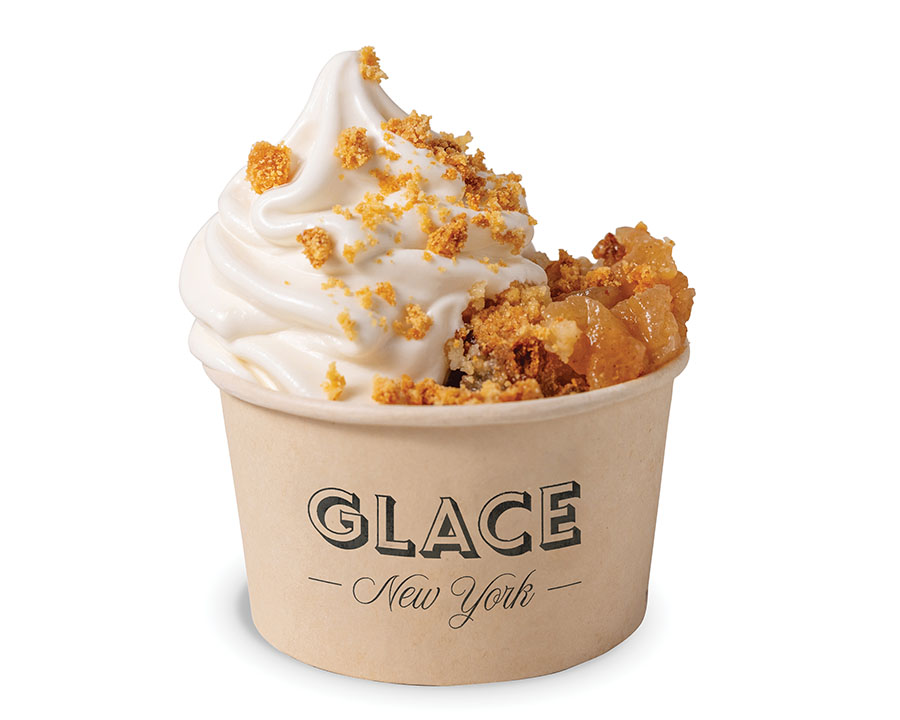
Sasha Zabar: Glace and Glace Candy, Nostalgia and Apple Crumble

What kid doesn’t love a good ice cream shop or candy store? And how many dream of opening that kind of business?

That’s exactly what Sasha Zabar, founder of Glace and Glace Candy in New York, did.

Zabar grew up on 92nd Street on the East Side; the neighborhood near Glace.

“There was always a neighborhood ice cream shop … and a couple of candy-focused delis,” Zabar told the Journal. “It was a real treat to come by after school and go pick out candy and ice cream, or after dinner, go get ice cream.”

All of those types of shops either went out of business before or during COVID, so Zabar felt like it was an opportunity to revitalize the neighborhood.

Food is, after all, the family business.

Zabar’s grandparents, Louis and Lillian, founded Zabar’s in 1934. Louis came to the United States through Canada from Ukraine, Soviet Union, in the early 1920s; he re-met Lillian, whom he knew from their village, in New York. They married in 1927, and had three boys, Saul, Stanley, and Sasha’s father, Eli.

“I don’t remember a time where I didn’t want to be in some way in the food business,” Sasha Zabar said. “So it is kind of destiny.”

Zabar spent his childhood working in his father’s various businesses, which included Eli’s Market and Eli’s Bread.

During the pandemic, while everyone else was baking bread, Zabar started making ice cream at home.

“We had some old ice cream equipment from a project my dad had done in the 1990s,” he said.

A priority for Zabar was keeping the business in the neighborhood, which is not without its challenges.

“You don’t get the same kind of foot traffic and high-end shopping that you find farther south,” Zabar said. “It really is a neighborhood, and we rely on neighbors and students and now we get a lot of tourists who come and visit us, uh, after seeing us on social media or hearing about us from friends.”

Zabar started using social media to make Glace a destination, and it has enabled the business to flourish.

“When we opened, we had a very good first summer,” he said. “I knew ice cream was seasonal [but] I eat ice cream year round, so it didn’t affect me so much.”

Until it did.

At the end of September, when the weather started to change, his business “fell off the cliff,” so he started thinking outside the box … er, cone.

“We created what has become kind of a viral sensation, which is our s’mores hot chocolate,” he said. “We make a house-made marshmallow [which] we pipe around the rim and toast … it’s very theatrical, but it’s also delicious.”

Their hot chocolate videos – some of which are in the millions of views – have led to lines around the block every day during hot chocolate season (November to middle of January),

While social media is an amazing tool to see what people and businesses are doing in the food scene around the world, you need to be creative to stand out.

“We take a common conceit – hot chocolate, ice cream, sundaes, candy – and play around with it until we find something that is both familiar but different ,” he said. “We randomly found our way into a corner of the universe: people love hot chocolate and they love … trying something different than what they expect.”

One thing that goes great with hot chocolate and ice cream – and is delicious year round – is fruit crumble. Zabar’s recipe for apple crumble is below.

Quality ingredients, careful preparation and good customer service are also part of the recipe. And he is now bringing candy into the mix.

“I had always wanted to open a candy store because that’s what  we had in the neighborhood growing up,” he said. “And candy’s kind of having a moment right now.”

Zabar said what makes Glace Candy special is that the two stores are connected in the middle, so customers can mix and match. While Cold Stone Creamery may have popularized the concept, mixing ice cream with other ingredients on cold and marble stones is not unique to them.

“When I opened the candy store, I had this idea of … if you could pick your own candy and then pick your ice cream and then have it all kind of mixed together [there are] infinite variations and options,” he said. “There’s a lot of interplay between the two stores.”

They are also making some of their own candy, like gummy and sour candies.

“It’s been really fun playing with different shapes and flavors and sours and textures,” he said. “It’s hard work – it’s science – but it’s really rewarding when it comes out. … It’s another avenue or another channel to play with … and come up with new inventions.”

Zabar is living his dream and letting others in on the fun.

“Coming up with new specials for Glace and new hot chocolates and new ice creams and now new candy and ‘What can we cover in chocolate?” Zabar said. “It has become kind of a playground.”

Learn more about Sasha Zabar at GlaceNY.com and follow @GlaceNewYork on Instagram.

For the full conversation, listen to the podcast:

Watch the interview:

Gluten-Free Apple Crumble

Ingredients

8 cups peeled, cored, and chopped apples (about 1000 g)

1 cup sugar (200 g)

Pinch of cinnamon

Pinch of ground ginger

Pinch of nutmeg


For the gluten-free crumble topping

1⅓ cups sugar (about 200 g)

1⅓ cups almond flour (about 130 g)

1⅓ cups (about 10.5 tbsp) unsalted butter, room temperature (about 150 g)


Instructions

  1. Preheat your oven to 325°F (165°C).
  1. Place the chopped apples in a baking dish. Sprinkle with the 1 cup sugar and pinches of cinnamon, ginger and nutmeg. Toss gently to coat.
  1. Prepare the crumble topping: In a mixer on low speed, combine the sugar, almond flour and room temperature butter until coarse crumbles form.
  1. Spread the crumble topping evenly over the apples.
  1. Cover the baking dish with tin foil and bake for 40 minutes.
  1. Remove the foil and continue baking until the topping is golden and crisp, about 15–20 more minutes.
  1. Let cool slightly before serving. Enjoy warm, ideally with ice cream or whipped cream!

Debra Eckerling is a writer for the Jewish Journal and the host of “Taste Buds with Deb.Subscribe on YouTube or your favorite podcast platform. Email Debra: tastebuds@jewishjournal.com.

Sasha Zabar: Glace and Glace Candy, Nostalgia and Apple Crumble Read More »

Tips For Speaking Out Loudly and Proudly

Surveys have shown that the number one fear for Americans is not flying, illness, drowning, or heights – it is public speaking. Death comes in fifth. As Jerry Seinfeld, among others, has observed, most people attending a funeral would rather be the deceased than the eulogist.

But if there is a time when Jews in particular need to be able to speak confidently, clearly and inspiringly, it is now. It is on all of us to correct misinformation and call out antisemitism, whether at a public talk, a dinner party, a work meeting, or in the classroom.

Fear of speaking isn’t new for Jews. When G-d ordered Moses to return to Egypt and demand that Pharaoh let the Jewish people go, Moses didn’t appear to be all that worried about coming back to a land where he was a wanted man (having killed an Egyptian overseer many years earlier), or that he was morally unworthy of being G-d’s representative before the Israelites and the Egyptians.  Instead, he seemed terrified that he lacked the oratory skills that were required for the task. “Please, O my lord, I have never been good with words, either in times past or now that You have spoken to Your servant; I am slow of speech and slow of tongue.” (Exodus 4:10) “The Israelites would not listen to me; how then should Pharaoh heed me, me – who gets tongue-tied!”  (Exodus 6:12)

But like most things (other than golf), practice makes perfect.  Here are some tips I have picked up from my decades as a college president:

Be prepared – however, there is no need to seek perfection.

Giving multiple speeches per day, I rarely had time to work out each one in advance. That isn’t so bad. Few of us are able to read a speech in a captivating manner.  But I found that if I had my facts straight, and I had a five-minute opening and two-minute conclusion ready to go, I could then feed off the audience for the rest.

Engage your listeners.

How painful it is to have a speaker drone on in front of a group that is fast asleep. In contrast, there is the legendary performer Wayne Newton, “Mr. Las Vegas.” The secret to his success has been an uncanny ability to engage the crowd, always assuring them that the reason that night’s show is going exceptionally well is that they are bringing out the best in him. During his encore, he thanks them for eliciting his finest performance ever. Fans would attend his shows over and over again, but apparently never doubted that he truly meant it. So watch your audience carefully. If you are losing them, pivot. And focus on the person who is hanging on your every word; not the person who is staring at his cell phone.

Use humor, when appropriate, to gain or keep the audience’s attention.

The longtime president of USC, Steve Sample, was a fabulous speaker who always opened with a prepared joke.  I’m not much of a joke teller, and prefer trying to work in some levity in a spontaneous way. Jews, of course, have been using humor to entertain and inform for generations.

Play to your strengths.

Some speakers are adept at using PowerPoint and videos to spice up their talks.  I am not one of them.  I can barely do email (please don’t force me to update my laptop – it drives me crazy when the icons move around).  If you want to watch a throw-back presentation, I am your man.  Last year I did a video for the Wall Street Journal on the economics of higher education.  Remember posters on an easel? If you check it out on YouTube, you will see them there.  If I had a pointer, trust me, I would have used it. 

Learn from our leaders.

Rabbis are professional speakers. I marvel at how they somehow bring their A-games to event after event – sermons, weddings, baby namings, b’nai mitzvahs, and funerals. 

For those of you who are less confident about your own oratory talents, I offer one final bit of advice: whether you are giving a speech – or writing a column – DO NOT NAME-DROP!

I learned that from my good friend, Bobby De Niro.


Morton Schapiro served for more than 22 years as President of Northwestern University and Williams College, where he was also Professor of Economics.

Tips For Speaking Out Loudly and Proudly Read More »

People Hate Dead Nazis

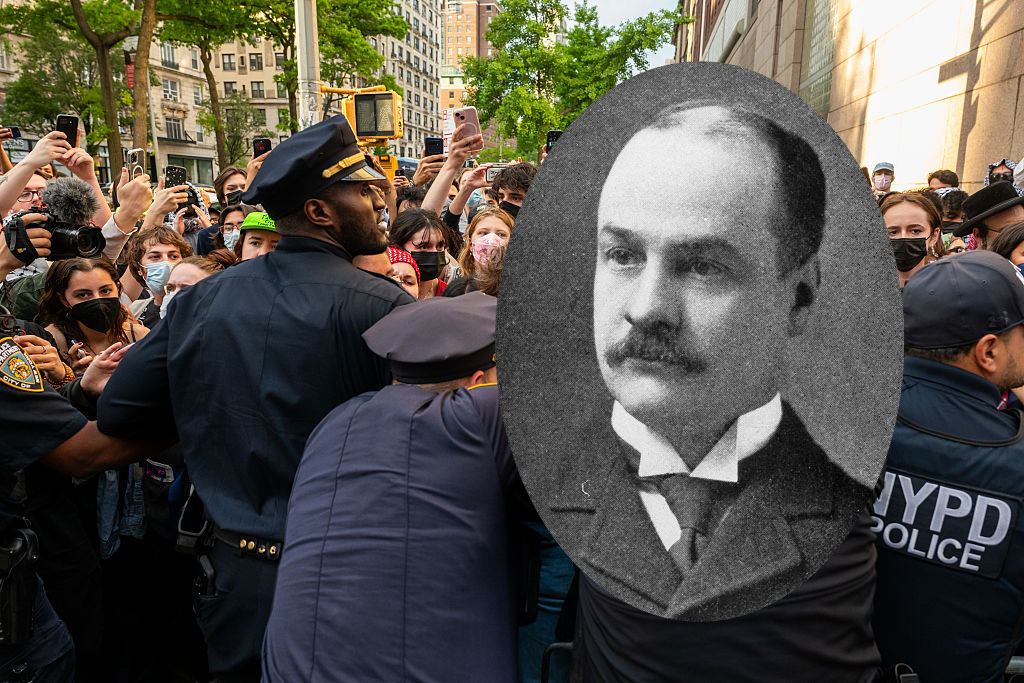
Last week, keffiyeh-clad “pro-Palestine” protesters at Columbia University stormed the university’s Butler Library — occupying it, defacing it, vandalizing the walls, and refusing to leave until police dragged them out in handcuffs.

By now, stories like this are familiar enough to be unremarkable, but one detail stands out. The students who “occupied” the Butler Library demanded that the name “Butler” be removed from the building, calling him a fascist who “dined with Nazis.”

I was skeptical when I heard this claim. After all, it doesn’t take much to get a dead white guy canceled in such circles. But after some cursory Googling, I discovered to my surprise that the claim is at least partially true. 

According to historian Stephen H. Norwood, the late Columbia University President Nicholas Murray Butler (1862–1947) failed to “grasp the nature and implications of Nazism,” a fact attributed by some to his privately expressed antipathy towards Jews. 

The irony is hard to miss. Here is a protest movement that clutches its pearls over the fact that Columbia’s library is named after a Jew-hater and Nazi sympathizer from the early 20th century while actively celebrating those who kill Jews today.

I’m not exaggerating. After the death of Yahya Sinwar, the mastermind of the Oct. 7 massacres, anti-Israel Columbia student groups praised him, calling him a martyr and sharing digital copies of his book online and posting pictures of him alongside “inspiring” quotes attributed to the terrorist. 

So, again, to be clear, naming a library after a largely forgotten college president who privately sneered at Jews is an unforgivable breach, while celebrating the man who ordered the largest mass murder of Jews since the Holocaust is kosher. Got it. 

Naming a library after a largely forgotten college president who privately sneered at Jews is an unforgivable breach, while celebrating the man who ordered the largest mass murder of Jews since the Holocaust is kosher. Got it. 

Columbia activists have also embraced the red triangle symbol, used by Hamas to mark Jewish targets. Though people claim this is merely a “pro-Palestinian symbol,” it was only popularized when Hamas began using it to mark military targets in November of 2023, making the association with the terror group hard to dismiss. 

The symbol not only visually recalls the Nazis’ use of inverted triangles, but is used for similar ends — humiliation and intimidation. In the past year-and-a-half, it has been painted on Jewish homes and on the front doors of university administrators.

To his credit, Nicholas Murray Butler did eventually condemn Nazism, even if it took him a while to do so. The event which prompted this condemnation was Kristallnacht, when the violent implications of the Nazi movement could no longer be denied or covered over.

Oct. 7 — when Hamas raided Israel to slaughter young people dancing at a party, rape women as they murdered them, and kidnap hundreds of innocent people — should have been a similar wake-up call to all those who thought that Hamas’ movement was some sort of plucky anticolonial freedom fight instead of a bloody, bigoted war on Jewish existence.

But it wasn’t. In fact, for these protesters, Oct. 7 only fueled their enthusiasm for Hamas’ cause.

All of this calls to mind Dara Horn’s important book, “People Love Dead Jews,” about the tendency to afford sympathy to dead Jews like Anne Frank while withholding it from living Jews.

As Horn writes, “the entire appeal of Anne Frank to the wider world — as opposed to those who knew and loved her — lay in her lack of a future.”

A follow-up to this book might be called “People Hate Dead Nazis.”

For whatever reason, these activists love to condemn the Jew-killers of the past while cheerleading and making excuses for the Jew-killers of today.

I’d point out to them that it’s possible to support the Palestinian people without championing Hamas, but I doubt they would listen. What’s more, I suspect that for many of these protesters, supporting Hamas is the whole point.

Which means that their claims about caring about human life, similar to their claims about opposing Nazis like Butler, should be dismissed as hypocritical posturing.


Matthew Schultz is a Jewish Journal columnist and rabbinical student at Hebrew College. He is the author of the essay collection “What Came Before” (Tupelo, 2020) and lives in Boston and Jerusalem.  

People Hate Dead Nazis Read More »

Has Our Swearing Habit Gone Overboard?

The email from Amazon Prime Video beckoned, “Based on the shows you watch, we think you might enjoy watching ‘Wear Whatever the F You Want,’ now available.” Their algorithms must be off. Despite the fascinating costumes in “Wolf Hall” — my most recent entertainment binge — nothing I’ve streamed suggests I’d enjoy a show about the fashion industry, let alone one that has the “F” word in its title. 

Profanities have been gaining in currency and losing shock value for years, but lately we’re seeing an explosion in expletives. A rising tide of literature, movies, articles, podcasts, and even some business names and consumer products are laced with four-letter words. Casual conversation is full of it, so to speak. Respectable media outlets used to publish only the first letter of a swear word followed by asterisks or dash lines. Now many are dropping the asterisks and dash lines. I’ll miss them. 

I understand that language evolves over time, reflecting changing societal mores. In some ways we’ve grown more sensitive about language usage in a good way, such as using gentler terms to describe people with disabilities. In other ways we’ve become draconian: A few college professors have actually been suspended because “the N-word” was part of a class reading from “The Adventures of Huckleberry Finn.”    

Sometimes, profanity expresses rebellion, a mutiny against society’s rules. Often, it’s the language of anger and hostility: rude, crude, and lewd. Being exposed to it so often desensitizes us to it, but who benefits from being desensitized to hostile, angry language? I see only a race to the bottom in civility and culture from our promiscuous use of swearing.

I’m especially turned off by pockets of the literary world where writers are fast and free with four-letter words in their works. They may enjoy the feeling of being bold truth-tellers, but when your artistry relies on mining our rich language to express an emotion or paint a picture, persistent use of crude obscenities feels lazy, unoriginal, and alienating. 

Nearly 20 years ago I first wrote about the dangers of our increasingly profane society. Then, virtually every study on the topic concluded that people who swore frequently rated higher on levels of anger and unhappiness, and were also considered less intelligent and less disciplined than more disciplined communicators. Now? Do a search about the impact of swearing and most recent studies endorse swearing as cathartic, a healthy way to get all that upset out of your system. Could these researchers have begun with their conclusion first and artfully crafted their questions later? 

I’m no purist about language. I accept occasional profanities in movies, music, literature, and conversation when they’re measured and not egregious. I’ve lobbed a few myself in heated moments of frustration or anger, never judging others who do the same. But words matter, full stop. This avalanche of casual swearing moves us in the wrong direction of building a better, more dignified, kinder society. 

I don’t buy from stores featuring merchandise with swear words, unsubscribe to publications that include them too often, and stop watching shows that are otherwise enjoyable for the same reason. Obscenities may now be ubiquitous, but each exposure feels like a little hammer blow against my soul. Even friends who swear regularly admit to feeling like this thing is a bit out of control.  

God created the world with words. And God gave language to us as a distinctly human gift, a gift of creativity and building to be used with thoughtfulness and self-restraint. Because we have so much power through speech, our laws of lashon hara (literally, “bad speech”) teach us how to carefully wield this power. If we curse others, we risk having those curses ricochet back to us. How often are we cursing the people we disagree with? Or who annoy us? Maybe there’s a better way to deal with these frustrations. We can use words to build, encourage, nurture, and inspire. Or we can demean, slander, cause pain, or cause other damage with our words. The impact of our words can be life-changing on ourselves and on others. The choice is ours.


Judy Gruen is the author of “Bylines and Blessings,” “The Skeptic and the Rabbi,” and other books. She is also a book editor and writing coach.  

Has Our Swearing Habit Gone Overboard? Read More »

Is Trump Getting Bored with Israel?

Eight years ago, after taking the initial overseas trip of his first term to Saudi Arabia, Trump made a point of spending time in Israel before returning to the U.S. But this week, the American president’s visit to the Middle East will include a return to Saudi Arabia, followed instead by stops in Qatar and the United Arab Emirates with no time at all in the Jewish state. Trump’s travels are designed to focus on economic matters rather than the security-related issues that normally dominate conversations in the region. But coupled with several recent Trump administration announcements that indicate a divergence of interests between the United States and its longtime ally, such a snub may indicate a greater challenge than simply logistics and travel time. 

The most notable disagreement has been over Trump’s outreach to Iran. When Israeli Prime Minister Benjamin Netanyahu came to the White House last month attempting to negotiate relief for Israel from Trump’s proposed tariffs, he was not only rebuffed on the trade barriers but was completely blindsided by Trump’s announcement that he would restart direct negotiations with Iran over that country’s nuclear capacity. Several administration officials, including Vice President JD Vance and Secretary of State Marco Rubio, have since indicated that Iran might be able to maintain civilian nuclear capability, closely mirroring the controversial JCPA treaty that Barack Obama signed in 2015 and reflecting a concession to which Israel has been strenuously opposed for many years. Despite bipartisan opposition to such a gift for the mullahs, Trump indicated last week that no decision had yet been made on this issue, leaving open the possibility that Iran might gain relief from international economic sanctions while still progressing toward full nuclear capability.

Also of great concern to Israel and its supporters were reports last week that Trump was no longer demanding that Saudi Arabia recognize Israel as part of a broader pact with the United States. For years, an expansion of the Abraham Accords has been a top priority for both the U.S. and Israel. The primary incentive for Saudi Arabia has been enhanced access to American weaponry and a closer security and defense relationship between the two countries. But it now appears that Trump is willing to forego a normalization of Saudi-Israeli relations in order to accomplish his economic goals.

At the same time, Trump’s representatives were finalizing a ceasefire with the Houthi terrorists who have been using Yemen as a staging ground for attacks throughout the Gaza War. But this agreement noticeably did not include Israel, a critical oversight that appeared to greatly surprise Netanyahu. Trump has also reportedly pressured Israel to let aid into Gaza, following a two-month stoppage. (These two steps seem to have sufficiently encouraged Hamas to attempt to drive even a deeper wedge between the U.S. and Israel by releasing Edan Alexander, the only remaining American hostage, just before Trump’s departure for the Middle East.)

Trump has always asserted a steadfast support for Israel, through his first term in office and all three of his campaigns, to a point where many American Jews would have preferred that he deal with Netanyahu more forcefully. What has changed?

In a word, Gaza. Throughout last year’s campaign, Trump promised to bring an immediate end to the Hamas-Israel war, threatening the terrorists with dire consequences if they did not cooperate. But just as Trump has discovered in Ukraine, ending a war can be more complicated than it appears. As the fighting in Gaza continues to escalate, and Netanyahu moves forward with his more aggressive plans for the region, Trump seems less willing to publicly associate himself with the Jewish state.

Despite Trump’s frustrations with both wars, the Gaza challenge is still much different from that in Ukraine. Trump obviously does not maintain the type of affection or admiration for Hamas’ leaders as he does for Vladimir Putin, so he will never criticize Netanyahu the way he has often scorned Volodymyr Zelensky. But his enthusiasm for Israel has clearly diminished. The question now is what will bring it back.


Dan Schnur is the U.S. Politics Editor for the Jewish Journal. He teaches courses in politics, communications, and leadership at UC Berkeley, USC and Pepperdine. He hosts the monthly webinar “The Dan Schnur Political Report” for the Los Angeles World Affairs Council & Town Hall. Follow Dan’s work at www.danschnurpolitics.com.

Is Trump Getting Bored with Israel? Read More »