fbpx

May 14, 2025

Let’s Start a Revolution: the Case for True Tikkun Olam

Tikkun Olam: Repairing the world. The Jewish world has largely defined this concept as social justice. Righting the wrongs of society: poverty, sickness, crime and more. It has become one of the defining characteristics of what it means to be an authentic Jew in the 21st century. However, the roots of Tikkun Olam go deeper; infinitely deeper. To connect to these roots is nothing short of lighting the spark for a world revolution. Allow me to explain … 

There are two spiritual paradigms that guide much of our behavior. One is referred in Hebrew as “bein adam l’chavero.” This is the notion of being a ‘good neighbor,’ which ties into the concept of Tikkun Olam relayed earlier. The other is “bein adam l’Makom.” This has to do with our personal relationship with Hashem/G-d/Existence. Some of us feel more comfortable with one paradigm and less with the other. And some of us recognize the beauty in harmonizing them with traditions like Shabbat, which for many involve both community and prayer. However, the truth is that they are fundamentally intertwined and cannot be separated. 

The Jewish people’s ultimate belief is, “Shema Yisrael Hashem Elokeinu Hashem Echad.” Oneness and the underlying unity of all of Existence resides in the soul of every Jew. But in this TikTok world, we have lost the ability to tap into this reality of Oneness on demand. Yes, that’s right. On demand. It’s our spiritual inheritance to be able to incorporate this transcendent belief into the operations and details of daily living. As Rabbi Aryeh Kaplan z’l taught, “the spiritual blueprint of the universe is hardwired into the human mind.” 

Many of us beam with pride when reflecting on the disproportionate number of Nobel prize laureates, heads of history-making social movements and organizations and other world-changing leaders who are Jewish. If we are honest, we know that this is absolutely not normal. It is not normal for such a small, vulnerable, at-risk people to survive centuries of genocides, inquisitions, expulsions and pograms, return to our ancestral homeland after 2,000 years and to top it all off be responsible for so much human progress. It doesn’t make any sense. And yet it does …

Our people have a grand destiny. Each and every one of us has a destiny. The great challenge today is quieting our minds, opening our hearts, and allowing ourselves to hear the Divine voice within. It’s there. It’s always there with so many answers and so much wisdom. Wisdom that will not only change your life, but serve as a blessing for those who you are connected to. And in this digital day and age, that could literally be millions of people across the world. 

But we have allowed layer after layer of spiritual toxicity to drown out the Voice. To bury that which are the keys to personal, and ultimately, global redemption. Like going to a Korean spa and getting a scrub treatment to remove the dead skin and dirt, we have a spiritual equivalent called “Sefirat Ha’Omer,” the “counting of the Omer.” This ‘spiritual wellness treatment’ can sensitize us to the Oneness of creation and might be one of the most powerful hidden secrets of our ancient and beautiful civilization. And today, it is accessible to us all. 

For many of us, Passover is a standalone holiday. But in truth, it’s the launching point to an epic seven-week journey of spiritual refinement. This stems all the way back to the original Exodus. When we left Egypt, we were free; but it was only a partial freedom. As Rabbi Shlomo Carlebach z’l explained, “freedom without direction is just another form of slavery.” In Hashem’s loving mercy, we were gifted seven weeks to refine ourselves in preparation for the receiving of the Light of Torah on the holiday of Shavuot. The receiving of our grand mission and destiny as a people. Not six weeks. Not eight weeks. Seven weeks. Why seven? This is where it gets interesting.

Many of us have heard the expression that humanity was created in the image of G-d. What exactly does this mean? We can never truly know G-d. But we can know the attributes in which S/He created existence like the way we can know music. From understanding the mechanics of music theory and symphony composition, to babies bobbing their heads to the rhythm of a song, we all can connect to music on some level. Sometimes, the simplest connection can even be the most powerful because it’s the most pure. The greatest pleasure is when you can lose yourself in the music and become one with it. 

So it is with seven Divine attributes: Chesed (loving-kindness), Gevurah (strength through restraint), Tiferet (harmony, balance, beauty), Netzach (eternity, endurance), Hod (humility, splendor), Yesod (foundation), and Malchut (Kingship/Queenship). Like a seven-tone, spiritual musical scale, when we connect to the frequencies of these seven Sefirot or attributes, we engage in Tikkun HaMiddot, the repairing of our personal character attributes. This individual repair then calibrates to and results in the repair of all of creation. And like an antenna that picks up a radio signal, when the connection is made, the most beautiful music starts to play. One act of goodness could have monumental, cosmic impact and literally be the tipping point towards global redemption. A true redemption song. The journey of Sefirat Ha’Omer is a journey of Tikkun HaMiddot, which directly contributes to Tikkun Olam, the ultimate repairing of our world. Not the symptoms of our society’s ails, but the actual source.

The blessing of the age in which we live is that never has esoteric, abstract, deeply spiritual concepts been so accessible to the Jewish masses irrespective of religious background as it is today. I only personally discovered the transformative power of Sefirat Ha’Omer in 2021, during the isolation of COVID. My journey was so life-changing that I knew I had to share it with others. The seed that was planted then is now blossoming into a global, spiritual movement with participants from the USA, Israel, Canada, England, Australia, Uganda, Spain … and the more recent country: Indonesia. I call the movement, “The Omer Aliyah: A 7-Week Spiritual Bootcamp of Personal Elevation” and every Jew on planet Earth is welcome to be a part of it. 

Together, let’s build a global consciousness of “K’ish Echad b’Lev Echad” (as One Person with One Heart) just like our people experienced over 3,300 years ago at the base of Mount Sinai. When we join together in a spirit of unity and unconditional love, we sanctify Hashem’s name, and blessing flows through us to the entire world. May our individual and national Sefirat Ha’Omer journeys be blessed, resulting in true and everlasting Tikkun Olam.


Neuriel Shore is the Founder of The Omer Aliyah (TOA): A 7-Week Spiritual Bootcamp of Personal Elevation. You can learn more and join the revolution at www.OmerAliyah.com.  

Let’s Start a Revolution: the Case for True Tikkun Olam Read More »

We Are Am Yisrael—So Why Don’t We Know Each Other’s Stories?

When I was growing up in London, I attended Orthodox Jewish day school where Ashkenazi culture shaped nearly every aspect of Jewish life. I was one of just a few Mizrahi kids, and I have distinct memories of being looked at as an “other.” My food was different. The way my family celebrated holidays was different. Even the Jewish studies curriculum — whether it was history or Torah — reflected a tradition that felt unfamiliar. The way we prayed in school—the melodies and pronunciations — felt foreign, though I didn’t fully understand why until much later.

I never truly felt like I belonged.

There were many reasons for that feeling — being Iranian in that environment was one of them. The fact that I was also clearly gay was another, though that’s a story for another article. But the result was the same: I was made to feel that my identity was somehow outside the boundaries of what it meant to be a “normal” Jew.

Recently, I participated in the Jewish Federations of North America and Leading Edge’s JPro Conference, representing JIMENA—Jews Indigenous to the Middle East & North Africa—where I serve as Director of Community Outreach. We presented a session and were asked to lead a trivia game to engage participants and introduce them to Sephardi and Mizrahi Jewish heritage. I reimagined the game — previously used in Hillel Houses nationwide for over a decade — and titled it “How Well Do You Know Your Jewish History?” Because this isn’t just my history, or JIMENA’s history — it’s our shared Jewish history.

And while the game was lively and the energy was positive, it quickly became clear that most attendees didn’t know the answers to even some of the most basic questions about Mizrahi and Sephardi Jews. That’s not a critique of those individuals; it’s a reflection of a much larger gap in Jewish education.

Shortly after, I spoke at the closing plenary of the SRE Belonging Summit in Baltimore. I shared my story and spoke about the need to expand our understanding of what it means to be Jewish. I urged us to stop seeing the histories of Jews whose Diaspora experiences were in places where our own ancestors did not live as separate or peripheral. I spoke about Am Yisrael — our identity as one people — and how we cannot be truly unified unless we recognize one another’s stories as part of our own.

After my talk, quite a few attendees came up to thank me — not just for what I said about Mizrahi history, but for speaking about Am Yisrael, and about how we can better be unified as one people. There was a shared recognition in that room that while the need to name and explore our differences is vital, we must never forget that what divides us should never be greater than what binds us.

Being Am Yisrael, one people, one nation, doesn’t mean flattening out our diverse histories and subcultures — it means incorporating them, honoring them. True unity comes not from sameness, but from shared recognition.

It might feel good to say it, but saying it is not enough. It must be put into action.

In school, I learned about the Holocaust, the pogroms of Eastern Europe, and, to a lesser extent, the Inquisition. These were powerful, formative stories — deeply important, and ones I understood to be part of our collective Jewish memory.

But I never saw the stories of Jews like my ancestors — of Iranian Jews, Yemenite Jews, even Babylonian Jews — reflected in the curriculum. I never questioned whether the European Jewish stories belonged to me; I accepted them as part of my history. But the absence of my family’s experiences from the Middle East made it feel like our story didn’t count. As though it existed outside the boundaries of “real” Jewish history.

I was never taught about the Allahdad in Mashhad, Iran, where Jews were forced to convert. I didn’t learn about the Farhud, the violent 1941 pogrom in Baghdad, driven by Nazi ideology and traditional religious and Islamic antisemitism. No one told me about the Orphan Decree in Yemen, a law rooted in Islamic supremacy that enabled authorities to abduct Jewish orphans and raise them as Muslims, or the mass expulsions of Jews across North Africa and the Middle East in the 20th century.

I wasn’t taught about Ethiopian Jews either — except for a single line, that they were a “lost tribe” who had “returned to Israel.” That was the entire story. No mention of their culture, their unique traditions, or the extraordinary journeys they endured.

And I had no idea there were Jewish communities in places like China, India, Greece or Afghanistan. No one ever explained how they got there or how they sustained Jewish life across centuries. Why wasn’t this ever part of the curriculum? These aren’t fringe stories. These are essential chapters in the Jewish story.

To understand the Jewish people — to understand Israel — we must understand these histories. Jewish identity is vast. It spans geography, culture, language, and experience. And yet, we are still so often taught only a narrow slice of it.

These stories aren’t just Mizrahi or Sephardi or Ethiopian stories. They are Jewish stories. They are your stories. Just as the stories of Auschwitz and Babi Yar are mine. We are one people — and our histories belong to all of us.

That’s the message we need to embrace: My family’s history is yours. Your heritage is mine. We are each other’s story.

Too often, Jewish history is presented in fragments. But Judaism is not just a set of beliefs — it is a shared identity, memory, and future. Jewish history does not begin and end in Europe. It stretches from Baghdad to Berlin, from Tehran to Warsaw, from Addis Ababa to Kyiv, to Kochi, Kaifeng and Thessaloniki.

This is the work I do at JIMENA. We’re committed to preserving and achieving recognition for the history, heritage, and rights of Jews from the MENA region. Our Sephardi Toolkit — available free at sepharditoolkit.org—has already been adopted by schools, and even some university and college professors have used it in their classrooms. Through our Speakers Bureau, survivors of the Farhud and other anti-Jewish riots share their firsthand stories. Our Sephardi Leaders Fellowship welcomes all Jews, including Ashkenazi Jews, because this work is not just for Mizrahim — it’s for all of us.

These are real successes. But they are just the beginning. Building an inclusive Jewish communal ecosystem — where every Jew sees their history reflected and taught — is the goal. And we still have a long way to go.

Mizrahi and Sephardi history must not be relegated to the margins. They must be embedded into the center. Because until we see each other’s stories as our stories, we will remain fragmented. And that fragmentation weakens us.

It also blinds us.

Perhaps if these histories were widely taught, our students would be better equipped to push back against the erasure and disinformation that plagues not only Middle Eastern studies departments, but social studies, religious studies and just about every other academic field. And not just at some universities — at most.

Perhaps if we embraced the full range of Jewish experience, we would have been better prepared to understand what happened on Oct. 7. That day was horrifying for all of us. But for many Mizrahi Jews — those whose families lived in Muslim-majority countries — it felt tragically familiar. We recognized the ideology. We understood the language — the same chants screamed during countless Islamic attacks on Jews across centuries. The sexual violence. The mutilation. The participation of civilian mobs. Our parents and grandparents had seen it before.

This intergenerational memory is part of Jewish resilience. And it should have been part of our communal story all along.

I always say: telling the Jewish story without including Mizrahi, Sephardi, and other global Jewish histories is like reading a book with half of its chapters missing.

Being Am Yisrael, one people, doesn’t mean flattening out our diverse histories and subcultures — it means incorporating them, honoring them. True unity comes not from sameness, but from shared recognition.

Jewish unity begins with shared memory. And shared memory means recognizing that there is no “them” and “us” among Jews. There is only us. My family’s story is part of your identity. Your heritage is part of mine.

You don’t need to wait for permission to engage with Mizrahi, Sephardi, or other underrepresented Jewish histories—they are part of your story, too. Honoring that history means making space for the people who carry it. Share it. Teach it. Amplify it. Highlight the voices who live it. This isn’t someone else’s story. It’s yours, and it’s ours.

Let’s stop reading just half the book. Let’s start reading our book — together.


Matthew Nouriel is an Iranian Jewish activist, content creator, and Director of Community Outreach at JIMENA—Jews Indigenous to the Middle East and North Africa.

We Are Am Yisrael—So Why Don’t We Know Each Other’s Stories? Read More »

Rosner’s Domain | Two Things Israelis Had to Relearn this Week

Countries are not friends: Israel developed an excessive emotional and political dependence on the United States. It was a long, multistage process, in which both facts and fiction played a role. It was a process that made Israelis forget basic truisms about relations between countries. It was a process that made Israelis assume that the foundations of the relationship with the U.S. are stable and unchangeable. As if – since ever and forever, no change should be expected in the strong ties between the two countries. 

A brief historical examination shows that this is an unfounded assumption. Israeli-U.S. relations began with important support for the establishment of the state, followed by an immediate cooling of relations, a cautious warming in the 1960s, crises and achievements in the 1970s, the beginning of a romance in the 1980s, a dramatic takeoff in the 1990s and 2000s, and then the beginning of a descent to normalcy. 

To understand why Israel imagines its relations with the U.S. in such a distorted way, one must go back to two presidents: Bill Clinton and George W. Bush. They provided Israel with 16 consecutive years of unusual friendship. Sixteen years that accustomed an entire generation of Israelis to assuming that the abnormal is the normal. Barack Obama was the president who began the climb down the ladder. He cooled relations with Israel.  

To understand why Israel imagines its relations with the U.S. in such a distorted way, one must go back to two presidents: Bill Clinton and George W. Bush. They provided Israel with 16 consecutive years of unusual friendship. 

Trump’s cozy first term fooled Israelis into thinking that Obama was the outlier. He was not. Trump was convenient for Israel, in part, because there were few things that challenged the relationship in his first term. Now, when there are challenges, Israelis discover that Trump does Trump. He ignored the rest of the world when moved the U.S. embassy to Jerusalem. He now ignores Israel in the same manner when he wants to do other things. Such as having an understanding with the Houthis in Yemen. Such as selling the Saudis the means to have nuclear power plants. 

It’s not because Trump is against Israel – it’s because he is for America. He is a friend, as long as the friendship does not interfere with his plans. He is a friend, but also the leader of another country. He is a friend, but “friend” in geopolitics speak isn’t a “friend” in everyday speak. Confusing these two meanings of “friendship” could be disappointing, and even dangerous. 

American passports are better than Israeli ones: Israelis holding foreign passports have an advantage over Israelis who do not have foreign passports. One can be angry about this situation, one can regret it, one can grumble, but that is the situation. The Israeli passport is a passport that fills the heart with pride, with a sense of belonging, but its value in the passport market is not as high as the value of, say, a Swiss passport. Of course, there are passports that are worse than the Israeli one. But there are many better ones – passports that allow easier and more convenient entry into many more countries, as well as residence in them, and also spare their owners the tense moment when the hotel clerk looks up at the guest, and the guest has to ask himself whether the clerk has a problem with the fact that the person standing before him comes from this place, you know, that has such baggage.

It was difficult to see an American passport holder being released from Hamas captivity while Israeli passport holders stay behind. Difficult – but not new. On the Air France flight that was hijacked to Uganda in the mid-1970s, there were Jews and non-Jews, Israelis and foreigners. The Israelis and Jews remained in captivity – until they were rescued in a heroic operation. The foreigners, and those assumed foreigners thanks to a foreign passport, were released. Ninette Moreno had several passports: Moroccan, Spanish, Belgian, French, Canadian. She was released. Drawings she made of the place where the hostages were being held helped plan the rescue operation.

So one can be frustrated with the fact that an Israeli passport has a value that is not equal to the value of another passport — but frustration will not change this reality. Nothing will change this reality. Not in the short, foreseeable term, not as long as Israel is a country in a conflict with its neighbors, which has an impact on the attitude towards it and its citizens in the rest of the world. Of course, the Israeli passport also has quite a few advantages. Israel is a country that usually excels in caring for citizens who are in distress in remote places. But an Israeli passport doesn’t include the guaranteed backing of the mighty U.S. government.

Something I wrote in Hebrew

When reports on a Trump-Netanyahu rift multiplied, I recommended Israelis do this: The right advice is to grow up. Stop pinning a child’s eyes on the American president in the hope that he will save Israel. Grow up — and remember how relations are conducted between a somewhat narcissistic great power and a country that is, at best, a small regional power. Grow up — and know that when faced with the U.S. in the dilemma between what is good for America and what is good for Israel, it will choose America. Grow up — and shape a realistic security, economic, and political policy, in a world where it is impossible to always rely on America to save us. 

A week’s numbers

International studies often include interesting facts about one own’s country:


A reader’s response

Misha A. writes: “Shmuel, can you explain how Israel intends to eliminate Hamas?” My answer: Sadly, the answer is no. That’s why most Israelis expect the war to continue for more than another year. 


Shmuel Rosner is senior political editor. For more analysis of Israeli and international politics, visit Rosner’s Domain at jewishjournal.com/rosnersdomain.

Rosner’s Domain | Two Things Israelis Had to Relearn this Week Read More »

New Administration Putting Jews in an Old Bind

There is a growing chorus in higher education that says the Trump administration is weaponizing its efforts to combat antisemitism for its own ideological ends.  Whether true or not, the public debate around Jew-hatred, free speech and the rule of law is putting Jews in an age-old bind. 

On the one hand, antisemitism has exploded on college campuses both before and after the Oct. 7, 2023, attacks, and far too many university and college leaders have been reluctant to confront it. That the federal government is holding higher ed leadership accountable is a good thing. 

On the other hand, Jews are now being portrayed as complicit in the administration’s excesses —  or worse — blamed for the draconian measures being taken in the name of antisemitism. 

If you were a Jewish financier of a medieval monarch — a “court Jew” — this would all sound familiar. Usually wealthy and sometimes brilliant, these individuals rose to positions of power within the royal courts of absolutist rulers.  But their power was always precarious, and it often ended badly for them, their Jewish communities, or both.

We might think of Biblical Jewish leaders like Joseph, Mordecai, and Daniel — who gained the favor of Pharaohs and Kings — as prototypes for the court Jews. But it was during the medieval period that the role became established in the modern sense. Unlike provincial nobles, they posed no dynastic threat to rulers, were aloof to Church controversy, and could lend money at interest. 

Men like Aaron of Lincoln in 12th-century England, and Isaac Abarvanel (the Abravanel) in 15th-century Spain, could therefore rise to prominence by providing financial services to monarchs that others couldn’t provide. In the 17th and 18th centuries, the Hofjuden (literally “court Jews” in German) were part of the political establishment in Central Europe, situated between two powerful factions — Church and King. In return for provisioning armies and financing wars, they were given special privileges, enabling them to worship freely and live outside of ghettoes. 

Joseph Süss Oppenheimer (1698-1738) is perhaps the most infamous example. He was employed by the Duke of Württemberg, becoming his most trusted and powerful adviser. However when the Duke died, Süss lost his protection and was promptly hanged by the new administration. 

Süss’ fate was by no means the exception, because the political rights of court Jews were based on the favor of their sponsor rather than the culture or constitutions of their states. For this reason, Isaac Abarvanel was powerless to prevent the Alhambra Decree, which led to the forced conversion or expulsion of Jews from Spain in 1492.  Likewise, Aaron of Lincoln witnessed the massacre of the entire York Jewish community by a noble who owed him money in 1190. When the political winds changed, they ended up like Daniel — in the lion’s den. 

While many court Jews were advocates of Jewish emancipation, others were simply in it for themselves. As such, the term has taken on a derogatory meaning today in Jewish circles. During the first Trump administration, Gary Cohn, Steven Mnuchin and Jared Kushner were often derided as court Jews by their political opponents within the Jewish community. 

The difference today, in Trump’s second term,  is that American Jews en masse are being positioned as court Jews — caught between the whims and weaknesses of a monarchial Trump and a dogmatic academy — within the polarized political landscape of the Israel-Hamas war.

American Jews en masse are being positioned as court Jews — caught between the whims and weaknesses of a monarchial Trump and a dogmatic academy — within the polarized political landscape of the Israel-Hamas war.

The Trump administration’s actions have been a jolt to the system for many universities. We have already seen some positive results, as antisemitism is far less tolerated on college campuses today than it was a year ago. 

However, in my own work supporting university administrators in combating Jew-hatred, I’ve also noticed something else. An “antisemitism fatigue” has set in among administrators less willing to engage with the nuances of the issues. They are instead, happy to tick all the right boxes because the priority is to keep out of the administration’s crosshairs.   

I have even had administrators insinuate that higher ed wouldn’t be facing this crisis, “if it weren’t for those Zionists.”

To be a court Jew is to receive temporary protections and privileges in return for loyalty and usefulness.  We should therefore take pause when the president calls Sen. Charles Schumer (D-N.Y.) a “Palestinian” for disagreeing with him. Or when the Equal Employment Opportunity Commission texts Barnard professors and asks them to self-categorize their Jewishness as part of a federal investigation into antisemitism.  

Our rights as Americans are founded in the Constitution, and any weakening of the rule of law will eventually impact all of us — because the pendulum always swings.

Louis Brandeis — the namesake of the university where I teach — was the first Jew appointed to the Supreme Court. A champion of workers’ rights, privacy, and the rule of law, Brandeis once said, “the greatest dangers to liberty lurk in insidious encroachment by men of zeal.”  In order to keep the fight against antisemitism free from political intrigue and partisan rancor, we should heed these words.


Dr. Rachel Fish serves as special advisor to the Brandeis University President’s Initiative on Antisemitism and is an associate research professor at the Cohen Center for Modern Jewish Studies. She is co-founder and president of Boundless Israel, an independent think-action-tank promoting Israel education and combating Jew-hatred. 

New Administration Putting Jews in an Old Bind Read More »

The Jewish Myth-Making African Adventurer

When Jewish comic book creators Stan Lee and Jack Kirby created the Black Panther character for Marvel, neither probably knew that they owed a debt of gratitude to a long-dead coreligionist. But as a new book shows, a 19th-century Jewish adventurer named Nathaniel Isaacs helped shape the myth from which the fictional African nation of Wakanda and its fearless leader emerged.

Adam Rovner’s “The Jew Who Would be King: A True Story of Shipwreck, Survival and Scandal in Victorian Africa” tells the fascinating tale of Isaacs, a British-born explorer who spent significant time as a young man with the legendary African ruler Shaka Zulu, a military innovator who reigned in southern Africa from 1816-1828. Isaacs wrote about his experiences across the continent, including his time with Zulu, in “Travels and Adventures in Eastern Africa,” published in 1836. As Rovner, associate professor of English and director of the Center for Judaic Studies at the University of Denver, notes, Isaac’s memoir inspired a late 19th-century novel, “King’s Solomon’s Mines,” which has never gone out of print. That book’s author, H. Rider Haggard, considered Zulu a “Napoleon” type who was a “colossal genius and most evil man,” ruthlessly ruling his kingdom with an iron fist.

In “King Solomon’s Mines,” Haggard “depicted the breakaway Zulu kingdom of Kukuanaland, which had once been exploited by the biblical Solomon for its mineral riches,” as Rovner recounts. One of the heroes of the novel, a fearless warrior, “returns to his ancestral home to claim his rightful throne from a cruel tyrant who had instituted a system of militarization even more ruthless than that of ‘Chaka in Zululand.’”

These tales of Shaka, in turn, not only inspired Black Panther (who, Rovner notes, had a father whose name is T’Chaka, an homage to Shaka), but other beloved tales of adventure in Africa as well. Arthur Conan Doyle’s “The Lost World” (1912), Edgar Rice Burroughs’ “The Land that Time Forgot” (1918) and the Indiana Jones movies draw thematically and stylistically from Isaacs’ tales.

Isaacs the man, however, as Rovner details, was no model worthy of imitation. Seeking economic opportunity in the shadow of the Napoleonic Wars, he dealt arms in West Africa, was a mercenary with blood on his hands and a harsh manipulator of men (and exploiter of women, with whom he fathered multiple children and subsequently abandoned). A serial entrepreneur, trader, local warlord, map-maker, explorer and advocate for British colonialism, Isaacs, “hardy and reckless, audacious and greedy, courageous and cruel,” shaped British imperial history for decades. 

Perhaps as surprising as Isaacs’ influence on the creation of a comic book character is how he was used as a footnote in support of the cause of Zionism. Israel Zangwill, the renowned playwright who wrote “The Melting Pot,” was a supporter of Theodor Herzl’s dream of a reborn Jewish state. He learned of Isaacs, possibly through Haggard’s writings, and saw him as a figure who proved the possibility of Jewish territorial self-determination. Zangwill, Rovner writes, referenced “a Jew named Nathaniel Isaacs[ [who], having fought for a Zulu king, was granted a large territory, with the title ‘Chief of Natal.’” To Zangwill, Isaacs demonstrated that the Israelites could “produce men … who can win territories and men who can govern them.”

Zangwill, who opposed dispossession of indigenous people, as Rovner cautions, did not realize the unsavory nature of Isaacs’ character and the exact nature of his actions. To him, Isaacs simply showed that through strength and determination Jews might lay claim to political self-determination. 

Thankfully, Isaacs did not end up serving as a moral model for Zionism in any practical way. None of Israel’s founding thinkers or governmental leaders cite his briefly held political power in Africa as precedent. 

But his story remains one worthy of being read, as masterfully told in Rovner’s account. Though largely forgotten today, Nathaniel Isaacs, the unlikely Jewish British adventurer, continues to shape how we perceive Africa, a land foreign to our own, one that continues to possess the possibilities of exploration, excitement and the lure of the unknown. 


Rabbi Dr. Stuart Halpern is Senior Adviser to the Provost of Yeshiva University and Deputy Director of Y.U.’s Straus Center for Torah and Western Thought. His books include “The Promise of Liberty: A Passover Haggada,” which examines the Exodus story’s impact on the United States, “Esther in America,” “Gleanings: Reflections on Ruth” and “Proclaim Liberty Throughout the Land: The Hebrew Bible in the United States.”

The Jewish Myth-Making African Adventurer Read More »

Campus Watch May 14, 2025

Columbia AAUP Chapter Denounces University’s Actions Against Anti-Israel Protesters Occupying Library

Columbia University’s American Association of University Professors (AAUP) chapter issued a statement on May 8 denouncing the university’s actions against anti-Israel protesters that occupied the main library on campus on the day before.

“Our senior administration, guided by the Board of Trustees, has taken a series of actions which, in an attempt to placate the Trump administration, have weakened academic freedom and shared governance and accelerated an institutional slide toward executive rule, echoing the authoritarian ethos now holding sway in Washington,” the Columbia AAUP statement, which was first reported by Fox News, read. “As the Trump administration has demanded ever more draconian crackdowns on student protest, our administration has responded by granting enhanced powers to public security that can as easily escalate as defuse confrontations with students and that last night did not prevent the administration from again summoning the NYPD to campus.” The AAUP chapter added that “the tragic events of last night illustrate the countervailing and urgent need for developing consultation protocols and mediation strategies that mitigate harm during protests, facilitate informed and balanced reporting, and ensure due process for all parties.”

According to The Washington Free Beacon, anti-Israel protesters in the library “clashed with security officials, injuring two, passed out pamphlets endorsing Hamas’s violence, vandalized and damaged the library.”

Arizona Bans Encampments on State University Campuses

Arizona Gov. Katie Hobbs (D) signed a bill into law on May 7 officially making it a state crime to erect encampments on state university campuses.

The Arizona Daily Sun reported that the bill requires university administrators to clear out any encampments being built on their campuses and arrest and discipline anyone that doesn’t comply for trespassing. The bill received bipartisan support, though the Daily Sun quoted some state legislators who were critical of it. State Rep. Quanta Crews (D-Phoenix), for instance, contended that the law “could be weaponized against different groups that are not intending to harm other students and are just trying to exercise their First Amendment right.” State Rep. Alma Hernandez (D-Tucson), who introduced the measure, pointed out that when Students Against Apartheid established their encampment at the University of Arizona in 2024, they presented the university with a “ridiculous list of demands” that included denouncing “Israel’s genocidal campaign.” “They had no intention of leaving,” Hernandez contended.

Police Clear Out Anti-Israel Encampment at Brooklyn College

The New York Police Department (NYPD) arrested at least 14 individuals on May 8 when it cleared out an anti-Israel encampment at Brooklyn College, which is part of the City University of New York (CUNY) system.

“Video from the wild scene shows an officer using a megaphone to warn the demonstrators to ‘disperse immediately’ or ‘face arrest,’ as defiant protesters bellow, ‘Free Palestine!’” The New York Post reported. “Another clip then shows officers wrestling a man before unleashing a Taser on him.” An officer also yelled at a woman carrying her toddler to “get that baby out of here now!”

A spokesperson for Brooklyn College said in a statement to the Post, “After multiple warnings to take the tents down and disperse, members of CUNY Public Safety and NYPD removed the tents and dispersed the crowd. The safety of our campus community will always be paramount, and Brooklyn College respects the right to protest while also adhering to strict rules meant to ensure the safe operation of our University and prohibit individuals from impeding access to educational facilities. Brooklyn College remains dedicated to fostering a respectful space for all voices to be heard in accordance with CUNY policy.”

Anti-Israel Protesters Launch Hunger Strike at Yale

Six people members of the Yalies4Palestine group began a hunger strike at Yale University on May 10.

The Yale Daily News reported that the six individuals plan to fast indefinitely until the university meets their demands of divesting from companies that enable human rights abuses; additionally, the protesters demanded that the university “end partnerships with Tel Aviv University, the Peace and Dialogue Leadership Initiative and any fellowships that fund student travel to Israel; to rescind its regulations that “limit peaceful protest and student advocacy” and to reduce the number of employees who mediate protests; and to ensure that ‘peaceful’ protesters, including the hunger strikers, would not be punished,” per the Daily News.

The protesters said they are expressing solidarity with the more than 25 students in the California State University system who have been engaging in a hunger strike since May 5. Six students at Sacramento State ended their hunger strike after “some participants [experienced] health issues,” KCRA reported on May 12.

Campus Watch May 14, 2025 Read More »

The Legacy of Free Public Education in California: A Forgotten Era of Opportunity

There was a time when the University of California (UC) system stood as a shining beacon of accessible education. For decades, California residents, including my parents, benefited from free tuition at UC schools, a bold and forward-thinking policy that reflected the state’s commitment to investing in its people in a period of post-war expansion. This era, which spanned much of the 20th century, was a testament to the belief that higher education should be a public good, accessible to all regardless of economic background. It laid the foundation for a generation of Californians to innovate, create, and contribute to the state’s rise as a global economic powerhouse.

However, the collective understanding and commitment to progress through free public higher education began to fade in the early 1970s, as shifting economic priorities and budget constraints led to the introduction of tuition fees. While comparatively more affordable than private universities, the transition to paid tuition marked a significant philosophical shift. Education was no longer seen purely as a collective investment but increasingly as an individual responsibility, leaving many students to bear the financial burden. Specifically, in-state tuition and fees for UCLA for the academic year 2024-2025 are $15,700. This includes UC systemwide tuition and campus fees. In addition, the average total cost for California residents attending UCLA in residence halls is $42,059. Given that the average median income in Los Angeles is $87K, tuition for one year represents approximately half the median household income of Los Angeles residents. This model is unsustainable and is contributing to the brain-drain of talented students and their families who cannot afford the core components of a stable middle class life-namely housing, education and healthcare. 

The concept of tuition-free education isn’t just a relic of the past; it’s a powerful solution to the challenges California faces today. Restoring free tuition at public colleges, including the UC system, could address the mounting student loan debt that burdens millions of Californians.  According to Alan Collinge, president and founder of Student Loan Justice, Californians owe approximately $180 billion in student loan debt. This staggering number far exceeds the annual revenue of all of California’s sports teams including the Los Angeles Dodgers, the Los Angeles Rams and the Los Angeles Lakers combined. In fact, $9.4 billion in interest and fees are being extracted annually from Californians and being sent to the Department of Education. Given the California state budget of 322 billion, student loan debt in California represents 55% of the entire state budget. This statistic should greatly alarm California policymakers when placed in context of the massive housing crisis that continues to drive people out of the state and further the crisis of homelessness that continues to grow annually despite billions in intervention. Moreover, a strong case for a return to a tuition-free model of public higher education would counteract the growing outmigration of young professionals, many of whom leave the state seeking affordable living conditions and relief from financial pressures. 

California’s vision for providing tuition-free higher education reflects its commitment to fostering equal opportunities and strengthening its workforce. Achieving this ambitious goal, however, requires innovative and sustainable funding methods. A wealth tax could serve as a key funding strategy by targeting the wealthiest individuals and corporations in California. The tax would focus on those with substantial assets, ensuring that financial responsibility aligns with the capacity to contribute. Such examples include taxing ultra-high-net-worth individuals with a small percentage of tax applied to assets exceeding thresholds like $50 million or $100 million. In addition, levies on large companies, particularly in profitable sectors such as technology and real estate could add substantial funding towards tuition-free college. A wealth tax ensures fairness by placing the financial burden on those most capable of contributing and revenue from the tax could be exclusively allocated to tuition-free education, increasing public transparency and support. Beyond immediate funding, a wealth tax could have far-reaching impacts, including reducing inequality where redistributing wealth toward public services helps close income and opportunity gaps. Also, expanded access to higher education ensures a more skilled and competitive labor force for California’s economy. Finally, demonstrating responsible use of tax revenue for education strengthens public confidence in government programs — a confidence that has been deeply eroded over decades of financial mismanagement and unfortunate corruption.

Reinstating free tuition would not only honor the legacy of California’s once-bold education policies but also pave the way for a more equitable and prosperous future. By reducing financial barriers, the state could empower a new generation of students to reach their full potential, fostering innovation and growth across industries. Moreover, it would reinforce California’s reputation as a leader in progressive policies, setting an example for the rest of the nation. The history of the UC system reminds us of what is possible when education is treated as a public good. As California grapples with the economic and social challenges of today, the return to a tuition-free model could offer a transformative path forward. It’s time to reignite the promise of opportunity that once defined the Golden State, ensuring that higher education is accessible to all who seek it.


Lisa Ansell is the Associate Director of the USC Casden Institute and Lecturer of Hebrew Language at Hebrew Union College-Jewish Institute of Religion Los Angeles.

The Legacy of Free Public Education in California: A Forgotten Era of Opportunity Read More »

America Is Going Full Jew

A Jew walks into LA City Hall and says to David Ryu, the recently elected first Korean American City Councilmember, did you know that May is not only AAPNHI Month but also Jewish American Heritage Month? He replied, I did not know that, why doesn’t anyone know that? We must change that, and we can start by making a program at City Hall. And just like that, after talking with Councilmember Bob Blumenfield, Los Angeles Jewish American Heritage month was born.

May was first proclaimed Jewish American Heritage Month in 2006 by presidential decree, celebrating more than 350 years of Jewish contributions to the United States and underscoring our nation’s commitment to pluralism. Since that time, with the exception of private congressional breakfasts and exclusive White House gatherings that happened mostly out of public view, celebrating JAHM has not been widespread across the country. When in 2017, 10 years after its creation, the City of LA made plans to hold its first JAHM program at City Hall, it was one of the only municipalities to do so at the scale it does.

2025 will mark the ninth year the City Council will celebrate the contributions of Jewish Angelenos and Jewish Americans.  In the beginning the Jewish Historical Society of Southern CA and the Jewish Federation of Greater Los Angeles became the inaugural community partners before it was funded as an official LA heritage program. I was blessed to be working for former Councilmember Ryu. I became the volunteer director for Los Angeles JAHMLA. Built out of Jewish pride and on the concept that all communities should share in Jewish culture, the program always includes Jewish and non-Jewish elected officials and participants from all the diverse backgrounds of Los Angeles.

The unique way and early adoption of JAHMLA is why the Weitzman National Museum of Jewish American History and the National JAHM program has chosen Los Angeles as the featured city for JAHM 2025. In addition, California State Senator Henry Stern  (D-Calabasas) has led on a special resolution to commemorate JAHM this year at the State Capitol.

In 2017, when first building JAHMLA, there were many members of the Jewish community who looked puzzled and said, Jewish Pride Month … do we do that? To which I said, of course we do! We have only built from there. In Los Angeles and nationwide, the number of JAHM programs being celebrated in 2025 has grown exponentially.  If you look at the number of JAHM Zooms and events currently run by Jewish and non-Jewish organizations nationwide, the increase is staggering and stands as a beacon against the Jew-hatred that seems to be all around these days.

In Beverly Hills, one of the many programs being offered featured a rugelach bake-off and a Gondi-making contest. The ceremony at Los Angeles City Hall, sponsored by Councilmembers Blumenfield, Yaroslavsky and Park, has music, food and an exhibit, sourced by the Academy Museum of Motion Pictures recognizing the Jewish composers who helped write some of the most iconic songs in film. 

As a reflection of the diversity of Jewish LA and in homage to LA’s industry, JAHMLA, in collaboration with Radford Studio Center, JIMENA, Jewtina y Co., Lunar Collective, ICAN, the Jewish Historical Society of Southern CA, the Los Angeles Jewish Federation of Greater LA, the LA Jewish Film Festival and The Weitzman National Museum of Jewish Heritage are hosting an intersectional Jewish film festival. 

The movie selection highlights true but lesser-known stories of Jewish heritage. They include “The Dove Flyer,” the only known movie to have been made in Judeo-Iraqi, and “Persona Non Grata,” that tells the true story of a Japanese diplomat Chiune Sugihara, who during WWII defied his government to issue Japanese visas to save the lives of 6000 Jews fleeing Hitler’s Europe. The film series is rounded out by Jewtina y Co.’s screening of “Adio Kerida,” a documentary that takes us on a journey looking back at the stories of Cuban Jewish exile. Under the vision of the LA Jewish Film Festival, the show goes on with Hershey Felder’s “Great American Song Book,” a sing-along concert, of tunes by great 20th-century Jewish American songwriters.

JAHM programs are occurring nationwide in many libraries through a partnership with national library associations. Philadelphia, Washington, DC and New York are options for both virtual and live concerts from Klezmer to Sephardic music ensembles, with joint Asian and Jewish Heritage month programs, diverse food panels and cooking classes and family festivals running the gamut. Whether at the Kennedy Center, college campuses or the Library of Congress, this May the country is alive with more Jewish joy and pride than possibly any  previous JAHM.

JAHM helps strengthen our communities and promotes a sense of belonging, a shared civic life and deeper understanding that helps breakdown stereotypes and hate. According to the National JAHM program, there are hundreds of organizations participating and activating this year. 

The red carpet is being rolled out for Jewish pride and sharing or, as Jewish actor and influencer Jonah Platt called it, the time to go “full Jew.” I started young going full Jew, being the only kid eating matzah in a lunchroom of hundreds talking about what it means to be a Jew.  I guess I was right where I was meant to be given the opportunity to help activate JAHM in Los Angeles.

Through an energized network of organizations led by the Weitzman National Museum, a surge of Jews wanting to do Jewish and share it widely with each other and others has been unleashed; an energy that perhaps has not been seen since the Jews last stood all together at Mt. Sinai.

Like Miriam with her timbrel and joyous song, who led the ancient Israelites across the turbulent yet parted Red Sea, Jews and allies across America are not being deterred by the tide of hate.

From sea to shining sea, let it be known that Jewish Americans still rejoice and contribute in spite of the rise in Jew hatred.


Adeena Bleich is a Jewish community organizer, bridge builder, Mizrahi Jewish Mom by Marriage, and Co-Founder of JAHMLA, to contact her and for a full listing of LA based JAHM month programs follow @jahmla or visit www.jahmla.org

America Is Going Full Jew Read More »

The Zionist Rabbinic Coalition: A Great Organization Serving a Doleful Need

Several years after the U.S. government moved its embassy to Jerusalem in 2018, the then Israeli ambassador to America, Ron Dermer, contacted his personal friend, Rabbi Stuart Weinblatt of Congregation B’nai Tzedek in Potomac, Maryland. He asked him to organize a mission to Israel comprised primarily of Conservative, Non-denominational, Reconstructionist, Reform and Renewal rabbis.

The ambassador’s concern was that too many non-Orthodox rabbis were expressing unwarranted criticism of Israel both in their sermons and writings. His hope was that a guided trip to Israel might stem, if not soften, their rhetoric.

As an outgrowth of that mission, The Zionist Rabbinic Coalition (ZRC) was formed. Today the coalition is comprised of more than 1,000 rabbis from different denominations, assorted political affiliations and diverse geographic backgrounds.

In the few years of its existence, the ZRC has become an effective rabbinic resource, providing a forum where kindred spirits can gather — aiming to strategize support for Israel and Zionism. The organization’s tag-line declares its purpose: “Rabbis Promoting Unity with Israel.” Under the guidance and inspiration of Rabbi Weinblatt, its founder, the ZRC began in August of 2020 and was incorporated in February of 2022.

Those dates are significant because sandwiched in between came a surprisingly depressing letter issued by nearly 100 rabbinical students, all of whom were future non-Orthodox rabbis. The signed letter, dated May 2021, accused Israel of being an apartheid state where “violent suppression of human rights occurs regularly.”

The newly formed ZRC promptly responded to the rabbinical students with a letter of their own, reproving their actions and challenging their assertions. The ZRC collected more than 600 signatures from rabbis across all denominational boundaries in condemnation of these future rabbis.

As worthwhile and beneficial as the ZRC is, something doleful lurks behind its reason for being. Seventy-seven years after Israel’s miraculous creation, the fact that we need a pretext for rabbis — of all people — to safely express their unapologetically pro-Israel, pro-Zionist convictions is an indictment of our time. Today “Zionism” is a dirty word. The simple ideal of Zionism is arguably more polarizing today than it was when Theodor Herzl proudly stood before his First Zionist Congress in the late 19th century. 

Cause and effect invariably bring about change. Residential building codes are beefed up after a hurricane, a fire, or an earthquake. A stop sign is installed after a car accident. 

So too with the ZRC. It came about as the result of a need — to speak out and defend against the many smears  delegitimizing Zionism, and Israel’s right to self-determination. The ZRC came about to stand up to the relentless pressure placed on Israel’s very existence — not uncommonly expressed by Jews themselves.

The members of the ZRC are a sophisticated bunch. They read The Atlantic. They read The New York Times editorials and columnists. They’re well aware of Peter Beinart’s work. They struggle with various policies Israel’s parliament advocates. They’re grounded in reality; they struggle with political paradox; they adhere to the timeless Biblical principle that all humans are made in God’s image. They eschew utopian idealism.

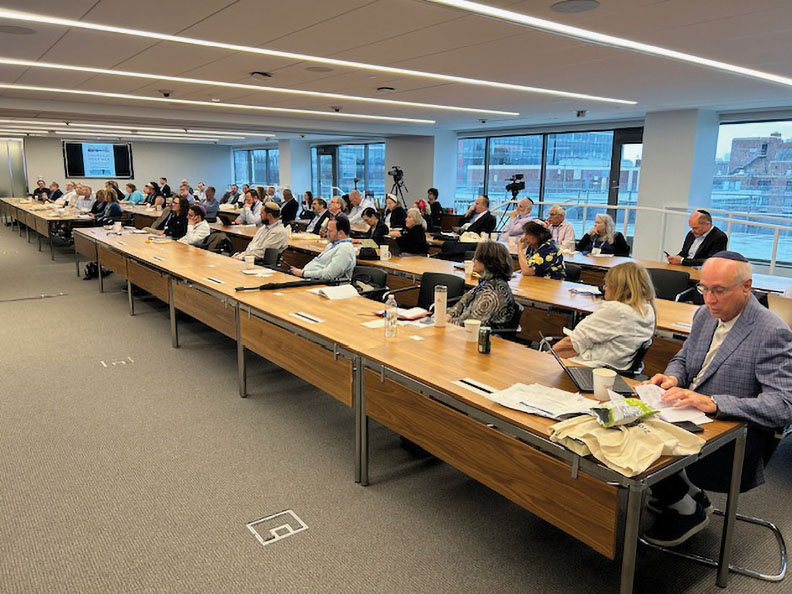
Since its inception, every May, the ZRC offers a three-day conference held in our nation’s capital. Washington, D.C. readily lends itself to political figures and think tanks, making the location ideal for academics, journalists and pundits to interact and present to the rabbis in attendance. This year was the ZRC’s fourth consecutive conference. Like previous years, this year’s conference was balanced and filled with insightful content. Upwards of 75 rabbis including myself participated — a nearly fourfold increase from the organization’s first conference, just four years ago.

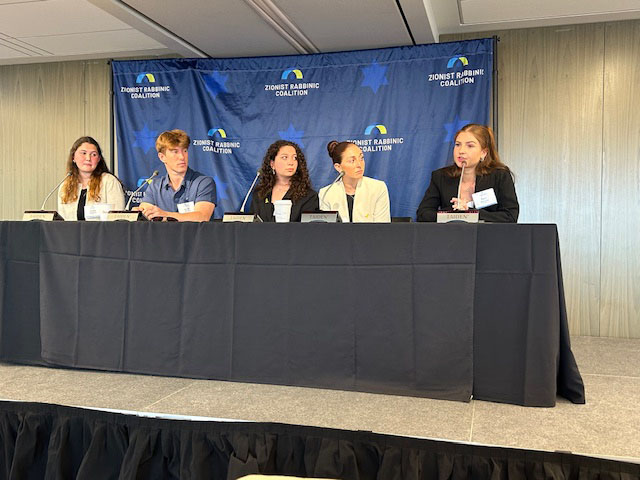
This year’s ZRC conference began with a student panel. Five young Jewish collegians gave a first-hand description of what’s happening on college campuses, and how they are coping. 

After them, Shai Davidai, an assistant professor at Columbia Business School, reflected on his experiences on campus post-Oct. 7 and how they affected his Jewish identity. 

Author Lee Yaron followed, sharing insights into her recent book, “10/7: 100 Human Stories.” As with all the presentations, questions and answers followed.

Later that evening, the rabbis of the ZRC dined with Israel’s deputy ambassador to the U.S., Eliav Benjamin.

The next day began with a lecture given by the president of The Louis D. Brandeis Center for Human Rights Under Law, Alyza Lewin. Her focus was in keeping with her life’s passion: advancing civil and human rights of the Jewish People. The topic she chose: “The Latest Trend in Antisemitism 2.0 — the Denial of Jewish History and Peoplehood.” 

Author Yardena Schwartz followed with a PowerPoint talk on her latest work: “Ghosts of a Holy War: The 1929 Massacre that ignited the Arab-Israeli Conflict.” So insightful was she, it was nearly impossible not to buy her book at the conclusion of her lecture.

Interspersed between the presenters, new for this year, were poems written by Rabbi Hanna Yerushalmi. Read out loud, the poetic selections were descriptive, impassioned and effective in their ability to pinpoint relatable aspects of Oct. 7. Though the poems were anything but analogous to a spoonful of sorbet served between courses at a gourmet restaurant, they helped maintain the atmosphere in the room, linking one speaker to the next. They were a meaningful addition.

Different from years past, a study component was also added to the conference. Led by author David Hazony, his topic for discussion was “You’re Fired! An Unconventional Reading of Elijah and the Kol D’mama Daka (a thin small voice).” For a room filled with rabbis representing the different streams of Judaism not to study together would be a shame, a missed opportunity. The learning session was a welcome add-on to the conference.

The executive director of the American Jewish Medical Association, Michelle Stravitz, followed, informing the group of antisemitism in the health and medical professions. A shocking and disheartening, relatively new development across parts of the U.S. and Canada.

The day concluded with dinner served at the Museum of the Bible where the rabbis were warmly greeted by some 300 pastors representing several pro-Israel, pro-Zionist Christian groups. The evening’s featured presenters were House Speaker Mike Johnson (R-La.) and Senator Cory Booker (D-N.J.).

The last day of the conference began on Capitol Hill with an exceptional address given by David Adesnik of the Foundation for the Defense of Democracy. He spoke on “The Threats, Challenges and Opportunities Facing Israel: Making Sense of the Current Situation and Beyond.”

Broken up into smaller groups, participants of the ZRC then joined a varied group of Christian leaders and organizations. Rabbis and pastors, regardless of their political sensitivities, visited senators and congress members in their offices. A total of 100 appointments were arranged.

Four agenda items were put forward at each meeting: 1) Advocating ongoing support for Israel. 2) The return of the hostages — living or not. 3) Demolishing Iran’s nuclear ambitions. 4) Putting a halt to antisemitism — particularly on college campuses.

Later that day the groups of Jews and Christians came together, one last time, to celebrate Israel Independence Day. Among the other speakers presenting was the Israeli ambassador to the U.S., Yechiel Leiter.

Rabbi Weinblatt shared the hope that next year’s conference will top 100 participants. Given the depth of the conference’s presenters, the sophistication and learnedness on the part of its membership and, most importantly, the increased need to combat anti-Israel, anti-Zionist animus, the likelihood of the ZRC’s continued growth is all but assured. For my part, I cannot wait to attend next year’s conference, along with the many more that inevitably will follow.


Michael Gotlieb is rabbi of Kehillat Ma’arav in Santa Monica.

The Zionist Rabbinic Coalition: A Great Organization Serving a Doleful Need Read More »

‘Don’t Send My Boy to Harvard,’ The Dying Mother Said — Some Meditations on Passover

We Americans once observed the birth of George Washington and Abe Lincoln as individual holidays, celebrating (or created to celebrate) the particular virtues of each man. In 1968 the two holidays were amalgamated into Presidents’ Day.

This celebrates nothing at all. It is enjoyed as the government gift of a day off, suggesting no consideration of courage or struggle. Rather than celebrating human virtue in government, it celebrates government itself, a faceless and powerful entity from which Good Things may flow.

Prior to the amalgamation, at the very least, we Americans received the prompts: Feb 12: Slaves; Feb 22: Cherry Tree. Today, any possible reflection on the holiday by name must incite chagrin or rage in devotees of the party out of office.


The Jewish calendar is full of holidays. Its most numerous, the Sabbath, is considered, rabbinically, the most important. In it, we are Commanded by God to cease the work of the week, and spend the day in rest, enjoyment, and prayer. The rabbis say that, should all Jews observe one Sabbath the Messiah would arrive.

There are three pilgrimage festivals, Sukkot, Shavuot, and Pesach, on which the ancient Israeli Jews were commanded to go to Jerusalem to pray, sacrifice and observe the ceremonies particular to that day.

How odd, to the supposedly rational mind, is the suggestion that a holiday must be celebrated in its particular fashion? But we know that every wedding creates anxiety. The bride and her mother fight about invitations, protocol and dress; they fight with the father about the cost; everyone argues with the clergyman; and the bridegroom and ring bearer obsess about losing the ring. Try as one might, the ceremony’s awesomeness – whether consciously avowed or not – will out.

As it will on Christmas.

A denatured celebration of Jesus’ birth – popularized as St. Nicholas-ism, and indicted as the “mercantilization of Christmas” – is actually a reassertion, in the Rational Mind, of an otherwise unacceptable metaphysical imperative: stand in awe before a miracle. How else to explain the “cultural” Christian anxiety about what to give to whom, the inevitable last-minute recollection that one has forgotten Aunt Martha, the recriminations about who gave what inappropriate or insufficient gift last year; and the ethical debates about regifting?

This anxiety has nothing to do with the cost of toys, or the content of a gift list, it is an unavowable fear of the night and the disappearance of the sun – the acknowledgement of the ultimate Reality of Nature, which is to say God’s World: in this case, the Solstice.

During the shortest days of the year, our primitive ancestors prayed for Grace – not that the sun might return (they knew it would), but that their food and fuel might last til replanting, and that God note their anxiety, accept their sacrifices and prayers, and bring an early and productive Spring.


The Jews, my people, are stricken by an anxiety ratified by thousands of years of persecution. Since the Fall of the Temple in 77 C.E., we enjoyed full citizenship nowhere – condemned to a second-class existence, sometimes through reduced rights, sometimes as outright slavery, and, often, and again today, as permitted victims of savagery.

My baby boom generation of assimilated American Jews bantered about “Jewish Guilt.” But what could this have meant, other than a confession of some nameless complicity in some nameless crime? 

There was, of course, no “Jewish Crime,” let alone heritable “guilt.” (For what?) There, however, was an inevitable anxiety, based upon a legitimate fear of violence; and on the internal conflicts raised by the (finally moot) promises of complicity in hope of exemption (the Stockholm Syndrome).

A year prior to my birth, Germans were heaving Jewish babies into the furnace. The entire Ashkenazi civilization of my grandparents was destroyed, and Jews denied entrance, by the British, to a Palestine which the British had been charged by the League of Nations to preserve as a home for Jews.

Today’s Israelis, living under threat and at war since the State’s inception, are today further traumatized by Islamist barbarity, and, further, by the Western world’s assignment of blame to the bereaved victims.

My grandparents fled the pogroms of Poland. My parents, born right off the boat, wanted nothing other than to assimilate as Americans. They’d been traumatized by poverty, the Depression, the War and the Holocaust. (I grew up in the era of “restriction,” that is, the barring of Jews from various institutions and professions.)

The immigrants’ reaction was to keep the head down, and work harder. Which they did. But the anxiety, though disregarded, was not diminished, and it sought and found acceptable means of expression (see Freud). 

The Christians rationalized – that is, demystified – concern about their faith in Christ as the question of what to buy Uncle William. The Jews, both as an explanation of our mental state, and as a sop to the majoritarian Christian culture, magicked up “Jewish Guilt.”

This helpful accommodation allowed us to take actions reasonably designed for its relief. These came under the rubric of Good Works. Jews supported antisegregation, voting rights, our beloved ACLU, and later, Black Lives Matter, the “Two State” Solution, and so on. Well and good, but good works did nothing to allay Jewish anxiety – and could not, as it was not engendered by an absence of Good Works.

In chasing the chimera of individual peace, generations of Western Jews moved farther and farther to the Left. If Equal Rights for Black Americans was insufficient, we would champion reparations and affirmative action; if Equal Justice for minorities did not free us from “guilt,” we would endorse abolishment of the police and erasure of our borders. If Title Nine, and eradication of the Glass Ceiling did not address our “guilt,” we’d vote for those allowing men to compete in women’s sports. If reparations and acknowledgements, DEI and CRT, didn’t do the trick, we would demand that the State of Israel and its people (our people) cease to exist – ceding the Jewish homeland to savages, our universities to savagery, and, furthermore, sending our children to these dangerous and corrupt institutions with the admonition “Be safe.” 

“Be safe” means “hide, and I hope you aren’t killed.” Thus sending Jewish children to the schools is a performative act of child sacrifice. Why? Why would a rational parent support an institution that allowed (and so, not only endorsed but promoted) antisemitic thuggery?

The most obvious component of “Jewish Guilt” – the desire to assimilate – masks the underlying cause: the abandonment of God. Orthodox Jews greet the notion of inherited guilt with incomprehension.


Jewish holidays each have their particular natures and ramifications. 

Yom Kippur is the Day of Atonement. Depending on his level of observance, the Jew may spend some or all of the day fasting, without water, and standing, with a prayer book. 

The holiday begins at sundown, with the celebration of Kol Nidre. The Jew stands, the cantor and the congregation pray or chant along with the magnificent music, and the Jew is instantly assaulted by weariness; the prayer book weighs 30 pounds, and his neck is bowed with fatigue. He has come to confess his sins before God, and to ask for forgiveness. His mind may dismiss the assertion, but his soul, and its extension, his body, remember.

See Sukkot: the Harvest Festival (adopted here as Thanksgiving). The Jew is commanded to Live in Booths for a Week – makeshift temporary structures, half-thatched, and open to the rain. A Jew who builds and inhabits the sukkah – whether for the entire week, or for one meal – experiences the unbidden thought: You know, this isn’t so bad. I’m here with my family and we have enough to eat. I’m appreciating my house, in a new way.” He’s instructed, while in the sukkah, to look back at his house, and should he do so, reflects, “how lucky am I …?” 

Passover is the Feast of Freedom. It celebrates the Exodus from Egypt. It is widely considered the oldest continuously celebrated holiday in the world.

How is it celebrated?

1) The Jewish household is to be cleansed of chametz, that is, any grain that might ferment. The Jew is instructed to abstain from bread, and any fermentable substance for eight days; he is to gather the family at a ritual meal, called the Seder (the Order), retell the story of the Exodus, explain the meaning of various ritual foods, and drink four ritual cups of wine. That’s it.

Over thousands of years, and through various different cultural traditions, the celebration has accrued various subsidiary observances and quirks, but the three commandments, above, are the only Halachic (religiously binding) requirements.

2) It is celebrated by feuding.

Nonreligious, assimilated, or apostate Jews invest their rationalized Passover with the same anxiety Christians devote to the mercantilization of Christmas. Jewish knowledge and identity has devolved into Liberalism and Good Works, and good works have proved ineffective as a placebo for terror, and the family feuding is an act of communal denial. 

Moses gave the Jewish slaves in Egypt the choice of the horror of slavery and the terror of freedom. Eighty percent chose to stay, rather than face the unknown. Although they saw what God had done to the Egyptians, they preferred not only to stay in slavery, but in subjugation to a ruler who, however badly he had treated them previously, now held them additionally guilty of membership in the Tribe and subjects of the God who’d devastated his country.

The Jews who fled Egypt fought with Moses from the moment of their Exodus, and, even before at the Red Sea, pleaded to be allowed to return. They turned on him, and so on the God who commanded him. Their resistance, apostasy, and treason are the leitmotif of the remainder of the Five Books.

At the Seder the assimilated Jews reenact the cognitive dissonance of those on the eve of the Exodus: they arrive late, argue about the direction of the ceremony, kvetch about the late-appearing food, the length of the Haggadah (the guidebook), and (especially of late) devolve into political rancor, and retire to their cars, to revile the fool swine (their family), who have desecrated everything they touched.

How many Seders were plagued this year by political vitriol? Each opposed member was as sure as that the sun rose, that he was correct, and his opponent, if not actually worthy of death, then of its psychological equivalent of familial excommunication. (Who has not heard, “and I will never speak to you again”?, and the attendant, “and, don’t ask me, Molly, you are a good soul, and I understand that you want peace; but in this instance, you’re wrong; and he/she [my brother, sister, cousin, aunt] is now nothing to me.”)

Jews have always been instructed to consider ourselves, at Passover, as if we were freed in the Exodus. I considered the admonition formal and pat, as I could not actually fantasize myself in sandals, fleeing in the night, with the unbaked bread. I might acknowledge it is a “good idea” (e.g. dismissible), but, beyond that, the suggestion left me flat.

Over the last two years I’ve come to understand this: not that we Jews are commanded to fantasize ourselves in a Sword and Sandals epic, but that, if we are at the Seder, that is, if we have made even the slightest gesture toward participation in a miracle, and whether we understand it as such or not, we will be touched, however lightly, by the Awe of God.

The Stockholm Syndrome is the animal instinct to barter submission for reprieve. Its recognition and rejection by Moses is the motivating factor of the Exodus.

A Jewish slave was being beaten by his taskmaster. Moses killed the taskmaster. The next morning, the deed was known, reported by the slave he saved. The moment Moses recognized it, he remembered that he, too, was a Jew, enjoying the perquisites of the palace, finally, only as its most petted slave.

A note to the Jews consigning their children to the Ivy League.


David Mamet

“DON’T SEND MY BOY TO HARVARD,” THE DYING MOTHER SAID – SOME MEDITATIONS ON PASSOVER

copyright © 2025 by D. Mamet

‘Don’t Send My Boy to Harvard,’ The Dying Mother Said — Some Meditations on Passover Read More »