fbpx

February 19, 2025

Joshua Silverstein: Mad Scientist Cooking, Family Food Cultures and Latkes

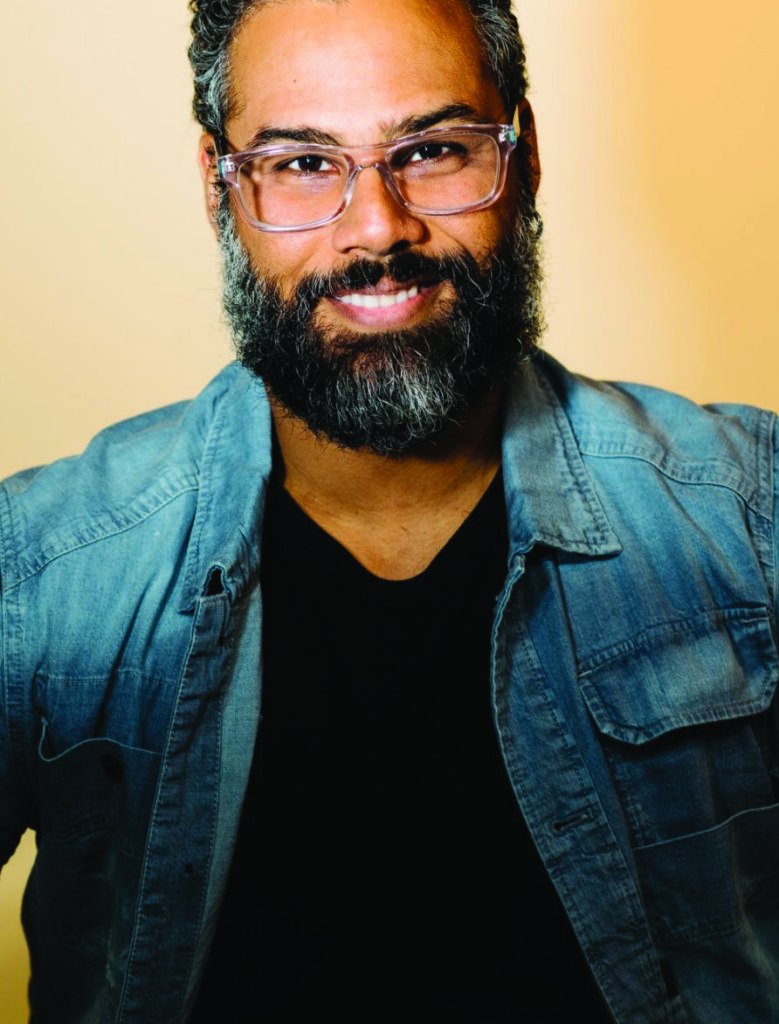
Joshua Silverstein is an award-winning actor, comic, writer, allergy-culture advocate and food lover.

Silverstein’s creativity clearly lends itself well to the kitchen, especially since he needs to work around his many allergies.

“My relationship with food has been challenging, it’s been exciting, it’s led to a lot of interesting stories,” Silverstein told the Journal. The executive director of Cazadero Performing Arts Family Camp, he is also a staple writer-performer at The Braid Jewish Theater Company. Silverstein’s The Braid’s shows include “True Colors,” “What A Surprise” and the upcoming “Hold Me, Heal Me,” as well as a solo show.

“Because I’m a father with a multicultural family that leaves room for a lot of experimentation [especially since] my children also have allergies,” he said.

Silverstein attributes his love of food to his paternal grandmother.

“She would make to this day, unbeatable, the best French toast that I ever had in my life,” he said.

Silverstein said his traditional Ashkenazi Jewish grandparents were very enthusiastic about making sure he understood his Jewish heritage. He did not realize till later that his grandmother altered her Jewish cooking for his benefit.

“She was changing the ingredients of her brisket … her latkes … all these foods that my father and his brothers had grown up eating, so that I could eat,” he said. Silverstein’s grandmother’s latke recipe is below.

“My mother’s family comes from the south, so I was exposed to that and I love that food too,” he said. “But I don’t think that I really took a liking to collard greens and black eyed peas and stuff like that until I got older.”

Today, Silverstein’s allergy-friendly kitchen is also overflowing with culture.

“My wife is from Nayarit – she’s Mexican – and my mother in law will come over and she makes Spanish rice and all kinds of different dishes from her culture,” he said. “So the kids are growing up with being Jewish and latino and having a father who’s African American.”

For instance, he said, their youngest son loves chicken, fried foods, hamantaschen and potatoes, but is still unsure about vegetables.

“Because of this melting pot of various backgrounds and stories, our children are growing up with this wealth of different taste buds,” Silverstein said. “And we try to do – what I feel like my parents and my grandparents did – is try to put as many different options on the table as possible.”

Silverstein said his grandmother’s latkes were his all-time favorite recipe.

“When she passed away, I had been invited to a party where we were supposed to bring a recipe that best represented our culture, so I chose to bring latkes,” he said. “Because I felt that latkes are always best made right there on the spot, I [decided to] make the latkes at the party.”

He showed up with the ingredients – he obtained the list from his father – along with a cast iron skillet and a blender.

Silverstein was told that most Jews don’t use a blender when they make latkes, but his grandmother did.

“Because they’re pancakes, she made them really, really thin,” Silverstein said. His batter was essentially chunky onion soup.

“I poured them in the cast iron skillet with olive oil, and I almost started a fire in the kitchen,” he said. “I almost burned my face off and I did not do a good job.”

They were wet in the middle, but he ate the whole thing.

“I’m not a quitter, so I’ve tried a few times,” he said. “Then Natasha [Feldman, author of “The Dinner Party Project”] came over to our home and perfected my grandmother’s recipe; [she] got them pretty darn close to what they used to taste like; she added a little twist and she didn’t use a blender.”

Silverstein said cooking creatively – especially when dealing with dietary restriction – means you get to be a “mad scientist” in the kitchen.

“The kitchen should be a place of play and fun, and that’s a privilege,” he said. “Not everyone has the luxury of being able to [have] the ingredients to play with.”

Combine the mindset of exploration with being inclusive.

“Food is supposed to be about bringing people together,” Silverstein said. “Whatever your tradition is with food, whatever the recipe is, [consider] how can you include others in that experience, how can that meal be about bringing people together.”

In Silverstein’s home, everything they eat is a community-based project.

“Everyone has an opinion, everyone has an idea,” he said. “We’ve given them too much agency in our kitchen – we messed it up a long time ago – so everyone has a say.”

As the kids have gotten older, they get assignments: Prepare this, chop this, heat the pan, pull this out of the fridge. It’s a family affair!

The kitchen is a great way to take care of one another, to practice showing up for your family, which is great training for showing up for others.

“My hope is that they’re going to carry the tradition into whatever their lives look like outside the house, wanting to feed … and take care of the people in their lives,” Silverstein said.

Learn more at thejoshuasilverstein.com and CazFamilyCamp.org.

For the full conversation, listen to the podcast:

Watch the interview:

Joshua’s Grandmother’s Latkes

makes about 20

LauriPatterson/Getty Images

30 potatoes, chopped in small pieces

1 whole onion, grated

4 large eggs, beaten

2 tsp garlic powder

1 Tbsp sea salt

1 Tbsp pepper

1/2 cup chives, finely chopped

1/4 cup rye flour

4 cups of olive oil

A pinch of rosemary and thyme

Heat a large, cast iron skillet. Add 4 cups of olive oil. Keep at medium heat.

In a blender, mix potatoes, onion, eggs, garlic powder, salt, pepper, chives, rye four, rosemary and thyme. Blend on a low setting. Keep at a chunkier consistency. Note: Blender is optional; you could also mix by hand.

Ladle batter into the skillet. Let fry and flip to achieve golden brown color; about 2 – 5 minutes per side.

Serve with applesauce.


Debra Eckerling is a writer for the Jewish Journal and the host of “Taste Buds with Deb.Subscribe on YouTube or your favorite podcast platform. Email Debra: tastebuds@jewishjournal.com.

Joshua Silverstein: Mad Scientist Cooking, Family Food Cultures and Latkes Read More »

Loay Alshareef Pioneers a New Era of Arab-Jewish Relations


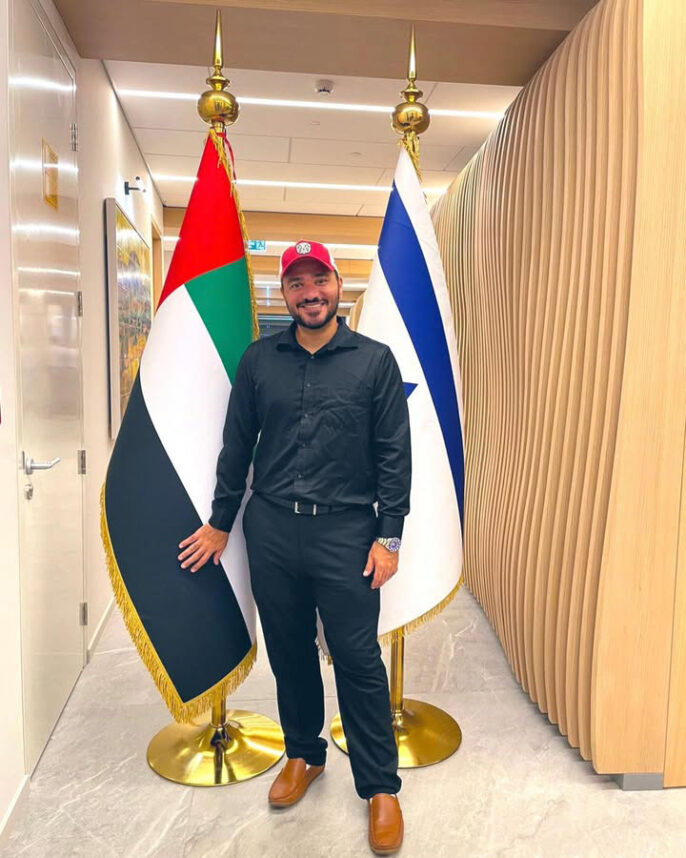
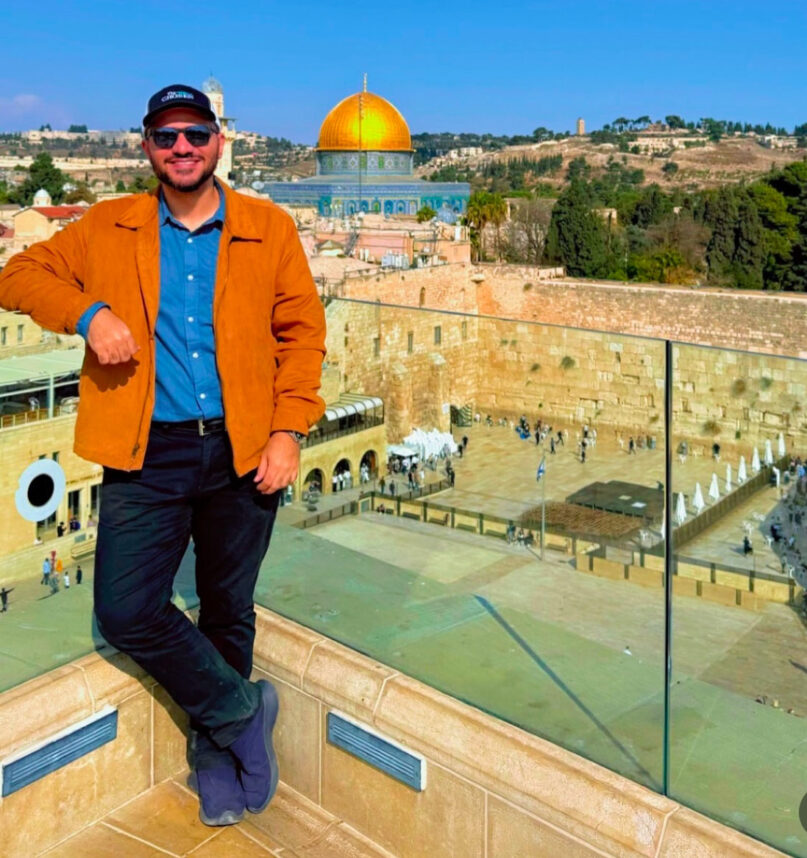
Loay Alshareef is a linguist and educator based in Abu Dhabi, United Arab Emirates, with a profound passion for modern and ancient Semitic languages, particularly Arabic, Hebrew, and Syriac.

Born and raised in Saudi Arabia with a religious Muslim background, Loay was initially exposed to negative views about Jews and Israel, but his perspective began to shift during his studies in France, where he lived with a Jewish host family.

Now, he’s a recovered anti-semite, in his own words. He says, “I went from someone who said that Israel and the Jewish people were cursed to saying, ‘How beautiful are your tents, Jacob, your dwelling places, Israel’.” 

In fact, the world now knows him as “an Arab activist who campaigns for peace in the Middle East”.

Loay Alshareef’s narrative is a testament to the transformative power of openness and education. Originating from a conservative Muslim background in Saudi Arabia where he was indoctrinated with anti-Semitic sentiments, Alshareef’s life took a transformative turn, making him see the incredible similarities between Islam and Judaism.

The Turning Point

The significant turning point for Alshareef came in 2010 when he visited France as an exchange student for a language immersion stay. Unexpectedly placed with a Jewish host family, fate forced him to face his prejudices head-on. 

Yet, what stands out, and what likely made him ‘the chosen one’, is Alshareef’s conspicuous willingness to hear and acknowledge the other side of the story. He started out as a “big fan of the Protocols of the Elders of Zion” who “thought that Jews are bad people”, but he was always open to change. 

And when the mother he lived with in the Jewish family shared first-hand accounts about the religion and culture of Jews, Alshareef found that there were undeniable similarities between the Judaism and Islam that struck the chords in his heart.

“…don’t forget that Muslims name their kids after Jewish prophets, kings and heroes,” he says.

This encounter ignited a personal transformation that redirected his life’s mission to “reconcile the children of Abraham.” 

Embracing a Mission of Tikkun Olam

Alshareef’s commitment to peace and understanding compelled him to go public with his journey in 2017. 

“Breaking my silence was a decision to fight against the hatred I once felt. I am now devoted to healing the world through dialogue,” Alshareef states, adopting the Jewish concept of Tikkun Olam — repairing the world. 

He now ardently believes that the Middle East is a shared homeland for the descendants of Isaac and Ishmael, and tirelessly works to foster a new era of cooperation and peace.

Global Advocacy for Peace Through Education

Beyond his activism, Alshareef invests in education as a crucial tool for sustainable peace.  “Education is the most powerful weapon which you can use to change the world,” he often says, paraphrasing Nelson Mandela.

And with his own technical background and a Master’s degree in Software Engineering from Penn State, he is well-positioned to leverage this weapon.

Alshareef enhances his educational outreach, reaching a wide audience with his message of unity. Towards this end, he has taken his message of reconciliation to global stages, including university campuses across the United States and community events in Canada.

At an event at the University of Southern California, he declared, “Misguided ideologies have perpetuated divisions between Muslims and Jews for too long. We are here to offer hope and to prove that coexistence is not only possible but necessary.” 

His participation in the March for Jerusalem in 2024 further emphasized his dedication to bridging divides. Meanwhile, through his YouTube channel, he delves into Semitic languages, history, and cultural exchanges to enlighten and connect people across historical divides.

The Price for Peace

Despite the purity and conviction that Alshareef has in his mission, is the journey to his vision easy?

On the receiving end of a lot of hate, and even threats on social media, he says, “Some people say, if I see you on the street I will just shoot you, I will do this and I will do that (…) I never rule out the possibility of something that would happen to me because of this message”. 

But do the threats and hatred ever water down his conviction?

He remains unfazed, adding, “I am very convinced down to the bottom of my heart (that) what I’m doing, in Hebrew, Tikkun Olam, I’m fixing the world, healing the world, making it a better place and I have zero regrets.” 

A Vision for a Peaceful Future

Alshareef is driven by a vision where Arabs and Jews share mutual respect and cooperation. His efforts illustrate the profound impact of individual transformation in achieving societal change. 

“Every step towards understanding is a step towards peace. I am committed to this path, regardless of the obstacles,” he asserts. His story remains a beacon of hope, demonstrating that even the most deeply ingrained prejudices can be overcome through understanding and dialogue, paving the way for a future of peace and mutual respect among the children of Abraham.

Loay Alshareef Pioneers a New Era of Arab-Jewish Relations Read More »

Campus Watch February 19, 2025

Georgetown Grad Student Is Daughter of Senior Hamas Adviser

A graduate student at Georgetown University has been revealed as the daughter of a senior Hamas adviser.

The graduate student, Mapheze Saleh, is the daughter of Ahmed Yousef, who served as a senior adviser to Hamas leader Ismail Haniyeh, according to CAMERA. Saleh has worked for the Ministry of Foreign Affairs in the Gaza Strip, the Qatari embassy in New Delhi and has written for Al Jazeera and Middle East Monitor, according to her biography on the Georgetown website. “In social media posts archived by CAMERA and published in the National Review, Saleh reportedly expressed support for the Oct. 7 terror attack, shared video of Israeli hostages being dragged in front of crowds and showed disdain for the United States,” The Daily Mail reported. Saleh is a first-year student in Georgetown’s Master of Arts in Arab Studies program.

Massachusetts Teacher’s Union Head Grilled Over Union’s Antisemitic Materials

Massachusetts Teacher Association (MTA) President Max Page was grilled during a Feb. 11 hearing in front of the state legislature over the union’s antisemitic material.

Democratic State Rep. Simon Cataldo asked Page if an image of a dollar bill folded into a Star of David with text about U.S. aid to Israel was antisemitic. Page demurred, stating, ‘We provide imagery, we provide resources for our members to consider in their own intelligent, professional way.’” The Free Press noted that the dollar bill image “is referenced in materials recently made available to Massachusetts educators for teaching about the Middle East. Entitled ‘Resources on Israel and Occupied Palestine,’ the union’s Training and Professional Learning Division developed the framework ‘for learning about the history and current events in Israel and Occupied Palestine, for MTA members to use with each other and their students.’” The commission also questioned Page about posters featured in MTA materials that included George Habash, who founded the Popular Front for the Liberation of Palestine terror group, and another with the words “Unity in Confronting Zionism” underneath a snake, which The Free Press said evoked Nazi-era tropes.

Additionally, Page was asked about MTA material featuring a children’s book titled “Handala’s Return” that refers to Zionists as “bullies” who stole “our land” and urges readers to raise funds for Palestinian causes and chant slogans at anti-Israel protests. Page said at the hearing that he understands “the historical virulence of antisemitism, I understand the newly resurgent strains of antisemitism, and I’m too old and too confident in my experience and views to be lectured about the dangers of antisemitism,” reported The Free Press.

House Education Committee Chair Accuses Columbia of Failing “to Uphold Its Commitments” to Combat Antisemitism on Campus

Rep. Tim Walberg (R-Mich.), who chairs the House Committee on Education and the Workforce, wrote in a Feb. 13 letter to Columbia University that the university “has failed to uphold its commitments” in combating antisemitism and campus, The Washington Free Beacon reported.

Walberg noted that this academic year, Israel protesters have blocked the entrance to campus, disrupted an Israeli professor’s history class, clogged toilets with cement and smeared red paint on the business school. These incidents are evidence of the university failing “to uphold its commitments, both because the disciplinary process has failed and because the campus administration has refused to enforce its pre-existing rules.” He then demanded that the university provide all documents on the disciplinary processes involved in these incidents in two weeks.

Wake Forest Cancels Former IDF Soldier’s Speaking Event

Wake Forest University canceled a Feb. 11 speaking event featuring a former Israel Defense Forces soldier following criticism from professors and students.

The American former IDF member, Sam Fried, had been invited by the university’s Center for Jewish Life to discuss his experience in the IDF. University Chaplain Chris Donald told The Old Gold & Black student newspaper that event was aimed at facilitating “meaningful dialogue on the complexities of the Israeli-Palestinian conflict. However, after careful consideration of recent discussions and the online interactions, it was determined that this event would not meet those objectives.” In a Jan. 31 op-ed,  three professors objected to Fried’s talk, contending that it was inappropriate to hold the event on the anniversary of Israeli forces striking Rafah. “We are especially concerned about how a Jewish Life-sponsored event will affect our students and colleagues who remain traumatized by the war in Gaza,” they wrote. “We emphatically reject this assumption and stress that support for genocidal violence cannot and must not be conflated with Jewish identity or scholarship.”

Chabad Student President Isabelle Laxer told the Gold & Black  that Fried’s talk was part of an effort to create a space to provide different perspectives for students to reach their own conclusions. She added that “there’s a lot of misinformation and blatant lies being made about [Fried].”

Campus Watch February 19, 2025 Read More »

How Does Qatar Do It?

Qatar is a small country, flanked by two much stronger powers, Iran and Saudi Arabia. It has to be creative to preserve itself in this tricky neighborhood. And indeed, it is creative. Just look at its unique ability to maintains close ties with Iran, with Hamas, with the Muslim Brotherhood and still have important relationships with the U.S. and with Israel. Its geography, social and political stability, and – of course – natural resources makes it punch way above its weight.  

Qatar has to be creative to preserve itself in this tricky neighborhood. Just look at its unique ability to maintains close ties with Iran, Hamas and the Muslim Brotherhood– and still have important relationships with the U.S. and Israel.

Qatar provided billions in aid to Hamas. These were the funds that enabled Hamas to build its infrastructure of terrorism. It also worked with Israel and was a broker of ceasefires and agreements. An honest broker? The fact is Israel came back for more. The fact is Israel needed Qatar’s services and still seems to need them.

Or maybe not? Qatar wields its power and influence in many ways, forging ties with countries and people. Earlier this week, Israel’s internal security service, the Shin Bet, began probing the ties between advisers to PM Netanyahu and Qatar. According to media reports, Eli Feldstein, a Netanyahu aide — already in trouble for leaking secret information — was paid by Doha for PR services. Other close aides were previously employed by Qatar to assist with image building. The U.N.’s office immediately rejected any suggestion of wrongdoing, and yet, this information is disturbing: Netanyahu was the PM when Israel-Qatari relations “underwent a dramatic shift,” as one research paper defined it. 

Qatar and Israel made Gaza a topic of mutual interest after the 2014 clash between Israel and Hamas. The countries’ strange allience endured when Qatar was shunned and boycotted by moderate Arab countries such as Egypt. Israel’s strategy, initiated and implemented by Netanyahu, was to use Qatar and its financial ability to tame Hamas. Qatar would be an important diplomatic player and bolster its Islamist ally, Israel would get security in return. 

This didn’t work as well as Israel hoped. Whether Qatar was blindsided by Hamas’ October 7 attack or not is anyone’s guess. But one thing is clear: it did not have the power or the will to prevent it. A war ensued and a year-and-a-half later we’re back at square one, using Qatar as mediator, talking to Qatar about hostage deals, communicating with Hamas via the same channel. Plus, this nugget of additional information we didn’t previously have: PM advisors were personally paid to improve Qatar’s image. 

It could be nothing. Life is complicated, and people do things that could seem suspicious without them commiting any sin. Relations between Israel and Qatar are frought with contraditions to begin with – is it a friend or a foe, and ally or an enemy? At the beggining of the week some Israeli journalists and activists were having such a debate on X, with no possible conclusion because it is, well, both. This could be confusing for all Israelis, this could be confusing for people who work for the PM. If Israel can talk to Qatar, deal with Qatar, ask for Qatar’s help, have commercial ties, diplomatic channels, hold secret talks – what’s the problem with getting a contract to improve Qatar’s image?

Well, there are two problems and these are the ones that are under investigation. Problem number one – if Qatar paid for PR, maybe it also paid to have influence on the PM’s policies. Of course, such a possibility has many degrees of severity. It could be more like soft power – having an ally in the PM’s circle. It could be more like espionage – having someone to leak information. It could be even worse. Just use your imagination to understand how.

Problem number two – when it comes to Feldstein it is already known that he didn’t have a security clearence you’d expect from someone with access to the PM’s inner circle. That is a problem in and of itself. Now it becomes even more troubling. He did not have a clearance, and was paid by Qatar. Again – there’s no proof of wrongdoing on his part. But it does raise questions about the management of the PM’s office and the PM’s work environment. 

A third problem is perception. Israel is still traumatized by the massacre, it is still sending soldiers to the front, it is still planning to fight in Gaza. The public must not be under the impression that financial interests are mixed into the process of decision making at Israel’s top offices. Israel, wrote a Misgav Institute scholar, must “act more assertively to show the international community that Qatari support for extremist groups is a threat not only to Israel, as the events of Oct. 7 demonstrated, but also to the United States and Europe.” Misgav is a think tank with a right-leaning bent and ties to the PM. 

So it sould be clear that one can’t be employed to “show” one bad side of Qatar – while also being employed to sell the good side of Qatar. Even in a complicated world, one must choose.

Something I wrote in Hebrew

Trump seems less inclined than Biden to tell Israel what it can and can’t do as it considers how to uproot Hamas. So … 

In the coming weeks, we will discover what happens when Israel feels more liberated. We will discover whether it is tempted to make dangerous, hasty moves, because without the American bridle, it loses the ability to think patiently and carefully – or we will discover the opposite: when the responsibility falls on its shoulders, without the ability to use a U.S. made excuse (“we didn’t attack because Washington wouldn’t allow it”), it shrugs off the adolescent attitude, and puts on the mantle of an adult. This does not mean that it will necessarily act more or less firmly, it means that it will act wisely according to the prevailing conditions. If the gates of hell need to be opened – so be it. But if it doesn’t need to – Israel will not open them just because Trump allows it.

A week’s numbers

Lest we forget: as Israel is still busy with issues of war and hostage release, the undercurrent of social tensions is still very much with the present.


A reader’s response

Yael Oren asks: “Are Israelis concerned about the attack on American democracy by the Trump administration?” Answer: Not really, their main interest is Trump’s Middle East policy, and for now they are pleased with it.


Shmuel Rosner is senior political editor. For more analysis of Israeli and international politics, visit Rosner’s Domain at jewishjournal.com/rosnersdomain.

How Does Qatar Do It? Read More »

An Exodus We Never Asked For: Why the California Housing Crisis Matters to the Jewish Community

Jewish history has been defined by migration toward safer havens amidst climates of antisemitism and economic uncertainty and specifically, Jewish migration to California, beginning in the 1850s, should be understood through this lens. California has always been a state where excess flourished, conscious of its trend-setting role as a world-leading innovator in technology, economics and the arts. For much of the past century, it also helped create a new model for middle and working-class upward mobility while addressing racial, gender and environmental issues well in advance of the rest of the country. However, lack of affordable housing for California’s once flourishing middle class has led to extreme constraints on upward mobility and pervasive poverty that is extending to wider swaths of the income distribution. According to a 2020 Chapman University study titled “Beyond Feudalism: A Strategy to Restore California’s Middle Class,” while California has experienced faster income and job growth relative to the rest of the country over the past decade, our concentration of higher earning job growth has fallen drastically behind other states, including Texas, Utah, Washington, Nevada and Arizona. The study further describes how California is “often praised for its elaborate environmental and labor protections, but its record on economic mobility, middle-class disposable income, and even on greenhouse gas reductions, is not encouraging.” 

At the center of the ever-widening divide between the rich and working poor lies the ruins of failed housing policy at both the state and local level and while as Jews we are not obligated to fix the most urgent of problems that confront us, we are obligated to try. In tangible terms, this means supporting the development of policies, including educational and regulatory reforms, that foster greater creation of higher wage jobs and address high costs, particularly in housing and in energy. According to Marshall Toplansky, Professor of Innovation at Chapman University, “restrictive zoning and multiple layers of environmental review practices, while steeped in good intentions, have had deeply deleterious consequences, especially on its middle and working-class families” as the development of housing for middle-income earners has been severely constrained since the 1970s. Consequently, California’s hallmarks of upward mobility, homeownership and the availability of economically sustainable jobs, have fallen far below the national average. In simplest terms, the detachment of real estate prices from the basic economic fundamentals of median incomes has resulted in unaffordable rents and has prevented many Californians, notably the young and minorities, from purchasing houses. Toplansky further describes how this is occurring at a time when the vast majority of jobs being produced in the state pay under the median wage, and 40% pay under $40,000 a year. Moreover, since 2008 California has created five times as many low wage jobs as high wage jobs. While high wage jobs have increased marginally in the state during the past decade, states such as Utah, Texas, Arizona, Nevada and Washington have seen much higher growth.

 These statistics in the abstract seem far removed from our daily lives yet phrased differently, California lost 1.6 million above-average-paying jobs in the past decade, more than twice as many as any other state. Toplansky expands on this seismic loss in high-earning jobs describing that this loss is occurring in “critical areas of opportunity” which include the software, international trade, space, and creative industries. 

Not only are our historically robust Jewish centers at risk of atrophy when the children and grandchildren of those who were able to afford housing decades earlier are forced to leave due to lack of affordable housing, but one-in-five Californians live in poverty. Even more alarming is that according to the Public Policy Institute of California, roughly 17% of California’s children live in or near poverty. In addition, half the nation’s homeless population lives in the California, with many concentrated in the deplorable conditions of tent cities in Los Angeles and San Francisco. 

In his recent essay titled “Why Jews are Fleeing the West,” Joel Kotkin, Roger Hobbs Presidential Fellow in Urban Futures at Chapman University, argues that demographically, Jewish migration is also changing. Specifically, Jews are “leaving liberal urban centers for safer, more welcoming environments.” Moreover, in the U.S., the “Jewish population in the South is rising, with cities like Miami, Atlanta, and Houston becoming major hubs.” Kotkin further describes that Southern universities, once dismissed as intolerant, now rank among the safest for Jewish students with far less antisemitic and anti-Israel sentiment than their costal counterparts.  

Whether this pattern can be turned around or not will largely depend on what ultimately matters more; creating the conditions for our state to thrive with housing for all demographic sectors at the center or yielding to the anti-growth voices that have rendered the California dream a living nightmare for millions today.

Jewish migration patterns have always reflected larger societal conditions that either allow for communities to take root or that necessitate the need to relocate either economically or socially. In California, the excess of regulation and empowerment of local communities to block solutions to the housing crisis have led to not only an exodus of middle- and working-class Americans, but of highly skilled professions who serve, according to Toplansky, as the “seed corn” of the innovation economy and of the companies that employ them. Whether this pattern can be turned around will largely depend on what ultimately matters more; creating the conditions for our state to thrive with housing for all demographic sectors at the center or yielding to the anti-growth voices that have rendered the California dream a living nightmare for millions today.


Lisa Ansell is the Associate Director of the USC Casden Institute and Lecturer of Hebrew Language at Hebrew Union College-Jewish Institute of Religion Los Angeles.

An Exodus We Never Asked For: Why the California Housing Crisis Matters to the Jewish Community Read More »

Australia’s Weak Response to Antisemitic Hate Crime

On Feb. 6, Australia’s parliament passed a bill to amend the current crime legislation to include “hate crimes.” Widely criticized as an attack on freedom of speech by conservatives, the legislation, which will become law once it is signed by the Governor-General, was meant to be a demonstration of the government’s response to ongoing antisemitism. 

Rather than represent action against antisemitism, however, the bill is more talk that does little to address the inaction of authorities at both the state and federal level to prosecute those who have terrorized and continue to terrorize Australia’s Jewish community.

A key feature of the left-leaning Labor government has been to play both sides of the debate in relation to Israel’s response to Hamas’s surprise terrorist attack on Oct. 7, 2023. Current images of Israeli hostages being returned by masked gunmen who force the released hostages to speak on stage, not knowing the fate of their loved ones, are abhorrent. The independent spectator can see the situation for what it is.

Yet Australia’s official response has been so weak it is an embarrassment to the many conservatives who see the attack on Israel as the catalyst for pro-Palestinian protests that wish to see Australia’s liberal democracy overthrown. Weak leadership begets brave antagonists. On this note, the Australian government has failed the Australian Jewish community and Australians more generally.

Instead, the hastily passed ‘hate crime’ legislation replicated the Labor government’s modus operandi. Rather than aggressively prosecute the various criminal attacks on Australian synagogues and Jewish communities, the government has chosen to make more laws. Unless the authorities wield the powers vested in these laws, these words are little more than hot air.

On Oct. 9, 2023, two days after Hamas’ cowardly attack at the Nova music festival, the steps of the famous Sydney Opera House were overtaken by pro-Palestinian activists who chanted anti-Jewish taunts. These were effectively excused by the authorities. While NSW Premier, Chris Minns, has been talking tough on antisemitism in Sydney since the events of Oct. 9, it is another case of more talk.

Pro-Palestinian activism, usually conducted with the public support of the Australian Greens, a radical far-left political party, is excused as “free speech.” Meanwhile, the Australian Jewish Association was unable to hire the Queensland Cricketers’ Club for an event, “How to Combat Antisemitism and Defend Western Civilization.” The Club decided that the event might be ‘seen as “controversial or insensitive” to stakeholders and players.

The response to pro-Palestinian activism, which has allegedly included the waving of proscribed terrorist organisations’ flags and banners on Australian streets, has been soft while antisemitism is regularly practiced with barely a whisper from the authorities. Like elsewhere, two-tier policing is alive and well.

Speaking up against hate crimes that are targeted specifically at Australia’s Jewish population is a sure-fire way to be cancelled in many circles. This appears to stem from voter behavior which is in focus with a federal election looming in the next few weeks. Indeed, the hate crime bill, once it becomes law, is more likely to be weaponized for radical lawfare by pro-Palestinian activists, given recent actions by the authorities.

Australian opposition leader, Peter Dutton, is expected to provide leadership on the issue and a tougher response to antisemitic hate crimes if he becomes prime minister. But the opposition’s support for the recent hate crime bill is not encouraging. Instead of focusing on rampant antisemitism, the bill encompassed hate crimes ‘distinguished by race, religion, sex, sexual orientation, gender identity, intersex status, disability, nationality, national or ethnic origin or political opinion.’

Once again, the term antisemitism cannot be uttered by itself, it must be surrounded by a diversity word salad or, in the same breath, included with Islamophobia. Such nonsense proves just how weak Australia’s response to antisemitic hate crimes has been.


Dr. Michael de Percy @FlaneurPolitiq is a political scientist and political commentator. He is a Fellow of the Royal Society of Arts, a Chartered Fellow of the Chartered Institute of Logistics and Transport (CILTA), and a Member of the Royal Society of NSW. 

Australia’s Weak Response to Antisemitic Hate Crime Read More »