fbpx

January 9, 2025

Politicizing the LA Fires

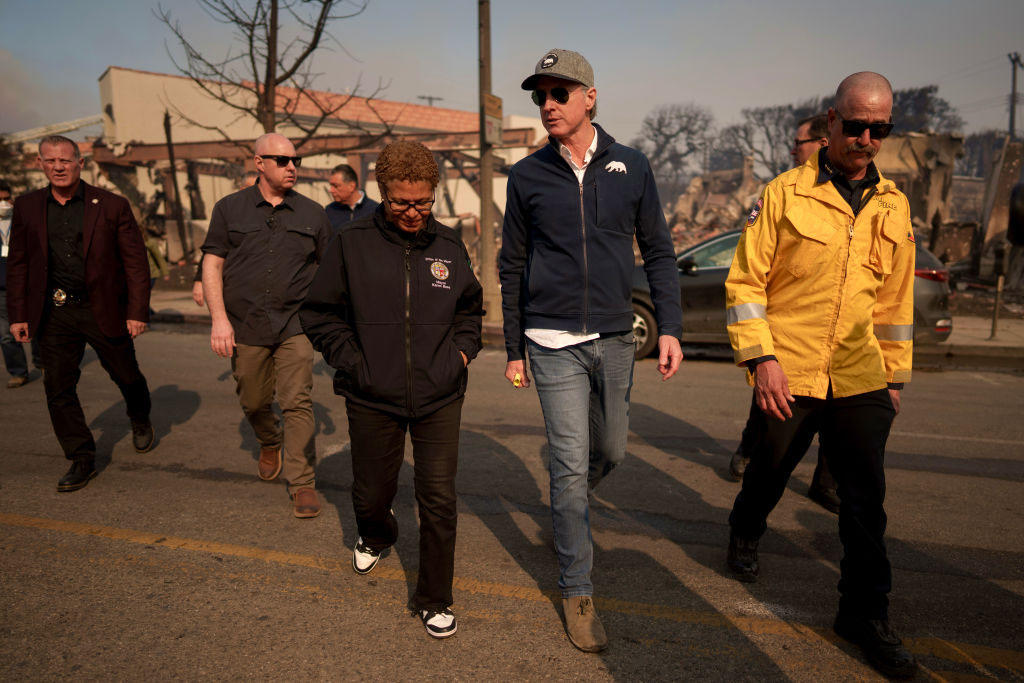
On Wednesday, standing in a burning Los Angeles neighborhood, Governor Gavin Newsom said on CNN, “People are literally fleeing. People have lost their lives. Kids have lost their schools. Families completely torn asunder. Churches burned down. This guy wanted to politicize it.”

He was talking about Donald Trump.

But we should “politicize” it, cast blame, and be specific. The Pacific Palisades and Pasadena didn’t have to burn. The LA firestorms were a consequence of politics and governance, not nature.

Southern California is a desert. Deserts are dry. Santa Ana winds blow in every year. One spark caused by human negligence or malevolence is all that’s needed. Nothing new.

Before the fires started, L.A. was under a red flag warning. Yet Democrat Mayor Karen Bass left town for Ghana.

Why would a Los Angeles mayor have a good reason to make an official visit to a small African nation 7,000 miles away? Especially during a red flag warning.

Why were the fire hydrants dry? That wasn’t fake news. That happened.

Why did Bass and the LA City Council (guess which party controls it) cut the Los Angeles Fire Department’s budget by $17.6 million?

Why does LA County’s “Community Forest Management Plan” from April 2024 begin with a “Land Acknowledgement,” include an Anti-Racism, Diversity, and Inclusion (ARDI) Initiative, and mention “equity” or “equitable” 64 times?

Why are the forests badly managed?

Why is there a firefighter staffing shortage?

Why did Gavin Newsom say that the state conducted fuel reduction work on 690% more acreage than it did?

In 2014, California voters approved a $7.5 billion bond to construct new reservoirs and water capture systems. Why have zero been built?

Why did LA Fire Department Assistant Chief Kristine Larson say, “You want to see somebody that responds to your house … that looks like you.”?

If I’m trapped in a burning house, and a firefighter tries to save me, I care more about how many pounds he can deadlift than whether he looks like me. And yes, I pray he’s a man.

Assistant Chief Larsen is part of LAFD’s “Equity and Human Resources Bureau.” On a college campus, DEI is foolish. In a fire department, it’s lethal.

The devastation we’re seeing is due to politics and policies. Since this is Los Angeles, California, the only people to blame are Democratic Party politicians and their appointees.

In Los Angeles, preventing or mitigating possible catastrophes, especially predictable, regularly scheduled wildfire threats, is a core government function. In Los Angeles, it’s the core government function. Nothing is more important than not burning the place down.

I dug up a cover story I wrote for this paper ten years ago that described LA’s foolish water policies. I was not at all surprised to see that a similar story could have been written today (emphasis added):

“In Los Angeles, an inordinate amount of the rain that falls on us makes no contribution to the city’s water supply — an estimated 80% of our rainfall flows directly into storm drains and heads out into the ocean, wasted before ever being used.

“Los Angeles and much of the surrounding desert region still will rely on a water transportation system that needs rethinking, and is already being rethought by water officials in Orange County and San Diego…The bad news is that the government’s water bureaucracy in Los Angeles is massive and it could take years for good ideas to blossom into policy.”

Because LA has never prioritized rainwater capture, getting water into the region is like the game of Labyrinth:

“The current inefficient water delivery system means the water that flows out of your tap may have arrived from multiple sources, because so many government agencies are involved in moving it through deserts and over mountains to get to your home.

“When rain falls, for example, around the town of Green River, Wyo., 830 miles from Los Angeles, it seeps into a watershed basin, flows into the Green River, which feeds the Colorado River, which flows southwest through Utah and Arizona before reaching the intake point of the Colorado River Aqueduct north of Parker Dam that is operated by the Metropolitan Water District of Southern California (MWD).

“It is at that point that MWD must pump the water 280 miles from the aqueduct to Los Angeles, a major technological challenge…On a single November day in 2011, the Julian Hinds Pumping Plant, east of Indio, had to propel more than 6 million tons of water over a 441-foot-high mountain. It took six 12,500-horsepower electric motors to get the water to a Riverside County reservoir.

“And that’s just the water that feeds Los Angeles from the east. Another source is rain that falls in the northern Sierra Nevada, which finds its way to the 1.1 trillion-gallon-capacity Lake Oroville Reservoir, then must travel 450 miles to get to Los Angeles.

“Flowing downhill and emptying eventually into the Sacramento-San Joaquin Delta (one of three of L.A.’s import sources), the California Aqueduct then ferries the water south in huge snaking pipes across the flat Central Valley and over the Grapevine, side by side with the notoriously steep run of the I-5 freeway.

“Pumping water from the Chrisman Pumping Plant over those mountains requires 44,000-horsepower pumps.

“At the Edmonston Pumping Plant 14 miles away at the base of the Tehachapi Mountains (84 miles north of downtown L.A.) … it takes 14 pumps to push water the 2,000 feet over the mountain.

“More power still is needed to transport the water to reach homes and businesses in Los Angeles, and MWD is not in the business of retail sales — that’s where LADWP comes in. As the largest municipal utility in the nation, LADWP purchased more than 126 billion gallons of drinkable water in fiscal year 2013, and 145 billion gallons this fiscal year, for $280 million and about $300 million, respectively, from MWD’s pumped-in water. Last fiscal year, LADWP sold 179 billion gallons of water for more than $1 billion to homes, apartments, businesses and factories throughout Los Angeles, almost all of which eventually became sewage treated for solid waste and piped into the Los Angeles River, Los Angeles Harbor, Santa Monica Bay and the Pacific Ocean.

“LADWP acknowledged the city’s deficient rainwater-capture infrastructure, noting current facilities ‘are inadequate for capturing runoff during very wet years.

On the enforcement side, California’s and L.A.’s water shortage have led to irksome water-use restrictions, fines of up to $500 for wasting water, #droughtshaming Twitter hashtags used by citizen water tattlers and “water cops,” LADWP inspectors who hand out warning letters and who have the authority to levy fines.”

The existing water system that supplies Los Angeles with water was an engineering feat in the early- to mid-20th century. However, with population growth and technological advancements, L.A. needs a 21st century approach

The existing water system that supplies Los Angeles with water was an engineering feat in the early to mid-20th century. However, with population growth and technological advancements, L.A. needs a 21st century approach, which many neighboring counties embraced years ago. Fire departments should hire based on merit alone. This stuff is too important.

If identifying why this happened and who should be held accountable is “politicizing,” then by all means, politicize. That’s the only way to ensure this never happens again.


Jared B. Sichel is a partner at Winning Tuesday. Follow Jared on X.

Politicizing the LA Fires Read More »

Emek Hebrew Academy Provides Vital Assistance to Pasadena and Palisades Fire Victims

Emek Hebrew Academy has set up a Crisis Center at their Magnolia Building  to provide much needed aid to families in Pasadena and Pacific Palisades who have lost their homes in the devastating wildfires this week. Many have been displaced from their lifelong houses and are living in temporary locations such as hotels and friends or relatives.

Today, January 9, volunteers will be delivering trucks full of food and other items to the Pasadena Chabad for distribution to the families in need. Additionally, the Chabad of Pacific Palisades has arranged that their community members will be arriving today after 2 pm till 6 pm to receive food, and other items gathered by the Emek community. Just last night and this morning, Emek parents have been dropping off at the school campus toys, games, stuffed animals, clothes and other needed supplies.

Michelle Andron, a parent at Emek who is spearheading this drive says “we have an amazing parent body. This started with one family of our parent body who lost everything and was in dire need. We began to brainstorm and, and we realized we needed to help on a broader scale.” Currently, as the children have a day off from school due to the fires, parents and children are manning tables set up in school hallways with supplies displayed.

Families from Pacific Palisades can come this afternoon between 2 pm and 6 pm for needed supplies. As well, volunteers from the school will be delivering food and supplies in trucks to the Chabad of Pasadena, led by Rabbis Zusha Rivkin and Rabbi Chaim Hanoka. Many caterers and food industry managers have donated food for this effort.

At the Emek Hebrew Academy building, parents and children are manning tables that are set up in the school hallways with the supplies displayed.

The organizers are asking that the community help out by dropping off additional items – most importantly toiletries, Gatorade and bottled water.

Emek asks that the community drop off basic items such as toiletry items, suitcases, and Gatorade to their main campus by 2 pm today at 15365 Magnolia blvd, Sherman Oaks, Ca.

Emek Hebrew Academy Provides Vital Assistance to Pasadena and Palisades Fire Victims Read More »

Rabbis of LA | 29 Years Later, Rabbi Lawrence Goldmark Looks Back

When Rabbi Lawrence Goldmark started his job at Temple Beth Ohr in 1979, people told him “‘It’s a nice place. You’ll be there for a year or two, then you’ll go on to a very large place.’” That’s not what happened: After 29 years leading the La Mirada congregation, Rabbi Goldmark retired. 

Sitting in a La Mirada coffee shop, Rabbi Goldmark looked back at his career. After 10 years as an assistant rabbi at Wilshire Boulevard Temple “I was looking to go solo,” he said.  “I put in here. I drove down the Santa Ana Freeway, got lost a couple times. They interviewed me. They liked what they saw, and I took the position.” And when the young rabbi and 250-family Beth Ohr met each other, it was love at first sight.

His path to the rabbinate was not that straightforward. He was ordained in 1969 —  the Vietnam War meant there was a need for Jewish chaplains in the military. “Two reasons could prevent me from going into the military,” said the rabbi. “One was physical, 4F. And two, it was against my conscience to serve in the military.” Neither applied to Rabbi Lawrence Goldmark. Still newlyweds, Goldmark and his wife Carol moved to Ft. Benning, Georgia, where he was assigned for two years. While serving there, their older son was born.

Talking about his two sons, Goldmark sounds like a proud father. They’re “extraordinarily talented, but very different,” he said. Joshua, his older son, is a police dispatcher in Southern California with a wife and dog. His younger brother Daniel is a professor of music at Case Western Reserve, in Cleveland, Ohio, where he is dean of the School of Liberal Arts. His wife has a Ph.D. in social work and teaches at Cleveland State. “They have two gorgeous children, a boy, 18, and a daughter, 14. They are the joys of our life.”

Growing up, Goldmark attended Temple Israel of Hollywood with the legendary Rabbi Max Nussbaum (1908-1974). “I was confirmed there, and here is the story,” Goldmark said. “The night before confirmation with 24 other students, there was a private ceremony called consecration. Max Nussbaum spoke to each member of the confirmation class with the parents standing next to the confirmand. “When he got to me, he said ‘Larry, I want you to become a rabbi.’ I almost fainted. There are no rabbis in my family, my Yiddish-speaking parents are from Poland. … I basically saluted him and said ‘Yes, sir.’”

Goldmark moved among giants of the Reform world. “It was Max Nussbaum and Lewis Barth who influenced me,” he said. “About a year after my confirmation, the junior rabbi at that time was Rabbi William Kramer. He said to me, ‘Let’s look at some place you might like to teach.’ So I went and taught at Wilshire Boulevard Temple. I also was a counselor at the late, great Camp Hess Kramer and so on. I got to meet Rabbi Edgar Magnin, but I didn’t know him.”

Looking back, he said Rabbi Magnin obviously was an influential person. “However, I must tell you the person whom I really was influenced by was Rabbi Alfred Wolf. He was always the second rabbi there, but he used the name of Edgar Magnin and Wilshire Boulevard Temple to achieve many of his goals.” From Rabbi Wolf, he learned how he could get people — whether it was Henry Winkler or the dean of the USC Law School — to come to the temple: Ask them to speak to students.

He also mastered the eight magic words: “’By the way, I am Rabbi Magnin’s assistant.’ Then people would say, in so many words, ‘What time do you want me to show up?’” Another lesson was that “one of the ways you get a famous person to speak at your synagogue is to use a magic word, which is ‘youth.’ People will come — stars will come — if they know they are not going to have to put on an act and do something for adults. But they will come when they know they will be able to speak to young people.”

Rabbi Goldmark reflected on a scene with actor Henry Winkler, The Fonz, one Sunday morning. “It was fabulous,” the rabbi said. “He spoke to the kids in grades 10, 11 and 12 about self-respect. The students looked at him as a role model.” The best part was: “I was walking him to his car and he said ‘What’s in that room?’ I said ‘Kindergarten and first-graders are having an assembly.’ He wanted to go in. We entered through the back, went onto the stage and I said, ‘Boys and girls, I’d like you to meet Henry Winker, The Fonz.’ He could have said ‘Boys and girls, I am busy.’ But he did the opposite. Winkler stood there and said ‘Boys and girls, I want you to brush your teeth every night. I want you to listen to your parents.’ He took on the role of a rabbi.”

So why did he leave high-profile Wilshire Boulevard? In 1978, on his birthday, the day after Rosh Hashannah, Rabbi Goldmark walked into Rabbi Magnin’s office. “I asked him how he was feeling. He was 81. He said, ‘Larry, congratulations on your birthday, but I think it’s time for you to go out on your own.’”

Rabbi Goldmark can now react to that remark with a laugh. Not then. Just 36, “I was shocked.” He stayed for several months — before going to La Mirada.


Fast Takes with Rabbi Goldmark

Jewish Journal: Was it difficult to step down from the pulpit?

Rabbi Goldmark: No. I found I had served Temple Beth Ohr for nearly 30 years. I was 65 years of age. I said [he shrugs], It’s okay. It’s time. That chapter was over.

J.J.: Do you have unmet goals?

RG: I find that at 82-plus, I don’t have a bucket list because I have achieved my dreams. My wife and I have traveled. My goals are to be of help and comfort to my rabbinic colleagues, whom I love dearly. 

J.J.: Your favorite moment of the week?

RG: My favorite day of the week is when my wife and I celebrate our anniversary. Caro and I met on a blind date on a Saturday. Recently, I said to her, why do we only celebrate our anniversary once a year? Why don’t we celebrate it once a week to commemorate our first date?

Rabbis of LA | 29 Years Later, Rabbi Lawrence Goldmark Looks Back Read More »

Jewish Travel Stories Featured in The Braid’s ‘Traveler’s Prayer’

The Braid takes the audience on a heartfelt and meaningful journey — through the stories of Jews with various backgrounds and experiences — in its latest show, “Traveler’s Prayer.”

Although it was first envisioned by The Braid’s founder and artistic director Ronda Spinak as a fun, breezy tour of the globe, she discovered the stories ran much deeper. 

“In these times, many Jewish writers are seeing travel as more than just a fun time,” Spinak, who produced the show, said. “They’re exploring our people’s history and grappling with our place in the world.” 

“Traveler’s Prayer” includes a hilarious, but cathartic, story by “Sex and the City” writer Cindy Chupack, a soul-searching one by novelist and playwright Lisa Pearl Rosenbaum and many others. As with The Braid’s salon shows, there will also be music; this one features Jewish songwriter Rhiannon Lewis. 

Chupack said her piece, “Pussy Writes a Letter,” is one of the more irreverent stories to make it into a Braid show. One of her favorite essays, it first appeared as part of a longer essay in Chupack’s comic memoir, “The Longest Date: Life as a Wife.” 

“It’s about a vacation in Thailand that my then-husband and I took while we were trying to get pregnant, which was a five-year process with a lot of heartbreak that finally ended with the adoption of our daughter,” Chupack told the Journal. 

Chupack said she always loved to travel and took trips for various reasons. 

“Not just to get away, but as a reset after leaving a job; a respite after getting my heart broken; a consolation prize when another round of IVF failed; or as an adventure where I know I will see, feel, appreciate and learn new things,” she said. “I’ve travelled alone, with girlfriends, with my mother and daughter and as a couple … and each trip has a story or lesson that becomes clear while you’re traveling.

Chupack hopes her story makes people laugh, think and feel. 

“I hope it brings comfort to people who have endured or are enduring the long and often painful process of trying to have a child,” she said. “I’m really appreciative that The Braid brings stories like mine to new audiences in a new way.”

Rosenbaum believes there is something to be celebrated not only about traveling but also in discovering how varied the Jewish experience around the world. 

“We are indeed Wandering Jews and this diversity within our own people is endlessly fascinating,” she told the Journal.

“We are indeed Wandering Jews and this diversity within our own people is endlessly fascinating.“
– Lisa Pearl Rosenbaum

Rosenbaum’s story, “The Man in the Doorway,” is about an experience she had in the spring of her sophomore college year, as she wandered alone through a quaint Paris neighborhood. Raised in a secular Jewish family, she felt she had nothing in common with the bearded old Jew whose gaze briefly met hers as he stood in a doorway.

“The shock of reading the metal plaques on the buildings along this street memorializing the killing of its inhabitants by the Gestapo, made me realize the centrality of my Jewish identity for the first time,” she said. “Until that day in Paris, I considered my Jewishness a mere accident of birth, something as alien to my identity as the bearded old Jew in his black gabardine coat and yarmulka.”

Seeing those plaques above the doorways made her realize that, “like it or not, I’m a member of a historical people who should never allow the antisemites to define me as a Jew,” she said. 

Rosenbaum said she wrote the piece to speak to people who feel as she once did, to ask them to wrestle with the question of what it means to be a Jew and hopefully, to discover deep meaning in it, as she has.

The cast of “Traveler’s Prayer” is Roni Geva (“Monsters,” “Law & Order”), Michael Naishtut (“Gene Simmons: Family Jewels”), Amy Tolsky (“Jury Duty,” “Mixed-ish”) and Jill Remez (“How to Get Away with Murder,” “Bosch: Legacy”), who also has a story in the show. 

“My story is about me, as a young woman, visiting Europe for the first time and placing flowers on a family gravestone in Germany at the request of my grandmother who fled Germany in 1938,” Remez told the Journal. “It was a turning point in my life and will hopefully resonate with other children of immigrants, who perhaps were so steeped in their new American culture that they avoided the stories of the past generations.”  

Remez said the experience changed her and her perspective on history and her family.  

“I’ve seen the photo albums that my grandparents brought with them from Germany,” she said. “In the photos they seem so happy, they are proud and sometimes even silly … They are surrounded by friends and family, and then, suddenly, that life was gone.” 

She added, “Seeing that gravestone really brought that all home to me; despite not actually knowing them, I will never forget them.”

For 17 years, The Braid has brought authentic Jewish stories to the stage. And this one is no exception. 

Remez said that travel makes the world both larger and smaller.  

“Larger, in the sense that we experience new cultures, languages, vistas, historic landmarks and ancient civilizations that rise and fall,” she said. “Smaller, in that we see how we are all the same, we love our families, friends and pets and we take pride in where we are from.”

“’Traveler’s Prayer’ recognizes how important it is for travel, how our mind and soul expands when we travel and that regardless of where we are, we always find home,” Todd Felderstein, Associate Director, “Traveler’s Prayer,” told the Journal.

“Traveler’s Prayer” runs from January 11 through February 6 in person in Los Angeles and the Bay Area, as well as live-on-Zoom. For schedule and details, go to the-braid.org/travelers.

Jewish Travel Stories Featured in The Braid’s ‘Traveler’s Prayer’ Read More »

Lay Me Down Somewhere – A poem for Parsha Vayechi

And Joseph bound the sons of Israel by an oath to bind their descendants by an oath, saying, “God will surely remember you and your descendants, and when He does, you must have them take my bones up from here.” ~ Genesis 50:25

When I die I want them to take my bones
and bring them to where I came from.
I’m just not sure where that is.

It could be the promised land.
If I could find a paper trail that definitively
had my feet there, it could be there.

It could be in Syracuse where the first Cohens
toddled around the 19th Ward before the
neighborhood became a highway.

My mother was a Cohen and though
my father didn’t give me her name
I still claim a familial bond.

It could be Florida. I spent some time there.
Though probably not. Please don’t
lay me down permanently in Florida.

It could be New Jersey where
I first breathed the air, but they
probably won’t remember me.

It could be Paris, but I think
I’d have to die there to earn it.
I wouldn’t mind dying in Paris.

It could be in California where
the foundations of who I am were
forged by the holiest of people

like Joseph, who became who he was
in the narrowest of places, but still asked
they bring his bones home.


Rick Lupert, a poet, songleader and graphic designer, is the author of 28 books including “God Wrestler: A Poem for Every Torah Portion.” Visit him at www.JewishPoetry.net

Lay Me Down Somewhere – A poem for Parsha Vayechi Read More »

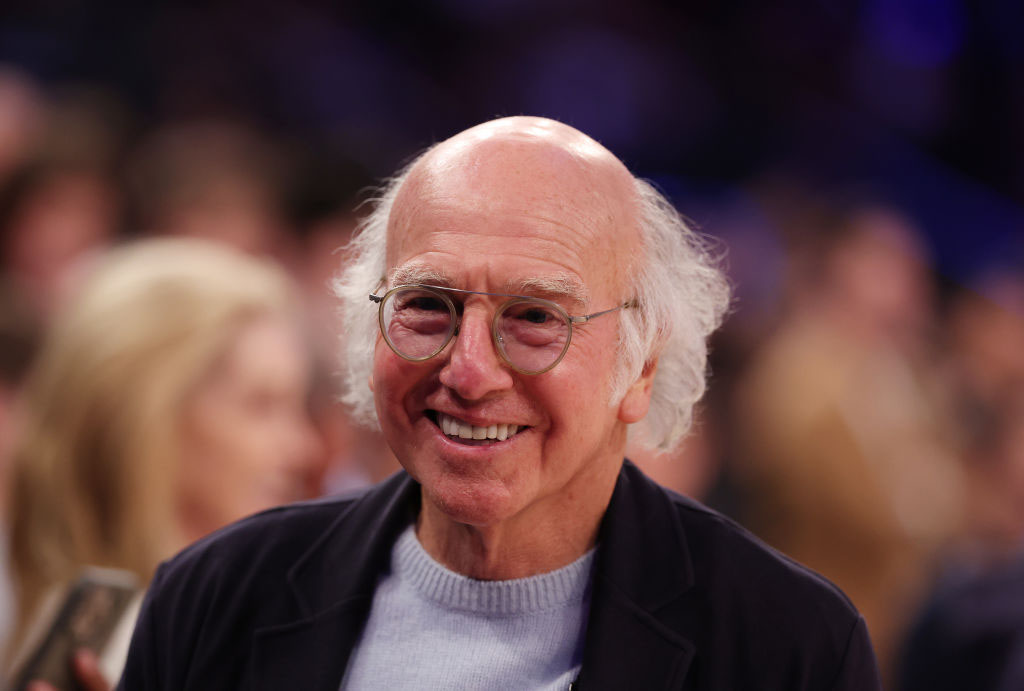
The Miracle of Larry David

’Tis the season for miracles….Beyond the oil that lasted 8 days, is there a more impressive feat than Larry David being singularly responsible for the world not entirely hating all Jews in 2024?

It’s been nearly 3 years since AARP magazine dubbed David as an “oddly sexy senior,” joining Paul Rudd and Adam Brody in the most unlikely hot rabbi trio for the new millennia. It’s been 30 years since Adam Sandler released “The Hanukkah Song,” proudly celebrating prominent Jews in the showbiz. And when it debuted, suddenly, perhaps even for the first time ever in history, it felt pretty, pretty, pretty good to be Jewish. To be name-checked in that song was an honor and festive coming-out party. Sadly, that’s no longer the case in 2024. Attacks on Jews continue to rise at alarming rates, despite the critical success of such Jewish centric shows as Brody’s “Nobody Wants This” and David’s “Curb Your Enthusiasm.”

Those who choose to openly support the Jewish people and defend their Jewish heritage, like Tik-Tok dancer turned activist, Montana Tucker, receive constant vit-riol and threats. At a recent appearance at the Sinai Temple in Los Angeles, Mon-tana admitted that some people she’s collaborated with for years no longer want to associate with her. Montana’s got model looks to go along with her thoughtful compassion and engaging personality. She’s also smart, well-spoken and accord-ing to her mother, never curses. If only she was more like Larry David.

No matter how much Larry kvetches on anything and everything, he’s still beloved by gentiles. How is that this bald bard from Brooklyn who looks and sounds the quintessential Jewish stereotype, remains above antisemitism?

This past year’s edition of “Curb Your Enthusiasm,” (it’s last of 12 in its 24-year run) was arguably its most Jewish and popular yet.

Just the other night in Los Angeles, Chargers Head Coach Jim Harbaugh (a faithful Jesus goy) gleefully kibbitzed with Larry pre-game on the field.

Larry is fresh off a sold-out “A Conversation” tour around the country and I can as-sure you, at the over-the-top prices he was charging, those crowds were not all Jewish.

Even the known anti-semite, rapper Kanye West, is a big fan. Ye collaborated with Travis Scott on his 2018 single, “Watch,” dropping bars like “I could tell Larry David was the mind behind Seinfeld.” West once told Larry Charles that he was “the black Larry David.” Charles, the brilliant Jewish man behind the Borat films, and multi-credited writer and director of “Seinfeld” episodes, helped West produce a HBO Curb inspired series for the rapper to star. While it failed to launch beyond the 2007 pilot, it proved once again of David’s miraculous cross-over appeal and influence.

And it’s not just famous men who bro-out over the self-proclaimed, “Big Jew.” Shiksas like Jennifer Lawrence, Elizabeth Banks, Sienna Miller, Tyra Banks and Nicki Minaj all swoon over this long-balled circumcised man. In one of the most iconic “Curb” episodes, a Palestinian woman (played by Armenian Anne Bedian) tries her best to “fuck the Jew” out of Larry, but fails to do so. Larry David will not give up his Jewishness for anyone!

In 2017, Israeli author, Nissan Shor, pined for Haaretz dot com on why Larry is a better Jew than most Israelis. He states, “Larry presents his Jewishness as a defiance of God, giving him the finger.” And not that there’s anything wrong that. According to Shor, Larry flaunts his Judaism wherever and whenever he can. “That egotistical, malignantly narcissistic man clings to his Jewishness.” Shor’s main point is that Larry is able to be exactly the kind of Jew he wants to be- unlike in Israel where a certain type of Jew is not only expected, but too often forced up-on you (and the world.)

David’s authentic behavior and one-of-a-kind persona is the reason he’s beloved. The fact he doesn’t shy away from his particular Jewishness is exactly what makes his genuine popularity so confounding. So, how does the man himself feel about being the Jewish Journal’s “most popular Jew in the world in 2024?”

“It’s a miracle.”*

*We reached out to Larry David’s rep for comment and he was not available, so we improvised Lar’s response.


Steve Matoren is currently directing “Bagels & Elvis,” a documentary that focuses on why everyone’s so obsessed with who’s Jewish.

The Miracle of Larry David Read More »

“Hard to Process We No Longer Have a Home”: Palisades Residents On Surviving a Nightmare

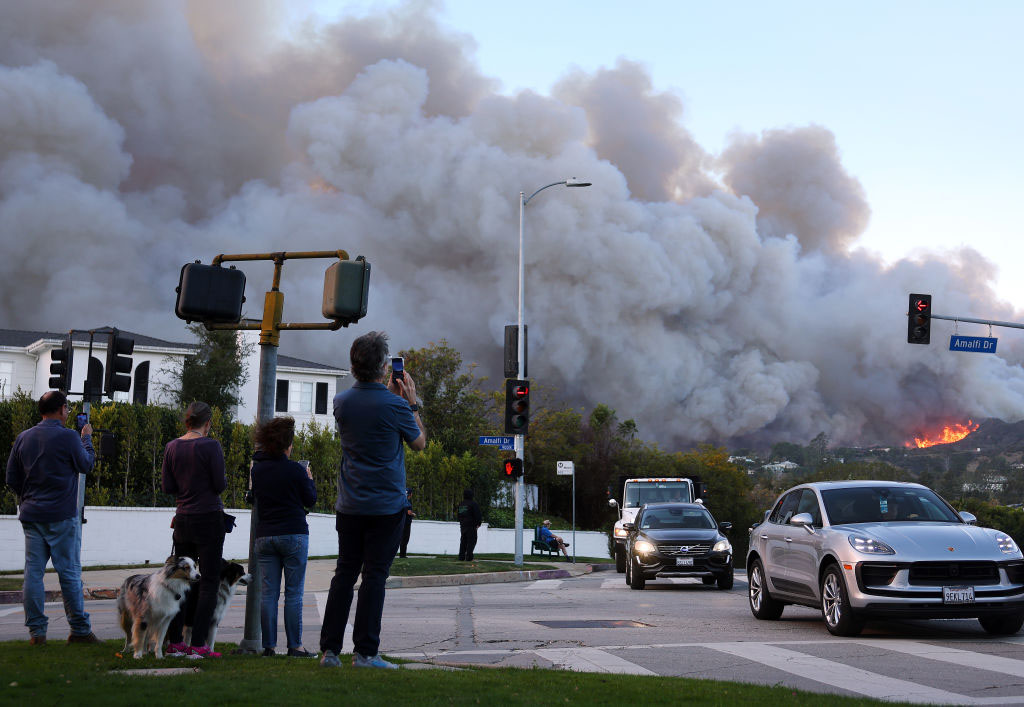
Pacific Palisades resembled the set of an apocalyptic film, with charred houses, raging fires, and billowing smoke. Residents of the once-picturesque neighborhood described driving through a surreal landscape that felt more like a war movie, with themselves cast as the unwilling protagonists.

“We were fleeing for our lives,” said David Levine, a Pacific Palisades resident of over 20 years. “The smoke was so thick it was hard to see the road. We barely made it out. Our entire life was left behind. We managed to grab some clothes, my laptop, and a few other items. It wasn’t until we were driving away that we realized how much we had forgotten to take—but by then, it was too late. Our house is gone.”

Levine, a retiree, drove with his wife to Santa Barbara to stay with friends. “I’m grateful that we made it out of there. It was the scariest day of our lives, but it’s going to take a long time for us to recover from this loss.”

Dorit Rotenberg, 66, has lived in Pacific Palisades for over 20 years. On Tuesday morning, she evacuated her home with her husband, their black Labrador and cat.

“We weren’t prepared to leave on such short notice,” she said. “I packed a few clothes, few pair of shoes and important documents, and we left. Some of our neighbors refused to evacuate, hoping to protect their homes. They only left when firefighters forced them to, and later told us our house had burned down.”

Now staying with friends in Thousand Oaks, Rotenberg is grappling with the loss.

“It’s hard to process that we no longer have a home,” she said. “At our age, starting over is difficult. We’ve left behind an entire lifetime in that house.”

Rabbi Zushe Cunin, leader of the Chabad in Pacific Palisades, described the devastating impact on his congregation. The storage structure was burned along with 16 Menorahs and vehicles used to transport children and elderly to and from their homes.

“Many members of our synagogue lost their homes in the fires,” he said. “Throughout the night and into Tuesday, I tried reaching out to the 250 members of our community, but I couldn’t get through to many of them.”

The rabbi added that some members initially refused to evacuate, desperate to protect their homes from the advancing flames. He was able to ask firefighters to rescue a 90-year-old couple who stayed behind in one of the buildings. Another elderly man who was the only one to remain in his building was also rescued by firefighters.

On Tuesday morning, the director of the Jewish Early Childhood Center of Chabad had her teachers call parents to pick up the 100-plus children. The parents rushed back, and the teachers carefully crossed the street across PCH to reunite them with their parents.

Over 5,000 Chabad rabbis and other rabbis from synagogues all over L.A., had called offering help. Chabad of Bel Air had offered shelter to anyone affected by the fires. Six families spent Tuesday and Wednesday nights there; others just came over to take a shower and charge their phones before arranging for a place to stay.

Liat Stenberg moved to Los Angeles with her family seven years ago and had been renting a home in Pacific Palisades. “We had just returned from a vacation with my parents, who were visiting from Israel,” Stenberg said. “Our suitcases were still packed—mostly with swimsuits and beachwear.”

When the evacuation order came, Stenberg left with her parents, her son—a lone soldier visiting from Israel—and her 11-year-old daughter.

“I took a few photo albums and our computers before leaving,” she said. “My husband and older daughter were still in Miami, where she’s training for the Olympics in windsurfing.”

By the time they fled, the fire had already reached their backyard.

“Our neighborhood in Marquez was the first to burn,” Stenberg said. “I don’t know anyone whose house survived. The entire area was engulfed in flames.”

Noa Goldberg, a resident of Highland Village in Pacific Palisades, evacuated her townhome at 3 p.m., when the flames were getting very close. “I tried to leave earlier, but the roads were gridlocked,” Goldberg said. “Traffic wasn’t moving, and I was panicking. My husband was out of town, so I was alone with my 12-year-old. I waited for the firefighters to clear a path before I could leave.”

The scene as she drove out was harrowing.

“Houses were burning on all sides,” she said. “My favorite restaurants, the grocery store, CVS, the supermarket—everything was gone. The destruction was total. It felt like I was driving through hell.”

Dina, who chose not to provide her full name, lost her home in Malibu. This was the couple’s second home; they live in a penthouse in Los Angeles and spend weekends and holidays in Malibu. A few years ago, they had completely remodeled the house. “It’s total devastation. We lost everything we had there,” she said. “When we saw the news about the fires, we drove there, but we had to take different routes because the firefighters had blocked the roads. By the time we finally made it, the house was gone. Completely.”

Dina, a mother of four grown children, shared that the house contained valuable artwork and countless memorabilia collected over the years. “We stayed there just last weekend. Friends came over, and it was so peaceful and fun. We have so many memories there. I’m heartbroken.”

“Hard to Process We No Longer Have a Home”: Palisades Residents On Surviving a Nightmare Read More »

Historians Trampling History (in Gaza)

Since there isn’t any evidence to prove Israel is committing genocide in Gaza, what’s the next best thing? Invent a new kind of “cide” and see how many scholars are gullible enough, or malevolent enough, to go along with it.

That, it seems, is the strategy of former PLO official Karma Nabulsi, who recently invented the term “scholasticide” to describe damage Israel has caused to college campuses in Gaza. From 1977 to 1990, Nabulsi was an official representative of a terrorist organization that murdered or maimed countless Israelis (and many Americans), and sought Israel’s destruction. Now she teaches at the University of Oxford.

Nabulsi’s strategy is working. By a vote of 428 to 88, members of the American Historical Association last week adopted a resolution accusing Israel of committing “scholasticide” through an “intentional effort” to damage universities and other schools and therebyobliterate Gazas educational system.”

There is not a stitch of evidence demonstrating any such intent by the Israelis. Lack of evidence ordinarily would stop an historian dead in his or her tracks. But in this case, the facts, sources, and standards upon which historians ordinarily rely were thrown out the window. By a large majority, those who are supposed to be the gatekeepers of the historical record have embraced a libel.

The damage to college campuses in Gaza is not the result of an Israeli plot. It’s the result of Hamas using those campuses as operational centers for terrorism and storehouses for weapons.

In November 2023, Israeli soldiers found weapons and other terrorist equipment in Gaza’s Al-Quds University. The following month, Israeli forces discovered explosives and rockets in Al-Azhar University, in northern Gaza, as well as a half mile-long tunnel under the university’s yard. The site resembled “a military base,” a sergeant told the New York Times; only “if you look closely, you can see it’s a university.” In January, troops searching the campus of Islamic University, in Khan Younis, discovered hundreds of mortars, explosive devices, grenades, AK-47 assault rifles, ammunition, Hamas flags, and safes stuffed with cash in the classrooms.

In February, Israeli troops found a tunnel underneath Israa University, in Zahra City. In June, they discovered quantities of weapons on the campus of the University College of Applied Sciences, in central Gaza; the army said Hamas used the college “as a command and control center.” Soon after that, terrorists in a building at Islamic University launched anti-tank missiles at Israeli forces.

None of that information is mentioned in the AHA resolution. In fact, Hamas itself is never mentioned. That’s like describing World War II without mentioning Nazi Germany.

The hypocrisy of the accusers is egregious. While these historians denounce Israel, they have said nothing when Israeli universities have been victimized by genocidal terrorists.

Sapir Academic College, the largest public college in Israel, is just a few miles from the Gaza border. The only thing saving it from mass bloodshed during the Hamas invasion of October 7, 2023, was that the campus was closed and nearly empty because of the Simchat Torah holiday. Nonetheless, terrorists cut through its fences and shot at the guard booths and buildings.

Dozens of Sapir faculty members, students and staff who reside near the campus were murdered, wounded, or kidnapped. Some are still being held hostage in Gaza. Yet the AHA has not protested.

More than 1,000 Sapir students and nearly 300 staff members and their families became refugees. The AHA has said nothing about them.

That was not the first Palestinian Arab violence against Israeli universities. In 2002, terrorists bombed the Hebrew University campus, in Jerusalem, killing nine—five of them Americans—and wounding more than 100. A previous bombing at Hebrew University, in 1969, left thirty-six students injured. The AHA said nothing about either of those attacks.

History shows that victims of aggression have sometimes damaged university campuses in the course of defending themselves, as in World War II. The Allies’ bombing of Hamburg in July 1943 caused major damage to the University of Hamburg. Allied bombers destroyed the main building on the campus of Munich’s Ludwig Maximillian University in July 1944. Allied strikes on Bonn in October 1944 completely destroyed the main building at the University of Bonn. More than three-fourths of the buildings of the Technical University of Aachen were leveled in that month’s bombings as well. The University of Greifswald was so badly damaged by the Allies that it had to be rebuilt on a different site. The University of Rostock’s medical clinic, dermatological clinic, and hygiene institute were completely destroyed in Allied bombings, and additional buildings were badly damaged.

The proceedings of the AHA’s annual meetings during World War II do not mention any resolutions condemning President Franklin D. Roosevelt or Prime Minister Winston Churchill for damaging German universities. One wonders if the current generation of AHA members would have viewed those events differently. Would they have pointed an accusing finger at the Allies, just as they now unjustly heap blame on Israel? Would they have branded FDR and Churchill guilty of “scholasticide” ?

Unless the AHA leadership intervenes, the “scholasticide” resolution will soon go to the association’s full membership for ratification. If adopted, the new official position of the AHA would contravene its own mission statement. Instead of “promoting historical work and historical thinking in public life,” the AHA would be on record as discarding historical thinking in favor of extremist political posturing.

According to the AHA’s by-laws, however, its leaders could step in and veto the resolution. To preserve the association’s credibility and to remain true to its mission, they should do so.


Dr. Medoff, a member of the American Historical Association for more than four decades, is founding director of The David S. Wyman Institute for Holocaust Studies and author of more than 20 books about Jewish history and the Holocaust. His book The Road to October 7: Hamas, the Holocaust, and the Eternal War Against the Jews will be published on October 1, 2025, by The Jewish Publication Society / University of Nebraska Press.)

Historians Trampling History (in Gaza) Read More »

LA Inferno: Who’s Accountable?

On Thursday, Jan. 2, in words that will live in LA infamy, the National Weather Service of Los Angeles warned of “extreme fire weather conditions” for the following Tuesday to Thursday— exactly when our city’s worst calamity became the biggest story on the planet.

By Sunday, Jan. 5, the warnings had become even more dire— “rapid fire growth and extreme behavior with any fire starts.” Why did our leaders not take advantage of these prescient warnings? And is it wrong to bring up such questions as the devastation continues and rescue efforts take top priority?

Maybe it is, but sooner or later, Angelenos will demand answers. They will want to know why, despite years of warnings, our city was not better prepared.

The horror scenes of the inferno were “years in the making,” according to a report in The New York Times: “Pacific Palisades residents had long pleaded for more attention to preparing for the fires that are striking the region with ever-greater frequency and ferocity. As recently as 2019, two fires that burned near parts of Pacific Palisades had shown the challenges of moving thousands of people through the area’s few escape routes.”

Traci Park, who has represented Pacific Palisades on the Los Angeles City Council since 2022, admitted to the Times that there had been a “chronic underinvestment” in essential infrastructure, including water systems, the electrical grid and resources for firefighting and other emergency response.

“What happened in the last 24 hours was not unforeseeable,” she said. “It was just a matter of time.”

These six words may haunt our city for years—”it was just a matter of time.”

Indeed the apocalyptic nature of the fires and their indelible images will follow our elected officials like a mark of shame until they come clean.

In a report in the New York Post titled, “How years of corruption and mismanagement led to LA running out of water in the middle of the Palisades wildfire,” Jared Downing gives us a glimpse of just one aspect of the breakdown: water.

“The water shortage was the result of years of mismanagement of LA’s water system — including a federal indictment of a leader and high-profile resignations — as well as major operational problems that drained reserves too quickly,” he writes.

“There’s no water in the fire hydrants,” former mayoral candidate Rick Caruso told the local media as the fires were raging. “The firefighters are there, and there’s nothing they can do — we’ve got neighborhoods burning, homes burning, and businesses burning. … It should never happen.”

Downing writes that “when the same thing happened in neighboring Ventura County in November, humiliated officials blamed damaged pumps and overall lack of water — despite backup systems and protocols that allow firefighters to draw water from other sources.” 

In L.A., “those fail-safes should have been working and the hydrants should have stayed full,” Caruso told the Times. Of course, as anyone whose home burned down can tell you, those fail-safes failed.

And speaking of failure, let’s not forget the failed legacy of fire, forest and water management by the state of California and Gov. Gavin Newsom, who also owes us answers.

“California’s wildfire prevention efforts have been costly and impractical, with tragic results,” energy expert Jonathan Lesser writes in City Journal. “Whether sparked by fireworks, powerlines, lightning, or arson, the conflagrations devastating Los Angeles are just the latest result of decades of ill-conceived policies.”

In other words, there’s plenty of blame to go around, not least our own Mayor Karen Bass, who chose to go on a ceremonial trip to Africa despite the dire warnings, and who approved a $17.5 million budget cut to…yes, the fire department.

This is not about right or left, Democrat or Republican. This is about a government’s duty to protect its people, and our duty to hold responsible those who fail to do so— regardless of party..

For now, let’s root for our brave firefighters and first responders and volunteers and community members and organizations who have mobilized to assist those who have lost their homes and others who are in urgent need.

But let’s also root for the reporters, activists and investigators who will dig into the gross incompetence and negligence that have contributed to a disaster that will impact our beloved city for years to come.

Winds and fires are acts of God. But heeding warnings and mitigating their damage is the role of elected officials whose #1 job is to keep us safe— and who seem to forget that they report to us.

Will those responsible will be held accountable? Let’s hope it’s “just a matter of time.”

LA Inferno: Who’s Accountable? Read More »

Print Issue: Saving California | Jan 10, 2025

CLICK HERE FOR FULLSCREEN VERSION

Print Issue: Saving California | Jan 10, 2025 Read More »