fbpx

January 7, 2025

How to Delegitimize a Nation

For today’s anti-Zionist, Palestine isn’t a place so much as a metaphor. Whatever someone sees as humanity’s biggest threat, that’s what Palestine is about. Galvanized by global warming? That’s what Palestine means. (Hi, Greta Thunberg.) Hate racism? That’s what Palestine means. (Greetings, Black Lives Matter.) Passionately opposed to reactionary patriarchal cisheteronormativity? That’s what Palestine means. (Salutations, Queers for Palestine.) That these beliefs defy readily available facts — that tiny Israel contributes almost nothing to global warming but might provide the scientists to fight it; that it’s one of the most diverse countries in the world, with equal rights for all citizens; that self-described “queers” thrive in Tel Aviv but are murdered in Gaza — is irrelevant. The mutability and emptiness of the charges poses a serious problem for those who believe the Jews have the right to a state, and the right to live. Because how do you combat a metaphor? 

Adam Kirsch has written a slim, eloquent book about how Israel-Palestine was transformed from a notoriously complex region into a simple, Manichean battle between good and evil. Performing the herculean task of erasing from this conflict all history, geography, material reality and human action, we find the motherlode of contemporary antisemitism, academia. Arcane ideas that percolated in the ivory tower for decades found their way into the mainstream progressive worldview, so that anyone who challenges these ideas today is regarded as an enemy of progress and the oppressed.  

Arcane ideas that percolated in the ivory tower for decades found their way into the mainstream progressive worldview, so that anyone who challenges these ideas today is regarded as an enemy of progress and the oppressed. 

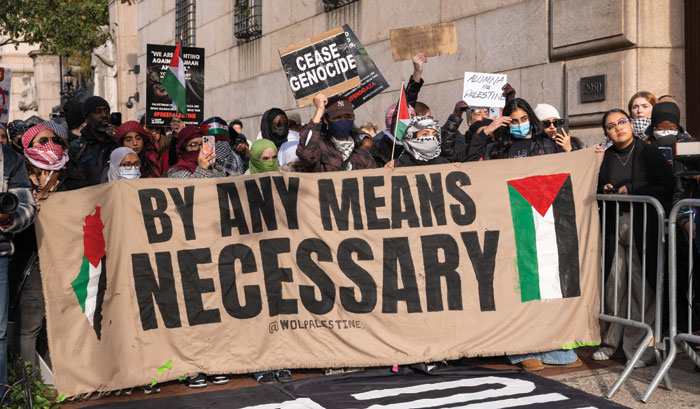
Kirsch zooms in on a once-niche ideology, “settler colonialism.” Readers who hadn’t come across the term before have certainly encountered it since Oct. 7, when “pro-Palestinian” protesters took to the streets, campuses and social media to howl that the “resistance” is always justified, because Israel is a “settler colonial” country. When they screamed that teenagers dancing at the Nova festival were “settler colonialists” so deserved to die, they were giving an especially vile interpretation to this once-obscure academic concept. 

Marx’s co-thinker Friedrich Engels is supposed to have written somewhere that all nations are founded on a mountain of skulls. Maybe it’s apocryphal, but that idea, anyway, was conventional wisdom in the Marxist party I once belonged to. Nation-building is an inherently bloody business: the Western left used to acknowledge this. They even used to recognize that the West didn’t have a monopoly on this; nations made up of nonwhite people could colonize, expel and subjugate others, too. You could feel great sympathy for the peoples who lost out in the battle against more powerful armies, but there was no point railing against history. All nations have the right to self-determination: The left used to insist on this, too. Once a nation was established, dwelling on the nature of its birth amounted to denying that right.

Settler colonial ideology evolved to justify excluding one nation (guess which) from the global community. When academics began writing about settler colonial societies in the 1970s, they meant countries like Algeria or Rhodesia: places where white people from a more powerful mother country subjugated the native population. Decolonizing those countries was violent but fairly straightforward, because the “colonists” had a place they could, at least in theory, return to. 

In the 1980s and ‘90s, however, settler colonial ideology underwent what Kirsch calls “a crucial shift.” It began, interestingly, in Australia, where academics began using the term to refer to themselves: part of a white, European-descended population that had largely replaced the indigenous peoples. Settler colonialism had taken place so thoroughly that white Australians now thought of themselves, illegitimately, as natives. This new definition of settler colonialism was then extended from Australia to other countries where the native population had been largely wiped out, Canada and the United States: nations hopelessly tainted with original sin. 

Again, this represents quite a shift from many previous left teachings. As a young Marxist in the 1980s and ‘90s, I was taught that America’s original sin wasn’t the genocide of the Native Americans, but chattel slavery. My comrades saw Native Americans as pitiable figures, but now socially marginalized. Black Americans, on the other hand, were central to the American economy as workers, traditionally militant and had fewer illusions in American democracy. We had every reason to look to them to be the vanguard of radical struggle, and reject signs that racism might actually be improving. In making slavery the rotten core of American nationhood, my little Marxist group had plenty of company on the left. The idea still has many adherents, including The New York Times’ 1619 Project. 

According to the new idea of settler colonialism, all non-Native Americans are guilty by birth. I was startled to read that according to the Southern Poverty Law Center, even African Americans whose ancestors came to the country as slaves “benefit from the settler-colonial system.” It’s hard to see how people who believe in this stark declaration of guilt square it with other aspects of the progressive program, like supporting Black Lives Matter. 

But intellectual consistency doesn’t seem to be these folks’ strong suit, so sure as the sun rises in the east, settler colonial ideology began taking aim at Israel. Australia, Canada and the United States clearly aren’t going anywhere, after all; nothing can really be done about the past except avow one’s guilt through endless land acknowledgements. The tiny Jewish state, on the other hand, attacked by enemies throughout its nearly 80 years, can be deemed inherently illegitimate, with the hope of reversing history and establishing a “Free [of Jews] Palestine, from the River to the Sea.”

Calling Israel a settler-colonial society requires both mental gymnastics and some awesome disappearing acts. Among these are that Jews actually are indigenous to Israel; Jews who emigrated to Palestine or Israel were generally fleeing antisemitism, not setting up colonies on behalf of Poland, Iraq or wherever; and establishing the State of Israel involved a fierce process of decolonization. As Kirsch writes, if Israel were a colonizing power, the Palestinian people should be able to win by using the tactics of the Vietcong or Algerian FLN, “sap[ping] the colonizer’s will to resist. But the fact is that Israel’s 7 million Jews have no other home to go home to. They or their ancestors left their former countries after suffering persecution and genocide, never to return. That is why they will fight for their country, not like the French in Algeria or Vietnam, but like the Algerians and Vietnamese.”

In a thought-provoking final chapter, “Justice and Despair,” Kirsch writes about the necessity of acknowledging the past and its injustices without hopelessness, or pretending they were “actually justice in disguise.” This means accepting that “while the creation of the United States and Israel was a curse to some people, it has been a blessing to many others.” The European settlement of America should not be undone, “but Native peoples should have the power to define and protect their way of life.” Similarly, “the creation of the State of Israel should not be negated, but Palestinians should have the security and dignity of their own homeland.” 

How this might happen, of course, is a question for another book, or a library of them. Kirsch has contributed a fascinating, beautifully written book that illuminates how we got to this dismal place, and provides hope for finding our way out.


Kathleen Hayes is the author of ”Antisemitism and the Left: A Memoir.”

How to Delegitimize a Nation Read More »

Hashem Can Do Anything

I was once watching ESPN as a reporter interviewed a football player about religion. 

“I don’t believe in God, because how can anyone be all knowing?” the football player said. “How can He be everywhere at once? How does He have the power to do anything? That doesn’t make sense.”

I thought, just because you can’t imagine Hashem and all his glory doesn’t mean He’s not there. I fully believe He is because I’ve experienced so many miracles. All I had to do was open my eyes and see them. 

Twelve years ago, my husband Daniel and I were living in a rent-controlled apartment in a fantastic area of Brooklyn. Every month, we paid our rent on time – always in cash, as our landlord’s office manager instructed us. 

One day, our landlord called to tell us that her office manager had stolen all the tenants’ cash and was going to jail. She had no record of us paying our rent for several months, even though we said we did. 

“I believe you, but do you have the receipts to prove it?” our landlord asked Daniel. 

“I have them somewhere…” Daniel’s voice trailed off.

“If you can’t find them, then add $500 a month to your rent so you can pay what you owe me. And if you ever find the receipts, I’ll send you your extra money back,” our landlord said.  

We panicked: how were we going to come up with all that money every month? 

After some initial doubt and worrying, we kicked into high gear. We made our living room into a bedroom and posted it up on Craigslist. We began renting it out as well as taking on more work. 

At the same time, we had a neighbor next door who was harassing and threatening us. I didn’t feel safe living in our place anymore, but we couldn’t afford to move to a different apartment in New York. 

We decided to try and leave for Los Angeles. There was only one problem: We needed a bunch of cash to get to the other side of the country and find a new place. We didn’t know how we would do it, so we prayed and prayed. 

And then, a few months into our new agreement with the landlord, I was cleaning our apartment. I looked inside the storage compartment of a fish tank Daniel had purchased and never used. As I rummaged through old trophies, unopened mail and dusty tank filters, I saw it: a piece of paper that looked like a receipt. I turned it over, and it said, “January 2012 rent: Paid in full.” 

I hurriedly pushed aside the other things and found another receipt. And then another. And another. Finally, I collected all the receipts for the back rent we owed. 

I called Daniel and told him the news. 

“Now we can go to L.A.!” I yelled with excitement. 

Our landlord kept to her word and sent us back all that extra money right away. We used it for our road trip across the country and to put down a deposit and first month’s rent on our apartment in L.A. 

Since then, I’ve experienced so many more momentous miracles. But I’ve also learned to see the miraculous in everyday life. 

Waking up every day is a miracle. Having a roof over my head and food in my stomach are miracles.  

It’s a miracle that I started believing in Hashem and converting to Judaism, which have given me endless meaning and fulfillment.  

You shouldn’t be afraid to ask for anything, no matter how impossible you think it is. You may not receive it immediately because the timing isn’t right, and it may not come in the form you expected. 

I’ve found that the more you let Hashem into your life, the more He will be there for you. You shouldn’t be afraid to ask for anything, no matter how impossible you think it is. You may not receive it immediately because the timing isn’t right, and it may not come in the form you expected.  You’ll also have to put in effort to get it.  

One thing is clear, though: Hashem has the power to do anything for you. You just have to open your heart to all the miraculous possibilities.


Kylie Ora Lobell is an award-winning writer and Community Editor of the Jewish Journal. You can find Kylie on X @KylieOraLobell or Instagram @KylieOraWriter.

Hashem Can Do Anything Read More »

The Peacock

Mark: Hey, Mom, I need two dollars.

Mom: I gave you two dollars yesterday. Ask your father.

Mark: Dad, I need two dollars.

Dad: Ask your mother.

Most kids think their parents are made of money; I was no exception.  

Even though my parents complained about not having money, that never stopped me from asking for some — and then some more. Occasionally, I even stole from them. Gently lifting a $10 or $20 from their wallet was not beyond me. If I didn’t believe in God and knew stealing was wrong, I’d likely be writing this from some cellblock.

Being an only child and because my parents deeply loved me, it made them a soft touch. It saddens me when I think about their sacrifices and my devious actions.

When my mother sent me to the store, she’d beg, “Please bring me back the change.” Not because she was cheap but because she needed it for something called food. My mother said wasting food was a sin. If she had to toss out old bread, she would kiss it and pray before tossing it into the garbage.

My parents didn’t understand how to save money to pay their bills. At times, they were so tapped out that they borrowed from mobster shylocks. The punishment for not paying on time was more interest — or threatening to slap my dad around. The depth of fear running through their veins was palpable when bills were due.

Still, it did not stop them from teaching me how to save by signing me up at the bank for a Christmas/Hanukkah club. Starting in January, you put a dollar or more into the account every week, and then by December, you have a nice chunk waiting. Most weeks, my parents put the money in for me. Some nights, I’d lie in bed staring at the bank book, amazed at how much money I had saved. 

At a young age, I knew I did not want to live hand-to-mouth like my parents did. Thank God, I have been able to pay my way through most of my life and, luckily, married a woman who understands how to handle money. There was a brief period at age 18 when, undeservedly, I collected welfare. I never felt good standing in line with the newly released Rikers Island prisoners. I feel a gush of self-worth when I get paid for my work. But because of my parent’s fear of not having money, I still fear never having enough.  

My parents, like most, would tell you they expect no payback and mean it. But you can repay them by doing well enough, so they do not need to worry about you. That is the payback. The saying is, “You are only as happy as your least happy child.” Relieving worry from your parents is a big mitzvah: Kibud Av Va’em means honoring your parents. 

When I was about 25, I started earning money and did something I will never forget. I bought my parents their first color TV and had it delivered to their apartment while they were working. Unboxing and plugging it in was a massive thrill for me. When my mother came home from work and saw me sitting there watching their new color set, she almost fell out the window.

The feeling of being able to support yourself should not be taken for granted. Being able to buy this for my parents with my money was one of my happiest and proudest days. Like most parents, it was hard for them to accept it. When you do give back to your parents, it’s off-centering to them. They want nothing except for you to do well, be happy, and stay healthy. 

The night I gave them the TV, the three of us sat in the living room of their one-bedroom apartment, had dinner on folding TV trays, and, for the first time, saw what the NBC Peacock looked like. 

Dad: Look at the picture.

Mom: Beautiful.

When I left their apartment to head home, my father slipped me a few dollars for cab fare. 

I took the bus and kept the cash.


Mark Schiff is a comedian, actor and writer, and hosts, along with Danny Lobell, the “We Think It’s Funny” podcast. His new book is “Why Not? Lessons on Comedy, Courage and Chutzpah.”

The Peacock Read More »

Israel Goes All In on PR

“No one roots for Goliath.”

This glum observation was offered many years ago by the late basketball star Wilt Chamberlain, who was often frustrated that fans enjoyed cheering for his smaller and less powerful opponents. But this is a lesson that the state of Israel has also been forced to learn belatedly, as its age-old and well-earned underdog status has all but disintegrated in the eyes of much of the global community. After several millennia of playing the more sympathetic role of David, the Jewish state is now seen by growing numbers of observers worldwide as the oppressor rather than the oppressed, accompanied by a precipitous and predictable decline in international popularity.

This increased hostility has caused not only reputational challenges for Israel but more dangerous security threats and greater political, diplomatic and economic difficulties. The widespread condemnation against Israel’s defense of its borders also serves as a reminder as to how little the Jewish state has done to make its case to an international audience. Almost every other nonauthoritarian government on the planet spends immense amounts of time and money to promote their interests to citizens of other countries as a critical way of building and strengthening relationships with like-minded allies, but Israel has never done nearly as much to promote a positive narrative about itself.

One of the reasons for this lack of effort has been a false sense of confidence in the staying power of the previously mentioned David vs. Goliath analogy.  Not only is the Torah itself filled with many other similarly inspiring tales of the Jewish people vanquishing seemingly dominant foes, but Israel’s War of Independence, Suez Crisis, Six Day War and Yom Kippur War all strengthened those credentials for much of the 20th century. 

But that was a long time ago. As the Jewish state grew in economic and military strength, the country’s pluck and perseverance became less endearing to many global observers. Rather than a single Jewish state bravely standing against an array of Arab assailants, Israel now found itself seen as the overbearing force that dominates its Palestinian neighbors. Fair or not, that shift in public opinion caught Israel and its supporters flat-footed, to a point where current-day sentiment is far more unfavorable than at any time in the past. 

Over the years, the Israeli government has launched a series of haphazard and underfunded efforts to develop and market a variety of pro-Israel and anti-Palestinian messages. But even those endeavors have tended to be overly shrill and highly dogmatic, aimed more at motivating existing followers than attempting to engage and persuade new audiences. Some of that lack of motivation is understandable: many Israelis see public relations as an unaffordable luxury when facing far more existential challenges. Better to be unpopular and alive, they reason, when weighing necessary security action against the vagaries of public opinion.

But the international condemnation that Israel has faced since last Oct. 7 has convinced at least one smart Israeli leader that the lack of a meaningful public advocacy strategy is no longer acceptable. When Benjamin Netanyahu recruited New Hope party leader Gideon Saar to take over as his Foreign Minister late last year, Saar’s appointment was largely overshadowed by the acrimonious departure of Defense Minister Yoav Gallant that created the vacancy in Netanyahu’s war cabinet. But as his price for signing on, Saar demanded a massive increase in the amount of government funding for an ambitious international public advocacy project designed to burnish Israel’s worldwide reputation. The result is that the government’s 2025 budget will allocate $150 million, more than 20 times what was spent on public diplomacy projects before the Gaza War. 

Saar has begun convening public relations specialists, social media influencers and other diplomatic and communications experts to formulate an action plan. Such an unprecedented and enormous hasbara is not guaranteed to succeed: the immense financial commitment alone will not singlehandedly remake Israel’s public image. But it is a critically important first step. Saar deserves immense credit for recognizing the importance of finally giving Israel a chance to tell its story to the world.


Dan Schnur is the U.S. Politics Editor for the Jewish Journal. He teaches courses in politics, communications, and leadership at UC Berkeley, USC and Pepperdine. He hosts the monthly webinar “The Dan Schnur Political Report” for the Los Angeles World Affairs Council & Town Hall. Follow Dan’s work at www.danschnurpolitics.com.

Israel Goes All In on PR Read More »

Betting on Hope: How Yesh Tikva Uplifts Jewish Couples and Refines Our Compassion

In all the years I have spent observing how we Jews speak to married couples, I have always recoiled with disappointment over one well-intentioned, but deeply troublesome question: “Are you going to have children?”

Sometimes, the question is modified to “Are you going to have more children?” I admit that the worst inquiry is also the most invasive: A perfectly nice individual will smile and ask an unassuming married couple, “Don’t you want kids?” without seemingly any thought as to whether the couple has struggled with infertility.

Gila Block and her husband were 22-year-old graduate students in New York when they first received a devastating infertility diagnosis. Their first doctor’s appointment was “one of the worst I can remember,” she told me. Depleted from hearing the doctor’s assessment, followed by descriptions of what was to come next, the final blow for the couple was hearing how much it would cost to undergo fertility treatments, without any assurance of success. 

Block, who was born and raised in Los Angeles, had always loved children. As a teenager, she was known as the sweet teen who loved holding babies, as well as babysitting. After marriage, she had assumed that the road to parenthood would be all but guaranteed. But after four years of treatment, including several cycles of IVF, Block knew that she needed more support in her fertility journey. 

In her last year of treatment, Block finally understood her longing for connection. Among her Jewish community as well as her friends, not having children made Block feel viscerally different. 

That deep need for support and connection inspired Block to create a small support group of other young women dealing with infertility problems who met around her dining room table in Queens. Today, that support group has morphed into the nation’s leading nonprofit supporting Jewish people facing infertility, Yesh Tikva. 

Block founded Yesh Tikva (“There is Hope” in Hebrew) in 2015, when she was only 27. At the time, one in eight men and women faced infertility. Today, that number has risen to one in six, according to the World Health Organization. 

In 2016, Block and her husband moved back to L.A. and Yesh Tikva moved its national offices here. In New York, most Yesh Tikva programs were virtual. “Because we started virtually, we had the impact touch nationally,” said development director Jackie Louk. 

Their approach is multi-layered: Jewish men and women facing infertility needed support nationwide; and their family, friends and community needed more awareness, education, and sometimes, basic compassion, to offer that support. Most important of all, Yesh Tikva hoped to end the silence over infertility in the Jewish community. 

In the past 10 years, the organization has offered a remarkable array of resources nationwide, all of them free: “C3” (Compassion, Conversation, Community) groups offer virtual emotional support by professionals. With “Fertility Friends,” participants are paired with a fellow “fertility warrior” who has faced similar challenges as them. The organization offers free, confidential support groups as well as an infertility support helpline.

There are “Tikva Talks” that feature lectures by reproductive endocrinologists, mental health professionals and even attorneys who discuss topics related to fertility journeys. Yesh Tikva’s annual Infertility Awareness Shabbat is a unique campaign that raises infertility awareness across North America. This year’s Infertility Awareness Shabbat will be held internationally over the weekend of March 27-30, with a goal of bringing as many Jewish communities and denominations together as possible. 

Talking with Block, I began to understand that everything at Yesh Tikva is handled with a certain mindfulness and sensitivity that most of us take for granted. For example, this year’s Infertility Awareness Shabbat is deliberately scheduled to take place two weeks before Passover.  

Talking with Block, I began to understand that everything at Yesh Tikva is handled with a certain mindfulness and sensitivity that most of us take for granted.

That is significant, because, as Block explained, “Passover is the most child-centered of the Jewish rituals and holidays.” Then she shared a heartbreaking observation: “We want to spread this concept of ‘Yes … and.’ Yes, we need to keep celebrating children; they’re the cornerstone of our existence, and there are those who are dreaming of holding their own children in their arms one day, and we have the opportunity to also include them in this holiday.”

Many Jewish rituals focus on the family unit, but “there are people out there who so badly also want to participate in that, and for reasons outside of their own control, have not yet been blessed with the opportunity to have children,” said Block. That makes Yesh Tikva’s work of raising awareness about the reality of infertility even more important. 

The organization also helps volunteers create hundreds of “Care Packages of Hope” each year to mail to “fertility warriors” nationwide (recipients abroad, including those in Israel, receive gift cards). On Dec. 9, I attended a Yesh Atid fundraiser at Young Israel of Century City (YICC), featuring Pizza Girl founder Caroline D’Amore, a steadfast ally of Israel and the Jewish community in the aftermath of Oct. 7. 

Attendees created over 200 care packages and Hanukkah cards with messages of love and hope for Yesh Tikva participants facing infertility. They also enjoyed fresh pizza, courtesy of Pizza Girl’s portable pizza ovens that were new (and hence, kosher). D’Amore was only five years old when she lost her mother, Bonnie Major, because of an unchecked blood transfusion. Major mistakenly received blood containing the AIDS virus. 

“I am living the life my mother would have wanted me to live,” D’Amore said as she addressed a large gathering of attendees at YICC. The entrepreneur then shared that many in the Jewish community who have acknowledged and thanked her for her support have been women, and mothers, in particular. 

Out of all the Yesh Tikva programs I discussed with Block, the #OneCandle initiative moved me most deeply. Women across the country sign up online to receive a beautiful Shabbat candle holder, along with the Hebrew names of three to five Jewish people struggling with infertility. When those women light their Shabbat candles each week, they leave the Yesh Tikva candle unlit and pray on behalf of those individuals. “We’re adding on more names than we’re taking off,” Block admitted somberly. 

The initiative was started by board member Ayala Gross and is described on the Yesh Tikva website as “an act of protest and a plea for miracles.” If the individuals for whom participants pray do have a child, that candle is also lit alongside the others during Shabbat candle lighting. It is one of the most powerfully visual and beautiful gestures I have ever heard in our extraordinary Jewish community. 

One of the best perks for Yesh Tikva staff is to notify #OneCandle participants that the recipient of their weekly prayers has had a child. Recently, a couple who had remained on prayer lists for two years had their first child. #OneCandle participants shared this joy by finally lighting that candle. 

In the past year, the organization has seen a 33% rise in participants that have needed services. Yesh Tikva boasts staff and offices nationwide. Locally, it has more than 100 volunteers and has received the support of major organizations, including the Jewish Community Foundation. Due to the increased need for its services, the nonprofit nearly doubles its budget each year. 

I am particularly touched by Yesh Tikva’s mission to bring the community that is not or has not struggled with infertility into the experience of those who have. The nonprofit even offers talking points on what to say when someone is dealing with infertility or has suffered a loss. 

“If you’re spending time with someone who is battling infertility, it doesn’t mean you can’t have your own kids around or talk about your kids,” said Block. “Again, it’s a ‘Yes … and.’ Just be aware of who you’re talking to and be more mindful. Just like you wouldn’t spend hours talking about how much you love your job in front of someone who just lost their job.”

Today, Block and her husband have three children. Her first “miracle baby,” as she called her, was born shortly before Block and her husband moved back to L.A.

Block’s bigger dream is to establish a brick-and-mortar space where “people can just drop in when life feels heavy and they need to get away. When they need someone to talk to, a meal because they’re about to start treatment, or just a couch to sit on. Somewhere to be that isn’t around triggering people. A place to call their community.” But her biggest dream? “That no one again faces an infertility journey alone.”

“Hope (“tikva”) is the cornerstone of what we need to function on a daily basis,” she said. “As long as I have hope that I can get through the day, everything changes. We can’t promise anyone will have a baby. But we can promise we will show up for you and that you are not alone.”

For more information, visit yeshtikva.org or email support@yeshtikva.org (and follow on Instagram @yesh_tikva).


Tabby Refael is an award-winning writer, speaker and weekly columnist for The Jewish Journal of Greater Los Angeles. Follow her on X and Instagram @TabbyRefael.

Betting on Hope: How Yesh Tikva Uplifts Jewish Couples and Refines Our Compassion Read More »

Antisemitism is More Stupid Than Cool

The last thing I needed to see after watching a movie about the amazing Bob Dylan was a year-end review with “antisemitism is cool” in the headline. Apparently, the evidence for this coolness was the “shocking rise” of antisemitism in mainstream institutions. In other words, the more that people hated Jews in 2024, the cooler it was to hate Jews. Power to the people!

What a silly equation.

Given that I had just watched “A Complete Unknown,” about the early musical years of Bob Dylan, I couldn’t help contrast Hamas supporters screaming “no Zionists here” in front of a Jewish hospital in New York with a Jewish troubadour bringing joy to millions and offering answers that only blow in the wind.

The thousands of Jew haters and useful idiots that have marched like hysterical robots spewing primal melodies around choice lyrics like “globalize the intifada” may be a lot of things. Stupid, boring, insufferable — yes. Cool — certainly not.

Why is this even worth bringing up? Because haters make so much noise they can make us lose our minds. Their bravado makes them look triumphant. Their chutzpah gives them the aura of Che Guevaras. They come across as fearless and fearsome fighters of justice. In an era when performance is everything, they check all the boxes.

Jews can never compete with those boxes. We can make plenty of noise when we argue at a Shabbat table about Donald Trump, but to damage our vocal cords by marching in unison on some busy street to “perform” a call for justice? We’d rather go to a deli for a pastrami or meet for coffee.

Jews will never outscream the haters. We can fight them by making sure they pay a price. We can use all legal means at our disposal. We can proudly practice our Judaism. But scream? Who needs to scream?

And who likes screamers anyway?

It’s so much cooler to make people laugh. Or dance. Or think. 

The pro-Hamas bullies who have tried to intimidate Jews since the Hamas massacre of Oct. 7 have attempted the ultimate switcheroo — by associating Jews with Israel, they’re hoping we will be seen as the true bullies. Sure, there are those who will get sucked in by such trickery. But let’s remember the words of a Jewish singer who was onto these tricks way back in 1983.

“Well, the neighborhood bully, he’s just one man.

His enemies say he’s on their land.

They got him outnumbered about a million to one.

He got no place to escape to, no place to run.

He’s the neighborhood bully.

The neighborhood bully he just lives to survive.

He’s criticized and condemned for being alive.

He’s not supposed to fight back, he’s supposed to have thick skin.

He’s supposed to lay down and die when his door is kicked in.

He’s the neighborhood bully.

The neighborhood bully been driven out of every land.

He’s wandered the earth an exiled man.

Seen his family scattered, his people hounded and torn.

He’s always on trial for just being born.

He’s the neighborhood bully.”

Yes, that’s the opening of a Dylan song. What’s cooler than that?

Antisemitism is More Stupid Than Cool Read More »

The Genocide Allegation: Amnesty, UN and Holocaust and Genocide Scholars

The publication of Amnesty International’s report “You feel like you are subhuman” on Dec. 5, 2024 is further proof of how tirelessly the genocide propaganda machine works. Amnesty (which does not regard Hamas as a terror organization) with its German branch follows the tradition of the German press to allow left-wing anti-Zionist Israelis to speak in criticism of Israel, in this case Holocaust researchers Omer Bartov, Amos Goldberg and Raz Segal, who have also testified continuously to the so-called genocide in Gaza since Oct. 7 2023.

Their expertise is taken as authority per se; it is most often expressed in the first person “I” perspective, which stylizes opinion as fact and, as the Amnesty report now shows, is uncritically accepted. They are not the only Holocaust researchers who continuously feed the genocide allegation.

Six days after the Hamas massacres of Oct. 7—and weeks before the start of the Israeli ground offensive in Gaza—Segal, a historian at Stockton University in New Jersey, attested to an Israeli “textbook genocide.” In the coming weeks and months, he was followed by academics such as genocide sociologist Martin Shaw, who in his research argues that the expulsions and flight of Palestinians in the course of the founding of the State of Israel (Nakba) in May 1948 already fulfilled the elements of genocide and calls to drop the intent required to prove genocide. Also following were Australian genocide scholar A. Dirk Moses, Holocaust researchers Bartov and Goldberg, literary scholar Michael Rothberg and others.

What they have in common is their claim that the massacres and hostage-taking of Oct. 7 took place in the context of a Palestinian “resistance” or “uprising” against the Israeli occupation, the “colonial power” that has supposedly been characterized by oppression and occupation since the creation of the state in 1948. In their attempts to explain Oct. 7, they legitimize and downplay the violence of Hamas, regard Palestinians as a people with neither responsibility nor agency (one of the key categories in Holocaust research), and assign only a subordinate or marginal role to the hatred of Jews and antisemitism among Muslim communities worldwide that has grown strongly also in Palestine over the centuries—as well as its current manifestations.

Their analysis is an uncritical, one-sided approach to information from Gaza. And it is no coincidence that Bartov, Segal and Goldberg draw comparisons with the German genocide of the Herero and Nama in German South West Africa as a historical analogy that kills several birds with one stone: The creation of the state of Israel is framed by the concept of settler colonialism (the concept is also used by Francesca Albanese as a “historical background”), which has an inherent tendency to commit genocide. This is followed by a statement about Oct. 7, when an indigenous population rose up against the settlers. And in this “logic” finally, the state of Israel is allegedly responding with genocide in Gaza. At the same time, they deny any subject status to the Islamist Hamas and its supporters, who acted on Oct. 7 in the manner of the Islamic State, which also caused fear among Yazidis and Kurds. As a result, arguing from the motive of “decolonization” legitimizes distorted patterns of interpretation of the war and manifests historical images that stylize Israel as the “root cause” of the region and strictly divide the conflict parties into victims and perpetrators. This interpretation corresponds to a supposedly progressive view that often thinks and argues in black and white, ignores history and sources, and projects its own political goals onto the Middle East conflict.

Holocaust scholars such as Bartov, Goldberg and Moses regularly express their views in interviews and articles in the international press, as well as on social media, and are among the initiators and supporters of the Jerusalem Declaration on Antisemitism (JDA), which was drafted in 2021 to replace the IHRA working definition of antisemitism and absolves anti-Zionism and Nazi comparisons from accusations of antisemitism. The JDA helps also to absolves their anti-Israel and anti-Zionist arguments from being defined as antisemitic. In recent years, they have published regularly in the Journal of Genocide Research, a mouthpiece of the International Network of Genocide Scholars (INoGS), founded in Berlin in 2005. The journal has in the past taken a decidedly anti-Israel stance and is committed to a post-colonial view of history. Such a view of history—as can be read in the book co-written by political scientist Stephan Grigat on the (re)interpretation of the Holocaust—always includes a reinterpretation of the Holocaust as a quasi-colonial genocide, in which antisemitism is interpreted as a sub-form of racism, as for example the antisemitism researcher Steffen Klävers points out in his study “Decolonising Auschwitz?”

The JDA helps also to absolves their anti-Israel and anti-Zionist arguments from being defined as antisemitic.

Postcolonial interpretations of the Holocaust regularly accuse German remembrance culture of focusing “too much” on the Holocaust, ignoring historical and contemporary (colonial) mass crimes and genocidal violence in the Global South, and “tabooing” comparisons with the Holocaust. This false view is based primarily on the perspectives of the respective researchers and always lacks empirical evidence. This is also the case with the continuity thesis put forward by genocide researchers such as Moses and Jürgen Zimmerer. Moreover, these statements are heard too often at the moment when it comes to “silenced” pro-Palestinian activists—a reality that does not exist, neither in Germany nor elsewhere.

The Journal of Genocide Research, whose editor-in-chief is Moses, invited scholars to debate the war and the events in Gaza at an “Israel-Palestine Forum” shortly after Oct. 7. It remains questionable why the title “Israel-Palestine” was chosen for the forum, especially since the majority of the contributions were intended to prove the alleged genocide in Gaza while applying Moses’s concept of “permanent security” from a clearly anti-Israeli perspective. Further, in the forum the film “The Zone of Interest” stood as a metaphor for Gaza, and a “crisis” in Holocaust and genocide studies was also attested.

The historian Moses’s concept of “permanent security” is intended to replace the UN’s concept of genocide and is said to use the instruments of genocide, war crimes and crimes against humanity to murder countless civilians, especially in the Global South and in the name of human rights. According to Moses’s argument, this mass violence is classified as morally lower or is hardly discussed “in the West.” However, “permanent security” is also linked to “settler colonialism,” as its core component is genocide because the indigenous population is perceived as a threat and therefore must be destroyed. The network honored Moses with its Impact Award in 2023 for “his insightful research on durable security and his leadership as editor of the Journal of Genocide Research.”

Implicit Holocaust analogies or inversions to an Israeli army portrayed as a homogeneous mass engaged in “acts of genocide” against Palestinians (stylized as “new Jews”) are ahistorical, as the conversation between Bartov and soldiers at Ben-Gurion University of the Negev in June 2024 demonstrates. In this conversation, Bartov drew on findings from his research on the Wehrmacht to draw similarities between the mindset of Israeli soldiers and German Wehrmacht soldiers of the time. Meanwhile, he talks of a cumulative radicalization of Israeli warfare, the aim of which was from the outset to make Gaza uninhabitable. The thesis that genocide in Gaza is difficult to prove due to the lack of a top-down order nevertheless assumes that there must have been at least a predetermined plan to achieve this goal. Without mentioning the Holocaust, facts from Holocaust research are applied to the war in Gaza, analogous to research on the lack of a Führer order for the genocide of European Jews.

The German genocide of the Herero and Nama (in the context of an indigenous uprising against the colonial power) is also repeatedly used as an explanatory model for Oct. 7 and the war in Gaza. Comparisons with the genocide of the Herero and Nama can also be read as an exonerating strategy for the Hamas massacres, since the genocide of the indigenous population in present-day Namibia has been proven to be a “retaliatory genocide,” and additionally they “prove” that Palestinians are the indigenous people of Palestine. Shaw, like Bartov, followed the “counter-genocide” thesis, as did Goldberg.

Lack of Source Criticism in the Argument

 The opinions by Holocaust and genocide scholars are misleading as they are taken as facts and they lack source criticism, for example with regard to Palestinian deaths in Gaza, provided by the Hamas-led Health ministry, which are uncritically spread by the United Nations Office for the Coordination of Humanitarian Affairs (OCHA). Both accepted these figures without question, even though they do not distinguish between combatants and civilians. Another fact is the proven crimes committed by Hamas and its supporters against the civilian population of Gaza, including the use of human shields or armed attacks on aid deliveries, but also reports that there is either no hunger or that it is caused by the logistical challenges of the war. The Hamas leadership itself has repeatedly stated that it is not responsible for protecting civilians. This is reflected in the misuse of these same civilian facilities such as mosques, schools or civilian infrastructure. In particular, the Hamas tunnel system, which the terrorist organization and the Palestinian Islamic Jihad also use for violent hostage-taking, and the funds stolen for this purpose from international aid organizations and Arab governments, are missing from a critical discussion. The eliminatory antizionism/antisemitism formulated in the Hamas charter, which claims Islamic supremacy over the territory of historic Palestine, is also not part of the political discourse of Holocaust and genocide scholars who claim to present historical lines of development leading up to Oct. 7. Last but not least, all the aforementioned scholars ignore critical Palestinian activists who despite the danger to their lives and bodies, including those of their families living in Gaza or Egypt, are taking a third path beyond the familiar, polarizing narratives instead of the “resistance narrative.”

The opinions by Holocaust and genocide scholars are misleading as they are taken as facts and they lack source criticism…

The textbook propaganda of genocide took on dangerous features after Oct. 7. At the same time, history is being rewritten. Now Amnesty has cemented its participation in the propaganda machine. Moreover, above mentioned scholars who are representatives of a certain school of thought within Holocaust and Genocide Studies who dissolve accepted scholarly definitions of the Holocaust, antisemitism, and genocide in order to fuel anti-Zionist and anti-Israel propaganda.


Dr. Verena Buser is a historian living in Berlin. She researches childhood during and after the Holocaust.

The Genocide Allegation: Amnesty, UN and Holocaust and Genocide Scholars Read More »

Adventures in Ireland: Part Two – Immersed in History and Culture

Ireland is a land where the past and present coexist in perfect harmony, each enriching the other. In my travel special on The Jet Set TV, I delved into the heart of this enchanting country, exploring its ancient traditions, revolutionary milestones, and modern-day elegance.

At Dromoland Castle, I stepped into a realm of regal beauty and age-old traditions. The falconry experience, where a majestic hawk took flight from my gloved hand, was a reminder of Ireland’s deep connection to nature and its enduring customs. Surrounded by the castle’s storied walls, I felt the weight of history blend seamlessly with the warmth of Irish hospitality.

In Dublin, The Shelbourne Hotel offered a front-row seat to Ireland’s revolutionary history. Celebrating 200 years of timeless elegance, this landmark is more than a place to stay—it’s a living monument. In its hallowed Constitution Room, the Irish Constitution was drafted in 1922, marking a pivotal step in the nation’s path to independence. My stay in the Michael Collins Suite was equally unforgettable, with its thoughtful nods to the legacy of one of Ireland’s most iconic leaders.

The journey back even further in time led me to Newgrange, a Neolithic masterpiece that predates the Egyptian pyramids by over a thousand years. I hope to one personally experiencing the winter solstice alignment, when sunlight pierces through the passage to illuminate the inner chamber—a tribute to the ingenuity and spirituality of Ireland’s ancient builders.

For a modern contrast, I stayed at The Spencer Hotel, a sleek and stylish retreat on Dublin’s Docklands, where the luxurious lap pool and vibrant atmosphere offered a contemporary complement to the city’s historic charm. Meanwhile, The Grafton Hotel, perfectly situated for immersing oneself in Dublin’s lively cultural scene, provided the ideal blend of comfort and energy.

Together with the breathtaking destinations from Part One—like the Burren, Trad on the Prom, and the Wild Atlantic Way—this journey was a celebration of Ireland’s ability to weave together its storied past with a vibrant present. From ancient tombs and revolutionary milestones to castles and cosmopolitan comforts, Ireland offers an experience as diverse and timeless as the country itself.

Newgrange Solstice: A 5,000-Year-Old Celebration of Light and History

My visit to Newgrange was unforgettable. On this December 21st solstice, the shortest day of the year, the sun perfectly aligns to illuminate the passage tomb’s inner chamber—a breathtaking sight that has been celebrated for over 5,000 years. Newgrange, a Neolithic tomb older than the Egyptian pyramids, holds a profound connection to Ireland’s rich heritage. Each time I’ve visited, I’ve been struck by the awe-inspiring history and the incredible alignment with the solstice. The precision of the ancient builders is truly remarkable, creating a deeply moving experience. On this special day, as the sun rises and its light pierces the passage, you feel a tangible link to the past—a moment that transcends time and reflects the power of ancient traditions. The ambassador of Ireland to the USA recommends it as her top pick for visitors to Ireland, and I wholeheartedly agree—Newgrange is a must-visit destination for anyone drawn to Ireland’s rich history and mystical sites.

Stepping into the enchanting world of Dromoland Castle felt like traveling back in time

Stepping into the enchanting world of Dromoland Castle felt like traveling back in time. Once the ancestral home of the O’Brien family, descendants of Brian Boru, High King of Ireland, this Irish castle is a living testament to over 1,000 years of history. With suits of armor guarding the hallways and stories echoing through its Gothic Revival architecture, the castle’s charm is truly timeless. During my visit, I had the privilege of meeting Jane O’Brien, Castle Historian, from @enniswalking_tours, who brought the rich history of the castle to life. I enjoyed drinks in the drawing room, imagining the countless tales and gatherings that have graced these walls. Exploring the estate was unforgettable—riding in a horse-drawn carriage, marveling at majestic owls, flying a Harris hawk during a falconry experience, and strolling along the walled garden. It felt like stepping into a Bridgerton-esque dream, where grand events and elegant parties might have once unfolded beneath the Irish sky. To top it all off, indulging in the luxurious spa and savoring exquisite meals made the day magical. Dromoland Castle seamlessly weaves history and luxury, creating an experience that feels like a page out of a storybook. Have you ever dreamed of staying in an Irish castle?

Staying at Dromoland Castle felt like stepping into a fairytale

Staying at Dromoland Castle felt like stepping into a fairytale, and my Queen Anne Suite was the perfect royal retreat. From the moment I walked in, I was enchanted by the giant marble tub, the spacious living room, and the thoughtful poem left by my bedside. Every detail was exquisite, from the plaid accents to the stunning views of the castle grounds. The luxurious bathroom featured Voya Irish seaweed products, making every bath feel like a spa experience. The grand staircase, with its red carpet, set the tone for the regal experience, and breakfast was no exception. Alongside a huge buffet of local delicacies, freshly baked bread, and tempting treats, my omelet arrived under a silver dome, making me feel like true royalty. Every corner of Dromoland Castle whispers elegance and history, offering an unforgettable escape into timeless luxury. Wouldn’t you love to wake up in a place like this?

Hula hooping my way through Dromoland Castle was pure magic!

Hula hooping my way through Dromoland Castle was pure magic! From the grand steps to the enchanting walled garden and a tunnel of fairy lights, every moment felt like a dream come true. Spreading joy and hooping with happiness through the heart of Ireland—what could be better?

Escape to The Spencer Hotel in Dublin, where contemporary luxury meets a prime location

Escape to The Spencer Hotel in Dublin, where contemporary luxury meets a prime location on the city’s vibrant docks. With spacious suites featuring private balconies, enormous bathrooms, and stunning views of the water, this hotel is an urban oasis like no other. The indoor swimming pool is perfect for a refreshing dip, while the onsite restaurant, EAST, delights with a fusion of bold flavors and exceptional dishes. Whether you’re starting your day with a swim or ending it with a delectable meal, The Spencer has it all. Located next to the award-winning EPIC Museum and offering spectacular nighttime views of the water, The Spencer Hotel is a perfect base for exploring Dublin while enjoying the serenity of the waterfront.

The Grafton Hotel is a true gem in the heart of Dublin!

The Grafton Hotel is a true gem in the heart of Dublin! Nestled just steps from vibrant Grafton Street, it offers unbeatable access to the city’s best nightlife, shopping, and cultural landmarks. Its prime location makes exploring effortless—stroll along Grafton Street, visit iconic spots like Dubray Books (where my book BRAVE-ish is now available!), and lose yourself in the magic of Dublin’s literary heritage. Whether browsing for your next read or soaking in the city’s creative energy, this neighborhood is a book lover’s dream.

The Shelbourne isn’t just a hotel—it’s a living testament to Dublin’s history and hospitality

The Shelbourne isn’t just a hotel—it’s a living testament to Dublin’s history and hospitality, nestled in the heart of the city. For anyone seeking a blend of culture, luxury, and iconic Irish charm, this is the place to be. Celebrating its 200th anniversary, The Shelbourne is a timeless icon in the heart of Dublin—a place where rich history and modern luxury intertwine seamlessly. Staying in the Michael Collins Suite was extraordinary. From the elegant furnishings to the storied charm of the room, every moment felt like stepping into Dublin’s past while enjoying the finest comforts of today. Breakfast was a feast for the senses, each dish crafted with care to start the day on a perfect note. And the staff? They exemplify Irish hospitality—warm, gracious, and dedicated to making every guest feel special. More than just a hotel, The Shelbourne is a living landmark—a destination that embodies the heart of Dublin’s culture, history, and hospitality. If you’re looking for an unforgettable blend of elegance and iconic Irish charm, this is the place to be.

Visit the constitution room at The Shelbourne

The Shelbourne Hotel isn’t just a luxurious stay—it’s a cornerstone of Irish history. In the room now called the Constitution Room, the Irish Constitution was drafted in 1922, marking a defining moment in the nation’s journey to independence. This historic space is intricately tied to the legacy of Michael Collins, the visionary revolutionary leader whose name now graces the extraordinary suite I had the privilege to call home during my stay. Michael Collins, often referred to as “The Big Fellow,” was not only a key strategist in Ireland’s fight for freedom but also a master negotiator who played a pivotal role in shaping the Anglo-Irish Treaty. His vision and determination laid the groundwork for the modern Irish state. Staying in a suite named in his honor was deeply moving, especially knowing that it pays homage to such a towering figure in Ireland’s past. The Constitution Room itself is a treasure trove of history, featuring five pages of the original draft of the Irish Constitution—a powerful reminder of the efforts that birthed a nation. It’s impossible not to feel the weight of history here, where the ambitions and ideals of a free Ireland were first written down. Adding to the sense of connection was signing the Shelbourne’s famed guest register—a tradition that links guests to a legacy of luminaries. U.S. Presidents like John F. Kennedy, Barack Obama, and Bill Clinton, along with Nobel laureates such as Seamus Heaney, have all left their mark here. It’s a moment that underscores The Shelbourne’s role as a gathering place for visionaries, leaders, and icons across generations. The Shelbourne is far more than a luxury hotel—it’s a living museum where Ireland’s past comes alive, offering a unique blend of history, heritage, and modern elegance. Staying here is not just a visit; it’s an experience that immerses you in the very fabric of Ireland’s story.

The Spa at The Shelbourne offers a serene escape in the heart of Dublin.

The Spa at The Shelbourne offers a serene escape in the heart of Dublin. After a refreshing swim in the stunning indoor lap pool—complete with a fitness center and sauna—it was time for the true highlight of my visit: the best blowout of my LIFE by Erin. Her precision and artistry created a flawless look that lasted longer than any other blowout I’ve experienced. Beyond the hair, the spa offers an array of luxurious treatments designed to rejuvenate the body and mind. From deep tissue massages to calming facials, each experience is tailored for relaxation and indulgence. Erin’s expertise as a master hair stylist elevated the experience, leaving me feeling refreshed and radiant. Whether it’s a soothing soak, a refreshing swim, or a pampering treatment, The Shelbourne’s spa is a haven of sophistication and serenity.

Flying to Dublin and back to Los Angeles! Thanks Aer Lingus for the direct flights.

My unforgettable journey through Ireland was filled with adventure, beauty, and charm! Aer Lingus made it seamless with their direct flight from Los Angeles to Dublin, and clearing U.S. customs in Ireland meant a smooth and stress-free return home. From soaring cliffs and ancient castles to falconry, gin tasting, and the enchanting Irish countryside, every moment felt like a story waiting to be shared.

Click here to see my TV travel special and see below for all of my videos from my journey in Ireland in Oct 2024.

Read PART ONE of this series: Ireland’s Celtic Charm on The Jet Set TV

Enjoy more of my travels in Ireland

Read more of my Adventures in Ireland in my book, Brave-ish, One Breakup, Six Continents and Feeling Fearless After Fifty!

Adventures in Ireland: Part Two – Immersed in History and Culture Read More »