fbpx

November 20, 2024

Catching Up with Israel’s New UN International Spokesperson

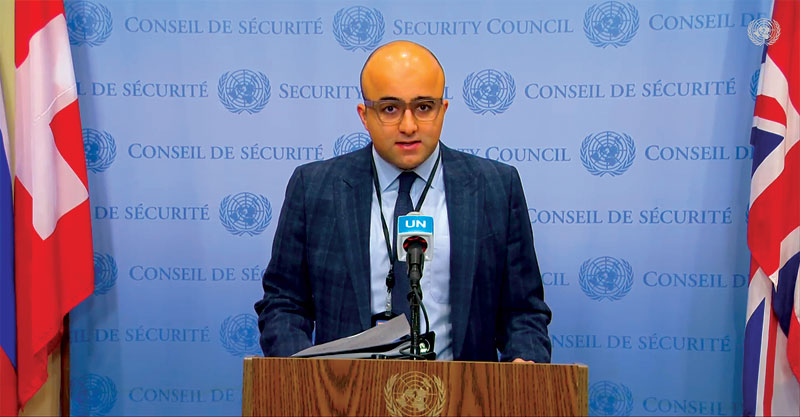
Jonathan Harounoff has spent the past seven years covering Israel, Iran and the Middle East as a journalist. Through his journalism – and his previous work as a communications consultant – he learned the ins and outs of working in the media. Now, Israel’s Ambassador to the U.N., Danny Danon, has appointed him as the new international spokesperson at the United Nations.

“Israel is an amazing, diverse country and an historic nation with an extraordinary population,” Harounoff told the Journal. “I’m honored to be able to play a part in sharing what Israel is really about with the world.”

Harounoff, an Iranian Jew from Britain, wrote about politics, religion and diplomacy in the Middle East for publications including the New York Post, Jerusalem Post, The Jewish Chronicle, Religion News Service and Jewish News Syndicate. He has also appeared on FOX, ABC and NewsNation to talk about Iran, a topic where he’s an expert — currently writing a book about the legacy of Iran’s “Woman, Life, Freedom” protest movement. Along with running his own media consultancy firm, Noff Media, he also worked in corporate communications at a Fortune 500 company and served as director of communications for the Jewish Institute for National Security of America. 

For the past four years, Harounoff has been based in New York, home to the U.N., which has been mired in its fair share of controversy over its relationship to Israel. Despite this, it’s important that Israel keeps being involved in the U.N., he said, because “there is always great value in sitting around the table to have difficult discussions. Being present to present your case is crucial. There is also invariably more value in Israel having a seat at the table presenting its positions on an international stage than not being there at all – and having that void possibly filled by more hostile voices.”

Harounoff, a graduate of Harvard and Columbia, plans to use his platform to present Israel’s case to the international media in a fact-driven manner as well as correct erroneous or misleading claims lodged at the Jewish state.

Harounoff, a graduate of Harvard and Columbia, plans to use his platform to present Israel’s case to the international media in a fact-driven manner as well as correct erroneous or misleading claims lodged at the Jewish state. 

“It is an immense responsibility and great duty to represent Israel on this international stage and remind those who may have forgotten how the conflict we see today in the Middle East started: On Oct. 7, when Hamas perpetrated the worst massacre of Jewish people since the Holocaust, as well as the deadliest concert attack in music history at the Nova Festival,” he said. “The war didn’t start in Gaza, nor did it begin in the Golan Heights. It started when crazed terrorists invaded Israel’s southern border and murdered any civilian they could find in their homes, communities and at a music festival celebrating peace.”

Harounoff assumed his position in September and looks forward to showing the U.N. and the world at large the truth about Israel – in one of the most antagonistic environments for the Jewish state, no less. Still, he has hope. 

“My experience in journalism and communications has helped me prepare for this important role to present Israel’s case at the U.N. in a way that is impactful,” he said. “One Jewish aphorism I like to live by belongs to one of our earlier sages: ‘A little light dispels a lot of darkness.’ Nowhere are those words truer than at the U.N.”

Catching Up with Israel’s New UN International Spokesperson Read More »

Holocaust Boxcar Arrives at Museum, IKAR Housing Project Receives $500,000, ‘Oz’s List’ Screening

Unearthed in Lublin, Poland, near the Majdanek concentration camp, an authentic boxcar was placed by crane on the roof of Holocaust Museum Los Angeles as a permanent exhibit and memorial. Believed to have carried thousands of victims to their deaths, the boxcar will be the only one at an institution on the West Coast and one of only 13 in the U.S.

Unlike other institutions that have boxcars, Holocaust Museum LA‘s forthcoming boxcar exhibit will encompass both Jewish life before the war and an examination of the Nazis’ use of the railroad system to execute “the final solution.” Components will include survivor testimonies and spoken names of murdered Holocaust victims.

Authentic boxcar being placed by crane on the roof of Holocaust Museum LA at Pan Pacific Park. 
Photo by Gary Leonard, Holocaust Museum LA

The finished exhibit, featuring the boxcar encased in a glass pavilion next to a reflective garden, will be open to the public in March 2026 when the museum completes the expansion of the Jona Goldrich Campus, named in honor of Andrea Goldrich Cayton and Melinda Goldrich’s father, survivor and museum co-founder Jona Goldrich.

The boxcar was donated to the museum by the Stanley and Joyce Black Family Foundation and the foundation has also provided the gift to name the pavilion that will house the boxcar. With the help of a friend in Poland, Stanley Black learned about the boxcar left in a forest. He wanted the boxcar to serve as a memorial in Los Angeles and ultimately found its permanent home at Holocaust Museum LA, in memory of his dear friend, Goldrich.

On Nov. 8, Holocaust survivors, dignitaries and government officials, including Los Angeles City Councilwoman Katy Yaroslavsky and California State Assemblymember Jesse Gabriel (D-Encino), gathered at the museum for the arrival of the rare boxcar. 

After being closed since June to prepare the roof for the boxcar, Holocaust Museum LA reopened to the public on Nov. 10.


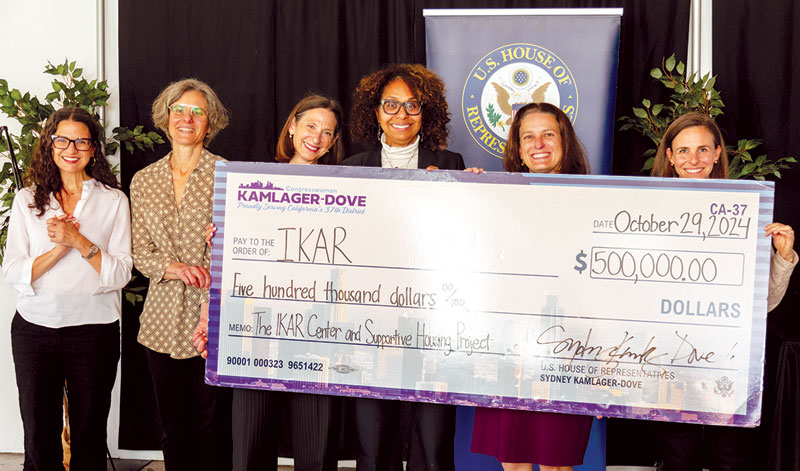
From left: Rabbi Sharon Brous, Brooke Wirtschafter, Melissa Balaban, Rep. Sydney Kamlager-Dove, Councilmember Katy Yaroslavsky and Michelle Rosenthal. Courtesy of the Office of Kamlager-Dove

Providing a template for how faith communities and the government can partner in addressing urgent community needs, U.S. Rep. Sydney Kamlager-Dove (D-Los Angeles) recently presented progressive congregation IKAR with a $500,000 check to support the development of the new IKAR Center and Supportive Housing Center.

This project will build at least 60 units of permanent supportive housing for unhoused people, including seniors, atop IKAR’s campus on South La Cienega Boulevard. It will also include space for supportive services and indoor and outdoor common areas for residents, according to a statement from Kamlager-Dove.

“Ensuring that all Angelenos have a place to call home isn’t just good policy — it is a moral obligation, often informed by faith. By incorporating permanent supportive housing into their new community space, IKAR is upholding its values and following in the long tradition of Los Angeles faith communities working to combat social and economic injustices,” Kamlager-Dove said.

The U.S. representative recently secured $12.4 million in federal funding for 15 respective community projects across her district, which includes Culver City, Ladera Heights and Beverlywood. The IKAR project is one of those.

During an Oct. 29 press conference announcing the gift from Kamlager-Dove’s office, IKAR Founder and CEO Melissa Balaban said the funding would go a long way toward providing needed support for the city’s unhoused population.

“We are honored to accept this federal funding award that will help us realize IKAR’s mission to build affordable housing as part of our new IKAR Center,” Balaban said. “Our community is tremendously grateful to Representative Kamlager-Dove for embracing our vision that faith communities can meet the need of the broader community for more low-income affordable housing by building those new homes on faith organization-owned land.”


From left: Rabbi David Baron, Frances Bilak, Oz Davidian, Ilysia Pierce and Yossi Eli at the movie screening. Photo by Orly Halevy

Temple of the Arts Rabbi David Baron, JNF-USA leader Frances Bilak, Oz Davidian, Cantor Ilysia Pierce and Yossi Eli attended a recent screening of “Oz’s List,” a film about a heroic Oct. 7 rescue effort.

Holocaust Boxcar Arrives at Museum, IKAR Housing Project Receives $500,000, ‘Oz’s List’ Screening Read More »

The Capacity to Change

Ever wonder why Joseph’s brothers threw him into a pit, and then sold him into slavery? Maybe it was jealousy. Their father, Jacob, made no effort to hide the fact that Joseph was his favorite son, signifying Joseph’s exalted status by presenting him with his legendary coat of many colors.

But there is another reason: The Torah reveals that 17-year-old Joseph was simply insufferable. He had recurring dreams extolling his own superiority, and he wasn’t shy about sharing them with his family. He reported that in his dreams not only did his brothers prostrate themselves in front of him, so did “the sun, the moon, and eleven stars.” Even his loving father was put off by his son’s self-importance: “What is this dream that you dreamt?  Your mother, your brothers, and I – must we really come to bow down to the ground before you?”  (Genesis 37:10). No surprise his brothers could no longer stand the sight of him.

However, two decades later when Joseph reunited with his family, he was a different man.  Having worked his way up from being a slave to becoming the equivalent of Egypt’s Prime Minister, you might expect that Joseph would have been more arrogant than ever.  So when Joseph unveiled his identity to his brothers, they “recoiled in fear of him.”  But instead of exacting revenge, Joseph expressed his forgiveness, kissing them, and promising to provide for them and their families.  I don’t know about you, but I would be hard pressed to forgive siblings who threw me into a pit, even if I deserved it.

There are many biblical characters who changed for the better over the course of their lives.  King David, for one, ordered the death of Uriah so that he could then marry Uriah’s wife Bathsheba.  We all sin, but that one is a doozy!  Yet, not only did King David eventually pray for absolution, he devoted his life to repentance, vowing never again to transgress.  His legacy was assured, and he is rightfully recognized as Israel’s greatest king. 

If Joseph and David can improve themselves after such spectacular failures, perhaps there is potential for us all.    

The subject of personal growth has long been of interest in the field of psychology.  An extensive literature focuses on why some traits change throughout one’s life, and others do not.  A critical element is individual desire.  Those who wish to develop in a specific way may succeed if they put in the effort.  And the aging and maturing process can be a catalyst, especially if it involves being exposed to new ideas and reevaluating past actions. That finding isn’t exactly shocking.  In ancient times, Aristotle argued that insight and growth arise from a lifetime of experiences, and a century ago, the essayist William George Jordan wrote that “mistakes are the growing pains of wisdom.”

That gives me hope for myself, and for others.  And I have particular people in mind.  

One of the most disturbing aspects of the aftermath of the Oct. 7 massacre is observing self-identified Jews acting in solidarity with those who seek the demise not just of Israel, but of Judaism.  I am beside myself trying to comprehend why any Jew would stand alongside individuals who gleefully tear down hostage posters, and chant about globalizing the intifada “by any means necessary.”  Are they so taken up in the mob mentality, and in their desire to prove they are bona fide “progressives,” that they are okay with aligning with those who have been calling for the death of all Jews, themselves included?  

I have to believe that they can change, that one day they will reassess their actions, reflecting with remorse how they provided comfort to our mortal enemies.  You might think I am hopelessly naïve.  To paraphrase Winston Churchill, if some people walked down the street and tripped over the truth, they would get up, dust themselves off, and continue down the road as if nothing had happened.

Judaism compels us not only to make the world a better place, but to make ourselves better as well. The stories of Joseph and David should inspire us to do exactly that.

But as Rabbi David Wolpe reminds us, Judaism compels us not only to make the world a better place, but to make ourselves better as well.  The stories of Joseph and David should inspire us to do exactly that.


Morton Schapiro is the former president of Williams College and Northwestern University.  His most recent book (with Gary Saul Morson) is “Minds Wide Shut:  How the New Fundamentalisms Divide Us.”

The Capacity to Change Read More »

Tom Nesher’s Poignant Debut “Come Closer” Premieres at Israeli Film Festival

The Israeli Film Festival (IFF) made its long-awaited return to Los Angeles after a two-and-a-half-year hiatus, kicking off its 36th edition with a gala at the Saban Theater. The event featured a lively atmosphere, beginning with a buffet-style dinner that set the tone for an evening of celebration. Stand-up comedian Elon Gold, a staple of the festival, hosted the ceremony and delighted the crowd with his spot-on impersonations, including a humorous take on former and future President Donald Trump that drew laughs from both supporters and non-supporters alike.

This year, IFF founder and executive director Meir Fenigstein selected a prominent Israeli figure for the prestigious 2024 Industry Leadership Award. Ynon Kreiz is the chairman and CEO of Mattel and is listed on Time magazine’s list as one of the 100 most influential people in the world. Actress Gal Gadot (Wonder Woman) took the stage to presented the award to Kreiz. 

“I’m so honored to present this award to my dear friend, Ynon,” said Gadot. “When I first met Ynon and his incredible wife Anat, I immediately found that we have much in common. We both have four children, we are proud Israelis and we love storytelling, but most of all, we enjoy spending time together.” 

Gadot lightheartedly revealed her nickname for Kreiz, “Mr. Robot,” highlighting his boundless energy and memory. “My husband and I wonder if he has an on and off switch on his back….. He is a machine, but a machine doesn’t have the heart, the passion and the love that Ynon has.”

The “Wonder Woman” actress went on to describe how Kreiz had brought significant financial success to Mattel since becoming its CEO in 2018, revitalizing the company by building a franchise around its most popular product, Barbie. He is credited with bringing the iconic doll to the big screen, resulting in a box office gross of over $1.4 billion.

Kreiz, who took the stage, reflected on his history with the IFF and how it came full circle that night. “In the 90s, as a UCLA student, I volunteered for this very festival, licking envelopes and sending out invitations,” he said with a smile. “I was new here to LA and I craved connection to my home country. This was also a great way to get into the festival for free. More than three decades later, receiving this award feels like a full-circle moment, with one key difference — no envelope licking this time.”

Kreiz praised the festival’s mission: “This is more than just Israeli filmmaking; it’s an opportunity to showcase a small piece of Israeli culture to the world. Israel is the most multifaceted place on earth, where secular and religious, liberal and orthodox, Ashkenazi and Sephardi, Jews and Muslims coexist. Show me one person who’s visited Israel for the first time and didn’t say it’s the most amazing place they’ve ever been to.”

“This is more than just Israeli filmmaking; it’s an opportunity to showcase a small piece of Israeli culture to the world.” – Ynon Kreiz

The evening also saw a special highlight with the screening of Tom Nesher’s film, “‘Come Closer,” which premiered in front of members of the American Film Academy. This marked the beginning of the film’s journey to the Oscars, adding a note of excitement to the festival, as Israel’s official entry for the Oscar for Best International Film. The screening attracted an impressive array of stars, filmmakers and members of the local film community, all eager to experience Nesher’s acclaimed work.

Nesher’s debut film is a haunting exploration of love, loss and obsession, set against a backdrop of stunning visuals. The story follows Eden, whose life begins to unravel after the tragic death of her brother. When she discovers that he had a secret girlfriend, her grief takes a dark and obsessive turn, propelling her into an unsettling spiral of fixation. The 27-year-old director dedicated the film to her brother, Ari, who, like Eden’s brother in the movie, was killed in a car accident at age 17, in 2018.

Fenigstein, who has a longstanding history of showcasing the works of Tom’s father, renowned filmmaker Avi Nesher, introduced the film. Before launching the IFF in New York in 1982, which later expanded to Los Angeles, Fenigstein was the drummer of the highly successful Israeli band Kaveret and even appeared in a few films, including Nesher’s 1978 classic  hit, “The Band” (1978).” 

Addressing the audience from the stage, Fenigstein said, “We are proud to present during this year’s festival more than 40 new feature films, thought-provoking documentaries, and our new initiative of a student short film competition. We remain dedicated to fulfilling our promise to our generous sponsors, our community partners, the beloved filmmakers and their great films.”

Twelve filmmakers and actors took the stage, representing the vibrant lineup of talent who will participate in Q&A sessions following the screenings of their films. The festival will run until November Nov. 26 at Laemmle Town Center 5 in Encino and Laemmle Royal Theatre in West L.A.

To purchase tickets visit: www.israelfilmfestival.com 

Tom Nesher’s Poignant Debut “Come Closer” Premieres at Israeli Film Festival Read More »

Color War Queen ft. Chloe Hechter

The first guest episode of Season 4 is here! With a lot of new listeners, Marla and Libby give you a quick introduction of themselves before giving their relationship updates of the week. They then welcome Chloe Hechter! Chloe has recently blown up on TikTok and Instagram spreading laughs through classic Jewish summer camp and college life skits. She talks about how she’s navigated growing her following while trying posting both Jewish and secular content. Libby and her share in the meaningfulness of having partners who are supportive of their content creation. She talks about growing her page, imposter syndrome, and how being a theater kid has helped her. Chloe also explains how she deals with hate on her videos. They then talk about common issues in Jewish dating and how to deal with them. She then shares some crazy dating stories and about her Jewish identity. They end with a camp version of Cute or Cringe.


You can follw Chloe @chloehechterr and the podcast @schmuckboysofficial

Color War Queen ft. Chloe Hechter Read More »

We Need a Jewish “Insurrection” to Combat Campus Antisemitism

Whenever we hear terms like “insurrection,” we assume it comes from oppressed Palestinian victims of Israeli aggression.

On U.S. college campuses, however, the oppressed victims are not Palestinians but Jewish faculty and students, and the oppressors are not Jews but the overwhelming majority of faculty who sympathize with Palestinians and indoctrinate students to hate Israel.

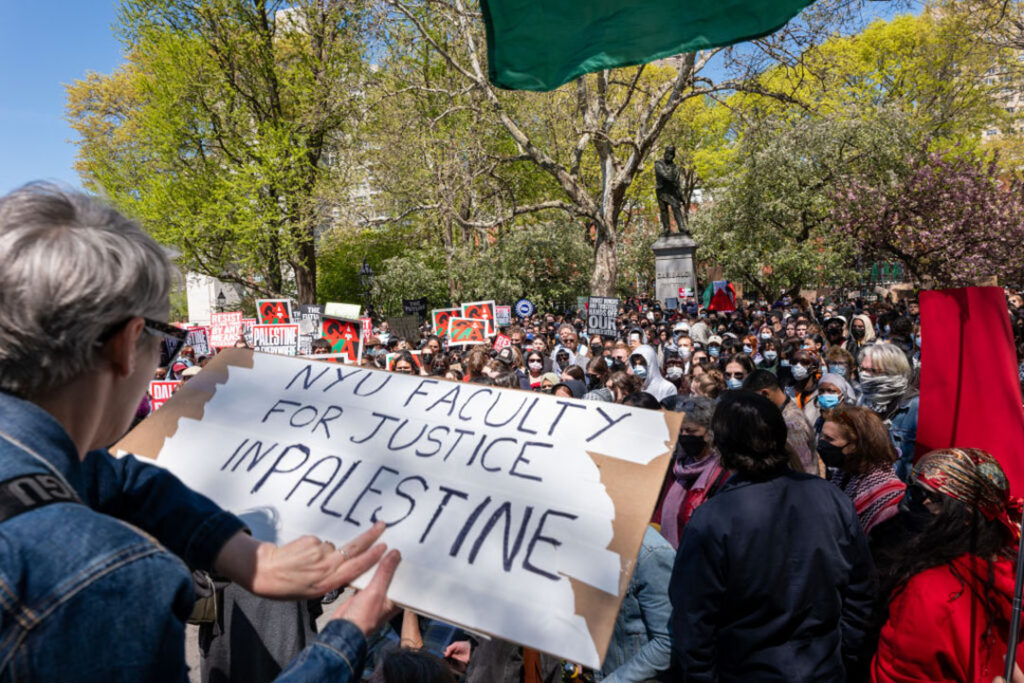
This became clear to me when I saw the latest initiative from AMCHA to combat faculty antisemitism. To give you a sense of how widespread the oppression is against Jews, AMCHA’s first target will be the Faculty for Justice in Palestine (FJP), a network of 170 faculty chapters established after the Hamas attacks of Oct. 7 that murdered 1200 Israelis.

Think about that: Israelis are massacred in Israel, and a movement begins in America on 170 college campuses whose sole purpose is to target Israel.

“The primary mission of FJP,” AMCHA said in its announcement, “is to exploit their academic positions and departmental resources to actively promote the academic boycott of Israel (academic BDS) by engaging in actions to rid their campuses of Zionism and Zionists, shut down educational opportunities and stifle free speech.”

The growing power of FJP and other anti-Israel groups is not a coincidence. It can be traced directly to a huge influx of overseas money into these universities. According to a 2022 study, for example, Qatar contributed $4.7 billion to dozens of academic institutions across the United States between 2001 and 2021.

In an ongoing research project started in 2012 titled “Follow the Money,” ISGAP examined “illicit funding of United States universities by foreign governments, foundations and corporations that adhere to and promote anti-democratic and antisemitic ideologies, with connections to terrorism and terror financing.”

The research revealed “the existence of substantial Middle Eastern funding (primarily from Qatar) to US universities that had not been reported to the Department of Education (DoED), as required by law.”

The point is this: The movement to oppress Jews and undermine Israel on college campuses is big, widespread and mainstream. Against such a juggernaut, groups like AMCHA are not just activists but feisty insurrectionists, a term I first heard from my friend UCLA Professor Judea Pearl.

Indeed another activist faculty group is The Jewish Faculty Resilience Group (JFrg) at UCLA, which bills itself as “a community of faculty, postdoctoral researchers, and staff, both Jewish and non-Jewish, dedicated to supporting the Jewish community on campus.”

Given what they’re up against, these groups and many others will be punching way above their weight.

FJP, with its 170 chapters and growing, has plenty of support. According to AMCHA, it is “linked to the U.S. affiliate of the Palestinian Campaign for the Academic and Cultural Boycott of Israel (PACBI), which has ties to terrorist organizations, including Hamas.”

It’s easy to see all these names, acronyms and figures and forget the daily impact on Jewish students and faculty. AMCHA’s research has revealed that FJP’s presence on campuses “significantly heightens risks for Jewish students, increasing the likelihood of physical assaults sevenfold and the likelihood of threats of violence threefold.”

FJP also contributed to the duration of encampment protests, “which were likely to last over four and half times longer on campuses where FJP faculty were free to influence and provide logistic and material support to students. And academic boycott calls were nearly 11 times more likely in student demands on campuses with FJP chapters, indicating academic BDS campaigns are faculty-driven.”

In short, the widespread oppression of Jewish students and faculty across college campuses is coming from powerful and mainstream centers of authority, fueled by overseas money.

Against such overwhelming force, Jews need a revolutionary spirit.

The first crucial step is to expose the breadth and depth of the oppression. For example, according to AMCHA, “FJP’s academic boycott extends beyond Israeli institutions, targeting pro-Israel students and faculty on U.S. campuses for exclusion, shutting down educational and research opportunities, refusing dialogue with Jewish organizations and bullying students and faculty who support Israel.”

Influential Jewish groups and activists must support this brave and fledgling “insurrection” by exposing the alarming network of institutional forces arrayed against Jewish students and faculty. I know that groups like StandWithUs, Students Supporting Israel and the Israel on Campus Coalition, among many others, are fighting the good fight. They understand that there must be consequences for discriminating against Jewish students and faculty, not to mention the bullying and intimidation of anyone who expresses support for Israel.

Just as every tiny action of Israel is put under the microscope, we must do the same with this pervasive movement, a movement that is not only normalizing Jew-hatred but also undermining the ideals of higher learning by replacing education with indoctrination. The world must see how far this calumny has gone and how corrosive it has become.

Modern-day Jews are not used to being insurrectionists and revolutionaries. We’re used to being the influential ones, the ones with wealthy donors and powerful lobbyists, part of the “privileged” class.

On college campuses, however, Jews facing oppression are anything but privileged. They are the new rebels on campus, and they’re up against an army of hate. Let’s show them we have their backs.

We Need a Jewish “Insurrection” to Combat Campus Antisemitism Read More »

A Muslim Scholar Criticizes Hamas: Sooner Would Have Been Better

A recent article published by the BBC reports that one of Gaza’s top Islamic scholars, Professor Dr Salman al-Dayah, former Dean of the Faculty of Sharia and Law at the Hamas-affiliated Islamic University of Gaza, has issued a fatwa condemning Hamas’s Oct. 7, 2023 attack on Israel. The fatwa, a non-binding legal ruling based on the Quran, criticizes Hamas for violating Islamic principles with respect to jihad (Arabic, for struggle). Dr. al-Dayah cites the Quran in specifying that jihad should avoid actions leading to disproportionate reactions from the enemy. He takes Hamas to task for not keeping its fighting forces away from civilians and for not “providing security and safety as much as possible in the various aspects of life … security, economic, health, and education, and saving enough supplies for them.”

The fatwa points to the brutality of the Hamas attack, the disregard for the lives of men, women, children and babies, the raping and mutilation of women, the kidnapping of 251 Israelis, and the firing of thousands of explosive rockets toward Israeli civilian centers, as a strategy meant to elicit a strong Israeli military response. In effect, the fatwa connects the civilian death toll in Gaza to Hamas, and to its disregard for the lives of its own people.

While I am not a military historian, I wonder if the Gaza War is the first case in history in which the deaths and injuries of its own people are a statistic used as a weapon by one of the protagonists. Hamas has maximized its own casualty numbers, not those of its enemy, by making it impossible to distinguish between combatants and civilians and by placing and using weapons in civilian homes, in schools and in hospitals—all war crimes. Nothing emphasizes the disregard by Hamas for the welfare of ordinary Palestinians more than the extensive tunnels built over many years to protect Hamas combatants and weapons, not civilians.

This is not to say that Israeli casualties during the Gaza war have been negligible. Hundreds of Israeli soldiers have been killed and thousands injured from ambushes and booby-traps set by an enemy that intentionally embeds itself in a civilian population.

In the immediate aftermath of the brutal Hamas attack on Israel, the Washington Institute for Near East Policy reported that at least 44 nations condemned Hamas and its terrorist tactics. However, the report also noted that few words of compassion for Israelis, or condemnation of Hamas, emanated from the Arab world. Statements from countries including Qatar, Saudi Arabia, Kuwait and Syria pinned the blame on Israel. Only Bahrein and the UAE, two of Israel’s Abrahamic Accords partners, offered mild criticism of Hamas.

This is why the fatwa issued by Dr Salman al-Dayah is an important and welcome change. (In fact, it was not the first fatwa criticizing Hamas. Months before the Oct. 7 attack, The Jerusalem Post published an account of a fatwa by the Islamic Fatwa Council stating that Hamas’s corrupt conduct and use of terror against Palestinian civilians violates the Laws of the Quran.)

While Arab governments and diplomats have been reticent to criticize Hamas, a number of courageous Palestinian bloggers and journalists have not hesitated to do so. These include Yosef Haddad, an outspoken Arab–Israeli journalist, Mosab Hassan Yousef (also known as the Green Prince) whose father was a co-founder of Hamas, and Ahmed Fouad Alkhatib a Palestinian-American blogger and activist. There are others.

While Arab governments and diplomats have been reticent to criticize Hamas, a number of courageous Palestinian bloggers and journalists have not hesitated to do so.

One writer I follow is Bassem Eid, a Palestinian human rights activist from the West Bank, who has written extensively about human rights abuses by the Palestinian Authority and Hamas. Eid’s views on the Gaza War appear in a number of publications such as Newsweek and in social media, particularly Instagram. Eid has pointed out that Hamas is responsible for the bloodshed in Gaza and for hampering the distribution of food and other supplies to the people of Gaza.

While Dr. al-Dayah’s fatwa is welcome, it is too late to have prevented or mitigated the tragedy experienced by Gazans. I can’t help but think of an unattributed but chilling quotation that has been circulating on social media for the past year:

“Imagine if on October 8, 2023 the UN Security Council voted unanimously to condemn Hamas for war crimes, demanded the immediate return of all hostages, and ordered Qatar to extradite Hamas leadership to the International Criminal Court in The Hague, where they could have been tried for War Crimes, Crimes against Humanity and Genocide. Had that occurred, think of how many people in Gaza would be alive today.”


Jacob Sivak, a Fellow of the Royal Society of Canada, is a retired professor, University of Waterloo.

A Muslim Scholar Criticizes Hamas: Sooner Would Have Been Better Read More »

Iranian Regime’s Strategies for Engaging with Trump

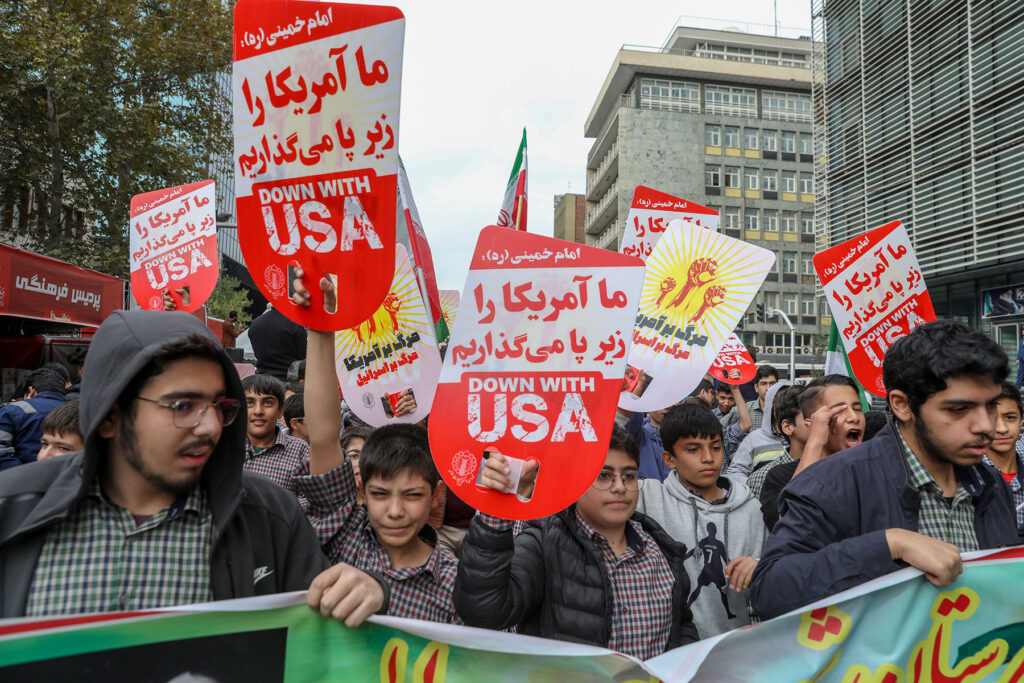
To fully understand the Iranian regime’s foreign policy strategies for engaging with Trump, one must first examine the domestic situation in Iran and the strained relationship between the regime and its people.

State of the Iranian Society

Currently, executions in Iran have reached unprecedented levels. In October alone, one execution was carried out every four hours, with reports of one individual even being executed twice. Female prisoners are often not released even after completing their sentences. The soaring number of executions since the appointment of Massoud Pezeshkian as president last August underscores how Ali Khamenei, the Supreme Leader and religious dictator, is striving to maintain control in a highly volatile domestic environment.

In an article titled “We’re Cornered,” published on Sept. 10 by the Shargh newspaper, Hashemi-Taba, a former presidential candidate, expressed: “All signs indicate that we are cornered. This is not the fault of this government or that government … This gridlock is not solely due to U.S. and European sanctions, but even if today we were to court the U.S., accept FATF, and have the International Atomic Energy Agency leave us alone, this gridlock would still persist.”

The Iranian society is currently trapped in a web of severe economic and infrastructural imbalances. From water and electricity shortages to gasoline and other basic necessities, the nation faces widespread deprivation. Despite Iran’s vast natural resources—including oil, gas, and minerals—more than two-thirds of its population live in absolute poverty.

The regime’s fear of popular uprisings has only intensified since the 2019 protests, known as the “Fiery Uprising.” During that three-day revolt, the regime retained its grip on power only by massacring over 1500 protesters. Acts of desperation have followed: For instance, a war veteran in Kazeroon (Shiraz) assassinated Khamenei’s local representative before taking his own life. Recently, after enduring three years of imprisonment and torture, a former journalist for Voice of America committed suicide to protest the horrific conditions in Iranian prisons. These events reveal the profound and growing resentment among the people toward the regime.

The Iranian leadership is acutely aware of the potential for another uprising and fears it may not survive a new wave of mass protests.

Resolving Khamenei’s Succession Issue

Amid these internal crises, the regime faces a critical issue: resolving the succession of Khamenei before his death. Mojtaba Khamenei, his son, has been floated as a possible successor. The Assembly of Experts* has reportedly shortlisted three candidates for the position. However, if the succession issue remains unresolved, the regime could collapse rapidly after the ailing 85-year-old Khamenei’s death. According to recent surveys conducted within Iran, more than 90% of the population opposes the current regime, signaling an existential crisis.

Khamenei seeks to secure his son’s position as his successor even through presenting him as a “reformist figure” who could advocate for internal reforms and external diplomacy.

French philosopher Bernard Henri Levy states that the weakened mullahs’ regime has little choice but to re-engage with U.S. president-elect Donald Trump.

The regime is under mounting pressure from thousands of resistance units affiliated with the opposition People’s Moujahidin (PMOI/MEK)—the main component of the democratic alternative National Council of Resistance (NCRI) advocating for the separation of religion and state. Since 2019, the NCRI has seen unprecedented growth in both size and influence.

In this context, the Iranian ambassador’s meeting with Elon Musk on Nov. 11 may signal the regime’s last-ditch effort to mitigate U.S. pressure and halt the decline in oil exports, which had surpassed pre-sanctions levels under Biden but could plummet again under renewed maximum pressure.

Iran’s Oil Exports

The outbreak of the Israel-Hamas war on Oct. 7 raised immediate questions about how Hamas funded its attack on Israel. With extensive underground tunnel networks reportedly longer than Tehran’s subway system and weapons factories, the scale of the operation far exceeded Hamas’s independent capabilities. Tehran was widely suspected of being Hamas’s financial backer.

This placed the Biden administration under intense pressure to halt Iranian oil exports. According to the Etemadnewspaper, which is close to the Iranian government, as of Nov. 6,
“Iran’s oil exports in recent years have returned to pre-sanctions levels, while during Trump’s presidency, oil exports dropped to below 500,000 barrels per day, placing severe pressure on the oil sector [read: the regime].”

Negotiating from a “Position of Strength”

Proxy forces like Hezbollah in Lebanon and the Houthis in Yemen have long served as the regime’s leverage to extort the international community. However, these tools are now significantly weakened. Continuous bombings in Lebanon and Syria, key logistical bases for these proxies, have eroded their effectiveness. The regime is now urgently seeking a ceasefire in Lebanon to prevent the complete collapse of Hezbollah.

Proxy forces like Hezbollah in Lebanon and the Houthis in Yemen have long served as the regime’s leverage to extort the international community.

The Iranian regime recognizes that any negotiations with a Trump administration would require significant concessions, including curtailing its support for proxy forces and scaling back its nuclear enrichment program. However, such concessions, deeply tied to the regime’s identity and survival strategy, would likely hasten its collapse. To avoid this fate, the regime aims to negotiate from a “position of strength,” hoping to extract guarantees critical to its survival in exchange for any compromises.

Abbas Araghchi, Iran’s chief diplomat, articulated this strategy after meeting with Rafael Grossi, the head of the International Atomic Energy Agency (IAEA) visiting Iran. Posting on the platform X, he stated: “We are ready to negotiate based on our national interests and legitimate rights, but we are not willing to negotiate under pressure or intimidation.”

A newspaper aligned with the regime recently noted: “The likelihood of reaching an agreement with Trump is low unless Iran raises its enrichment levels to over 90%.”

Reaching 90% enrichment is a critical step toward acquiring a nuclear weapon. The question remains: Is the regime prepared to conduct a nuclear test at any cost to strengthen its bargaining position and ensure its survival?

Despite the formidable challenge of destroying underground enrichment facilities buried hundreds of meters below the surface, the U.S. and Europe have repeatedly and explicitly declared that they will not permit Iran to achieve nuclear capability. Crossing this red line would have irreversible consequences.

Conclusion

Even if the Iranian regime were to successfully test a nuclear bomb and acquire a deterrent weapon, history demonstrates that such measures cannot prevent internal collapse. The Soviet Union, despite possessing an array of nuclear warheads, ultimately succumbed to widespread public dissatisfaction and systemic failures.

The Iranian regime faces a similar dilemma: its reliance on repression, nuclear brinkmanship, and proxy forces may buy it time, but cannot address the underlying grievances of its population. Unable to pursue genuine reforms, its survival remains precarious.

Notes

*The Assembly of Experts: This body, composed of qualified clerics, is responsible for selecting, dismissing, and overseeing the leader of the Islamic Republic of Iran, as stipulated in Article 107 of the Iranian Constitution.


Hamid Enayat is a political scientist, specializing on the topic of Iran, who collaborates with the Iranian democratic opposition.

Iranian Regime’s Strategies for Engaging with Trump Read More »

Online Journalist of the Year: NAEJ 2024 Finalist

THANK YOU! I am honored to be a FOUR TIME finalist for the 2024 17th annual National Arts and Entertainment Journalism Awards. I am a finalist for Online Journalist of the Year, and for three of my podcast interviews with Beth Santos, Wanderful, Carolyn Roy, JourneyWoman, and Samantha Brown, Places to Love.

What an honor to be a four-time finalist. The judges carefully reviewed more than 1,600 entries to find the best Arts and Entertainment reporting the nation had to offer, and I am a finalist for these awards:

A3. Online Journalist of the Year — Independent 

  • Lisa Niver, We Said Go Travel 
  • A.D. Amorosi, Freelance
  • Philip Boroff, Broadway Journal
  • Holly Gleason, Freelance
  • Kate Nelson, Freelance

J3. Diversity in the Entertainment Industry 

  • Lisa Niver, PODCAST: Make Your Own Map, “Ageless Ambition: Inspirational Leadership of Carolyn Ray, JourneyWoman”
  • Lisa Niver, PODCAST: Make Your Own Map, “Maximum Beth: Disrupting Travel for Women, Changing the Wander World Worldwide – A Community Builder’s Journey”
  • Caroline Feraday, KCLU, “America’s first all-female mariachi group bring the rich cultural heritage of Latin America to Santa Barbara County”
  • Norma Martinez, Marian Navarro, Texas Public Radio, “‘My instrument is the orchestra’ — Colombian-born conductor discusses her path to the podium”
  • Elvis Mitchell, Rebecca Mooney, Katie Gilcrest, KCRW, “New Yorker writer Hua Hsu reflects on memoir ‘Stay True’”

J5. One-on-One Interview, TV Personalities

  • Lisa Niver, We Said Go Travel, “Journey into the World of Wanderlust: Samantha Brown, Travel Goddess”
  • Madeleine Brand, Angie Perrin, KCRW, “Julia Louis-Dreyfus on coping with grief, refusing to be ignored”
  • Deborah Zara Kobylt, iHeartRadio and Youtube, “Fox11’s Christine Devine talks about meeting her father for the first time in Brazil”
  • Jennifer Maas, Variety, “Xbox Game Content and Studios President Matt Booty on ‘Beginning to Hit Our Stride,’ Game Pass Strategy, ‘Fallout’ Update, Studio Closures and More”
  • Michael Schneider, Variety, “Day Eating With Seth Meyers: The ‘Late Night’ Host Counts Down His Top 10 Pizza List”

Melissa Etheridge, Tiffany Haddish, Kevin Frazier and Kathy Bates to Be Honored at 17th National Arts & Entertainment Journalism Awards

Lisa Niver has won many awards! From 2017 to 2024, in the Southern California Journalism Awards and National Arts and Entertainment Journalism Awards, she has won eight times and been a finalist thirty-five times for a variety of broadcast, print, podcast and digital categories.

More about Lisa Niver: https://lisaniver.com/awards/

More about BRAVE-ish

Online Journalist of the Year: NAEJ 2024 Finalist Read More »

Echoes of Fairfax: Simon Rutberg and the Golden Age of LA’s Jewish Music Scene

Simon Rutberg hadn’t set foot on Fairfax Blvd in years. In fact, it’s been nearly two decades since he closed his record store there in 2006. The memories are too painful and there are too many of them. 

In a way, he grew up on this street. As a child, he would go shopping with his mother at the Jewish market and bakery. Trips to Fairfax always excited him because that was when he got to visit Norty’s, the Jewish record store, to check out their latest arrivals. Later, in his late teens, he worked there and in 1989, he took over the location and opened his own record store, Hatikvah.

Today, there’s nothing left of the street as he knew it. Solomon’s Bookstore, Schwartz’s Kosher Bakery and other Jewish stores have been replaced by street-wear shops, Flight Club LA, skateboard stores and pop-up shops that change frequently. Almost nothing remained of the Jewish street it once was, except for a few establishments like Canter’s Deli.

But what became of the store owners who had to close their doors after so many years? Rutberg, for one, moved his massive collection of over 9,000 records, cassettes and CDs to his West Hollywood apartment. I met him at his home, where shelves and dozens of boxes filled with inventory crowded the space. He apologized for the mess, explaining that after 27 years, he was moving out because the building’s new owners had sold it, forcing him and the rest of the tenants to leave. It was a familiar story. The same thing happened to him in 2006 when a businessman began buying up blocks on Fairfax Avenue, pushing him and many others out.

“I refuse to walk down the block; it just hurts too much,” he said. “There are stickers and graffiti everywhere—it’s dirty and neglected. In my time, people swept the sidewalks outside their stores. The street was clean. Fairfax was the center of Jewish life. When people said, ‘We’re going to Fairfax,’ everyone knew what that meant—those two blocks where you could buy anything you needed. Today, there is nothing Jewish about it.”

Rutberg was born in Russia and moved with his parents to Belgium and then to theU.S. before his eighth birthday. “We first lived in Dallas, and I went to Dallas Hillel Academy, which was my first introduction to Judaism. When I was 10, we moved to Los Angeles. Fairfax was the Jewish neighborhood in town and Fairfax High was 99% Jewish. But we lived on the wrong side of town, in Vermont, because we couldn’t afford to live there.”

Years later, when the family could afford to move to the Fairfax District and Rutberg could have attended Fairfax High, he chose to continue at Belmont High School. “I didn’t feel like I had anything in common with the Jewish students. I felt more comfortable among Black and Mexican students, as my school had an overwhelmingly African American and Mexican population. I loved listening to R&B. That’s the music I grow up on.”

Nevertheless, his parents insisted on sending him to Hebrew school in the afternoons, and he walked a mile and a half to Sinai Temple and back home in the dark. “We couldn’t afford bus fare, so I walked,” he said.”

Rutberg loved Norty’s Music Center at 436 N Fairfax Avenue, just across from Canter’s.  He spent so much time there that the owners knew him by name. “Steve Barri was always behind the counter, writing. One day, when I was 18, Norty asked if I’d like to work there. I said, ‘Sure, but what about Steve?’ Norty said Steve had found another job. He later became vice president of Dunhill Records and I found out that he was writing hit songs while sitting in the store.”

He wasn’t the only songwriter who started there. Jerry Leiber who also worked at Norty’s, became a very successful composer, writing with his partner Mike Stoller many R&B and pop songs. Together, they wrote hit songs for Elvis Presley like “Jailhouse Rock” and “Hound Dog,” to name a few. Rutberg recalled that as a teenager he used to see Phil Spector coming to the store often. “It was a hangout place.”

The store featured both American, world music and Yiddish and Israeli music. “After the Six-Day War in 1967, Israeli music exploded. ‘Jerusalem of Gold’ was played constantly and we started importing music from Israel. Many Israeli singers started coming here,” Rutberg said. “We had no competition for Israeli and Jewish music.”

Rutberg stayed at the store until 1971 and then moved to work independently in other businesses, but kept in touch with the store’s owner until she decided to sell it. 

He seized the chance to take over, rented the location and reopened the store under a new name: Hatikvah.  “I knew the business inside and out. Whenever I admired a singer, I’d call them directly. I called Yaffa Yarkoni, and she recorded ‘Sabra Sings Yiddish’ with both Hebrew and Yiddish songs, which I released under my own label. I reintroduced a lot of Israeli and Yiddish music that had gone out of print. Beside Jewish music I also produced three CD box sets by the late Jackie Wilson, who was my best friend.”

Rutberg’s eyes lit up as he recounted the golden days when people would visit his store to find records. He and other store owners didn’t even lock their doors when stepping out; everyone looked out for each other. “You just left and came back and nothing was stolen. My favorite time of the day was closing up and looking at the inventory, knowing I had the biggest Jewish music collection in the world. For me, it was a library of our culture.”

“My favorite time of the day was closing up and looking at the inventory, knowing I had the biggest Jewish music collection in the world.”

Since moving his collection home, Rutberg has sold some of it privately and recently donated many CDs to the Workers Circle. But he still has much left. His dream is to find a new home for his collection, perhaps sell it to a museum or a library that appreciates its value. 

“It hurts to see it go. I would have loved for someone to keep the Jewish music alive,” he said.

For more information, visit hatikvahmusic.com. 

Echoes of Fairfax: Simon Rutberg and the Golden Age of LA’s Jewish Music Scene Read More »