fbpx

October 16, 2024

Lesléa Newman: Food Poetry, Children’s Books and Latkes

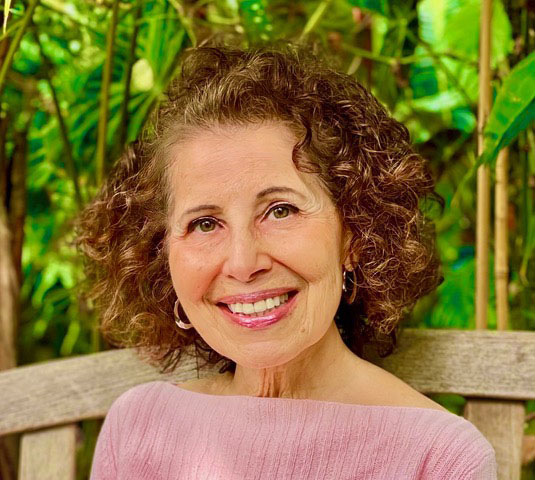
Jewish comfort food showed up in one of Lesléa Newman’s first children’s books, “Matzo Ball Moon.” It has been making appearances in her work ever since.

“[Food is] part of our every holiday, every Shabbat,” author and poet Newman told the Journal. “It’s really important to  … literally break bread – break challah, break matzah – depending on the holiday.”

She added, “It’s a way to show love, it’s a way to nourish each other, literally and figuratively… it does invoke a sense of community.”

Although Newman’s titles, which include “The Babka Sisters,” “A Sweet Passover” and the recently released “Hanukkah,” are fiction, they are based on her own experiences.

For instance, “A Sweet Passover” is about a little girl who is sick of matzah. Then, her grandfather, based on Newman’s father, makes a matzah brei.

“Through making the matzah brei [it] tells the story of Passover,” Newman said. “And at the end of the book, of course, the little girl changes her mind, and she and her grandfather make the matzah brie together.”

“Hanukkah” also guides the reader through the holiday via the family’s traditions.

“Different guests come to the table and they all bring food, they spin the dreidel,” she said. “They just have a wonderful time together; it’s very hamish.”

Most of Newman’s cooking specialties are Jewish foods that she learned from her grandmother, who also appears in a lot of her children’s books.

“My grandmother was from the old country, and she was a real balaboosta, which is someone who really runs the kitchen well’” Newman said. “She used to say [that] she could make a meal out of a potato and half an onion.”

Although Newman’s mother was not the world’s greatest cook, she called her one of the world’s “greatest defrosters.” Newman’s cooking skills are somewhere in between.  She is known for her chicken soup with matzo balls; she also makes wonderful applesauce and latkes. Her recipe for year-round latkes is below.

Newman writes books for adults as well, though her first love is poetry. She has a lot of poems about food, too!

“I grew up in Brooklyn and then when I was eight, we moved to Long Island, which I really was very unhappy about,” she said. “One reason was because my grandmother, who lived across the street from us from Brooklyn, now lived a 45-minute car ride away.”

Nobody suggested Newman start writing poetry to feel better. Somehow, innately, she did.

If you want to write poetry, it’s important to read poetry.

“If you don’t know where to start, you can pick up an anthology that has poetry written by many people, and, when you find some poets in there that you like, go buy their books,” she said. “I find whenever I’m not sure what to write next, reading poetry really can be very inspiring.”

Develop a habit of writing, Newman said, “And you will be amazed, surprised, and delighted by the genius that lives inside of you.”

When asked what she hopes children get from her books, Newman talked about the concept  of mirrors and windows.

“When a child reads a book that, if the family in the book is like their own, it’s like looking in a mirror,” she said. “If the family is not like their own, it’s like looking through a window and seeing another culture.”

There are also sliding doors, which is a way for the reader to enter the world of the story.

“It’s really important for kids to see themselves in books and it’s really important for kids to see families and kids, who are not like themselves, so they learn about the world,” she said. “I hope … Jewish children will see themselves in these books and feel proud, excited and like they have a place to belong.”

Learn more about Lesléa Newman – her books and poems – at LeselaNewman.com.

For the full conversation, and to hear Lesléa Newman’s knish poem, listen to the podcast:

Watch the interview:

Latkes and Applesauce for Hanukkah or All Year Round

For the latkes

6 large potatoes

3 eggs

½ cup to a cup of matzo meal

vegetable oil as needed

Peel the potatoes and then use either a grater or food processor to grate them. I’m old-fashioned so I use a grater (and often work up a sweat!).

Place the shredded potatoes in a large bowl. If they are watery, drain off the liquid.

In a separate bowl, crack the eggs and whisk them with a fork. Add to the potatoes.

Add ½ cup of matzo meal to the potato/egg mixture. Mix everything together well. If the mixture is too soupy, add more matzo meal. You can also drain the mixture again.

Pour a good layer of vegetable oil into a large frying pan. Make sure the bottom of the pan is completely covered.

Once the oil is sizzling, place a tablespoon of the latke mix into the frying pan and flatten with a spatula. Repeat until there is no more room in the frying pan.

When the latkes look like they are becoming crispy, flip them over and cook the other side.

When both sides of the latkes are crispy, place on a paper bag or paper towel to soak up the excess oil. Serve hot (but be careful not to burn your tongue).

For the Applesauce

12 ripe apples (I use Macintosh, very ripe, just this side of mushy)

1/2 cup of water

sugar, brown sugar, and cinnamon to taste

Peel and core a dozen ripe apples and cut into very small pieces.

Place apples in a pot with about 1/2 cup of water.

Bring to a boil and cook apples until they are mushy

While the apples are cooking, add sugar, brown sugar and cinnamon to taste.

When the apples are very soft and mushy, turn off the stove and mash them with a potato masher (I always leave the applesauce a bit lumpy).

Serve hot or cold. Goes magnificently with latkes!


Debra Eckerling is a writer for the Jewish Journal and the host of “Taste Buds with Deb.Subscribe on YouTube or your favorite podcast platform. Email Debra: tastebuds@jewishjournal.com.

Lesléa Newman: Food Poetry, Children’s Books and Latkes Read More »

Lawsuit: Jewish Teachers Object to UTLA Dues Over Union’s Antisemitism

Four Jewish teachers in the Los Angeles Unified School District (LAUSD) filed a lawsuit over being compelled to provide dues to the United Teachers Los Angeles (UTLA) despite leaving the union over what they see as antisemitism and anti-Israel bias in UTLA.

The lawsuit, which was obtained by The Journal, lists the members of the California Public Employees Relations Board (PERB) and LAUSD Superintendent Alberto Carvalho as defendants. Under state law, PERB certifies UTLA as the sole bargaining representative for LAUSD teachers; Carvalho, according to the lawsuit, “oversees and manages the collective bargaining process between the LAUSD bargaining unit and UTLA, and approved the resulting CBA.” The CBA states that LAUSD teachers will have their UTLA dues automatically deducted from their payroll. Thus, the four Jewish teachers are still being compelled to pay UTLA dues despite having sincere religious objections to the union’s activities, the lawsuit states.

The lawsuit accuses UTLA of “longstanding antisemitic speech and public positions” as well as harassing and discriminating “against Jewish and Zionist teachers who are forced to associate with UTLA because of exclusive representation.” Since the Oct. 7, 2023 massacre, UTLA has “refused to allow pro-Israel and Zionist members to participate in Zoom meetings” while those participating in the Zoom were allowed to have “overtly anti-Israel background screens.” Additionally, the lawsuit notes that UTLA’s Political Action Council of Educators (PACE) endorsed school board candidate Kahllid Al-Alim in Nov. 2023; Al-Alim “has an extensive number of public antisemitic posts on both Twitter/X and Instagram, including blood libel, conspiracy theories and anti-Zionist rhetoric.” The Journal has previously reported that Al-Alim issued an apology for a post on X calling a Nation of Islam book “required reading” and that he has “spent my life fighting against antisemitism, anti-Arab hate, Islamophobia, and all forms of oppression.”

UTLA allegedly pressured a Jewish member “to stop disclosing Mr. Al-Alim’s positions, and subsequently [the] UTLA removed all evidence of the endorsement from its website a few hours before the election,” the lawsuit states. “However, this did not stop UTLA from donating $728,887.44 to Mr. Al-Alim’s campaign.”

The lawsuit also notes that the UTLA house of representatives voted to support the UCLA anti-Israel encampments in June, and that Jewish members who spoke out against UTLA voting on anti-Israel resolutions and motions in March and April “were harassed and removed” from meetings. Meanwhile, UTLA has failed “to express support for the victims” of the Oct. 7 massacre.

The UTLA house of representatives voted to support the UCLA anti-Israel encampments in June, and that Jewish members who spoke out against UTLA voting on anti-Israel resolutions and motions in March and April “were harassed and removed” from meetings.

The union is also an advocate of the Liberated Ethnic Studies Model Curriculum (LESMC) and that “the Ethnic Studies material taught in LAUSD is heavily influenced by the LESMC and denounces the State of Israel,” per the lawsuit. The lawsuit points to an April 2021 ethnic studies panel training hosted by UTLA in which Celine Qussiny, a “Palestine Studies” expert, told attendees that “we must always be confronting Zionism.” She called Zionism a “settler-colonial ideology that justifies the ethnic cleansing of Palestinians from their ancestral homeland” and that Israel is a “fascist dictatorship.” Further, UTLA has offered “Teach Palestine” training for teachers that omits how relevant Israel is to Judaism.

The lawsuit also claims to have evidence of an August 2024 UTLA conference where members discussed how to be “anti-Israel in the classrooms without getting fired.” During this meeting, “UTLA staff spread antisemitic talking points by falsely implying that a Jewish cabal accused an anti-Israel teacher of possessing child pornography ‘because of this issue,’ so that the teacher would stop teaching anti-Israel information to his students.”

Further, the lawsuit accuses UTLA President Cecily Myart-Cruz of claiming during a Zoom meeting that signing a petition advocating against a ceasefire in the ongoing Israel-Hamas war would be “white supremacy” and that “UTLA administrators and officials referred to Jewish parents as those ‘Europeans, white oppressors in the Valley’” as well as “those Middle Easterners in the rich areas of Los Angeles” during meetings.

The lawsuit alleges that even before the Oct. 7 massacre, UTLA has excluded Jewish and Zionist members from their Facebook group, Myart-Cruz referred to the Museum of Tolerance as “the enemy,” and the union’s house of representatives passed a motion supporting the Boycott, Divestment and Sanctions (BDS) movement.

The plaintiffs believe that UTLA has fostered a hostile environment against Jewish and pro-Israel teachers and students in the district, which is why they have resigned from the union and no longer wish to have their wages go toward UTLA dues.

“In the aftermath of the deadly Hamas attacks, UTLA used membership dues to subsidize anti-Semitic school board candidates, curriculum and rhetoric,” Shella Alcabes, the Freedom Foundation’s California litigator, said in a statement. “When educators objected, UTLA retaliated by intimidating Jewish teachers and barring dissenters from union activities. Our lawsuit seeks to put an end to this and hold UTLA accountable.” The Freedom Foundation is representing the plaintiffs.

A spokesperson from PERB told the Journal that “the board is reviewing the lawsuit and has no comment at this time.” A LAUSD spokesperson told The Journal that the district “does not comment on pending or ongoing litigation.” UTLA did not respond to the Journal’s requests for comment.

Lawsuit: Jewish Teachers Object to UTLA Dues Over Union’s Antisemitism Read More »

Alon Shaya’s Italian Matzah Ball Soup

October is Italian-American Heritage Month. In a show of appreciation for the Italian culture, chef Alon Shaya wanted to share one of his favorite fusions: Italian matzah ball soup.

“This dish is deeply rooted in my culinary background, which blends Italian American and Jewish influences,” Shaya, co-founder of Pomegranate Hospitality and author of “Shaya: An Odyssey of Food, My Journey Back to Israel,” told The Journal. “It represents a harmonious blend of traditions from the Italian ghettos, where Jews would adapt culinary practices to [their] environment.”

“(The soup) represents a harmonious blend of traditions from the Italian ghettos, where Jews would adapt culinary practices to [their] environment.”
– Alon Shaya

Shaya explained that the smell of charred peppers, the variety of marinated olives, multiple textures of goat cheese and crispy golden schnitzel (also known in Milan as Cotoletta alla Milanese) are just a few ways that Israeli and Italian food come together beautifully and naturally. 

“I have always felt the cuisines belong together and have always had difficulty peeling them away from each other in my cooking,” he said. 

Matzah Ball Wedding Soup

1 duck (5 to 6 pounds)
3 pounds chicken feet
1 gallon plus 3 quarts water, divided
1 yellow onion, quartered
1 carrot, peeled and chopped
2 stalks celery, chopped
2 sprigs fresh thyme
3 Tbsp plus 2 tsp Morton kosher salt, divided
1 cinnamon stick
8 whole allspice berries
2 star anise pods
2 dried bay leaves
1 tsp whole coriander seeds
1 tsp whole black peppercorns
11⁄3 cups matzah meal
¾ tsp onion powder
¾ tsp garlic powder
½ cup schmaltz or ghee, melted
4 eggs
2 cups cherry tomatoes, quartered
1 quart lightly packed fresh arugula
1 tablespoon lemon juice
Best — quality extra — virgin olive oil, for serving

Lay the duck on a cutting board, breast side up, with the legs facing you. Discard the giblets and neck, or save them for another use. With your knife angled­ toward the body, cut through the seam between the thigh and the breast. Once you hit the hip joint, pop it loose with your hands and slice through it to separate the legs.

Keeping your knife very close to the bone so you don’t waste any meat, carve along either side of the breastplate and the ribs to remove the meat. Pull the wings taut, away from the body and cut through the ball joint that attaches each of them to the breast (pop it with your hands, as you did the hip joint, if you have trouble getting through). Set the legs and wings aside to come to room temperature (you’ll be cooking them in about 1 hour) and refrigerate the breasts.

In a large stockpot, combine the duck’s carcass with the chicken feet and 1 gallon water over high heat. Once the water is simmering, reduce the heat to medium and skim away any foam. Continue to simmer, skimming frequently, for about 10 minutes, until you’ve removed as much of the foam as you can.

Add the onion, carrot, celery, thyme, 1 tablespoon salt and all the spices. Gently simmer, uncovered, for about 1½ hours, until the chicken feet have softened but are not falling apart and all the aromas in the broth are coming together. Decrease the heat a bit if the stock is bubbling too rapidly. 

Submerge the duck legs and wings in the stock, and cook for another 75 to 90 minutes, until the meat is pulling away from the bone (the wings may be falling apart). Pull them out and reserve, then add the duck breasts to the stock and cook for just another 15 minutes or so, until they’re firm to the touch and no longer pink in the center. Reserve with the rest of the meat, and remove the pot from the heat. 

Once the duck meat is cool enough to handle, trim away and discard all the skin and any remaining fat. Slice the breast against the grain, and then cut it into ­ bite-­sized pieces; pull the meat off the legs and wings, and roughly chop it. Store all the duck meat in the refrigerator until the soup is ready.

Strain the duck stock, reserving the solids, and allow the stock to cool. You’ll see some fat rise to the top, which adds flavor and body, but you can skim away some or all of it. While it’s cooling, make the second stock: Add all the solids to a separate wide pot or Dutch oven, which you’ll later use to cook the matzah balls, and cover them with 3 quarts water and 2 tablespoons salt. Bring to a boil over high heat, then reduce the heat to medium and continue to simmer for about 30 minutes, until it’s fragrant and tastes well-seasoned.

While the second stock simmers, make the matzah balls: In a large bowl, combine the matzah meal, onion powder, garlic powder and remaining 2 teaspoons salt. In a separate bowl, beat the schmaltz and eggs together, then add them to the dry ingredients and stir until well combined, with no dry pockets of matzah meal. Press a sheet of plastic wrap directly onto the surface of the dough, and refrigerate for at least 1 hour and up to 4 hours.

Strain the second stock (discard the ­exhausted-­looking solids) and either store it for later use or, if you are finishing the recipe now, return it to the same wide pot and bring it up to a simmer over medium heat.

Roll the chilled matzah ball dough in tablespoon sized balls, and, as soon as you shape them, drop them into the second stock; they should float in a single layer with a bit of room between them (they will expand as they cook). Leaving the heat on medium, partially cover the pot to cook for about 1 hour. The matzah balls are done when they’re the same color throughout; if you cut one open, it should have the same texture as pound cake. Cover, and remove the pot from the heat while you assemble the soup.

Put the duck stock back in your large pot, and bring it to a simmer over medium heat. Reduce the heat to low, and immediately add the duck meat, tomatoes, arugula, and lemon juice. To serve: Place a couple of matzah balls at the bottom of each bowl, then ladle the soup over it. (The broth you used to cook the matzah balls can be discarded.) Finish with a drizzle of olive oil.

Alon Shaya’s Italian Matzah Ball Soup Read More »

Protecting Children in Tzfat with Bomb Shelters

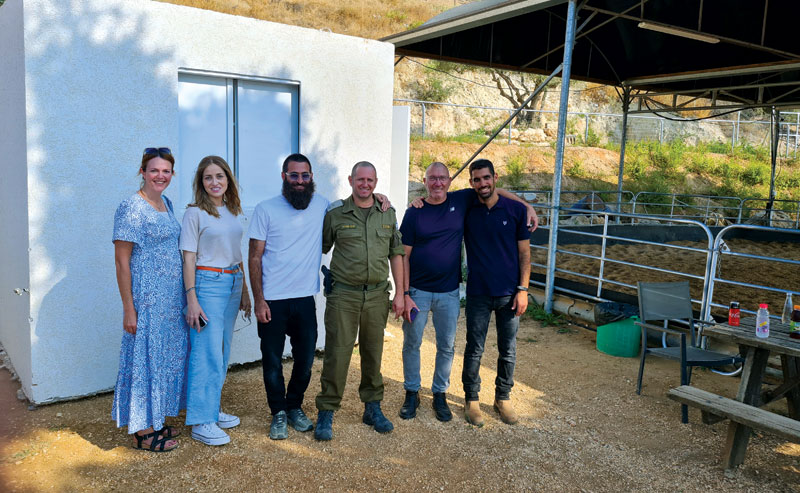
Shayna Paquin, co-founder of the non-profit organization Sparks to Life, lives in Tzfat (Safed), Israel, a city in the northern part of the country near the Sea of Galilee. The mother of seven children, ranging from 15 months to 20 years old, has lived on three continents, in four different countries and moved 28 times before settling in Tzfat with her husband, Yishai. “This is the most amazing place I’ve ever lived in,” she told The Journal in a phone interview. “And I have plenty to compare it to.”

Tzfat is situated high in the Upper Galilee, home to approximately 40,000 residents, many of them Orthodox Jews. This demographic contributes to the city’s abundance of young children and numerous day care centers and preschools. Unfortunately, not all of these facilities are equipped with bomb shelters, leaving parents to face the difficult choice of sending their kids to preschool and risking their safety or keeping them home.

This is why Paquin is dedicated to raising funds to install bomb shelters in every preschool. She aims to build 35 shelters, at an estimated cost of $20,000 each. So far, she has secured funding for 20. 

Five years ago, Paquin co-founded Sparks to Life with her friend Klara Levy. Initially, their projects focused on visiting individuals with disabilities and supporting single mothers by providing nutritious food and companionship, among other things.

When the war in Israel expanded last year, Paquin became aware of deaf and hard-of-hearing residents who couldn’t hear the sirens and thus didn’t rush to the bomb shelters.

“We only get 30 seconds of warning and they need to react quickly,” she explained. “That’s why we distributed over 100 smartwatches that provide vibrating alerts.”

One pressing issue that arose was the lack of a bomb shelter at her son’s preschool. She also learned about a preschool for children with autism that had been evacuated and crammed into a small room in another center.

At that moment, Paquin and Levy decided to take action and ensure every preschool in town had a bomb shelter. “We saw the suffering of the kids and the anxiety of the parents. Some schools struggled to find teachers willing to take responsibility in places without shelters,” she said.


The first shelter they purchased was for a special needs preschool, followed by others with inadequate protection. Before these shelters were installed, children would rush outside when sirens sounded, ducking down and covering their heads for 10 minutes.

“During winter, when it was raining and cold, kids didn’t have time to grab their coats because they only had 30 seconds to find cover,” Paquin said. “But staying inside was too dangerous due to metal shards from the roof and glass from windows.”

Obviously, being outside poses a great risk as well, no matter where you duck.

When asked why the government doesn’t provide bomb shelters for preschools, especially in areas targeted by Hezbollah in Lebanon, she responded, “If they can’t afford helmets or updated gear for the soldiers, I guess they can’t afford bomb shelters in Tzfat either.”

The shortage of bomb shelters (in Hebrew: migunit) is not unique to Tzfat, but Paquin argues that the situation is particularly severe there, in part because 46% of the population is under 18.

“Our schools are growing so fast that the city can’t keep up, resorting to bringing in trailers for classrooms. Plus, being up in the mountains makes it harder to build shelters. Tzfat has a lower socio-economic status and our economy depends heavily on tourism. The city is struggling with debt from the pandemic and the war,” she said.

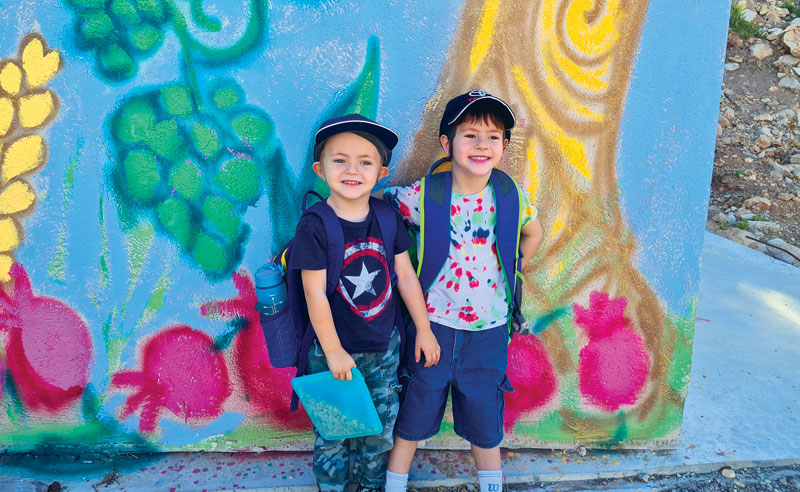
Sparks to Life recently also worked on installing playgrounds with bomb shelters. With over 16,000 children living in Tzfat — many from large families living in small apartments — there’s a pressing need for safe spaces for them to play outside of school hours. Sheltered playgrounds can provide a secure communal space for families to meet, share resources and support one another. When equipped with shelters, playgrounds become places where families can reclaim a sense of normalcy and stability.

“We got our first three shelters at playgrounds this week and are hoping to do more very soon,” said Paquin.

“We got our first three shelters at playgrounds this week and are hoping to do more very soon.” –Shayna Paquin

Israel is perhaps the only country in the world where you’ll find playgrounds with slides right next to bomb shelters, but this is the reality of life there. Paquin, who was born in Virginia and grew up in Texas, doesn’t regret her decision to settle in Israel for a moment.

“I love it here,” she said. “Tzfat is an amazing place with all its ups and downs. It’s big enough to offer conveniences, yet small enough that you can walk down the street and know every shopkeeper. You can’t take five steps without running into someone you know. It feels like one of those small towns in a movie where everyone knows everybody.”


To sponsor a shelter, contact Shayna Paquin at +972-50-424-2268 or sparksisrael@gmail.com

Protecting Children in Tzfat with Bomb Shelters Read More »

Rabbis of L.A. | Food Truck Next on Rabbi Kahn’s To-Do List

The living room of Rabbi Yanky Kahn’s Tarzana home is packed, but there are no guests. Instead, large cardboard boxes filled with Sukkot material take up all nearly all the space, leaving just a single place to sit. 

Over the last year, hundreds, if not thousands, of Israelis have discovered that Rabbi Kahn is a bringer of everyday necessities. Clothing, food, even money when needed.  Not just material needs but spiritual ones as well; he brings the ceremonial items observant American Jews take for granted.   

With his seventh wartime mission to Israel scheduled after Sukkot ends, Rabbi Kahn looked back on his work since Oct. 7, 2023. He remembered a scene from the start of the war. “We went to an army base that on Oct. 7 had 12 to 16 soldiers. On Oct. 8, they had about 20,000 soldiers. For the first few days, everyone slept in cars until they got them signed in and obtained beds. A while later, the new soldiers were sleeping on mattresses.” 

Rabbi Yanky – he’s widely known by his first name – recalled a “holy soldier” whose base had been struck by Hezbollah. His tefillin was ruined. “We gave him a new pair,” which sparked a story. The soldier asked for a favor on the rabbi’s next trip: Could he sponsor a food truck?

Ever since, attracting funding for a food truck has been No. 1 on Rabbi Yanky’s to-do list.

A food truck, he explained, can serve two uses. “G-d willing, the war will be over, and it can go to help people.” For now, food is not always within easy reach for IDF soldiers. “Remember, when soldiers are fighting, all of them – across the border they have very small bases because they are afraid that there will be an attack. You don’t want to have many soldiers together on one base. The food truck will be a way to give a hot dog or burger to a soldier standing all night in the cold.”

In addition, “If someone approaches him and gives him warm food, it shows friends from Los Angeles care.”

Rabbi Yanky, a fixture at Chabad of the Valley, last led a delegation of more than two dozen in July. It included his community and three of his four children along with rabbaim from Chabad of Bel-Air, Chabad of Stockton and rabbis from Scottsdale, Az.

This trip trained attention on an often overlooked dimension of war. “We focused on widows, helping them,” said Rabbi Yanky. “We took a bunch of them to a restaurant. Then Chabad of Bel-Air gave each widow a significant monetary gift. They went home crying. There was such a feeling of love, of caring, of someone thinking about you. It was emotional.”

Eighty percent of the widows, he said, are young women in their early 20s, newly married, with babies at home ranging from a month to two years old. The restaurant meal was a rare treat. “It’s very difficult for them to go out,” Rabbi Yanky said, “because besides getting a babysitter, a lot of logistics are involved.”

He had a three-part message for the widows: “We love you. We care for you. We are here for you.”

The rabbi remains in contact with them. “It’s an ongoing relationship,” he said. “We are just there to help them. One contacted us in the summer about building a synagogue in memory of her husband. Can we get involved?”

When Rabbi Yanky was asked what is the greatest need, he said “love is the greatest need. If you are giving them a warm burger, they are so grateful. If you give a pair of tefillin – if they don’t have any – they are so grateful. If you give them mezuzahs, at an army base, if you give them equipment which they need – just to feel that we care for you, we are here for you – that is what they really need.”

In early September, Rabbi Yanky was asked to secure 100 shofars for Rosh Hashanah. “Think about all of the bases that need shofars,” he said. What was his next step? “You pay for them,” said the rabbi, “give them to someone you know, and the army is pretty good at distributing. “Hanukkah we gave out hundreds of menorahs, Purim we gave out thousands of Mishloach Manos, Pesach hundreds of matzahs, thanks to Mt. Sinai.”

Rabbi Yanky made his first mission days after Hezbollah’s initial bombing. If he had not returned five times since then, would he have recognized Israel? “It’s different,” he said. “And people are different. I could tell you I am in the Sukkot business. I spoke to a friend who had a baby a few weeks ago. He sells sukkahs wholesale, like those pack-and-go sukkahs. He told me, ‘I may have to go to Lebanon.’ I said ‘Yossie, who’s going to take care of your business.’ He said ‘It’s a time of war now.’

“His wife just had a baby. This is his busiest time of the year, and everyone in Israel is giving up everything just to keep Israel safe, to keep themselves safe. We have to continue fighting and we have to continue helping in every single way we can.”

In late September, the rabbi got a phone call from a soldier he had met months ago. He said there are two soldiers who have been called back to the army. They have no money for food for Rosh Hashanah and Sukkot. Could you help?

“Think about these families who literally have no money to pay for Sukkot,” the rabbi said. “It’s expensive. These soldiers are going to fight. The wives are home alone. No money to pay for anything.”

“Think about these families who literally have no money to pay for Sukkot. It’s expensive. These soldiers are going to fight. The wives are home alone. No money to pay for anything.” 

Fast Takes with Rabbi Kahn

Jewish Journal: Have you had time to read since Oct. 7?

Rabbi Kahn: I have tried to study more Torah.

JJ: What was the most memorable moment of the last 12 months?

RK: Thanks to my wife and kids, it’s a family mission we do together. To see your kids going out to give hugs to people in hospitals. The joy of seeing your kids in your footsteps, holding the baby of a widow. That is the most beautiful thing.

JJ: Have you noticed a change in the minds of Israeli children?

RK: Absolutely. So many children are stuck in a hotel room. They haven’t been home, haven’t gone to school, haven’t seen friends. The trauma they have is crazy. You have 15 seconds to run to a bomb shelter at 2 in the morning.

Rabbis of L.A. | Food Truck Next on Rabbi Kahn’s To-Do List Read More »

Campus Watch October 17, 2024

Brown Votes Against Israel Divestment

The Corporation of Brown University voted against a proposal to divest from 10 companies that conduct business with Israel on Oct. 8.

Chancellor Brian Moynihan and President Christina Paxson announced the decision in a letter to the community, stating that the board based its decision on the recommendation by the Advisory Committee on University Resources Management (ACURM); ACURM found “that Brown has no direct investments in any of the companies targeted for divestment and that any indirect exposure for Brown in these companies is so small that it could not be directly responsible for social harm.” Additionally, Moynihan and Paxson noted that “if the Corporation were to divest, it would signal to our students and scholars that there are ‘approved’ points of view to which members of the community are expected to conform. This would be wholly inconsistent with the principles of academic freedom and free inquiry, and would undermine our mission of serving the community, the nation and the world.”

Anti-Israel Protesters Occupy Pomona College’s Carnegie Hall

A slew of anti-Israel protesters occupied Pomona College’s Carnegie Hall on Oct. 7.

The Claremont Courier reported that 100 anti-Israel protesters were demanding that the college divest from companies that conduct business with Israel and some of those protesters went inside the building. “Once inside, demonstrators used signs to obscure windows on the east side of the building, and one student blocked the west entrance to persons not affiliated with the colleges, while another person zip-tied the building’s north exit,” the Courier reported. “Photos showed the Arabic word ‘INTIFADA’ graffitied in red paint in a hall and elevator.” There have been no reported arrests after protesters left the building. College President G. Gabrielle Starr said in an Oct. 11 letter to community members that what occurred was “unacceptable” and that “the vast majority of those who occupied Carnegie are not Pomona students.” Those who are students will face discipline and that those that aren’t students “will be banned from campus.”

Anti-Israel Group at Columbia Endorses “Armed Resistance”

The Columbia University Apartheid Divest (CUAD) announced in a statement posted to Instagram on Oct. 8 that it supports “liberation by any means necessary, including armed resistance.”

CUAD retracted its apology over one of its members, Khymani James, saying that “Zionists don’t deserve to live” and “be grateful that I’m just not going out and murdering Zionists.” “We caused irrevocable harm to you by contributing to the ostracization you experienced from your fellow students, fellow organizers, the media, and the public,” CUAD’s statement read. The group later added that “in the face of violence from the oppressor equipped with the most lethal military force on the planet, where you’ve exhausted all peaceful means of resolution, violence is the only way forward.” James thanked CUAD for its “beautiful” statement on X and that “anything I said, I meant it.”

University spokesman Ben Chang said in a statement to USA Today, “Statements advocating for violence or harm are antithetical to the core principles upon which this institution was founded. Calls for violence have no place at Columbia or any university.”

Anti-Israel Protesters Get Confrontational When Gaza Aid Measure Fails at UMich Student Gov’t

Anti-Israel protesters became “confrontational” when University of Michigan’s Central Student Government (CSG) rejected a measure that would have sent $440,000 to a West Bank university aiming rebuilding education in the Gaza Strip, Campus Reform reported.

The money would have gone toward Birtzeit University’s Rebuilding Hope Initiative; Campus Reform noted that Birtzeit “is a subject of controversy for its ties to terrorism.” When the measure failed, “yelling and physical confrontations” occurred, resulting “in police escorts and student government members reportedly having to run to their cars,” Campus Reform stated. CSG General Counsel Tyler Watt, a law student, told Campus Reform that the “mob got more confrontational” and that he had to give some people a ride because they didn’t feel comfortable walking home or taking public transportation due to the nature of the protesters. Watt and other students also told Campus Reform that the protesters shouted slurs like “race traitor” at Arab American members of the CSG who voted against the measure as well as other slurs like “colonialist Mexican” and “Zionist whore.”

Swarthmore College Condemns SJP’s “Glorification of Violence”

Swarthmore College Vice President of Student Affairs Stephanie Ives issued a statement on Oct. 11 condemning the campus Students for Justice in Palestine (SJP) chapter for calling Oct. 7 a “glorious day” on their Instagram account.

The SJP chapter said on their Instagram account in part: “Happy October 7th everyone! In honor of this glorious day and all our martyred revolutionaries …”

“Swarthmore College condemns the statements made in the SJP Instagram post and rejects the glorification of violence. Celebrating the killing of innocent people is shocking and reprehensible,” Ives said. “I would hope, despite all the various and often opposing views that exist at Swarthmore, we can at least agree on that.”

Campus Watch October 17, 2024 Read More »

Under Fire: A Tourist’s Journey Through War-Torn Israel

Tel Aviv, Oct. 1, 2024.

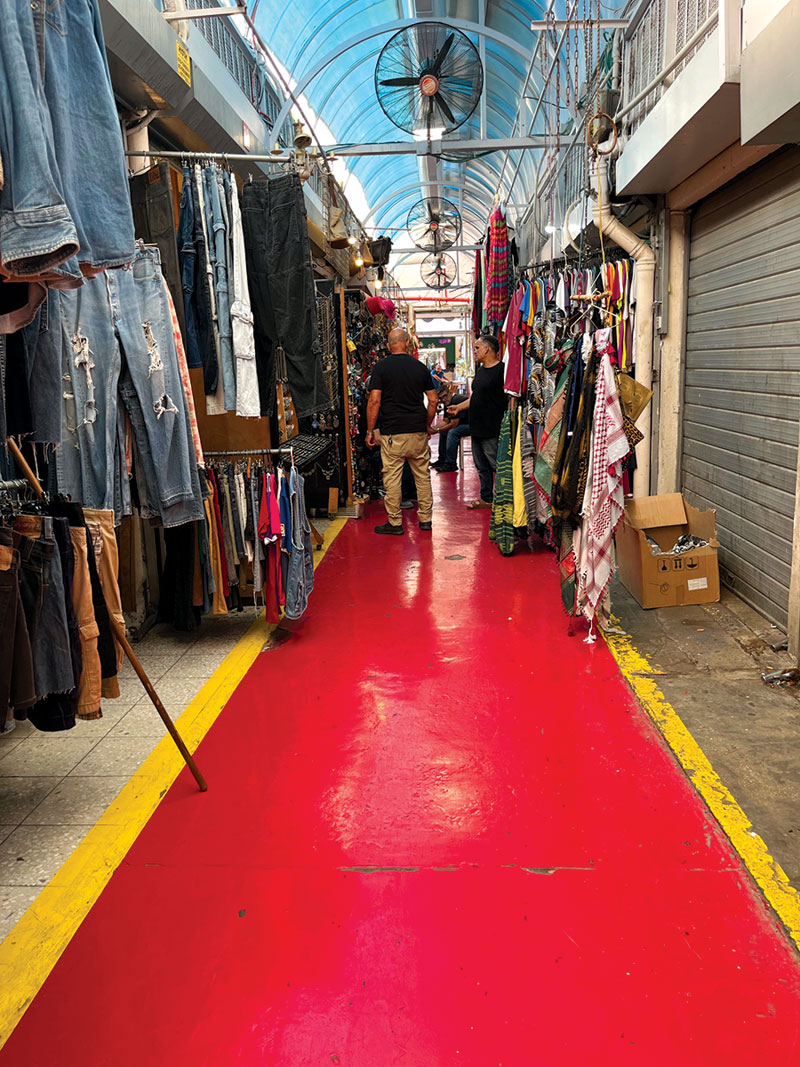
On my recent trip to Israel, we walked through the streets of Jaffa, visited the flea market and explored the famous galleries in the old town, overlooking the blue Mediterranean Sea. In the afternoon, we headed to the beach and at 7:30 p.m., as sirens sounded across the country, we rushed to the bomb shelter in the basement of the Armon Hayarkon Hotel in Tel Aviv. There, we listened as the Iron Dome intercepted ballistic missiles launched by Iran, which had damaged 100 homes in northern Tel Aviv. 

That same evening, two Hamas terrorists took a train to Jaffa and opened fire, killing seven and injuring 16, not far from where we had been just a few hours earlier.

The following day, we enjoyed breakfast at a restaurant on Dizengoff Boulevard before shopping at the bustling Carmel Market. Life seemed to carry on as usual, with little indication of the events from the night before.

A couple of days later, on Saturday, Oct. 5, while visiting Haifa, we rushed to the bomb shelter again after rockets were fired from Lebanon. Ten minutes later, when the shelter time was up, we got in the car and headed to Caesarea. A few families strolled through the archaeological park, originally built in Roman-ruled Judea under the Jewish client king, Herod the Great, around 22 BCE. Some fishermen sat with their poles unbothered by the fact that only a short time earlier they had to run for shelter as rockets were sent to Israel from Lebanon. And a bride and groom posed for photos before their wedding that day.

The boutiques, restaurants and ice cream parlor were mostly empty. “We almost don’t see any tourists here,” a gallery owner told me. “People are afraid to visit Israel.” 

I heard similar sentiments from many store owners in tourist areas. At the flea market in Jaffa, several shops had closed by 1 p.m., and those still open stood empty. Jacob Cohanim, a jewelry and clothing store owner, considered closing his shop, as business had dwindled since Oct.7 of last year. 

“I’ve been here for 40 years, and this is the worst it’s ever been,” he said. “Nobody is coming. I’m using my savings to pay rent and support my family. Many stores are either closed for good or open late and close early.”

“I’ve been here for 40 years, and this is the worst it’s ever been.” – Jacob Cohanim 

Other store owners echoed his feelings, imploring the few passersby to check out their merchandise, but customers rarely buy anything. “I don’t know where I’m going to go from here,” said Eli Davidov, who owns a souvenir store. “I come here every day, open at 10 a.m., and close at 4 p.m. There’s no point in staying open longer; we have no customers. Even locals are afraid to come here. Where would they escape if the sirens go off?”

Israel’s tourism industry has seen a major drop in visitors over the past year, and it’s unclear when things will improve. Almost all European airlines have announced cancellations of their routes to Israel, with tentative plans to resume between October 14-31, but it remains uncertain.

This drastic decline in tourism has affected many businesses, from restaurants to travel agents and tour guides. Avi Agajany, vice president of the Israel Hotel Association, noted that while the government provided assistance during the COVID-19 pandemic, little help is available now, except for travel agents.

“Before Oct. 7, hotels in Jerusalem were occupied by 85% tourists and 15% inside tourism, while Tel Aviv had 75% tourists and 25% inside tourism,” he said. That’s now flipped; only 15% of hotel guests in Jerusalem are tourists, same goes for Tel Aviv. And these tourists are mainly those visiting family members in Israel. There’s no real tourism.”

Between January and September 2023, Israel welcomed 2.8 million tourists. However, from January to July 2024, there was a 73% drop in the number of tourists entering the country. It is estimated that by the end of 2024, Israel will see only 1 million visitors, primarily consisting of Israelis living abroad visiting family, solidarity delegations and some Birthright groups. 

Additionally, rising flight prices have compounded the issue. With only El Al operating flights to Israel, prices have skyrocketed. The airline’s revenue in the first quarter of 2024 was 48% higher than in the same period in 2023, with profits exceeding $80 million. In the second quarter, it set another record with a net profit of $147.4 million.

On Sunday, Oct. 6, after visiting family in Be’er Sheva, in the southern part of Israel, we planned to travel to Tel Aviv by bus when we heard that a Bedouin had opened fire inside a bus station, killing a 19-year-old female Border Police officer and wounding 10 others. The gunman, identified as Ahmad al-Uqbi, 29, entered a McDonald’s and opened fire.

Our plans changed — again. After receiving warnings about a potential suicide bomber planning a mass attack in Jerusalem, we canceled our plans to stay in the city for Yom Kippur. Authorities feared that a Palestinian terrorist might infiltrate from the Bethlehem or Ramallah areas. During the High Holy Days, the IDF intensified operations to locate terrorists in Bethlehem. In response to multiple warnings, the Jerusalem Police bolstered their forces, setting up checkpoints at the city’s entrances and along its seam line. Border Police were also patrolling East Jerusalem to locate suspects, conducting both open and undercover patrols.

There is much uncertainty. On Oct. 7, 2024, as Israeli TV broadcast continuous interviews with survivors and released hostages, reports surfaced of rockets fired at Israel from Lebanon and a missile launched from Yemen. There were also constant updates in recent days about soldiers killed in Lebanon, most of them in their early 20s. We decided to stay in; home seemed to be the safest place to be.

Israel is a country at war and the impact on its economy will likely last for years. Convincing people to visit a country in conflict is a significant challenge. With time, however, the sirens and occasional reports of terrorist attacks will diminish, allowing the vibrant markets, beautiful beaches and hotels to once again fill with tourists.

Under Fire: A Tourist’s Journey Through War-Torn Israel Read More »

Dating Coach Advises How to Get That Ring in New Book, ‘Marry a Mensch: Timeless Jewish Wisdom for Today’s Single Woman’

Dating coach Devorah Kigel  has bad news and good news for single Jewish women. First the bad news: There is no Mr. Perfect. You’ll never reform that irresistible “bad boy” who’s on track to break your heart. And even if you love big projects, marrying a man you plan to remodel is sure to backfire.  

Fortunately, the good news outweighs the bad, as Kigel writes in her new book, “Marry a Mensch: Timeless Jewish Wisdom for Today’s Single Woman.” Having coached close to 310 women who eventually walked down the aisle, Kigel touts what she believes is a smarter way of dating, one that weeds out the unserious, the unsuitable, and the unstable. This framework also reduces anxiety while boosting clarity.  

As a first step to finding Mr. Mensch, Kigel advises that women take time to carefully define their values, separating their list of fantasy wants (hunky, tanned Israeli with a killer smile) from their nonnegotiable must-haves (intelligent, calm during a crisis). It’s also important to identify the negative nonnegotiables, the things you know you cannot tolerate (miserliness, impulsiveness, anger). She “doesn’t allow” clients to include physical traits on their non-negotiable list, because with women, attraction often grows in response to emotional connection. “And,” she writes, “it’s much easier to fix muscles than middos” (character traits).
Kigel spent many frustrating years dating in the secular world, wondering why no guy ever turned out to be “the one.” While studying in Israel, she tried dating according to religious standards, dressing more discreetly and focusing dates around discussions of religious values and life goals. Unfortunately, by that time she was so “jaded, cynical, and discouraged” that she agreed to marry someone with whom she felt no chemistry. A rabbi advised her to break it off, and three months later, still despairing over her single state, her future husband sauntered over to introduce himself in a shul on the Upper West Side of Manhattan. 

About half of her clients are not religiously observant, but are increasingly open to adopting traditional Jewish dating practices, including holding back on intimacy until marriage. Women tend to feel stronger emotional attachments to men they sleep with, and this can cloud their thinking about whether the relationship makes sense overall. As our grandmothers may have warned, when a woman “acts like a wife and not a girlfriend,” the man has little incentive to propose. Kigel has seen many women endure cycles of heartbreak from investing so much of themselves this way, and it often leads to their building emotional defense mechanisms and becoming cynical. 

Kigel asserts that when women claim a physical boundary (which will differ among women), it “empowers them to take back their feminine energy and hold themselves and their dates to higher standards.” While most nonreligious men will walk when they hear this, Kigel says, “You only need one. If a man can’t see you as a high-value woman and respect your boundaries, goodbye.” 

To avoid sending mixed messages, she makes the case for what she calls “image integrity.”  Dressing like a party girl gives a very different vibe than dressing more discreetly, like the difference between showing up for an interview as a bar hostess versus for a corporate leadership position. Roughly half her clients are not religious, and frequently are willing to try this new way of dating as a way to be both proactive and breathe new life in a moribund process. 

She’s also got plenty of advice on dating “don’ts,” including: Dating guys who aren’t serious about marriage; giving up too fast on guys who seem solid and nice but aren’t exciting (yet); having unrealistic expectations; expecting fireworks right away; or requiring a guy to look a certain way. Also on the don’t list: Dating dysfunction because it feels familiar; falling into the trap of waiting for something better to come along; and ignoring a gut feeling that something important is off. 

Kigel writes in a breezy, chatty, “hey there, girlfriend” style, yet each short chapter packs in a lot of common-sense wisdom. Toward the end of the book, she contrasts the classic Hollywood romance template where people “fall” in love — it just happens, you can’t help it — with Judaism’s belief that we step consciously into a relationship. Chemistry and attraction are vital, but allowing those sensations to be the leading indicators in a new relationship can spell trouble. 

The Jewish emphasis in marriage is on giving more than receiving, but the more we give, the more we love. Without negating themselves, man and woman have the potential to complete one another, “where one plus one equals one.” Sharing foundational goals, such as infusing one’s home life with Jewish values, also builds emotional intimacy. 

The advice in this compact, highly readable book follows one of the author’s tag lines: “Lead with your head and bring your heart and hormones along after.” She acknowledges the painful truth that the numbers are skewed in favor of men, and that after dating so many “frogs,” exhaustion can set in. “Many women get to a point where they expect every date to be DOA,” she said. “However, the number one characteristic I’ve seen among my clients who get married is maintaining hope, optimism, and faith. They may need to take a break, do some self-care, but then are ready to get back in the game, being open to the possibility that this time could be different. I know that Hashem is in charge of each person’s life, and I see miracles every day with my clients.”

The advice in this compact, highly readable book follows one of the author’s tag lines: “Lead with your head and bring your heart and hormones along after.”  

To contact Devorah, go to devorahkigel.com or find her on You Tube or Facebook.


Judy Gruen is the author of “Bylines and Blessings,” “The Skeptic and the Rabbi,” and several other books. She is also a book editor and writing coach. 

Dating Coach Advises How to Get That Ring in New Book, ‘Marry a Mensch: Timeless Jewish Wisdom for Today’s Single Woman’ Read More »

Milken School, Magen David Adom and Sephardic Org Mark Oct. 7 Anniversary

On the morning of Oct. 7, Milken Community School held an all-school town hall meeting to mark the one-year anniversary of the Oct. 7, 2023 attack on Israel.

The school’s entire student body — from grades 6-12 — gathered in the gymnasium on the high school’s Bel Air campus, along with faculty, alumni and supporters of the school, for the occasion. 

Sarah Shulkind, head of school at Milken Community School, spoke of the school’s commitment to promoting a love for Israel among its students. Since Oct. 7, Milken’s teens have shown their support for Israel by writing letters and sending supplies to Israeli soldiers and their families, creating art exhibits dedicated to the victims of Oct. 7 and participating in community events, including the March for Israel rally in Washington D.C. last November.

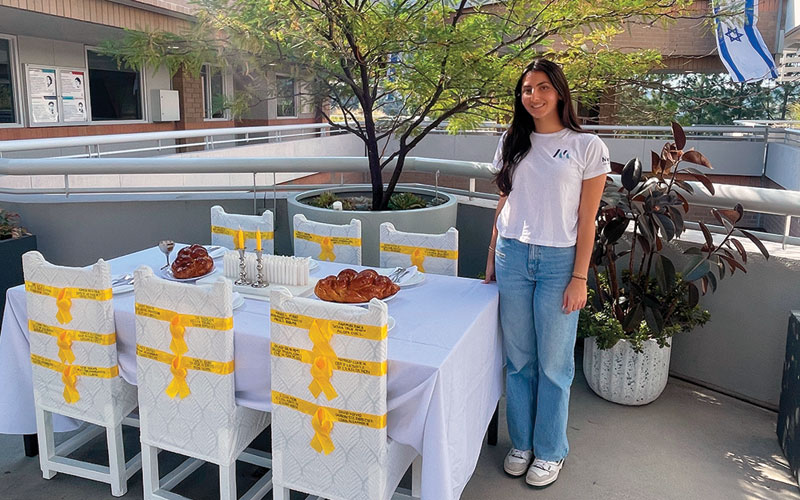
Milken Community School Senior Chloe Nikravesh designed a Shabbat table exhibit in honor of the hostages still held in Gaza. Courtesy of Milken Community School

“The victims, families, soldiers and people of Israel are not alone,” Shulkind said.

During the program, students delivered moving tributes to the hostages; recited the “Hatikvah;” and performed a rendition of Israeli singer and “Eurovision” contestant Eden Golan’s Oct. 7-inspired anthem, “Hurricane.”

Richard Sandler, chair of the board at Milken Community School, was among the attendees. In an interview after the event, Sandler said it was events such as these that made him proud to be involved with the school’s leadership.

Along with the town hall, Milken—one of the largest Jewish day schools in the country—marked the anniversary of the attack by displaying student-created art exhibitions. Milken Senior Chloe Nikravesh, class of 2025, designed a table that had been set for Shabbat. On the table were 104 Shabbat candles, each pair representing a Shabbat that the hostages haven’t spent with their loved ones since being taken captive.

Milken eighth-grade student Sarah Falkov and ninth-grader Julia Refoua also created art exhibitions that were on display.

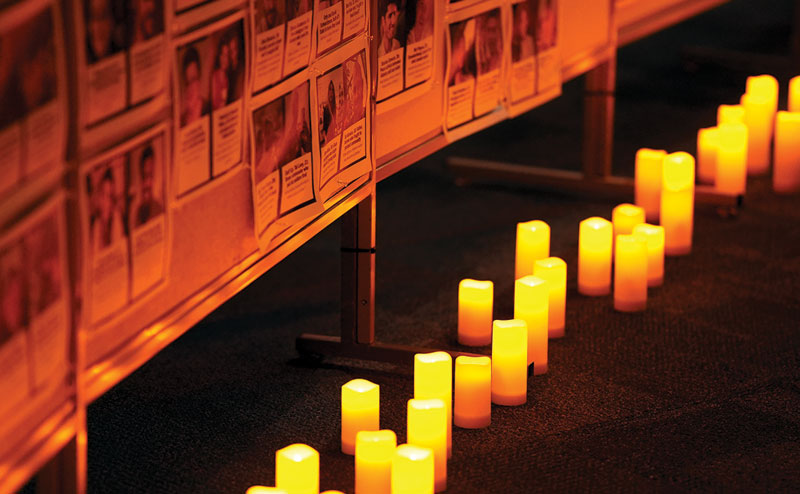
Additionally, a memorial gallery—partially inspired by the Nova music festival exhibit—was set up in the school’s auditorium. Inside the gallery, which honored the memory of the victims of Oct. 7, students viewed artwork, poetry and photography and were able to leave a note card sharing their sentiments of hope. 


A Magen David Adom ambulance stops at the Oct. 7 Memorial Square in Beverly Hills for a community gathering. Photo by Tess Cutler

Three Magen David Adom (MDA) ambulances, donated by congregants of Wilshire Boulevard Temple (WBT),  visited Los Angeles on Oct. 7, prior to their departure to Israel. These ambulances were three out of seven donated by the WBT community immediately following the horrendous attacks on Israel last year on Oct. 7.

The three ambulances drove throughout L.A., visiting all three WBT campuses for hundreds of children to explore and learn. The ambulances also stopped at the October 7th Memorial Square in Beverly Hills for a community gathering.

In the evening, approximately 300 community members attended an evening commemoration at WBT. The event featured songs and prayers as well as remarks by WBT Senior Rabbi Joel Nickerson; MDA Director of International Relations Yoni Yagodovsky; actress Ginnifer Goodwin; and WBT congregants.

“In such a challenging time for the Jewish people and for our brothers and sisters in Israel, it was important for us to mark the one year anniversary with opportunities for people to come together, find comfort in their connection to the Jewish community, and highlight the tangible ways we can show our support for Israelis who have suffered the consequences of the horrific attack on Oct. 7,” Nickerson said. “We also wanted to remind our community that despite the challenges we face, we never give up on hope and prayers for peace.” 


SEC Board Member Nira Sayegh, International Director Rabbi Daniel Bouskila, Jeremy Friedman, Sephardic Spice Girl Rachel Sheff, Simone Friedman and Beverly Hills Mayor Lester Friedman and SEC President Neil Sheff. Courtesy of Sephardic Educational Center

The Sephardic Educational Center hosted a special Oct. 7 commemoration in Beverly Hills with a sneak preview of a soon-to-be-released film with witness testimonies, as well as songs and prayers for the hostages and soldiers.

Milken School, Magen David Adom and Sephardic Org Mark Oct. 7 Anniversary Read More »

A Book of Torah Commentaries with Variety of Torah Voices

Rabbi Elchanan Shoff, the leader of Beis Knesses Los Angeles in Pico-Robertson and a local educator, is known for thinking outside the box when it comes to Torah learning.

Whether he is giving a drasha (lecture) to his congregants, teaching students at Beis Yaakov Machon or commenting on the Torah portion in Table for Five, he presents a wide variety of sources, including Haredi scholars, Sephardic voices and ancient and modern rabbis. Now, he’s brought that same spirit to his new work, an extensive book called “Rabbi Elchanan Shoff on the Parashah (Bereishis)” from Mosaica Press.

“The material inside is just really different – from eye opening material exploring how rationalist Maimonidean scholars have understood ‘demons,’ and what that means in terms of understanding mental health, to eyewitness stories of how R. Yitzchak Hutner conducted himself whilst kidnapped by the Popular Front for the Liberation of Palestine after his airplane was hijacked,” Shoff told the Journal. “One cannot fail to be gripped with fascination when reading this book.”

Each Torah portion includes a line-by-line analysis, with Shoff sometimes bringing in multiple sources to provide insights. For the line, “In the beginning,” he provides commentary from the Rokeiach, the fourth Rebbe of the Belz Hasidic dynasty; the Talmud Yerushalmi; Rabbi Eliyahu Guttmacher, the rabbi of Greidetz; the Baal HaTurim, an influential Medieval rabbinic authority; and Mordechai HaKohen of Safed, a scholar who lived in Safed in the 1600s. 

“We quote from rationalists and kabbalists, Sephardic giants and Lithuanian geonim (leaders) and everything in between, including contemporary works, all the way back to the Talmud, spanning that last 2,500 years of scholarship and commentary,” Shoff said.

“Rabbi Elchanan Shoff on the Parashah (Bereishis)” is an English translation of a book published in Hebrew two years ago, “China V’chisda,” but with additional commentary and callouts of fascinating historical content related to the authors or topics covered. In the part on Rabbi Guttmacher, for instance, Shoff discusses how the rabbi was a miracle worker who used prayer to exorcise evil forces from a child. 

Another portion shares the story of King James IV of Scotland (1473-1513), who took two infants into seclusion before they heard any human language; he told a woman who was deaf and mute to raise them. When they were old enough to speak, he said they spoke to one another in perfect Hebrew. Insights from the Rambam back this up; he said that if one would not speak to a child for the first seven years of their life, they would then speak Hebrew, lashon hakodesh, naturally.

“The book is a collection of extremely interesting insights from an extremely wide variety of works that I had studied or found over the previous 20 years or so,” Shoff said.

The rabbi is a husband and father, as well as the founder of BKLA, along with his wife Rebbetzin Sara Shoff. Their shul was one of the first to be established outside of the immediate Pico-Robertson vicinity, though still within walking distance, since many members of the community started moving due to more affordable home prices in the Faircrest Heights area. Though Shoff, a Los Angeles native, leads a busy life, he always finds a way to further his learning and compile the most interesting commentaries he discovers.

“Making time to learn Torah is of utmost importance to me, and when I learn new things, whether in preparation for a drasha at shul, or a class, I find that when I do not write them down, I regret it endlessly, for sometimes it is just lost,” he said. “I try my hardest to write things up.”

Shoff sees the Torah as being our “very life’s blood. It is the story of the Jewish people and the story of every one of us. Judaism only passes along when there is passionate excitement for Torah study.”

He quoted the ancient blessing, “Please, Hashem our God, make the Torah sweet in our mouths, and in the mouths of all Jewish people. That way, we and our children and their children will all know Your name and study your Torah sincerely. Blessed are you Hashem, who teaches the Torah to your nation Israel.”

He quoted the ancient blessing, “Please, Hashem our God, make the Torah sweet in our mouths, and in the mouths of all Jewish people.”

The rabbi continued, “Jewish continuity depends on authentic passionate Torah study. Don’t miss an opportunity to learn, and may it always be approached with sweetness and joy, for nothing in the world compares to it.”

A Book of Torah Commentaries with Variety of Torah Voices Read More »