
fbpx

August 15, 2024

The Sisyphus of Middle East Peace— Ambassador Martin Indyk

The last time I visited Ambassador Martin Indyk in his elegant Upper West Side New York apartment in May, he made me matza brei. It was Pesach and I was passing through New York on my way to spend a month in Germany as a distinguished fellow at the American Academy in Berlin, doing a deep dive into the state of antisemitism in a democracy that has both historical and current-day significance. But that’s another story.

Martin looked frail and weak, but he insisted on going to the kitchen while I caught up with his wife Gale Hodges Burt, former social secretary for President Ronald Reagan and the founding chair of the American Academy in Berlin.

Once Martin returned with the perfectly cooked scrambled eggs and matzah, served professionally with cinnamon and sugar powder, we delved into the issues of the moment: the U.S. presidential elections, Gaza war, Iranian proxies’ aggressions toward Israel.

When I said goodbye that morning, I knew it might be my last visit with a man who had come to be a mentor, a role model and a friend.

At Ambassador Indyk’s shiva three months later, in a beautiful Georgetown villa filled with Washington, D.C. royalty, the Rabbi reciting Kaddish described Martin as the Sisyphus of Middle East peace. He couldn’t have used a better character to depict Indyk’s lifelong obsession: an end to the generations-old conflict in the region. Even in his last days, he published a piece in Foreign Affairs Magazine titled “The Strange Resurrection of the Two State Solution: How an Unimaginable War Could Bring About the Only Imaginable Peace.”  He simply would not give up — just as Sisyphus wouldn’t, and of course, neither should we. 

The Council on Foreign Relations, The Brookings Institution and Israel Policy Forum, all policy organizations with whom Indyk had an affiliation, eulogized him to their communities in a similar fashion. 


A veteran diplomat and author, Ambassador Indyk devoted his illustrious career — both in and out of government — to pursuing a path to peace in the Middle East. A practitioner and scholar, he served as U.S. ambassador to Israel from 1995 to 1997 and again from 2000 to 2001. He also served as special assistant to President Bill Clinton and senior director for Near East and South Asian affairs at the National Security Council from 1993 to 1995, as assistant secretary of state for Near Eastern Affairs in the U.S. Department of State from 1997 to 2000, and as President Barack Obama’s special envoy for the Israeli–Palestinian negotiations from 2013 to 2014.

A veteran diplomat and author, Ambassador Indyk devoted his illustrious career—both in and out of government—to pursuing a path to peace in the Middle East.

Outside of government, Ambassador Indyk spent decades in leadership positions at prominent U.S. think tanks, including the Center for Middle East Policy and the Brookings Institution. He was also the founding executive director of the Washington Institute for Near East Policy for eight years.

Ambassador Indyk was a leading expert on the Israeli-Palestinian conflict as well as U.S. relations with Israel and the Arab states. His writing featured prominently in Foreign Affairs and other influential outlets. Throughout his career, his was a rare, trusted voice within an otherwise polarized public debate on U.S. policy toward the Middle East.

He was the author of “Innocent Abroad: An Intimate Account of American Peace Diplomacy in the Middle East” and coauthor, with Michael O’Hanlon and Kenneth Lieberthal, of “Bending History: Barack Obama’s Foreign Policy.” He published his final book, one that was very close to his heart, “Master of the Game: Henry Kissinger and the Art of Middle East Diplomacy,” a major work of diplomatic history published in 2021, which offered important lessons for current and future U.S. policy toward Middle East peacemaking.

He was all these things, but to me, he will always be my loving friend. Finding mentors who live up to the values they teach can be rare. I was blessed and lucky to have found Martin in my camp. Ambassador Martin Indyk will be dearly missed.


Dr. Sharon S. Nazarian is President, Y&S Nazarian Family Foundation and Chair of Community Advisory Board, UCLA Y&S Nazarian Center for Israel Studies.

The Sisyphus of Middle East Peace— Ambassador Martin Indyk Read More »
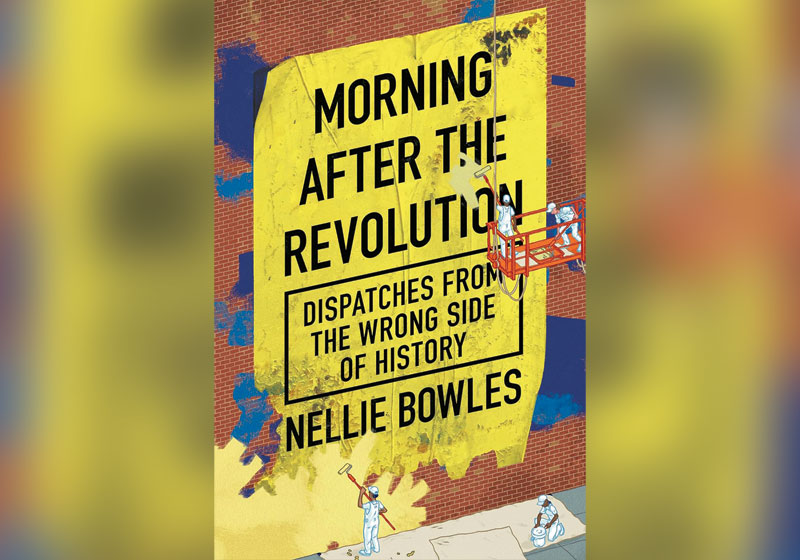
Chronicle of a Renegade

A few years ago, Nellie Bowles was a successful young reporter for the New York Times. When she joined its illustrious staff, Donald Trump was president, subscriptions were surging, and readers knew what they wanted for their money. The Times would give it to them. They would be “the heart of resistance,” championing “the beautiful world that could be.” Bowles fit right in. She wrote big stories that were widely cited and praised, and she never missed a happy hour.

But then things turned weird. Black Lives Matter gripped the country, and it became essential for progressives to uphold truths that no one had heard of five minutes ago. Bowles’ colleagues earnestly agreed “that being On Time and Objectivity were white values,” and that although any backlash to the revolution was bizarre and vile, “it was important to note that there was no revolution happening.” New words and acronyms entered the lexicon which had to be adopted immediately; no one would respond with anything but solemnity to announcements such as: “May 17 marks the International Day Against Homophobia, Biphobia, Interphobia, and Transphobia (IDAHOBIT), which celebrates LGBTQIA+ people globally and raises awareness to combat discrimination.” The letter X had to be added to gender-neutral words, whether the people associated with those words liked it or not, to indicate you were “extra-pro-trans.” “Latino became Latinx. Otherwise, you were a monster.” 

Bowles found some of the new dogmas strange and the fixation on upholding them oppressive, but felt it would be morally messy to challenge them. As she writes: “If you want to be part of a movement that supports gay marriage, and I did and do, then you can’t question whatever disinformation is spread this week. Fine, I can identify as a non-man attracted to non-men [translation for the uninitiated: a lesbian]. If anything in the movement looked anything but perfect, the good reporter knew not to look.” When a Times in-house Disinformation Expert instructed her that her article on PragerU should attack the conservative outlet for, among other things, “getting people questioning,” Bowles obliged. The piece ran and, she writes with unsparing honesty, she got the praise she craved. 

But in the febrile summer of 2020, Bowles got curious about happenings in Seattle. Much of the city had been declared a police-free “autonomous zone,” there were reports of chaos and shootings, and Bowles thought The Times should check it out. Yet when she pitched the idea to travel there, her colleagues sensed something terribly wrong with her. One told her he worried she was “into all this cancel culture stuff.” When he’s old, he said, he wants to know he was on the right side of history. Why did she want to be on the wrong side?

So begins Bowles’ delightful, compulsively readable, often screamingly funny chronicle of our strange times, “Morning After the Revolution: Dispatches from the Wrong Side of History” (Penguin/Thesis). Bowles describes her trip to Seattle, where by day she found a heady sense of liberation, which by night turned to window-smashing, looting and fear in a lawless urban landscape. Only after several people were shot and two teenagers died did the experiment end. In another chapter, Bowles wonders what happened to all the money people gave to Black Lives Matter. She finds, among other things, that the self-described Marxist and creator of the #BlackLivesMatter hashtag bought four homes, totaling nearly three million dollars.

In the next section, “Atonement,” Bowles provides a harrowing description of a Zoom meeting she attended, “The Toxic Trends of Whiteness,” where attendees — all white, almost all women — shared their feelings of self-hatred about “being a privileged white supremacy person” and invoked “white women’s tears” against sensitive souls who broke down. Another chapter describes the scene after the Democratic Socialists of America decided to help turn over L.A.’s Echo Park to hundreds of homeless people. The park quickly became unvisitable, and the neighborhood’s Mexican-American homeowners reminisced about the days it only contained gang members. That experiment too only ended after an 18-year-old honor student volunteer mysteriously turned up dead and another corpse was found floating in the lake. 

“We Mean, Literally, Abolish the Police” traces the entirely predictable crime wave that arrived after American city governments resolved to defund or abolish their police departments. This led to some interesting racial dynamics, such as an incident in West Oakland, where Black activists memorializing 71 homicide victims, and criticizing plans to cut the Oakland police department budget, were denounced as “Nazis” by white activists who would soon return home to their safe neighborhoods. 

Part III, “Men and Non-Men,” involves women, that class of people who can no longer be defined without an advanced degree in biology. It opens with L.A.’s Wi Spa, where a — to be indelicate — person with a penis began lounging unclothed in an area where women and girls were naked. When a woman patron complained, the video of her complaint went viral and progressives worldwide raged against transphobia. The furor quietly died down after it was revealed that the person with the penis was, inconveniently, a registered sex offender with a history of indecent exposure.

In “Toddlers Know Who They Are,” the American Psychological Association, doctors, schools and media explain that children know whether they’re transgender, often from a very young age. If a boy-toddler likes playing with dolls, or a girl doesn’t like girly things, there’s a good chance they’re transgender. These children must be taken to a gender clinic or Planned Parenthood for puberty blockers to be followed by cross-sex hormones, and possibly surgical intervention such as mastectomies or removal of testes. The child’s soul, we’re told, is in the wrong body. Parents who disagree with these medical treatments can and sometimes do lose custody of their children.

“The Best Feminists Have Always Had Balls” describes the novel developments in feminism since it came to be led by transwomen — people who in a less enlightened age were termed men. When one of these trans feminists, Andrea Long Chu, explains in a book of gender theory that females are not full human beings, but holes, any woman who isn’t a transphobe smilingly agrees.

Bowles finds the humor where I confess I’m often too angry to, and sometimes more compassion than I can muster. Still I appreciate her insistence on recognizing the humanity of those spearheading today’s bizarre revolution. “I think about the parts I loved at the start of the fragile, hopeful movement that really did bring new ideas into the world,” she writes in the concluding section. “Ideas around fairness, around language, around our bodies. The revolution believed in profound, almost violent empathy, and it believed that life could be gentle and easy if we spoke just a little differently and walked just a little softer.” It’s a beautiful thought, even if it’s hard to reconcile with the foam-flecked activists of the previous pages.

Bowles finds the humor where I confess I’m often too angry to, and sometimes more compassion than I can muster. Still I appreciate her insistence on recognizing the humanity of those spearheading today’s bizarre revolution.

For me (and undoubtedly many others who once lived easily on the left), Bowles’ account of breaking painfully with a community that once provided a sense of meaning and belonging resonates. She represents a growing community of politically homeless — people who still associate the left with humanity’s betterment, but are repelled by its current state — and describes the predicament in seemingly effortless, breezy and sharp prose. (Her weekly column in The Free Press, “TGIF,” is reason alone to subscribe.) Sitting with her book was like being with a friend.

In the penultimate page, Bowles mentions the left’s recent lionizing of Hamas. Some may wish the book contained more about antisemitism, but I don’t see it as a weakness. I urge those concerned about antisemitism — particularly its leftwing variant — to read Bowles’ book because it broadens the picture of today’s progressive activists. “From the River to the Sea” has its corollary in the crazy things happening in race and gender. It’s the same movement; you just have to see the whole gestalt. But read it, also, because you will learn and laugh — when you aren’t seething.


Kathleen Hayes is the author of ”Antisemitism and the Left: A Memoir.”

Chronicle of a Renegade Read More »

Patricia Heaton and the O7C

After Oct. 7, actor, author and activist Patricia Heaton formed O7C aka the October 7 Coalition.

“Our motto is to help Christians be visibly and vocally supportive of Jewish people, of Israel’s right to exist and to fight antisemitism, wherever it is found,” Heaton, best known for roles on “Everybody Loves Raymond” and “The Middle,” told The Journal. ”I think the first thing you have to do, as a Christian and as a Jew, is to get out of our silos and come together and start getting to know each other.” 

In support of this effort, Heaton has been co-hosting unity dinners throughout the country. 

“There [are] many Christians who love Israel and [take] many trips to Israel, but they come back and they don’t necessarily know any Jewish people in their own neighborhood,” she said. 

At these events, Christian and Jewish leaders, and supporters, come together in conversation and to break bread. “The best way to get people together is over a meal,” Heaton said.

In July Heaton and O7C partnered with Maman Nonprofit (MamanNonprofit.org) for a Unity Table with The Dream Center Foundation.

“We are so grateful to be partnering with Patricia and the O7C,” Sara R. Jacobs, founder/director of Maman Nonprofit, told The Journal. “We have formed a sisterhood and have bonded on so many levels.”

According to Jacobs, both Maman and O7C are nimble, volunteer-based and women-run. 

“We share a common spiritual foundation and derive strength from one another,” Jacobs said. “We are so blessed that they are selflessly putting themselves out there to support the Jewish nation and Israel at a time when it’s not ‘cool’ or popular to do so.”

She added, “We are proud to activate and unite our Maman community [as they] show up and show appreciation to our Christian brothers and sisters for standing with us.”

Heaton explained how in her first Instagram post after Oct. 7, she asked, “Did you ever have that thought that, if you were a German during World War II, you hoped you would have been that good German who hid their Jewish neighbors. Well, today we have that opportunity.” And she listed a bunch of places where people could donate.

“Then I said, if you can’t afford it right now, call or text a Jewish friend and just ask how they’re doing,” Heaton said. “You won’t believe how meaningful it will be to [them].” 

Heaton calls herself “as Catholic as you can get.”  

“My mother was one of 15 children,” she said. “I have over a hundred first cousins on my mother’s side of the family, my grandmother was Catholic mother of the year for the United States and got a medal from the Pope and my sister’s a nun.”

Heaton, along with her British husband, recently experienced her first Passover seder at a friend’s house. It was a “joyful” experience.

The prayers and the music and the food and the history and the symbolism; it was such a rich evening,” she said. “And as a Catholic, who can trace my spiritual history back through the Old Testament, it was very, very meaningful to me; and I saw a lot of my own religious tradition in Judaism, because, of course, Jesus was a Jewish rabbi.”

People ask her why she is advocating so strongly for the Jews. Heaton said what is going on in Israel affects us all.

People ask her why she is advocating so strongly for the Jews. Heaton said what is going on in Israel affects us all. 

As she has spoken to a lot of different Jewish groups, and gotten to know a lot of different people in creating safe and welcoming places, Heaton has found so many similarities.

“I’ve found that the Jewish people are so deeply philanthropic, and it’s been a reminder to me that really our mission on earth for all people is to create opportunities for human flourishing,” she said. “The Catholic Church has always been about serving the poor and they do that everywhere all over the world, but I am seeing that that is also in the Jewish community.”

Heaton added, “It’s easy to partner because we have the same outlook on life, which is, as I said, to help advocate for human flourishing.”


Learn more about O7C at October 7 Coalition.com and follow @theofficialo7c on Instagram. Learn about MamanNonprofit.com and follow @mamannonprofit on Instagram.

Check out the Taste Buds with Deb conversation at https://jewishjournal.com/culture/food/373812/patricia-heaton-philanthropy-food-in-entertainment-and-chicken-chilaquiles/

Patricia Heaton and the O7C Read More »

JNF-USA Memorial Convenes Golf Classic, Wilshire Blvd. Temple Holds Election Discussion

Jewish National Fund-USA’s (JNF-USA) 2024 David Frank Memorial Golf Classic took place at The Riviera Country Club on July 29. Nearly 130 philanthropists and golf aficionados came together for a day on the greens to raise money for the land and people of Israel and to rebuild Israel’s battered north and south.

As the leading philanthropic organization for the land and people of Israel, funds raised at the event will support JNF-USA’s Israel Resilience Campaign, which was established after Oct. 7. The campaign includes the organization’s “Build Together” plan to restore the southern Israeli communities in the Israel Envelope, providing the infrastructure and quality of life needed to allow residents to feel safe coming home.

A nonprofit, JNF-USA is dedicated to supporting the land and people of Israel. The organization has a particular focus on less-populated areas of the country, including in the north and south through its Go North and Blueprint Negev initiatives.

The annual Golf Classic is one of most anticipated annual events among members of JNF-USA’s local chapter.


From left: Steven Windmueller, emeritus professor of Jewish communal studies at HUC-JIR;
Spectrum’s Alex Cohen and Jewish Journal U.S. Politics Editor Dan Schnur appear in conversation at Wilshire Boulevard Temple’s Resnick Family Campus. Photo by Ryan Torok

On July 23, three experts on U.S. politics came together at Wilshire Boulevard Temple’s Resnick Family Campus for a timely discussion titled “15 Weeks Out: The 2024 Election and the American Jewish Vote.”

Before a crowd of approximately 100 people, Steven Windmueller, emeritus professor of Jewish communal studies at Hebrew Union College-Jewish Institute of Religion, moderated an animated conversation with Alex Cohen, a host and anchor at Spectrum News, and Dan Schnur, who serves as the U.S. politics editor at the Journal. 

The discussion was held just days after U.S. President Joe Biden announced he would not be seeking reelection, thus causing much of what had been planned for the program to change. The panelists discussed the significance of Vice President Kamala Harris’ entrance into the race, to what extent partisanship over Israel and the country’s current war in Gaza would influence how American Jews vote and the differences between how the Democratic and Republican Parties have addressed rising antisemitism in this country.

The evening also included a Q&A, with audience members posing questions to the three speakers. Wilshire Boulevard Temple Rabbi Susan Nanus was among those in attendance at the event. When the discussion became overtly political, she encouraged the speakers to stay away from comments that could be perceived as the synagogue backing one presidential candidate over another. 

In recent weeks, much has been made over whether Jews in this country, who historically have voted for the Democratic presidential candidate in large numbers, will continue that trend as that party faces a split among its own over to what extent the U.S. ought to be supporting Israel in ways including military aid. At Wilshire Boulevard Temple, the panel addressed this issue and more. There were those in the crowd who expressed a reluctance to vote for Republican candidate and former President Donald Trump while also expressing concerns about progressive stances toward Israel within the Democratic Party.

At the same time, there were those who suggested they were motivated by issues other than Israel in determining how they would vote this November. Those issues included the economy, abortion and immigration.

The program concluded around 9 p.m. with attendees gathering in the synagogue’s courtyard for refreshments. 

JNF-USA Memorial Convenes Golf Classic, Wilshire Blvd. Temple Holds Election Discussion Read More »

The Six Chairs

Much like I need updating, my wife and I agree that parts of our house also need updating. Our 98-year-old oak floors are too thin to resand without hitting nails or a dead possum. We need a generator in case of “the big one” and we possibly need a new stove. Certain family members, like “our children,” wonder why Mr. and Mrs. Medicare suddenly desire to spend what someday will be money they might need to do their floors. What they are saying is, “Don’t waste the money; you’ll either be dead or in a nursing home with the toothless in the not-too-distant future.” I already have no teeth. 

My wife told me she also wanted to get new dining room chairs. I’m not good at getting rid of things. She’s living with someone who’s had the same hairbrush since 11th grade. How can we part with the six dining room chairs we’ve had for 33 of the 34 years we’ve been married? Her parents owned these chairs for at least 20 years before that. Can we pitch these family heirlooms? 

After Nancy’s mother, Elinore, died 34 years ago, her father offered us their buffet, dining room table, and six beautiful solid wood seats. They don’t make this kind of furniture anymore — real quality stuff. He shipped them from Texas and even paid the freight bill when we said yes. 

The six chairs provided support during times of deep grief, such as the loss of her father and my mother, Nancy’s brother Mark, our aunts, uncles, cousins, friends, and pets. And, of course, during the most joyous times — the birth of our three boys, anniversaries, birthdays, engagements. 

When we weakened in spirit, they remained firm. When we clapped, they clapped with us. They stood as a symbol of stability, always ready for us during countless family dinners, homework, putting together photo albums, signing of wills, and mortgage documents. 

These chairs bore witness to the tears shed, and the laughter shared. Seated on these chairs, I looked at my emails and found out about work I did and didn’t get. They were present during the most pivotal moments in our lives, from career milestones to health challenges and now my wife’s retirement. They were the silent witnesses to our joys and sorrows, triumphs and tribulations, and many human mistakes.

On Shabbat, these chairs were where we thanked God for our food. From my chair, I would rise and give my children and now their spouses their Shabbat blessing. We shared Torah talks with friends and family — retelling the same ten stories for decades. 

As we unknowingly aged, these chairs never seemed to grow older — just stronger and more important. They were timeless. Their seams never busted like my pants when I battled weight. There was never a moment when they faltered and lost their way. There were no knee replacements or bad backs. Nor did anyone complain about their comfort. Their seat never sagged like mine is starting to. They were friends in the truest sense, always there when they were needed. They were old like their owners were quickly becoming.

How important are chairs? According to Jewish tradition, children should not sit in their father’s designated seat even when the father is absent.  But after 55 years in our families, it wasn’t easy, but we decided to say goodbye.  It was time to move on. 

When a family friend, who also got new dining room chairs, heard we were looking, she offered us her eight beautiful chairs in near-perfect shape. We grabbed them. 

The following day, I put our original chairs in front of our home for anyone to take. A few minutes later, while taking the dog out, I spotted my neighbor standing beside them. He said, “Are these yours?” 

“Yes. I just put them out.” 

“They’re beautiful. Can we have them?” 

“Enjoy.” 

“We have a Farbrengen at our house every Friday night after Shabbos dinner, and they’ll be perfect. Please come by if you can.”  

With our new chairs, I don’t yet feel their arms surrounding me like I felt before. But as we get used to our new friends — and I’m sure we will, like everything in life — we must give them time.


Mark Schiff is a comedian, actor and writer, and hosts, along with Danny Lobell, the “We Think It’s Funny” podcast. His new book is “Why Not? Lessons on Comedy, Courage and Chutzpah.”

The Six Chairs Read More »

Notes from the Sickbed

Is it okay to indulge in a pity party, even if our complaints are minor? I wrestled with this dilemma two weeks ago when COVID hit again and I realized: This thing is still nasty. My husband got it first and felt absolutely awful. Fortunately, he recovered quickly — just in time to take care of me. 

I try not to feel sorry for myself when things go wrong or I don’t feel well. Living with chronic headaches for my entire life, I’ve had loads of practice. Judaism has helped enormously, teaching me to keep perspective and to count my blessings every day, no matter what. I wake up saying “Modah ani lefanecha,” thanking God for giving me another day and remembering so many people have it much harder than I do. 

By nature I am optimistic and even-keeled. And yet when I got sick this time, I was in no mood to trot out that cheerful, positive attitude. I wanted to wallow in self-pity, to release my inner grump, let it off-leash and run wild! And why not? My head felt like it was in a vise and the rest of my body wasn’t much better. When I looked in the mirror on the second day of my illness, my head nearly exploded. Did I really look this bad, or was COVID messing with my eyesight? I had no appetite, but even that didn’t cheer me up. 

But what a time to feel self-absorbed! Who was I to complain about anything when our brothers and sisters in Israel live in anticipation of the next siren sending them to a bomb shelter? When we’re all anxious from the metastasizing virus of antisemitism, with no apparent vaccine in sight? Now, not only was I exhausted by the idea of keeping perspective, I was front-loading Jewish guilt to my COVID misery. Really, did I have to overthink everything?

I decided to stop fighting and gave in to the temptation to feel sorry for myself for as long as it took until I felt better. Maybe, working along with the decongestants, self-absorption would have some healing effects. Other people self-medicated through self-absorption all the time! Maybe it could work for me? After decades of doling out empathy and sympathy to family and friends, I figured, this was my moment to wallow. I had earned it. That was my story and I was sticking with it. I hoped my husband, Jeff, would continue to bring me bowls of soup and chamomile tea while my behavior was so annoying.

After decades of doling out empathy and sympathy to family and friends, I figured, this was my moment to wallow. I had earned it. That was my story and I was sticking with it. I hoped my husband, Jeff, would continue to bring me bowls of soup and chamomile tea while my behavior was so annoying. 

While in bed, I tried to catch up on some reading. I pulled out Geraldine Brooks’ “Year of Wonders,” which had been on my nightstand for months. But reading about a 17th-century English village whose inhabitants were mostly wiped out by the bubonic plague was not the balm my soul needed. I picked up something lighter, a mystery, only to realize I couldn’t think straight enough to pick up the clues the author was sprinkling along the way. I resorted to binge-watching “All Creatures Great and Small,” which is sweet and charming and doesn’t feature anything disturbing, like war, mental illness, or plague. The most alarming thing on that show is the occasional breech birth of a sheep. Yes, this would make me feel better.

My kids and close friends called and texted regularly to see how I was feeling. My 3- and 4-year-old grandkids sang an adorable get-well song for me which was recorded, and I watched it about 10 times. My daughter-in-law and a good friend brought us food for Shabbat, and Jeff kept the soup and tea coming. Under these waves of care, I began to revive.  

Nearly two weeks later, I’m still not 100%, so I’d appreciate more text messages with sympathetic emojis. Besides, what if this is long COVID? Why else am I still so tired, and even felt dizzy this morning? Oh — it’s time to stop. My visit to Self-Absorption Island is over. I could still use some more chicken soup, but thank God, I’m well enough to make it myself.


Judy Gruen is the author of “Bylines and Blessings,” “The Skeptic and the Rabbi,” and several other books. She is also a book editor and writing coach.  

Notes from the Sickbed Read More »

Meet the Bukharan Jew Going Viral for Her Kamala Harris Impression

Estee Palti is standing in a room, wearing a black blazer jacket and looking into the camera. But in this moment, she’s not Estee Palti. She’s Vice President Kamala Harris, addressing the nation after finding out that President Biden has stepped down, and she is the new Democratic party nominee.

“I didn’t think that sticking all those needles in that Biden doll would help, but here I am,” Palti says, impersonating Harris’ signature laugh.

In another video, Palti pretends to call Senator J.D. Vance to talk to him about his Republican VP nomination – and he repeatedly hangs up on her.

“We keep getting disconnected, Senator Vance,” she says. “It’s like you fell out of a coconut tree.”

Again, there’s that high-pitched laugh, or the “Kamala cackle” as her detractors like to call it.

Palti, a New York-based nurse and Bukharan Jew, started doing her Kamala Harris impression back in 2020. She landed on Fox News, Sky News Australia, and “Gutfeld!”, and ended up signing a contract with Rebel News to create content for them.

Now that Harris is a presidential nominee, Palti has been busy creating videos several times a week and posting them to Instagram and YouTube, where she receives hundreds of thousands of views.

“Most of my comedy involves taking jabs at Kamala,” she said. “I picked up on her cadence and mannerisms and honed in on the laugh, and voila, I sounded like her.”

“I picked up on her cadence and mannerisms and honed in on the laugh, and voila, I sounded like her.”

While Palti has made it big in right-wing media, she’s been largely ignored by those on the left. They have their own Harris impressionist, Maya Rudolph, who has appeared as the VP multiple times on “SNL.”

“I think Maya Rudolph is incredibly talented,” Palti said. “I loved her in ‘Bridesmaids,’ but her impression is very vanilla. She doesn’t do the cadence or the mannerisms. She’s simply trying to portray Kamala as the cool, fun aunt in the White House, and that’s not realistic.”

In the past, Palti hoped to get on “SNL,” but now, she said it’s not her ultimate goal anymore.

“The current people in charge are stopping great comedy from happening,” she said. “I wouldn’t go on if the intention was to make Kamala look amazing. I laugh at many Trump impressions, because he says ridiculous things all the time too. When I look at the grand scheme of things, I hope ‘SNL’ and comedy in general turn around. I have hope.”

Palti, who shares her conservative views online, is also vocal about being a proud Jew and Zionist. Since October 7, she’s been posting pro-Israel content to her large following; she’s gotten her fair share of backlash, and her X account was recently hacked. She was also demonetized on Facebook for speaking out against the anti-Israel model Mia Khalifa.

“I guess I was ruffling feathers,” she said. “While I definitely played a part in losing my privileges, I also thought the community guidelines aren’t fair. I believe it’s unjust to punish people who are pro-Israel, especially since Zuckerberg is Jewish.”

With her Harris impression, Palti not only hopes to bring joy to people and put a humorous spin on the chaotic times we live in. She also tries to show how, in her opinion, Harris isn’t the strongest candidate for the Jewish community.

“She ignores antisemitism,” Palti said. “And she likes to play both sides when it comes to Israel.”

Though the impressionist has faced a slew of issues when speaking up online, she isn’t giving up. She’s urging her fellow Jews to continue being vocal as well.

“Never be ashamed of who you are,” she said. “Even if you get hacked or demonetized, these are all small things compared to your integrity. You can tell your kids you were on the right side of history.”

She continued, “Never give up, and don’t allow them to silence us.”

Meet the Bukharan Jew Going Viral for Her Kamala Harris Impression Read More »