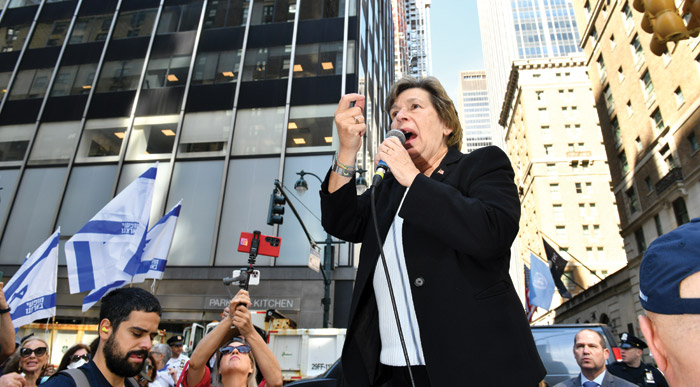
Seven Jewish individuals have filed a federal lawsuit against the three organizers of the protest in front of Adas Torah Synagogue in the Pico-Robertson neighborhood in June, alleging that the protest violated federal law barring people from obstructing access to religious institutions.
The lawsuit was filed on July 24; each of the plaintiffs filed it through their membership at the StandWithUs Center for Legal Justice (SCLJ) and are anonymous. The lawsuit refers to the June 23 protest as an “antisemitic riot” and alleged that the three groups who organized it — CodePink, Palestinian Youth Movement and the WESPAC Foundation — violated the Freedom of Access to Clinic Entrances (FACE) Acts found in both federal and state law. According to a SCLJ press release, the FACE Act “imposes civil and criminal penalties on any person who ‘by force or threat of force or by physical obstruction, intentionally injures, intimidates or interferes with or attempts to injure, intimidate or interfere with any person lawfully exercising or seeking to exercise the First Amendment right of religious freedom at a place of religious worship.’ It also imposes penalties on any person who ‘intentionally damages or destroys the property of a place of religious worship.’”
The lawsuit explains that the protest that day claimed to be over a real estate event held at the synagogue aimed at “stealing” Palestinian land, but the “My Home in Israel” event actually educates “people about the realities of making Aliyah, [which] represents a key aspect of an integral part of Jewish religious observance.” There were also multiple prayer services being held inside the synagogue during the event. The lawsuit proceeds to detail “the violence and chaos” that ensued after the anti-Israel protesters arrived in front of the synagogue, as the anti-Israel protesters “donned masks and signs; threw punches at synagogue members and Jews who arrived to provide support for their fellow worshippers and engaged in other acts of violence … Scenes of blood on the streets, use of bear spray, and the brandishing of makeshift weapons (including, among other things, a skateboard) permeated cyberspace and was reported by dozens of news outlets.”
The plaintiffs had attempted to enter Adas Torah to either attend the event and/or the services, but were blocked from doing so by the protesters; all but one eventually made it inside thanks to an alleyway behind the synagogue. One of the plaintiffs was already inside the synagogue when the protest began, but found it difficult to study Torah as a result of the protesters’ actions.
“Those SCLJ members had to expose themselves to possible physical danger to attend their respective events,” the lawsuit stated. “On information and belief, the reason why the members who were able to enter the synagogue were nonetheless unable to find an available prayer service is because the prayer services were interrupted and obstructed by the mob.”
The lawsuit alleged that CodePink posted false statements to social media that the events of June 23 were a “peaceful protest” and denied blocking the entrance to the synagogue; they also denied that religious services were happening during the “My Home in Israel” event.
“Targeting Jewish families on their way to exercise their religious freedom at a house of worship is abhorrent and has no place in modern society,” SCLJ Director Carly Gammill said in a statement. “The organizers of this antisemitic riot need to learn they cannot use violence and intimidation to deprive Jews of their First Amendment rights – and that we are here to help the Jewish community ensure that our laws are enforced to their fullest extent.”
“Targeting Jewish families on their way to exercise their religious freedom at a house of worship is abhorrent and has no place in modern society.” – Carly Gammill
National Jewish Advocacy Center Director Mark Goldfeder also said in a statement, “The evidence is overwhelming that these groups maliciously organized more than 200 people to deprive Jewish citizens of their First Amendment right to freedom of religion using violence and intimidation. That’s more than 200 clear-cut violations of federal law and more than 200 clear-cut violations of state law. Those responsible for violently stopping Jewish people from entering their house of worship should face steep consequences.”
A spokesperson for CodePink told The Journal that they don’t comment on active litigation. PYM and the WESPAC Foundation did not immediately respond to The Journal’s requests for comment.
To the south, in Spain, raucous protesters emboldened by their government’s recent recognition of Palestine are urging Prime Minister Pedro Sánchez to go even farther and cut diplomatic relations with Israel.
And to the north, in France, Jews fear an escalation of antisemitism following elections that saw a far-left party grab the biggest share of votes.
Wedged between these two big countries, however, is a tiny one where anti-Israel rallies are unheard of, ties with Israel remain strong, and the Jews enjoy prosperous, quiet lives — as long as they don’t officially call their subterranean cultural center a synagogue.
Wedged between these two big countries, however, is a tiny one where anti-Israel rallies are unheard of, ties with Israel remain strong, and the Jews enjoy prosperous, quiet lives — as long as they don’t officially call their subterranean cultural center a synagogue.
Welcome to Andorra, a mountainous microstate of 82,000 nestled in the eastern Pyrenees. Just 181 square miles in size — about three times bigger than Washington, D.C. — this principality is a skiing and duty-free shopping paradise. Andorra is also the world’s only self-declared Catalán-speaking nation, and since its founding in 1278, its state religion has been Roman Catholicism.
That doesn’t seem to be a problem for the local Jewish community, estimated by its members to number just 73.
“I don’t hide the fact that I’m Jewish. I’m proud of it,” said Andorra-born Mercedes Abitbol, 52, an official of the MoraBanc financial group who on a recent afternoon was sporting a small silver “chai” necklace while sitting an outdoor café in this picturesque city, which at 3,042 feet above sea level is Europe’s highest capital.
Unlike France and Spain, Andorra has no history of antisemitism. Maybe it’s because for most of its existence, not a single Jew lived here. In fact, there’s no record of a Jewish presence in this landlocked nation until World War II, when it became a temporary haven for French Jews and others fleeing the Nazis — a historical footnote alluded to in the 2023 Netflix miniseries “Transatlantic.”
Unlike France and Spain, Andorra has no history of antisemitism. Maybe it’s because for most of its existence, not a single Jew lived here. In fact, there’s no record of a Jewish presence in this landlocked nation until World War II, when it became a temporary haven for French Jews and others fleeing the Nazis.
Between 2,000 and 3,000 French Jews and others escaped Vichy France through neutral Andorra under incredibly harsh circumstances, according to mountaineer and local historian Joan Janer Rossell.
“Guides would take these people — including Poles, Germans and Hungarians — on foot to cross over the Pyrenees into Spain,” he said. “These mountain people were very poor, and the conditions were very bad. Some took advantage of the refugees, stole their money and even killed them. Many made it to Spain, but others died along the way.”
Rossell, 66, was raised Catholic but later discovered that his father had Jewish roots. He visited Israel in 1980 and got “Am Yisrael Chai” (Long live the people of Israel) tattooed on his forearm in Hebrew. He can sing Israel’s national anthem, “Hatikvah,” and has also written several novels in Catalán, including a history of the Andorran Pyrenees.
Panoramic view of Andorra la Vella, capital of the Principality of Andorra, from a hiking trail in the Pyrenees. (Larry Luxner)
“The Jews here have always accepted me as a friend,” Rossell said. “Every year, the Israeli ambassador to Spain visits Andorra, and they always invite me to their cocktail reception.”
Officially, the country is governed by two co-princes: the French president and the bishop of Urgell, a region in Spain. And minuscule as it is, Andorra is not Europe’s tiniest microstate: Liechtenstein, Malta, Monaco, San Marino and the Vatican are all considerably smaller in size.
Virtually all Andorrans speak fluent French and Spanish besides their native Catalán. English is also widely understood, as is Portuguese, and foreigners make up two-thirds of the population.
In 1962, Andorra — which then had only 11,000 people — was the subject of a whimsical anti-war parody by folk singer Pete Seeger, a non-Jew who often sang in Hebrew and had visited Israel several times. It was around that time that Jews started trickling into Andorra again — this time from Morocco, by way of Spain.
Isaac Benchluch Ayach, a former physical education professor, is now the principal of a high school, the Escola Andorrana de Sant Julia. He’s also president of the local Jewish community.
“The Jews were in Morocco for almost 500 years, but when the state of Israel was established, problems began. My mom was threatened several times by her Muslim neighbors,” said Benchluch, explaining that his parents left for Barcelona with the idea of making some money and then emigrating to the United States.
But in Barcelona, he said, they heard that Andorra was looking for workers, so they came here. In the 1960s, local officials, hoping to transform the country from a poor farming nation to a tourism and banking hub, began developing ski resorts and building up the transport network.
Today, Andorra is an easy, three-hour drive from either Toulouse or Barcelona. In 2023, it attracted 10.2 million tourists, and thanks to strict immigration controls at the French and Spanish borders, it boasts very little crime, zero unemployment and virtually no homelessness.
Unlike most European destinations, Andorra has no sites of Jewish interest. It does, however, offer majestic mountain panoramas, dozens of medieval churches, quaint cobblestone streets, a network of hiking trails and a national automobile museum with 80 vintage cars on display.
Although it uses the euro as its currency, Andorra isn’t part of the European Union, meaning that the liquors, perfumes, cigarettes and electronics stocked in its many duty-free shops are far cheaper than in neighboring countries.
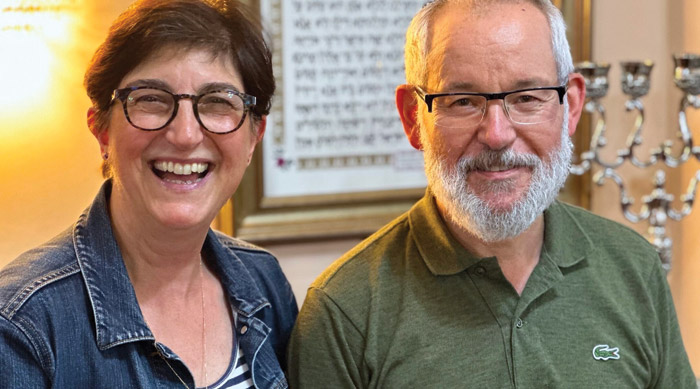
Baruj and Miriam Rodríguez, both 62, are pillars of Andorra’s Jewish community, most of whose members work in the import-export or retail industries.
“My parents are from Andalucia. During the Spanish Civil War, they escaped and came to Andorra for political reasons since my father was a communist,” said Baruj, a pharmacist and a convert to Judaism. “But practically 100% of this community is from Morocco, mostly from the city of Larache.”
Added Miriam, an immigrant from Casablanca who spent two years on a kibbutz in Israel before settling here: “For the moment, there is no antisemitism in Andorra. Sometimes they ask questions and make faces, but people here don’t really know anything about Judaism.”
Likewise, Israelis are ignorant about Andorra, said Miriam, recalling an incident several decades ago when immigration officials at Tel Aviv’s Ben-Gurion Airport questioned her Andorran passport.
“They didn’t know where Andorra was, and had to look for it on a map,” she said. “Another time, I tried calling my mom from Israel and the operator thought I said ‘Honduras.’”
In 1998, local Jews formed the Associació Cultural Israelita de les Valls d’Andorra, or ACIV, in a large meeting hall tucked away on an underground level of a medical office building that used to be a warehouse.
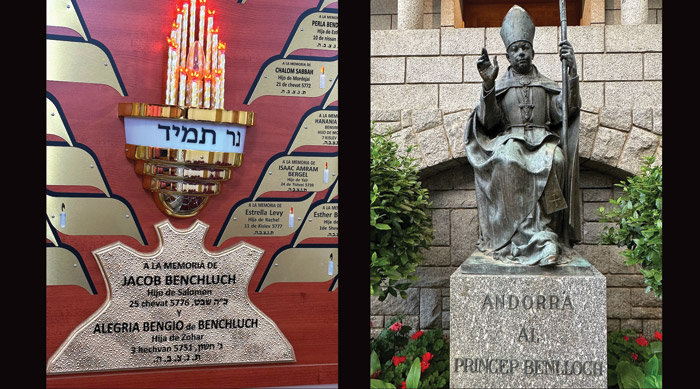
At left, a Ner Tamid burns in memory of the founders of Andorra’s Sephardic Jewish community at the local Jewish community center. At right, a statue of Princép Benlloch, a medieval Catholic ruler of Andorra whose name bears a resemblance to the Sephardic Jewish surname of Benchluch. (Larry Luxner)
“It’s not technically a synagogue, because that would be prohibited,” said Baruj, citing Andorran regulations that forbid the consecration of any non-Catholic house of worship. “Before this, we used a private home with a second-floor view. But that was too obvious, so we chose this site.”
There are no outside markings at the entrance to ACIV — not even a mezuzah — only a small label above the buzzer. Inside, however, is a space large enough for 150 people, complete with Jewish prayer books, a large memorial wall, a silver menorah and an ark containing three donated Torah scrolls including one from Gibraltar.
When ACIV was established, Andorra was home to around 120 Jews. Since then, 15 of its founding members have died, and many younger congregants have left for Paris; the nearest synagogue to Andorra is a Chabad Lubavitch center in Barcelona.
“Every Shabbat we try to get a minyan, but it’s very difficult,” Baruj Rodriguez said, noting that as time goes on, fewer and fewer people attend — particularly in the summer, when most Jews are on vacation.
One reason, said Miriam, is that “the young people are marrying late, and then they leave. There are no Jews here between the ages of 13 and 30. The good jobs are abroad, and they generally don’t want to intermarry.”
Baruj Rodríguez said that he and 82-year-old Meir Muyal are the only Jews in Andorra who still keep kosher. The country has never had its own rabbi, though for the High Holidays, the congregation brings rabbis from Toulouse or Paris.
Benchluch, the community president, has four children: Malka, Meir, Yosef and Nathaël. His Catholic-born wife, Lidia, converted to Judaism under the supervision of two Orthodox rabbis in Barcelona.
“There’s no mikvah here, so she had to do it there,” he said, explaining that mohels must be brought from either Toulouse or Barcelona to perform the occasional circumcision. “Andorra has no kosher restaurants, and Catalán cuisine is all about pork. It’s very hard to live as a Jew here.”
Dying as a Jew in Andorra is also problematic. Due to limited space, most Andorrans are cremated — no problem for Catholics, but traditionally a taboo in Judaism. Yet because Andorra lacks a Jewish cemetery, local Jews generally opt to be buried in either Toulouse or Barcelona.
However, that may soon change, said Benchluch.
“After 20 years of just talking about it, we’re now negotiating with the government to establish a Jewish cemetery in 2025 or 2026,” he said. “Land is very expensive, so we’re asking them to give us a plot of land in Escaldes for 100 graves.”
Things are gradually changing politically, too. About a year ago, Benchluch’s brother, Salomó, was elected to Andorra’s 28-member parliament — becoming the first Jewish legislator in Andorran history.
Spain, Ireland and Norway recently formally recognized Palestine in an effort to pressure Israel over its war against Hamas. In France, the leftist leader Jean-Luc Mélenchon announced he’d immediately push to recognize a Palestinian state after his party’s strong electoral showing.
Bucking that European trend, Andorran Foreign Minister Imma Tor declared in mid-June that Andorra would do no such thing.
“The conditions are not met for us to recognize Palestine as a state. We think it’s not yet the right time to position ourselves in the middle of this conflict,” she said, adding that “with Israel, we have a relationship of rapprochement, and we’re receiving more and more tourists from there.”
JTA asked Muyal, the oldest Jew in Andorra, if he’d ever given any thought to moving to Israel, as so many other Moroccan Jews did.
“No,” he replied without hesitation. “Aside from the difficulties of being a Jew, I’m very happy here. This is a wonderful country.”
Vice President Kamala Harris, now the frontrunner for the Democratic presidential nomination, will likely continue Biden’s foreign policy on most issues, but might diverge when it comes to Israel, NBC News reported on Monday.
While Harris initially expressed support for Israel in its war with Hamas following the terror group’s invasion on Oct. 7, she turned increasingly critical as the war dragged on.
While Harris initially expressed support for Israel in its war with Hamas following the terror group’s invasion on Oct. 7, she turned increasingly critical as the war dragged on.
“We are not going to create any conditions on the support that we are giving Israel to defend itself,” she told a conference in Britain on Nov. 2, less than a month after the assault.
A month later on Dec. 2, Harris said at an environmental conference in Dubai that “too many innocent Palestinians have been killed. Frankly, the scale of civilian suffering and the images and videos coming from Gaza are devastating.”
“This was the rhetoric that Biden would shortly adopt,” noted conservative columnist Daniel Greenfield.
Politico reported in December that Harris had told the administration “to show more concern publicly for the humanitarian damage in Gaza.”
“One person close to the vice president’s office said she believes the United States should be ‘tougher’ on Israeli Prime Minister Benjamin Netanyahu,” the report said.
On March 3, in Selma, Alabama to commemorate the 1965 civil rights march, Harris dedicated the first five minutes of her speech to expressing sympathy for Gazans, holding Israel responsible for their condition.
“Before I begin today, I must address the humanitarian crisis in Gaza. What we are seeing every day in Gaza is devastating,” she said.
“People in Gaza are starving. The conditions are inhumane,” she said. (Reports of a full-scale famine turned out to be untrue. In June, the Integrated Food Security Phase Classification admitted its dire predictions had been incorrect.)
“The Israeli government must do more to significantly increase the flow of aid … No excuses. They must open new border crossings. They must not impose any unnecessary restrictions on the delivery of aid,” she said.
While she also said that the Hamas threat to Israel must be eliminated and the hostages returned, those statements seemed perfunctory in comparison.
“Her forceful delivery went viral, with thousands of people posting her comments online and a number of media outlets writing about them,” NBC News reported.
The first draft may have been even harsher, as NBC News reported that officials at the National Security Council had toned it down. Harris’s communications director called the report “inaccurate.”
Later in March, Harris opposed Israel’s plan to invade Rafah, the last stronghold of Hamas in the southern Gaza Strip, although not doing so would have enabled the terror group to survive.
“We have been clear in multiple conversations and in every way that any major military operation in Rafah would be a huge mistake,” she told ABC News.
“Let me tell you something. I have studied the maps. There’s nowhere for those folks to go, and we’re looking at about 1.5 million people in Rafah who are there because they were told to go there, most of them,” she said.
Harris’s assessment turned out to be wrong, as 900,000 Gazans evacuated Rafah within one week from the time Israel issued its first evacuation order for the city on May 6.
“[C]rowded tent camps in the central and northwest regions of the city grew sparse within days of the order,” the Associated Press reported in late May, after analyzing satellite photos.
In July, she expressed sympathy for anti-Israel campus protesters, telling left-wing periodical The Nation that students were “showing exactly what the human emotion should be.”
The Washington Post reported in March that Harris had warned White House advisers that young voters see the Israeli-Arab conflict differently than older ones.
Also, immediately after the Oct. 7 attack, Harris lobbied the president to include a line about Islamophobia in his speech promising unconditional support for Israel, the Post reported.
That decision recalls another Harris made as California attorney general to convene interfaith, community and law enforcement leaders to condemn the rise of Islamophobia after a husband-and-wife Islamist terror team killed 14 and wounded 22 others at a Christmas party in San Bernardino in 2015.
“She is on the fringe of the progressive wing of the party, which sympathizes more with the Palestinian cause,” David Friedman, former U.S. Ambassador to Israel under Donald Trump, told The Jerusalem Post on Sunday, predicting that U.S. Jewish voters would move to the Republican Party due to Harris’ rise.
“She is on the fringe of the progressive wing of the party, which sympathizes more with the Palestinian cause,” David Friedman, former U.S. Ambassador to Israel under Donald Trump, told The Jerusalem Post.
Prominent pro-Israel lawmakers, however, defended Harris’ record on Israel and antisemitism, telling The Jewish Insider that she is a “staunch ally” of Jewish people.
Rep. Jared Moskowitz (D-Fla.) told the Insider that “people were serving different roles” in the administration, suggesting that Harris was reaching out to the Democratic Party’s progressive base, and that she would shift to a more centrist position as president.
“Soon-to-be President Harris [will] support Israel, our No. 1 ally in the region,” he said.
However, Friedman insisted that Harris didn’t pass the “kishkes test.”
“Combine that with the Republican Convention being historically pro-Israel and the Democratic Convention likely to be pro-Palestine, and you have a significant shift,” he added.
When it meets this week at its annual convention, the American Federation of Teachers (AFT) will not be focusing on the need to improve teaching in American schools. Sadly, instead of figuring out ways to raise student scores in language, math and science so our public school graduates can enter college, technical schools and the workplace, the AFT is weighing in on Israel and its war with Hamas.
In the aftermath of the Oct. 7 massacre and given Israel’s need to defend its citizens, I find myself shaking my head in disbelief more frequently than ever before. Pro-Hamas college students rioting and making life difficult for Jewish students on campuses, Jews being harassed and attacked on American city streets, the vandalizing of synagogues and Jewish schools, and hostage posters being torn down make my head spin. Now comes the AFT.
Those attending the convention in Houston will be treated to several anti-Israel resolutions, such as “Opposing the Weaponization of Antisemitism,” “For an End to the War in Gaza and Lasting Peace, Security and Self-Determination for Israel and Palestine,” “Sell State of Israel Bonds,” “AFT Divestment from State of Israel Bonds” and “Stop Enabling Genocide: Halt U.S. Military Aid to Israel.”
While you’ll find mention of Hamas’ Oct. 7 attack in a resolution, there’s no mention of the corruption of Palestinian schools that use children’s education as a weapon against Israel. Nor will you find a condemnation of the Palestinian school system’s glorification of terrorism and martyrdom.
While you’ll find mention of Hamas’ Oct. 7 attack in a resolution, there’s no mention of the corruption of Palestinian schools that use children’s education as a weapon against Israel. Nor will you find a condemnation of the Palestinian school system’s glorification of terrorism and martyrdom.
Maybe the AFT has to be shown the reports about textbooks used in Palestinian classrooms. According to Palestinian Media Watch, it’s the Palestinian Authority and Hamas who are “pulling the strings” and “putting the content in the schoolbooks” glorifying terrorists and inculcating students in Jew-hatred.
Among the AFT resolutions, you won’t find a condemnation of UNRWA, which permits its school buildings to be used by Hamas for weapons storage or as launching pads for missiles, rockets and mortars aimed at Israeli civilians. Nowhere in the list of resolutions will you find any criticism of the P.A.’s treatment of teachers, including mass arrests of teachers on strike. Nor will there be any mention of the P.A.’s decision to spend money on salaries for convicted terrorists and stipends to their families rather than education.
Instead of targeting the P.A. and Hamas with its resolutions, the AFT calls for U.S. aid to Israel to “be used only for purposes that conform with American and international law: American military aid cannot be used in ways that facilitate the seizure of Palestinian land, the violent dispossession of Palestinian communities and the annexation of occupied Palestinian territory. Nor can U.S. military aid be used to harm civilian populations.”
While it puts a modicum of blame on Hamas, which the AFT admits “has demonstrated a readiness to sacrifice Palestinian life on a massive scale when it thinks it will serve its ends,” the union nonetheless goes on to claim, “Israeli Prime Minister Netanyahu and his far-right government are an obstacle to achieving lasting peace, freedom and security.”
America’s schoolteachers have, at a minimum, a bachelor’s degree. Many have master’s degrees and PhDs. They’re educated. We expect them to be rational and enlightened. That’s why we entrust our children’s education to them. We also expect them to know when they’ve crossed the line between areas of their expertise and international politics.
I’m not saying that these terrorist-defending teachers are typical of the entire public education community. I’m certainly not suggesting they should be deprived of their legal right to adopt immoral positions. But parents have rights too; including the right to ensure their children get a first-rate public school education from teachers who focus on education, not politics.
Stephen M. Flatow is president of the Religious Zionists of America.
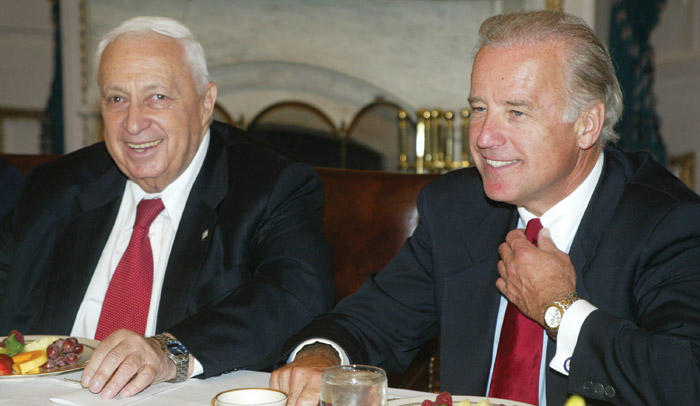
If there is one story that defines Joe Biden’s relationship with Israel, it is the famous Golda Meir anecdote.
At an Israeli embassy Independence Day bash in 2015, the then-US vice president told the story he had been telling for 42 years.
He was a neophyte Delaware senator in the fall of 1973, barely 30 years old. She was the wizened, chain-smoking prime minister. He conveyed to her his sense that Israel’s enemies were about to launch a war. She seemed pessimistic, too. (The attack that launched the Yom Kippur War would surprise Israel within days.) She asked him if he wanted to pose for a photograph. They stepped outside of her office.
“She said, ‘Senator, you look so worried,’” he said. “I said, ‘Well, my God, madame prime minister,’ and I turned to look at her. I said, ‘The picture you paint.’ She said, ‘Oh, don’t worry. We have’ — I thought she only said this to me. She said, ‘We have a secret weapon in our conflict with the Arabs. You see, we have no place else to go.’”
The 2015 speech was aimed at assuaging tensions between his boss, President Barack Obama, and Prime Minister Benjamin Netanyahu over the Iran nuclear deal Obama was brokering that year.
But buried toward the end of the speech was a prophecy, made by a vice president and fulfilled by the same man once he became president: America would bring its military might to bear on Israel’s behalf, if it came to that.
“We’ll never stop working to ensure that Jews from around the world always have somewhere to go,” he said. “We’ll never stop working to make sure Israel has a qualitative edge. And whoever the next President is — Republican or Democrat — it will be the same because the American people, the American people are committed. The American people understand.”
In 2023, President Biden made good on that promise, literally embracing Netanyahu in the wake of the October 7 attack by Hamas in which some 1,200 people were killed and 251 were taken hostage, and pledging, “As long as the United States stands — and we will stand forever — we will not let you ever be alone.”
Over the next nine months and the war that followed those attacks, that pledge has been tested, with the administration withholding large bombs from Israel’s arsenal and warning repeatedly that the Israeli counterattack was in danger of going too far.
The Hamas-run health ministry in Gaza claims more than 38,000 Palestinians have been killed. The toll cannot be verified and does not differentiate between civilians and and terror operatives. Israel says it has killed more than 15,000 gunmen in Gaza and another 1,000 in Israel on October 7.
The war cost Biden political capital across the board: a rebellion among pro-Palestinian voters who voted “uncommitted” in various state primaries, and anger from the right and the kinds of pro-Israel interests who consider anything but a full green light to Israel a betrayal of America’s closest ally in the Middle East.
‘Basic friendship’
For nearly his entire political career Biden represented the once-mainstream Democratic view of Israel: When Obama was pressuring Israel over Iran and other matters, veteran Mideast peace broker Dennis Ross said at the time, Netanyahu “understood that Biden would disagree with him on a lot of things but never questioned Biden’s basic friendship.”
Biden has long identified as a Zionist, including a nod to that identity as recently as last week, when he said, “You don’t have to be a Jew to be a Zionist, and a Zionist is about whether or not Israel is a safe haven for Jews because of their history of how they’ve been persecuted.” He also said he believed many people did not know the term, which pro-Palestinian voices have increasingly used as a pejorative.
Biden’s relationship with Israel dates back to that visit in 1973. It’s a personal history that makes him something of the last of a breed.
“There’s hardly anyone out there who was in the US government in 1973 and is still involved in politics in 2020,” said David Makovsky, a member of the Obama administration team that tried in 2013 and 2014 to broker an Israeli-Palestinian peace and is now at the Washington Institute, in a 2020 interview. “He remembers an Israel that is not just a startup nation, but facing wars.”
By withdrawing from the presidential race, after an agonizing few weeks of defiance and indecision, Biden at last became the bridge to the next generation that he once pledged to be.
But it appears unlikely that another Democratic president will ever have his generational and personal attachment to Israel — while the Democratic platform staunchly supports Israel, and most Democratic lawmakers do, too, anti-Israel sentiment is on the rise among younger Americans and within the progressive wing of the Democratic Party. And even some mainstream Democrats have, in the context of the war, entertained policies that previously had been off-limits, such as conditioning aid to Israel.
Vice President Kamala Harris, a front-runner to replace Biden at the top of the ticket, has stoked worries among pro-Israel voters for appearing to be more vocal than Biden in calling out what the administration sees as the oversteps of Netanyahu.
In March, she was the first administration official to call for an “immediate” ceasefire and used tough language to describe demands on Israel to allow in humanitarian aid.
“No excuses,” Harris said. “They must open new border crossings. They must not impose any unnecessary restrictions on the delivery of aid. They must ensure humanitarian personnel, sites, and convoys are not targeted.”
Still, administration officials are adamant that those claiming the vice president will take a tougher stance on Israel are hard-liners engaged in wishful thinking.
Harris, who drew Biden’s endorsement on Sunday when he exited the race, is married to a Jewish man, Doug Emhoff, who has been a vocal advocate against antisemitism during his stint as second gentleman. Emhoff’s first trip to Israel was in 2017, when he traveled with his wife, then a California senator.
A range of Israeli politicians referred to Biden’s long record of support when responding to his exit — though Netanyahu, who is scheduled to meet with Biden during a Washington visit this week, did not immediately issue a statement. He did so on Monday morning, as he left Israel en route to Washington, DC.
“President Biden is a true friend of Israel who stood by us in our most difficult moments,” tweeted former prime minister Naftali Bennett. “During my tenure as Prime Minister, I witnessed his unwavering support of the State of Israel. Thank you for everything.”
“President Biden is a true friend of Israel who stood by us in our most difficult moments.” – Fmr. Prime Minister Naftali Bennett
A left-wing former lawmaker, Stav Shaffir, tweeted, “President Biden, you will be remembered as one of the greatest leaders of our time. Thank you for your unwavering support of our country, your tireless efforts to safeguard democracy, your courage and responsibility. The world desperately needs more leaders like you.”
Shabbos Kestenbaum stood on stage at the Republican National Convention on July 17 wearing a black kippah and a dog tag necklace for the hostages in Gaza. He told the crowd, “My name is Shabbos Kestenbaum. I am a proud, first generation American. I am a proud Orthodox Jew. And as of five months ago, I am the proud plaintiff suing Harvard University for its failure to combat antisemitism.”
The audience cheered loudly, with some jumping up out of their seats to show their support.
This wasn’t the first time Kestenbaum had gotten involved in the political sphere. Back in February, he and other Jewish students testified before Congress about antisemitism on their college campuses. At the time, he was working towards his master’s degree at Harvard Divinity School, and he told members of the House Education and Workforce Committee that he’d written to Harvard’s antisemitism task force more than 40 times about the hate he’d seen on campus – but he never received a reply. As he recounted other shocking accounts of antisemitism, he told the committee, “This is the reality of being a Jew at Harvard in 2024.”
Kestenbaum then filed a lawsuit against Harvard, now his alma mater, alleging that the school “has become a bastion of rampant anti-Jewish hatred and harassment… What is most striking about all of this is Harvard’s abject failure and refusal to lift a finger to stop and deter this outrageous antisemitic conduct and penalize the students and faculty who perpetrate it.”
Deliberations have begun on the lawsuit, but Kestenbaum told the Journal the judge won’t issue a ruling for some time now. While he’s waiting, he’s going to continue to speak out and support other students who have experienced antisemitism on their own campuses.
“Hundreds of students reached out to me over the last couple of months,” he said. “The Jewish community is in deep crisis, and we need to fight back.”
“The Jewish community is in deep crisis, and we need to fight back.”
Getting onstage at the RNC and showing how proud he is to be a Jew, as well as suing Harvard, are how Kestenbaum is choosing to stand up to the hate.
The outspoken grad received a call from the Trump campaign a few weeks before the convention; they said they were concerned about the experiences he and too many other Jewish college students were going through.
“I was fortunate I got to speak about my own experiences and about bipartisan policy I believed would help the Jewish community,” said Kestenbaum. “I was extremely nervous to speak, as I was not aware that the former president would be at the convention at the time. I knew that I was speaking on behalf of many people, and that this movement was much bigger than just one person.”
Kestenbaum’s moving speech lasted five minutes, and he ended it with “God bless the land of Israel. God bless, protect and return the American hostages in Gaza now” to thunderous applause. After he got off the stage, he was embraced by those in the crowd.
“People stopped to hug me and say they were praying for me,” he said. “One person was from a parish in Iowa, and other people were putting up hostage posters in their communities where there are almost no Jews. It was deeply moving and gratifying.”
Before his speech, Kestenbaum was in the waiting room with the parents of the Israel-American hostage Omer Neutra – they also addressed the convention.
“Just like Omer’s parents, I was there to bring a bipartisan message,” he said. “It was a message of the plight of the Jewish hostages, the experience of Jewish Americans on college campuses and the importance of the state of Israel. I did not endorse a person – I endorsed policies. Should the Democratic party have me or any Jewish student, or any family of the hostages, we would be honored to do so.”
No matter what happens with his lawsuit, Kestenbaum urges Jewish students not to give up or leave their respective universities. Even before Oct. 7, he saw antisemitism on campus, and there was always, as he said, “an unwillingness from Harvard to do anything about it.”
However, he doesn’t think that Jewish students should give up without a fight.
“Do not acquiesce your place there,” he said. “We are working with donors and students to create real change. Making sure there is sustained public pressure on these universities is critical. Hopefully, Congress will take away the tax-exempt status and subsidies they give to these universities.”
Despite dealing with his disappointing alma mater, and seeing discrimination at Harvard and at other colleges, Kestenbaum is appreciative of the fact that he gets to be such a public advocate for the cause.
“It will be difficult to shake off the memory of not only 34 student groups writing a letter on the night of Oct. 7 blaming Jews for the massacre, but in my personal WhatsApp group, seeing individuals say, ‘Long live the Palestinian resistance. Victory is ours’ and having students respond, asking how they could help. That will always scar me. After Oct. 7, I booked a one-way ticket to Israel, dug graves for fallen soldiers, went to the hospitals and played guitar, delivered goods to the Army bases and did whatever I could to help and get out of Harvard.”
He continued, “That experience will always be with me, and it’ll always be a difficult part of my story. But at the same time, I’m very thankful that I was able to speak out on behalf of the community I love so much.”
Around 360 social media influencers were invited to a unique event held in New York City, “Voices for Truth: Influencers United Against Antisemitism.” The summit, held at The Glasshouse, was hosted in partnership with the Israeli Foreign Ministry and featured well-known figures such as New York City Mayor Eric Adams, Bravo host and producer Andy Cohen and singer Montana Tucker, who has become a prominent advocate for Israel since the war started.
Ayelet Raymond, whose public persona is Kosher Barbie, arrived at the event wearing a Marilyn Monroe-inspired dress that she designed herself. Raymond, born in Jerusalem to an ultra-Orthodox family, said she was never allowed to play with Barbie dolls due to her family’s religious beliefs.
“On the final step of completing the Kosher Barbie dress design,” Raymond told The Journal, “I sent a picture of the dress to my entertainment aficionado Aunt Marcelle in London for approval.”Her response: ‘You remind me of this character in “Diamonds Are a Girl’s Best Friend.'”
Raymond, who didn’t have a television at home growing up, and had never watched any of Monroe’s films, then watched the clip of the song from the film and got inspired. “I decided to honor Marilyn by adding the long pink gloves she wore in the movie to the iconic Kosher Barbie dress, celebrating my Israeli roots and our Jewish spirits through fashion,” she said.
Raymond left Israel five years ago, leaving behind her Orthodox way of life as well; she never felt she belonged in the Orthodox community.It wasn’t something her family supported, but she was determined to study film and pursue a career in the entertainment world. Her family expected her to get married at a young age and have children, but she had other plans.
“The average family in our neighborhood had 12 kids,” she said. “My next-door neighbor had 19. We were only six kids and as a result, I always felt we were not religious enough. My family would have been a lot happier if I got married and had 10 kids, because if you don’t, they consider it as [though you’re] wasting your life.“
However, Raymond was not going to allow the fear of how she would be perceived in the ultra-Orthodox community to stop her. She produced a short film, “A Sweet Moment,” about a Jewish boy who ate too much candy and needed to see a dentist. The film was labeled kosher, giving it a sort of a green light for kids in that community to watch.
“All the Orthodox kids watched it,“ Raymond said. “I also produced a Purim play each year. I saved the money I made and then moved to New York, where I attended the filmmaking program at NYFA (New York Film Academy).”
Once in New York, Raymond allowed herself to take off the long skirts and elbow-length sleeves and start dressing differently. It was there that she also created her persona as Kosher Barbie, designing all of her outfits herself. Since Oct. 7, she has started incorporating a yellow ribbon in her Kosher Barbie outfits, calling for the return of all hostages.
While attending the influencer summit, Raymond met Oli London, who she described as “a real-life Ken.” London is known for undergoing multiple surgeries so he resembles the K-Pop star Jimin of BTS, but to Raymond“he looked just like the doll.”
Most of the influencers at the summit were Jewish, but some, like London, were not.
“I asked him why he have decided to support Israel and he said, ‘After witnessing the horrors of the Oct. 7 videos and seeing what Hamas did, it was clear to me that I will always support Israel.” About 100 followers and supporters of Kosher Barbie arrived at the Manhattan hotel where the influencers were staying. Raymond wore her strapless pink dress with a huge Swarovski Star of David at the front.
“It was so moving,” she said. “I’ll never forget that moment. I went down the stairs with Biana, a violin player, who accompanies me in all of my appearances. She played the Israeli national anthem. It was like a scene from a movie — everyone at the hotel started singing ‘Hatikvah.’“
“It was like a scene from a movie — everyone at the hotel started singing ‘Hatikvah.’“–Ayelet Raymond
Raymond is now working on a new YouTube channel, “My Hebrew Land,”where she teaches children Hebrew through song with the help of young performers from the New York stage.
With her long blonde hair and pink Barbie-doll outfits, she looks a far cry from the Orthodox girl she used to be.
“I do look a lot different,” she said. “I wasn’t allowed to wear pants or any of these outfits I wear today. Maybe that’s why I became such a fashionista when I moved to New York. On the outside, I might look different, very glamorous and confident, but deep inside, I’m still that shy and good girl from Jerusalem.”
If making bouquets were an Olympic sport, this torch bouquet would be the G.O.A.T. Give it as a gift if you’re going to an Olympics watch party. Or just run around the neighborhood holding it up and revel in the cheers (in your head). It’s so easy to make, you can get straight 10s even if you’re an absolute beginner.
What you’ll need:
Brown paper
Red and yellow tissue paper
Red or yellow tulips
1. Cut a piece of brown paper into a 10-inch square. (I cut up a brown paper bag.) Then roll it into a cone and tape it securely.
2. Wrap tulips in red and yellow tissue paper. The red and yellow paper looks like flames, and the tulips are also flame-shaped.
3. Insert the paper and tulips into the cone.
Jonathan Fong is the author of “Flowers That Wow” and “Parties That Wow,” and host of “Style With a Smile” on YouTube. You can see more of his do-it-yourself projects at jonathanfongstyle.com.
The thinking of Carl Jung helped me learn the distinction between the God one might believe in versus the gods that are operating within us. To know that a person believes in the idea of God of Judaism, Christianity or Islam, for example, does not tell us much about what motivates a person.
Under the mask of how we present ourselves to society are unconscious forces that drive us. While the mask we present to the world might be stable, in the deeper, unseen self, a battle sometimes rages. Powerful, opposing forces vie for control. We have forces for decency and forces of destructiveness.
When unleashed, destructive forces, forces of desire, violence and vengeance can reign, as they did at the end of last week’s Torah portion, Balak. In a dismal backwater called Shittim, bands of Israelites committed mass promiscuity with Moabite women and fell into mass apostasy, worshipping the Moabite God, Ba’al Peor. God’s burst forth and, as far as we can tell, a civil war broke out. Horrid events are recounted. Jung might say, after Shakespeare, that gods of havoc were let slip.
And yet the Torah is filled with laws and teachings of righteousness, virtue, reason, restraint and wisdom that call on us to do battle against those destructive forces.
Why might Jung call those darker forces within us “gods”? I think because these energies within present themselves not as psychological quirks but rather as dynamic forces, forces that push against anything that we thought we were or might believe in, forces that can overwhelm us. I have seen people who proclaim that their word is their deed make weighty promises upon which others depended, and then break those promises because they have been miffed. A feeling of being disparaged, whether that feeling is based on any fact or not, can cause a person to wreak havoc in the lives of others. And that wreaking havoc, that desire to punish, can be fueled by a primal sense of vengeance, of fury unleashed. It does not matter what religion one might profess; unless one has in place countervailing forces, inner gods of vengeance can hold sway.
This week’s Torah portion brings to mind a vengeful God, and his agent of vengeance, Pinchas, a force of God’s vengeance in last week’s Torah portion. The idea of vengeance seems so archaic, but of course, we see the lure of vengeance every day. In acts of terrorism and war, violent vengeance often plays a huge role. In our more day to day lives, verbal vengeance arises, like the wrath of God.
The drive of vengeance is not just to right a wrong, but to make suffer those who are or symbolize the wrongdoers. Think of the amount of literature, theater and cinema devoted to themes of vengeance and retribution. While people may not believe in a god of vengeance, that god seems to be operating in the myths and stories of our culture, and within us. When Jung looked deeply into the human psyche, he could see not only powers of repression symptomized into neurosis, the focus of Freud. Jung also saw forces that reminded him of the Greek gods vying for power. The human soul is a battleground. A depressed person might look placid, but that depression might be battle fatigue from wars raging within.
When Jung looked deeply into the human psyche, he could see not only powers of repression symptomized into neurosis, the focus of Freud. Jung also saw forces that reminded him of the Greek gods vying for power. The human soul is a battleground. A depressed person might look placid, but that depression might be battle fatigue from wars raging within.
I write all of this to give depth to my teachings on how to look at the God of the Hebrew Bible. even we say “God is One” in the Shema, we know that the God of the Bible is not one – the various depictions of God in the Bible are in many ways irreconcilable. The loving and healing God of Psalms is not the vengeful God we find appearing often in the narratives of the Torah. Jung would teach that the various depictions of the God of the Bible are at least in part projections of the forces that rage in the human psyche.
I find this interesting: Some who say that they don’t believe in the God of the Bible, at least the most troubling depictions, act as if they do. A person might say that they don’t believe in a God of vengeance, but when disappointed, feel entirely justified in their own vengeance. It is as if they are obeying the God they don’t believe in.
As I have said often, the Bible is more about the human condition than a theological inquiry into the nature of the divine. Depictions of God, perhaps especially the ones that trouble us the most, tell us more about ourselves than we would like to admit.
I think that what I believe to be the true nature of God – as metaphorized in Lurianic Kabbalah – leaks through now and then into the Hebrew Bible. Other than that, the depictions of the various personas called God in the Bible are complex reflections of human nature and the human condition projected on the canopy of heaven.
I revere the Bible as a Torah of truth – a truth about ourselves, about our wars within, and about our means for transformation into something better than we are.
As Abe Gold in the latest season of “Babylon Berlin,” Israeli actor Mark Ivanir speaks English, German, Yiddish and Hebrew But his best moment requires no words as he beats up some Nazis who attacked his uncle. Gold hits them with a cane and despite being outnumbered, scares the hell out of them. Then he takes out a gun and hits one of them.
The scene struck an emotional chord with Ivanir, who ad-libbed a line: “Anybody else want to get beat up by a Jew?” Prior to shooting, he spoke with his cousin, Danny, whose grandfather had been beaten up on the streets of Berlin in that time period for being Jewish.
“I didn’t even know that part,” Ivanir said. “So, for me, it had this extra family connection when I was doing it, which was very emotional.
“Babylon Berlin” tells the story of homicide investigator Gereon Rath (Volker Bruch). He’s helped by Charlotte Ritter, played by the beautiful and lively Liv Lisa Fries. or its first three seasons, “Babylon Berlin” was available on Netflix, but the fourth season is streaming on MHz Choice. It’s one of the best TV shows you will see this year.
Based on the “Gereon Rath” series of crime novels by series by Volker Kutscher, the new season — based on “Goldstein,” the third novel in the series), the season opens with Rath joining the SA (the Nazi paramilitary group known as the “Brownshirts”) and donning the swastika armband, much the chagrin of Charlotte. The organized crime syndicates have gone wild and Rath is trying to fix the problem, knowing one of the key players is Jewish mobster Walter Weintraub, played with some panache by Ronald Zehrfeld. It’s a sexy show with great music and some violence that gets its energy from the great chemistry of Bruch and Fries, but Ivanir helps make this season, with ten episodes, the best one yet.
Abe (the Goldstein now shortened to Gold) returns to Germany to recover a diamond known as the Blue Rothschild. He threatens Alfred Nyssen (an exquisitely bizarre Lars Eidinger) who claims that the jewel is missing. Though not religious, Abe is asked by relatives to join them for a Shabbat dinner and he reluctantly agrees. Not wanting to tell them he is involved in crime; he makes up a story about chewing gum and finds some connection to his roots.
“In the book he had this notion of shame of the shtetl Jew,” Ivanir said. “Now, he’s a gangster. His whole connection to the family in Germany and his origins were there but he tried to keep himself away from that.”
Ivanir also speaks Ukrainian, Arabic, French, and Arabic. He turned down the possibility of being in the Mossad and said his grandfather Meshulem impacted him.
“It was like a cultural salon in my house always,” Ivanir said. “The house was always full with poets and painters and writers and actors and there was all of that and I guess there’s something in my genes. I always wanted to do that. My grandfather at the time set me up with this Yiddish theater for kids that I attended in Israel. I admired him.”
“The house was always full with poets and painters and writers and actors and there was all of that and I guess there’s something in my genes. I always wanted to do that. My grandfather at the time set me up with this Yiddish theater for kids that I attended in Israel. I admired him.”
Ivanir is a gifted and versatile character actor. Some found his appearance too Ashkenazi to pass for Israeli, he got several roles as tough Russians. Including a memorable turn as a chainsaw-weilding Chechen in the Max comedy, “Barry.”
One intriguing role was in Showtime’s “Homeland.” He played Ivan Krupin, a high-ranking Russian secret service agent who battles withs with Saul Berenson, a senior CIA agent played by Mandy Patinkin.
American audiences will likely first remember Ivanir from his role as Marcel Goldberg, a Jew with access to black market goods in “Schindler’s List.”
Working with such a famous director in a blockbuster Holocaust film could make anyone nervous. But Ivanir said the director’s excellence helped.
“Of course, there was pressure, it’s Spielberg and a big production,” he said. “There were moments where I was stressed but I can’t say I had three-and-a-half months of stress. Steven was amazing. I did three movies with him and it’s always the same deal. He’s so open to improv and suggestions.”
Many might also know Ivanir from his strikingly good performance as Zvika, an agent for gorgeous actress Noah Hollander (Rotem Sela) in “The Baker and The Beauty” (“Lehiyot Ita) available for rent on Amazon. It tells the story of a Sephardi son of a baker, Amos (Avraham Aviv Alush) who has an unexpected romantic relationship with Noa, Ivanir plays a gay agent, he said he spoke with several gay friends to see how he should approach the role.
One told him that some gay couples don’t have kids, or when they do, it’s at a later stage, after they first focus on work.
“People from work could be the equivalent for kids,” Ivanir said. “That’s what I took from it for Zvika. His client was his work, and his daughter, and everything. That kind of focus lead me to create that role.”
The Los Angeles resident has appeared in many films and shows, and notably got to riff in Hebrew to Robert DeNiro in “What Just Happened?” and he showed his funny bone with a great joke as a cab driver picking up Tom Hanks in “The Terminal.”
He said he recently saw DeNiro, as they will appear in the new series, “Zero Day.”
“I said ‘Mazel Tov’ on his new baby we had a nice conversation,” Ivanir said. “I’m very lucky to work with both amazing people.”




 Once in New York, Raymond allowed herself to take off the long skirts and elbow-length sleeves and start dressing differently. It was there that she also created her persona as Kosher Barbie, designing all of her outfits herself. Since Oct. 7, she has started incorporating a yellow ribbon in her Kosher Barbie outfits, calling for the return of all hostages.