fbpx

June 19, 2024

12 Tough Questions and Simple Answers About Israel

My good friend, Taglit-Birthright Israel’s CEO Gidi Mark, challenged me recently. “Can you offer short, punchy answers to some of the pressing questions our participants have – and some of the accusations being thrown at them?” Here’s my best shot…. 

I offer these backs-and-forths — which represent my best effort, without speaking for Birthright or any other organization —   with a massive disclaimer. Beware! Each question deserves a book on its own, not just a snappy, 100-word answer.  I hope that all of you will use my answers as springboards for more formal and informal discussions clarifying where you agree – and where you disagree – with me, with Israel, with others. As defenders of democracy, we continue to benefit by arguing respectfully over difficult issues, while also having clear red lines distinguishing between good and evil.

I hope that all of you will use my answers as springboards for more formal and informal discussions clarifying where you agree – and where you disagree – with me, with Israel, with others. 

1. Isn’t Israel an Apartheid State?   South Africa’s racist Apartheid Regime enacted 148 laws defining people as “white,” “mixed” and “colored.” No Israeli law ever defined anyone based on race or skin color. Israeli-Arabs enjoy equal rights. In the disputed territories, Palestinians and Israelis are often kept apart based on security and/or mutual preference. But apartness is not Apartheid. The Apartheid libel tries racializing the Israeli-Palestinian national conflict. Israel’s enemies want to demonize and Nazify Israel, finding it guilty of biological racism. This charge deems Israel evil and worthy of the international death penalty, rather than a country in a complicated, painful border dispute.  

2. Isn’t Israel a Settler-Colonialist Enterprise? “Colonialism” means settling a far-away land, to extract resources or extend power. Calling Israel “colonialist” negates Jews’ indigenous ties to their homeland, while rejecting Christianity too.  Jesus emerged in a deeply-Jewish land of Israel also called Judea. Jews are the original aboriginal people. They put the “in” in indigenous, being tied to the same land, praying to the same God, maintaining the same traditions and culture for millennia. Whether you’re religious and believe the Bible, or historically-oriented and trust archaeological evidence – or both! — “Eretz Yisrael,” the land of Israel, has always been central to “Am Yisrael,” the Jewish people.

Jews are the original aboriginal people. They put the “in” in indigenous, being tied to the same land, praying to the same God, maintaining the same traditions and culture for millennia. 

3. Don’t Israelis have White Privilege? There are light-skinned Palestinians, while most Israelis are dark-skinned. The conflict between Israelis and Palestinians is national not racial. That statement acknowledges Palestinian national consciousness not just Zionism, while calling out those who want to inject America’s racial dynamics into the Middle East, simply to make Israel look bad. True, in a matter of decades, despite few natural resources, using their smarts and their sweat, Israelis built a strong country with a thriving start-up scene. Israelis shouldn’t apologize for succeeding. Moreover, there still are poor whites in Israel and elsewhere – maybe the term “White Privilege” is problematic too. 

4. Why does Israel still occupy the Palestinians? In 1967, under attack, Israel won the Sinai and Gaza from Egypt, the Golan from Syria and Jordan’s “West Bank,” what Jews called “Judea and Samaria” since Biblical days. Israel returned the Sinai to Egypt in 1979 – hoping for peace. Israel started withdrawing from six West Bank cities under Oslo in the 1990s – only to suffer waves of Palestinian terrorism from 2000-2003 that murdered over 1,000 innocents. In 2005, Israel disengaged – withdrew – completely from Gaza, only to see Hamas slaughter over 1,200 people on Oct. 7. Most Israelis keep wondering why Palestinians remain so preoccupied with trying to kill them.

In 2005, Israel disengaged – withdrew – completely from Gaza, only to see Hamas slaughter over 1200 people on Oct. 7. Most Israelis keep wondering why Palestinians remain so preoccupied with trying to kill them.  

5. Why is Israel committing genocide in Gaza? It isn’t. Genocide means trying to wipe out a nation. For years, Gaza averaged a growth rate of 1.99 percent, 39th in the world. Having started this war, Hamas is 100% responsible for every death, especially because its terrorists hide behind Gazans and Israeli hostages. Still, Israel has minimized civilian deaths in its just war of self-defense. Urban warfare, atop hundreds of tunnels, is treacherous. A U.S.-led coalition killed 10,000 innocents to defeat ISIS in Mosul. After Oct. 7, when Israel needed to protect its civilians from Hamas, and deter others from massacring innocents, what else could Israel have done? 

6. Why can’t everyone just make peace in the Middle East? Israelis sing and pray for peace constantly. Israel made peace with Egypt, Jordan, the UAE, Sudan, Morocco. Israel entered the Oslo Peace Process in 1993, and withdrew 100% from Gaza in 2005, trying to make peace with the Palestinians. Israel’s Arab citizens enjoy full rights. By contrast, the Hamas charter and most Palestinian documents call for Israel’s annihilation “from the River to the Sea.” Chants to “Globalize the Intifada” also endorse the mass murder of Jews. Israel is not perfect – but too many Palestinians’ apocalyptic ideology calling for the Jews’ destruction (not “just” Israel’s) is perfectly awful. 
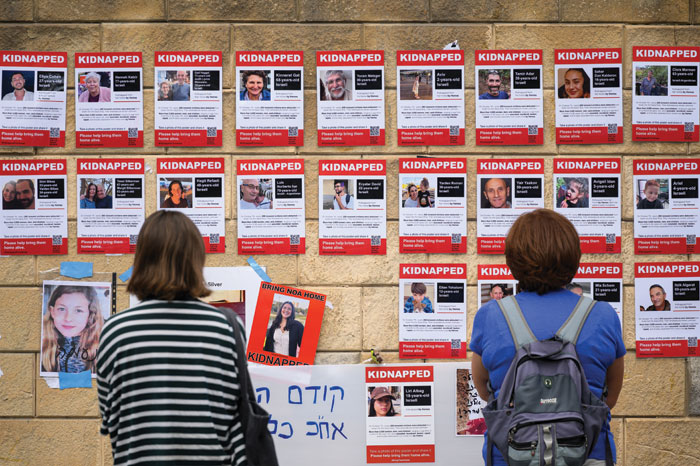
Photo by Leon Neal/Getty Images

7. Why does everyone hate us?  Over 70% of Americans support Israel and like Jews. But a rabid minority, left and right, hates Jews. They even pounced on Oct. 7, as Jews endured unspeakable violence. That joy showed they hate that Israel is, not what Israel does. Some dislike Jews because we’re similar enough to fit in, yet different enough that we keep sticking out.  Unfortunately, every democracy has killed innocents in self-defense. But pro-Palestinian Intifadists celebrate rape, maiming, purposeful killing and kidnapping. And they burn the American and Canadian flags, disrupt national ceremonies, and attack American icons. Which side would you rather be on? 

8. What about those who say, “I’m not antisemitic, I’m just anti-Israel”?  Jews confuse. If the Jewish people, believing in Judaism, created a national liberation movement “Judeanism” to establish Judea, few would claim: “I like Jews but hate Judeans.” Kind of like saying “I hate Italy, but like Italians.” Instead, Jews, following Judaism, established a national movement Zionism – after that legendary hill in Jerusalem – and the State of Israel, on the land of Israel. And what happened Oct. 7? Those who hate Israel, killed with a traditional Jew-hating zeal – while those who hate Jews, used hatred of Israel to justify Jew-bashing. Most Jew-haters combine anti-Zionism, anti-Israel, and anti-Semitism, targeting all three simultaneously. 

9. And aren’t there many Jews who hate Israel and reject Zionism? Some Americans hate America too. But polls show that the overwhelming majority of Jews – young and old – see Zionism and Israel as central to their Jewish identities. Far more Jews support Israel and Zionism than believe in God, or observe most other commandments. True, a few outspoken Jews who attract lots of attention reject Israel. But those un-Jews are trying to un-do the core consensus most Jews have accepted — especially since the Holocaust that ended in 1945 and the State of Israel which began in 1948 — that Judaism, Zionism, and support for Israel are intertwined and mutually reinforcing.

Polls show that the overwhelming majority of Jews – young and old – see Zionism and Israel as central to their Jewish identities. Far more Jews support Israel and Zionism than believe in God, or observe most other commandments. 

10. C’mon, don’t you have ANY criticisms of Israel? Of course I do! Like most thinking citizens, I criticize every government frequently but never reject my country. Israelis are torn, facing hard dilemmas. Seventy percent want a new government – but 70% applaud this government’s zero-tolerance-for-terrorists military strategy. I, like most, won’t criticize hostage families but fear that when Hamas refused to release the 18 women it promised to last fall, the abuse these holy women endured was too obvious and the chances of anyone being released through diplomacy plummeted. It’s complicated. But patriotism means loving your country because of its politicians sometimes … but despite its politics, always. 

11. What is Zionism anyway? Zionism, reflecting Jews’ love of Jerusalem’s Mount Zion, understands that both the Jewish people and Jewish religion are rooted in the Jews’ homeland. Zionism is Abraham and Sarah, Deborah and David. It’s breaking the glass when you marry and singing “next year in Jerusalem” at Seder. Today, Jews have the right to establish their old-new state on their homeland, like 192 other U.N. countries. Until 1948, Zionism, the Jewish nationalist movement, tried rebuilding the Jew and establishing a Jewish state; today, Zionists defend the state when necessary, but work to perfect it, while dreaming about a better tomorrow, always.

Golda Meir said you can’t be a Zionist and a pessimist. I’m a Zionist. Knowing Jewish and Israeli history, I remain an optimist, and blessed by Zionism, today’s greatest Jewish renaissance project.

12. With Israel targeted by Hamas and other Gazans, West Bank terrorists, Hezbollah in Lebanon, Iran, even the Houthis from Yemen and the world, aren’t you worried? Sometimes, I’m not worried – I’m terrified! We’ve seen Gazans slaughtering our kids, Hezbollah rocketing houses up north, and 320 Iranian missiles trying to eradicate us. In response, 200,000 Israelis rushed home, our crazy country mobilized heroically, and you, our brothers and sisters abroad, cried with us, fought for us, supported us. We historians know how vulnerable Israel was, even in the 1970s. So, worry, yes – but despair, no. Golda Meir said you can’t be a Zionist and a pessimist. I’m a Zionist. Knowing Jewish and Israeli history, I remain an optimist, and blessed by Zionism, today’s greatest Jewish renaissance project.


Gil Troy is a Senior Fellow in Zionist Thought at the Jewish People Policy Institute, and as a volunteer chair Taglit-Birthright Israel’s International Education Committee. His next book, “Identity Zionism: Letters to My Students On Resisting the Academic Intifada,” will be published this fall. All the views expressed here are his own.

12 Tough Questions and Simple Answers About Israel Read More »

Are We Obsessing Over Our Children’s Feelings?

Back in the 1990s, when we were raising our kids, we already felt under siege from a world of information overload. In that decade, five times as many parenting books were published than parents had faced back in the 1970s, a far less anxious time when our parents let us drink from the garden hose, and none of us looked at pictures of kidnapped children as we poured milk from cartons. 

With four kids of my own, I hoped for parenting advice that was simple and straightforward, but each kid was so different, individual tailoring was required. Some advice books were so complicated with charts and tables that I thought I was reading actuarial tables, not parenting guides. Was parenting really that complicated? At one lecture given by a renowned educator who had raised eight children — seemingly successfully — an audience member asked him for a precious drop of wisdom on childrearing: What was the secret sauce? How had all his kids grown up so well adjusted? I perched on the edge of my seat waiting for the answer. 

The speaker looked at the woman who had asked the question, shrugged his shoulders and finally said, “Just don’t get personally involved.” We were all slack-jawed. Here we were, Jewish parents worrying excessively about our children’s well-being, using the homework and behavior charts and reflecting our children’s feelings back at them, hoping we weren’t messing anything up so badly that our kids would need decades of psychotherapy (which we, naturally, would pay for). How could the sum total of this expert’s parenting advice basically be, “hands off”? 

Of course, raising kids is never easy, with no one-size-fits-all recipe to get the job done. The Torah acknowledges this, advising that we raise each child “according to his/her own way,” challenging parents to find and follow the path that suits each child. The best thing we did for our kids was to raise them in a home where we honored traditional Jewish practice, did our best to demonstrate our faith and loyalty to God, and model a loving, respectful marriage. A life of rich Jewish engagement, practiced with love and enthusiasm, provides spiritual and psychological grounding for children. It provides a foundational sense of identity and purpose. This deserves its own column or two, but today I wanted to share another idea about parenting that strikes me as timely, and goes against the current zeitgeist to boot. 

All good parents want their children to grow up to be responsible, ethical, well-adjusted, and happy. But what if something we’re doing works against two of these goals? In an essay from March 9 in The Wall Street Journal titled “Stop Constantly Asking Your Kids How They Feel,” excerpted from her new book “Bad Therapy: Why the Kids Aren’t Growing Up,” Abigail Shrier argues that parents spend too much time taking their adolescent children’s emotional temperatures. 

Studies reveal that the more people focus on their own feelings, especially their happiness, the less happy they are. “Instead of constantly asking kids to describe how they feel in the moment, adults should be telling kids how imperfect and unreliable their emotions can be,” Shrier writes. “This means helping them to recognize not only that their feelings of envy or indignation or infatuation rarely reflect a full and accurate picture of the world, but also that these feelings sometimes deserve to be ignored.” 

Studies reveal that the more people focus on their own feelings, especially their happiness, the less happy they are. 

Equally destructive, fixating on feelings also places kids in a “state orientation” rather than a “task orientation,” according to psychologist Michael Linden: “State-orientation keeps you from being successful in anything. No winning head coach asks his players to dwell on their feelings at halftime.”

Feelings matter. Children do need to feel heard and understood. But encouraging kids in adolescence to marinate in their feelings hurts them, making it harder for them to achieve the emotional peace and even happiness we hope they can achieve. Listen and reflect your children’s feelings to gain trust, but then encourage your children to move forward, setting goals and taking risks. As Shrier concludes the article, “The world outside of their own heads turns out to be a worthy distraction from the turbulent gloom of adolescence. It may also contain the cure.”


Judy Gruen is the author of “Bylines and Blessings,” “The Skeptic and the Rabbi,” and several other books. She is also a book editor and writing coach.  

Are We Obsessing Over Our Children’s Feelings? Read More »

Nothing Feels Normal

As I drove down a side street near my home I noticed something akin to a robot or droid from Star Wars with flashing lights. I looked at this rather cute movable box as it stood waiting, as if watching carefully for passing traffic, to cross the road. It was a moment that felt surreal, but I smiled at the charming sight and drove on, only to find, a couple miles down Beverly Blvd, another vision that challenged my sense of reality once again. This time, stopped at a red light, I looked to my left and gasped, as the car beside me didn’t have a driver. I did a double take. I wasn’t hallucinating, it was truly a car without a driver waiting patiently, like myself, for the green light so it could move forward. How, I wondered, did it know when to stop, and even more miraculously when to go? 

In the midst of the insanity and absurdity we live with on a daily basis, I’m wondering where is the normal we once knew. Change is inevitable, yet on many levels it has been at the speed of light in every part of our lives — cultural, political, international, and technological. Technology evolves, demanding a kind of intelligence many of us in our elder years feel we lack. We watch our grandchildren consume and digest apps, memes and new gaming trends while they answer our questions that reflect how slow and dimwitted we may appear. I had to call my grandson when I saw yellow while my phone was charging. Red and green I know, but why yellow? Of course, he knew exactly why, teaching me something new.

The smartphone and computer are a necessity in our times. I can’t buy an article of clothing that doesn’t have a pocket where my phone can rest as I walk through the day. Every bit of information one needs, secular or Jewish, is at our fingertips. But this is only part of the picture. Everything that happens in the world can be seen on our newsfeed seconds within their occurrence. 

We all know this after the horrific events of Oct. 7. Every moment the excruciating information was available to us, along with the pain our brethren were going through, and each moment of the war that followed, is viscerally felt by all. The recent antisemitic events astonish and frighten even the most stoic and Jewishly committed American. The roller coaster ride of attempts at a potential ceasefire and bringing hostages home feeds the anxiety we hold living with the unimaginable in our country. A neighbor recently stopped me to check how we were doing asking, “Do you think we’re going to lose our democracy?” I cautiously answered, “I don’t know. I hope not.” Even the thought of this possibility feels ‘not normal.’

The roller coaster ride of attempts at a potential ceasefire and bringing hostages home feeds the anxiety we hold living with the unimaginable in our country. 

We see the collapse of so many norms creating the unthinkable: Open expression of America becoming a Christian country; states reflecting the limitation of teaching real history, whether Black history or Jewish history, specifically the Holocaust; banning books that parents or schools find discomforting; scores of mass shootings each year; taking away women’s rights and control over their bodies; gerrymandering so certain citizens are limited from voting and allowing a man who is a convicted felon, found guilty of sexual abuse, and verbally threatening judges and government officials along with their families to run for political office while promising to punish all his enemies and watching the highest court of the land function without ethics or any concern for even the visibility of conflict of interest. There is chutzpah all around and from all sides, diminishing much of what we count on and have, for much of our lives, seen as “normal.”

When we are confronted with this much change and the slashing away of norms, our psyches and our souls need compassion and nurturing. We feel exiled from ourselves. We need to accept and have empathy for the extraordinary demands on our nerves and find ways to soothe our inner selves. We need to have chesed, kindness, both for ourselves and for others, especially for those with whom we disagree, aware that we are not alone in this dissonance. We need moments of calm and quiet, surrounded by G-d’s creation, nature, that has a way of settling us in what is real and generative. In inconceivable times, ‘nachamu, nachamu, comfort, comfort’ is what we need.


Eva Robbins is a rabbi, cantor, artist and the author of “Spiritual Surgery: A Journey of Healing Mind, Body and Spirit.”

Nothing Feels Normal Read More »

Briahna Joy Gray Blames Everyone But Herself

For those who missed it, podcaster and anti-Israel pundit Briahna Joy Gray was fired earlier this month from Rising, a political talk show she co-hosted on The Hill’s YouTube channel, which boasts nearly two million subscribers.

The departure of Joy Gray followed a recent interview she conducted with Yarden Gonen, whose sister has been held hostage since Oct. 7. As the segment came to a close, the guest called out Joy Gray specifically for consistently denying that Hamas terrorists committed sexual violence on Israeli women. In response, Joy Gray visibly rolled her eyes in disdain. 

This abhorrent dismissal of the pain of hostage family members would be unseemly coming from random users on social media, let alone someone calling herself a journalist. For this, and this alone, The Hill severed her contract.

Yet, in the nearly two weeks since her exit, Joy Gray has been on an internet-wide media tour blaming everyone and everything but herself. Not only has she misrepresented the facts surrounding her firing, she has rejected the testimonies of sexual assault victims, denied clear evidence of sexual violence by Hamas and launched personal attacks on pro-Israel individuals, myself included.

As someone who twice appeared on her program, once in February and once in May, I have become the most visible target of Joy Gray’s recent ire. By my count, I have been named at least three times, including in a recent episode of her own podcast — ironically called “Bad Faith.” During the show, Joy Gray claimed that she supported having Zionist voices on Rising but questioned why her producers couldn’t find “someone who has written a book, not just some guy off the internet.”

Unfortunately for Joy Gray, I am an author. My book is called “The Wrong Kind of Jew.” The book, which has been called an “energetic, and heartfelt book that enriches the discussion about Israel and its future” by New York Times contributor Martin Friedman, is about how my Jewish family was ethnically cleansed from North Africa and Iraq by pan-Arabs. A simple Google search of “Hen Mazzig book” reveals the top 10 results are all about my book, which is also available at Barnes & Noble and Kindle, as well as on Amazon, Google and Apple Books. 

Further, during my February appearance on Joy Gray’s show, the chyron with my name on it read, “Author: ‘The Wrong Kind of Jew.’” Not to mention the fact that I contacted Rising following the 2022 release of my book with the express desire to appear on the program to discuss the often untold stories of Mizrahi Jews who sought refuge in Israel following Holocaust-like pogroms across the Middle East.

More important than my own credentials though is that in her many interviews since being fired, Joy Gray has grossly misrepresented the truth. Primarily, her issue lies with the idea that — in her view — The Hill has a “clear pattern” of suppressing free speech. This claim is unfounded considering she shared her anti-Zionist and antisemitic views consistently on the program for months.

The idea that Joy Gray was fired for simply being critical of Israel is downright absurd. The truth — available on video — is that she brazenly dismissed a family member of a hostage to her face. As if this weren’t bad enough, the reaction was based on her assertion that sexual violence against Israeli women by Hamas did not happen.

The idea that Joy Gray was fired for simply being critical of Israel is downright absurd. 

This claim is based solely on two debunked accounts, among a litany of other verifiable ones. In fact, the most recent reporting in May revealed that the United Nations and a host of other international organizations presented “credible evidence” that Hamas militants committed sexual assault. The sick irony of all of this is that had the terrorists not filmed themselves committing these atrocities, we may never have known the true depravity of these acts.

Joy Gray is out at The Hill, but that does not mean she will disappear from the political landscape. In fact, her willingness to scapegoat her former employer, cry censorship, and attack pro-Israel voices is likely to earn her even more favor amongst her most ardent supporters. But make no mistake: The blame for Joy Gray’s ousting from The Hill lies squarely on her shoulders alone.


Hen Mazzig is an Israeli author, former IDF Humanitarian Officer and a Senior Fellow at The Tel Aviv Institute.

Briahna Joy Gray Blames Everyone But Herself Read More »

A Chronicle of Hate

For most American colleges and universities, both the academic school year and the accompanying campus protest season have now mercifully concluded. After more than eight months of demonstrations, unrest and outright bigotry and antisemitism that directly corresponded with the Gaza war, let’s review what happened in the closing days of the 2023-24 school year.

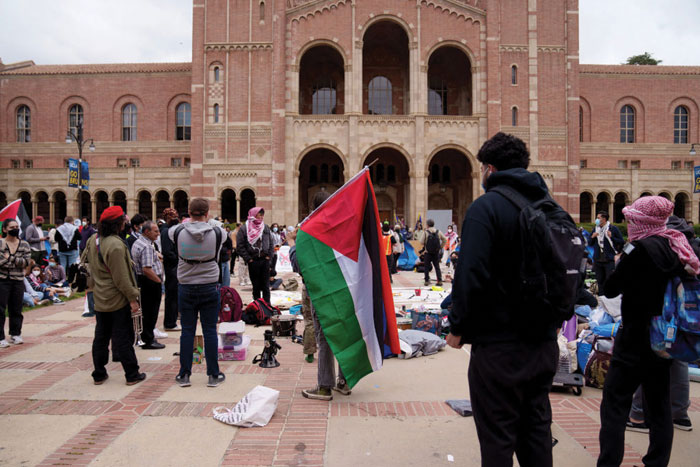
UCLA’s commencement week began inauspiciously with a return of the anti-Israel encampments that have upended the Bruin campus for most of the school’s spring quarter. According to the student newspaper, the protesters carried “a coffin-shaped object and objects painted to resemble bloodied body parts,” set up barricades blocking entry into classroom buildings, and vandalized a nearby fountain named after philanthropists Ralph and Shirley Shapiro. By the time the protests had been disbanded several hours later, students had been prevented from completing final exams and several protesters and law enforcement officers had sustained injuries.

There were no reports on whether any minds were changed about the war in the Middle East as a result of the on-campus violence.

By midweek, a pro-Palestinian group at UC Berkeley claimed credit for an alleged act of arson on that school’s campus in protest of the arrests at UCLA. This was the second incident of arson at Berkeley in recent weeks. Earlier in the month, an individual had set a university police vehicle on fire in retaliation for crackdowns on student protesters at UCLA and UC Santa Cruz.

Commencement day itself was marked by numerous disruptions. UCLA’s three graduation ceremonies were interrupted by demonstrations, walkouts, faculty boycotts, and several students standing while wearing and raising blood-red gloves in mid-ceremony. Neither Chancellor Gene Block or Provost Darnell Hunt, the university’s top two ranking officials, attended the ceremonies despite long-standing tradition, presumably to avoid any further controversy or confrontation.

This may be a logical time to investigate the impact of all this tumult over the last several months. Public opinion polls suggest that the protests are making a difference – just not that for which their organizers had hoped. If anything, the unrest may be driving voters in the opposite direction. In several recent national surveys, Democratic voters are much more likely to support the protesters’ policy goals but disapprove of the way they are making their voices heard. The independent voters who will decide the election feel even more strongly that the protests are wrong — even those who support their objectives.  (Not surprisingly, large majorities of Republicans disagree with both the protests and their objectives.) 

There is a notable generation gap showing that young people are much more likely to support the protests. But among the older voters who dominate the electorate, it appears that the activists are hardening opinions in opposition to their efforts. The primary goal of such confrontational activity is usually to motivate a cause’s existing supporters. But presumably the organizers also hoped to attract new advocates as well. While measuring the enthusiasm of loyal backers is difficult, it is clear from polls that the swing voters who are also a target of these protests are not reacting favorably to what they are seeing and hearing.

A similar dynamic occurred in the 1960s when campuses were roiled by protests in opposition to the Vietnam War. The majority of Americans did oppose the war, but their discomfort with the violence and malevolence of many of the war’s opponents may have slowed the war’s conclusion. Today’s debate has created a comparable situation: a plurality of American voters support a ceasefire, but oppose the campus protests by roughly a 2-1 margin. Twice as many respondents also believe that university administrators have been too lenient in response to the protests as those who think they have been too harsh.

When the riots begin again in the fall, let’s remember how much damage the instigators are doing to their own cause. 

This is not to minimize the effect of these disturbances, especially on Jewish and other pro-Israel students who are forced to endure the invective, the hatred and the violence directed toward them as they attempt to achieve the education to which they are entitled. But when the riots begin again in the fall, let’s remember how much damage the instigators are doing to their own cause.


Dan Schnur is the U.S. Politics Editor for the Jewish Journal. He teaches courses in politics, communications, and leadership at UC Berkeley, USC and Pepperdine. He hosts the monthly webinar “The Dan Schnur Political Report” for the Los Angeles World Affairs Council & Town Hall. Follow Dan’s work at www.danschnurpolitics.com.

A Chronicle of Hate Read More »

A Tribute to the Jewish American Songwriting Duo Who Helped the Medicine Go Down

I love Jewish American stories, and last month, a light dimmed on one of the brightest Jewish Americans to ever contribute to this country, and inarguably, the world. 

Richard Sherman, who, with his late brother, Robert (1925-2012), wrote some of the most beloved music for motion pictures the world has ever known, died in Beverly Hills at age 95. 

I will wager that you know many of the Sherman Brothers’ songs. And I will also wager that you love many of the Sherman Brothers’ songs. Award-winning composer John Williams has rightly described their work as “what we recognize as the American sound.”

That’s because they wrote over 200 classic songs, in particular, for the Walt Disney Company (and several theme parks), including the scores for “Mary Poppins,” “The Sword in the Stone,” “The Jungle Book,” “Winnie the Pooh,” “The Aristocats” and many more. 

After Disney died in 1966, “Dick” and “Bob,” as they were known, also wrote the songs for classics such as “Chitty Chitty Bang Bang” and Hanna/Barbera’s 1973 adaptation of “Charlotte’s Web.” The duo created more film song scores than any other songwriting team in the history of film. 

We, Jews, are an undeniably intellectual people. And while we may relish in sharing news about the latest Jewish Nobel Prize winner, or the latest contribution by a visionary entrepreneur or inventor, we are, at our core, a people of heart. And nothing enters the heart deeper than a truly resonant piece of music. This helps explain why many Jews may not be able to name the most famous Jewish Nobel laureates, but know nearly all the words to “Supercalifragilisticexpialidocious” from the 1964 classic “Mary Poppins” by heart. 

Like many, I believe that the Sherman Brothers were geniuses, whether as lyricists or composers. Their work possessed a rare combination of magic and method; a blink-and-you’ll-miss-it sunshine (Richard) tempered with a slower complexity (Robert) that delighted the child in the grownup and the grownup in the child. 

In contemplating this magical, yet methodical genius, consider the somber, yet whimsical playfulness of “Feed the Birds” from “Mary Poppins”: “Though her words are simple and few/Listen, listen/She’s calling to you/Feed the birds, tuppence a bag/Tuppence, tuppence, tuppence a bag.”

“Feed the Birds” was Walt Disney’s favorite song of the hundreds that The Sherman Brothers wrote and produced for him. In fact, Richard’s son, Gregg, told me that at the end of a long work week, on late Friday afternoons, Disney would ask “The Boys” to enter his office on the lot. And, in near Humphrey Bogart-Dooley Wilson fashion, Disney would simply declare, “Play it.” Robert and Richard knew Disney wanted to hear “Feed the Birds.”

Other Sherman Brothers’ songs are even more global. In some ways, “It’s a Small World,” their beloved song written for Disney’s exhibit at the 1964 World’s Fair, can be heard as an anthem for Jewish peoplehood — the kind of peoplehood that inspires a tattooed Argentinian Jew to notice a Star of David necklace and hug a tattooed American Jew as they discover one another at the summit of a Himalayan mountain. “People think it’s a novelty; it’s a prayer for peace,” Richard once remarked about the song.

The Sherman Brothers’ music was particularly meaningful to me after my family and I escaped Iran in the late 1980s. “Mary Poppins” and my favorite film with a Sherman Brothers’ score, “Charlotte’s Web,” were among my first introductions to America and the great American songbook, as heard through motion pictures. In hindsight, Richard and Robert’s music offered me a softer landing as I struggled to find my place in the painfully unknown new reality of my early years in this country.

The Sherman Brothers’ music was particularly meaningful to me after my family and I escaped Iran in the late 1980s. “Mary Poppins” and my favorite film with a Sherman Brothers’ score, “Charlotte’s Web,” were among my first introductions to America and the great American songbook, as heard through motion pictures. 

I will never forget the elated wonder that engulfed me in the 1990s when my second- grade teacher at Horace Mann School in Beverly Hills asked each one of us to sit on the musty, carpeted floors and rolled a hefty television on top of a cart to the middle of the classroom. Incidentally, over five decades earlier, Richard and Robert had attended El Rodeo, another wonderful Beverly Hills public school (that’s where Robert met Samuel Goldwyn, Jr. and the two became best friends). 

I had recently escaped the fanaticism of post-revolutionary Iran, surviving trauma that included rabidly antisemitic female teachers and administrators; for me, “Mary Poppins” was healing. In fact, it was the answer to the one question I had been too traumatized to ask back in Iran: “Can a female authority figure set boundaries while remaining kind and enabling children to feel safe?”

When I shared this story with Jeffrey, Robert’s son (and Richard’s oldest nephew), he said, “I’m glad that Dad and Dick’s music brought you comfort. That was my dad’s greatest wish.” Based in Los Angeles, Jeffrey and Gregg are both talented writers, producers, directors and composers.

“Charlotte’s Web” is another form of magic altogether. The E.B. White children’s book is beloved in its own right, but who could have imagined that a pig, a spider, a rat and a slew of other animals could inspire some of the most beautiful prose and melodies in recent movie memory? No, between “Mother Earth and Father Time” and “There Must Be Something More,” it’s hard to believe that such sublime music centered on the life and times of a fictional pig in Maine. 

“My grandfather, songwriter Al Sherman, agreed with your choice for favorite score, ‘Charlotte’s Web,’ as did my late uncle Bob,” Gregg told me. Al was a Tin Pan Alley songwriter who, during the Great Depression, wrote songs for stars such as Rudy Valee and Eddie Cantor. “My dad and uncle each had an amazing gift and one phenomenal mentor,” said Gregg. “Their dad taught them to write simple, singable, sincere songs that were wholly original. And the brothers were, in my opinion, divinely inspired to create memorable melodies and catchy lyrics that had the ability to click with the audience.”

Fans of “Mary Poppins” will also be delighted to know that Al loved flying kites. Some of the Sherman Brothers’ most well-known songs were inspired by heart-warming reality. “‘Mother Earth and Father Time’ were written for and about my grandparents,” Gregg explained.

It’s no secret that the brothers had a tumultuous relationship, and that’s why it was even more special that cousins Jeffrey and Gregg directed and produced the 2009 Disney+ documentary, “The Boys: The Sherman Brothers Story.” 

If you love music, I recommend watching the documentary, and using the rewind button to marvel at the real-life story behind “A Spoonful of Sugar” from “Mary Poppins.” When I asked Jeffrey whether he had a favorite Sherman brothers’ song, he said, “I love ‘Spoonful of Sugar,’ since I inspired it, and “River Song” from “Tom Sawyer” — Dad wrote it for me.” Gregg’s favorite songs were too numerous to list and “they seem to rotate,” but they include “River Song” and “If’n I Was God” from “Tom Sawyer.”

Richard and Robert’s music was at times so whimsical that it’s hard to believe that Robert had been witness to the worst atrocity in human history. At age 17, during World War II, Robert begged his parents to let him enlist, and subsequently served in France, Belgium, Holland, Luxembourg, and Germany. He was shot in the knee by a machine gun.  

But the most extraordinary aspect of his service was that Robert Sherman, the man who gave us such songs as “Let’s Go Fly a Kite” and ”There’s A Great Big Beautiful Tomorrow,” was among the first American soldiers to enter and liberate the Dachau concentration camp. According to Jeffrey, his father was the only Jew in his squad. “That experience and all those he had from D-Day on,” said Jeffrey, “made him feel hope for humanity was in human kindness and tolerance.”

Robert Sherman, the man who gave us such songs as “Let’s Go Fly a Kite” and ”There’s A Great Big Beautiful Tomorrow,” was among the first American soldiers to enter and liberate the Dachau concentration camp. 

Regarding Dachau, Robert once said, “It was enough nightmares for the rest of my life.” Upon returning home, he began painting to “get rid of the thoughts of Dachau. Beautiful things helped clean my soul of the horror. But the horror lasted a long time.”

I asked Jeffrey whether his father ever spoke of Jewish identity, and if Judaism was practiced in their home. “Yes,” he said. “Mom was more religious growing up than Dad. I shared that with her. Dad honestly stopped believing there could be a God after he witnessed what he did liberating Dachau. He loved the Jewish traditions and culture though.”

Regarding Richard and his ties to Judaism, Gregg said, “While my dad was not particularly religious, he was profoundly spiritual. He believed doing what you love and loving what you do was his little secret to living long and well. And Dad had a spectacular life.”

After moving to London in 2002, Robert donated two of his paintings to the Western Marble Arch Synagogue, in memory of his late wife, Joyce, who passed away a year earlier. Each painting depicts an elderly Jewish man.

I also could not resist asking Gregg and Jeffrey whether “The Boys” ever experienced antisemitism in Hollywood. “They did not,” said Jeffrey. “In fact, for all the nasty things said about Walt Disney on this topic, they would angrily defend Mr. Disney.” 

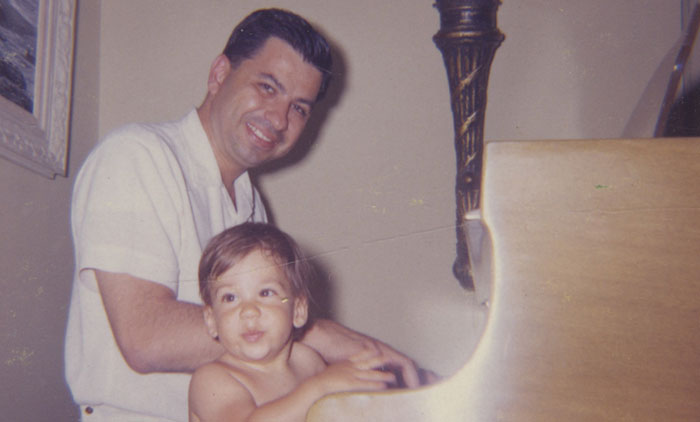
Dick teaaches Gregg to play piano
Photo Credit Gregg Sherman

But Gregg believed his father and uncle did experience the world’s oldest hatred: “Unfortunately, antisemitism was consistently a factor in many of their business dealings throughout their career,” he said. But Gregg also agreed with Jeffrey: “A rare exception was Walt Disney, who is often falsely labeled as being antisemitic, but was not. My dad and uncle were the only staff songwriters in the 100+ year company history and I can assure you, as he told me many times — Walt loved all people. His only criteria for his employees were creativity and positivity.”

While there was nothing funny about the personal tension between the brothers, I like to imagine an almost Talmudic air to how they disagreed over their creative output. In the Disney+ documentary, Jeff Kurtti, co-editor of “Walt’s Time: From Before to Beyond,” a 1998 autobiography written by Robert and Richard said, “The crucible of creativity for these guys is conflict.” 

Like most conflicting relationships between Jews, new and better ideas emerged. “My cousin, Jeff, speculated in our documentary that their friction helped bring over a thousand songs to life,” said Gregg. “And while their differences certainly played a part, along with their stereoptic views of the world fueling their songs’ memorable qualities, I would say their similarities also played a huge role in their success: they both absolutely knew when they’d struck musical gold. They pushed each other to remain at their creative peak and the true miracle of the Sherman Brothers was how they continued working together for over five decades.”

Jeffrey also captured the power of this creative tension by observing, “If you agree on everything, there’s no need to collaborate.”

For a new generation of songwriters and composers today, the brothers showed that two creative minds may have a hard time tolerating one another, but still collaborate together to produce extraordinary works of art. And, above all, that creative endeavor requires a near-obsession with ideas. 

The Sherman brothers were idea men. Before there were any lyrics or music, the idea came to them. For their brilliance, they were awarded multiple awards, including two Academy Awards (from a total of nine nominations), three Grammy Awards, five Golden Globe Awards and 23 gold and platinum albums. The brothers also have a star on the Hollywood Walk of Fame. “Keep singing their songs and sharing their hope and prayers,” Jeffrey told me. 

“I have always been impressed with both their talent and their graciousness on and off stage,” Gary S. Greene, Founder-Conductor of the Los Angeles Lawyers Philharmonic, said. “The Sherman brothers were the most delightful people.” Greene’s friendship with the brothers dates back to the early 1960s, when Richard and Robert became honorary members of the Jr. Philharmonic Orchestra, founded by Greene’s late uncle, Maestro Ernst Katz (Greene was concertmaster of the orchestra for nearly four decades).  

Greene recalled one particularly memorable moment: “At one concert around 1964, Richard and Robert told the audience, ‘You are about to hear a song that no one has heard before, but it will become very popular.’  Richard sat at the piano and Bob sang the lyrics. Together, they performed ‘It’s A Small World.’  At the time, I was excited to be present at this special debut and honored to be one of the first to hear a song that soon became a world phenomenon.” 

On several occasions, Richard appeared with and conducted the LA Lawyers Philharmonic. In 2018, they held a special performance for Richard’s ninetieth birthday. On June 22, the LA Lawyers Philharmonic is dedicating a special concert at Disney Hall to the memory of Richard Sherman.

“Every night before I put my kids to sleep, they ask me to play ‘It’s A Small World’ as I twirl them in a swivel chair,” Debra Kaiser, Gary’s daughter, told me. “It’s now our family tradition.” As a child, Kaiser played violin in the Jr. Phil as Richard conducted “Mary Poppins” and “It’s A Small World.” The families were so close that Richard even attended Kaiser’s bat mitzvah and her wedding.

In 2013, Disney brought the making of “Mary Poppins” to life with “Saving Mr. Banks,” starring Tom Hanks and Emma Thompson (B. J. Novak played Robert and Jason Schwartzman played Richard.) One of the most endearing stories related to “Mary Poppins” is found in Jeffrey and Gregg’s documentary: In the early 1960s, Walt Disney asked the brothers, “You know what a nanny is?” 

Robert responded, “Yeah, a goat.” 

“No, no, it’s a British nursemaid,” Disney corrected him. And the rest was the stuff of movie magic.  

It’s tempting to imagine the souls of Robert and Richard, fully reconciled, embracing one another and playing heavenly pianos today. Gregg left me with a deeply poignant thought when he said, “The truth about my dad and uncle, Richard M. and Robert B. Sherman is: Deep down, they loved each other – even if they didn’t like each other that much.”

For more information on the June 22 concert honoring Richard Sherman at Walt Disney Concert Hall, visit lalawyersphil.org


Tabby Refael is an award-winning writer, speaker and weekly columnist for The Jewish Journal of Greater Los Angeles. Follow her on X and Instagram @TabbyRefael

A Tribute to the Jewish American Songwriting Duo Who Helped the Medicine Go Down Read More »

The Talk for the Jewish Community

In the three months following the October 7th terrorist attacks on Israel, 3,291 antisemitic incidents took place in the United States alone. In 2022, there were 3,697 antisemitic incidents in the entire year. Threats of violence and harassment against Jews remain omnipresent. In this environment, parents of children in the Jewish community must teach our youngest members about the dangers and realities of the world. I want to propose that the Jewish community create a new tradition called “lekach” (Hebrew for “lesson”).

This idea of such a lesson is not new; it comes from a generations-old tradition in the Black community of parents talking with and sharing painful truths, wisdom and guidance with their children. These talks have long been viewed as rites of passage critical for preparing children for the realities they will face in the world. Broderick Leaks, a mental health professional at the University of Southern California, notes that with his son the talk became a moment of “how to prepare children of color, and specifically Black boys, for the realities of living in a society amid racism.” Leaks believes these talks play a vital role in “prepping your children for the realities of society that they have to navigate” are a challenge because “you want them to be kids. You want them to go out and have fun and not stress … But you also don’t want to set them up for a rude awakening.” Versions of the talk change and evolve,  each one with a specific set of warnings about the times, and each family “must decide what kind of values, life lessons and guidance to impart.”

Recently I decided to give my six-year-old son his first lesson because I could no longer shield him from the harsh world that Jews are now forced to confront. While I never shared the details of the October 7th massacre with him, he has picked up on the fact that something awful happened. He knew that his cousins were suddenly trying to save people in a “war” in Israel. He was visibly distressed and worried about the hostages, especially the children, because he could see the posters all over the city. And as a member of a Zionist Jewish family active within the Jewish community, my son eventually figured out that a lot of Jews were killed. Being in New York City, he has witnessed several anti-Israel demonstrations, heard their words, and seen their posters, flags and graffiti.

The Israel Day Parade, with the “Bring them home” chants, prompted me to talk with him. I needed both to bring him comfort and offer some guidance. I explained to him that we are proud to be Jewish; our faith informs how we interact with others, and how we make the world a better place. But not everyone in the world is very nice; some try to hurt Jewish people for being Jewish.

I tried to teach him that not everyone will help you and that we need to love our friends, our family, and know who will be there for us and who can help us. I stressed that he should never intend to hurt anyone, only help others, and I tried to explain that the world can be a dangerous place and we need to be careful. He said that he understood that not everyone will be nice to us, and while I wished I could have been more eloquent, it was difficult because this was a conversation I never wanted to have with a six-year-old. However, he listened to my words carefully, loved waving the Israeli flag, and I assume that this was the first of many such talks that I will have with him over the years.

The lesson that I gave to my son could not wait. These lessons for Jewish children are sadly needed across the Jewish community because many truths have now been revealed. Parents need to prepare their children to understand how to manage and thrive in a world where Jews are hated and not protected. Our children must learn that despite all the language and action around diversity equity and inclusion, those ideas are often anything but inclusive. And parents must help children learn that some people who claim to be our friends and allies are not always what they appear.

These lessons for Jewish children are sadly needed across the Jewish community because many truths have now been revealed.

I do not want to burden my son with the intensity of the antisemitism. But it is my responsibility to prepare him for this harsh world. I never had such a talk with my parents; nor did every other parent that I have talked to about the current wave of hate. Many of us parents learned about antisemitism from school and Jewish communal events and activities such as the March of the Living and school programs and we recognized that there was hate, but much of it was in the past or marginalized. As true feelings toward Jews and Israel are now out in the open for the world to see, other parents and I regularly talk about how to prepare our children for a social order that is anything but civil.

Other parents and I have been struggling with the question of how do we prepare young children for a world that is hostile to them for no other reason than that they are Jewish and are believed to be part of a class of people that should be taken down as oppressors. Of course, there are numerous possible responses to how to manage the pervasive antisemitism that can range from changing school curricula to advocacy and counter-political action. But I, like many parents, want to feel that I can have some direct and immediate response and influence over my son and how my own family reacts to this tragedy. So I had a tough talk with him about the world and I suspect that I will sadly have more down the road. Creating a new Jewish tradition of teaching our children lessons about the world that they must now traverse is one powerful and direct way Jewish parents can help protect and fortify the next generation.


Samuel J. Abrams is a professor of politics at Sarah Lawrence College and a senior fellow at the American Enterprise Institute.

The Talk for the Jewish Community Read More »