fbpx

June 19, 2024

The Antisemitism Behind the Celebration of Oct. 7

President Joe Biden surely didnt intend to wade into the public debate over how to define antisemitism, but he has just done so—in a big way.

In a June 14 post on X (Twitter), the president condemned what he called the horrific acts of Antisemitism this week.” Those acts were abhorrent,” he wrote. They didnt just threaten Jewish Americans,” but all Americans.” And they threaten our fundamental democratic values,” too.

What were the incidents that President Biden defined as antisemitic? He cited four types: vandalism targeting Jewish homes,” “attacks on Jewish faculty at college campuses,” “harassment of subway riders” and—most notably—“a demonstration celebrating the 10/7 attack.”

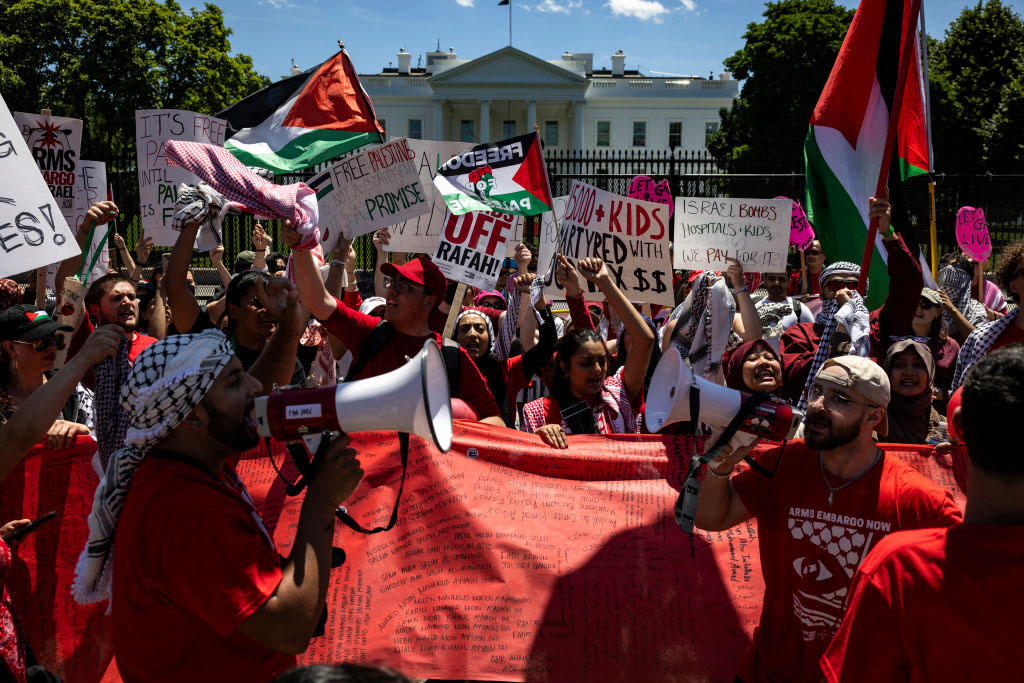
He was referring to the demonstration by thousands of Hamas supporters outside the White House on June 8. How do we know that they were, in the presidents words, celebrating the 10/7 attack”? The evidence was their clothing, their placards, and their slogans:

— Some demonstrators wore green Hamas headbands. Others wore the headband of the Popular Front for the Liberation of Palestine, which also took part in the October 7 massacres.

— A huge banner read:Jihad of Victory or Martyrdom – Al Qassam.” (The latter is the armed wing of Hamas.)  Another banner declared: Long Live October 7th,” in English and Arabic. Other demonstrators held signs urging Intifada Now” and F*** Israel / Stand with Hamas.”

— Protesters chanted slogans urging Hamas: Kill another soldier now!” They also chanted, There is only one solution: intifada, revolution,” and From the river to the sea, Palestine will be free,” echoing the Hamas goal of replacing all of Israel with a State of Palestine.

— The protesters unspooled a lengthy paper scroll on which, according to the New York Times, they wrote names of the more than 36,000 Palestinians who had been killed during the war.” The number 36,000, which is the exaggerated figure Hamas circulates, includes both civilians and terrorists. By including all of the names, the demonstrators were memorializing and honoring approximately 15,000 dead terrorists.

The fact that the president considers those words and actions to be antisemitic has enormous implications, because almost all of the pro-Hamas rallies that have been held since last October have included one or more of those elements.

Whether they have been shutting down bridges, invading museums, blocking traffic, or pitching tents on college campuses, the protesters have, again and again, celebrated the October 7 pogrom in their chants, speeches, and signs.

They have openly cheered the attack as resistance.” They have hailed dead terrorists as our martyrs.” They have called for the liberation of Palestine by any means necessary.” They have sported Hamas headbands or waved Hamas flags. They have circulated cartoons glorifying the killers who crossed into Israel on paragliders.

Now President Biden has, in effect, said that all of those actions were antisemitic, just as the rally outside the White House was antisemitic. He is saying that supporting the mass murder, rape and torture of Israeli Jews is antisemitic.

Its antisemitic even if the protesters arent saying the words We are against Jewish people” (which is how Rep. Ilhan Omar has defined antisemitism). Its antisemitic even if demonstrators are not calling for the murder of every Jew in the world.

President Bidens position is consistent with the definition of antisemitism that has been adopted by the 33 countries belonging to the International Holocaust Remembrance Alliance, a definition used by the U.S. State Department since 2010. That definition includes eleven specific examples of antisemitism. The first one states: Calling for, aiding, or justifying the killing or harming of Jews in the name of a radical ideology or an extremist view of religion.”

President Biden, in his tweet, has affirmed what many people have been pointing out for a long time. Now we need a serious discussion about how to address the fact that so many antisemites—not just critics of Israel” or critics of Zionism,” but antisemites—are wreaking havoc throughout the country.


Dr. Medoff is founding director of The David S. Wyman Institute for Holocaust Studies and author of more than 20 books about Jewish history and the Holocaust. His latest is Whistleblowers: Four Who Fought to Expose the Holocaust to America, a nonfiction graphic novel with artist Dean Motter, published by Dark Horse / Yoe Books.

The Antisemitism Behind the Celebration of Oct. 7 Read More »

Noa Argamani’s Secret Annex

Perhaps this is something one shouldn’t say out loud, but when I was a kid, I was obsessed with Anne Frank. It’s not that I was interested in history, or her message of hope and humanity. I was obsessed with her diary the way I was obsessed with “My Side of the Mountain” and “The Swiss Family Robinson.” I thought of it as a kind of adventure story — one which was terribly thrilling and romantic. It got to the point that I even begged my dad to let me have a bookcase door for my bedroom. He, to his credit, ignored this bizarre request. 

As I’ve grown older, I’ve learned that there were others who read Anne Frank this way when they were kids. This probably has something to do with the fact that nothing truly terrible actually happens in the diary. It does not end with her death at Bergen-Belsen. Rather, it simply ends. 

According to Cynthia Ozick, this has profoundly shaped our understanding, or misunderstanding, of Anne’s life. “The diary is incomplete, truncated, broken off,” she writes in her essay “Who Owns Anne Frank?” Our focus on her time in the annex, and our obsession with her positive message, is symptomatic of an “implausible and ugly innocence” as well as an inability to confront the dehumanizing reality of her final days.

It wasn’t until I was a teen, when my parents took us to see “The Diary of Anne Frank” on stage, that I began to have some sense of what really happened to her after the voice of the diary stops. The image of the Gestapo, guns drawn, breaking into the annex lingered in my mind for years. 

Anne in the diary was verbose and witty. I related to her. She felt like a friend. But this new image of Anne was impassively silent. I recognized no shred of myself in her. She didn’t speak to me, and I dared not speak to her in return. 

Over the past week, I have been thinking of both Annes, and the moment that separates them — the moment when we hear a bang at the door. The reason I am thinking of this is because of the recent rescue of Noa Argamani and three other hostages from Gaza.

Like Anne, Noa was secreted away in an apartment while a war raged outside, unsure if she would ever again be allowed to walk free. Like Anne, Noa was living a completely ordinary life until war intruded upon her and changed it forever. Like Anne, Noa became a symbol —and a polarizing one at that. For some, she was a symbol of innocence lost and humanity caught in the jaws of hatred and brutality. Others tore down her poster, either justifying or denying what was done to her, and what was still being done.

This comparison forces us to confront all that hasn’t changed for Jews since the Holocaust. Though the dynamics are very different, we have to face it: Then, as now, there are Jewish men and women hidden away in secret annexes and dark tunnels.

Though the dynamics are very different, we have to face it: Then, as now, there are Jewish men and women hidden away in secret annexes and dark tunnels.

That said, we might also take this moment to recognize what has changed for us. When armed men beat down the door of Noa’s secret annex, they were not there to take her to a concentration camp, but to bring her back home to her family and her people. 

To a Zionist, this is a remarkable tikkun — a triumphant reversal of the dynamics of Jewish history. Apparently, there is no way to escape the Jewish condition. State or no state, there will always be those who wish us harm and who have the capacity to inflict it upon us. But the rescue of Noa Argamani reminds us that for us — unlike for Anne — rescue is at least possible. A bang on the door is not necessarily an enemy. 

But the most powerful difference of all between the two young women is this: While Anne’s story was “incomplete, truncated” and “broken off,” Noa’s story continues. 

Anne was silenced by death and later transformed into a symbol — the meaning of which has been decided for her by others. For Noa, all of this is reversed. Her presence and her voice have been returned to us. As to what her story means, for Zionism or humanity or anything else, that is something she will have to tell us herself.


Matthew Schultz is a Jewish Journal columnist and rabbinical student at Hebrew College. He is the author of the essay collection “What Came Before” (Tupelo, 2020) and lives in Boston and Jerusalem.  

Noa Argamani’s Secret Annex Read More »

Remembering Howard Fineman: What Every Journalist Should Aspire to Be

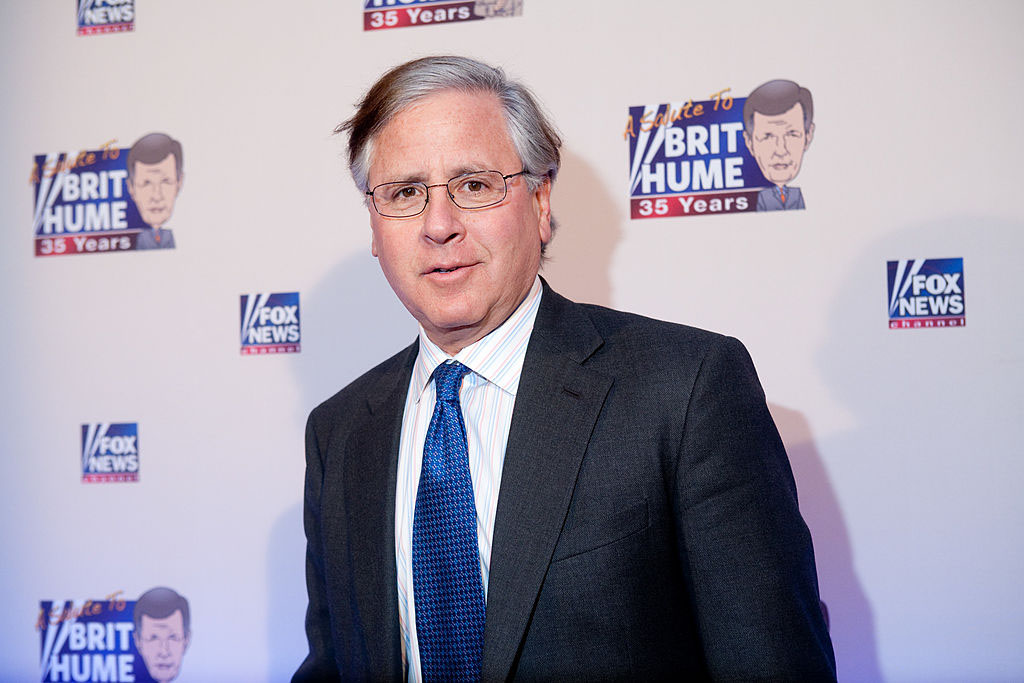
For political junkies in the U.S., Howard Fineman was a familiar face and trusted source of wit, deep political knowledge, and unwavering commitment to journalistic integrity. The esteemed journalist and political commentator passed away on June 11, 2024, at his home in Washington, D.C., after a two-year battle with pancreatic cancer. He was 75.

President Joe Biden summed up Fineman’s contributions to political discourse in a statement the week of his passing: “Great journalists hold a mirror up to the Nation to reveal the good, the bad, and the truth of who we are as Americans. For four decades, Howard Fineman was one of the great journalists of our time.”

While his career in journalism spanned over four decades, it would be more appropriate to say that Fineman’s life spanned 18 Presidential elections. In his thousands of articles and appearances on cable news, and over 27,000 Tweets since 2012, Fineman shared reflections on his own life and perspectives on the trajectory of American politics. He had a front row seat to the minds and workings of the U.S. leaders dating back to the 1970s. Some of Fineman’s most profound reflections would happen in the days following the deaths of key players in American politics. Fineman was apt to make tributes but also put the lessons into the perspective and context of the present-day political landscape in the U.S.

Howard David Fineman was born on November 17, 1948, in Pittsburgh, Pennsylvania, just weeks after President Harry S. Truman’s surprising victory over Thomas Dewey and Strom Thurmond.

His father, Charles Morton “Mort” Fineman, served in the U.S. Army Air Corps during World War II from 1942 to 1945 on a top-secret radar team. Fineman described his father as “Voracious reader with a symphonic sense of history. My best teacher. Heroes included Churchill, Truman, Asimov, Spinoza, Gauguin, Martha Graham, Frank Herbert, Lead Belly, Dylan, Thomas Wolfe, [Pittsburgh] Pirates.”

After the war, Mort met Jean Lederman in a philosophy of education class at the University of Pittsburgh’s Cathedral of Learning. They married in 1946. Jean, who passed away in 2016, taught in Pittsburgh schools for over 30 years.

Fineman grew up in the Pittsburgh suburb of Squirrel Hill, a Jewish neighborhood on the city’s east side. His parents were active members of the Tree of Life Synagogue, where they taught Sunday school, and Howard and his sister Beth Fineman Schroeter attended.

It was during President Dwight D. Eisenhower’s first term, though, that Fineman’s early interest in journalism started to bud.

When he was eight years old, on the day of the rematch between the President Eisenhower and Adlai Stevenson, the young Fineman created his own “newsroom” at home during the election, and shared the results with his parents. Years later, Fineman would be an invited speaker at the Eisenhower Institute at Gettysburg College in Pennsylvania.

The Finemans became one of the first subscribers of the New York Times when it became available in Pittsburgh, he remembered that “the living room became immersed in papers.” While he was a political wonk from a young age, he had other interests. His dream “was to get an autograph from [professional wrestler] Bruno Sammartino at the Jewish Y, where he worked out.”

It was John F. Kennedy who really sparked Fineman’s interest in politics. “As a boy I loved to watch JFK’s press conferences,” Fineman wrote on the 60th anniversary of Kennedy’s assassination in 2023. “I didn’t want to be him — an impossible dream — but I wanted to be in the press corps asking him questions. We all loved our country. We were inspired by his presence, wit, and ideals. Hope for us didn’t die with him, but innocence did.”

During the Civil Rights Movement, Fineman was inspired by the work of Dr. Martin Luther King, Jr. “A good, strong, principled man,” Fineman said about King. ‘One of the best we’ve ever had in this country. I didn’t know him, never met him, but as a boy I watched him on TV, and came to believe that America could overcome the worst of its history to become, as Lincoln said, ‘the last best hope of Earth.’” In the 1960s, Fineman took notice of another civil rights icon from this era, future U.S. Congressman John Lewis.

“One of the most decent, inspiring men I’ve met in covering politics for all these years,” Fineman said on the day of Lewis’ passing. “He’s a civil rights hero, and as passionate a patriot as we’ve produced. The key to him is that he sees no conflict between the two; indeed, they’re the same thing.”

During his senior year of high school, Fineman’s two favorite Beatles albums were released. “[‘Rubber Soul’] and ‘Revolver’ are best,” Fineman wrote. “‘We Can Work it Out’ was my favorite when it came out and still is. The startling start, the harmonium, the tight vocal harmony, the staggered rhythm of the bridge. Their genius in a tiny package, plus the upbeat message. The sheer joy of being a band.”

Weeks after “Revolver” was released in August of 1966, Fineman entered Colgate University in upstate New York. There, he would edit the college newspaper, The Colgate Maroon. “ Fineman’s engagement with political journalism deepened as he edited the newspaper. In 2011, he’d return to his alma mater to give a commencement address. “A Colgate commencement isn’t always a good omen,” Fineman dryly told to the Class of 2011. “Four presidential nominees have spoken at commencement, and they all lost.”

Fineman was keenly aware of injustice and antisemitism. In August 2023, he shared a Jewish Journal article to his nearly quarter-million Twitter followers titled, “Has Princeton Returned To Its Antisemitic Roots?” Commenting on the article, Fineman wrote,  “a dear friend of mine was driven from Princeton in the late sixties by the toxic, pervasive antisemitism of the place.” The late 1960s were a time of much political upheaval. On April 4, 1968, Dr. King was murdered. Two months later, Senator Robert F. Kennedy, then the Democratic nominee for President, was murdered in Los Angeles. On the 55th anniversary of RFK’s assassination, Fineman looked back at that day and juxtaposed the elder Kennedy with his son who is running for President in 2024.

“RFK died on June 5, 1968 trying to bring fairness and decency to us all,” Fineman wrote. “His son and crackpot namesake would divide the forces of fairness and decency in a way that might insure the return of a dictator to the office once held by another Kennedy martyr, JFK. Shame on RFK Jr.”

In the summer of ‘68 the Democratic National Convention was held in Chicago. And it will be returning to Chicago in this summer. But in April of this year, Fineman reflected on the riotous convention in 1968. “The 1968 Dem convention was underway in Chicago the week I arrived in London to study abroad,” Fineman wrote. “We were listening to Radio Free Europe that infamous night of shouting on the floor. Radio Free Europe’s reaction? THEY SHUT OFF THE BROADCAST! Eerie silence. What’ll happen in Chicago this year?”

In the summer before his senior year at Colgate, the 20-year-old Fineman drove 100 miles south with his friends to attend the Woodstock Music and Art Fair in Bethel, New York.

“When we got to Woodstock, entrance fences were down,” Fineman wrote. “We walked in. Found a spot with strangers on a blanket in the midst of the sea of people. Sound was not great; mud galore; Wavy Gravy’s bus! Sly Stone in command that night. I thought: yes, solidarity, but do we know for what?”

After graduating from Colgate, Fineman won a Watson Traveling Fellowship, a postgraduate award for a year abroad pursuing an original, personal research project. Fineman’s project was on Jewish and family history in Europe, Russia, the Baltics and Middle East. He called it “a pioneering Boomer ‘Kosher Roots’ odyssey.”

On Christmas Eve in 2021, Fineman wrote a Twitter thread reminiscing about his 1971 experience abroad  “I went to Bethlehem, a Jewish student bending low through a church door to see where Jesus was born. Fifty years on I value even more the message of that place and of Christmas, which as I hear it is: the world needs more love, hope and justice.”

Following the fellowship in 1972, Fineman would pursue a Master’s Degree in Journalism from Columbia University. On his way to New York, Fineman took a detour to Miami, Florida to cover the 1972 Democratic Convention for a Denver magazine a college buddy had started. “I’ve been reporting on politics ever since,” Fineman wrote on the 50th anniversary of the convention.

After graduating from Columbia in 1973, Fineman began his career at the Louisville Courier-Journal, covering state politics, the coal industry, and environmental issues. His tenure at the Courier-Journal marked the beginning of his deep connection with Kentucky, a state he would still feel connected to long after he departed to cover national politics in Washington, D.C. Fineman covered the Kentucky Derby every year he lived in Louisville. “I’m honored that my ‘home’ newspaper, [Louisville] Courier-Journal, asked me to write about what it was like covering the Kentucky Derby in the 70s, when I was a cub reporter there,” Fineman wrote in March 2024. “Short answer: fun! My favorite assignment was the ‘backside’ with the horses, and walking with them onto the track.”

While at the Courier-Journal, Fineman would dive head first into reporting on Kentucky politics. He would also become friends with future U.S. Rep. Jon Yarmuth (D-Ky.). At the time, Yarmuth was the publisher of an alternative city paper. When Yarmuth retired from Congress in 2021, Fineman said that Yarmuth was “the classiest, kindest, most thoughtful politician I’ve had the privilege to know and cover.”

This was also the era of Nixon’s Watergate Scandal, which would change political reporting forever. “When I entered Columbia Journalism in 1972 my model was political saga-ist Teddy White [Author of “The Making of the President” books],” Fineman wrote. “By late Watergate spring of 73, it became relentless bloodhounds Woodstein [Bob Woodward and Carl Bernstein]. If I were entering [journalism] now? Who? She might not even exist: a universally respected facts-only reporter.”

During Gerald Ford’s brief presidency, Fineman’s career continued to evolve. Also during this era, it was a great time to be a Pittsburgh Steelers football fan. In 1975, his beloved Steelers won the first of four Super Bowls they’d win by 1980. Looking back, he wrote, ‘the Steelers saved Pittsburgh. They WERE Pittsburgh. Still ARE Pittsburgh. A fifth-generation native, they saved ME in the grim 70s, as I slogged through the Nixon-Ford-Carter Years. The Steelers were a rare gem of excellence in a louche, crappy era of waterbeds and bad pot.”

In his later years, Fineman often compared the temperament of President Donald Trump to that  of his predecessors. “After Watergate, Jimmy Carter won in 1976 as a cleansing figure promising he’d ‘never lie’ to us,” Fineman wrote in 2020. “It helped that [he] was an outsider; a relative novice in politics who’d never held a DC office. Joe Biden’s been in and around DC since 1973. But Trump’s a far bigger liar than Nixon.”

President Carter would be the first U.S. President that Fineman would interview. They first met in Kentucky in 1977. When Carter fell ill in 2019, Fineman described the 39th President as “tough as nails and decent as the day is long. I covered his first State of the Union in Jan. 1978. America felt like one family for a year or two, believe it or not.”

Fineman joined the Louisville Courier-Journal’s Washington D.C. bureau in 1978, expanding his coverage to national politics. On the day of Joe Biden’s inauguration in 2021, Fineman looked back at this era and said, “when I started as a reporter, Jimmy Carter was rising in his role as antidote to criminal liar Richard Nixon, promising to tell the truth to the American people. I’m struck by how that echoes now. Biden in this is Carter redux: a prayerful truth-teller follows a criminal liar.”

Fineman earned his law degree from the Louis D. Brandeis school of law at the University of Louisville in 1980, having attended part-time while working as a reporter for the Courier-Journal. Though the best part of law school, Fineman said, happened three decades later: when Fineman received an honorary doctorate from the university as a whole, he got to spend time at the ceremony with Louisville native and one of the greatest athletes of all time, Muhammad Ali.

The 1980s were a period of tremendous professional growth and personal milestones for Fineman. In 1980, he joined Newsweek, where he would work for the next three decades. He held various positions, including political correspondent, chief political correspondent, senior editor, and deputy Washington bureau chief.

On October 31, 1981 at a Halloween party at Capitol Hill’s Tune Inn, he met Amy Lee Nathan, then a D.C. journalist (now a tech lawyer). “I was a reporter who’d attended Georgetown Law; Amy was a former reporter going full-time to GU,” Fineman wrote. Halloween would remain a special day for the couple and their family year after year. Fineman and Amy got married on April 21, 1984.

“She was busy studying for the D.C. bar. I was covering my first presidential campaign for Newsweek,” Feinman said. Even though it was a Presidential election year, Fineman and Amy would find time to honeymoon in Paris, France and Siena, Italy.

“My first campaign as Newsweek chief political correspondent in 1984 was Walter Mondale’s,” Fineman wrote on the day of Mondale’s passing in 2021. “He was a classy product of the respected tradition of Minnesota farmer-labor liberalism. ‘Well-run government could help us all,’ he said. Reagan scoffed; Fritz lost. Now the idea’s back at the forefront.”

Fineman continued to cover the changing political landscape during Ronald Reagan’s second term, providing in-depth analysis and reporting on the evolving dynamics within the Republican and Democratic parties of the mid-1980s. “In 1986, I sat across a table from Henry Kissinger at a small off-the-record dinner in DC,” Fineman wrote on the day of Kissinger’s passing in 2023. “It was supposed to be civil, but he quickly sized me up: a kid who in college had opposed the war in Vietnam and Cambodia. From then on he had hatred in his eyes. Scary, disproportionate.”

In 1988, Vice President George H.W. Bush ran for the GOP nomination; on the Democratic side was then-U.S. Senator Joe Biden from Delaware and U.S. Colorado Senator Gary Hart. Fineman’s been credited breaking  the story that ultimately ended Hart’s Presidential bid in 1988. It was about a conversation Fineman had with a Hart campaign staffer about the Senator’s alleged extramarital affairs. Hart, who was seen as a rising star, dropped out of the race and Massachusetts Governor Michael Dukakis ended up winning the Democratic nomination that year.  “Last time a Newsweek cover labeled a GOP nominee a ‘wimp’ was 1987,” Fineman wrote. “It was George H.W. Bush, who went on to drub Dukakis with the Willie Horton ad.” George H. W. Bush’s inauguration would be the first of eight straight that Fineman would attend “at close range.” Fineman later wrote that he had to watch what would have been his ninth inauguration (Biden in 2021) on TV “thanks to COVID and Trump.”

In 1990, the Americans with Disabilities Act passed, largely through the advocacy of U.S. Senator Bob Dole. When Dole passed away in 2021, Fineman wrote, “I covered Senator Dole for many years, and admire his courage in overcoming bitterness and dedicating himself to public service after being severely wounded in the waning days of WWII. A lasting achievement is the Americans with Disabilities Act, which wouldn’t exist but for him.”

As Bill Clinton took office, Fineman’s role at Newsweek expanded. In 1993, he became Deputy Washington Bureau Chief and was appointed Senior Editor in 1995. During this time, Fineman also became acquainted with James Carville, a strategist for the Clinton campaign who became a political commentary fixture on cable television news. “I watched him whip the Clinton staff into fighting shape in New Hampshire in ‘92 like a Derby jockey,” Fineman said. “Funny, smart, effective.”

Fineman would later write about Carville, “…the best insult I ever heard was from one of my all-time favorite people, James Carville, who said of someone he despised — I forget who — ‘I wouldn’t piss in his mouth if his heart was on fire.’ That’s not Yiddish, but it might be Cajun.”

Fineman was a regular panelist on the PBS show “Washington Week in Review” on PBS from 1983 to 1995. He made frequent appearances on CNN’s “The Capital Gang Sunday” from 1995 to 1998.

Covering the 2000 election, Fineman wrote a cover story on McCain in Newsweek, “The McCain Mutiny.” After McCain dropped out of the race in 2000, Fineman traveled to Hanoi, Vietnam with McCain and his family and saw where the Navy pilot was shot down and  where he was a prisoner of war for five years. “We saw the source of his pain & courage,” Fineman wrote, adding that McCain “ran a campaign in 2000 that opened up politics in a good way.”

Fineman covered the contentious 2000 presidential campaign and the aftermath of the disputed election. Less than a year later, the terror attacks of September 11, 2001 would change everything. “What I remember about this day: our kids hustled off their school playgrounds to shelter,” Fineman wrote. “The view from my office window of dark smoke rising from the Pentagon across the river; the sense that a dreadful new era was upon us. We live to honor those who died that day.”

Fineman’s interview with President George W. Bush aboard Air Force One only ten weeks after 9/11 was one of the most notable cover stories of his career. He interviewed Bush for another cover story in Newsweek in March 2003 titled, “Bush & God: How Faith Changed His LIfe and Shapes His Presidency.”

In 2004, Fineman would join the blogosphere, writing on msnbc.com in real time at the national conventions in New York and Boston — on his Blackberry. “I was a very early adopter, starting when it was little more than a glorified paging device with a tiny screen,” Fineman wrote. “Wanted to call it my ‘BlogBerry’ but Microsoft, which half-owned MSNBC, nixed it.”

Fineman’s book, “The Thirteen American Arguments: Enduring Debates That Define and Inspire Our Country,” was published in 2008. In the afterword of the book, Fineman wrote, “The real question is: How do we do it better? If our disputes don’t produce results, one reason is because we have lost a shared sense of — and pride in — ourselves as Americans. The most patriotic things we can do are to take part in the debate, and honor with all our hearts the humanity of whoever else does the same. Patriotism isn’t merely a salute; it’s the right to speak. Indeed, it is the very act of speaking.”

Barack Obama’s election in 2008 marked a new era in American politics, and Fineman was there to cover it.

“The decade began for me covering Tea Party rallies and town hall protests sparked by Obama’s ACA but also fear (immigration, global trade and race) and resentment (often justified) at Ivied elites,” Fineman wrote of the era. “In ten years that’s metastasized, ironically, into Trump’s reign of the rich.”

In 2010, Fineman joined The Huffington Post as senior politics editor and later became the global editorial director. He described it as a “hot startup” when he joined. “I was lucky to be asked by Ariana Huffington in September 2010 to join the core editorial ranks of The Huffington Post,” Fineman wrote. “She built an amazing global news site.” Arianna Huffington, founder of HuffPost, looked back at her time working with Fineman, remembering “His brilliant mentorship, insightful voice and fearless embrace of the news as our Global Editorial Director helped HuffPost scale to 17 international editions and over 200 million unique visitors.”

During Obama’s second term, Fineman continued to report at The Huffington Post. In 2011, he delivered a Commencement speech at Colgate. That same year, he received the Alumni Fellows Award from the University of Louisville’s Louis D. Brandeis School of Law. In 2013, he delivered the law school’s convocation speech and was awarded an honorary doctorate.

The open election to succeed Obama in the White House slowly heated up for three years. In 2013, future President Donald Trump praised one of Fineman’s articles, titled “Karl Rove Is Done,” tweeting “Great column by@howardfineman on @HuffPostPol.”

In 2014, Fineman wrote what (he realized in retrospect) was the first “mainstream” media interview with U.S. Senator Bernie Sanders and his presidential ambitions. “I didn’t dismiss him,” Fineman wrote about Sanders. In 2015, Fineman interviewed Trump in his office in New York. “I saw that no one could sit on the chairs and couches (except a chair in front of his desk) because they were piled high with plaques, trophies, framed certificates and other ego-feeding bric-a-brac,” Fineman wrote. The election of Trump in 2016 marked another massive shift in American politics. Fineman, deeply affected by the divisive rhetoric and policies of the Trump administration, continued to advocate for integrity and compassion in journalism — even as the president denigrated the institution of journalism as a whole.

In 2018, Fineman was deeply disturbed by the shooting at Tree of Life synagogue, which he attended as a child. On October 27, 2018, a gunman opened fire. Eleven people were murdered and six wounded. That day, Fineman, shared his reflections on his early life at Tree of Life: “My God Tree of Life synagogue in Pittsburgh is the loving, dignified place where my sister and I attended, and our parents taught, Sunday school; where I was bar mitzvah; where my sister wore to class a velvet jumper my mother made; the deep Jewish roots of my own tree of life.”

He wrote about the shooting in the New York Times in an opinion piece, “Shaking My Faith in America: The bloodshed in the Tree of Life synagogue is a sign that hatred of The Other is poisoning our public life.”

An excerpt of Fineman’s story in the aftermath of the shooting:

“I was reared in a Jewish paradise — aka America, my Promised Land. Not the one God gave us (though I love that one, too), but the one we chose for ourselves … Now I must wonder: If Pittsburgh isn’t safe for Jews, if Squirrel Hill isn’t safe, if the Tree of Life isn’t safe, what place is? Without diminishing anyone else’s suffering and death, it’s a sad fact that the Jews often are the canaries in the coal mine of social and political collapse. So, what does the bloodshed in the Tree of Life mean?”

In 2018, Fineman taught a seminar at the Annenberg School of Communication at the University of Pennsylvania. Then-former Vice President Biden was a guest lecturer. That same year, Fineman left the Huffington Post. He wrote that he “left in 2018 after Verizon’s B-school suits took control, but admire the journos there and cringe as [HuffPost co-founder Jonah] Peretti destroys what he invented.”

The election of Joe Biden in 2020 would be the last election Fineman would see through election day. He’d be diagnosed with pancreatic cancer in 2022. Still, he remained actively engaged in political commentary and continued to mentor young journalists. Though he lived in Washington, D.C. for most of his life, he never forgot where he came from, those who raised him, and the generations before who built and defended the U.S.

Fortunately for the American people, Fineman recorded his observations on what works and what doesn’t when it comes to leading the country. “Not surprisingly, I’ve found that the best politicians are those who genuinely like people, who are gregarious and have a sense of humor about politics, life and especially themselves,” Fineman wrote. His Twitter feed was a reliable source of historical anniversaries, and often put into the context of the news of the day. Indeed, it’s that trail of memories and perspectives Fineman shared on Twitter between writing, reporting, and lecturing that made this obituary possible.

He would often bring up the inspiration he drew from his father at any opportunity.

“Mort served with pride to protect freedom and justice in a society defined by the democratically-elected rule of law,” Fineman wrote about his father on Veterans Day in 2021. “All that is under attack again, this time not by Hitler and Tojo, but from within, by leaders who sneer at truth, law and decency.”

In the days following Fineman’s passing, many of his contemporaries had glowing praise along with profound sadness at his untimely passing.

“Howard Fineman was the consummate political magazine reporter — a deft writer with great sources and a keen feel for telling anecdotes,” Jay Carney, Obama’s White House Press Secretary, said. “He was also funny and kind, even to those of us who tried (and usually failed) to compete with him.”

Ron Insana, a CNBC finance reporter, wrote “I had the pleasure of interviewing and working with Howard over the years. He was a true gentleman, scholar, and a lovely human being. He was a force for good in our chosen business and will be sorely missed.” Norah O’Donnell, the anchor of “The CBS Evening News,” called Fineman “a brilliant journalist—adored for his humor and kindness.”  And Arianna Huffington, founder of HuffPost, said “American journalism is better because of Howard Fineman, and I will miss him dearly,”

“I am heartbroken to share that my brilliant and extraordinary husband passed away late last night surrounded by those he loved most, his family,” his wife Amy wrote on Fineman’s Twitter on June 12. “He valiantly battled pancreatic cancer for 2 years. He couldn’t have been adored more. ”His son Nick said “the world was a better place because he lived in it and wrote about it,” said. “I was lucky enough to get to call him dad.”

Fineman is survived by his wife; their daughter, Meredith Fineman, an author and speaker, their son, Nick, a producer as MSNBC, and his sister, Beth Fineman Schroeter.

Remembering Howard Fineman: What Every Journalist Should Aspire to Be Read More »

Actor Nadiv Molcho on Playing a Villain for the First Time

For Nadiv Molcho, landing the role of one of the villains in the upcoming Netflix film “Trigger Warning” was an unexpected and thrilling opportunity.

The movie stars Jessica Alba as a special forces commando avenging her father’s death and squaring off with a ruthless gang swarming her hometown. According to IMDB, the screenwriters pitched the script as “female versions of ‘First Blood’ and ‘John Wick’ mixed together.”

For Molcho, his role as Beck in “Trigger Warning” is the first time in his career playing a villain on screen.

“Playing one of the bad guys was always something I was intrigued by,” Molcho told The Journal. “To think that my first time portraying one of the villains in a Hollywood picture would come with a deep southern accent, a goatee beard and rocking some cowboy boots (alongside the great Jessica Alba), is beyond surprising. As a Jew from Vienna Austria, I’d say I’ve come a long way from home.”

The 34-year-old actor has indeed traveled a long and winding road to get to this point in his career. Born and raised in the Austrian capital with three older brothers and parents from Tel Aviv, his 88-year-old father, Samy Molcho, is a renowned Israeli-Austrian mime.

“I’ll forever be a proud European, but my parents are both from Israel,” Molcho said. “So when I fly to Tel Aviv where we have a lot of family and we have an apartment there, I feel so viscerally connected to the environment in Israel, the air, the semitic culture, the traditional stuff. I feel Israeli in many ways, more so when I’m in Vienna, because I stand out like a black sheep there. And when I’m in Tel Aviv, I feel more foreign where I say I want to fit in. I do feel it’s part of my genetics and DNA. But I come in with this, ‘we’re Austrian and I live in the U.S. now,’ so I never know really where I feel at home. And I guess up until today, I’m still searching for that. That being said, me being Jewish and connecting with other Jewish people around the world gives me a sense of home, no matter the city. But why I love going home to Vienna, as beautiful a city as it is, is because my family is there. My three older brothers, my parents, my nephew, now my friends. And then I go to Tel Aviv and it gives me a sense of home and belonging as well. Talking about community, being Jewish there, having Israeli parents makes me feel that that is a big part of my identity. I love LA so much, but when I’m on set, or even on stage as a standup comedian, the most I feel at home away from actual cities is when I’m on set filming a movie or a show. That’s where I really am the freest.”

As a kid, Molcho attended the Vienna International School, where his closest friends were from around the world. It was there that his love for acting took root, with his first on-screen role coming at the age of 10 in the NBC television film, “Uprising.” It was shot in Bratislava, Slovakia, about 50 miles east of Vienna. It was about the Warsaw Ghetto Uprising and starred Leelee Sobieski, Jon Voight and David Schwimmer.

In 2008, after he finished high school, Molcho went on to study acting in New York at the American Academy of Dramatic Arts. He moved to Los Angeles and threw himself head-first into auditioning and making friends with other creatives. He ended up living with friend and fellow actor Jeff Wilbusch. They even made a nickname for their apartment.

“We call it the ‘audition factory,’” Molcho said. It earned the name from the number of remote Zoom auditions they did as Los Angeles dug out from the pandemic restrictions. They supported each other in their endeavors. Molcho worked with Wilbusch on his audition for the Peacock police drama series “The Calling,”— and Wilbusch got the starring role. Wilbusch returned the favor when Molcho was auditioning for Netflix’s 2023 historical drama series “Transatlantic.” The idea behind their shared home was to create an environment akin to what the late Heath Ledger had — a creative space with artists and friends constantly coming and going. Molcho was inspired after watching a documentary about Ledger’s life.

“What was so beautiful was that [Ledger] had all these artists and friends coming in and out of the house and a space to be creative,” Molcho said. “And Jeff and I are adults, and I normally wouldn’t live with roommates anymore, but something about being in this city, L.A. and us being transplants here, just really love living together.”

The “audition factory” house became a creative hub where they could workshop audition tapes, share notes, and support each other’s artistic endeavors. It’s an unconventional living situation, but one that has obviously paid dividends, with both actors landing high-profile roles like Wilbusch in “Unorthodox,” and “Schächten,” and Molcho in “Freud,” “Transatlantic” and now “Trigger Warning.”

“I am eternally grateful that I have been so welcomed by this beautiful, creative community here in Los Angeles,” Molcho said.

With “Trigger Warning” one of the most anticipated action thrillers of the summer (the trailer has racked up over 1 million views in just two weeks), Molcho is eager to see how audiences respond to his portrayal of a villain and his fellow production mates work.

Audiences, he said can expect to be “wildly entertained — I mean, come on, it’s Jessica Alba kicking ass! But I feel they will equally be in awe of her nuanced performance as well as the entire look and feel of this film. Mouly Surya, our director, and Zoë White, our cinematographer, created a visual atmosphere that doesn’t only keep you on the edge of your seat for action purposes, but for the stunning backdrop of this movie.”

More than just the high-octane action, however, it’s the personal connections fostered during filming “Trigger Warning” that have really made an impact on the young actor.

“I instantly felt welcomed [to the cast] as if I was a part of the family (yes, even though I play a baddie),” Molcho said. “They were all so welcoming on and off the set. I was invited into some of their homes, made new friendships and ultimately had a kind, generous and safe on-set environment. I felt equally as connected to our wonderful crew, the producers and everyone in between.

Getting to play a role unlike any other he’s played before has been an incredibly validating experience.

“When I had the dream to become an actor in the US as a seven year old, waking up to this reality today is mind boggling,” Molcho said. “I feel we all have interesting stories to tell— I’m just glad I get to unravel mine in front of you all on your screens.”

Actor Nadiv Molcho on Playing a Villain for the First Time Read More »

Transforming Pain into Purpose in Israel

I’ve had the honor of leading many trips to Israel over the years, but my most recent one felt like my first.

October 7, for better or worse, compelled me to look at the country anew. During my six-day journey of leading a cohort of mostly husbands and fathers through evacuated kibbutzim, meetings with hostages’ families and harvesting crops in Israeli farms desperate for volunteer workers, the line between trip leader and participant was blurred.

Our six days felt akin to the seven days of mourning Jews practice when a loved one dies. But like a shiva, every day of grief has its purpose and every visit, every meeting, every interaction was intentionally cathartic. However, because this is Israel — a country that is no stranger to loss — moments of intense grief are often intertwined by uplifting hope.

Like a shiva, every day of grief has its purpose and every visit, every meeting, every interaction was intentionally cathartic. However, because this is Israel — a country that is no stranger to loss — moments of intense grief are often intertwined by uplifting hope.

At the Shurah military base, which before October 7 served as the IDF Rabbinate’s headquarters, we witnessed a storage locker of death where soldiers’ bodies can be identified and prepared for burial through DNA, fingerprints and dental records. On that tragic day and long afterwards, truckloads of bodies arrived at this site. Now, even though the stench of death has dissipated over time, the haunting feeling of despair still lingers in the air. When we arrived, a van was ready to leave with another murdered soldier who was on his way to his funeral. A member of our trip whose mother recently passed away stepped up to the soldier and said the mourner’s kaddish for his mother and the fallen young soldier whose life was cut short.

We were then ushered to a room where each body was displayed so their family could say their final goodbyes. Even though we were the only ones in this austere place, we could hear the figurative wails of grief from hundreds of wives, mothers, fathers, children and siblings reverberate off the walls.

And yet, just a moment later we were ushered to a room next door filled with over 400 Torah scrolls. We saw dozens of beautiful pages of holy scripture in this room which houses all the Torah scrolls for the IDF. Even if some were previously defiled and desecrated, we knew that here they would be cherished forever.

Photo courtesy Saul Blinkoff

The juxtaposition of the two rooms as we went from darkness to light, mirrored the themes of our trip. It was clear that you can murder and maim us, but our enemies will never kill our spirit, and our dedication to ensuring the Jewish way of life lives on.

Leaving the base, I shared with our group of 25 men that the people brought to this base died for Judaism. But what are we doing to live for Judaism? What does our Jewish identity mean to us? What kind of Jewish home do we want to create?

These are the important thematic questions we’ve asked our participants to contemplate following this trip with Momentum, an organization that brings Jewish parents from around the world to Israel with the goal of connecting them with Israel, Jewish values and their heritage. I have led six trips to Israel for Momentum over the years and guided over 700 men. And yet, this eye-opening experience was unlike any of the prior journeys. Kicking off on Yom Hazikaron, this seminal trip struck a different tone, where commemoration, reflection and cultivating a resilient spirit was paramount.

This resilience is more necessary than ever as our participants return home to the United States, where many in the Jewish diaspora are under attack. At the end of the trip, each of us has a responsibility to go back home and share what we learned.

As fathers, we are obligated to be responsible — responsible for the health and safety of our spouse, our children, our home and our community. This is even more true of Jewish fathers who are burdened with the responsibility of ensuring that our heritage lives on.

So, while they are in Israel, I tell them to savor the foods, take in the sounds around them, meet as many Israelis as they can, and then, once they return home, share it all with everyone they meet. Every Jew is an ambassador of their people, and this trip has equipped our participants to represent the Jewish people honorably in their communities.

Representing the Jewish people is something I’m acutely aware of in every aspect of my life. Even in my career as an animator and producer where I’ve worked with major studios in Hollywood like Disney, Dreamworks and Netflix, I make sure to infuse my Jewish values in everything I do. I will not work on a story unless I think it reflects those values and have even turned down work as a result. While I understand not everyone can make such a sacrifice, this is a moment where Jews should think carefully about where they can make an impact and how they should dedicate their time in meaningful ways.

There are some Jews in the diaspora who don’t understand the urgency of this priority. It is my hope that members of this trip will reach out to these Jews and their words will serve as a wake-up call that we can be asleep at the wheel no longer.

On this trip, we learned collectively how to transform pain into purpose. On Yom Haatzmaut, we saw Israelis do just that as they channeled all the pain they’ve felt since October 7 into a somber celebration of life. We saw grandmothers and grandchildren dancing together and, as the sun set, we gathered around with Jews from a myriad of backgrounds at the Kotel where we prayed to our one and only God. Together, as men, we wept and were vulnerable. I’m confident all of us have emerged from this experience prouder than ever about who we are as men and as a people.

Now, it’s up to us to show up and tell the world about it.


Saul Blinkoff is a Hollywood producer who works for many high-profile clients including Disney, Dreamworks and Netflix. He is also an inspirational speaker where he shares transformative tools to empower others to live their dreams and is the host of the inspirational podcast “Life of Awesome!”

Transforming Pain into Purpose in Israel Read More »

‘Second Chances’ by Levi Meier Z”L: A Remembrance

Levi Meier was fond of saying that we are all on a journey whether we know it or not. It is the journey that begins when we are born and ends when we die. In “Second Chances,” Rabbi Meier illuminates that journey by drawing parallels between our journeys and the difficult and at times tragic journey of Ruth. The book is a rich source of biblical scholarship as well as a guide to help us deal with difficulties along the way.  

The Book of Ruth, which we read during the holiday of Shavuot begins, like many Biblical stories, with a famine in the land. A wealthy Jew and his wife Naomi take their sons and their sons’ wives, the Moabite princesses Ruth and Orpah, out of Israel and into Moab. He intends to avoid the famine and evade helping his fellow Jews in a national time of need. Ruth’s life, Orpah’s life and that of their mother-in-law Naomi undergo a catastrophic convulsion when all the men in their lives die suddenly. Devastated, Naomi is left to face the world with two young daughters-in-law, neither of whom is Jewish or has children. Naomi urges them to remain in Moab, remarry and start new lives. Naomi tells them she will return to Israel to try to put the pieces of her life together. Orpah decides to stay in Moab. But in a stunning gesture Ruth declares that she will stay with Naomi.  In an act of loving kindness, she states, “Do not urge me to desert you. To turn away from you.  For wherever you go, I shall go; wherever you rest, I will rest; your people are my people, and your God is my God.” She is taking a step into the unknown. This has become the statement of conversion – which is used to this very day when gentiles convert to Judaism.

Rabbi Meier points out Ruth is not just taking on the form of Naomi’s faith, she is becoming one with it. There is nothing tentative in her action. She is embarking on the very journey of Abraham, when God instructed him in Genesis 12:1, “lech lecha — go forth from your father’s house, your birthplace, to the land I will show you.” The parallels between the two are stunning. Meier further points out “Any person who would undertake such a difficult, dangerous and frightening journey requires special divine protection. That is what was promised to Abraham when he became the first convert …”   

The relationship of Ruth and Naomi is one full of lovingkindness. Rabbi Meier points out that, “… even when Naomi is confronting her inner bitterness, she extends kindness to Ruth, and Ruth reciprocates in the same manner …  kindness as a response to pain, suffering and tragedy is one of the overriding themes of the Book of Ruth.” Rabbi Meier further states that individual acts of kindness can have repercussions well beyond themselves. Ruth accepts the kind offer of Boaz (whom she will later marry) to follow the harvesters and glean the grain that they leave behind. “She leaves some food uneaten, intending to take it home to share with Naomi. In this way Ruth takes advantage of an opportunity to repair the past – she demonstrates how different she is from her selfish Moabite forebears, who wanted to sell bread and water to Israelites wandering through the desert.” Ruth is ultimately rewarded for her great kindness by becoming the progenitor of King David and ultimately from whom the Messiah will come.

Drawing from his own experience as Chief Chaplain of Cedars Sinai Hospital as well as a clinical Jungian psychologist, Rabbi Meier shows that the way to transform bitterness and pain is through personal acts of generosity and kindness. The most important, yet the hardest, are acts of kindness within one’s own family. Some of the ideas in this book came to Rabbi Meier while he was teaching a Monthly Torah class to Hollywood writers which I organized for the Avi Chai Foundation.

Drawing from his own experience as Chief Chaplain of Cedars Sinai Hospital as well as a clinical Jungian psychologist, Rabbi Meier shows that the way to transform bitterness and pain is through personal acts of generosity and kindness.

“Second Chances” is filled with insight that is readily applicable to everyone. Using anecdotes from his clinical practice and life experiences, Rabbi Meier’s humanizing insights give the reader strength to take difficult steps on the journey we all are on. It is as timely now as it was when he wrote it. Rabbi Meier was a Renaissance man, a brilliant teacher, an original Jewish voice and a man of compassion. His untimely death was a profound loss for me personally as well as for our community. May his memory be a blessing.


David Brandes is the writer and producer of the award-winning film “The Quarrel.”

‘Second Chances’ by Levi Meier Z”L: A Remembrance Read More »

Antisemitism Is Anti-American

Recent events at Stanford University have highlighted a disturbing trend that extends beyond mere hate speech. Graffiti found on campus, which included messages such as “Death to Israel,” “Death to America,” “Kill cops,” and “F— America,” underscores a significant and troubling reality: Antisemitism and anti-Americanism are often intertwined. This connection is not just philosophical; it manifests in real-world hostility that targets both Jewish and American ideals.

America was founded on the principles of liberty, equality, and justice for all. These values are enshrined in our Constitution and have been a beacon of hope and freedom for people worldwide. Antisemitism, however, stands in stark opposition to these ideals. It promotes hatred, discrimination, and violence against Jews, undermining the very fabric of American society. When antisemitism rears its ugly head, it invariably brings with it a broader disdain for the core values that America represents.

Philosophically, antisemitism is anti-American because it rejects the pluralism and inclusivity that are fundamental to the American ethos. The United States prides itself on being a melting pot where diverse cultures, religions, and ethnicities coexist. Antisemitism, with its roots in xenophobia and intolerance, directly contradicts this vision. It seeks to isolate and vilify a specific group based on their religious and cultural identity, thereby threatening the pluralistic foundation upon which America is built.

Moreover, historical and contemporary evidence reveals that antisemitism often accompanies other forms of bigotry and anti-American sentiment. The graffiti at Stanford is a stark example: Those who express hatred towards Jews frequently extend their animosity to America as a whole. This is not a coincidence. The same mindset that fuels antisemitism also drives anti-American rhetoric, as both are born out of a rejection of the values of freedom, democracy, and human rights.

Marc Rowan, CEO of Apollo Global Management, highlighted this troubling phenomenon at the conference in New York recently saying: “Is there antisemitism? You betcha there’s antisemitism. But it’s very hard to separate what’s happening on our campuses today from anti-Americanism.” Rowan, a prominent philanthropist and the largest donor to the University of Pennsylvania, has been at the forefront of efforts to address antisemitism on college campuses. He emphasizes that the problem extends far beyond impacting Jewish students alone.

The recent surge in antisemitic incidents across the United States, including violent attacks on Jewish communities, also signals a broader threat to American society. When antisemitism goes unchecked, it creates an environment in which other forms of hatred and extremism can flourish. This undermines the safety and security of all Americans, not just Jewish citizens. The hatred that starts with Jews often spreads to other minorities and to the nation itself, revealing a deeper animosity towards the American way of life.

When antisemitism goes unchecked, it creates an environment in which other forms of hatred and extremism can flourish. This undermines the safety and security of all Americans, not just Jewish citizens. 

Addressing antisemitism is, therefore, not only a matter of protecting Jewish communities but also of safeguarding American values and principles. It is imperative that we recognize the interconnectedness of antisemitism and anti-Americanism and confront both with equal vigor. Educational institutions, law enforcement, policymakers, and community leaders must work together to combat this dual threat.

Education plays a crucial role in this effort. By teaching young Americans about the history and consequences of antisemitism and the importance of diversity and inclusion, we can build a more informed and resilient society. Law enforcement agencies must also take a firm stance against hate crimes, ensuring that perpetrators are held accountable and that communities feel protected.

In addition, policymakers must enact and enforce laws that combat hate speech and hate crimes, providing the necessary resources for prevention and response. Community leaders and organizations should foster dialogue and understanding among different groups, promoting unity and solidarity against all forms of bigotry.

The graffiti at Stanford is a wake-up call. It is a stark reminder that antisemitism is not an isolated issue but part of a broader threat to American values and society. We must stand together against this hatred, recognizing that in defending our Jewish neighbors, we are also defending the principles that define us as Americans. Only through a united and determined effort can we ensure that the legacy of liberty, equality, and justice for all endures.

By addressing antisemitism head-on, we reaffirm our commitment to the core values that make America strong and resilient. Let us reject hatred in all its forms and work towards a future where all Americans can live in peace and security, free from fear and discrimination.


Aya Shechter is the Chief Program Officer at the Israeli-American Council (IAC).

Antisemitism Is Anti-American Read More »

Nova Survivors Share Stories at Jewish Federation Event

Two survivors of the Oct. 7 massacre at the Nova music festival — Danielle Sasi and Lion Piv — appeared at the Jewish Federation Los Angeles to share their stories. And as Danielle spoke about losing her father that day, there was hardly a dry eye in the Federation conference room.

As Danielle spoke about losing her father that day, there was hardly a dry eye in the Federation conference room.

Danielle, 32, an Israeli American from the San Fernando Valley, attended the Nova music festival with her husband, her father and several cousins. At the time, the family was visiting Israel for a monthlong stay, as they do every year. On Friday night, after Shabbat dinner, the group drove to the festival. Danielle and her husband have an infant son and had planned to bring him, but Danielle’s mother convinced her to let him stay back. 

At Nova, the group spent hours dancing until the sun came up. Danielle’s 65-year-old father, Avi, was a hit among the young crowd of Israeli partygoers. 

Then, the rockets began flying into Israel from Gaza overhead.

The family fled the festival site by car and pulled over to a roadside shelter — bus stop-adjacent concrete boxes known in Israel as “miguniyot.”

That morning, as a group of about 40 people, including Danielle, her husband and her father, huddled inside the shelter, three Bedouins came over and warned them a white truck loaded with Hamas terrorists was up the road and would be coming that way to kill them. The group considered fleeing to nearby Kibbutz Be’eri but ultimately decided to remain. 

As the minutes passed, Avi warned Danielle that once Hamas’ men came inside, they would aim their guns at the center of the room. The safest place for her was the corner. 

Soon, Hamas terrorists came and fired inside. They tossed in a grenade, and Avi threw himself onto it to save the other people. He was killed. Danielle was shot in the leg. 

Hours passed until help arrived. Of the approximately 40 people who’d been sheltering there, only nine came out alive, including Danielle and her husband. 

As they were driven away from the bus stop in a Ram pickup truck, she saw four Hamas terrorists who’d been arrested, seated on the street with their eyes covered and hands tied.

“I felt such anger I wanted to get out of the car and kill them myself,” Danielle said during the June 19 event. 

Lion was working as a bartender at the music festival at the time of Hamas’ attack. On Oct. 7, he lost 14 friends. “Two weeks of funerals” immediately followed, he said. 

The two shared their stories in conversation with Sinai Temple Co-Senior Rabbi Nicole Guzik. The Friday morning event at the Federation drew approximately 100 attendees and was co-organized by Anti-Defamation League, American Jewish Committee, Holocaust Museum LA, JIMENA and Sinai Temple.

Danielle and Lion met this past February at an Ojai-based retreat for survivors of the Nova festival. Lion, who lives in Israel, has been staying with Danielle’s family in West Hills. They’ve been speaking publicly before audiences at UCLA, BBYO and elsewhere.

“What I think this does is remind us of the humanity of that horror-filled day,” Diego Chojkier, who helped coordinate the event at the Federation, said in an interview. “It moves us from numbers and statistics to a more humanity-centered understanding of what happened.”

Danielle’s connections to the L.A. Jewish community run deep. She attended Kadima Day School before going to de Toledo High School (then known as New Community Jewish High School).

At the Federation event, she wore a yellow ribbon pin — a symbol of solidarity with the hostages still being held by Hamas — on the lapel of her blazer. In an interview, she said speaking in public wasn’t her favorite thing to do — in fact, she experiences flashbacks to that awful day whenever she does—but she realizes she “must do it to spread awareness.” 

And she plans to keep sharing, she said, “until the world knows what happened.”

Nova Survivors Share Stories at Jewish Federation Event Read More »

An Open Letter to the Academy Museum of Motion Pictures About the Hollywoodland Exhibit

As fate would have it, I had been rereading Neal Gabler’s “An Empire of Their Own: How the Jews Invented Hollywood” when, as a member of the WGA (also a past committee Vice Chair in Inclusion & Equity), I received an opportunity to sign the recent letter to the Academy regarding the new “Hollywoodland” exhibit at the Academy Museum of Motion Pictures.

It has always been difficult for Jews to publicly extoll their own. We worry about how it looks. We worry if we’re worthy. We worry about how it looks. We worry about what the repercussions will be over how it looks. We imagine all the gentiles saying, “Can’t those Jews just keep their heads down and be quiet!” (Who knows; maybe more are saying that these days than a year ago.) However, this museum demonstrates why we must not keep our heads down.

When you walk into the Museum of Science and Industry in Chicago, which I did many times as a kid, you are immediately met with real World War I planes (and now an added Boeing 727) hanging from the ceiling. A gigantic pendulum hangs from the 120-foot ceiling, moving continuously since the museum’s opening, powered by the movement of the Earth. Nearby is a gigantic steam locomotive and nearly a mile of model train tracks with multiple trains, just to name a few exhibits in the rotunda. You’re smacked in the face by the ideas of “science” and “industry.”

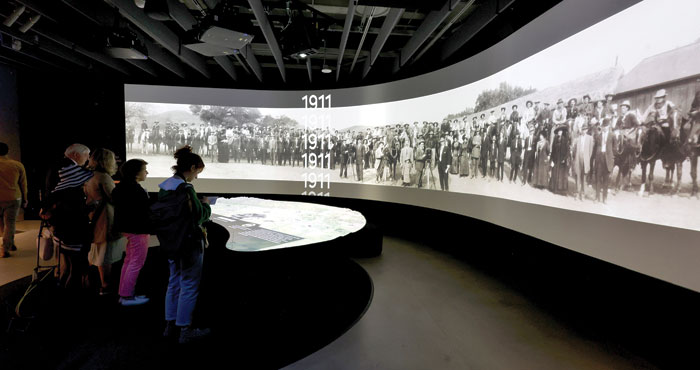
Entering The Academy Museum of Motion Pictures, one should be immediately greeted by an indoor “sculpture garden” of larger-than-life statues of Carl Laemmle, Adolph Zukor, Louis B. Mayer, The Warner Brothers, Zanuck, Fox, Cohn, etc., flanked by tributes and examples of their work. There’s a reason Gabler’s book opens with five extensive chapters, nearly 200 pages, on several of these men: They took what came before them — little nickelodeon rooms — and not only created Hollywood, but changed the country and the world — creating a narrative for what success and failure, happiness and sadness, victory and defeat, family, ambition, horror, science fiction, adventure, romance, etc. have meant in the modern age. They laid the groundwork for exhibitions that subsequent generations have camped out for days to see. They were giants, yes, with all the foibles giants have, but giants nonetheless, and they were Jews. (And, okay, everyone admits Harry Cohn was a jerk; you can squeeze that in somewhere, no doubt.)

They were, in fact, tough men in a very, very tough world in which much was denied them professionally because of their religion. They fought off an attempt by an uber-gentile, Thomas Edison, to completely control a business they had invested their lives and fortunes in, a business they were relegated to because they held onto their ambition when so many professional tracks were completely off the table. (Gabler repeatedly makes this point.) And yes, like seemingly everyone who becomes ridiculously rich and powerful, many of them also gave free reign to their libidos and piratic business tendencies. They were human beings. Human nature, as we see so graphically today, is the most powerful motivator of our actions and often not pretty. (It’s a Talmudic teaching, by the way, that the inclination to do bad is stronger than the inclination to do good, and Jews have done a lot of good in this country.) So? It’s not like they were financing slave ships. Or posting death threats to jurors.

They were, in fact, tough men in a very, very tough world in which much was denied them professionally because of their religion. 

What is gained by demanding they be generations ahead of their time when it comes to civil rights and social and gender justice? Are they to be held accountable for every perceived slight, by a society that’s come to be dominated by splintered identity politics?

Hollywood has always been a sexual free-for-all and chock-full of professional abuse. It doesn’t make that admirable, but what is really gained by calling someone “a womanizer” in this context? You should be able to see it for what it is, an unfortunate cheap shot. Does the World War II Museum in New Orleans mention Eisenhower’s long-time affair with his driver, Kay Summersby? Of course not. Must we diminish Jack Warner to Brett Ratner? To what end? Must #MeToo – a movement whose importance is manifest – also be the yardstick by which museums are measured? And only the Jews are called out for exhibition?

I developed a theory about Los Angeles and Hollywood decades ago. The unspoken secret of Hollywood, and L.A., (and in reality, much of the entire far West) is that it’s halfway around the world from where Western Civilization all began. It’s the nth degree of social evolution; it ended here, where you couldn’t go any farther because of the ocean. Here is where people in this country and from other countries went – and, most notably in many cases, Jews – to get away from tradition and traditional expectations they had to answer to – both within their religion and from prevailing Christian society –and reinvented themselves in their own image.

Here Jews could change their names, marry non-Jews, exhale into an expanded moral code, and get away with a lot for a long time until the rest of the country caught up to them. (In Northern California it took a different turn – hippies and gay freedom; in Portland, it’s “Portlandia”.) Everyone who’s come since is here for some take on that endeavor. You can’t hold Hollywood up to Boys Town (the actual place, not the movie; the movie is the magician’s misdirection) as some sort of fair comparison.

Other peoples and religions don’t seek to undercut their own credibility like this. The Christians, despite billions paid out worldwide in settlements for sexual abuse scandals, seem to believe they have trademarked morality itself, when the first Bible was the Torah. Do they do it by listing settlement dollar amounts on a plaque at the Vatican or St. Peter’s? Does the Louvre have a large room where the behavioral peccadillos of da Vinci, Delacroix, Vermeer, Titian, and others are graphically on display? I toured the Musée Lumière in Lyon. I’m sure the Lumière brothers had bad habits; you just didn’t read anything about it in the exhibits. To quote Stan Lee, “’Nuff said!”

I understand that the museum is not a synagogue nor one of the many great Jewish museums. However, Jewish hegemony over Hollywood has been so complete for such a long time that Joel Stein could write an op-ed in the L.A. Times in 2008, nearly a century after Laemmle founded Universal and Zukor founded Paramount: “Who runs Hollywood? C’mon.”  Must we go dig up dirt on these guys, too, for a credible museum experience? (OK, admittedly, Les Moonves requires little elbow grease.)

Lawrence Bender is completely right, and it’s not just the “Hollywoodland” exhibit that needs a major overhaul. The very idea of the Museum has to be rethought in terms of the unique and outsized contributions of its Jewish studio executives, producers, writers, directors, etc., but especially, The Founders. There should be a tasteful and exciting way to accomplish this end without needless repetition or being, as we say in the business, too continually “on the nose.”

Do not be the fingers at the end of the long arm of the ADL, worrying how it might look. Do not sacrifice these contributions on the altar of political correctness.

Instead, stand up and do us proud.

All the best,

Mitch Paradise


Mitch Paradise is a writer and producer living in Los Angeles. He also taught for 24 years as a substitute at more than 100 schools, PreK to 12th Grade, for the Los Angeles Unified School District.

An Open Letter to the Academy Museum of Motion Pictures About the Hollywoodland Exhibit Read More »

Chef Rossi: “The Punk Rock Queen of the Jews,” Putting Love into Food and Gluten-Free Mac N Cheese

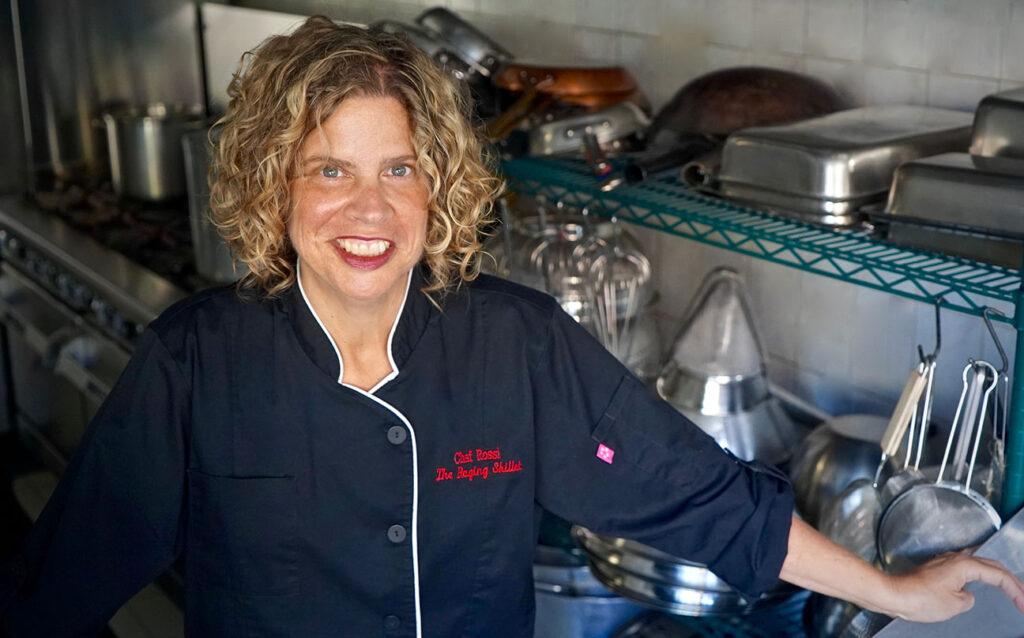
Chef Rossi is known as the anti-caterer! The founder of The Raging Skillet (which happens to be the name of her first memoir), Rossi is all about making fun, surprising foods that people love and putting love into everything she makes. This shines through in her writing, as well.

Whereas “The Raging Skillet: The True Life Story of Chef Rossi” shares the behind the scenes of how she became a chef and caterer (complete with kooky recipes), her latest, “The Punk Rock Queen of the Jews” is kind of a prequel. It’s her wild, queer coming-of-age true story.

“I never quite wrote anything like that where I made myself so vulnerable,” Rossi told the Journal. “I was a wild punk rocker and my parents wanted me to be a nice Jewish girl with 1950s values and it wasn’t working out.”

Rossi ran away from home, and had a giant party, because that’s “what you do when you run away from a repressive home. “The police busted my party and my parents got the bright idea to ship me off to a Chasidic rabbi in Crown Heights, Brooklyn, in 1981, who specialized in taking in and turning around wayward Jewish girls.” Rossi had to stay with them for two years.

She added, “You can see that worked really well.”

Rossi hopes the book serves as an inspiration for those living in a repressive society, religion or family.

“If I could give [courage] to one teenager who is depressed and sad and scared and thinks they might be gay, that would just make everything worthwhile,” Rossi said. “I wish so much that I had been able to read something like that when I was 16 years old, because I felt very often like I was the only person in the entire world who understood what I was going through.”

Whether your gift is writing, cooking or something else, find the thing you are good at and use that to put good into the world.

For instance, Rossi said, you can speak out about kindness, speak out against anti-semitism or even bake cookies to share with those attending a rally.

Rossi lives by the motto: “Food is love is love.”

“When I was a starving artist trying to survive in Crown Heights, I would take a few dollars and my mother’s care packages and somehow weave together a meal that would feed all my starving artists friends,” she said. “For $3.99 cents, I managed to put together a meal that fed 10 people and they were so happy.

“They were so full of love and joy; their stomachs were full and it’s a powerful thing.”

Perhaps the ultimate comfort food is mac n cheese. Chef Rossi’s recipe is below.

“I think the secret ingredient is just really taking the time,” she said. “If you rush through it, you might not have the great balance; you want to really whisk it with a lot of love in your heart.”

Follow @ChefRossiNYC on Instagram and learn more at TheRagingSkillet.com. Find “The Punk Rock Queen of the Jews” at Bookshop.org or at your favorite place to buy books.

For the full conversation, listen to the podcast:

Watch the interview:

Chef Rossi’s Zingy Gluten-Free Mac n Cheese

I start by making a roux. That’s fancy French talk for flour and butter. When I make this, I am making a lot of it, so, I start with one pound of sweet butter and 1 pint of Gluten free flour for mac and cheese for 100! For Normal folks, scale down a lot.

Ingredients

3 tbsp sweet butter

3 tbsp gluten-free flour

Hot sauce or tabasco

Mustard

2 cups milk

~ 1/2 cup cheddar cheese, grated

~ 1/2 cup Monterey jack cheese, grated

Seasonings: paprika, old bay, celery salt, garlic powder and ground black pepper

1 box of pasta

For mini-pies:

Baby-tart shells

For mac fritters:

1 egg

Gluten-free panko

Drop three good spoons of sweet butter and three good spoons of gluten-free flour

Into a deep, heavy bottom pot.

Melt your butter and stir in the flour then keep stirring over low heat for a few minutes.

Then I stir in a shot of Franks Hot sauce or tabasco, or both and a good plop of mustard (almost any kind).

I cook this for a few minutes then slowly whisk in milk. About 2 coffee cups of milk should do it. Keep whisking the milk for maybe ten minutes. When you start to feel it pushing back as it’s thickening up, throw in 2 heaping handfuls of grated cheddar and 2 heaping handfuls of grated Monterey jack. I like to season with a good pinch each of Paprika, old bay, celery salt, garlic powder and ground black pepper. I always wait to add salt once all the cheese is melted. If your sauce feels too thick, you can drizzle in a little more milk.

Meanwhile, put a pot of water to boil on the stove. Add salt once boiling. Boil one box of pasta (one pound). I use gluten free elbow macaroni.

Drain the pasta and mix with your hot cheesy sauce.

We like to spray a deep baking dish with cooking spray, so it doesn’t stick, and then pour the whole shebang into the pan.

Mac N Cheese Tarts

Another option is to put it in baby tart shells for mini-mac n cheese pie; just toast it in the oven for a few minutes.

You can chow down and eat just like that. Or chill until you are ready.

It also freezes fabulously. We often chill it overnight and then roll it into balls, dip in egg and then gluten free panko and fry for fabulous spicy mac fritters.

Mac N Cheese Fritters

Debra Eckerling is a writer for the Jewish Journal and the host of “Taste Buds with Deb.Subscribe on YouTube or your favorite podcast platform. Email Debra: tastebuds@jewishjournal.com.

Chef Rossi: “The Punk Rock Queen of the Jews,” Putting Love into Food and Gluten-Free Mac N Cheese Read More »