fbpx

May 22, 2024

Rosner’s Domain | The Most Dangerous Week?

This week may well be the most dangerous week in the war so far. Dangerous — not as in the horrors of massacre, or the agony of the battlefield, not because of an exceptional number of dead and wounded. This is perhaps the most dangerous week in the war so far in a strategic sense. This is dangerous in everything that concerns Israel’s ability to overcome the crisis, to win the war, and to avoid an unbearable internal crisis.

This is a dangerous week in everything that concerns Israel’s ability to overcome the crisis, to win the war, and to avoid an unbearable internal crisis.

Let’s map the reasons for the danger:

Israel has a government that the majority of the people do not trust. But it is a legitimate, legally elected government, with a mandate to continue ruling. Theoretically, it can rule for a long time (more than two years), even though a clear majority of the public (around 70%) support an early election. 

The untrustworthy government is waging a war for which almost all Israelis are paying a price, including all those who do not support it. In other words, many Israelis are required to bear the burden of a war that is being led by a people they do not trust.

The share of Israelis in such situation is about to increase because of the expected decision by Benny Gantz and the Mamlachti Camp Party to leave the government. Gantz chose to convey his “I-can-no-longer-stay” as an ultimatum — he’d quit only after three weeks of waiting for the PM to respond to a list of his demands. But Netanyahu didn’t even bother to pretend to be considerate of the warning. He promptly rejected Gantz’ demands, which means that if Gantz intends to actually wait the three weeks, he is wasting his time and ours.

Also this week, the summer session of the Knesset was opened, which foreshadows two things: This is the only window of time in which the parliament can vote to have early elections in the coming months; also, this is the window of time in which the government intends to pass a law exempting the ultra-Orthodox from military service. The two things will be a fuse that generates protests and a heated debate. 

That is, in the midst of a war that Israel is not close to winning, the country is likely to engage in a persistent, bitter and difficult social and political battle. Obviously, this is a dangerous situation. Obviously, it would have been better to avoid it.

The rift that I described here is probably inevitable. There will be a government with a majority in the Knesset and lacking in public trust that is going to lead Israel at war. There will be a government with legal legitimacy but without broad civilian legitimacy that is going to lead Israel at war. And it doesn’t matter much if you think that this situation is the fault of Netanyahu, or Gantz, or the protesters. This is where we are, and we will all pay a price for it, because damage to the country’s security, to its international status, to its ability to defend itself, to its resources, to its economic robustness — these will come at the expense of all of us.

This is where we are, which means that every move of the government will be viewed with suspicion, and that every decision will be more difficult to implement. Which also means that the government will not have a broad international backing. Which also means that the tone will become harsher: The government and its supporters will blame their political opponents for the failure of the war effort. Opponents of the government will say that with this government it is impossible to win.

Is it possible to avoid this dangerous and destructive situation? The answer I can offer will anger those who still support the government. But this, in my opinion, is the only plausible option: Netanyahu, or some members of his coalition, should announce that they understand that the situation calls for elections, and set a date for as soon as possible. Then the government will continue to wage the war as it sees fit, until a new government is implemented. Hopefully, one based on a broad coalition.

The likelihood that this possibility will be realized seems currently low, but this could change if and when it becomes clear that the government is having trouble running the country, and the spiral towards possible defeat continues. And one must admit: an election would not be a good way out of a bad situation. It would be, at best, a slightly less bad way than the other way — that is, less bad than a government that insists on waging the war without the public’s trust. 

Coalition supporters will argue, not without reason, that this proposal is a gift to Israelis who refuse to accept the legitimacy of a government with which they ideologically disagree. The opposition will argue, not without reason, that the root of the tragedy is the promiscuous conduct of a government that made a deliberate effort to antagonize half of the public. Either way, the troubling news is that it’s no longer possible to prevent a dangerous stage of social turmoil during a war. The only thing that Israelis can still do is try to make it shorter.

Something I wrote in Hebrew

When Defense Minister Yoav Gallant publicly implied that PM Netanyahu’s position on “the day after” in Gaza is based on political reasons, I wrote this:

Gallant has a claim: We need to talk about the day after, and we need to announce right now that there will be no prolonged military rule over Gaza. Netanyahu has a counterargument: There is no need to talk about the day after, and any proposal that could possibly mean control by the Palestinian Authority in Gaza should be rejected. These are substantive claims, and they must be discussed on their own, regardless of the question of the motives of those who express them. Sometimes, even a nonkosher motive produces a valid claim.

A week’s numbers

A majority of the Jewish public (and essentially all Arabs) are ready for new election, but the coalition has a 64-seat majority to prevent it. 

A reader’s response:

Ella Azulay asks: “Do you think Israel was involved in what happened in Iran?”Answer: Assuming you refer to the helicopter crash – no. Sometimes bad weather is just bad weather. 


Shmuel Rosner is senior political editor. For more analysis of Israeli and international politics, visit Rosner’s Domain at jewishjournal.com/rosnersdomain.

Rosner’s Domain | The Most Dangerous Week? Read More »

Why Israel Is a Miracle

Last week we celebrated Yom Ha’atzmaut, Israel Independence Day. Our joy was, of course, muted given the terrible war we find ourselves in and the fact that so many of our family members are still held captive in Gaza after enduring more than 224 days of hell.

One of the many superpowers of the Jewish People, however, is our astonishing strength and resilience. When others might have given up, assimilated completely, or faded away, we soldier on. Even in challenging times, we find the way to celebrate our festivals and rejoice in our blessings.

There is an insertion to our liturgy on Yom Ha’atzmaut that I find particularly resonant and inspiring at this moment. In one section of the Amidah, the central prayer of our service, there is a passage known as “Modim” (“Thanksgiving”), where we express our gratitude for the many gifts, including that of life itself, that God showers upon us day by day. On Yom Ha’atzmaut, we add special words of gratitude for the gift of sovereignty. With all of its messiness, challenges, and obligations, our return to power has been an extraordinary blessing that we must never take for granted.

In our siddur (prayer book), we add these words: “In the return to Zion of our time, Your people gathered in Your land to build it up and be built up themselves. They established this Independence Day as a festival of joy, thanksgiving, and praise to You. As You performed miracles for our ancestors, do likewise for us, saving us now as You did then” (Mishkan T’filah).

These words feel terribly relevant this year as we pray for deliverance from this horrible situation just as we have done time and time again. In addition to our advocacy, our philanthropy, and the work of our hands, we offer our prayers for a miracle.

And at this time especially we should acknowledge the truth that Israel is itself a miracle — an inexplicable occurrence that is both surprising and welcome.

Once, years ago, I was speaking with a congregant at a Yom Ha’atzmaut celebration. He was the kind of synagogue member who didn’t often attend worship services but would never, ever miss an event celebrating Israel or a gathering of solidarity when, God forbid, something tragic befell our people. He turned to me with tears in his eyes and said, “Rabbi, I am a total atheist but there’s one miracle in which I believe: The miracle of Israel! Out of the ashes of the Holocaust, against all odds, we built a State!”

Israel is a miracle, one earned through enormous sacrifice. 

It wasn’t given to us on a silver platter; it was bought with blood and tears. 

Israel is a miracle that should be celebrated not just by Jews but also by people of conscience throughout the world, especially by those who would describe themselves as progressives — because what could be a more inspiring example of progress than an oppressed people returning to its land of indigeneity? But sadly, many of those whom we would expect to celebrate alongside us instead demonize and delegitimize us.

One of the many superpowers of the Jewish People is our astonishing strength and resilience. When others might have given up, assimilated completely, or faded away, we soldier on.

On Yom Ha’atzmaut, even in the middle of a painful, bloody war that included this week the tragic and heartbreaking news of five soldiers killed by “friendly fire,” we must have the strength and resilience to express our gratitude and even joy that we are of the generations who merit to have the privilege to build up and to be built up through the task of our return to sovereignty, the sacred task of Shivat Tzion, our coming home to Zion.

Our work is not finished, it never will be. Like every other nation-state or worthy endeavor, it is an ongoing, iterative process that continues as new challenges emerge and new opportunities present themselves. There is always room for growth and improvements. 

But this week especially, we celebrate with pride what we have built, what we have accomplished. Despite the challenges, the forces aligned against us hell-bent on our destruction, we hold on to our humanity and strive to be worthy of the time when the dream of the prophet Micah will be fulfilled:

Every family shall sit 

Under its own vine and fig tree

And no one shall give them cause to fear!

May this be a miracle that we experience soon, speedily, in our own day.

Am Yisrael Chai!


Rabbi Yoshi Zweiback is the Senior Rabbi of Stephen Wise Temple in Los Angeles, California.

Why Israel Is a Miracle Read More »

Take Persian Jews Seriously

Recently, the protests at UCLA — a university not far from my own home — reached a fever pitch after a Jewish girl was violently attacked. The girl, who was kicked in the head and knocked unconscious while trying to help her sister pick up a fallen Israeli flag, was a psychology student at a nearby college and a Persian Jew who came with her family to show solidarity with Jewish counterprotesters. 

News of the attack circulated quickly among the Persian Jews of Los Angeles, and within hours, a group of counterprotesters mobilized to push back, not content to let the “Tentifada” set the tone at UCLA — let alone attack a member of the Persian community.

My family immigrated to Los Angeles from Iran when I was a child, fleeing the religious persecution that Jews in Iran are subjected to.I’m thrilled to see the Persian community being recognized for what we bring to the table — for Jews and for America at large. I’ve said for a long time that the American Jewish community has a problem listening to its smaller constituencies, particularly Middle Eastern Jews who don’t vote, act, or look like them. Persian Jews usually hold more conservative positions than the rest of our Jewish counterparts, particularly with regard to foreign affairs and the dangers of radical Islam — but it is because we know these dangers acutely. It did not take the biggest massacre of Jews since the Holocaust for us to see them.

We know these dangers, and have been sounding the alarm about them, precisely because we have lived through and fled them. My family fled Iran, hiding in the back of a pickup truck being shot at by border police, after the Islamic Revolution, when the ayatollahs took the sophisticated, cosmopolitan society I remember from my early childhood and transformed it in a dystopian theocracy that detests women and detests Jews even more. Along with the thousands of other Jewish families who fled, we were among the first victims of the jihadist wave that started then and is still crashing over the world today, with Iran funding the terrorist proxies — from Hamas to Hezbollah — that wreak havoc through the Middle East and hope to do the same to the Western world. 

This is why Persian Jews warn continuously of the evils of radical Islam — we know how it can destroy once-thriving societies until they are unrecognizable, and we know the way this destruction can spread. We understand the pressing, urgent danger that Iran poses to the West, and we understand the need to elect officials and back policies informed by this understanding, even if it means a shift from the traditional American Jewish party line.

Persian Jews also understand another vital lesson that the broader Jewish community seems to miss—the importance of showing strength. This is true for our positions on politics, notably in the Middle East, where we know the dangers of soft leaders who don’t take bold, resolute stances on Iran and its terrorist allies.

Persian Jews also understand another vital lesson that the broader Jewish community seems to miss — the importance of showing strength. This is true for our positions on politics, notably in the Middle East, where we know the dangers of soft leaders who don’t take bold, resolute stances on Iran and its terrorist allies. This is also true for the positions we take on asserting our own identity as Jews. Persian Jews do not apologize for acting in accordance with our Jewish values and interests, and standing up for ourselves rather than bowing to the mob when these values and interests are threatened. We do not feel the need to explain or justify ourselves to the seemingly ever-growing horde of people who do not value our existence — instead, we forge ahead uncompromisingly and look out for our own. This, too, should offer a model for American Jews who don’t understand why their endless efforts at convincing people of their basic right to exist haven’t made any progress. Jewish effort is better spent nurturing and maintaining our own communities than playing endless defense, especially right now, when spending our energy on our enemies means that we will have no energy left. 

I have been warning of the Iranian regime and extolling the foresight of Persian Jews for years and, until recently, it fell on deaf ears. I would have given anything to be wrong about the cruelty of Iran or the essentiality of Jewish strength, but now that these warnings have been vindicated, I can only hope that the wider Jewish community begins to listen to Jews like us who still carry the hard lessons of history.


Dr. Sheila Nazarian is a Los Angeles physician whose family escaped to America from Iran. She stars in the Emmy-nominated Netflix series “Skin Decision: Before and After.“

Take Persian Jews Seriously Read More »

A Chancellor’s Appeasement

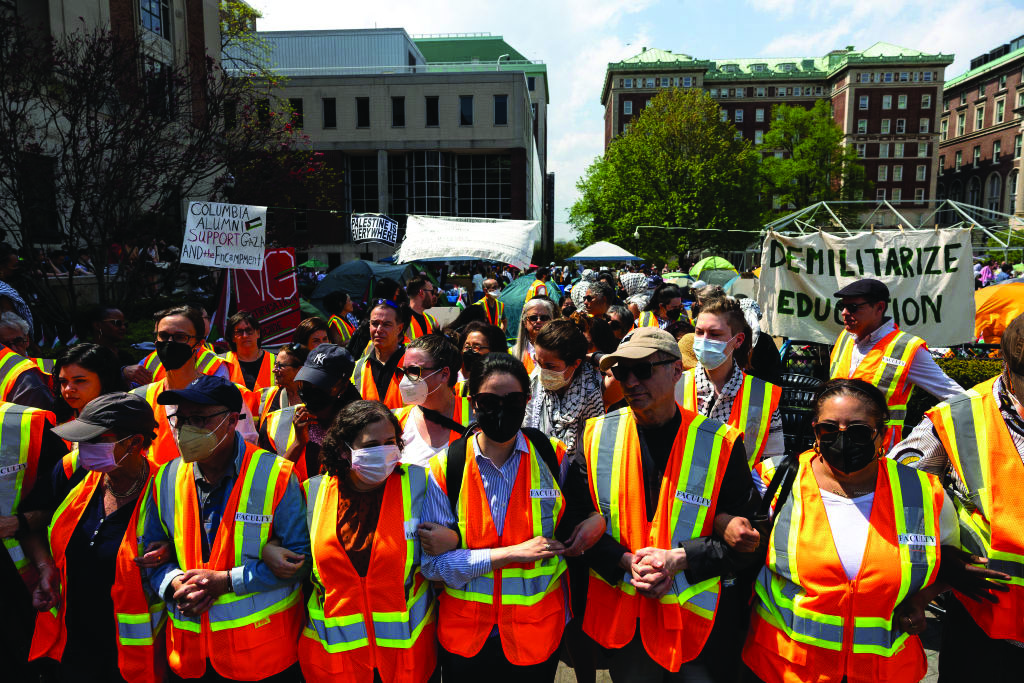
While the national media have given extensive coverage to the violent removal of “pro-Palestinian” encampments at Columbia, UCLA and other universities, a far different yet also troubling scenario has played out on my home campus, the University of California, Riverside (UCR). Our chancellor, Kim A. Wilcox, recently reached an agreement with the campus Students for Justice in Palestine leaders to end their encampment. The university agreed to consider divesting from companies that do business in Israel and to consider banning Israeli products on campus and study abroad programs in Israel.  Those who like the deal think the chancellor managed to clear the encampments peacefully without anyone getting hurt and without giving away much in return.

The videos of the scene, however, tell a different story, one of administrators who lack moral compasses. They point to the bias, expediency, and dishonesty surrounding their actions. A video prior to the announcement shows the SJP leading chants, including “Israeli Settlers Leave Us Alone.  Palestine is Ours Alone” and “The Only Solution is Intifada Revolution.” As he takes up the microphone, the chancellor then praises the chanting students. The video then shows the administrators standing solemnly as the SJP leaders hail the campus for “robustly meeting our demands,” promising an “academic boycott” of Israel, and standing with “the student intifada.”  The chancellor then embraces the student activists, affirming their harangues.  This public embrace will haunt the campus long after the protesters have departed. 

Like most on my campus, I am a critic of Benjamin Netanyahu and his extremist coalition and am sickened by the number of innocent people who have died in this war, including the many whose deaths are due to preventable failures of the Israeli military. I support a ceasefire if the hostages are part of the agreement. But it is also sickening (though at a far lesser scale of course) to see a University of California chancellor aligning his campus publicly with the goals of Hamas, a terrorist organization that has vowed to erase the State of Israel.

The agreement, we are now told, was about clearing the encampment a day before thousands of parents and prospective students were slated to visit the campus.  The chancellor may not have wanted tents and chants to overshadow the day-long recruitment events, but he had other options for handling the issue. He could have told the parents that he supports students’ rights to protest and that he is talking with them. He could have favorably compared UC Riverside to the chaos at UCLA, and he could have said that it is not the role of the university to take stands on foreign policy.  Institutional neutrality is a principle and asset many university presidents understand and have applied to the “pro-Palestinian” protests.

Wilcox’s capitulation is not an isolated event or even surprising. Rather, it is the culmination of a long series of failures by the administration to protect the rights of Jewish students. Hillel has been vandalized.  Speakers have been prevented from speaking due to the failure of the UCR police to provide security. Jewish students have been harassed. Posters that violate university policy have been allowed to stand.  Protesters have marched through campus repeatedly chanting slogans the administration knows are heard by Jews as threatening, yet no efforts have been made to educate the student population about how Jews hear the chants. Scores of emails sent to the chancellor raising these concerns have gone unanswered.  

Following their disgraceful public capitulation, Wilcox and other administrators scurried to a private meeting with a few Jewish faculty and students. They apologized for not alerting them to the impending announcement and then told them that the agreement would have little impact. A cancelled study abroad program it seems was already going to be closed and no decisions on divestment can be made that violate a UC policy that currently prevents these actions. The provost told Jewish students to be “resilient” in the face of antisemitism. Chancellor Wilcox promised to take into consideration demands from Hillel students. But surely some must have wondered why sincerity would suddenly enter into any agreement with students at Hillel when he had just admitted to dealing cynically with SJP.

Wilcox and his subordinates have damaged the University’s reputation. Many faculty and students feel betrayed and donors are threatening to withhold donations and good will. Compounding the damage, Wilcox seems to have done nothing to prepare his staff from the blowback now occurring. Depending on what happens in the war, the cycle could begin again in the fall. At UC Riverside, we’ve seen our Chamberlain in action. What we hope for now is a Churchill in response.


Steven Brint is Distinguished Professor of Sociology and Public Policy at UC Riverside and director of the Colleges & Universities 2000 Project.  He is the author, most recently, of “Two Cheers for Higher Education” (Princeton University Press, 2019).

A Chancellor’s Appeasement Read More »

All the Darkness They Cannot See: The Tunnel Vision That Drives Faculty Antisemitism

After Oct. 7 I didn’t think I could be more shocked than by seeing American campuses explode in support rather than condemnation of that barbaric massacre. I was wrong. Now after seven months of open season on Jews both rhetorically and physically, culminating in the encampments on well over 100 campuses, I find myself struggling not to think of the disastrous years 70 C.E., 1492, and 1939, alongside America of 2024. 

Oddly, though, even though the encampments break so many campus rules and often local laws, my starting point is actually to be sympathetic to them. I think about how I would act, say, during the early 1940s, when I learned that a genocide against the Jewish people was occurring and people were not paying attention. Wouldn’t I protest, loudly? Disrupt “business as normal”? Maybe even break a few rules or laws? I hope that I would. 

The problem, then, isn’t the mayhem, per se (though it’s appropriately against the rules and must be — is long overdue for being —punished). It runs deeper, rooted in the academy itself: It’s that these people falsely believe a genocide is occurring (when it clearly isn’t), and misidentify the true genocidal agent (as we’ll see). More generally, it’s that they have adopted an entire narrative that is one-sided, oversimplified, ignorant of history, often counter to the facts, mistaken about who are the good guys and the bad, and driven, ultimately, by hatred and bigotry—and that licenses the outrageously immoral violence of Oct. 7.

A painful glimpse of all this may be found in a revealing statement recently issued by some 90 faculty and staff at Connecticut College, constituting almost half the fulltime faculty at this typical liberal arts college, in “solidarity” with the encampments. Much is objectionable in it; but we will look only at one sentence: 

“We also stand in solidarity with Israeli organizations and activists who oppose Israeli apartheid and Jewish supremacy …”

Shades of 1939 indeed, when half the professors at a college can so casually accuse the Jews of “Jewish supremacy”; Nazi Propaganda Minister Goebbels would be pleased to see his trope flourishing so. No number of fig leaves (by invoking some Israelis who agree with it) can conceal the fact that this is “Protocols of the Elders of Zion”-level delusional antisemitic rhetoric that professors in 2024 America are happily signing their names to. 

It is also dangerous rhetoric. A person who believes in “Jewish supremacy” will soon support drastic measures against Jews, up to and including genocide. Witness the Nazis, directly inspired by the Protocols, and Hamas, whose openly genocidal founding charter liberally quotes from the Protocols. That connection, note, is not accidental. The Muslim Brotherhood worked with the Nazis during WWII, and the infamous Mufti Hajj Amin Al-Husseini, representing the Brotherhood as the long-time leader of the Palestinian national movement, spent the war in Berlin to help the Nazis bring the Final Solution to the Middle East. Hamas is of course a branch of the Muslim Brotherhood in Gaza. Contemporary progressives, including these professors, like to distinguish: “Nazism bad, Palestinianism good,” in essence. But in the context of the current war, supporting Hamas — as every measure demanded by the encampments and thus by this faculty statement does — is supporting literally the same Jewish eliminationist program as the Nazis.

In the context of the current war, supporting Hamas—as every measure demanded by the encampments and thus by this faculty statement does—is supporting literally the same Jewish- eliminationist program as the Nazis.

Right there is the heart of the problem, what these people cannot or will not see; the hyperfocus, the tunnel vision, that leads so many to casually accept “Jewish supremacy.”

Israel is surrounded by openly genocidal neighbors. Just in the current war it has been attacked by Hamas, Hezbollah, Syria, Iraq, Yemen, and of course Iran. Hamas has launched five wars against Israel since seizing Gaza in 2007, and that was after two decades of launching suicide bombers, in total murdering thousands of Israelis. And yet all these faculty members can see are Israeli offenses, only Israeli offenses, out of their context, which they see as aggressions and describe using such inflammatory language as “apartheid” and “Jewish supremacy.”

But remember Israel was founded for a reason: to be a safe haven for the widely persecuted Jews. And note that as of the 1947 U.N. partition proposal there were zero Palestinian refugees: not only did Zionism itself not displace anybody, there was significant Arab immigration into Palestine precisely because Zionism developed the country, with room enough for all. Had the Arabs accepted partition we might have been celebrating the 76th anniversary this month of the two states living next to each other in peace.

The Arabs chose war, and continued to choose war for decades; in the form of Hamas, they continue to choose war.

That is the context these professors cannot, or will not, see.

Now consider what the Israelis — the Jews — accomplished in this context, apart from managing not to be exterminated.

Despite ongoing threats and attacks faced by no other country, despite relentless terrorism, Israel built a flourishing democracy that enshrines civil and legal equality for its many minorities, including its at times hostile Arab minority. It is neither perfect nor free of discrimination and inequality; no country is. It is a Jewish country, which creates perhaps some challenges for its minorities; but every country has a majority nation or culture with similar challenges. And yet despite all that Israel still manages to be a country where its sometimes hostile Arab minority has more rights and freedoms than Arab citizens have in most Arab countries. It also manages to be a country where its own citizens, such as the Israeli fig leaves above, can freely condemn its government and its society, even labeling them as “apartheid” and “Jewish supremacy,” if that’s how they feel.

Those who believe in free speech — as the faculty statement claims it does — ought to be applauding that amazing achievement. 

Compare that to Israel’s neighbors, most of whom are its enemies. Not a democracy among them, neither freedoms nor basic human rights for their citizens, no equality for their minorities, and certainly no rights for their Jews—because they all ethnically cleansed their Jews. Compare Israel just to the Palestinian Authority, which forbids land sales to Jews, restricts Jews from accessing holy sites under P.A. jurisdiction, and has for years run its “pay to slay” program rewarding its citizens for murdering Jews. Or to Hamas, whose founding charter justifies genocide of the Jews by the same Protocols that motivated the Nazis. If you’re looking for actual apartheid — legally enforced separation — then you don’t get more of that than in the expulsion, restriction of mobility, subsidized murder, and wholesale genocide supported by most of Israel’s neighbors and enemies.

The professors can only see alleged Israeli offenses. They fail to see the in fact far greater offenses of all the surrounding entities, much less consider that much Israeli action is not aggression but reaction, reaction to being surrounded by dozens of countries and hundreds of millions of people who wish to erase this sliver from the globe and murder its seven million Jews.

And so they think “Jewish supremacy” is the problem.

The “Jewish supremacy” allegation is a vile, antisemitic lie — targeting the one actual democracy in the region that strives to maintain equal rights under security conditions faced by no other democracy. Oh, and that also happens to be a Jewish democracy.

Beneath the professors’ fancy talk of freedom and human rights, then, there is just good old-fashioned antisemitism.

Nineteen-thirty-nine indeed.


Andrew Pessin is Professor of Philosophy at Connecticut College and Campus Bureau Editor of The Algemeiner.

All the Darkness They Cannot See: The Tunnel Vision That Drives Faculty Antisemitism Read More »

Antisemitism: A Hatred Like No Other

In 2019 I went on a European vacation with a Jewish tour group. Although the tours were not primarily Jewish-themed, they did include quite a bit of Jewish history. Visiting Italy, Spain, France, and Monaco, we heard a litany of persecution, injustice, and violence against our people. Indeed, one needs a stiff drink before learning about Jewish history.

Jews were blamed for the Black Death. Christians could think of only one reason why their prayers in church were going unanswered: It was because the Jews were not praying in church. Furthermore, it was apparent that Jews were not as impacted by the plague as non-Jews, leading Christians to the erroneous conclusion that there was a sinister reason behind the disparity. In fact, long before modern science — and Dr. Fauci — told us that we needed to wash before we ate, Jewish people were already doing so.

An amalgam of ignorance and hatred produced deadly results for our people.

Antisemitism, a hatred like no other, is unparalleled in its ferocity. It is the oldest hatred, yet always manages to reinvent itself.  Rabid, visceral, and often based on conspiracy theories, antisemitism is like a virus that survives by morphing in line with current events.

In 2020 when COVID was the world’s biggest problem, it provided a new reason to blame the Jews. When progressives decided to divide the world into a binary classification of oppressor and oppressed, antisemitism increasingly found a home among the left-wing.

Jean-Paul Sartre said, “If the Jew did not exist, the antisemite would invent him. Antisemitism is a view that arises not from experience or historical fact, but from itself. The antisemite convinces himself of beliefs that he knows to be spurious at best.” As an example, Sartre spoke of his classmate who failed a French exam, while a Jew whose family was not of French origin, had passed. In order to rationalize his own failure, Sartre’s classmate accused the Jew of cheating.

“Jews cannot fight antisemitism alone,” said Rabbi Jonathan Sacks. “The victim cannot cure the crime. The hated cannot cure the hate. It would be the greatest mistake for Jews to believe that they can fight it alone.”

Unfortunately, we Jews seem to have very few allies in our fight. Jews are drastically outnumbered in their counterprotests, with few non-Jews supporting them. Very wealthy donors who have pulled their support for their alma maters seem to be mostly, if not all, Jewish. This lack of allyship is disheartening, especially when contrasted with both the number and the diversity of supporters participating in the Black Lives Matter protests.

Antisemitism should not be lumped together with Islamophobia, yet it almost always is. While both types of hatred are equally vile, Islamophobia is far less prevalent. I have not seen anyone burning Palestinian flags or stopping traffic on bridges, or campuses shut down due to anti-Palestinian or anti-Muslim protests. The most high-profile act of violence against Palestinians was the shooting of three students in Vermont. While it was widely assumed that the shooter was Islamophobic, we later learned that the shooter’s writings indicated he was anti-Israel and pro-Hamas. How strange it is that even a supposedly Islamophobic act can be traced back to antisemitism.

Jews are the only people who are objects of hatred by three very distinct groups of people: The far right, the far left, and radical Islamists. Antisemitism is the most contradictory and ubiquitous hatred. It is everything, everywhere, all at once. Like the manna from heaven that was said to taste like whatever the consumer wanted it to, antisemitism is adapted at will.

The Nazis killed Jews because we were not considered white enough. Today progressives rail against Jews because of our supposed white privilege.

The far left despises Jews because they say we are all capitalists. The far right despises Jews because they say we are all socialists.

The far right abhors Jews because they think we are all globalists. The far left abhors Jews because they think we are all isolationists.

Jews are hated for being too weak. Jews are hated for being too strong.

We were once hated because we didn’t have a country of our own. Today we are hated for having a country.

Antisemitism, the great unifier, is perhaps the only topic that far-right Republicans and far-left Democrats agree upon. What else could unite Marjorie Taylor-Greene (R-Ga.) and Rashida Tlaib (D-Mich.) other than their vehement antisemitism, demonstrated by their shameless lies about Jews?

A confounding hatred, antisemitism leads us to question how it is possible for such talented and enlightened people to hold such abhorrent views. How could T.S. Eliot write such magnificent poetry and also write, “The rats are underneath the piles. The Jew is underneath the lot.?” How could Wagner compose such beautiful music, yet be connected with Nazism? How could Roald Dahl write such charming children’s novels, yet harbor such Jew-hatred?

Antisemitism is revealed in a variety of ways.

Sometimes antisemitism is blatant. The khaki-clad men with tiki torches shouting, “Jews will not replace us” leaves no question. 

Sometimes antisemitism is outed in an unintentional slip of the tongue. French Prime Minister Raymond Barre’s reaction to the October 1980 Palestinian terrorist attack on the Rue Copernic synagogue in Paris is a good example. Noting that four people had been killed outside the synagogue — only one of whom happened to be Jewish — Barre stated that “this odious attack was aimed at hitting Jews going to the synagogue, but hit innocent French people who were crossing Rue Copernic.” His comments divulged his belief that Jews were neither innocent nor French.

Sometimes antisemitism reveals itself by way of comparison, proving that comparison is indeed the thief of joy. In 2023, the U.N. General Assembly condemned Israel 14 times, versus seven times for the rest of the world combined. According to this body, Israel is a bigger violator of human rights than the aggregation of Russia, China, Iran and North Korea.

Recently at the U.N., Israel’s Ambassador Gilad Erdan said, “As we speak, there are over one million Muslims being forcibly removed from their homes, all of their possessions taken from them as they face poverty, famine, and disease. No, I am not talking about the situation in Gaza, but about Pakistan’s forced displacement of 1.3 million Afghans.”  He highlighted the UN’s disregard for non-Israel human rights violations, saying, “No Jews, no news.”

Cloaked in concern for human rights, the self-aggrandizing protesters have latched onto the Palestinian cause, ignoring all others.

The Iranian government kills women for not covering their hair and hangs LGBTQ from cranes, yet the US government lifted sanctions against Iran and unfroze billions of dollars to give to the Iranian government. Where are the protests?

In the Yemen war, Saudi Arabia, backed by America, engaged in starvation tactics against innocent civilians. Where were the protests?

China has put an estimated 1 million Uyghur Muslims in concentration camps. Where are the protests?

Islamist forces are committing atrocities, including mass killings, rape, and a modern-day version of slavery, against black Africans in Sudan and Nigeria.  Where are the protests?

The Kurds are one of the largest people without self-determination. They are a persecuted people who, unlike the Palestinians, were never offered a state of their own. At least one million Kurds have been killed, tortured, wounded, or deported. Where are the protests?

How ironic it is that students on college campuses use their right to protest to rise up against the only Middle Eastern country that actually allows its citizens to protest.

Hiding behind masks and keffiyehs, protesters consider themselves morally superior, yet they are no better than the KKK who hide beneath white hoods. Unperturbed by the fact that Hamas endorsed them, they do not realize that if a radical terrorist group that committed atrocities against babies and children endorses your cause, perhaps it is time to rethink what you are doing.

Hiding behind masks and keffiyehs, protesters consider themselves morally superior, yet they are no better than the KKK who hide beneath white hoods. Unperturbed by the fact that Hamas endorsed them, they do not realize that if a radical terrorist group that committed atrocities against babies and children endorses your cause, perhaps it is time to rethink what you are doing.

Because classifying something as antisemitic can be subjective, in 2016 the International Holocaust Remembrance Alliance (IHRA) clearly defined what constitutes antisemitism. The definition has since been adopted by 42 countries, including the U.S. One criterion is: “Applying double standards by requiring of Israel a behavior not expected or demanded of any other democratic nation.”

We sometimes hear the complaint that one cannot criticize Israel without being accused of antisemitism. This is a specious argument. Of course, simply criticizing Israel is not antisemitic, but people who condemn Israel tend to condemn only Israel, indicating a double standard that makes demands on Israel that it does not make on any other country.

Bereft of any concern for the welfare of the Israelis, the protesters demand that Israel withdraw, leave the hostages in Gaza, and return home, waiting to be attacked again. Their ultimate goal is for the eradication of Israel. They have not called for the eradication of any other democratic country, and they would not deny any other country the right to self-defense. This is antisemitism.

After the Sept. 11 attack on the World Trade Center, any rational person understood how unjust and downright stupid it would be to blame a random Muslim person for that act of terrorism. Today, however, and even before the Oct. 7 attack, on college campuses Jews have been routinely blamed for anything Israel does that their fellow students perceive to be unacceptable. This is antisemitism.

The progressives would rightly find it unthinkable to ask a Chinese student to denounce China, a country with atrocious human rights violations; however, before Jewish students have been allowed to join clubs and advocacy groups, they have been asked to denounce Israel, effectively shedding part of their Jewish identity. This is antisemitism.

In an act that is the apex of injustice, LGBTQ actually protest against Israel for providing rights to LGBTQ. Claiming “pink-washing,” they refuse to acknowledge that LBGTQ have rights in Israel because it is a modern, progressive democracy. It is noteworthy that they do not criticize any of the other countries in the Middle East where LGBTQ are arrested or murdered. The fact that these LGBTQ would complain if Israel did not provide rights to their group, yet also complain that they do, indicates that in their eyes, Israel is always wrong. This is antisemitism.

Antisemitism is the most illogical hatred.

Jews are the only people who are attacked for being attacked, and the only people who must constantly defend themselves for defending themselves. Antisemites rationalize their hatred by claiming that Jews are responsible for violence against themselves.

It is true that today Israel has the most right-wing government in its history; however, if you think this is why there is no peace, then you must explain why there was no peace when the prior government, the most diverse coalition in Israel’s history, was in power.

If you think the settlements are the problem, then you must explain why there was no peace before there was even one settlement built.

If you think that Israel’s existence is the problem, then you must explain why the Arabs committed pogroms, including wide-range killing, mutilation, and rape, well before modern-day Israel existed. The list of pogroms in the 20th century include the 1920 Tel Hai and Nebi Musa pogrom, the 1921 pogrom in Jaffa, and the 1929 pogroms in Safed and Hebron.

If you think that Zionism is the problem, then you must explain why the Arabs’ first recorded pogrom took place in the mid-1800s, 25 years before the Zionist movement began.

We thought the days of acceptance for public spewing of antisemitism by the likes of Father Coughlin and Henry Ford were over. Today, students call for the murder of Jews with impunity.

There is an eerie similarity between the events of today and those of Germany nine decades ago.

Elie Wiesel’s son, Elisha, recently likened today’s situation on college campuses to his father’s experience growing up in eastern Europe in the 1930s. He recounted how his father had to cross the street to get away from an angry mob who accused the Jews of genocide. Today Jews at Columbia and other campuses must avoid protesters who unrelentingly shout invectives at them. In fact, strangely, today it is safer to wear a yarmulke in Abu Dhabi than on many American campuses.

In 1938, at the University of Vienna, Nazis blocked Jews from entering. In recent days, in America, protesters have prevented Jewish students from going to class.

The Jewish people cannot afford to ignore warning signs. The following is an excerpt written by the editor of a Jewish newspaper in Berlin in 1933:

“We do not subscribe to the view that Mr. Hitler and his friends, now finally in possession of the power they have so long desired, will implement the proposals circulating in Nazi newspapers; they will not suddenly deprive German Jews of their constitutional rights, nor enclose them in ghettos, nor subject them to the jealous and murderous impulses of the mob. They cannot do this because a number of crucial factors hold powers in check… and they clearly do not want to go down that road.”

On the last day of my 2019 European vacation, we visited Tuscany and saw the Leaning Tower of Pisa. In person, the tilt was even more pronounced than in pictures, and it was a marvelous sight.

After visiting the tower, we strolled through a plaza in Pisa and came upon a street musician playing an accordion. To our surprise, he was playing the Hebrew song, Havah Nagilah.

What else could we do, but form a circle and dance the Hora. It was a wonderful way to end a tour that included much Jewish history that was difficult to hear.

So, we danced right there on a continent where so many succeeded in killing our people, yet could never kill the Jewish spirit.

We danced right there in the city of Pisa, for we had just seen that it is possible for a leaning tower to withstand all external forces, to defy all expectations, and yet never be toppled.


Marjorie Davis lives in Providence, R.I. She graduated from Brandeis University with a degree in Computer Science, and is a Senior Database Specialist in a large, international technology company. She is a frequent writer on antisemitism and Israel.

Antisemitism: A Hatred Like No Other Read More »

October 7, Verbatim

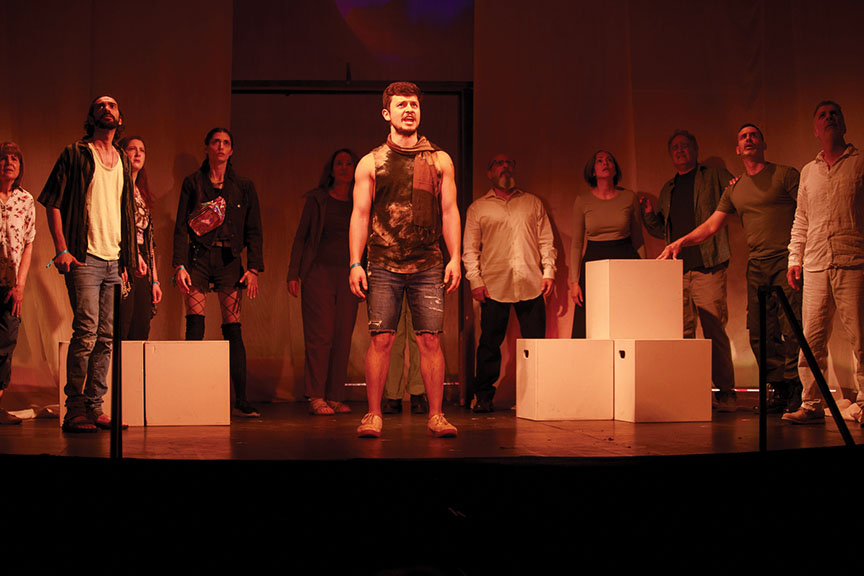
The same week Ireland’s Bambie Thug was embarrassing her country at Eurovision, in New York City two Irish investigative journalists premiered the first play about Oct. 7. Not surprisingly, it was difficult to find a theater willing to produce the play. And then it needed nonstop NYPD protection.

“Amazing that you can’t find a theater willing to put on a show about a massacre against Jews,” playwright Phelim McAleer, 57, said. “October 7 the Play: In Their Own Words” ultimately found a home at the Actors Temple Theatre, a theater and synagogue founded in 1917 as the West Side Hebrew Welfare Union. “A play about the Jewish people needs police protection in New York. In 2024. How did we get here?” 

McAleer and his wife Ann McElhinney, 60, were aghast at how quickly the world wanted to forget Oct. 7. “We were in Ireland. On the morning of Oct. 8, the media and people we met were immediately talking about how awful it was that they were turning off the electricity in Gaza. We were quite shocked by how efficiently the media caused people to look at something else so quickly and not talk about this massacre,” McAleer said. “There was a story that wasn’t being told, and that’s what we specialize in: Telling untold stories.”

The couple is known for exploring tough issues through film, plays, books, and podcasts through their Unreported Story Society. “This is a play about the truth. It seems there are a lot of people who don’t want the truth on stage in New York,” said McAleer.

“This is a play about the truth. It seems there are a lot of people who don’t want the truth on stage in New York.” – Phelim McAleer

McAleer and McElhinney flew to Israel in November, their first visit to the country. “It was truly a unique privilege to speak to the people we met,” said McElhinney. “Remarkable people, each of them very strong … in their own way.”

They spent three weeks in Israel, speaking with the wounded, rescue workers, worried families, and a police officer who killed several Hamas terrorists. The play presents 13 detailed accounts drawn verbatim from these interviews. “Stories of tragedy, heroism, fighting back, survival,” McAleer said. “We watched people describe the worst day of their lives, and their resilience, strength, courage, and hope are what you end up walking away with,” McElhinney.

In a barbershop in Tel Aviv, McAleer heard people talking about the Irish prime minister’s statement about Emily Hand, the 9-year-old Irish Israeli girl who had been kidnapped by Hamas. “He presented it as if she went missing,” McAleer said. “I apologized for being Irish for the first time in my life.”

“I told the people around me that I’m Irish and I apologize on his behalf. I said that not everyone in Ireland is like him, and we all got close, hugged each other. It was a very specific experience to be Irish and work on this story at this time,” McAleer said. “Hiding things just isn’t something that suits us. It’s an honor to tell such a story, and we will continue to tell it even in places where people don’t want to hear it.”

Verbatim theater is both a challenge and an opportunity, McAleer said. “You’re limited, but if in a regular play the audience sits back and absorbs what the playwright wrote for them, here they lean forward to listen to every word because they know it was spoken by a real person.”

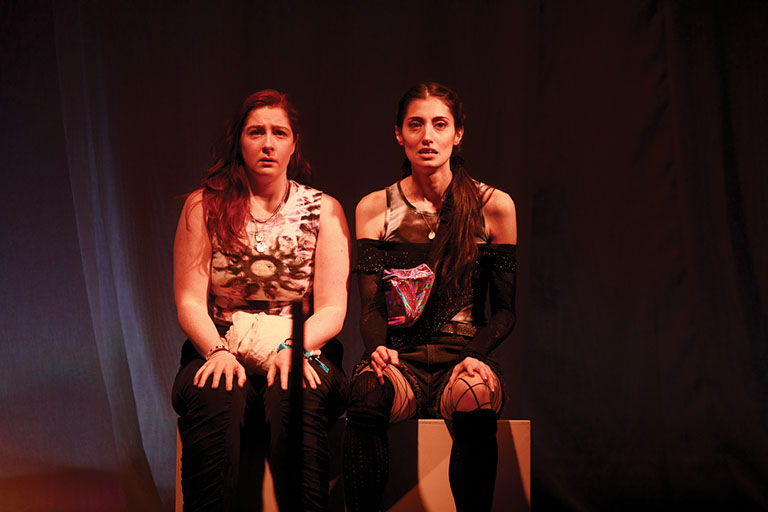
Amidst a background of explosions and screams, the play is a collage of 13 testimonies — from grandmothers and mothers who hid for hours in safe rooms wondering if their families survived; a policeman with only nine bullets left in his gun who killed several terrorists and saved dozens of his neighbors; an IDF soldier who defended his kibbutz and was shot five times by three different terrorists; a truck driver who saved over 100 people in his truck; and testimonies of those who narrowly escaped the massacre at the Nova Music Festival.

Some clips:

Isaac: At first when we saw the people on the paragliders, we thought they were Israelis. We waved at them: Shalom!    

Michael: We got up about 8:30. That’s when I saw a message from Rachel [his daughter]. “Bombs. They are bombing us. We are trying to escape.” And that was it. Nothing else.

Shani: It’s like the end of the world, messy, everyone shouting, screaming, running, hiding … just chaos.

Biliya: I know he’s dangerous. But I wasn’t scared. How can I explain this? I know he only knows how to kill. I cannot relate to him as a human. It’s a something, it’s not someone … He doesn’t deserve my fear.

Avishag (8): Grandma, let’s pretend like we’re dead.

Orderly: You can’t believe what’s going on. Like, people are coming with their organs, with their limbs in bags.

Shani: I have started to keep Shabbat. I began to believe … I’ve found faith. My faith. I think God was with me that day.

The couple hopes the play eventually lands on Broadway, and then travels throughout the U.S. In the meantime, they’re planning to take the play on a tour of Ivy League colleges in the fall. “They need education they don’t get in their classrooms,” said McAleer.

The couple hopes “October 7 the Play” will also encourage leaders from other areas of the arts to speak out on behalf of Israel. They are disgusted that Hollywood has not taken a bigger stance, but it’s the silence from the music industry that really irks them. “They were hunted down and slaughtered at a music festival. Massacred, because they were Jewish.” 

The couple was surprised at the resilience of Israelis. “Even in the darkest days, the Israeli people were able to be humorous,” he said. “Laughter is an act of defiance, too. You’re not going to destroy us. We’re going to rise again. Humor is both a coping mechanism and an act of defiance.”

The staccato intensity of the play leaves you feeling like you lived through a tiny fraction of what Israelis had to endure that day. It’s not a pleasant feeling but for American Jews, who are now enduring a level of anti-Semitism that none of us were prepared for, it can strengthen our own resilience. 

And while it’s beyond sad that an Irish Catholic couple are braver than NYC’s entire theater district — heavily populated with Jewish playwrights and producers — one is ultimately left with a small amount of faith in humanity. The same kind of faith that Christian resistance to Hitler gave European Jews.


Karen Lehrman Bloch is editor in chief of White Rose Magazine.

October 7, Verbatim Read More »

The Peaceful Public Square

As colleges descend into violent chaos, it is worth remembering that one of the most consequential “protests” about Mideast policy was entirely peaceful. It involved synagogue students who opposed the U.N.’s 1975 anti-Zionism resolution. The case reached the California Supreme Court, and then the U.S. Supreme Court, whose decision protecting their speech will shape its decision next month regarding social-media regulation.

Sunday at the mall with Michael

One morning in 1975, students from San Jose’s Temple Emanu-El, including the rabbi’s son Michael Robins, went to Santa Clara’s Pruneyard mall and started collecting signatures for a petition they would send to President Gerald Ford. Their activity was “peaceful and apparently well-received by Pruneyard patrons,” as judicial opinions would observe, but a guard soon told them to stop.

They reported back the Temple’s Board, whose president, Philip Hammer, was its only attorney. Though Hammer practiced family law, he brought a constitutional challenge with the help of a first-year associate, Ann Miller Ravel, who, decades later, would chair the Federal Election Commission.    

It would be Ravel’s first trial, and Hammer’s first — and only — Supreme Court appearance. But their inexperience became an asset. 

Speech and suburbia

As the U.S. Supreme Court had held there is no First Amendment right to speak in a privately-owned mall, a constitutional objection seemed fruitless. So Hammer focused more on sociology: He argued suburbanization had shrunk the “public square” where people could exchange ideas, with potentially calamitous consequences for democratic self-government. “[W]here there are no adequate public forums, the shopping center must take on the role of the defunct downtown, so that the extremely important need in our society for the dissemination of ideas by individual citizens does not become impossible.” 

A comparable argument had prevailed in 1946, when the Supreme Court ruled for a woman who sought to distribute religious pamphlets on the sidewalk of a company-owned town. As it was technically private property, she had no First Amendment right to speak. But the court held that self-government demanded an exchange of ideas, regardless of property title: “Whether a corporation or a municipality owns . . . the town, the public in either case has an identical interest in the functioning of the community [so] the channels of communication remain free.”

The mall functioned as a public square in the 1970s and 80s. Victor Gruen, the Jewish architect who had escaped Austria in 1938 (when a friend dressed as a Nazi drove him to the airport), envisioned this role when he designed Minneapolis’ Southdale mall, which opened in 1956 as the nation’s first fully-enclosed shopping center. Malls should “fill the vacuum created by the absence of social, cultural, and civic crystallization points in our vast suburban areas… Humans want to mingle with other humans.” 

The litigation

The lower court, bound by precedent, rejected the students’ claim, but its reasoning that neither the federal nor California constitution protected the petitioning was a revelation. Hammer had not cited the state constitution, but he would eventually ask the California Supreme Court to rely on this “independent state ground.”

In 1979, it agreed. It recognized the federal constitution did not protect the right to speak at the mall, but held the broader California Constitution did.

Now before the nation’s highest court, the mall revised its arguments. It asserted not just a Fifth Amendment property right but also a First Amendment speech right to exclude unwanted petitioners. Citing precedents holding students could not be forced to salute the flag, and drivers could not be forced to drive with “Live Free or Die” license plates, the owner contended California had unfairly compelled him to speak: If he “could not be forced to sign a petition condemning Syria,” likewise “he cannot be required to devote his private property” to signature-gathering efforts.

Hammer’s oral presentation again relied on sociology, citing California’s car culture. “The people in … California are rarely found on public property. They are in their homes and workplaces, their automobiles and their privately owned shopping centers. They are rarely on the public streets.” A supporting brief from the American Jewish Congress and the Synagogue Council of America deemed shopping centers the “modern equivalent of the Greek agora [so] First Amendment guarantees must be afforded these modern-day public forums.”

The high court confirmed there was no First Amendment right to speak in the mall, but the mall had no affirmative right to exclude the speech, so California could go beyond the First Amendment in guaranteeing speaker access to privately-owned property. No justice dissented. In his only trip to the U.S. Supreme Court, Phil Hammer won 9-0. 

The new public square

The public square is no longer the shopping mall; there were 25,000 malls in the 1980s and barely 700 today. As one prescient law student observed in 1980, “a totally new public forum may arise which cannot be pinpointed precisely today …  but one is nevertheless likely to appear within the next few decades.” Sure enough, the primary marketplace of both goods and ideas is now online. 

Concerned about internet censorship, Florida and Texas enacted laws to ensure social-media users could present their ideas without viewpoint discrimination. The Pruneyard cases were the model; just as California could protect (nondisruptive) speakers’ access to shopping centers, these statutes protect speakers’ access to Facebook, Twitter, and YouTube. One federal appellate court upheld Texas’ law but another struck down Florida’s, setting up Supreme Court review.

The platforms contend that, unlike malls, their business is spreading ideas, so, like newspapers, they deserve “editorial discretion” about which to present. But while many assailed corporate speech rights in the Citizens United case, censorship is worse. So long as corporate advertising merely adds ideas to debate, voters remain the ultimate decisionmakers. But when corporations subtract them from online exchanges, it extinguishes debate altogether.

Moreover, the platforms disavowed such “editorial discretion” in last year’s Twitter, Inc. v. Taamneh case. Sued for enabling terrorism that killed plaintiffs’ relatives, platforms insisted ISIS’ posted content was not the platforms’ speech (because newspapers are liable for what they publish). The Supreme Court agreed and found platforms “transmit most content without inspecting it” and thus function not like newspapers but phone companies — which enjoy immunity for speech they transmit.

A pivotal question is whether, as the mall asserted, hosting unwanted speech on one’s property infringes one’s conscience as much as having to post it oneself. The “Live Free or Die” case held states could not conscript drivers to “use their private property as a ‘mobile billboard’ for the State’s ideological message,” which, like forcing students to salute the flag, could violate their conscience. But like Pruneyard, the online laws do not enable the state’s ideological message but the user’s own.

Perhaps the best guide for balancing the public interest in exchanging ideas with the private interest in conscience was the Supreme Court’s 2000 Southworth case. Students objected to a University of Wisconsin program that taxed them to pay for speech on controversial topics, and the Court of Appeal found such compulsory support violated dissenters’ consciences. But the Supreme Court unanimously reversed. So long as the funding was viewpoint-neutral, it did not subsidize any particular idea but a forum for their exchange—which benefited everyone.

Even if the internet resembles malls so that Pruneyard supports the current provisions, there are important differences. When the public square was physical, whether sidewalk or mall, speakers tried to persuade their neighbors, and developed the capacity for civil discourse and mutual understanding. But there is less incentive for civility in anonymous online interactions. And the very viewpoint discrimination that the new laws seek to remedy has created digital echo chambers, whose users never hear competing positions and thus believe the worst about their opponents. 

What will really restore civility is not regulating the internet but spending less time on it. Victor Gruen was right; humans need to mingle with other humans.


Mitchell Keiter is the author of Forum for the Common Man: How Robins v. Pruneyard Integrated the Marketplace of Ideas with the Marketplace of Goods, which will be published next month in the California Supreme Court Historical Society Review. He will also lead a webinar on May 29 concerning Free Speech and the Internet: Will the U.S. Supreme Court take California’s “Pruneyard Principle” nationwide? See https://my.cschs.org/civicrm/event/info?reset=1&id=10  

The Peaceful Public Square Read More »

AJU’s Ziegler School Celebrates New Home—and Chapter—on Beverly Drive

American Jewish University (AJU) unveiled the new home of the AJU Ziegler School of Rabbinic Studies during a May 7 dedication ceremony.

The new 7,700-square-foot Ziegler Campus is located at 350 S. Beverly Drive, at the corner of S. Beverly Drive and W. Olympic boulevard.

While Ziegler opened at the site on March 11, shortly after the start of this academic year’s second semester, the dedication ceremony provided community members their first opportunity to see the new location in-person.

“This is really an exciting moment for us,” AJU Board Chair Harold Masor said at the event, addressing approximately 100 guests, including AJU students, faculty, donors, board members, rabbis and friends of the school.  “We’ve been preparing for this for a couple years, and to have Ziegler in this space where the collaboration can take place on an informal and formal basis is really wonderful.”

AJU designed the new space to encourage scholarly collaboration and communal spirit. The campus’ beit midrash is a rotunda area that is surrounded by the offices of the school’s faculty and administrators. A nearby hallway—adorned with framed portraits of every Ziegler graduating class since 1999—leads to five classrooms, workspaces, a conference room, kitchen and library, which will house AJU’s major book collection and was configured to accommodate not only students but outside researchers as well, according to AJU President Jeffrey Herbst.

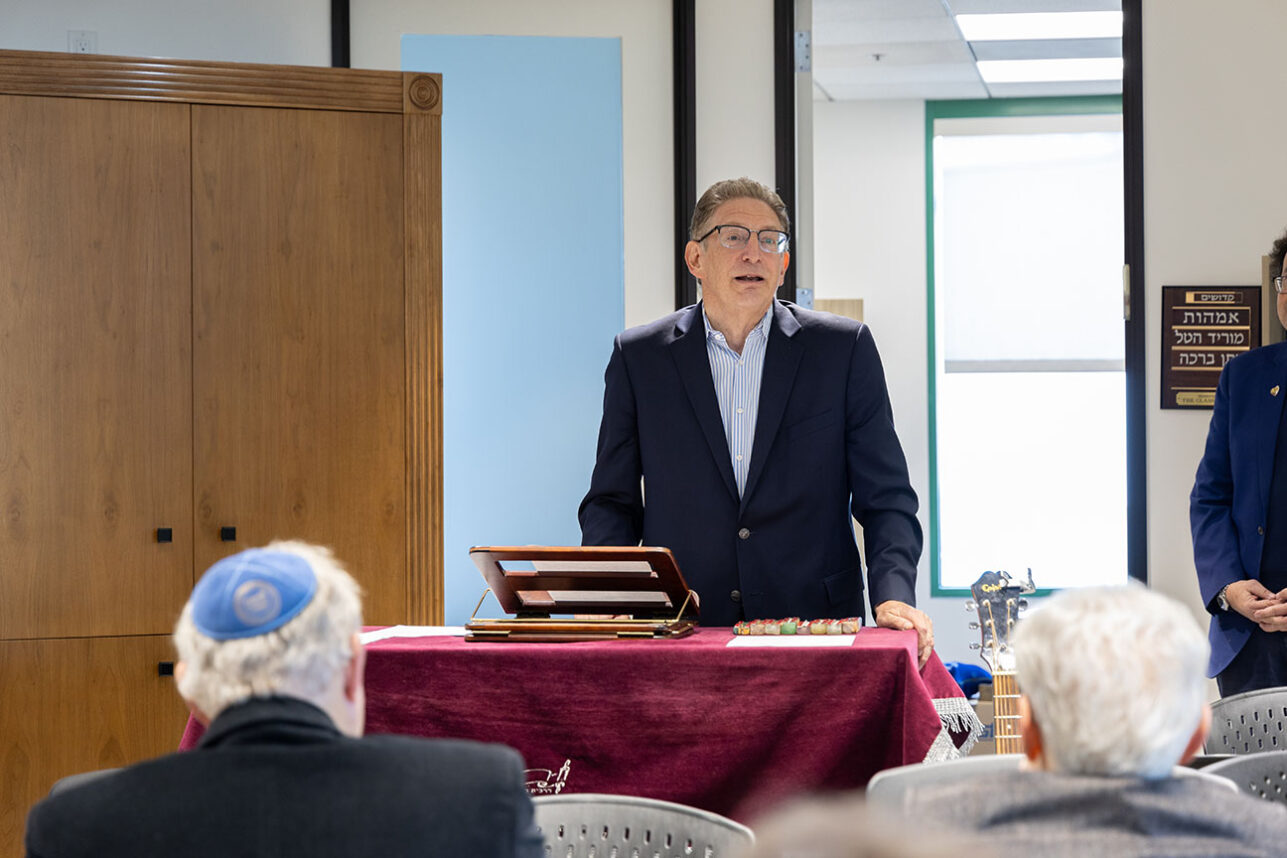
AJU President Jeffrey Herbst speaks at the dedication ceremony for the AJU Ziegler School of Rabbinic Studies’ new home in Beverly Hills. Photo by Jodye Alcon Photography, courtesy of American Jewish University.

“When we walked in here, we immediately understood, with the rotunda and the possibility of faculty and the offices and students studying in the beit midrash, that this could be a place of exceptional intellectual vitality, collegiality and learning,” Herbst said. “We’re delighted this day has come.”

While the new site is being used primarily by the Ziegler School, it will also host “outward facing” community programming, including public events, Herbst told the Journal.

Additionally, because the school is centrally located, in proximity to the predominately Jewish Pico-Robertson neighborhood, many of the school’s faculty and students will now be able to walk and bike to campus, Herbst said. And for those students who aren’t located nearby, the expectation is over time they will “situate themselves” in the area, Herbst said.

Artistic flourishes at the campus include a vibrant Andy Warhol portrait of Jewish philosopher Martin Buber hanging on the wall of the conference room. Additionally, classroom walls are painted purple, which is a color that’s conducive to making students feel more upbeat, according to Ziegler School of Rabbinic Studies Dean Rabbi Bradley Artson.

In a humorous touch, a sign in the kitchen was labelled “hefker corner.” “Hefker” is Hebrew for “unclaimed property.”

Over the past several years, AJU has undergone significant transitions, most recently with the sale this year of its Bel-Air hilltop property to Milken Community School. Before the sale, in a move accelerated by the COVID-19 pandemic, AJU began placing greater emphasis on online learning. This followed a tuition reduction, structural and curriculum changes at the Ziegler School, a leading rabbinical school in the Conservative movement that remains focused on graduating rabbis who are prepared to take on leadership roles in the Jewish community even as the Jewish world around them changes, said Artson.

“In the past we Jews have wandered from place to place, often out of desperation…but AJU’s history of going from campus to campus has been, I think, a wonderful demonstration that we don’t allow nostalgia to preclude our future,” Artson said at the ceremony. “That campus in Bel Air was a magnificent chapter in our history, but it’s not our history. It’s a place. And when it no longer serves the advancement of our mission, the mission is primary.”

Additional attendees included AJU Associate Dean and Rabbi Cheryl Peretz; Past AJU Board Chair Virginia Maas; and Ziegler School Professor in Philosophy Elliot Dorff.

Mezuzahs were affixed outside the doors of the campus’ offices during the dedication ceremony. Photo by Ryan Torok

The dedication ceremony included the affixing of mezuzahs outside several of the school’s named offices, classrooms and shared spaces, including the Sara and Simcha Lainer Beit Midrash, the Abner and Roslyn Goldstine Dean’s Office and the Norman and Lela Jacoby Conference Room.

With anti-Israel protests prevalent on college campuses nationwide and antisemitism surging in the aftermath of Oct. 7, not lost on those celebrating Ziegler’s new home was that the joyousness of the occasion was happening at a difficult moment for the Jewish community.

In  his remarks to the program’s guests, Artson—who has been with the Ziegler school for 24 years—noted this dichotomy.

“This is a shared triumph,” the Ziegler dean said, “and this is something at a bleak time to actually feel good about.”

AJU’s Ziegler School Celebrates New Home—and Chapter—on Beverly Drive Read More »

Pico Union Project: Transforming Community, One Initiative at a Time

Every Friday at 10:15 a.m., there is a line of community members outside a beautiful red brick building on the corner of 12th and Valencia Streets, a block west of the Harbor Freeway in the Pico Union neighborhood. Adjacent to this historic building, which once housed Sinai Temple, is a large parking lot that each week becomes a farmers’ market with tables overflowing with fresh produce.

A group of musicians fills the bustling market with music. Sister Alberta, a volunteer and a great singer, spontaneously joins in with the song, “When the Saints Go Marching In,” clapping to the rhythm.

The ambiance is inviting, enveloping all who arrive with a sense of belonging. This cherished tradition unfolds seamlessly week after week, thanks to the guiding hand of Craig Taubman. 

Once a leader of the famed Friday Night Live service at Sinai Temple, Taubman found a new purpose in his life when he fell in love with the red Greek revival style building.

Built by the Jewish community as Sinai Temple in 1909, which stayed there until 1925, when it moved to mid-Wilshire (now Koreatown), and later to its current location on Wilshire Blvd in West L.A. The building was then sold to Welsh Immigrants who opened a Presbyterian church that remained there for 88 years. During that time, the church served different communities, including the Latino community. It was also used as a recovery house. 

With membership dwindling, the church decided to sell the building – and that’s how Taubman came into the picture.

“It was on the market for several million dollars. I told my wife, ‘We’re going to buy it.’” Taubman said. “She looked at me and said, ‘How?’ She was right. We didn’t have that kind of money. So, I talked to the elders of the church and told them what I’m planning to do, but I don’t have the kind of money they are asking for.”

The elders felt it would be fitting for the building to go back to the Jewish people; they are the ones who built it, after all. So after discussing it amongst themselves, they got back to Taubman. “They told me: ‘Make a love offering,’ This meant, don’t think how much you can pay for it, but how much can you afford not to get it. Come with a number from your heart, not from your bank account.”

Taubman thought about it and felt they were right: he couldn’t afford to lose this place. There were other offers from investors on the table, but they weren’t as passionate and didn’t have Taubman’s vision for the place. In the end, his low offer won. 

“Now I had a vision of what I’m going to do there,” he said. “I’m a musician, and I was thinking, I’m going make the coolest nightclub in Los Angeles. We are going to have the best music in town with R&B on Monday, jazz on Tuesday, an open mic on Wednesday and so on.”

For the second floor of the building, overlooking the sanctuary where Shabbat services were once held, he also had special plans. “I was thinking about a bar with bottles of scotch and a great restaurant. I asked my daughter, what do you think of the idea? Do you think it’s going to fly? And she said, ‘Daddy, I think it’s the worst idea ever.’ I asked her why and she said, ‘I’m white, have privilege and I’m from Studio City. Why are you asking me what to do in the poorest neighborhood in town? Why don’t you ask the people who live here?’ And I was like, ‘Oh my God, she is right.’”

He abandoned his plans for a trendy nightclub and instead opened the venue to the community. He named the place The Pico Union Project (PUP) and started offering yoga and art classes. However, people hardly responded and hardly came. It wasn’t until three years later that he realized the key to people’s hearts was through food.

Before Thanksgiving 2015, Taubman organized a food drive, distributing over 500 turkeys to the community. The response was overwhelming, signaling to Taubman the direction he needed to take. He resolved to provide fresh produce to the community. With the support of local markets, he launched the Vida Sana market (Spanish for “Healthy Lifestyle”), where people could freely take as much as they needed without any cost. This time they came in flocks. 

It’s 11:30 a.m. and the tables at PUP are empty now. Most of the people who come here on Friday are Hispanic, with a few South Koreans. They all live in the area. Some of them started by coming here to pick up vegetables and became volunteers, and some became employees.

One of the things that Taubman wants to do for the community is not only provide them with food, books and toys, but also offer them jobs and teach them new skills. Recently, they installed a new pizza oven, and the hope is that community members will be able to find jobs thanks to what they’ve learned. 

It’s noon, and Celia Ramirez Torres in the kitchen, preparing lunch for the volunteers. They gather outside and sit around the tables. Today’s menu includes chips and salsa, chicken soup, vegetables, noodles and potato burekas. 

Taubman noted that Torres once frequented Vida Sana and decided she wanted to give back. She used to cook meals at home and bring them for the volunteers, eventually offered a job as the chef at PUP. Since then, she has been an integral part of the team. She is not the only one who has transitioned from a “customer” to an employee.

Bianca, a young woman and student, had been passing by the historic building for a few years, admiring it. “I saw people lining up there on Fridays but had no idea what was going on until someone told me [about it],” she said. 

Bianca started coming on Fridays to get fruits and vegetables, and soon after became the outreach coordinator. She assists with various programs at PUP, from the weekly Vida Sana distribution to organizing ESL and additional classes.

“When Craig heard I live right down the block, he told me, ‘Where were you? We’ve been looking for someone just like you,'” she said. Now she is a full-time worker and is there almost daily.

Bianca remarked on the profound sense of community at PUP, likening it to a family. It’s evident that she and the rest of the crew yearned for such a place.

Taubman didn’t give up on his dream of hosting concerts at the venue. He hired someone to arrange regular concerts spanning from jazz to world music and also renowned Israeli musicians such as David Broza, Idan Raichel and Rami Kleinstein. These performances take place inside the sanctuary, on the stage that once held the Torah ark and the bima. The huge, impressive pipe organ is still there, and Taubman found out a few years ago that it’s worth more than what he had paid for the entire building.

Before the inception of PUP, the neighborhood grappled with high crime rates. However, a shift has occurred in the decade since the project’s initiation. While residents still face economic challenges, including multiple families living in the same household and incomes well below the national average, there is a newfound sense of hope in the community.

Food isn’t the sole offering at PUP; the community can also participate in guitar classes, where attendees receive a free guitar after completing 10 lessons, ESL (English as a Second Language) and art classes. There’s also a support group aimed at teaching stress-management skills.

In June, PUP will launch a Spanish language film series, with plans to introduce a film lab for community members to learn the art of filmmaking. Volunteers engage in Team Green activities on Tuesdays through Thursdays, ensuring the neighborhood stays clean by tidying up litter.

PUP’s endeavors epitomize the concept of tikkun olam.

A block from the building, Taubman has created a small garden that resembles a peaceful oasis. Volunteers tend to the plot of land, growing flowers, herbs and vegetables. Surrounded by a fence and an unlocked gate, the garden remains pristine, untouched by the neglect and homelessness just beyond its borders.

This garden is not only Taubman’s pride and joy but also a symbol of hope for the community. Its existence, undisturbed amidst one of the poorest neighborhoods in town, stands as a testament to one man’s determination to rejuvenate the area and instill hope.

On May 26, Pico Union Project will celebrate its 10th Anniversary with Pico De Mayo – a street fair/fundraiser. Participants will enjoy cuisine from over a dozen local restaurants, street entertainers and volunteer distributing produce. The afternoon will conclude inside the sanctuary with a festive program hosted by MC and past PUP board chair Stuart K Robinson, a performance by a Grammy Award-winning artist and remarks by special guests, including Mayor Karen Bass, Supervisor Hilda Solis and Council Member Eunisses Hernandez.

Find out more info at PicoUnionProject.org.

Pico Union Project: Transforming Community, One Initiative at a Time Read More »