fbpx

May 1, 2024

UCLA Chancellor: Last Night’s Violence “A Dark Chapter In Our Campus’s History”

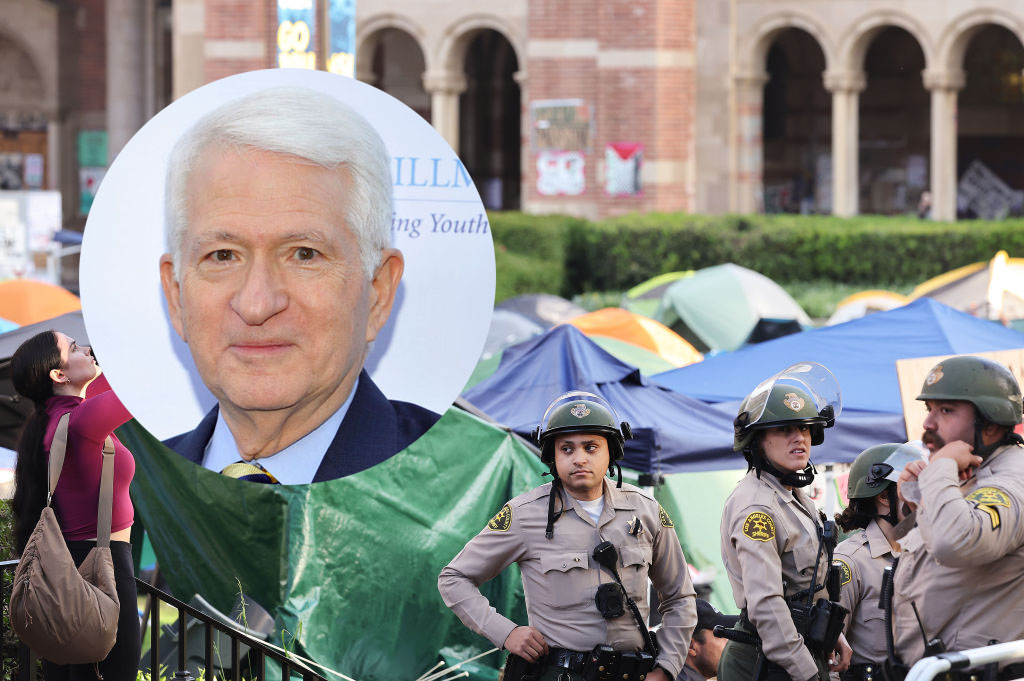
UCLA Chancellor Gene Block issued a statement on May 1 condemning the violence that took place on campus on the previous evening, calling it “a dark chapter in our campus’s history.”

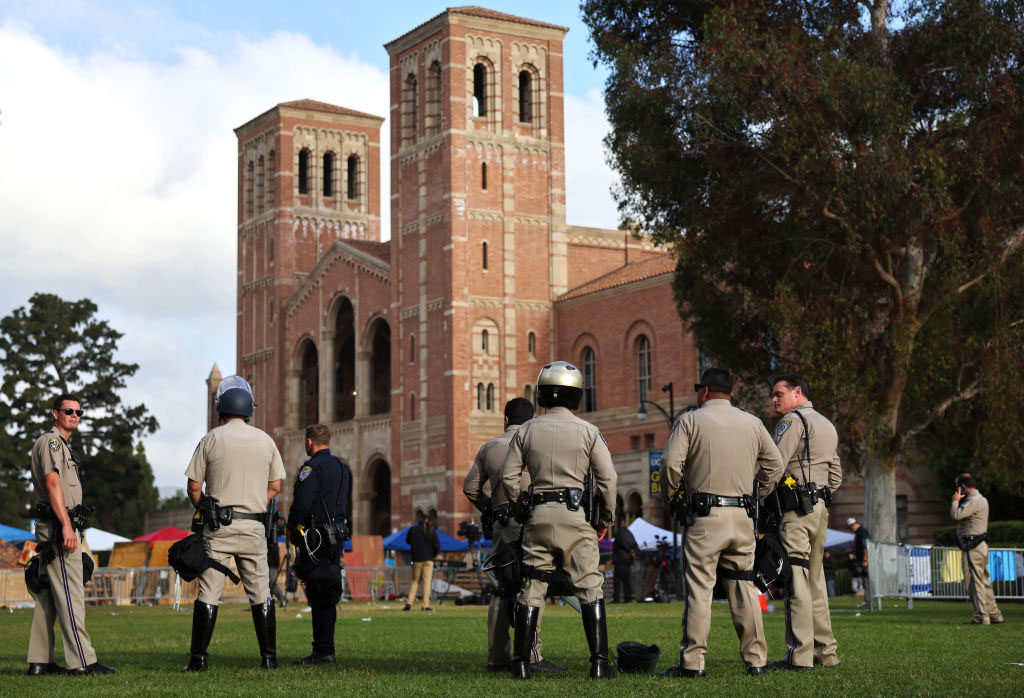
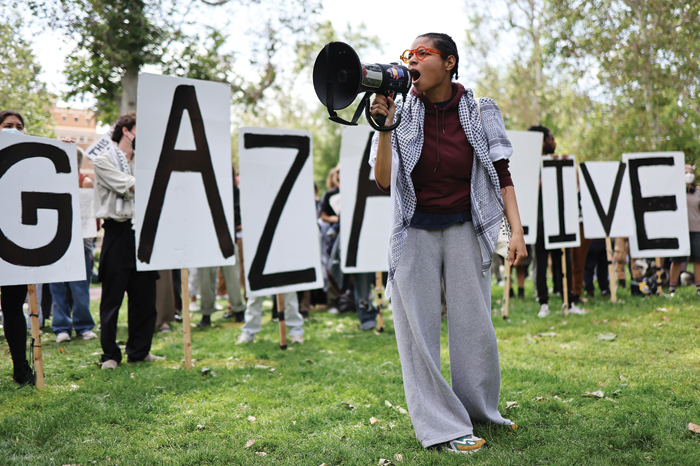
Clashes took place between pro-Israel and pro-Palestinian protesters after some in the pro-Israel group descended upon the pro-Palestinian encampment and attempted to tear it down. No arrests were made; FOX 11 Los Angeles reporter Matthew Seedorff reported that there were at least 15 confirmed injuries and one hospitalization.

The university canceled classes on May 1 as a result of the clashes.

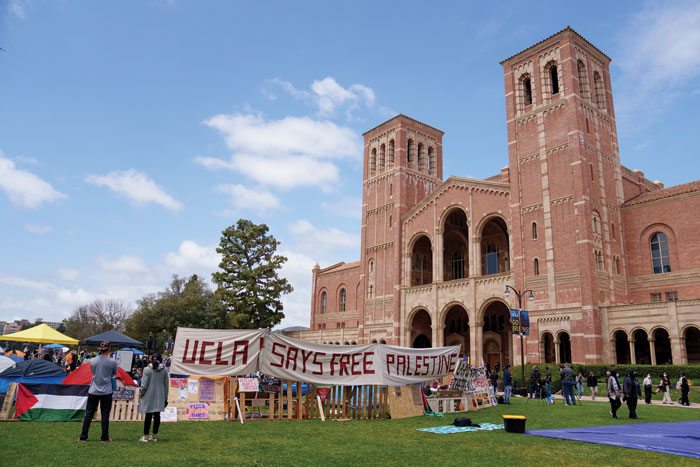
“Late last night, a group of instigators came to Royce Quad to forcefully attack the encampment that has been established there to advocate for Palestinian rights,” Block said. “Physical violence ensued, and our campus requested support from external law enforcement agencies to help end this appalling assault, quell the fighting and protect our community. However one feels about the encampment, this attack on our students, faculty and community members was utterly unacceptable. It has shaken our campus to its core and — adding to other abhorrent incidents that we have witnessed and that have circulated on social media over the past several days — further damaged our community’s sense of security.”

Block gave his “sincere sympathy” to all those were injured during the clashes, as well as “all those who have been harmed or have feared for their safety in recent days. No one at this university should have to encounter such violence.” He added that the university is investigating the matter, and it could result in “arrests, expulsions and dismissals. We are also carefully examining our own security processes in light of recent events”

“This is a dark chapter in our campus’s history,” Block concluded. “We will restore a safe learning environment at UCLA.”

On April 30, Block referred to the encampment as being “unauthorized” and said that while the protests and counterprotests have been mainly peaceful, “we have seen instances of violence completely at odds with our values as an institution dedicated to respect and mutual understanding. In other cases, students on their way to class have been physically blocked from accessing parts of the campus… These incidents have put many on our campus, especially our Jewish students, in a state of anxiety and fear.”

Block’s May 1 statement was faced with criticism on social media.

“You will be blanketed with civil rights complaints and lawsuits, and you will deserve it,” attorney Julie Hammill, who also serves as a member of the Palos Verdes School Board, replied to Block on X. “I hope you are personally sued following your resignation.”

Stella Escobedo, a news anchor for One America News Network, asked Block on X, “Do you even know who’s in that encampment? Last night I watched a live stream and there were people there who didn’t look like they were students!”

Journal Editor-At-Large Monica Osborne posted on X that the “subtext” of Block’s statement “is concern for anti-Israel protestors with no mention of the way some of them have been violent to Jewish students or prohibited them from entering buildings.”

Ophthalmologist and research scientist Dr. Houman Hemmati posted on X that he was “disgusted” that Block didn’t mention in his May 1 statement that members of the encampment “1. Vandalized Royce Hall 2. Kept Jews off many parts of campus 3. Attacked Jewish students/faculty 4. Openly called for death of Jews and incited violence 5. Literally begged for the abolition of all police.”

“I know Block’s time at UCLA is over soon, as he’s retiring shortly, but Newsom & UC Regents should send a VERY loud message by firing him for cause, without any *very generous retirement benefits, for his negligence and implicitly supporting antisemitism,” Hemmati added.

Jewish student Eli Tsives told Fox News on May 1 that the counterprotesters were not students, but “Jewish L.A. residents that have noticed how these pro-Hamas protesters are treating Jewish students at UCLA, and they said, ‘Enough is enough.’” He claimed the counterprotesters told him that they took action in order to force the police to arrive “so they could finally go inside the encampment and start making arrests.” Tsives said that he urged his fellow Jewish students to stay away from that part of campus and not engage in violence.

Fox News reporter Bill Melugin posted on X, “The anti-Israel protesters at UCLA just held a press conference where they said they were victims of a ‘life threatening assault’ at the hands of ‘Zionists’ last night. They complained that police didn’t do enough to intervene, however, their demands include ‘abolish policing.’”

UCLA Chancellor: Last Night’s Violence “A Dark Chapter In Our Campus’s History” Read More »

A History of a Pivotal Era in Palestine Wins a Top Jewish Book Prize

One of the most prestigious prizes in Jewish book publishing has gone to a nonfiction book that, by suggesting how Arabs and Jews might have learned to live together in historical Palestine, offers a glimmer of hope for a better future.

That’s one way to read “Palestine 1936: The Great Revolt and the Roots of the Middle East Conflict,” by the American-Israeli author Oren Kessler. The other way is to see the events described in the book — a period of military and political consolidation by Zionists and near total rejection of a Jewish state by the Palestinians — as the inevitable harbinger of the bloody impasse of the next 88 years. 

In its announcement earlier this month, The Sami Rohr Prize for Jewish Literature said its top prize, $100,000, was going to Kessler’s book for “its nuanced and balanced narrative on the origins of the Middle East conflict with far-reaching implications for our time.” The annual prize is administered in association with the National Library of Israel.

The book focuses on the period between 1936 and 1939, when Arabs living under the British Mandate rose up against a swelling Jewish population and the Brits in charge. Kessler, who has worked for various think tanks as well as the Jerusalem Post, cites estimates that 500 Jews, 250 British servicemen and at least 5,000 Arabs died in the rioting and the ensuing British crackdown.  

In the wake of the violence, Britain’s Peel Commission proposed partitioning the mandate into Jewish and Arab states — while placing limits on Jewish immigration. The Zionist establishment, led by David Ben-Gurion and Chaim Weizmann, accepted the proposal; Mohammed Amin al-Husseini, the grand mufti of Jerusalem and the de facto leader of the Palestinian Arab community, rejected the idea and called for jihad.

Kessler calls the events “a story of two nationalisms, and of the first major explosion between them.” The Jews would turn the rebellion to their advantage, by professionalizing their military (with Britain’s help), expanding agriculture and industry and moving into the next tumultuous, tragic decade with the confidence that they could withstand Arab resistance. 

The Palestinians, meanwhile, emerged from the revolt weakened politically, economically and militarily. Historians on both sides agree that the failure of the revolt set the stage for what the Palestinians call the Nakba — or “catastrophe” — and Israel’s triumph in its 1948 war for independence.

Although a work of history, the book landed on the eve of Oct. 7, and inevitably offers fuel for the debates central to the protests and counter protests that followed the Hamas attack on Israel and the Israelis’ subsequent war in Gaza.

Although a work of history, the book landed on the eve of Oct. 7, and inevitably offers fuel for the debates central to the protests and counter protests that followed the Hamas attack on Israel and the Israelis’ subsequent war in Gaza: Are the Palestinian Arabs victims of a “settler colonial project,” or their own failed leadership? Can two people so at odds share the land, either by dividing it or creating some sort of confederation? And might knowing this history bring both sides closer to a resolution?

“This is the more optimistic version of the answer,” Kessler told me last week, when I put the last question to him. “I think my book and this chapter in history is full of ‘what if’ questions. The idea that things could have indeed gone differently and that we weren’t fated for endless conflict suggests maybe they still can go differently in the present and the future.”

What if, he asks, Herbert Samuel, the British high commissioner for Palestine, had appointed a moderate instead of al-Husseini as grand mufti? What if the two-state solution offered by the Peel Commission report in 1937 had gone through? 

“Jews would have gotten less than 20% of the country and there would have been no Palestinian refugee crisis. There would have been no Nakba in 1948. The Gaza Strip would not be teeming with refugees today,” Kessler said, describing what he knows are unknowable but still strong possibilities.

As a counter to the mufti, who would later line up with Adolf Hitler and further discredit the Palestinian cause, Kessler offers an extensive treatment of Musa Alami, a Palestinian nationalist known for his relationships with the British and the Jews. Alami met several times with Ben-Gurion during the 1930s, suggesting ways in which Jewish national ambitions might coexist within a regional majority of Arabs, with both sides gaining from the economic and public health progress being made by the Jews. 

“Despite diametrically opposed political aspirations they met in an atmosphere of real candor and respect, and they really tried to reach a modus vivendi, to reach some kind of agreement that both sides could live with,” Kessler explained. “Alami was not a peacenik. He does his part for the Arab Revolt, and then some. He’s not opposed to violence, nor is Ben-Gurion. 

“But I do think his personality was kind of the polar opposite of the mufti’s in his ability to hear the other side, to understand the other side and to try to reach a solution. And it gives a glimpse I think of perhaps what could have been had things gone a bit different.”

A pessimist, Kessler conceded, would reject this hopeful vision out of hand. In the book, as in our interview, Kessler strives to view the emerging Jewish state from the Palestinian perspective. “It’s not that difficult to understand that people who were living in a certain land and whose ancestors have lived there for centuries wouldn’t look all that kindly on another people coming in en masse,” said Kessler. “We don’t need a very active imagination to understand that.” 

But the question, he continued, “is how they responded, how they registered their opposition. And with every rejection by the Arabs in Palestine, their position got worse and worse and it continues to this day.”

Kessler mostly leaves it to readers to decide if the lessons of the 1930s are useful in 2024. He’d also like his book to be seen as a lens on a time period that hasn’t gotten its due, at least in English, and one that has “so many fascinating, complex and compelling characters on all three sides of the Palestine triangle: the Jews, the Arabs and the British.” 

They include household names such as Winston Churchill and Ben-Gurion, and more obscure figures like Orde Wingate, the Bible-thumping British military strategist who helped build up the Jewish army and liked to greet visitors in the nude. 

But at the end of the book he returns to Musa Alami, who lived most of the rest of his long life (he died in 1984) exiled from his native Jerusalem, raising money and international support for Arab refugee youths living in Jordan.

In an interview after the Six-Day War, Alami offered both sides a prescient warning that sounds what Kessler calls “a note of hope”: “You are not considering the future — you are only considering the present,” he told the Israelis. “And we are not considering the distant future — only our present suffering. But I do believe, still now, that this country has the makings
of peace.”

A History of a Pivotal Era in Palestine Wins a Top Jewish Book Prize Read More »

Stephen Wise Temple Trustees Demand Immediate Action Against Antisemitism at Loyola Law School

Following an antisemitic incident at Loyola Law School, members of the Board of Trustees of Stephen Wise Temple have issued a stern demand for decisive action and a new approach to addressing hate speech against Jewish students.

On April 16, 2024, a student reportedly disrupted a Jewish Law Student Association (JLSA) event by screaming antisemitic slurs. The event, at Loyola’s Downtown Los Angeles Campus, featured Israel Defense Forces veterans speaking to the JSLA about their experiences in the Israel-Gaza War. Students for Justice in Palestine (SJP) showed up at the event in protest. At one point, a student who has been identified as Grace Obi-Azuike, allegedly made several antisemitic outbursts during the event. The Loyolan reported that Obi-Azuike was not affiliated with SJP.

In a video on StopAntisemitism’s X account identifies Obi-Azuike shouting, “Get the f— out of here all you ugly ass little Jewish people in this b—-.” The continued disruptions led to the event ending prematurely.

Loyola Law School’s administration responded to the April 17 incident with a statement signed by Brietta R. Clark, the Law School’s Interim Dean and Senior Vice President. The statement, titled “Law School Denounces Hateful Speech” mentioned antisemitism once, saying “Let me be clear: Antisemitism, Islamophobia, racism, and xenophobia will not be tolerated on our campus.”

The next day, the school issued an unsigned statement, “LLS Rejects Antisemitism.” The two-paragraph statement acknowledged that “during an April 16 event planned by the Jewish Law Students Association, community members were subjected to antisemitic insults.”

In their April 24th letter to Dean Clark, the Stephen Wise Temple trustees call Loyola’s first response to the incident “extremely tepid.”  The letter claimed that Loyola “had an opportunity to unequivocally denounce the antisemitic slurs at issue. … This is how similar statements have been made in the past when racist and inappropriate slurs have been made about other minority groups. Unfortunately, however, rather than making such a clear statement, you instead stated generally that racism and xenophobia, including Islamophobia, ‘will not be tolerated on our campus.’ The student event at Loyola on April 16 was not disrupted because of Islamophobia or racism in general. It was disrupted by law students who hate Jews. The problem on April 16 was antisemitism, not other forms of generic racism.”

“The student event at Loyola on April 16 was not disrupted because of Islamophobia or racism in general. It was disrupted by law students who hate Jews. The problem on April 16 was antisemitism not other forms of generic racism.”- Stephen Wise Temple Trustees

The trustees are incensed that the initial statement didn’t include direct language rebuking antisemitism, let alone “took multiple days to respond to a clear example of hate speech” directed at the Jewish students. The trustees also lamented that the second statement did not bear the signature of any of the administration.

In addition to the letter, the trustees are establishing a committee on overseeing antisemitism initiatives, which will be chaired by attorney Robert Glassman of the Los Angeles law firm Panish Shea Ravipudi LLP.

“As a board at Stephen Wise, we felt compelled to address the rampant antisemitism plaguing our universities and campuses,” Glassman told the Journal. “There’s no place for those who shout antisemitic slurs in law school or the legal profession.”

The trustees’ letter to Loyola Law School calls for an unequivocal denunciation of these acts and stressed the need for prompt action, including the expulsion of the student.

“This person must not sit for the bar or become a lawyer in this city,” Glassman said. He added that none of the student’s future Jewish colleagues in the legal community “would feel safe with her in this profession” and that “the Jewish students at Loyola certainly do not feel safe with her on campus.”

Addressing broader issues of antisemitism on campuses, Glassman criticized institutional responses to incidents of antisemitism.

“Sensitivity training and condemning all acts of violence and bigotry do nothing, we need real social consequences,” Glassman said. “They need to expel the student who was yelling antisemitic rhetoric. They need to make sure that person doesn’t sit for the Bar, and can’t become a lawyer in this city. If this were about slurs against any other minority group, it would not be tolerated. They would be expelled and made an example of.”

Although Loyola is a Jesuit school, their law school has had many prominent Jewish alumni including activist Gloria Allred, former Screen Actors Guild President Barry Gordon and attorney and entrepreneur Robert Shapiro.

Among the thirteen trustees who signed the letter on Stephen Wise Temple letterhead are seven Loyola Law School alumni, dating back to the class of 1974.

“We are a large and powerful congregation, eager to use our influence constructively,” Glassman said. “We are committed to ensuring that all Jewish students feel safe. If they need help, they can reach out to us, and we will do everything we can to support them and make life difficult for their antagonists.”

The text of the letter from the Stephen Wise Temple Board of Trustees Members is below:

April 24, 2024

Brietta R. Clark
Interim Dean and Senior Vice President Loyola Law School
Burns 235
919 Albany Street
Los Angeles, CA 90015

Dear Dean Clark:

We are members of the Board of Trustees of Stephen Wise Temple, a reform Jewish Temple with nearly 1600 families. We are also lawyers who work in a wide range of law firms and companies throughout Los Angeles. Many signatories are alums of Loyola Law School. We are all upset by the antisemitic slurs made against Jewish law students at Loyola and by your extremely tepid initial response to them.

On Tuesday, April 16, 2024, a group of law students interrupted an on-campus event organized by the Jewish Law Student Association and made antisemitic slurs and statements to Jewish law students. The incident was widely reported and condemned by major Jewish organizations.

Following the event, on April 17 you distributed a message to the Loyola Law School community. You had an opportunity to unequivocally denounce the antisemitic slurs at issue. This is how similar statements have been made in the past when racist and inappropriate slurs have been made about other minority groups. Unfortunately, however, rather than making such a clear statement, you instead stated generally that racism and xenophobia, including Islamophobia, “will not be tolerated on our campus.”

The student event at Loyola on April 16 was not disrupted because of Islamophobia or racism in general. It was disrupted by law students who hate Jews. The problem on April 16 was antisemitism not other forms of generic racism. When other minority groups are victims of racism, University administrators quite correctly call out the specific form of racism directed at those groups. They do not try to hide the problem by discussing unrelated other issues. When the victims of these kinds of slurs are Jewish we often find this kind of generic, whitewashed response. We expect better from you.

On April 18, the Law School issued a second unsigned statement providing that “During an April 16 event planned by the Jewish Law Students Association, community members were subjected to antisemitic insults. The law school rejects hateful rhetoric—in this case, antisemitism leveled against members of the law school community. Antisemitism has no place on our campus or in our society.” This should have been the message in your initial statement. We are concerned that it took multiple days for the Law School to properly respond to a clear example of hate speech directed toward your Jewish students. And we are concerned that the second statement was unsigned rather than bearing the signature of the Dean.

We strongly condemn and denounce the antisemitic attacks on the Jewish law students at Loyola on April 16. We stand in solidarity with Loyola’s Jewish Law Student Association and Jewish law students everywhere who are affected by the rampant antisemitism pervading law schools throughout our country.

Jeremy Rosen
President, Stephen Wise Temple Partner, Horvitz & Levy

Michael L. Wachtell
Board Member, Stephen Wise Temple Shareholder, Buchalter

Rabin Pournazarian
Vice-President, Stephen Wise Temple Resolve Law Group

James D. Leewong,
Board Member, Stephen Wise Temple Loyola Law School, ’74

Karen Morse Denvir
Board Member, Stephen Wise Temple Loyola Law School, ’05

Victor Svilik
Board Member, Stephen Wise Temple

Golareh Hamid Ramin
Board Member, Stephen Wise Temple Loyola Law School, ’98

Robert Glassman
Board Member, Stephen Wise Temple Partner, Panish | Shea | Ravipudi LLP

Alexsondra Fixmer
Vice-President & Secretary, Stephen Wise Temple Assistant Chief Counsel, The Walt Disney Company Loyola Law School, ’04

Robin Hanasab
Principal, Robhana Group, Inc. Loyola Law School, ’06

Donna Yamini
Board Member, Stephen Wise Temple Principal, Yamini Law Group

Sussan H. Shore
Former Board Member, Stephen Wise Temple Managing Director,
Weinstock Manion ALC Loyola Law School, ’76

Stephen H. Kay
Board Member, Stephen Wise Temple General Counsel, Roku Inc.

Roya Hekmat Melamed
Board Member, Stephen Wise Temple Loyola Law School, ’03

Stephen Wise Temple Trustees Demand Immediate Action Against Antisemitism at Loyola Law School Read More »

UCLA Cancels Classes Following Night of Violence

UCLA announced on the morning of May 1 that they are canceling classes following a night of clashes between pro-Israel and pro-Palestinian protesters.

According to reports, the clashes began at around 11 p.m. on April 30 when pro-Israel counterprotesters arrived at the pro-Palestinian encampment on campus that the university had deemed “unlawful” and in violation of university policy earlier that day. The counterprotesters appeared to try and tear down parts of the encampment.  Video footage showed physical fighting, as The Guardian reported that there were “fistfights and shoving, kicking and using sticks to beat one another” and that “at one point a group piled on a person on the ground, kicking and beating them with sticks until others pulled them out of the scrum.” Additionally, mace was sprayed, and water bottles, chairs and various other objects were thrown between the two sides. The barricades around the encampment also appeared to be used as weapons, according to ABC 7.

The Daily Bruin posted on X that four of their reporters “were followed and then assaulted.” Five to six assailants “also sprayed reporters with an irritant,” the student paper wrote. “As some reporters went to help a reporter that was pulled to the ground, assailants began to record on their cellphones.”

“More than two hours of clashes passed with no uniformed campus police or LAPD officers on scene,” ABC7 reported. “The officers did not move in to disperse the crowd until around 3 a.m. Once law enforcement moved in, it appeared that the situation calmed down. Mutual aid that responded to the campus were seen pulling out of the area around 4 a.m., including Santa Monica and Culver City police.”

No arrests were made, and it was not immediately clear how many protesters were injured, per ABC7.

UCLA announced on X, “Due to the distress caused by the violence that took place on Royce Quad late last night and early this morning, all classes are cancelled today. Please avoid the Royce Quad area.”

Mary Osako, vice chancellor for UCLA Strategic Communications, told The Daily Bruin “horrific acts of violence occurred at the encampment tonight and we immediately called law enforcement for mutual aid support. We are sickened by this senseless violence and it must end.”

Los Angeles Mayor Karen Bass (D) called the clashes “absolutely abhorrent and inexcusable” in a post on X.

California Gov. Gavin Newsom (D) issued a statement condemning the violence at UCLA. “The right to free speech does not extend to inciting violence, vandalism, or lawlessness on campus. Those who engage in illegal behavior must be held accountable for their actions––including through criminal prosecution, suspension or expulsion.”

“The right to free speech does not extend to inciting violence, vandalism, or lawlessness on campus. Those who engage in illegal behavior must be held accountable for their actions — including through criminal prosecution, suspension or expulsion … the limited and delayed law enforcement response at UCLA last night was unacceptable — and it demands answers.” – Gov. Gavin Newsom

Newsom’s office issued a follow-up statement that said “the limited and delayed law enforcement response at UCLA last night was unacceptable — and it demands answers.”

Two journalists who covered the clashes in person expressed anger at the lack of security around the area.

“What I witnessed tonight is like nothing I have ever seen in my life,” independent journalist Anthony Cabassa posted on X. “Complete lawlessness, anarchy, body’s [sic] dragged away after scuffles, blood, mace after mace after mace spray, fires, explosives, the list goes on. The school and the city failed the students tonight. Insanity.”

Journalist Cam Higby posted to X, “Shame on CHP, LAPD, [UCLA Chancellor Gene Block] and other organizations for not clearing the camp. UCLA was anarchy tonight. Complete lawlessness. You all stood by while this happened, your school’s private security aid the campers. They routinely assault students, journalists, and members of the public on campus. I personally have been assaulted and witnessed countless assaults. You expect the victims wouldn’t respond? Now there are more victims on both sides and the camp remains.”

He accused Block of lying when he claimed that “that barriers had been removed, and that staff had been placed in the quad where the encampment was. After receiving the email, I went back to UCLA and it was exactly how I left it earlier that day.”

The Daily Bruin quoted UC Divest at UCLA as saying: “The life-threatening assault we face tonight is nothing less than a horrifying, despicable act of terror. Law enforcement simply stood at the edge of the lawn and refused to budge as we screamed for their help.”

UCLA Hillel Executive Director Dan Gold told the Journal, “The Jewish students at UCLA and our Hillel condemn all forms of violence on our campus and the Jewish students are requesting and asking that all agitators from the outside of any kind stay off campus and help work toward a safe and welcoming environment for all students. Jewish students and all students just want their campus to be calm and a place where they can learn, they can live and they can be themselves. And we’re hoping that the sense of calm will come from the rules being followed, the policies being observed … and all outside groups refrain from creating chaos.”

He added that “the agitators that came to campus last night … are not student groups, they’re not encouraged by students and the students are not asking for that type of involvement. Any member of the Jewish community from outside of campus should do so in the way students are asking, which is to support Jewish student life and to help advocate for their rights in productive and civil ways.”

Assembly Democratic Caucus Chair Rick Chavez Zbur, whose district includes UCLA, released a statement: “The horrific acts of violence against UCLA students and demonstrators that occurred on campus last night are abhorrent and have no place in Los Angeles or in our democracy. No matter how strongly one may disagree with or be offended by the anti-Israel demonstrators’ messages, tactics, or goals, violence is never acceptable and those responsible must be held accountable.

“For days, I have been requesting increased security on campus, after my staff and I witnessed rising tensions between demonstrators and counter-protestors and ourselves felt unsafe on campus. I have pled with the UCLA Administration to take necessary steps to protect students from violence, harassment, and intimidation.”

He added: “Yesterday, my staff witnessed the violent assault of a Jewish student on campus, just one of many antisemitic incidents that have occurred in the last week and in recent months. Hours later, a violent mob attacked protestors at the encampment with fireworks, pepper spray, and blunt objects, reportedly injuring students and reporters. In both instances, University security failed to prevent the assaults or respond in a timely manner, despite Chancellor Block’s assurances of adequate security on campus. While we continue to gather all the facts, one thing is abundantly clear: the UCLA Administration has failed in their most important duty — to protect the safety, wellbeing, and civil rights of all students on campus.”

The Jewish Federation of Greater Los Angeles said in a statement that they’re “appalled” at the clashes that took place. “The abhorrent actions of a few counter protestors last night do not represent the Jewish community or our values,” the organization said. “We believe in peaceful, civic discourse.”

The Federation blamed the violence on “the lack of leadership from the Chancellor and the UCLA administration. The Chancellor has allowed for an environment to be created over many months that has made students feel unsafe, allowed for illegal encampments in violation of its own laws, refused to censure faculty and staff who flouted UCLA’s Code of Conduct, and has been systemically slow to respond when law enforcement is desperately needed. His failed leadership has enabled the chaos we witnessed last night.”

The Federation called for the university “to immediately close the encampment” as well as for Chancellor Block “to meet with leaders of the Jewish community and with elected officials to articulate how UCLA will ensure Jewish safety and safety for all on campus, and establish long-term security plans to prevent any future violence.”

This is a developing story.

UCLA Cancels Classes Following Night of Violence Read More »

UCLA Student Eli Tsives on Standing Up to Campus Antisemitism

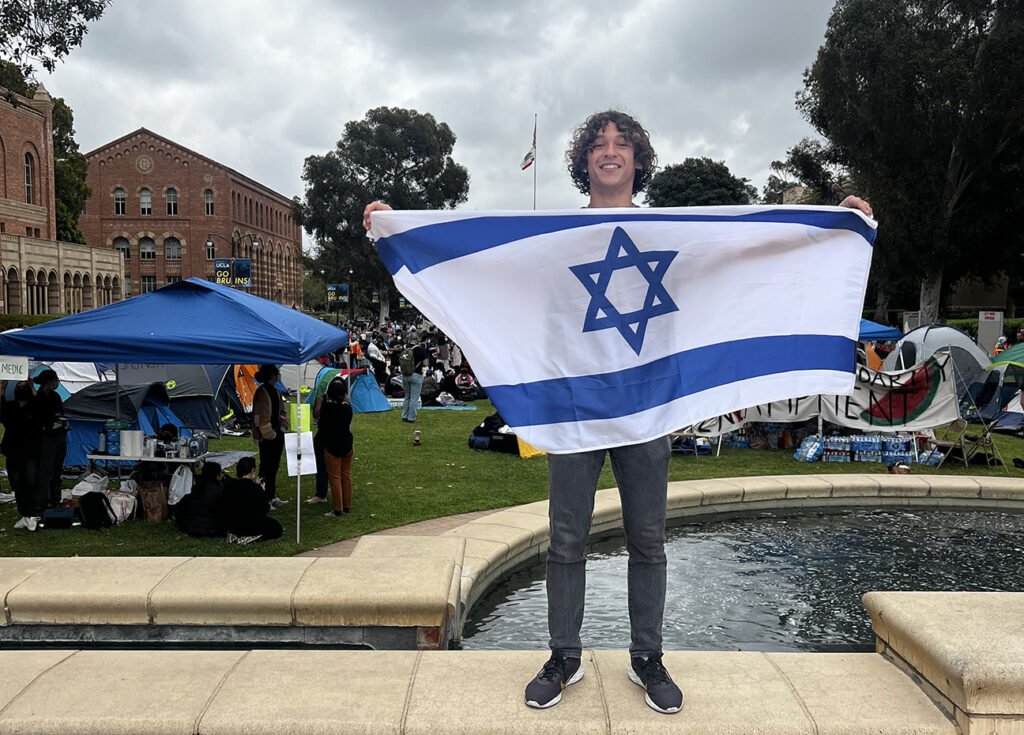
A Jewish student wearing a Star of David necklace was on his way to class when he encountered a group of students wearing face masks and keffiyehs. Without a word, they formed a blockade, obstructing his path. Retrieving his UCLA student ID, he politely requested that they let him through, a request which was refused. He then asked his friend to start recording the encounter.  “I’m a UCLA student, I deserve to be here, I pay tuition,” he said.

He took to Instagram, sharing the incident, which quickly went viral. Overnight, Eli Tsives, a 19-year-old majoring in film and theater, found himself thrust into the spotlight, inundated with interview requests. As Tsives follower count soared from 1000 to over 20k, he found himself not only grappling with newfound fame but also the accompanying challenges.


View this post on Instagram


A post shared by Eli Tsives (@tsiveseli)

“I used to feel safe but just yesterday I came back to my dorm room and somebody wrote: “Shame on you,” so people know where I live now and now my mother and other people are helping me get private security,” he told the Journal.

This statement isn’t an exaggeration of the situation — as pro-Palestinian demonstrations escalated in the past week, turning violent. Professor Nir Hoftman, who has taught at UCLA for 22 years, was assaulted earlier this week while walking on campus looking down on his phone. In an interview with Fox News, he described what had happened: “They literally assaulted me on the way over here. I was walking to give the interview to a news station and two or three thugs tried to block my approach to the open area. I ignored them and one of them stood in front of me and said, ‘you can’t walk this way.”

Hoftman said that another person tackled him from the side and ripped his earbud from his ear before running off. “The security people who were there, were watching, not doing anything.”

The professor called what’s going on today in UCLA as “anarchy, it’s like the wild, wild west.”

Tsives is deeply concerned about the escalating situation. While he doesn’t regret enrolling in UCLA, he voices apprehension about potential threats to his safety. “Someone will try something,” he said, emphasizing the dangerous ideologies promoted by pro-Palestinian groups. “These people advocate for the destruction of our beautiful country. They are not only against Israel but also against the United States, they are promoting hate. Shame on UCLA for allowing them to do what they are doing.”

Despite lodging a complaint with administration, Tsives has yet to receive a response. Although the office of student affairs assured him that they are monitoring the situation, Tsives remains dissatisfied. “They said that they do not have any plans to remove the peaceful protesters,” he said. “I have a very simple response to that: Shame on them. These are not peaceful protesters. They are breaking the law, calling for intifadas, which entail the genocide of Jews. The administration is well within their legal right to call upon UCPD [University of California Police Department] or LAPD to come and remove and arrest all the protestors. The fact that they are not doing it shows how scared they are of the mob.”

Last Sunday, when several hundred Pro-Israel demonstrators arrived at the campus brandishing Israeli and American flags to express solidarity with Jewish students, a brawl erupted among the crowd. A 20-year-old girl was viciously attacked, resulting in a head injury and bleeding.

Ruth Sonbolian, the mother of the victim, recounted the harrowing incident: “My younger daughter dropped her flag, and once they noticed it, they swarmed into our section and began stomping on it. When my older daughter Elinor bent down to retrieve it, they started kicking the flag and her head.”

Sonbolian rushed to her daughter’s aid but was forcefully pushed back. “I fell to the ground and witnessed my daughter being thrown into the air and crashing onto the asphalt. My son helped her up. She briefly lost consciousness. We called the police and an ambulance, but they refused to come.”

Sonbolian explained that the LAPD informed her they were unable to enter the campus and instructed her to transport her daughter outside for assistance. “With the help of Hatzalah, we took her out, and she was admitted to the emergency room at UCLA. She couldn’t sleep all night due to pain and trauma. When I questioned the LAPD about their inaction, they callously stated that they didn’t want to provoke riots or violence in the town. They seemed indifferent to the potential loss of Jewish lives in the process.”

“If it were a KKK encampment, it would have been shut down immediately, but we are allowing these students to spread hate,” Tsives said. “Gene Block, the Jewish Chancellor, should be ashamed of himself. He’s hiding behind the protection of his office.”

“If it were a KKK encampment, it would have been shut down immediately, but we are allowing these students to spread hate … Gene Block, the Jewish Chancellor, should be ashamed of himself. He’s hiding behind the protection of his office.”- Eli Tsives

UCLA’s campus now resembles a homeless encampment, with numerous tents and graffiti adorning walls, stairs, and pavements, bearing messages such as “Free Palestine,” “Free Gaza,” and “Zionism is Nazism.”

“They’ve defaced our beautiful buildings within the encampment,” Tsives said. “Using chalk, they’ve drawn Stars of David on the ground, accompanied by the directive ‘Step here,’ encouraging students to trample upon them. Many Jewish students feel profoundly unsafe.”

“It’s disgraceful what’s unfolding at UCLA. The administration must swiftly dismantle all encampments and suspend these students. Since last Thursday, they’ve been violating both UCLA’s code of conduct and the law. They have no legal permit for their encampments,” said Tsives.

Photo by Michael Marom

Professor Judea Pearl who has been teaching at UCLA since the ‘60s, thinks one of the reasons universities, including UCLA, tolerate such occurrences is due to the substantial funds they receive from Qatar. “They are providing millions in tuition and scholarships, and universities understand that if they speak out against something Qatar disagrees with, the funding may be withdrawn and redirected to another institution that aligns with Qatar’s agenda,” he explains. “Qatar can easily divert the hundreds of students they financially support to another university. By funding their education, Qatar knows it can influence them to participate in demonstrations.”

Tsives still needs to work with his fellow students in his acting classes. Some of them arrive wearing keffiyehs and obviously don’t support his advocacy. He understands that he may face another three years of potentially unpleasant experiences at school, but he remains resolute in his decision to speak out.

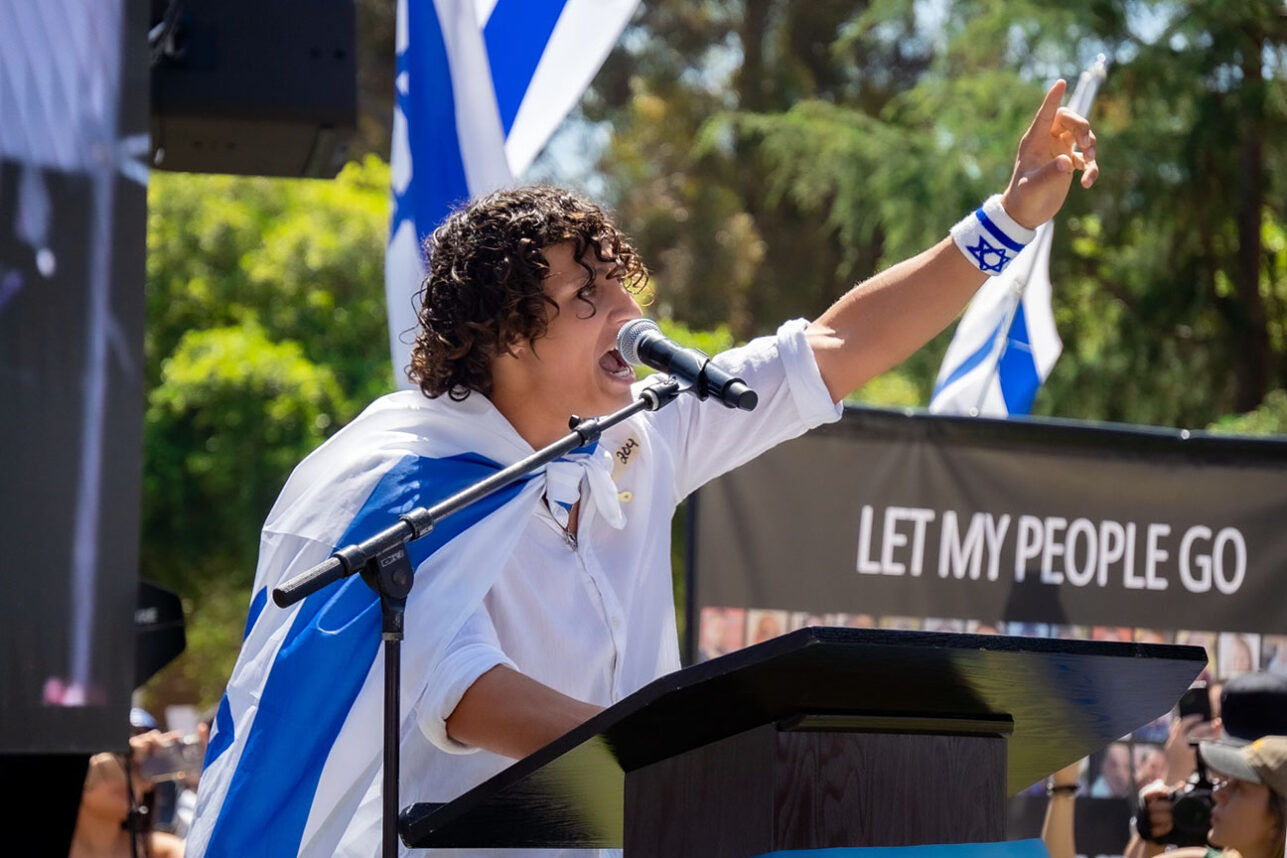
“I do not regret a single second of it,” he said. “The Jewish people, especially Jewish students, need a voice. They need someone to demonstrate that there’s no reason to fear these bullies, that we cannot yield to their intimidation. This is my voice, and if my face becomes the face of that voice, so be it. I view this as a blessing in disguise. I have people walking up to me and thanking me saying that my courage encouraging them to also be courageous and speak up.

“My goal is to show Jewish students there is no need to be afraid of them and I hope to see the day when all of Jewish students will be able to walk in campus with their star of David out.”

UCLA Student Eli Tsives on Standing Up to Campus Antisemitism Read More »

Columbia Then and Now: Lessons for Today’s Jewish Protesters from Nazi Germany’s Notorious Columbia Concentration Camp

I spent the last several months as a teaching fellow at the University of Southern California and its Center for the Political Future. I had a great group of students – interested in helping shape a better political and civic future. Yet with what we all see exploding on campuses nationwide, I’m more concerned than ever about our political future – as Jews and as Americans. The hatred of Israel and of Jews is now on full display – some of it coming from our own people. As I have watched and listened to what has been brewing at Columbia University, I can’t help but recall the cautionary history of another Columbia — in the 1930s: the Columbia prison/concentration camp (also known as Columbia-Haus). That Columbia was a Nazi concentration camp situated in the Tempelhof area of Berlin – and one of the first such camps established by the regime.

Alas, our people have always had our very own antisemites – or what we might more accurately call Jew-haters.

Adding to the tragic story of the Nazi Columbia camp is the fact that some of its very first prisoners were Jews who had actually supported Adolf Hitler and the Nazi party. Alas, our people have always had our very own antisemites – or what we might more accurately call Jew-haters. Exhibit A: Max Naumann, a Jew born in Berlin and educated as a lawyer. In 1921, he founded the Verband Nationaldeutscher Juden (alternately referred to as the League — or Association — of National German Jews).  The Association’s stated goals were the total assimilation of Jews into the German volk, eradication of Jewish identity and expulsion of Eastern European Jewish immigrants from Germany. He was also an ardent opponent of Zionism. He published a magazine that in 1927 had 6,000 subscribers. 

Naumann’s organization supported both Hitler and the Nazi party – and for a brief while served as a useful pawn for the party. Naumann even issued a manifesto claiming Jews were being “fairly treated” by the Nazis. Having outlived its propaganda value for the Nazis, however, the Gestapo outlawed the League/Association in 1935. Max Naumann was sent by the Gestapo, along with others of his ilk, to Columbia. He was later released and managed to live until 1939, but unfortunately for many of Jews who supported the Verband, their support did not spare them from the deadly fate of much of the rest of European Jewry. In fact, members of the Verband were among the very first to get rounded up.

What’s happening on our campuses is tragic, enraging, sad, disheartening and, frankly, scary. Not every criticism of Israel is de facto antisemitic or anti-Jewish. If that was the case, about half of Israel might be labeled as such. But much of the hatred against Israel and the Jewish people that has exploded on campuses – and elsewhere – is textbook antisemitism. Terms such as colonialist, genocidal, racist and apartheid have been coopted to label Israel as a pariah. Moreover, the oft-chanted “from the river to the sea” is a clear call for the elimination of the State of Israel and its Jews. Shouts at Columbia University to burn down Tel Aviv are a clear call to genocide – if only people would really listen.

Most painful and upsetting is seeing members of our own Jewish community chanting this call to genocide, calling for boycotts, divestments and sanctions and calling for an end to the Jewish state. As a Jew, I’m mortified and horrified.

But most painful and upsetting is seeing members of our own Jewish community chanting this call to genocide, calling for boycotts, divestments and sanctions and calling for an end to the Jewish state. As a Jew, I’m mortified and horrified. And as a member of the LGBTQ community, I’m also dumbfounded by groups like Queers for Palestine. Just trying being a queer in Palestine: It’s often a death sentence in Gaza, the West Bank and, of course, Iran.

Much has been written and discussed recently trying to understand the antipathy that a certain number of vocal Jews have developed to Israel. Not to mention that they are cover for a growing chorus of antisemites and pawns of those who would gladly eradicate us if they had the chance. Free speech is a bedrock of our American democracy and social and political activism is very much a part of the university experience – but we have a generation of young Jews who don’t know the history of our people – people like my father of blessed memory, who escaped Romania during the Holocaust and survived thanks to his migration to Israel. Or my mother, also of blessed memory, whose parents escaped pogroms in Russia and Ukraine and lived to raise a family only because they found refuge in Eretz Yisrael.

History is replete with Jews, and persons of Jewish ancestry, being our own worst enemies. Jewish members of groups such as Jewish Voice for Peace or Not in Our Name will emphatically deny that they represent even a whiff of antisemitism. For them, opposing Israel is often even an expression of their Judaism. But make no mistake, they are serving as foils for terrorists, misogynists, homophobes and those who would perpetrate a real genocide that would inevitably ensue if the perverted dream of “from the river to the sea” was, heaven forbid, to be realized.

In 1905, the Spanish-American philosopher George Santayana famously said: “Those who cannot remember the past are condemned to repeat it.” In 1948, British Prime Minister Winston Churchill repeated Santayana’s message. How right they were. As we witness what burst into view at schools such as Columbia University, we would all do well to remember the Columbia of 1934 – and the anti-Jew Jews who came to painfully learn that nothing good can come of aiding, abetting, and supporting those who would seek to destroy us.


Ron Galperin served as the Los Angeles City Controller from 2013 to 2022.

Columbia Then and Now: Lessons for Today’s Jewish Protesters from Nazi Germany’s Notorious Columbia Concentration Camp Read More »

The Screams in the Thicket

During the cold month of January 1944, Arthur Koestler wrote about a dream he kept having. “It is dark and I am being murdered in some kind of thicket or brushwood,” he wrote. “There is a busy road at no more than 10 yards distance; I scream for help but nobody hears me, the crowd walks past laughing and chatting.” 

Koestler noted that he and others had been at it for about 10 years, beginning in 1933 when the German Reichstag was set on fire. “We said, if you don’t quench those flames at once, they will spread all over the world; you thought we were maniacs. At present we have the mania of trying to tell you about the killing, by hot steam, mass electrocution and live burial of the total Jewish population of Europe. It is the greatest mass killing in recorded history; and it goes on daily, hourly, as regularly as the ticking of your watch.”

We are not living in Nazi Germany; Oct. 7, for all its horror, was not the Holocaust. But there’s a sense of being in the thicket again, screaming while an indifferent — or worse — crowd walks on. My X/Twitter feed contains scenes eerily reminiscent of the past. A Jewish professor is denied access to his own campus. Students form a human chain to drive Jews out of their encampment. A student protest leader calmly explains to an interviewer that Jews (“Zionists”) don’t deserve to live. A Jewish student is jabbed in the eye with a flagpole. A rabbi at one of the country’s leading universities advises Jews to stay away from campus for their safety. 

Above all, there’s the atrocities of Oct. 7 and the world’s response to them. “I have photographs before me on the desk while I am writing this, and that accounts for my emotion and bitterness,” Koestler continued. “People died to smuggle them out of Poland; they thought it was worth while. The facts have been published in pamphlets, white books, newspapers, magazines and whatnot. But the other day I met one of the best-known American journalists over here. He told me that in the course of some recent public opinion survey nine of out of 10 average American citizens, when asked whether they believed that the Nazis commit atrocities, answered that it was all propaganda lies, and that they didn’t believe a word of it!”

Koestler was writing in the New York Times to people whose attention he sometimes grabbed for a moment, so that “a certain dumb wonder” appeared on their faces, before they shook themselves “like puppies who have got their fur wet” and resumed walking, “protected by the dream-barrier which stifles all sound.” They were, in short, bystanders, disbelieving the atrocity reports but all too disinterested.

Today I’m haunted by people who are not disinterested, but are all too intent on denying the atrocity reports in defense of those committing them. 

Today I’m haunted by people who are not disinterested, but all too intent on denying the atrocity reports in defense of those committing them. People like Susan Sarandon, dressed in a jaunty “Simpsons” jacket, continuing to walk briskly while a young Jewish Iranian woman tries talking to her about Oct. 7. “All those myths about babies in ovens and the rapes…” the actress says, her beautiful face contorted. “You are not up to speed.” 

Or there’s The Intercept, founded by journalists Glenn Greenwald and Laura Poitras, which last month published a lengthy piece under the headline “Kibbutz Be’eri Rejects Story in New York Times Oct. 7 Expose: ‘They Were Not Sexually Abused.’” The article is cited by “pro-Palestinian” supporters such as the Party for Socialism and Liberation, which published its own lengthy version “debunking” the accounts of mass rape. The socialists concluded: “To this movement, ‘believe women’ means believing the women of Palestine.” 

Or there’s Electronic Intifada, which has issued a series of “exposes.” During last month’s installment — “NY Times found no Oct. 7 rape victims, reporter admits” — Ali Abunimah smoothly asserts that “there is no physical or forensic evidence” of rape, only “dubious and noncredible eyewitness accounts.” His interviewer, Nora Barrows-Friedman, shakes her head. “Incredible,” she says.

There’s an oddly perverse kind of depravity at work here. It’s actually more disturbing than extreme callousness. After all, you have to confront the evidence in order to dismiss it. You have to read about the young man at the music festival who left a final voicemail telling his brother he loved him and asking him to look after his kids; read about the kibbutz strewn with corpses; read about the little boys asking their grandmother how their mother died; read about the phone call with the 80-year-old who told his daughter the fingers on his left hand had been removed and who died as she begged him to stay with her — and wave it away like so much noise. Your only interest is finding something, anything, to tear apart. Inevitably you find it — a reporter’s unseemly social media “like,” a trivial inaccuracy — and declare that the overwhelming evidence that Hamas committed atrocities is a lie. You howl that 40 babies were not beheaded but say nothing about those who were burned alive. You pounce on a tiny discrepancy to cast doubt on whether two teenage sisters were raped and ignore the undeniable fact they were murdered. You reassure your tribe that there is nothing to be troubled over, provide endless hyperlinks from sources agreeing with you, and confidently assume that no one will investigate what the enemy has to say.

It isn’t suffering that makes the Jews unique, but the clear signs that so many people — our college peers, work colleagues, former friends — think we deserve it. 

“A dog run over by a car upsets our emotional balance and digestion; a million Jews killed in Poland cause but a moderate uneasiness,” Koestler wrote. Countless millions of people today are experiencing horrors in our troubled planet, and they barely prick the attention — assuming they’re known at all — by today’s “bien pensants.” It isn’t suffering that makes the Jews unique, but the clear signs that so many people — our college peers, work colleagues, former friends — think we deserve it.  

So we go back to screaming, thinking that this time around, surely, people will hear. But they keep walking and chatting, or insisting there’s nothing in the thicket at all.


Kathleen Hayes is the author of ”Antisemitism and the Left: A Memoir.”

The Screams in the Thicket Read More »

Not My Father’s Antisemitism

When my father went to USC Law School in the 1950s, he was one of three Jews in his class at a time in American post-war history where successful assimilation came at the sacrifice of open Jewish observance in the public sphere. Our last name, Ansellevich, was stripped of a traditional Jewish suffix and Yiddish was relegated to my grandmother’s kitchen never to be spoken outside of the confines of the home or the sanctity of the synagogue. In the simplest terms, the American academy was a place where historically one’s pedigree, legacy and breeding determined one’s place in present and future society and that usually came with checking off “white Christian male” on the application. 

Behind the covert and often overt antisemitism that colored the American higher education landscape was a belief in the supremacy of the white Christian in defining what it meant to be a patriot. Before the 1960s, there was little appetite for admission of the “other,” which often meant female, students of color, and of course Jews. How did Jews like my father cope with this white Christian domination of higher education that came interlaced with antisemitism? They flew under the radar. They excelled in their studies, graduated, and then went on to have distinguished careers compartmentalizing their Judaism to the home rather than risk their economic prospects given the prevailing climate of antisemitism that drove many establishments to hang signs that read “dogs and Jews not welcome.” 

Today, what we are witnessing on college campuses across the nation is an entirely new breed of the old antisemitic tropes that have waxed and waned on the battlefield of the American academy. The WASPy halls of yesterday from USC where I work to Harvard, my graduate alma mater, now serve as venues for students of all ethnicities donning keffiyas to disrupt classes and block Jewish student movement while marching to the slogan “From the river to the sea, Palestine will be free.” We see tenured faculty members participating in the encampments preaching warped revisionist history to highly impressionable young minds who grew up in a generation where society’s failures are always seen through the DEI lens. We witness firsthand the damage of accepting billions of dollars from Middle East nations who house and fund Hamas leadership and by default the ingrained biases and antisemitic rhetoric that these academic chairholders espouse.  Finally, we see the gross underperformance of university presidents across the nation hiding behind the cloak of free speech to avoid dismantling these encampments ultimately acting upon the threat of losing donations from wealthy Jewish owners yet refusing to strongly condemn messages of hate that color the sanctity of the university mission.

From the perspective of working in higher education for the past 15 years, it appears that Israel has become the sacrificial lamb of a post-colonial world where any white presence in a country that should be brown, is deemed genocidal. 

Yet what is behind these cascading protests and encampments that are sweeping the nation? It can’t be historical accuracy, nor can it be any common thread of patriotism when “Death to Israel, Death to America” are chanted in the same mindless mantra. From the perspective of working in higher education for the past 15 years, it appears that Israel has become the sacrificial lamb of a post-colonial world where any white presence in a country that should be brown, is deemed genocidal. Notwithstanding the fact that Jews have lived in Israel for over three millennia and that many  of Israel’s Jewish citizens have Middle Eastern origins, the image of a white Jew in Tel Aviv juxtaposed with a Palestinian living in a tent has come to visually represent the economic and social inequality that has been at the center of post-colonialist theory.

 What is lost in the discourse of the start-up nation of Israel vs Palestinians living below the poverty line in Gaza and in the West Bank, is the nuance of the impact of their respective elected governments and how resources are deliberately withheld from their citizens in order to create and sustain an unlimited economy of terror. Never mind the fact that no other country would go to the extent that Israel does in order to warn Palestinians to evacuate specific areas that will be targeted. Never mind the fact that those terrorists responsible for the October 7 massacre are treated humanely, fed three times a day, and as of last week, will be granted visitation rights by their families. Are the hostages stolen from their families on October 7 accorded the same humane treatment?  As we have seen throughout our history, people need a scapegoat to pit their grievances on and yet again, the Jews are blamed for all that is seemingly wrong with the world.

The past decade has seen deliberate moves on behalf of universities such as USC to right the wrongs of the misguided sense of patriotism by renaming buildings and removing statues of university presidents past who had known affiliations with the Nazi party and even Hitler himself. These efforts come from a sense of acknowledgement of the role that the academy has played in facilitating both local and global antisemitism resulting in the marginalization and abuse of Jewish students. It is of paramount importance that the level of response at the highest levels of the university today meet the moment by adopting a zero-tolerance policy of antisemitism and hate masquerading as free speech across the nation. Yes, free speech is a fundamental component of what it means to be American. Yet, setting up firm boundaries between free speech and hate speech is what it means to be a patriot.


Lisa Ansell is the Associate Director of the USC Casden Institute and Lecturer of Hebrew Language at Hebrew Union College-Jewish Institute of Religion Los Angeles

Not My Father’s Antisemitism Read More »

Anti-Israel Protesters Demand the Censorship of Knowledge They Don’t Like

Last week, as we have witnessed at so many universities like Columbia, Harvard, Yale and USC, anti-Israel protesters descended onto UCLA’s campus, set up “encampments” and posted their demands to the University’s leadership. Among them, they demanded UCLA “sever all UC-wide connections to Israeli universities, including study abroad programs, fellowships, seminars and research collaborations, and UCLA’s Nazarian Center.” This was a reference to the UCLA Nazarian Center for Israel Studies which our Family Foundation named and endowed in 2010 and where I serve as Chair of its Community Advisory Board. 

These protesters were demanding, essentially, the censorship of knowledge they don’t like.

Our Foundation’s primary mission is “the promotion of education as the most important catalyst for societal change.” To us, this means for students to achieve life success, there is a fundamental need to develop critical thinking skills, to learn with depth, to grapple with complexity and to put facts at the center of their learning.

Our support for UCLA, a most revered public institution, and the endowment of the Nazarian Center for Israel studies, is one of our greatest expressions of that commitment. We understood then, and are today more convinced than ever, that only through a serious scholarly and holistic study of Israel as a Jewish and democratic state can we fully understand and appreciate the nation and its people. Academically rigorous study of the complexities the state faces with regards to its domestic, regional, and international challenges equips UCLA students with the knowledge and understanding of what the contemporary state of Israel truly represents.

We are a proud Jewish Iranian-American family, who have been warmly welcomed and embraced by two great nations in our lifetime. My father was forced to uproot our family from Iran in 1979 in order to flee the fanaticism, extremism, and antisemitism of the Iranian Revolution. The kind of hatred and extremism we are now witnessing on US campuses. We fled first to Israel and eventually to the United States, seeking refuge in a democratic country that welcomed and protected Jews.

My parents were able to rebuild our lives and instilled in us a love of our new homeland and an understanding that America, its democratic institutions, and its generosity toward us and all immigrants seeking refuge was something that we should cherish. Our family has tried to find impactful ways to give back to the country that has given us so much through the work of our Foundation.

Because we as a family so highly valued the two countries which have embraced us, and two countries that share fundamental democratic values, we knew that the Center for Israel Studies had to be built on a foundation committed to rigorous independent scholarship about America’s strongest and only democratic ally in the Middle East. Through in-depth, holistic, and multidisciplinary curricula about Israel in the classroom, diverse and rich public programming, by inviting Israeli visiting scholars in the fields of law, sociology, history, the arts and economics, the Center offers UCLA students from diverse backgrounds a lens onto the only Jewish and democratic state in the world. And by being housed within the International Institute, Israel is taught just as Mexico and Japan and Germany are taught, as a country with its own complexities, its own rich history, and its own socio-political dynamics. The Center’s students — Jewish and Christian, Muslim and Buddhist and atheist, Latino, Black, Asian, and White, Israeli, Chinese and French and all others — are welcomed into the Center’s classrooms and invited to engage, question and learn from a diverse array of perspectives.

Our family and our Nazarian Center Advisory Board unequivocally and stridently reject any calls for boycotting academic centers of learning and research of any country, and specifically of Israel.

So today, our family and our Nazarian Center Advisory Board unequivocally and stridently reject any calls for boycotting academic centers of learning and research of any country, and specifically of Israel. Impeding access to knowledge is a medieval and anti-democratic tactic that has never led to any positive societal change. Those targeting such scholarship—in many cases animated by antisemitism and anti-Israel hatred—aim only to vilify Israel and those who study and teach about it. Boycotting academic institutions is blatant censorship, just as book burning is.

We proudly stand with Jewish and Israeli students at UCLA and across the country who are facing intimidation and threats during this deeply frightening and unprecedented time.

We condemn these groups’ attempts to denigrate the Center’s core mission of free academic inquiry, just as we most stridently condemn violent words and actions that we are unfortunately witnessing from some of the anti-Israel protesters toward their fellow Jewish and Israeli students. We proudly stand with Jewish and Israeli students at UCLA and across the country who are facing intimidation and threats during this deeply frightening and unprecedented time.

That is simply not what democracy is about nor what academia is about and certainly not what my parents brought us to America for.


Dr. Sharon S. Nazarian is President, Y&S Nazarian Family Foundation and Chair of Community Advisory Board, UCLA Y&S Nazarian Center for Israel Studies.

Anti-Israel Protesters Demand the Censorship of Knowledge They Don’t Like Read More »

Picking Out the Subtle Bias Against Israel

One morning during Pesach, I sat down with a cup of coffee and began to read the news. I started with one article about the Columbia University protests and then read another about West Bank violence. By the time I finished the articles I was so furious I had to leave the house and take a walk. 

As these articles demonstrated, the legacy media continue to treat “pro-Palestinian” protesters with kid gloves, while depicting Israel as the bully terrorizing the neighborhood. You might shrug and ask, why should these news articles be different from any other news articles? 

I wasn’t reading The New York Times, Washington Post, Los Angeles Times, CNN.com, or similar outlets where such coverage is expected. These were in The Wall Street Journal, which most people assume is a conservative news outlet and therefore might be a little tougher on Hamas and its university fan clubs. While the WSJ’s editorials and commentary lean to the right, I’ve been dismayed that their reporters are part of the activist set, promoting an anti-Israel agenda.

Unless you are attuned to it, it’s easy to miss how language, headlines, and images are all carefully chosen in service to anti-Israel bias. 

Unless you are attuned to it, it’s easy to miss how language, headlines, and images are all carefully chosen in service to anti-Israel bias. None of this is new. One of the first feature stories I ever reported in the early 1980s was about this same topic. With so much at stake now with Israel coverage, learning to recognize instances of bias and calling them out by sending emails to the news agencies may help stem the tide. 

Here are a few examples of the bias I have seen in the WSJ that I have found especially galling.  

1. An endless parade of photos of destruction in Gaza, often with Gazans sitting forlornly amid the rubble, or desperately trying to reach aid packages. But outside of the newspaper’s commentary section, almost no photos have shown the burned, shot up kibbutzim and their blood-soaked grounds, or mourning families burying soldiers or victims of the Hamas massacres. I’ve seen none of the terrified children huddling with their families in safe rooms as rockets fly overhead. Grief and loss seem to all be on one side. Also strangely missing: Any coverage of Hamas’ well documented role in stealing humanitarian aid packages and shooting or running over their own people who got in the way. No investigations of how Hamas parlayed billions of dollars in international aid into a terror network of tunnels and munitions, with seemingly nothing left to build an urban infrastructure.  

2. Headlines such as “Netanyahu Won’t Bend on Hostage Deal” (WSJ, February 28), accompanied by a photograph of Israeli police in Tel Aviv clashing with protesters demanding new elections. This coverage fits the media narrative of divisiveness in Israel, while ignoring the extraordinary (and therefore newsworthy) examples of a stiff-necked society coming together in unprecedented ways. While this article did refer to Hamas’ demands to release thousands of prisoners in exchange for a few handfuls of hostages, it neglected to mention that many of these prisoners were convicted terrorists. Despite the outrageousness of their ever-changing demands, Hamas was never branded as the party that wouldn’t bend.    

3. On March 11 the headline “Hamas Pins Survival Hopes on Ramadan” was accompanied by a photograph of Palestinians in Rafah peacefully bowing in prayer. Note the contrast: the Israelis were pictured in the Feb 28 story as volatile and angry; the Palestinians on March 11 were seen as the underdog, praying for their survival. Like nearly every other major media outlet (except for Fox News, which sometimes refers to Hamas as an Iranian-sponsored terror group), the WSJ calls Hamas members “militants,” despite the U.S. having designated it in 1997 as a foreign terror organization.  

4. Repetition of the claim that tens of thousands of innocent Gazans have been killed by Israel, which is impossible to verify as it comes from the “Gaza Health Ministry”  – otherwise known as Hamas. The same Hamas that accused Israel of destroying a Gaza hospital and killing hundreds, a lie instantly reported by a credulous media before having to backtrack.    

5. The article about Columbia’s campus protests headlined, “At Columbia, Discontent Rises Over Handling of Protests,” was accompanied by a photo of a small sea of brand-new-looking tents and staff wearing reflective gear milling about. It looks so friendly, clean, and innocent. The article disgracefully ignored the hatred spewed by the protesters, many of whom have harassed, threatened, and in some cases assaulted Jewish students. Reporters wrote blandly about issues of “free speech,” failing to quote the protesters shouting, “The Seventh of October is going to be every day for you,” and “Long live the intifada.” This article was written by two experienced Journal reporters, with credit also given to five additional reporters. Odd that none of the seven managed to find these and other relevant bits of evidence that would have added context to this anodyne report. After all, we know how these universities love context. 

6. Finally, the article I read titled “Military Struggles to Quell Rising West Bank Violence,” which made me assume the focus was on ongoing terror attacks throughout Israel carried out by West Bank Arabs against Jews. Among the most recent: an April 22 car-ramming attack in Jerusalem by three terrorists who injured three and exited the car with machine guns — which, thank God, jammed; and the murder of a 14-year-old Jewish shepherd. 

Dozens of terror activities are carried out each week throughout Israel. According to the FernMusing Substack “War Day” post on April 21, a partial list of recent terrorist activity by West Bank Arabs included “shots fired in Efrat; shooting of a soldier in Binyamin; a terrorist with a knife at Magalim; car ramming in Haifa; another shepherd attacked by 15 terrorists; when IDF forces were called and arrived, they were also attacked … attempted terror attack near Hebron, attempted stabbing and shooting at Beit Enun. … Arson via Molotov cocktails hurled from vehicles in Benyamin. Israeli wounded in an explosion on Route 465 near El Muayir; Palestinians violently rioting in Nablus last night.” 

But I was naïve. The article, written by Omar Abdel-Baqui, Fatima AbdulKarim and Anat Peled, opened like this: “As it battles on several fronts with its fiercest enemies, the Israeli military is pressured to address of its thorniest challenges: Jewish settlers in the West Bank and their violent attacks on Palestinians.” It focused on retaliatory violence against Palestinians by West Bank residents resulting from the disappearance of the shepherd, “who was later found dead.” Mysterious! Did the 14-year-old have a stroke? Did he OD on fentanyl? The teen had been murdered — stoned to death — which reporters chose not to mention. Nor did they offer him the dignity of printing his name: Benyamin Achimair. The reporters quote a U.N. statistic that Israeli forces have killed more than 435 Palestinians in the West Bank and East Jerusalem since Oct. 7, adding that Israel says that roughly 80% of them were armed. That statistic puts the number of killings into a very different perspective. 

These examples of anti-Israel bias are just a drop in the bucket. As I wrote in my new memoir, “Bylines and Blessings,” media bias is so routine that it can be easily missed.  It can also be subtle: who is quoted in an article, and from which organizations? Who goes on record with their quotes, and who requires anonymity? Which point of view gets more airtime or words? Who gets the last word? Which photos accompany the articles? Is something “alleged,” “claimed,” or stated as fact “according to” someone? Consider the subtle differences among those phrases.   

Battling the media bias war by calling it out is one way we can be on the urgent front lines of standing up for truth in an upside down and dangerous world.


Judy Gruen is the author of “Bylines and Blessings,” “The Skeptic and the Rabbi,” and several other books. She is also a book editor and writing coach.

Picking Out the Subtle Bias Against Israel Read More »