fbpx

April 11, 2024

Rosner’s Domain | Do Israelis Want Unity?

October 7, whose long-term consequences will become clear in the years to come, opened up an opportunity for Israeli society: a window through which it is possible to return to a state of greater cohesion. You probably remember the first weeks of the war. The quick mobilization, the urge to volunteer, the recognition that Israel must change, the abandonment of the divisive discourse. In his new book The Eighth Day, Israeli philosopher Micah Goodman returns to those days, and tries to derive from what happened a few lessons for a better future. As part of the research for the book, a survey was conducted. Its purpose was to try to find what Goodman calls the “zone of agreement.”

Goodman deals extensively with the zone of agreement. And he clarifies as follows: “One must distinguish between zone of agreement and agreement. Agreement is a situation where two or more people have the same opinion; In a zone of agreement there are people who do not necessarily have the same opinion, but their difference of opinion is small enough for them to be able to close it through conversation, listening and compromise.”

In the survey we tried different means to locate this “zone” and define its boundaries. One of them was to look at the motivation of people to have unity in Israel. Who wants unity? That’s an easy question: everyone wants unity. Costless unity is like “world peace.” Is there anyone who does not want world peace? Everyone wants it — on their own terms. The problem with world peace is not a problem with the principle, it is a problem with the details. Russia wants world peace without an independent Ukraine; Ukraine wants world peace without Russian patronage. This is one of many reasons why world peace is a noble but unattainable aspiration.

It’s easy to like unity in principle, it’s harder to like it when it’s weighed against a price. 

Like world peace, so is Israeli unity. It’s easy to like it in principle, it’s harder to like it when it’s weighed against a price. And here is a way to identify this difficulty. In the survey we did not ask about unity as a general matter, but about unity in the face of its possible cost. What is the possible cost of unity? To have unity, each one of us has to give up something. To compromise. Unity will require compromises on charged issues, such as the policy regarding the Israeli-Palestinian conflict, or the powers of the Israeli justice system.

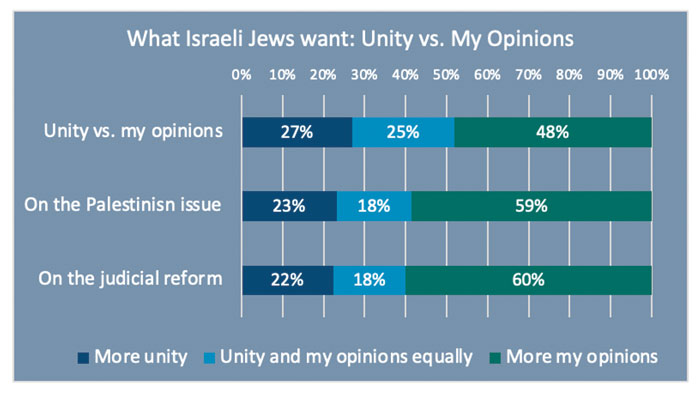
So we presented a scale and asked as follows: “The upper part of the scale symbolizes your positions. The lower part of the scale symbolizes the unity of the society. Please try to place the marker on the place that, in your eyes, is the right balance between your desire for the policy to be the way you want it, and your desire for unity in Israeli society. 

This is the real choice: not whether we want unity, but whether we are willing to give up a little for the sake of unity. Well then, what do Jewish Israelis want? It turns out that the public has a slight preference for their positions over unity. But there are two groups that lean towards unity, and are ready to compromise their positions: those who define themselves as “moderate right” and those who define themselves as “center.” Ask: What is the size of these groups out of the entire Jewish society in Israel? The answer: Nearly half defined themselves this way in our survey. Sixty-four percent of those self-defined as “moderate right” placed their marker on the unity/me scale towards unity. Sixty-two percent of those self-defined as “center” placed themselves on the unity/me scale in the direction of unity.

But it doesn’t end here. Because after we asked generally about unity vs. my opinions, we continued to ask about two specific issues. We asked about the issue that split Israel before October 7, and the one that may split it in after October 7.

We asked: What is the right balance between the need for unity and your opinion on the Israeli-Palestinian conflict. We asked: What is the right balance between the need for unity and your opinion on matters related to Israel’s judicial system?

Two things happened when we moved from the general dilemma to the focused dilemmas. First, for all the respondents, the tendency to prioritize unity decreased. Second – it was possible to identify the difference between the “moderate right,” for whom it is more difficult to give up on their opinions on the Palestinian issue, and the “center,” for whom it is more difficult to compromise on the legal reform issue. In fact: only the “center” bends towards unity in the Palestinian context, and only the “moderate right” bends towards unity in the context of the judicial system.

You want to draw a pessimistic conclusion from this data? It is certainly possible: Israelis want unity only in theory, not in real life. Or – you can read Micah Goodman, and look at the data, and understand that unity and cohesion will not emerge by itself. It is a challenge that needs to be worked on. And Israel has no other choice.

Something I wrote in Hebrew

Regular readers of this column know that Prof. Camil Fuchs, a well known and distinguished Israeli statistician and pollster, was my friend and my partner. We wrote a book together, we started a research initiative together. Prof. Fuchs died last week at 78. Here’s a paragraph I wrote about him:

I once asked him what he thought the pollster’s role was in a democratic society. He looked at me, as if bewildered at the very question. Then he said: to provide information. We are providers of information. And it should be reliable. If the information is useful to someone in making decisions, what to support, who to vote for, how to think about policy – we have fulfilled our role. But it must be reliable, he repeated. Fuchs was straight as a ruler. Sometimes straight to the point of boredom. I once wrote: “Last Thursday we asked 100 Meretz voters who they support.” Fuchs sent a comment: “There were only 99 respondents.”

Can’t we round up? No, we can’t!

A week’s numbers

Read the column above to understand how this was done and what it means:
A reader’s response:

Amy Dobrinsky wrote: “I don’t think Israelis understand how badly their country is portrayed these days.” My response: Some do, and they are worried about it. We’d have to wait and see if this is a passing wave of negativity, or a new image that is going to stick. 


Shmuel Rosner is senior political editor. For more analysis of Israeli and international politics, visit Rosner’s Domain at jewishjournal.com/rosnersdomain.

Rosner’s Domain | Do Israelis Want Unity? Read More »

Shylock No More

The Venice Biennale, kicking off April 20 and running until November 24, decided, despite the best efforts of critics of the world’s only Jewish state, not to kick out Israel. Thousands of artists and curators had signed an open letter urging organizers of the art world’s most renowned event that due to “ongoing atrocities against Palestinians in Gaza,” the festival should not “platform… a genocidal apartheid state.” It likely will not shock readers to know that in the eleven-paragraph-long letter, the word “Hamas” appears exactly zero times. Additionally, the month of October 2023 seems to have mysteriously lacked a beginning, since the missive only mentions the number of bombs Israel has fired “by the end of October.” Seemingly, all the creative types lacked the imaginative faculties to recall what occurred earlier that month that might have elicited a response from Israel.

The Israeli artist Ruth Patir, whose exhibition, curated by Mira Lapidot and Tamar Margalit, was the source of the ire of over 8,000 signatures, tried to placate her critics by issuing a statement to ARTnews following the October 7 attack by Hamas and Israel’s military response. Patir and her curators wrote: “We have been left stunned and terrified by the horrendous attacks of October 7 by Hamas that brutally shattered the lives of so many of our relatives, friends and acquaintances.” They then expressed concern for innocent lives in Gaza, continuing, “Our immense sense of grief is compounded by profound worry about the escalating humanitarian crisis in Gaza, and extends to the tragic loss of lives there, and what’s still to come.”

“Israel not only has the right to express its art, but it has the duty to bear witness to its people precisely at a time like this when it has been ruthlessly struck by merciless terrorists.“ – Gennaro Sangiuliano, Italy’s Minister of Culture

The strongly-worded response to the controversy from Italy’s culture minister, Gennaro Sangiuliano, on the other hand, was unequivocal. “Israel not only has the right to express its art, but it has the duty to bear witness to its people precisely at a time like this when it has been ruthlessly struck by merciless terrorists. Venice Art Biennale will always be a space of freedom, encounter and dialogue and not a space of censorship and intolerance,” Sangiuliano said. Venice, thankfully, no longer is Shylocking its Jews, forcing the Jewish people to apologize for their self-defense.

President Biden’s “hot mic” moment after his State of the Union address in which he said Israel’s Prime Minister Benjamin Netanyahu needs a “come to Jesus moment” was another example of attempts to handcuff Israel’s efforts to destroy a hateful and genocidal enemy by painting the victim as unjustifiably vengeful. Whether the spiritual overtones were purposeful or not, it evoked the same religious condescension the Bard had Antonio’s snark to Bassanio in Merchant of Venice, “You may as well do anything most hard/As seek to soften that than which what’s harder?—His Jewish heart.” One would not have blamed Bibi for responding:

“Hath not a Jew eyes? Hath not a Jew hands, organs, dimensions, senses, affections, passions? Fed with the same food, hurt with the same weapons, subject to the same diseases, healed by the same means, warmed and cooled by the same winter and summer, as a Christian is?”

As Harry Freedman notes in his recent study Shylock’s Venice: The Remarkable History of Venice’s Jews and the Ghetto, the moneylender’s daughter’s conversion to Christianity in Act 4 no doubt endeared the character to audiences at the Globe, and in countless performances since. The President evoking a figure who for centuries was used to justify the slaughter of Jews who refused to believe in him marks the latest but likely not the last attempt to frame the defensive war of the world’s only Jewish state as a “teachable moment,” with politicians and performers playing the instructors and the Jewish people the pupil. As Marco Roth recently observed in Tablet, “Shylockism often comes across as a wish to save Jews from themselves, most especially from Jewish anger, however righteous, by making them into something else, either through assimilation / conversion (as with Shylock’s daughter, Jessica) or through an extra-legal but pseudo-legal framework—adherence to a higher law—that will ensure a happy end for everyone, once the Jews have renounced their claims.” 

Thankfully for Israelis, and for the art world, instead of turning the other cheek or being forced off the stage, Israel’s war against Hamas continues. And it will do so until the hearts of the families so desperate to reunite with their loved ones are softened by the warm embrace of the freed hostages.


Rabbi Dr. Stuart Halpern is Senior Adviser to the Provost of Yeshiva University and Deputy Director of Y.U.’s Straus Center for Torah and Western Thought. His books include “The Promise of Liberty: A Passover Haggada,” which examines the Exodus story’s impact on the United States, “Esther in America,” “Gleanings: Reflections on Ruth” and “Proclaim Liberty Throughout the Land: The Hebrew Bible in the United States.”

Shylock No More Read More »

As Ready As We’ll Ever Be

When I’m home, I like to keep the radio on. In the morning, as I get ready, I listen to Israeli and international hits on Kan. In the afternoons, as I work at my laptop, I beam some high culture into the house with the classical station.

The song playing now, according to Shazam, is a piano sonata by Haydn. Sometimes I fantasize about becoming an aficionado. It seems like a neat thing to be — a sophisticated gay man who knows about composers and operas and goes to the symphony. Maybe there’s a book I could read. Or a class I could take. 

It’s easy to forget that I bought the radio in a fit of panic, worried about the slow march toward a war with Hezbollah in the north. 

That was a few months ago. A friend told me I should get a battery-powered radio, just in case. I went out and bought the thing, but I never bought batteries for it. If the power goes out, bye bye Haydn. 

My first round of prepping for the northern war was characterized by this kind of half-assedness. A battery-powered radio with no batteries, two six-packs of bottled water, and then I forgot about it. 

This time I’m determined to do a better job for my partner Yoav and myself. I want to be able to protect him. I want him to look at me like he’s Rose and I’m Jack from Titanic — strong, competent, trustworthy, prepared for anything. A survivor. 

Of course, Jack didn’t survive, but he’s still the kind of guy you would want around in an emergency. 

So, earlier today, I bought us a first aid kit, some LED lamps, and two more six-packs of water. I then went to the supermarket and filled up my backpack with canned goods. I’ve been hearing things. My barber told me it will start on Passover and will be like the apocalyptic war described in the book of Ezekiel. Someone on a podcast said it would start after the Rafah operation and would set Tel Aviv on fire. 

Still, I can’t quite picture what it will be like. I know that Hezbollah is a heavily armed and sophisticated fighting force. I know that they can strike us wherever we are. In short, I know that it will be worse than anything Hamas could muster — worse than anything I’ve ever known since moving to this country from the United States 10 years ago. 

I open up my Tanakh to the book of Ezekiel. “I will invade a land of open towns, I will fall upon a tranquil people living secure, all of them living in unwalled towns and lacking bars and gates …”

I slam the book shut. This isn’t helpful.

Instead, I call the municipal hotline to find out where the closest underground air raid shelters are located. When this thing goes down, I want to know what’s up. I don’t want to be who I was on Oct. 7 — bewildered, with tears in my eyes, hands clutching a shoehorn for self-defense, wondering if Hamas will make it to Tel Aviv — to our door.

The uncomfortable truth is that I can’t think about leaving, only preparing. Some of my American friends left after Oct. 7, but I couldn’t countenance the thought then and I can’t countenance it now. 

“Why don’t you just come back to America now?” a friend asked me on the phone last night. It’s a reasonable question, but one I couldn’t answer. I lied about having to go buy canned beans and got off the phone. The uncomfortable truth is that I can’t think about leaving, only preparing. Some of my American friends left after Oct. 7, but I couldn’t countenance the thought then and I can’t countenance it now. 

If Israel is at war, I need to be here. To be helpful? To witness the spectacle? To avoid feeling some deranged sense of wartime FOMO? All of that.

But what if Yoav wants to leave? Would I send him off without me? Perhaps then I really would be Jack, putting Yoav on the door — in this case a ship to Cyprus — while I stay, sinking down into the icy deep. 

Shutyot — nonsense — I’m catastrophizing. The sun is out. I can hear children downstairs playing in the park. Yoav and I will stick together. We’ll figure it out. 

Shazam tells me that the song coming out of the radio now is Rachmaninov’s Piano Concerto No. 4. It’s beautiful. Perhaps this would be a good place to start my classical education — by diving into one composer and really exploring his work. Rachmaninov. Why not?

I jot down his name in the notes app and add “buy batteries for radio!” Other than that, it seems that I’ve at last gathered all the recommended items. 

In other words, we’re as ready as we’ll ever be for what comes next.


Matthew Schultz is a Jewish Journal columnist and rabbinical student at Hebrew College. He is the author of the essay collection “What Came Before” (Tupelo, 2020) and lives in Boston and Jerusalem.  

As Ready As We’ll Ever Be Read More »

The Box

Deuteronomy 4:15
 “And you shall very carefully watch your bodies.”

God wants us to take care of our health and that’s what I’ve been doing.

My last colonoscopy did not start well. It was at a teaching hospital, and the intern, a nice young doctor mistakenly — I later learned — went down my throat. Am I that bad-looking that he could not tell the difference between my top and my bottom? 

A few years earlier, I had a colonoscopy performed by a colorectal surgeon friend. Because I am a comedian, he thought it would be funny that as I was drifting off after the anesthesiologist released the drug, he said, “Let me just get my pants off and I’ll be right with you.” His timing was impeccable. 

How people handle medical procedures solely depends on that person. I had an uncle who loved being operated on; he felt it was an opportunity for him to get a few minutes of quiet time away from my aunt. I have another friend who had surgery for melanoma on his nose and acted no different than when he was purchasing elotes from a food truck on Olvera Street. 

Surgery scares the stuffing out of me which is not bad if you’re getting a colonoscopy. My doctor, who knows me well and knows how nervous I am, and because of the slight possibility of something going wrong, during a colonoscopy gave me a choice. I could now skip the ancient Roto-Rooter method which in some parts of the world is used to get information out of captives, and instead consider the Cologuard method.

Cologuard is a company that sends an unmarked box to your home. Inside the box is an empty plastic container for you to drop a stool sample into. Once you’ve done your business, you pour a bottle filled with liquid over the sample and, as if it were radioactive, quickly seal the box. Because someone might think the bottle was a Gatorade treat for your hard work, it clearly states in bold letters, DO NOT DRINK. And there is a reminder for you to seal the box.  Immediately after sealing, you are told to drive the box to the nearest UPS store as if your wife was in the car ready to pop with a set of twins.

What I would have liked to have told them was to keep this box far away from a potential sponge cake that some kind grandma was sending to the East Coast. 

Once I had passed the box over to the UPS worker, I wanted out of there before they noticed what it was. What I would have liked to have told them was to keep this box far away from a potential sponge cake that some kind grandma was sending to the East Coast. 

Back in my car, I ruminated about the type of person that has this job at Cologuard where every morning UPS delivers dozens of boxes for someone at Cologuard to open probably an hour after a hearty breakfast. I wondered what kind of a space suit someone wears that has this job.  I also wonder how they explain to their children what is waiting for mom or dad to open each morning. And if you know what that person does for a living, are you inclined to pass on a barbecue where you know they will be doing the cooking? 

Two weeks later, I got a repeat box in the mail. They wanted me to take the test over because I sent them too much.  Damn, those flax seeds and arugula. After taking care of business this time, instead of heading right off to UPS, I sealed the box and put it on the table next to another box that had to go out: a wedding present. One of my sons stopped by to pick up something and saw the two boxes, placed the address stickers on each box, and was very kind to drop both off at UPS. The problem was he put the wrong sticker on each box. To the newly married couple we sent my sample and to Cologuard, a bottle of Dom and a set of stemmed flute champagne glasses. 

Asking the married couple to forward the box to Cologuard was out of the question.  But I did email Cologuard and told them to enjoy the Dom Perignon. In case you’re interested my results — thank God — were good.


Mark Schiff is a comedian, actor and writer, and hosts, along with Danny Lobell, the ‘We Think It’s Funny’ podcast. His new book is “Why Not? Lessons on Comedy, Courage and Chutzpah.”

The Box Read More »

Rabbis of LA | Rabbi Joshua Katzan Wants to Create a Big Jewish Tent

The path of Rabbi Joshua Katzan, the leader of Venice’s Mishkon Tephilo, is a story that stretches back generations. “My great-grandfather was classically religious in Poland,” Katzan said, “and his younger siblings were more adventurous. Socialists.”

His Uncle Yoel told him that by the early 1930s, economic pressures forced his family to reconsider their position in Poland. “Hitler was making some hay,” Katzan said, “and apparently, my great-grandfather had lost everything once before to the Bolsheviks.” All but two members of the family declared “We are out of here.” 

Hearing those stories influenced his childhood, starting in the 1960s: “My father was an immigrant. He came here in 1946 when he was 15. My mother was born here, and was a second-generation Angeleno. They were divorced when I was very young. I was raised by my father.”

Although father and son moved to Pico-Robertson, the European life his father left behind was never far away. “Holocaust survivors were in the air. I wasn’t told much about the Holocaust, but when I did learn about it, it made sense.”

The younger Katzen attended Hillel Hebrew Academy — for four years. “In the fourth grade, I emancipated myself,” he explained. “Couldn’t stand it anymore. It was normal for me to be around older people with accents and bad attitudes. They were really harsh, with punishments and threats.” That same year, a cousin around Joshua’s age moved to L.A. and was enrolled at Sinai Temple’s Akiba Academy, a green light for young Joshua. “Akiba was a w-o-n-d-e-r-f-u-l experience,” he said.

His father, raised in a classic shtetl community, owned “a beautiful voice, like a hazzan.” He realized he was a humanist. Rabbi Katzan described him as “an extraordinary man, able to hold two realities at one time: There is no God, on the one hand, and on the other, it did not translate into a rejection of culture. He created for me something of what he had: Shabbat at the center — there doesn’t have to be God for there to be Shabbat. My father’s attitude was, ‘There is no God, but if you are going to pray, do it right.’ Some of that rubbed off on me.” It also inspired him to  reassess Jewish traditions, Katzan said. “Where does tradition come from? Why do it?” 

Father and son also attended the Orthodox Beth Jacob Congregation — but only twice a year. And when he was 14, young Josh decided even that was too often. He didn’t want to go to shul on Yom Kippur to hear Kol Nidre. “Fasting was bad enough,” he told himself. Fine, his father said, they would stay home and listen to Yossele Rosenblatt, perhaps the greatest cantorial voice in American history, on their record player. Thereafter, young Joshua participated in Kol Nidre.

When he was in high school, Katzen relented a bit; he would go to shul for holidays and special occasions. “Davening, though, never was a real thing for me,” he said. His father was fine with that. “But when I was on the phone with my zayde [grandfather], my father would take the phone from me and say ‘If he asks if you are putting on t’fillin, say yes.’ I said, ‘But that is lying.’ He said, ‘It will make him feel better’  … That was confusing,” said Katzan, “but it was the reality I grew up with.”

While a student at CSUN, he would visit Tommy’s Burgers with pals, avoiding baconburgers because they aren’t for Jews. At a point, Katzan said “it struck me I was abandoning the religion of my childhood or I needed to take another look at it. It was a child’s religion. I needed to know if there was anything adult about it. That’s an important bridge adolescents need to make — through questioning.”

Katzan said he never left Judaism, but now he was back. He began his new life by wearing a kippah. 

Soon after he started college, he recalled, “a group of us started to get much more religion-curious.” A friend told Katzan that Aish HaTorah was sponsoring a Shabbaton weekend, which  caused a big change in attitude. It  resonated.  “It was very moving,” he said, “because I saw my zayde everywhere, the joy, the cultural uniqueness. It was mine, proprietary. This is where I come from. Katzan said he never left Judaism, but now he was back. He began his new life by wearing a kippah. Soon he saw a person in a wheelchair trying to enter the school library. “I realize I’m on display here,” he thought. “Be the mensch.” He opened the door – to a new and fulfilling life. 

After teaching for more than a half-dozen years at Milken Community High School, he became a rabbi “because it was a natural expression of my own spiritual seeking. I want to share it as a teacher, as a guide.” And three years ago, after stops in Denver and New York, mid-Covid, Rabbi Katzan came to Mishkon Tephilo, a Conservative congregation founded by his grandparents. “We are very much rebuilding,” he said, “and it’s all been working. “We just landed our 100th paid membership, up from 76 last year … I am really passionate about there being a place in traditional Judaism for the atheist. Many Jews are atheists. They don’t admit it. The teachings of our tradition are incredibly wise.” 

Fast Takes with Rabbi Katzan

Jewish Journal: Do you have an unfulfilled goal?

Rabbi Katzan: Writing the book “Judaism for Atheists.”

J.J.  Your favorite place in Israel?

Rabbi Katzan: Hummus Pinati in Jerusalem. Everyone sits together, and soon as you are done, they kick you out.

J.J.  Best book you have read?

Rabbi Katzan: “As a Driven Leaf” was one of the more important ones. Also, “The Amazing Adventures of Kavalier and Clay” by Michael Chabon.

Rabbis of LA | Rabbi Joshua Katzan Wants to Create a Big Jewish Tent Read More »

Joan Nathan: “My Life in Recipes” and Pecan Lemon Torte

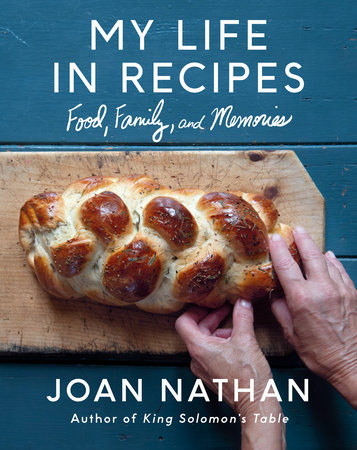
Joan Nathan has made a career of discovering Jewish cuisine from around the world and sharing it with others. Her latest – and she says her last – book is “My Life in Recipes: Food, Family and Memories.” What a way to cap off a legendary career!

“It’s a story of my life, starting from when I was two years old and I was at the Gordon School in Providence, Rhode Island,” Nathan told the Journal. “My teacher wrote a report on me that I liked my morning lunch; I’m not so sure I like lunch so much, but I do like to eat and it’s been my whole life.

She adds, “I always remember good food and having dinners with family and with friends.”

With more than 100 recipes, along with the memories attached to them, “My Life in Recipes” includes updated versions of old favorites (matzoh ball soup to challah and brisket) and new ones too (salmon with preserved lemon and za’atar; Moroccan chicken with almonds, cinnamon and couscous). You do not want to read this book when you are hungry. At least have a snack nearby.

The author of twelve books, including “Jewish Cooking in America” and “The New American Cooking,” both of which won James Beard Awards and IACP Awards, Nathan enjoys the creativity, as well as the connection, of cooking.

“I like to use food as a way to see other things,” she said.

For instance, she loves making salads out of whatever she finds in her refrigerator.

“Your creative gene wakes up,” Nathan said. “I like to have fun with food.”

For Passover she makes a tart with a lemon curd filling; though she finds other ways to use the filling, like on a meringue or in a pie crust. “It’s my favorite dessert.” Nathan’s recipe for Passover Pecan Lemon Torte with Lemon Curd Filling is below.

“Every time I make any recipe, I think about the people who gave me the recipe,” she said. “I might have changed the recipe … but it [still] connects me with my past.”

Nathan feels as if the past is the future too.

“I’m not sure [my kids will] make gefilte fish anymore, but I hope that they’ll make a lot of my recipes in the future,” she said.

Nathan says she hopes her memoir is an inspiration for others to live a good life.

“I think it’s the most important thing I want to teach people,” she said.

For the full conversation, listen to the podcast:

Passover Pecan Lemon Torte with Lemon Curd Filling

Serves at least 8

From “My Life in Recipes” by Joan Nathan. Copyright © 2024 by Joan Nathan. Excerpted by permission of Alfred A. Knopf, a division of Penguin Random House LLC. All rights reserved. No part of this excerpt may be reproduced or reprinted without permission in writing from the publisher.

Many years ago, in Jerusalem, I was given a recipe for an almond-lemon torte. I loved the tartness of the lemon but wanted it even more lemony. I was reminded of my love for lemon curd, which started when I’d go from bakery to bakery in Paris, tasting each lemon-curd tart. For this torte, I changed the almonds to pecans (because Passover already has so many almonds) and added my favorite lemon curd, which I learned from Suzanne’s, a long-gone restaurant on Connecticut Avenue in Washington. It’s not hard at all: make the curd a few days in advance and, if you want, freeze the cake up to 2 months ahead.

Torte

1⁄4 cup (29 grams) matzo meal, plus more for the pan

8 large eggs, separated

1 cup (200 grams) sugar

1⁄4 teaspoon kosher salt

Grated zest of 1 lemon

1⁄2 tablespoon fresh lemon juice
1 cup (100 grams) pecan halves, coarsely ground

Lemon Curd Filling

3 lemons
3⁄4 cup (150 grams) sugar 3 large eggs
1⁄4 cup (1⁄2 stick/56 grams) unsalted butter, vegan butter, or coconut oil
Fresh blueberries, for serving

  1. Preheat the oven to 325 degrees. Dust a 9-inch springform pan with matzo meal.
  1. Beat the egg yolks with the sugar and the salt until they’re smooth and pale lemon yellow. Gradually add the 1⁄4 cup of matzo meal, the lemon zest, and lemon juice. Fold in the pecans.
  1. In a separate bowl, whip the egg whites until stiff but not dry (by hand or using a hand mixer or stand mixer). Gently fold them into the yolk mixture.
  1. Scrape the batter into the prepared springform pan and bake on the middle rack for 45 minutes, or until a toothpick comes out clean when inserted. Let it cool while you make the lemon curd.
  1. To make the filling – Grate the rind of the lemons to get 2 tablespoons zest, then juice the lemons to get 3⁄4 cup of juice. Whisk the sugar and the eggs in a medium saucepan. Gradually add the lemon juice and zest. Add the butter or coconut oil, and cook over medium heat, stirring constantly and being careful not to boil, until the lemon thickens into a curdlike custard, about 5 minutes. Set aside to cool.
  1. Once the cake is cool, split it into two round layers. Spread the lemon- curd filling, reserving a few tablespoons, on the cut side of the bottom round. Add the second round, top side up, then spread the remaining curd, dot with blueberries, and serve.

Debra Eckerling is a writer for the Jewish Journal and the host of “Taste Buds with Deb.Subscribe on YouTube or your favorite podcast platform. Email Debra: tastebuds@jewishjournal.com.

Joan Nathan: “My Life in Recipes” and Pecan Lemon Torte Read More »