Columbia Student Group Holds Virtual “Resistance 101” Event
The Columbia University Apartheid Divest student group held a “Resistance 101” event on March 24 that reportedly included speakers that praised terrorism.
According to The Washington Free Beacon and The Jerusalem Post, Samidoun International Coordinator Charlotte Kates called the Oct. 7 massacre as “necessary action” and that it provided a glimpse into “the potential of a future for Palestine liberated from Zionism.” She also reportedly claimed that “there is nothing wrong with being a member of Hamas.” Palestinian writer Khaled Barakat, Kates’s husband, said during the event that “hijacking airplanes… was one of the most important tactics that the Palestinian resistance have engaged in” and that he has conversations with his “friends and brothers in Hamas [and] Islamic Jihad.”
Israeli intelligence reportedly believes that Barakat is a member of the Popular Front for the Liberation of Palestine terror group, though he reportedly denies it.
A university spokesperson told the Post, “We are aware of an unsanctioned, unapproved event that took place last night. Columbia canceled the event, denying requests to use university space, as did Barnard. Despite this, the event organizers held the event in a residence with an online option. We are investigating this matter and will not tolerate violations of university policy.”
UC Berkeley Prof Ends Sit-In Protest
UC Berkeley Professor Ron Hassner ended his nearly two-week long sit-in protest on March 21 after he announced that the university agreed to his three requests to better protest Jewish students on campus.
Hassner’s three requests were for the university to allow all students to pass through Sather Gate entrance into the university unimpeded by protesters, invite back any canceled speakers and make antisemitism and Islamophobia training required on campus. He claimed that the university will now be patrolling Sather Gate “to actively document bullying, abuse, blocking or intrusion on personal space,” Jewish News Syndicate reported. He also said that attorney Ran Bar-Yoshafat, a former Israel Defense Force member, spoke on campus on March 18 after his initial Feb. 26 speech at the university was canceled by a pro-Palestinian mob and that the university assured him that the antisemitism and Islamophobia training will be mandatory.
“There is a plan forming to schedule a national sleep-in so that professors all across the U.S., Jewish and non-Jewish, demonstrate their resolve to banish antisemitism from their campuses,” Hassner told JNS.
House Education Committee Announces Investigation into UC Berkeley Over Campus Antisemitism
The House Committee Education on Education and the Workforce is investigating UC Berkeley over its response to recent incidents of antisemitism.
InsideHigherEd reported that Rep. Virginia Foxx (R-NC), who chairs the committee, wrote in a March 19 letter to UC Berkeley Chancellor Carol Christ, UC President Michael Drake and UC Board of Regents Chair Richard Leib that the committee has “grave concerns” over the university’s response to antisemitic incidents on campus. This included the university’s response to a pro-Palestinian mob canceling a Feb. 26 speech by Ran Bar-Yoshafat; Foxx criticized the university for failing “to identify the riot as an act of anti-Jewish hate.”
University Assistant Vice Chancellor for Executive Communications Dan Mogulof told InsideHigherEd, “We will provide a comprehensive response to the committee’s questions and concerns. UC Berkeley has long been committed to confronting antisemitism, and to supporting the needs and interests of its Jewish students, faculty, and staff.”
Poll: 73% of Jewish Students Believe “They Are Less Safe” on Campus After Oct. 7
A poll released by the Israel on Campus Coalition (ICC) and Schoen Cooperman Research on March 18 found that 73% of Jewish students believe “they are less safe on college campuses” since the start of the Israel-Hamas war.
Other findings in the poll include that 65% of Jewish students believe the Boycott, Divestment and Sanctions (BDS) movement “poses a threat to Jewish students” and that 62% believe that “it is important to use their voice to stand against the BDS movement on college campuses.” Eighty-one percent voiced the importance of standing “with the Jewish community on campus” and 66% said “it is important to use their voice to stand with Israel on campus.”
ICC CEO Jacob Baime said in a statement to The Algemeiner, “BDS is not about free speech. It’s about free hate. It’s time for university leaders to step in and cancel these [BDS] votes.” Baime also praised Jewish students’ “remarkable resilience” in “standing up for Israel and their Jewish identity.” “Their strength and their determination in the face of adversity will only make them stronger as they continue to encounter antisemitism on campus after they graduate,” he said.
To read more articles from The Media Line, click here.
Decades of conflict between Israel and its neighbors have made innovation an Israeli national trait, giving rise to the development of a flourishing high-tech sector. This has brought global recognition of the country’s tech and innovation prowess, spotlighting the necessity for a clear path to engage with the startup nation. This situation has catalyzed the formation of an organization dedicated to orchestrating monthly missions aimed at the high-tech, biotech, and fintech sectors.
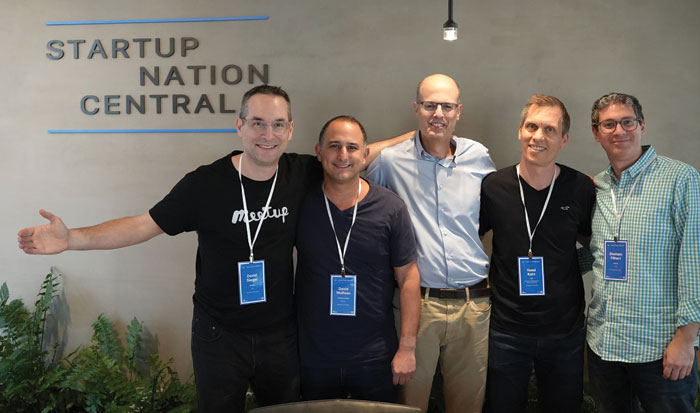
That’s why David Siegel, former CEO of Meetup and Investopedia, created the Israel Tech Mission “with the goal of being just like AIPAC, which brings the top political leaders to Israel,” he told The Media Line.
“There is no organization that brings the largest and most important tech businesses and investors to Israel. We are going to be that organization, and it’s incredibly exciting to me.” – David Siegel
Siegel added, “There is no organization that brings the largest and most important tech businesses and investors to Israel. We are going to be that organization, and it’s incredibly exciting to me.”
This mission, the second of its kind, included leading investors and founders, some residing in Israel and others who had visited before, united by a common purpose to effect change. Participants explored top high-tech firms, Reichman University’s research and innovations in health and tech, and the nation’s largest patent office, Pearl Cohen; and met with local innovators and senior figures from the Israel Defense Forces.
Adam Sager, Stoa’s founder and CEO, told The Media Line, “We need to see the kind of technology, everything from drugs and medication, to software that could help people get diagnosed with what they have, to hardware devices.”
At the second Israel Tech Mission, entrepreneurs like X-trodes founder Dr. Ziv Peremen captured widespread interest. Peremen showcased a joint invention with Prof. Yael Hanein: a home-use wearable medical-grade skin patch, drawing keen attention from tech leaders and investors.
Peremen told The Media Line, “We basically develop skin patches that can measure the body’s signals, such as heart, muscle, eye, and brain activity, and make them accessible everywhere.” He explained the company’s goal to democratize health care by facilitating access to medical-grade data beyond traditional medical settings.
“The current FDA approval is the result of more than a year of efforts, including the efforts of our team during this war. I think a third of the company, including myself and the rest of the management, was on reserve duty.”
The entrepreneurs showed particular interest in innovations related to physical and mental health, especially given the ongoing Israel-Hamas war.
Esther Howard, founder, CEO, and president of Bezyl, a US-based mental health company supporting cancer patients and veterans with PTSD, underscored the critical need for such mental health technologies.
Howard told The Media Line, “I think the biggest thing missing right now is tools and the ability for people to help each other.”
“We all want to help each other, and everybody is traumatized in some way, but the knowledge, the skills, and the ability to do that is lacking. And since there are so few limited resources in the healthcare system for us, we need to learn to help each other, and that’s what I want to do.”
One participant, Alexandra Benedon, corporate innovation and venture at Deloitte, explained to The Media Line that the war is part of why she felt it was important to go on the trip. She explained she heard about it during a Shabbat dinner in Philadelphia, and “it was a spark that went off.
“I felt so helpless in the United States,” she said about the war. “I’m a doer. I wanted to take action, and I felt like it was my duty, my responsibility, to help and show the world the resilience of the startup nation.”
Attorney Avigail Goldglancz told The Media Line, “Whether it was during the intifada back then or now, this is where we belong no matter what’s going on, no matter what’s happening. It’s wartime. And honestly, it’s worse in America. There is no place I’d rather be.”
Goldglancz, who left Israel when she was 7 years old during the First Intifada and has lived in the United States since, continued, “I really think there should be mental health help, not just for soldiers, but for everyone who experienced October 7 and everything that they have been through. The PTSD, I can’t imagine it, especially for children.”
The strong bond with Israel during the war that many participants expressed echoed the need for the new tech mission enterprise.
“My husband took off his kippah in New York City just a few weeks ago, which is mind-boggling,” Benedon explained. “So to come here and just feel embedded in the community and feeling like we are doing, and we’re feeling and we’re touching the technology and business ecosystem, it’s just a tremendous relief. This is the first time I feel like I could breathe since October 7.
While discussing the role of technological developments and their connection to the Jewish state, one participant who is involved in artificial intelligence is concerned with the distortion of news. “Well, it’s a huge reminder of just how easy it is to manipulate people and to create propaganda for good or for bad,” Avi Muchnick, the CEO of BurnerPage, told The Media Line.
“Countries on all sides are really able to change the narrative, and AI is just another tool in their arsenal, but probably the most powerful tool the world has seen to date to do so.”
By the same token, social media has played a huge role in the current situation. PikMe founder Isaac Laifer noted, “I think people have to be very specific about where they get their news from. They have to be really well versed in what the agendas are that each platform has.”
“And honestly, the best way to understand truth from falsehood is seeing it for yourselves.”
Vib Prasad, a private equity operating adviser and one of the only two non-Jews on the trip, explained to The Media Line how visiting Israel helped him understand just that. Prasad said that has a strong connection with the country through his business and works with several Israeli companies. “I came away very impressed with the resilience of these companies, which are facing an existential crisis. Many of them can’t even work in their companies because of this.”
“One thing I noticed is that Israel isn’t particularly good at talking about its PR. I work in the software industry, and we describe one of the challenges in software as whether you have a good product or a good market strategy. If I had to categorize Israel from the perspective of a software executive, Israel has a great product, but Israel’s ability to tell that story on the world stage is lacking, and it’s not very good.”
The Israel Tech Mission is ramping up to bring more missions to Israel, hopefully monthly. Siegel told The Media Line, “We already have a waiting list for our next mission from the hundreds of thousands who have been reading about the mission and its impact through social media.”
Siegel shared the impact that these missions have on the country, “Another example of something that happened from the last trip, there was a very large, 70,000-person organization, and an executive from there came from that trip. After the trip, he then said that we’re now going to get the entire executive team for this enormous manufacturing company and they’re now going to be opening an R&D center in Israel as a result of this trip.”
“The Jewish Holiday Table” is “a love letter to our diverse culinary heritage,” Naama Shefi told the Journal. Shefi is founder of the Jewish Food Society, a non-profit that works to preserve, celebrate and revitalize Jewish culinary heritage from around the world.
In March, Shefi and the Jewish Food Society published their first cookbook: “The Jewish Holiday Table: A World of Recipes, Traditions & Stories to Celebrate All Year Long,” a vibrant collection of 135 recipes and stories, with beautiful photos to match. It is as much a celebration of resilience, tradition and joy, as it is a resource for holiday cooking.
“The book celebrates Jewish holiday traditions from families around the world in places as far apart as Argentina, Hungary, India and Italy,” Shefi, who is also founder of Asif: Culinary Institute of Israel, said.
“My good friend Mitchell Davis once said that food without a story is just calories. More than simply a recipe book, this is a book that celebrates Jewish stories and honors the rich tapestry of our heritage.”
Since 2017, the Jewish Food Society has been building the largest archive of family recipes and histories. This book is a showcase for their deep research and rich cultural food history, and includes recipes and stories that have been passed down through generations.
Shefi says the book was a collaborative process with her core team at Jewish Food Society. This includes co-author Devra Ferst, their archive’s editor; creative director Amanda Dell and award-winning photographer Penny de Los Santos; as well as the recipe developers, testers and the featured families.
“We did a deep dive to understand where their traditions come from, how they celebrate different holidays and how they set their own tables.” – Naama Shefi
“We did a deep dive to understand where their traditions come from, how they celebrate different holidays and how they set their own tables,” Shefi said. “There is nothing more powerful than hearing these stories in the families’ own words.”
The book is organized by seasons and their respective holidays, closely following the Jewish agricultural calendar. There’s a Milanese Hanukkah menu, recipes for an Iraqi Purim party, a festive French Shabbat and a Moroccan Mimouna gathering to mark the end of Passover. There are also stories of a long journey via camel in Yemen, survival in Ukraine, a Bukharian grandmother on YouTube and women baking holiday sweets together in what’s now Zimbabwe.
“For each holiday, we feature four to five family tables and their menu alongside a personal essay about their history and journey,” Shefi said. “It’s more than just a collection of recipes, it’s also a look at how we celebrate, and it brings to light cuisines and communities we don’t hear about as often within the American Jewish community.”
For instance, Yonit Naftali shares her beautiful Purim cakes: Beigli and Fluden.
“Yonit’s grandmother was one of 10 siblings, but only four of them survived the Holocaust,” Shefi said. “They were left with nothing, just her mother’s recipes, which she knew by heart and which she wrote down for her own children.”
Shefi explains that it was important for Yonit’s mother, Paula, to recreate the recipes precisely; she won’t even use a machine to grind the nuts.
“As a kid growing up in Israel, Yonit noticed that these Hungarian treats were different from food being made by her predominantly Moroccan community, and at first it was a point of embarrassment,” Shefi said. “When she was 11, a local neighbor asked her if she would be making more for the holiday, and she soon realized that the recipes were actually a source of pride. These recipes represent a journey from loneliness and grief to acceptance and pride.”
Shefi hopes “The Jewish Holiday Table” makes readers feel proud, connected and inspired.
“There is no one standard definition of Jewish food, but I do believe it lives at the intersection of Jewish rituals and holidays, and includes ingredients and techniques that Jewish people have encountered in 2,000 years of diaspora,” she said. “I also hope that home cooks discover something completely new and perfectly delicious that they bring to their holiday table for years to come.”
She adds, “We feel there is no one way to celebrate and we wanted to show an openness and flexibility in how to honor the past while creating new traditions.”
During the Passover seder, foods like bitter herbs, matzah, and charoset — a sweet paste made from fruits and nuts — help tell the story of the Exodus from Egypt. There are different interpretations of the symbolism of charoset, but it’s most often seen as representing the mortar the Jews used for constructing buildings when they were slaves in ancient Egypt. The custom of eating charoset is ancient. As the late culinary scholar Gil Marks explained in his “Encyclopedia of Jewish Food,” it was widespread as early as 200 C.E.
There are countless ways to make charoset. Jewish cooks across the diaspora have prepared it with the various ingredients available to them — apples and walnuts in Eastern Europe, dates in parts of North Africa and the Middle East. Rinat’s charoset draws inspiration from both sides of her heritage. The cardamom and sesame seeds, she notes, are from her Yemenite family, while the dates, almonds and hazelnuts come from the Moroccan side. Like her mom, Rinat forms the charoset into snack-sized balls, which can be enjoyed at seder or any time as an energy snack.
Makes about 3 dozen 1-inch (2.5 cm) balls
½ cup (55 g) raw walnuts
½ cup (55 g) blanched raw almonds
1/3 cup (40 g) blanched raw hazelnuts
¼ cup (30 g) raw sesame seeds
1 cup (200 g) Medjool dates, pitted
½ tsp ground cinnamon
¼ tsp ground cardamom
¼ cup (60 ml) sweet red wine
1 Tbsp honey
Preheat the oven to 300°F (150°C). Line a baking sheet with parchment paper
Spread the walnuts, almonds, hazelnuts, and sesame seeds on the baking sheet and toast in the oven, stirring once or twice for even toasting, until aromatic and golden, about 10 minutes. Remove from the oven and set the nuts aside to cool.
Meanwhile, put the dates in a small heatproof bowl, cover with boiling water, and soak for 5 minutes to soften. Drain the dates thoroughly.
Put the dates, walnuts, almonds, hazelnuts, sesame seeds, cinnamon, cardamom, wine, and honey in a food processor and process the mixture until it forms a paste that’s uniform but not completely smooth. If the mixture seems too dry, add up to 1 tablespoon of hot water and process a bit more (but you want the mixture to be stiff enough to roll into balls). Transfer the charoset to a bowl, cover tightly, and refrigerate for at least 20 minutes, and up to overnight.
To shape the balls, coat your hands with a bit of neutral oil, scoop up a heaping teaspoon of the mixture, and roll the charoset into 1-inch (2.5 cm) balls. The charoset balls can be stored in an airtight container in the fridge for up to 2 weeks.
Arrange the charoset balls on a serving plate and serve at room temperature.
My memories of Casablanca come in snapshots. Bright blue skies, tall palm trees, the boulevard outside the balcony of our apartment. My cousins and my brothers blaring pop music. My Maman and her sister, my aunt Clara, with their perfect bouffant hairdos and their impossibly chic clothes. My father and my uncle Menasse and their friends playing cards and smoking cigarettes.
One memory which I can only imagine is the Bab Marrakech, the imposingly grand and ornate sandstone wall that surrounds the old Medina of Casablanca. Behind its grand walls sits the old Jewish quarter, called the Mellah. Also behind the Bab Marrakech is the exotic old souk with its magical sights and smells and sounds. The many vendors hawking their different wares — gallons of olive oil and olives of every color and variety, fragrant fruits and bright fresh vegetables, plump black dates, soft dried apricots and nuts.
Of course, there is the pungent, aromatic smell of the spices. The mounds and mounds of powdery spices. A brilliant, earthy collage of deep reds and browns, yellows and oranges. Paprika and cinnamon, mustard and turmeric, cayenne and saffron, cumin and ras el hanout, to name a few.
Bab Marrakech is where my mother and my aunt would go to place their fish orders. On Fridays and on the eve of Jewish holidays, the fish would be delivered to our homes, fresh off the fishing boats that docked in the nearby port.
My cousin Simy remembers that for Passover her grandmother would make a special fish called shad. This freshwater fish had a large roe sac, which would simmer in a tomato broth made with fresh tomatoes and flavored with cumin and paprika.
Proximity to the Atlantic Ocean meant that we ate a lot of fish. Sardines, millets, mackerel, hake, whiting, sole, pandora, sea bream. But most often for Friday nights, my mother would prepare Lou de Mer, which is a firm, white branzino.
Maman’s Moroccan Fish recipe steams the fish in a rich, hearty, spicy, tomatoey stew. The sauce has a satisfying umami depth which comes from spicy harissa and dried peppers, smoky paprika and garlic melded with the exuberance of juicy tomatoes, sweet red peppers, cilantro and preserved lemons. My family recipe includes carrots for sweetness and garbanzo beans to offset the spiciness.
Moroccan fish is a perfect dish to prepare for Passover. Our ingredient list gets a little bit shorter on this holiday, so I’ve adapted this recipe for Passover.
Nowadays, I prepare this dish with whitefish, halibut, cod or sea bass, but any firm fish works with this recipe. If your family loves salmon, that is good too. In fact, salmon has become the go-to fish in many Moroccan kitchens in America because it absorbs the flavors of the sauce without falling apart or becoming dry.
—Rachel
One day, Rachel and I and our families will travel to Morocco together, be’ezrat Hashem. Morocco is a country that maintains warm ties to Israel and where the king, Sultan Mohammed VI, extends his hand in friendship to the Jewish people. In the meantime, Rachel and I will have to be satisfied with writing about this land.
North African Jewry transported their culture and cuisine to Israel with great success. The mystical religious traditions, like the henna ceremony and Mimouna have captured the Israeli imagination.
The Maghreb is a region that has been home to an ancient Jewish community since Roman times. It’s a part of the world that captures the imagination. North African Jewry transported their culture and cuisine to Israel with great success. The mystical religious traditions, like the henna ceremony and Mimouna have captured the Israeli imagination. As you may know from reading this column, exotic things like matbucha and shakshuka, preserved lemon, harissa and ras el hanout are part of the lexicon of Israeli food.
Rachel and I hope you save this recipe for Moroccan Fish and prepare it for Passover and beyond. This recipe is bursting with flavor but it’s also forgiving and foolproof. The technique of poaching the fish in a rich, flavorful sauce is the main takeaway. (Add creamy potatoes for an even heartier, more rustic dish.) And if you haven’t preserved your lemons in advance, Rachel shares her hack for an extra quick way to get them.
—Sharon
Moroccan Fish
3 lbs of branzino, filleted and cut into pieces
1/4 tsp salt, for salting fish
1/4 cup olive oil
6 garlic cloves, finely sliced
1 Tbsp cumin
2 Tbsp sweet paprika
1 tsp salt
1 tsp white pepper
1 large yellow onion, thinly sliced
1 red pepper, sliced in thin strips
1 yellow pepper, sliced in thin strips
3 medium carrots, cut into thick diagonal chunks
3 Tbsp tomato paste
1/4 cup preserved lemon, finely diced or juice of one lemon
1 dry red chili or 1 seeded jalapeño
3/4 cup water
1 bunch fresh cilantro, finely chopped
1/3 cup water
Rinse fish filets with cold water and pat dry. Season fish with salt, then place skin down on top of paper towel. Set aside.
In a large round skillet with lid, warm oil over low heat and add garlic, spices, peppers and carrots. Sauté for 3 minutes to coat the vegetables with spices.
Add tomato paste, preserved lemon or lemon juice and chili pepper. Stir until all sauce is smooth and the ingredients are coated, about 2 minutes.
Add 3/4 cup water, cover and simmer for 15 minutes. Stir occasionally to ensure sauce doesn’t stick to the bottom of the pan.
With a large spoon, move the carrot and onion to the outer edges of the pan. Place fish in the center of the pan, then spoon a generous amount of sauce onto each piece.
Add chopped cilantro, reserving a handful for garnish.
Add 1/3 cup water, cover and simmer for another 10 minutes, depending on the thickness of fish.
Fish can be re-heated in a covered pan over low heat or in the oven.
Add reserved fresh cilantro just before serving.
Quick preserved lemon
1 lemon, washed, thinly sliced and pitted
1/2 cup kosher salt
Dip each slice of lemon into a bowl of kosher salt, fully coating all sides.
Place in a baggie or freezer safe container and freeze for a few hours or a day.
Use just like preserved lemon.
Sharon Gomperts and Rachel Emquies Sheff have been friends since high school. The Sephardic Spice Girls project has grown from their collaboration on events for the Sephardic Educational Center in Jerusalem. Follow them on Instagram @sephardicspicegirls and on Facebook at Sephardic Spice SEC Food. Website sephardicspicegirls.com/full-recipes.
One verse, five voices. Edited by Nina Litvak and Salvador Litvak, the Accidental Talmudist
Any person who eats any blood, that soul shall be cut off from its people.
– Lev. 7:27
Denise Berger Freelance writer, “Miracle in the Minutiae” columnist
What’s most interesting to me in this admonition is the part at the end, about the nation. The penalty of being cut off, kareit in Hebrew, is perhaps the most ominous in the Torah. There are different understandings of exactly what happens when someone is kareit. It might mean having one’s life cut short, it could mean dying without children so that the lineage is cut off, it can mean being disconnected from yourself or from relationship or joy. Part of what’s scary is that we don’t quite know.
In the instance of eating blood, this parsha is telling us that the person’s soul will be cut off from the nation. To a modern reader, particularly one who eats non-kosher meat (which generally includes blood), this might seem somewhat drastic — even if we don’t know just what form that rupture will take. But it’s worth thinking about in a slightly different way.
The soul is cut off, but not the entire person. This suggests that the person is still included with the activities of the nation, they just feel an internal disconnect. And the soul is cut specifically from the nation — not from the self, not from love, not from G-d. This carries the possibility of repair, because there is support. Despite the harsh tone, Hashem never leaves us without a way back. To me that’s the ultimate message.
Lori Shapiro Rabbi, Open Temple
Our parsha reminds us of Torah’s consequence of the idolatrous act of consuming blood — one becomes kareit, or “cut off, separated” from their people. This edict alludes to a punishment from acts that defile rather than purify, and draws our attention to the choices we make— are we human, or animal? Do we choose to draw God close through a relationship with Torah, or do we make choices that lead us into exile?
With Passover on the horizon, the history of the blood libel intimidates like a sleeping beast. The blood libel, a medieval canard, claims that Jews require the blood of humans to bake matzoh. Historically, edicts from Muslim leaders prohibited this discrimination, and defined them as a slander. This was best exemplified in 1840, when European leaders enlisted Sultan Abdulmejid I of the Ottoman Empire to declare, “and for the love we bear to our subjects, we cannot permit the Jewish nation, whose innocence for the crime alleged against them is evident, to be worried and tormented as a consequence of accusations which have not the least foundation in truth …”
May our entry into this Passover season, replete with conversations for peace, recollect this shared history of Muslims, Christians and Jews restoring dignity and humanity for one another; May the Holy Land be a shelter for peaceful celebrations of Eid, Passover and Easter; and may all of us cultivate a path of intimacy with the Divine through peace and wholeness for all.
Rabbi Elchanan Shoff Rabbi, Beis Knesses of Los Angeles
Maimonides (Guide 3:46) records (using the copious written material at his disposal from the ancient Sabeans) that until the time of the giving of the Torah, people believed that blood-eating connected them to demons (sheidim). Their rationale was this: Demons have the capacity to reveal useful things, and future predictions in one’s dreams, they believed. But one needs to create friendly connection to demons for them to be inclined to share knowledge. Dining with them would create connection, and demons eat blood! So they’d slaughter an animal into a vessel or ditch collecting the blood, and eat the meat along with the blood, imagining that they were sharing this meal with demons. This was understood and accepted in pre-biblical times as absolute fact. “There wasn’t a person among the masses,” says Maimonides, “who had any doubt that this was all true.” Torah came to enlighten us, prohibiting this behavior. Kosher meat is salted; great pains are taken to remove excess blood. Here’s a tremendous takeaway to consider the next time that you fulfill the mitzvah of eating only kosher meat. People generally accept whatever society believes, unflinchingly. Questioning what is “Truth” is always seen as absurd. That’s what Torah is for. No groupthink allowed. Living with uncertainty is healthy — part of life. Relying on demons and magic isn’t the solution, comforting as it may seem. “Question even the most well accepted things, don’t just accept them,” says the Jew, with every bite of blood-free kosher meat that he ingests.
Rabbi Aryeh Markman Executive Director, Aish LA
Why does the Torah have to command us not to ingest blood? It’s disgusting.
Truth be told, if you are not eating kosher, then you are consuming blood. Part of the koshering process is to remove all “active” blood from meat. That’s the coarse salting process your great-grandmother used to perform in the bathtub. Grilling kosher meat and having the juice sizzle is not the blood the Torah is describing. Blood is dangerous to our spiritual health. It contains the brutish nature of the animal. In eating blood, you are intaking the animal’s bestial drives. That is anathema to being a Jew, where we strive to rise above our savage nature.
Kabbalistically, our bad character traits reside in our blood. Our blood is a cocktail of life-giving oxygen and cell waste. Would you want to drink radioactive water if you were thirsty? Jewish factoid: Technically blood that hasn’t left the body, like blood in your gums, can be swallowed. Keep flossing!
The Torah warns us if we do eat blood, we receive the most severe punishment, being cut off spirituality. Total oblivion upon death. This is not vengeance. It’s the result of poisoning the soul with the forbidden, with inevitably severs us from our life source — God. And now we understand why Israel is blamed for genocide and blood libels. These elements are despicable to us, and the world knows it. Our enemies self-project their own worst behaviors on the Jews, which assuages their guilt for their failings.
Rabbi Benjamin Blech Professor of Talmud, Yeshiva University
It may seem completely irrational but purveyors of propaganda long ago understood it: The more outlandish a lie the more powerfully and speedily it gains acceptance.
So it was in the Middle Ages with an absurd antisemitic claim that cost the lives of countless innocent Jews — and so has an equally irrational condemnation surfaced today that makes a mockery of the world’s supposed sense of truth and morality.
How was it possible for so long for “the big lie” to gain countless believers in the abhorrent falsehood — Jews slaughtered Christian babies before Passover because Torah law commanded Christian blood be a required ingredient of holiday matzah? Did no one know the gravity of the biblical sin that “any person who eats any blood shall be cut off from his people”? Was it not a preposterous claim that the very people who gave the world the ethical mandate against bloodshed — a religion that required even an egg with a bloodspot be discarded— should demand innocent blood on the menu of their Passover festival?
The more absurd the lie, Adolf Hitler proved, the better its chance for belief. And so too the victims of Oct. 7 — victims of a Hamas massacre that echoed the worst violence perpetrated against the Jews since the Holocaust — have incredibly been branded by much of the world as the villains. And their crime? The crime of genocide – a word which did not exist prior to 1944, coined by a Polish-Jewish lawyer, Raphael Lemkin, to describe the pioneering Nazi policies of systemic national murder. The “blood libels” of the Middle Ages have again found their irrational partner!
Hamas’ massacre on Oct. 7 was understood rightly by all decent people as a crime against humanity.
For less-than-decent people, it was understood as an invitation to get in on the carnage.
As the Hamas militants blasted through Israel’s billion-dollar barrier fence, it was as if they had managed to also tear down the invisible force fields of shame and restraint that we once imagined protected Jews in America from the most abject forms of bigotry and discrimination.
This was most prominently seen on college campuses, and it began almost immediately. On the morning of Oct. 7, as the IDF was still fighting to regain control of Israel’s southern towns and dead bodies still lay abandoned in Hamas’ killing fields, student activists at Harvard drafted a letter that held “the Israeli regime entirely responsible for all the unfolding violence.”
It has been signed by 35 different student organizations.
In the days that followed, campus activists rallied to support Hamas’ “freedom fighters” and denigrate Israel’s response — which had not yet begun — as genocidal. Many media personalities and pundits condemned this phenomenon, but also fundamentally misunderstood it as an expression of sophomoric ignorance rather than institutional rot. As we would soon learn, the problem extended to the so-called adults in the room as well.
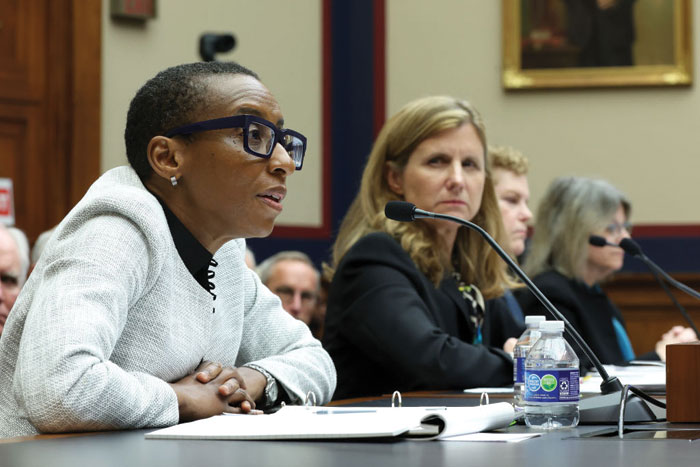
The past four months have produced no shortage of disturbing images that will haunt Jews for decades to come. Among them is the image of three college presidents from elite universities, mocking smiles on their lips, deflecting questions about whether or not calling for the genocide of Jews constitutes a breach of their schools’ respective codes of conduct.
For Jewish students, the damage was done. A message had been broadcast to the world. Violent rhetoric against Jews would not be condemned, but rather examined for “context.”
“It is a context-dependent decision,” UPenn’s Liz Magill said, days before the fallout from the hearing led her to resign in disgrace.A month later, tainted by the scandal of the hearing in addition to an ever-growing heap of plagiarism accusations, Harvard’s Claudine Gay would be ousted as well. For Jewish students, however, the damage was done. A message had been broadcast to the world. Violent rhetoric against Jews would not be condemned, but rather examined for “context.”
This was merely a reiteration of what anti-Israel student activists had been saying about Hamas’ attack. Whether dealing with physical violence or genocidal rhetoric, “context” would be invoked to minimize and dismiss the concerns of Jewish students.
For Jewish high school students and their families getting ready for college application season, this added a disturbing new dimension to an already stressful process. I posted a message to a Facebook group called Mothers Against College Antisemitism (MACA) and received a deluge of responses from parents and college counselors who have spent the past four months rethinking their options.
“Mira Andrews” (she requested a pseudonym), an independent educational counselor who mostly works with Jewish families, has been working to help students reshape their college lists to avoid schools where toxic antisemitism has been most flagrant. One school that’s been largely ruled out is Barnard, which she described as being essentially “the same as Columbia.”
Columbia, for those who don’t know, has become a watchword for aggressive anti-Zionism. Jewish students have been harassed and even physically assaulted for supporting Israel, and pro-Palestinian protests at the gates of the university have featured signs that say “Israel the new Nazi Germany” and “Israel steals Palestinian organs.” An alleged incident in which anti-Zionists protesters were sprayed with a foul-smelling substance has further inflamed passions on campus.
(L-R) Dr. Claudine Gay, President of Harvard University, Liz Magill, President of University of Pennsylvania, Dr. Pamela Nadell, Professor of History and Jewish Studies at American University, and Dr. Sally Kornbluth, President of Massachusetts Institute of Technology, (Photo by Kevin Dietsch/Getty Images)
Andrews’ own daughter, however, is planning to start at Barnard in the fall. Having been accepted Early Decision before Oct. 7, she is determined not to be scared away from her dream school by antisemites — a decision which her mother looks on with pride and concern. “It is sad that her huge accomplishment has now been tainted, but she believes that Barnard needs strong Jewish voices.”
Most of the parents I spoke to seemed genuinely rattled. “My high school senior has been auditioning for theater and musical theater programs,” said Stephanie Abramowitz of Calabasas. “She’s always concerned about mentioning she’s Jewish or that her dad’s Israeli.” Elena Rivers’ daughter hasn’t made a decision where she will attend. “I’m honestly terrified for her,” she said. She’s such a kind, gentle soul and would not handle all this very well.”
Some parents were eager to tell me that the problem preexisted Oct. 7. “Jewish families have been factoring campus antisemitism for Jewish students into their decisions for decades,” Emilia Green wrote. “My daughter is a freshman in college this year and we ruled out schools based on blatant antisemitic attitudes/actions/anti-Israel graffiti, etc.”
Abby Moskowitz was already worried about campus antisemitism before Oct. 7, but the ensuing outburst of anti-Zionist sentiment convinced her that she needed to take a more active role. “We took Columbia off the list as well as UCLA, which is sadly my alma mater. My son’s first choice was WashU… We met with the Hillel there and they are amazing. He felt super comfortable there. Thankfully he was accepted.”
I was also curious to know if any of the parents in the group were concerned not that their children would become targets of anti-Zionist harassment, but that they would join ranks with anti-Israel student groups like Jewish Voice for Peace or Students for Justice in Palestine. I was surprised, after having received so many messages to my first question, by the silence that met this second question. Perhaps, I wondered, these parents don’t want to admit that their children may come home from school with radically altered politics on Israel. Or perhaps they simply felt confident that their children’s Israel education could withstand the storm.
For students who entered college before Oct. 7, the result has been a sudden and dramatic shift in how they feel on campus.
“I wear a chai necklace and sometimes a Magen David as well. Strangers on campus have definitely stared at my necklaces in ways that made me feel unsafe, I’ve never had an experience like that on campus before Oct. 7th.” – Tali, University of Colorado Boulder student.
Tali, at University of Colorado, Boulder, reports a noticeable shift in how she is treated. “I wear a chai necklace and sometimes a Magen David as well. Strangers on campus have definitely stared at my necklaces in ways that made me feel unsafe, I’ve never had an experience like that on campus before Oct. 7th.” At campus protests she sees signs that read “Zionism is genocide” and “Keep the world clean” with images of Israeli flags tossed in garbage cans.When I ask her if campus antisemitism played any role in her college decision-making process, she says no, but that it would if she were applying today.
Hannah Levy, from Silver Spring, Maryland, is currently enrolled at Tel Aviv University as part of a joint program with Columbia. “We do our first two years here and the next two years at Columbia, so naturally a lot of people in the program have been seeing what’s going on and getting quite nervous.” Many campus activists at Columbia have focused their attention on the very program in which Hannah is enrolled, trying to pressure the college to end its partnership with TAU. Hannah, however, isn’t too afraid. “Reports of antisemitism can be overblown to push a certain narrative,” they tell me.
When I ask how the rest of their cohort feels about the matter, Hannah tells me that some are afraid to go while others are eager to go so that they can play a role in combating antisemitism and anti-Zionism at Columbia. “I feel like I have a role to play too in pushing back on the narrative there, but not in a radically pro-Israel way. More of a balanced and nuanced approach. And there’s a lot of repression of pro-Palestinian voices at Columbia too.”
Finally, there were those I spoke to who had decided to radically jump the track. One girl had abandoned college plans to join the IDF. One father told me that his daughter had opted for college in Europe where she felt the environment would be less politicized around Israel.
I also made a trip to Herzliya to visit Reichman University, formerly known as IDC Herzliya, a small private university known for its large population of international students. There, I sat down with five students from the U.S. to discuss what inspired them to get their degrees abroad in Israel.
The students I met with were representative of a very particular demographic of American Jewry. Whether from the Orthodox world or not, they had grown up with strong Jewish educations and several of them had at least one Israeli parent.
When I asked if their decision to study at Reichman was rooted in concerns about campus antisemitism, they suggested that this was only a small part of the equation. “It’s good to be studying around like-minded people,” Daniel, who studies communications, said. “It’s a safe place.”
The idea that Israel, in the wake of its worst terror attack and in the midst of a brutal war, would be thought of as a “safe place” should be a worrying indication of how Jewish students currently view American campuses, but not necessarily a surprising one.
The idea that Israel, in the wake of its worst terror attack and in the midst of a brutal war, would be thought of as a “safe place” should be a worrying indication of how Jewish students currently view American campuses, but is not necessarily a surprising one.
More than fear of antisemitism, the students I spoke to seemed to have been motivated mainly by a love of Israel and a desire to be among people who they could relate to, which for this group meant people who had dual Israeli American identities.
In the words of Limai, a psychology student: “Sometimes, I don’t feel like I connect fully with Americans or Israelis.” The others nodded vigorously. Here, on this campus at least, they had found a community of people who shared both parts of their identity.
Talking with these students, I was reminded of the people I had studied with during my year abroad in Jerusalem in 2009. I grew up in a thoroughly secular Jewish home in Massachusetts where Zionism and Israel had never been topics of conversation. In this, I was a complete outlier on my program. Everyone else had gone to Jewish day school and Jewish summer camp and had been on countless trips to Israel with their families over the years.At the end of the year, when I announced my intention to make aliyah, one of my peers expressed disbelief. “You’re not the type,” she said.
Recalling this, I wondered if Reichman University was interested in reaching out to potential students who didn’t fit the mold. After all, antisemitism isn’t the only crisis rocking the world of higher education right now. There’s also the exorbitant expense and the diminishing returns of having a college degree in the United States.
Enter Reichman, which costs $16,000 a year for international students. This is quite high compared to Israeli public universities, which cost about $4,000 a year, but it’s a steal compared to the $50K price tag attached to a single year at many American institutions.
That’s not to say that college isn’t “worth it,” merely that the equation has changed. Enter Reichman, which costs $16,000 a year for international students. This is quite high compared to Israeli public universities, which cost about $4,000 a year, but it’s a steal compared to the $50K price tag attached to a single year at many American institutions. Moreover, the degrees are practical and career-focused and can be finished in just three years.
I asked Jonathan Davis, vice president for external relations and head of the Raphael Recanati International School, if he had plans to expand outreach in the wake of Oct. 7. I felt sure that many Jewish parents would be interested in hearing about an English-language option in Israel that costs a fraction of the price of an American school. As Rahm Emmanuel once said, never let a crisis go to waste.
When I asked this, however, Davis essentially just said that “they know we’re here” indicating that there are no real plans in place to increase outreach or to market themselves to disenfranchised Jewish students who increasingly feel that they have no good options.
If we take a broad historical view, we might see what’s happening now not as a new crisis, but rather as the return of the previously existing state of affairs. For decades, American college campuses were hostile to Jewish students in ways that were both institutionalized and cultural. Notably, the widespread practice of having Jewish quotas severely limited how many Jews could access the best schools.
By the 1970s, Valerie Strauss writes in The Washington Post, “Jewish quotas were seen as a thing of the past and Jewish enrollment in U.S. higher education rose … Jewish students in the last part of the 20th century were largely comfortable on campus, with overt antisemitism displayed by administrators” all but gone.
It was at the tail end of this golden age that I attended Sarah Lawrence College. I did not enter as a Zionist in my freshman year. Rather, it was because of my experience studying abroad in Jerusalem during my third year that I came to have a relationship with Israel at all. Later on I would make aliyah and start my life here.
I now wonder if any of that would have happened if I were a student today. Would I have felt comfortable applying to study abroad in “the new Nazi Germany?” Would my mind have been so filled with anti-Israel bias that I would be prevented ever getting the chance to learn what Israel is actually like with my own eyes?
The immediate concern on American campuses is one of safety for Jewish students, and rightly so. But there is another concern which has to do with the mission of universities to foster independent and rigorous thought.
The immediate concern on American campuses is one of safety for Jewish students, and rightly so. But there is another concern which has to do with the mission of universities to foster independent and rigorous thought. Will students who, like me, come into college as blank slates on Israel get the chance to really learn about Israel and its history from a multiplicity of perspectives so that they can draw their own conclusions?
This is what I was allowed to do, and I was allowed to do it in peace. I had debates about Israel with my peers and sometimes faced strong pushback for my views, but never taunting or harassment. Ultimately, this made me a stronger person and a more critical thinker. This is what college is for.
I wondered, as I spoke to the students at Reichman, if they felt that they could do the same. Perhaps the school was a place where they felt they could engage in respectful but complicated discussions about Israeli history and policy. But when I asked them if they had “hard” or “complicated” conversations about the Israeli-Palestinian conflict, they seemed confused by the very premise of the question. “We’re like a parochial school,” Davis told me. “There are Catholic schools. There are Jewish schools. And this is a Zionist school.” Which is to say that just as an anti-Zionist orthodoxy stifles debate on American campuses, a Zionist orthodoxy gently quiets it at Reichman.
After my interview, I lingered on the Reichman campus. Like American campuses, it was a secluded world within a world, lush with greenery and lively with student life. I thought then of campuses in the United States, and the images of protesters planting Palestinian flags on the top of Hanukkah displays or tearing down photos of kidnapped Israeli civilians. How strange that the peaceful campus is found here, in Israel, in the midst of an existential war while the turbulent campus is found in America, whose borders have never been crossed by invading armies.
Kohelet wrote that there is nothing new under the sun, and this isn’t new either. Jews have often been excluded from aspects of mainstream culture and their usual response has been to create their own opportunities.
Excluded from the world of European theater, Jews created the Yiddish theater scene. Excluded from Harvard, Jews founded Brandeis.These alternative versions of mainstream cultural institutions allowed Jews to participate in safety and on their own terms.
Ultimately, the fate of Jewish students rests on their ability to do this again. Whether that means creating a mass movement for Jewish students to earn their degrees in the ancient Jewish homeland, or investing their tuition and academic skills in new institutions in the U.S. has yet to be determined.
Fleeing anti-Zionist bullying in the Ivy League is one thing. Turning that crisis into an opportunity for Jewish gathering, Jewish learning, and Jewish flourishing is quite another.
Matthew Schultz is a Jewish Journal columnist and rabbinical student at Hebrew College. He is the author of the essay collection “What Came Before” (Tupelo, 2020) and lives in Boston and Jerusalem.
I love the old story about the observant Jew who was marooned atop the roof of his house during a flood.A raft drifted a few feet away, but the man passed up the chance to climb aboard, waiting instead to be rescued by G-d.A couple of minutes later, a rowboat came by, but the man didn’t budge. Finally, a motorboat pulled up and the driver invited the man to step in.Again, he refused, saying “G-d will save me.” Alas, the waters rose higher and higher until the man drowned. When he arrived in heaven he stood in front of G-d and asked angrily: “Why did you forsake me?” “Forsake you?” G-d replied. “I sent you a raft, a rowboat, and a motorboat!”
These are excruciating times for Israel, and for the Jewish people.It is so tempting to succumb to despair. That is why we must keep our eyes open and revel in any blessing we can find.
It now seems apparent that Jews have focused too much on what separates us, rather than on what brings us together.Ask yourself, do divisions within the Jewish community really matter when so many are against us?Orthodox, conservative or reform; secular or religious; Ashkenazi or Sephardic; Black or white; straight or gay; these distinctions are unimportant to our enemies.To them, a Jew is a Jew.Post-10/7, I imagine that lots of us are thinking that way as well.
We learned a great deal on that awful day, and during the dark times that ensued, about who among our acquaintances are true friends.Real friends stand beside you in moments of utmost need.They don’t talk about “context,” and they don’t try to debate.
We learned a great deal on that awful day, and during the dark times that ensued, about who among our acquaintances are true friends.Real friends stand beside you in moments of utmost need.They don’t talk about “context,” and they don’t try to debate.Personally, I was surprised to find out who offered unequivocal support, and who did not.For members of the first group, I will be forever grateful.I promise to be there for them as they have been for me.For the latter group, they have demonstrated who they really are, and there will never again be a place for them in my life or in my philanthropy.I am thankful that I figured out who is who.
The relationship between Jews in the diaspora and the State of Israel has for the most part changed for the better.I am obviously not talking about those “useful idiots” who are so eager to condemn Israel.That evocative phrase is attributed to Vladimir Lenin, and describes those who sow the seeds of their own destruction by supporting adversaries who seek their demise.How shameful to witness how these “idiots” provide solace to the antisemites vowing to destroy not just the Jewish nation, but the Jewish people.
I am speaking instead about those of us who have taken increased pride in our mighty homeland.As we stand before the Israeli flag and sing Hatikvah at the conclusion of services, I glance around and see the tears in the eyes of my fellow congregants. And how appreciative Israelis are of anyone willing to travel there, to advocate for them politically, and to donate funds so generously. They have also discovered who are their true friends.
Finally, in times of extreme peril, it becomes easier to focus on what is essential in one’s life.When we woke up that terrible morning and saw that our world had changed, it was as if we had moved out of a house where we had lived for decades.We discarded some of the clutter, and retained that which is most precious.I have heard from many that they realize more clearly than ever that their family, friends and faith deserve their full attention, and now will get it.
Don’t misunderstand me, silver linings such as these are much too great a price to pay for the horrors of 10/7 and its aftermath.But, unlike the man stranded in the flood, we need not be blind to the opportunities and blessings that have been sent our way.
Morton Schapiro is the former president of Williams College and Northwestern University.His most recent book (with Gary Saul Morson) is “Minds Wide Shut:How the New Fundamentalisms Divide Us.”



 The book is organized by seasons and their respective holidays, closely following the Jewish agricultural calendar. There’s a Milanese Hanukkah menu, recipes for an Iraqi Purim party, a festive French Shabbat and a Moroccan Mimouna gathering to mark the end of Passover. There are also stories of a long journey via camel in Yemen, survival in Ukraine, a Bukharian grandmother on YouTube and women baking holiday sweets together in what’s now Zimbabwe.