Texas Republican Gov. Greg Abbott signed an executive order on Wednesday requiring college campuses to take tougher action against antisemitism on campus.
The executive order stated that “incidents of antisemitism have increased since Hamas’ attack, and the proliferation of antisemitism at public universities is particularly concerning” and that “some radical organizations have engaged in unacceptable actions on university campuses … Protected free speech areas on Texas university campuses, as well as the buildings and parking lots of Jewish student organizations, have been covered in antisemitic graffiti … multiple protests and walkouts have been staged by universities’ student organizations, with students chanting antisemitic phrases such as ‘from the river to the sea, Palestine will be free,’ which has long been used by Hamas supporters to call for the violent dismantling of the State of Israel and the destruction of the Jewish people who live there,” the executive order continued.
While the state recognizes free speech, “such speech can never incite violence, encourage people to violate the law, harass other students or Texans, or disrupt the core educational purpose of the university,” it stated.
The executive order mandates college campuses to “review and update free speech policies to address the sharp rise in antisemitic speech and acts on university campuses and establish appropriate punishments, including expulsion from the institution” and use the International Holocaust Remembrance Alliance (IHRA) definition of antisemitism in their policies. Campuses will have to discipline “groups such as the Palestine Solidarity Committee and Students for Justice in Palestine” that violate the policies.
“Antisemitism is never acceptable in Texas, and we will do everything we can to fight it,” Abbott said in a statement. “The State of Texas stands with Israel and the Jewish community, and we must escalate our efforts to protect against antisemitism at Texas colleges and universities and across our state. Across the country, acts of antisemitism have grown in number, size, and danger to the Jewish community since Hamas’ deadly attack on Oct. 7. Texas took immediate action to protect Jewish schools, synagogues, and other key locations. Many Texas colleges and universities also acted quickly to condemn antisemitism, but some radical organizations on our campuses engaged in acts that have no place in Texas. Now, we must work to ensure that our college campuses are safe spaces for members of the Jewish community.”
“The State of Texas stands with Israel and the Jewish community, and we must escalate our efforts to protect against antisemitism at Texas colleges and universities and across our state.” -Gov. Greg Abbott
The Combat Antisemitism Movement lauded Abbott’s executive order, noting that the use of IHRA on campuses “has shown to be one of the most effective tools for identifying and countering on-campus antisemitism.” “We thank Governor Abbott for his leadership in taking this crucial step to ensure a safe learning environment for Jewish students in Texas.”
The Foundation for Individual Rights and Expression (FIRE) criticized the executive order, contending that while antisemitism is a “real problem” on campus, “today’s executive order relies on a definition of antisemitism that reaches core political speech, including criticism of Israel. The order also singles out student organizations by name, suggesting these groups should draw official scrutiny on account of their views.” “By chilling campus speech, the executive order threatens to sabotage the transformative power of debate and discussion,” FIRE added. “That’s in sharp contrast to Texas state law, which wisely recognizes ‘freedom of speech and assembly as central to the mission of institutions of higher education.’ When speech on contentious issues is subject to punishment, minds cannot be changed.”
The House Young Republicans thanked Abbott in a post on X “for taking a bold stand against antisemitism. After our own experience last week, when pro-Hamas supporters threatened to burn down our venue for hosting a pro-Israel event, it’s encouraging to see Republicans at all levels stand up for what’s right.” The Young Republicans group was referencing a March 19 event featuring Consul General of Israel to the Southwest Livia Link-Raviv that was subsequently canceled.
Thank you, @GregAbbott_TX, for taking a bold stand against antisemitism.
After our own experience last week, when pro-Hamas supporters threatened to burn down our venue for hosting a pro-Israel event, it’s encouraging to see Republicans at all levels stand up for what’s right. https://t.co/HBAIl1XdIG
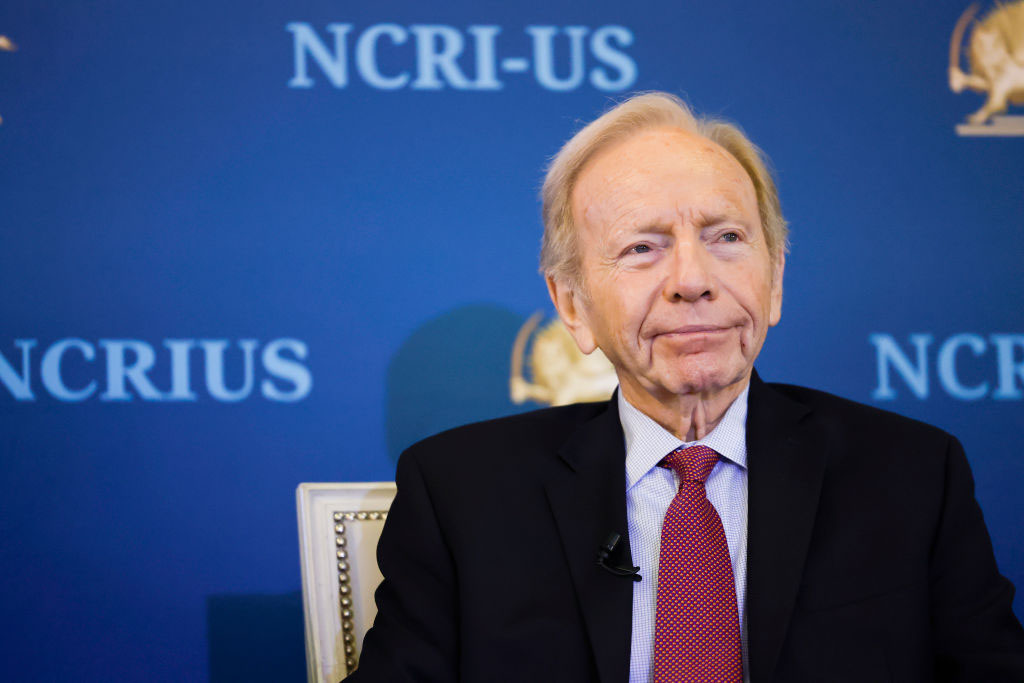
Joseph Lieberman, a longtime senator from Connecticut who as Al Gore’s running mate in 2000 became the first Jewish member of a major presidential ticket, died Wednesday. He was 82.
A statement sent to former staffers and reported widely said Lieberman had suffered complications from a fall.
A moderate — some would say conservative — Democrat turned independent, Lieberman was known for his attempts to build bridges in an increasingly polarized Washington, sometimes losing old friends and allies along the way.
He also became one of the most visible role models for Jewish observance in high places, in contrast to the largely secular Jewish politicians who had preceded him on the public stage. In 2011, he wrote “The Gift of Rest: Rediscovering the Beauty of the Sabbath.” In it he wrote how on Friday nights he would walk the roughly four miles from the Capitol to his home in Georgetown after a late vote so as not to violate Shabbat — to the bemusement and admiration of Capitol police.
In announcing that he would not be running for reelection in 2012, Lieberman spoke in emotional terms about what it meant for the grandson of Jewish immigrants to be considered for a role just a heartbeat from the presidency.
“I can’t help but also think about my four grandparents and the journey they traveled more than a century ago,” he said. “Even they could not have dreamed that their grandson would end up a United States senator and, incidentally, a barrier-breaking candidate for vice president.”
Vice President Al Gore and Joe Lieberman wave to delegates accepting the democratic nomination for president of the United States August 17, 2000. (Photo by Mark Wilson/Newsmakers)
That legacy, the first Jewish candidate on a major ticket, would be the Lieberman legacy to outlast all others, Ira Forman, the former director of the National Jewish Democratic Council, declared at the time.
“It was an electric moment,” Forman recalled of Gore’s choice of Lieberman in 2000. “It galvanized the feeling that everything is open to you.”
The pro-Israel lobby AIPAC memorialized Lieberman as “indefatigable in advancing pro-Israel policy and legislation.” He watched his onetime party drift away from his beloved Israel, and it pained him. Last week, in one of his last public statements, he excoriated Sen. Chuck Schumer, the Jewish senator from New York who called for new elections in Israel.
“Senate Majority Leader Chuck Schumer last Thursday crossed a political red line that had never before been breached by a leader of his stature and never should be again,” Lieberman wrote in the Wall Street Journal.
Lieberman’s religious orientation also came in to play when he emerged as a voice of traditional values within a party that he feared had surrendered the moral high ground to Republicans.
In 1998, he delivered a floor speech excoriating President Bill Clinton for his affair with an intern, Monica Lewinsky. He called his one-time friend “immoral” and said that Clinton had “weakened” the presidency.
The speech sent out shockwaves — news networks interrupted broadcasts to go to the Senate floor — but it also staved off calls for Clinton’s removal from office. It was credited with salvaging the presidency when the Senate subsequently rejected the U.S. House of Representatives’ impeachment. Through a Democrat’s excoriation of a Democratic president, Lieberman seemed to have punished Clinton enough.
Lieberman’s reputation for outreach to the other side defined his career in the Senate after he arrived in the body in 1989, having been elected after serving as Connecticut’s attorney general. His break with Democratic ranks in backing the first Persian Gulf War in 1991 helped him later in the decade, when he rallied Republicans to support Clinton’s military actions in Kosovo.
In 1992, when Clinton’s campaign was cold-shouldering Arab Americans, the community reached out to Lieberman, despite pronounced differences with him over Israeli-Palestinian issues, because of his reputation for fairness.
James Zogby, the president of the Arab American Institute, once recalled Lieberman’s outrage, and how after one phone call from the senator, Clinton’s headquarters in Little Rock, Arkansas, abashedly opened its offices to Arabs.
Yet it was at his very pinnacle — running for vice president — that signs emerged of how the subsequent decade would play out. He delivered an ineffective — some said even deferential — performance in his debate with Dick Cheney, George W. Bush’s running mate. And during the recount, he undercut one of Gore’s best arguments — questionable absentee ballots from the military — when he told NBC’s “Meet the Press” that they should be honored.
The real turning point came after the Sept. 11, 2001 terrorist attacks, when the Bush administration launched a political and diplomatic campaign to make the case for war against Iraq.
Like many other Democrats, Lieberman steadfastly backed war. But while many of his Democratic colleagues came to regret their decision, he stuck by it, and even made it the centerpiece of his 2004 campaign for the presidency. He was bitter when Gore, who opposed the war, endorsed Howard Dean for president that year.
Lieberman’s adamant backing of the war led to an insurgency in Connecticut. Liberal Democrats descended on the state to back his anti-war opponent, Ned Lamont, helping him win the primary. It didn’t help that at this late stage, when the Iraq war’s failure had become conventional wisdom, Lieberman wrote an Op-Ed in The Wall Street Journal backing Bush’s strategies.
Establishment Democrats, including a freshman senator from Illinois named Barack Obama, supported Lieberman in the primary but could not see a way to support him once Lamont prevailed. Lieberman ran as an independent, and with the Republican Party refusing to back its candidate, he won with votes from the GOP and independents.
In that election, Jewish Democrats were torn between their loyalty to the party and to Lieberman. Notably, the National Jewish Democratic Council stayed out of the fight.
That loyalty helped Lieberman capture a fourth term and proved he still had ties to the Democratic Party.
But that bridge burned when he made it clear that he’d back his old friend Sen. John McCain (R-Ariz.), the GOP candidate, in the 2008 election. Lieberman’s announcement led to a tense, whispered conversation with Obama on the Senate floor in which Obama reminded Lieberman of how he had made time to campaign for him against Lamont.
US Senator Joseph Lieberman (L) and US Senator John McCain arrive for the 50th Munich Security Conference in the Bayerischer Hof hotel on January 31, 2014 in Munich, Germany. (Photo by Joerg Koch/Getty Images)
Particularly galling for Democrats was Lieberman’s agreement to endorse McCain on the floor of the Republican National Convention in Minneapolis. McCain even considered Lieberman as a possible running mate.
“He put himself in a position where his longtime supporters, particularly the hard-core Democrats who had supported him over the years, could no longer defend him,” Marvin Lender, who raised money for Lieberman in 2006, recalled in 2011. “I say that recognizing he was a very loyal person to his old friend, but he crossed over a line when he did that and disappointed a ton of people.”
After the election, Obama made it clear that he wanted Lieberman to stay on his side. That meant Lieberman maintained his chairmanship of the Homeland Security committee while caucusing with Democrats.
He still had a bridge or two left to burn: On health care reform — a signature issue for Jewish Democrats — Lieberman equivocated until the last minute, ultimately casting his vote in favor.
His relationship with Obama remained cordial but tense. Lieberman took the lead in criticizing Obama’s approach to Israeli-Palestinian peacemaking as overly confrontational when Obama met last May with Jewish lawmakers.
Lieberman maintained his fierce independence until the end. His career cap was a nod to his more liberal sensibilities, when in the final weeks of 2010 he earned kudos from liberals for enabling repeal in the Senate of the “don’t ask, don’t tell” rule that had made it impossible for gays to serve openly in the military. Gay activists did not fail to notice that Lieberman stuck out the vote, even though it was on Shabbat.
Yet that also was a bridge burner of sorts. When Lieberman a few nights later attended a Republican Jewish Coalition party celebrating the GOP’s win of the U.S. House of Representatives, at least one GOP donor to Lieberman’s 2006 campaign buttonholed him and said he would never again give him money because of his success in leading the “don’t ask” repeal.
Lieberman smiled, said he had to do what he had to do and left the party.
“Senator Lieberman is a true mensch and a great American,” the RJC said in a statement at the time. “He showed that it’s possible to have a successful political career while doing what you feel is right — even when what’s right is not what’s in your political best interests.”
Last year he became a founding co-chair of No Labels, an independent group laying the groundwork to put a centrist “unity ticket” on the 2024 presidential ballot. After he wrote a Wall Street Journal op-ed titled “No Labels Won’t Help Trump,” few Democrats were persuaded.
Joseph Isadore Lieberman was born in Stamford, Connecticut, the son of Henry, who ran a liquor store, and Marcia (née Manger). His paternal grandparents emigrated from Poland and his maternal grandparents were from Austria-Hungary. He became the first member of his family to graduate from college when he received a B.A. in both political science and economics from Yale University in 1964. He earned his law degree from Yale Law School in 1967.
Lieberman served for 10 years in the Connecticut Senate beginning in 1970. From 1983 to 1989, he served as Connecticut Attorney General, emphasizing consumer protection and environmental enforcement.
Lieberman was first elected to the United States Senate in 1988, in a major upset over incumbent liberal Republican Lowell Weicker.
Following his retirement from the Senate, Lieberman returned to practicing law, and joined the conservative American Enterprise Institute think tank as co-chairman of their American Internationalism Project. He also held the Lieberman Chair of Public Policy and Public Service at Yeshiva University, where he taught an undergraduate course in political science.
In August 2015, Lieberman became chairman of United Against Nuclear Iran, a group fiercely opposed to efforts by the Obama administration to broker a deal with Iran over its nascent nuclear program.
“While Iran’s leaders may be prepared to make some tactical concessions on their nuclear activities, they would do so hoping that this would buy them the time and space needed to rebuild strength at home — freed from crippling sanctions — while consolidating and expanding the gains they are positioned to make in Iraq, Syria, Lebanon, Yemen and Afghanistan,” he wrote in an oped in 2013.
Lieberman was married twice. He and his first wife, Betty Haas, were married in 1965 and had two children, Matt and Rebecca; the couple divorced in 1981. In 1983 he married Hadassah Freilich Tucker, who was previously married to Rabbi Gordon Tucker, the former senior rabbi of Temple Israel Center in White Plains, New York. He is survived by his wife, his son and daughter and a stepson, Rabbi Ethan Tucker.
Just in time for Passover, Manischewitz is unveiling a new look, along with some new products. The leading kosher brand for more than 130 years, Manischewitz aims to invite a broader audience to explore the cultural richness of Jewish cuisine, while continuing its commitment to be a product line that brings family and friends together.
“The colors and graphics are now as warm and delicious as the food we make.” – Shani Seidman
“People have been purchasing the Manischewitz food products for generations,” Shani Seidman, CMO of Kayco, parent company of Manischewitz, told the Journal. “We wanted [Manischewitz] to still look and feel familiar, and it does, but the colors and graphics are now as warm and delicious as the food we make.” The goal, she said “is to remain true to the heritage while opening up the brand to those who may not know Manischewitz.”
The rebrand, which has been in the works for about three years, is a result of interviews with consumers and experts. Through on-site visits to Manischewitz headquarters, they delved into the historical roots of the company. According to their press release, this exploration highlighted the profound connection between Jewish culture, cuisine and the importance of family and food, while also addressing the societal challenge of defining Jewish food in a contemporary context.
“We hope the update will expand the reach to a younger Jewish audience, as well as everyone who is curious about Jewish food,” she said. “We want to invite Jews young and old and non-Jews to take a walk down the kosher aisle.”
The brand was founded in 1888 as a small bakery, built to make Passover matzah, by Rabbi Dov Behr Manischewitz, and is now part of New Jersey-based Kayco, a family-owned company. Over the years, Manischewitz has remained true to its origins, while adapting to the tastes and dietary needs of the modern consumer.
“We are very excited about our debut into the frozen category, and this year, people can find kosher for Passover and gluten-free frozen matzah balls and frozen knishes,” Seidman said.
Manischewitz will also introduce a new grapeseed oil, as well as new branding on traditional products, such as their complete line of matzah, matzah meal, gefilte fish, matzah ball soup, matzah ball mix, matzah farfel, mandlen soup nuts, chicken broth, macaroons, cake mixes and more. They will also be offering Manischewitz merchandise online that feature ”Yiddishisms” reflecting the brand’s Jewish heritage.
Some of the updated lines and Yiddishisms include:
• I’m cooking my tuchus off
• The Soup with Balls
• Bubby knows best but we are a close second
• Delicious food’s always been our schtick
• Great taste runs in the family
• Live love latke
• For small talk or dinner table spiels
• Soup with chutzpah
“Manischewitz is not just about food; it is about stories, heritage, and a sense of belonging,” Seidman said. “Through this rebranding, we aim to capture the hearts of the culturally curious and kosher-keeping alike, offering a taste of Jewish tradition that is accessible to all.”
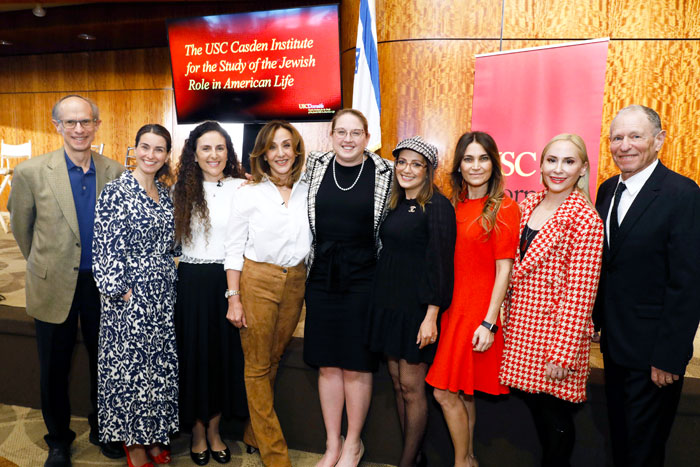
The USC Casden Institute, Sinai Temple and the Jewish Community Foundation of Los Angeles partnered to recognize the contributions of Iranian Jewish women in literature and academia and to commemorate Nowruz, the Persian New Year, for the Los Angeles Jewish community.
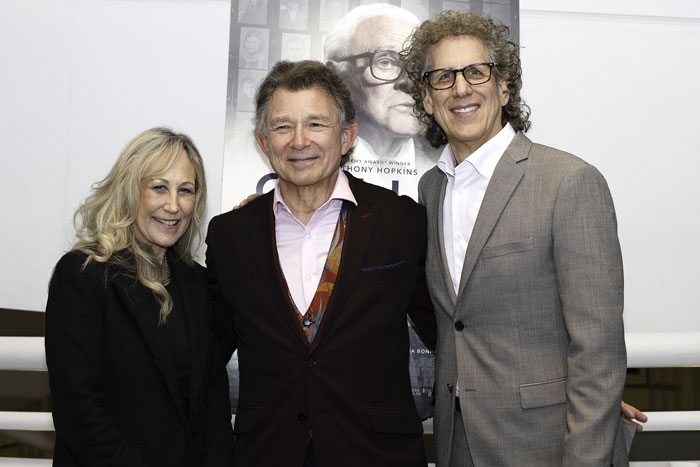
From left: Los Angeles Jewish Film Festival Director Hilary Helstein; Nick Winton, son of Sir Nicholas Winton; and Simon Wiesenthal Center CEO Jim Berk. Photo by Todd Felderstein
The Los Angeles Jewish Film Festival, Simon Wiesenthal Center and AKLA held the Los Angeles premiere of the drama “One Life,” starring Anthony Hopkins, at the Museum of Tolerance on March 14.
The event opened with a reception sponsored by the David and Janet Polak Foundation. The program drew an audience of 300 and featured an introduction by Sir Nicholas Winton’s son, Nick Winton, sharing that March 14 marked the anniversary of the first transport of children from Czechoslovakia to the U.K.
The audience was moved to tears at the end of the screening by the surprise live appearances and introduction of several children of the children that Winton saved.
The film is currently playing in theaters across Los Angeles.
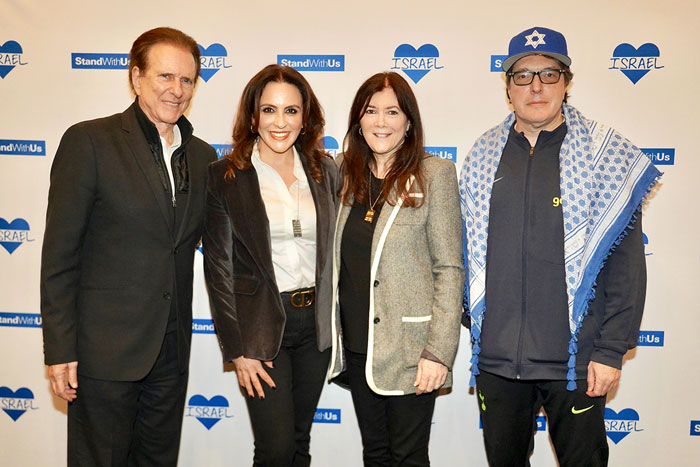
From left: Rabbi David Baron, Beverly Hills City Councilmember Sharona Nazarian, StandWithUs CEO Roz Rothstein and Beverly Hills City Councilmember John Mirisch attend a screening in Beverly Hills. Photo by Orly Halevy
Nearly five months since the Oct. 7 attack on Israel, a raw and chilling documentary about that day’s Nova music festival massacre screened at the Saban Theatre in Beverly Hills.
The film, “#Nova,” features minute-by-minute video and audio shot and recorded by victims of music festival attack in Israel as they fled for their lives, phones in hand.
At the Nova music festival, more than 300 partygoers gathered at an outdoor trance music festival near Israel’s border with Gaza were killed. The film shows what they experienced, from the festivalgoers arriving at the party and dancing through the night, to them fleeing for their lives after the arrival of gunmen from Gaza.
The hourlong film was shown at the Beverly Hills venue on March 4.
Nova massacre survivor Talia Biner attended the screening and shared her personal story as well as her reaction to those who’ve cast doubt about Hamas’ atrocities on Oct. 7.
“You’ve seen what happened to us. All the videos you saw I have those in my cell phone, I have watched them and still [watching the screening] … was the hardest thing I’ve done in a while,” she said from the Saban stage. “I didn’t speak about what happened to me. Only after two months did I realize people were saying the things that I heard, and the things that I saw, didn’t happen.”
Briner, who worked as a surgical nurse before Oct. 7, brought a guitar onstage and performed a song she wrote about the experience.
Before the screening, StandWithUs CEO Roz Rothstein and Temple of the Arts Rabbi David Baron delivered remarks, and Temple of the Arts Cantor Nathan Lam recited a prayer.
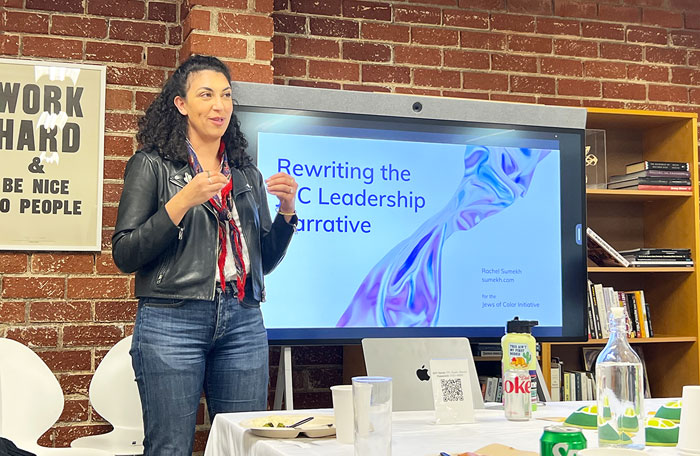
Community leader Rachel Sumekh leads the workshop, “Rewriting the JoC Leadership Narrative,” on March 13 in Beverly Hills. The event was designed to highlight stories about Jews of color. The Jewish Community Foundation of Los Angeles provided support. Photo courtesy of Jews of Color Initiative
Our tendency to look for the blameworthy often hides a simple truth: There’s more than one party to blame. Such is the case with the current tension between Jerusalem and Washington. Israel’s government “lost Washington in six months,” commented a leading Israeli commentator. But a reverse headline would be as valid: The U.S. government “lost Jerusalem in six months.” Of course, one could argue that it’s Israel who needs Washington more than the other way around. And yet, as Israel fights an existential war that the U.S. aims to affect, losing Jerusalem is a problem. And losing the argument is a problem.
When the war started there was a short honeymoon: President Biden demonstrated his commitment to Israel’s security in a way that Israelis admired. What happened since then? There are two basic story lines available for those wanting to answer the question. One — Israel was not attentive enough to American requests and wishes, did not present a day-after strategy that the administration could work with and dragged its feet on humanitarian aid. Two — the Biden administration lost patience, attempted to limit Israel’s options to win the war, became nervous for domestic political reasons, and aired naive ideas about the prospect for a day-after peace initiative.
These two storylines aren’t similar, but they are also not mutually exclusive. You could pick one of the two, or pick both as explanation for a disturbing reality. Indeed – the Israeli government did not present a clear plan for the future. Indeed – the Americans lost patience and the U.S. doesn’t seem like the formidable, intimidating presence on which Israel can rely for deterrence. Indeed – Israel is somewhat indifferent to reports about human suffering in Gaza. Indeed – Washington says it wants Israel to win the war, while also saying it doesn’t want Israel to do the things that could bring about victory.
There are many Israelis – and probably many Americans as well – who’d say it is all politics. Biden is engaged in an election campaign, Netanyahu is trying to boost his meagre approval rating by “standing up” to Washington. In both cases, I don’t think that’s the full story. Surely, both men are politicians, and as such, they always have political considerations as well as other things on their minds. But in this case, an attempt to belittle the debate as if it is all about winning Michigan, or reengaging disillusioned Likud voters, would be to testify to our own state of mistrust of all politicians more than about the actual situation.
Take Rafah as the most critical example. Israel says that winning the war without going into Rafah, where most senior Hamas leaders currently hide, would be impossible. The U.S. says that going into Rafah, where a million and a half civilians currently have shelter, would be a recipe for disaster. Israel says: Rafah can be evacuated before we go in. The U.S. says: We are not convinced, because you didn’t yet solve the humanitarian situation in other areas. And so on and so forth, without end, because this debate is not just about tactics – what can be done in a certain situation, can Israel win without it, can Israel do it without causing disaster, etc. – it is also about priorities. For Israel winning is the utmost priority. For the US winning is one of many priorities. For Israel, winning is an existential need. For the US, it is not.
Thus, both governments climbed the Rafah tree and keep climbing. Almost daily, PM Netanyahu vows “to act in Rafah even without American approval.” Almost daily, a Biden official warns Israel of “consequences.” When VP Kamala Harris was asked whether there would be consequences if Israel enters Rafah, she responded in this cryptic manner: “We’re going to take it one step at a time … I am ruling out nothing.” So, an Israeli leader would not be able to save face without going into Gaza, and an American leader would not be able to save face if Israel goes into Rafah. A tall tree indeed, from which a fall could be devastating.
A compromise must be one that lets Israel do what it needs to do to win the war and let the U.S. get a tangible achievement to boot. For example: Israel would accept the idea that a reformed Palestinian Authority would be the best candidate to run Gaza when the war is over. Is it a good idea? Many Israelis think it is not. The coalition is based on parties who think it is not. And yet, if winning is the utmost priority, such a declaratory move seems like a small price to pay if it leads the two countries off the Rafah tree.
If Israel can win the war without the U.S., this might be enough. If Israel can keep a strong alliance with a formidable U.S., this also might be enough. Losing both is the worst option.
Because right now Israel has a problem. Its ability to deter its very real enemies is built on several pillars, two of which are at risk. One is its ability to decisively defeat an enemy – and this ability is currently limited by the US. The other is its alliance with the world’s most powerful country – and this alliance currently seems more fragile than it used to be. In other words: If Israel can win the war without the U.S., this might be enough. If Israel can keep a strong alliance with a formidable U.S., this also might be enough. Losing both is the worst option.
Something I wrote in Hebrew
The government set a date for an annual Memorial Day for the Simchat Torah massacre. But the date is not an easy one to remember:
The massacre’s Memorial Day will be a day of uncertainty, at least until a tradition is established – if a tradition is established. Some Israelis will follow the government’s date, the Hebrew date of Tishrei 24, others will follow the date they remember, Oct. 7. Of course, personal and communal decisions will also have a sectoral nature. Religious Israelis will not commemorate a massacre during a holiday. Seculars might do just that. Religious Israelis will dance with the Torah in Simchat Torah. Seculars – or some of them – might feel that this is not the right day for joy.
A week’s numbers
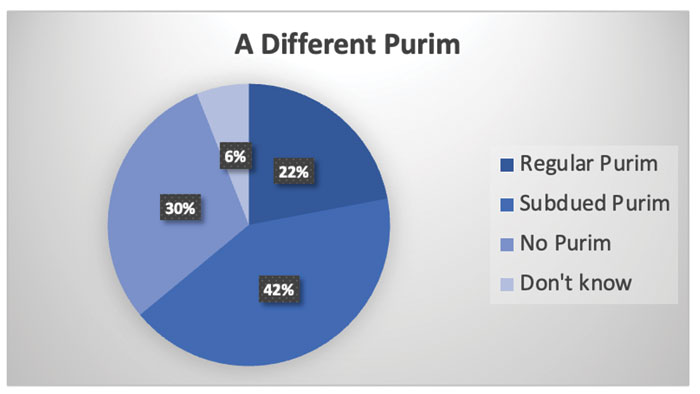
Israeli Jews were asked before Purim how they plan to celebrate this day of overstated joy. The answer, as you’d expect, was “not as usual” (Maariv poll):
A reader’s response:
Edi Bronstein wrote: “If Israel loses America it will not be able to survive.” My response: losing America would be devastating, and yet there are many countries in the world who survive without American support.
Shmuel Rosner is senior political editor. For more analysis of Israeli and international politics, visit Rosner’s Domain at jewishjournal.com/rosnersdomain.
Since Oct. 7, the Jewish community has been subject to hatred, bullying and gaslighting. In mainstream media and on social media, on city streets and college campuses, online and off, we’ve been viciously attacked after one of the most horrifying days in Jewish history.
So why should we stay silent?
Now is when we need to speak up.
Some Jews are afraid to speak up because they believe they will lose their friends. News flash: If your friends don’t like you for saying something, they were never your friends in the first place.
Other Jews are afraid to speak up because they don’t want to deal with the possible online trolls who will come their way. You know what? You could ignore them; they’re mostly fake accounts, anyway.
Some Jews stay quiet because they don’t want to deal with the drama; they are too emotionally exhausted. I understand this one very well, and of course, I empathize with this point of view. At times over these past few months, I’ve had to step back from writing my columns and putting up posts on social media to get a breather and recharge.
But I’ve found that when I come back and I’m outspoken, it gives my fellow Jews strength and courage to also say something. And that gives me the energy to keep going.
People have asked me, “Aren’t you worried there will be pushback?”
I’ve certainly gotten pushback, but I ignore it and block my fair share of people on the internet. Overwhelmingly, I’ve gotten support from my fellow Jews, as well as non-Jews who stand up for us.
I’ve certainly gotten pushback, but I ignore it and block my fair share of people on the internet. Overwhelmingly, I’ve gotten support from my fellow Jews, as well as non-Jews who stand up for us. Receiving messages that I put a smile on someone’s face during these distressing times is an incredible feeling. It means I’m fulfilling my mission to make the world a better place.
Recently, I spoke at the JNF-USA conference about anti-Israel bias in the media, and a woman came up to me afterwards and told me how disappointed she was in her progressive friends. She’d supported all the progressive causes, and yet, when Oct. 7 happened, all her friends abandoned her. All the news she listened to was extremely anti-Israel. She was pushed out of her social circles and changed her views right then and there.
“Speak up,” I told her. “Write about it.”
“You think people want to hear from me? I’m scared no one will care, or that people will come after me,” she said.
“Your voice is needed, especially now. People will appreciate it.”
Just last week, she got her first column published in a major Jewish newspaper. She’s been receiving praise and feels encouraged to keep speaking up and writing about her experiences.
In this moment, we can’t be silent. In fact, it’s the opposite: we must be shouting at the top of our lungs. We shouldn’t worry about whether or not we’ll come across as “the good Jew” – the time for that is over. We must stand up for Israel, for Judaism, for God. We must stand up for truth. We must stand up for what is right.
I know that at first, it’s a little scary. Hey, it was also scary for Nachshon to be the first Jew to jump in the Sea of Reeds. Once the water was up to his nose, though, the sea parted, and the Jews were able to pass, escape the Egyptians and receive the Torah in the desert, fulfilling their mission.
I urge you, too, to take that leap of faith.
We only have to fear Hashem. And as Jews, it’s our job to spread Hashem’s love and light in this world, which means we have to be outspoken.
So, take a stand. The world needs your voice now… more than ever.
When was the last time you went a solid 24-48 hours without checking email, texts, social media or any digital apps?
For me, it was 18 years ago, on the last day of my Birthright trip to Israel. My Motorola Razr was useless outside of the U.S. It was also the last overseas trip I took before the iPhone was released in 2007, unleashing a new era in digital technology . There is little doubt that every day since then, I have checked social media, email and/or used a smartphone. That’s 6,640 consecutive days and counting. Though the smartphone gave me the magic power to identify any song just by listening to it (via Shazam, still my favorite app of all time), digital connectedness has slithered into most waking moments of our lives.
The American Academy of Pediatrics said in 2020 that “on average, children ages 8-12 in the United States spend 4-6 hours a day watching or using screens” and that “teens spend up to 9 hours.” A 2012 Pew Research Center survey found that 30% of adults say they are “almost constantly” online. The U.S. Surgeon General highlighted a 2016 study that concluded that “Social isolation, or even the perception of isolation, can increase inflammation in the body to the same degree as physical inactivity.”
Enter Reboot. An organization founded in 2001 as “a small group of imaginative young Jews who greeted the new Millennium with a desire to manifest Jewish lives full of meaning, creativity and joy,” according to its website. In 2009, Reboot created the “National Day of Unplugging,” based largely on the customs of Shabbat. It was created in part with an organization called Sabbath Manifesto, founded by digital artist Dan Rollman and Jessica Tully, the creator of the cellphone sleeping bag.
In 2020, Unplug Collaborative, a nonprofit dedicated to digital wellness awareness, took over the campaign. In 2023, they changed the name from “National Day of Unplugging” to “Global Day of Unplugging.” The it’s celebrated over the first weekend of March, but any day will do to make room for a restorative pause.
The Journal spoke with the co-founder of Unplug Collaborative, Kim Cavallo, about their mission.
“If we’re going to combat loneliness as a society, we need to address the issue of stepping away from technology and reconnecting with what makes us human, which is really about our relationships, our interests and anything beyond the screens,” Cavallo said.
She first learned of the Day of Unplugging in 2018 when she was working in the digital wellness. She kept hearing from people about it and finally Googled it. Cavallo was amazed to see who was behind it. The CEO of Reboot, David Katznelson and Cavallo’s husband Rob had known each other for three decades from their days co-producing The Muffs 1993 debut album at Warner Bros. Cavallo served as an ambassador for National Day of Unplugging from 2019-2020 until she was brought on as executive director and board chair of Unplug Collaborative. It was renamed Global Day of Unplugging in 2023.
From its roots in Reboot 15 years ago, the initiative has blossomed well beyond being just an offshoot of Shabbat.
“It went from a kind of Jewish Shabbat to, ‘oh wow, well, Christians and Muslims also have a Sabbath’ and other secular experiences built in this ‘taking time away’ ritual,” Cavallo said.
But for many people, the notion of completely unplugging, even for just 24 hours, can feel intimidating in our digitally-tethered age. That’s why the organizers emphasize that the Global Day of Unplugging is less about absolutes and more about raising conscious awareness.
“Nobody’s asking you on Earth Day to just give up your worldly items and become the most recyclable,” Cavallo said. “It’s just about consciousness and awareness and conversations. Check! You’ve participated! That’s it. We’re just trying to raise people’s consciousness and the awareness around the idea that this is a problem.”
“Nobody’s asking you on Earth Day to just give up your worldly items and become the most recyclable. It’s just about consciousness and awareness and conversations. Check! You’ve participated! That’s it. We’re just trying to raise people’s consciousness and the awareness around the idea that this is a problem.” –Kim Cavallo
Cavallo suggests easing in with baby steps tailored to your own habits — something as simple as while streaming something on Netflix, consciously putting the phone out of reach. And if that’s easy enough, consider taking it a step further and turn off notifications during that time. There is no question that unhealthy digital dependencies can harm our relationships and sense of presence. Which is why Cavallo emphasizes that it’s important to treat others (and ourselves) with patience and respect when presenting a conscious unplugging.
“We try not to shame people or make anybody feel like they have a problem,” Cavallo said. “As a society, we have a problem.”
Whether it’s unsuspecting fans at baseball stadiums getting hit by foul balls in greater numbers, or distracted drivers who can’t seem to lay off their phone, the addiction is getting worse. This year, the generation of people who have only known a world where iPads exist turn 14 years old. If you’re 17 and in the developed world, a day hasn’t gone by without a smartphone within an arm’s reach. It’s so ubiquitous that it’s important to check ourselves without judgment, and use unplugging as an opportunity to look up from our devices, and reconnect with each other and ourselves. By taking an intentional pause from our usual online engagements, the Unplug Collaborative encourages creating a space to celebrate the artistry, relationships and experiences that imbue life with true richness beyond rote screen time.
“I think people want this kind of prescription on how to do this…there is no prescription. This is just a moment in time that you can take,” Cavallo said.
Cavallo also mentioned the Log Off Movement, a non-profit led by high schoolers and college students since 2020. Though unrelated to the Unplug Collaborative, the Log Off Movement aims to help kids, teens, and young people build healthy relationships with social media and online platforms.
“These are young people that are like, ‘we grew up with this and we can see what our problems are,’” Cavallo said. “I look at them and I think, wow, you’re my role model, honestly. And by the way, people that have young kids, let’s think about before Smartphones. Somebody told me ‘when you greet your kid after school, have a smile on your face, obviously not forced or fake, but think of something beautiful, see their face, because that’s the energy that you’re giving them.’”
But what about the fear of missing out (FOMO) while unplugged?
For so many people oscillating between digital burnout and being addicted to their devices, the Global Day of Unplugging represents a vital recalibration and possibly enduring an anxious feeling of being left out.
“Let’s turn that on its head a little bit and think about what we are missing out on?” Cavallo said. “How about that kind of collective experience of even those moments in time where everybody knew the same thing, or they were listening to the same music because it was released on a medium that you could only get access to in a certain way, and it wasn’t on-demand? My kids are in their 20s and they’re constantly saying, ‘I’m jealous of you, that you had those moments where it was like everyone was talking about this one thing.’”
Cavallo also brought up how a friend of hers, as a New Year’s resolution, decided that every day in 2024, he was going to listen to an album from start to finish. He even made a spreadsheet and he rates them.
But unplugging doesn’t have to be a solitary experience. This year, the Unplug Collaborative is partnering with dating app Hinge to fund events that encourage real-life interactions, particularly targeting the Gen Z demographic. Their year-round program, Unplug Collab, has a micro-grant for anyone who wants to plan an event. It doesn’t have to be a major event — a book club or a small intimate dinner would suffice. It’s bankrolled by dating app Hinge, in partnership with several get-out-and-connect organizations: OneTable Shabbat, Don’t Tell Comedy, Moishe House, Repair the World, SoundMind, Conversationalist, ProjectBe, Go-Out, What the Dance and Club Rewire.
From now through April 2024, they are taking applications for and supporting 100 events as part of the partnership with Hinge “to combat loneliness and encourage meaningful, mindful, community gatherings.” Their only rules: The event must be in real life (IRL), attendees must include at least 50% Gen Z (ages 18-28), and unplugging must be encouraged. If selected, the host of the event will be sent funding, and mailed “smartphone nap-sacks” for people to stow away their phones during the duration of the event. The website has a list of over 200 ideas on what to do when you’re unplugged. Hinge even mailed out printed booklets in the shape of a smartphone, with 55 pages of ideas. Although this “Hinge Phonebook” is out of stock at the moment, a PDF is still available on the Hinge website. If you’re in the L.A. or New York area, Unplugged Collaborative will set you up with a videographer and photographer to make shareable content about the event. So far, they’ve already funded about 25 out of the 100 available grants.
A ‘smartphone napsack’ at an Unplug Collaborative-funded event
“I know people that are like, ‘oh, hey, I’m in my 20s and I want to get together and play football with a bunch of my friends,’ so we’re going to pay for the equipment,” Cavallo said. “There’s a carwash fundraiser happening this week, and we’re going to pay for the supplies for the carwash. Hinge wanted us to be able to make it easy for people to gather. That’s the whole point. Figure out what it will take to get you off your phone and out of your house. Hinge has really done this great thing for us and allowed us to power up these IRL events and gatherings.”
Though the 2024 Global Day of Unplugging has come and gone like our elusive attention spans, any day or any hour seems ripe for conscious, deliberate unplugging.
It’s just … different. Normally you say your goodbyes, and all you have to think about is the next time you’ll visit one another. You recount the good times you just had during the visit, and you’re sad about how long it will be before the next one. And that’s the end of it. This time, it’s just … different. Ask anyone who lives in Israel, and has left the country for even a weekend away since Oct. 7. Ask them how it feels to return home and they’ll likely tell you it’s … different. It’s complicated. Emotions are mixed.
You miss Israel, you love Israel, you hate the government, you love the government (okay maybe that’s a stretch), you need the war, you hate the war, you are proud to fight, you are scared to fight, you hate the Palestinians, you mourn for the Palestinians. And yes, I’m likely projecting much of how I feel, living here in the Diaspora of the United States. I worry about Israel, and I worry about my family and friends who are there, while they also ironically worry about us here.
When Adi’s brother Adam came for a visit with his son Malachi, one of the first questions he asked us was if it was safe to wear a kippah in Disneyland. The guy just released from the Israeli Reserve duty, needed to know if his Judaism could be safely on display at the Happiest Place on Earth. We assured him that anything could happen, but that our experiences (including recently) at Disney were as warm and friendly (and expensive) as ever, and we had no negative experiences with ME wearing my kippah. In fact, when we visited California Adventure during this past Hanukkah, they were playing Jewish holiday music in Hebrew on the loudspeakers! And true to form, we had no ugly encounters. But that’s not to say it isn’t happening far more frequently on the streets and campuses, and they are seeing that in Israel, and feeling sorry for the U.S.
At the same time, it’s scary watching Adam return, and his own feelings of safety and security have been heavily compromised. He lives in the North, in the gorgeous area near Tsfat. He’s a tour guide there, used to giving tours to happy visitors of all nationalities and religions. Birthright trips full of college kids hooking up with one another while also learning about the land and history. But now instead of tourism, there are rockets being mostly intercepted by the Iron Dome. Instead of lullabyes, there are emergency sirens. Instead of warm beds, there are children sleeping on the floor of the master bedroom, as their sense of security and safety has been infiltrated. With every online message of support from abroad come two (sometimes) anonymous messsages of hatred.
Until now, the war has mostly been in the South, where all we talk about is Gaza. But as things wind down there, and Hamas will hopefully be physically (if not ideologically) destroyed, there’s Iran’s proxy of Hezbollah in the North Israel has to worry about. They have more money, more backing, more of an organized infrastructure, more and better weapons, and some speculate an even more advanced terror tunnel system. That’s the north. That’s close to where Tsfat is. That’s where tons of rockets are already being fired. A day after he returned, 50 rockets landed in Meron, just a 10 minute drive away.
As Israel watches its allies in the U.S. and the rest of the world grow weary of the conflict, the war may be shifting from one region that wishes to kill Jews, to another. Apparently the world believes in self-defense, but only to a point. If any Western country was attacked incessantly, with a stated goal of eradicating that country of its citizens, few would say a word until that threat was eliminated. When the same happens to Israel, many turn the victim into the oppressor, and those who realize that Israel must defend itself, also insist it end as soon as their political leaders determine it is hurting their own cause. It may have taken 6 years to defeat Germany and Japan, but if it takes 6 months to defeat Hamas, we’ll say you’re using excessive force, and causing a humanitarian crisis. Apparently the allied powers of WWII didn’t cause a humanitarian crisis when they bombed the world into the ground to stop the Axis powers. All those farmers and civilians from occupied France to Germany itself, must have just loved being in a warzone, and losing their homes, and members of their family to “collateral damage”. Nobody ever looks back at WWII, and says we should have stopped fighting before we captured and destroyed the Nazis. But I digress …
Normally we say goodbye to our loved ones, as they fly back to their normal lives, but what is normal about the lives they fly back to at this moment in time? I pray for my friends and family in Israel, and I pray for a swift end to this war, but not before those trying to kill them are no longer a threat to their safety.
Boaz Hepner works as a Registered Nurse in Saint John’s Health Center. He moonlights as a columnist, where his focuses are on health, and Israel, including his Chosen Links section of the Journal.
Katie Workman spent her childhood reading cookbooks the way others devour books.
“My mom was a great cook, my sister and I grew up cooking in our house … my father was a book publisher and published a lot of cookbooks,” Workman, founder of the Mom 100 website, told the Journal. “We love food [and] we love entertaining.”
When she was growing up, Workman says she made Toll House chocolate chip cookies constantly. She also made Bisquick coffee cakes every Sunday, until her family begged her to stop. “How many coffee cakes can one family eat?” she said. “When I was 12, I got a [hand crank] pasta machine for my birthday, and I used to make pasta all the time … there was always pasta hanging over the back of chairs in our house.”
Workman, author of “The Mom 100 Cookbook” and “Dinner Solved,” and a food writer for the Associated Press, started her career as an assistant cookbook editor and then cookbook editor. As she moved her way up the publishing ladder, she got farther away from cookbooks and food.
“I love cooking, I love feeding people and I love writing,” she said. “When I left book publishing, I became the founding editor-in-chief of a website that no longer exists; it was a recipe based website and an incredible learning experience.”
Then an editor friend approached Workman about writing a cookbook.
“I had the idea for “The Mom 100 Cookbook,” which is 100 recipes every mom needs in her back pocket,” she said. “It was an answer to the everyday cooking challenges, conundrums that parents face, day-in day-out when they’re cooking for their families.”
Whereas many cookbook authors get discovered from their blog, Workman’s journey was the reverse.
“I started the blog as sort of a companion to the cookbook because [in] 2012 food blogs were becoming a thing and you needed an online presence of some sort,” she said.
TheMom100.com started as a “supporting character” to both of her cookbooks; then it started taking off. So Workman shifted her focus.
“It was a ‘go big or go home’ moment,” she said. “I was either going to make the website into something that was going to be a real job or I was going to find something else to do; it ended up becoming a real job.”
Workman says her Jewish background has influenced some of her recipes, and her Jewish recipes, like noodle kugel and brisket, are some of the most popular ones on the site.
“We’re food Jews as much as anything else,” she said. “We definitely express our Jewishness through cooking and through the holiday meals, such as Passover, Rosh Hashanah, break fast and Yom Kippur.
She adds, “Those meals and foods associated with them were definitely a very, very intrinsic part of my, my childhood.”
If Workman had to pick a favorite Jewish recipe, it would be latkes.
“I had a latke party this year, which we often do,” she said. “I made 200 latkes and there were only like three of four left.”
She adds, ”This is the other part of me that’s Jewish; thank God there was some left, because if I had actually run out of food, that would have been devastating.”
Comfort foods are big in her online presence, as well as in Workman’s house.
Tacos, which she often makes with ground turkey, are a particular favorite. Recipe is below.
“Were this Jewish. New York family, and our comfort food is a Mexican or a Tex Mex dish,” she said. “I make my own taco [seasoning] blends, which I spent an enormous amount of time creating.”
She makes the seasoning in batches, and is taco-ready at any moment. Workman can have tacos on the table in 30 minutes.
Comfort foods inspire a visceral reaction, and there’s nothing like it.
“When somebody says, ‘What are you making?’ [And the answer is] ‘Chicken pot pie, chicken and dumplings, steak and potatoes,’ you have a natural longing for it,” Workman said. “It doesn’t just have to be ‘American food,’ [which is] a weird big bucket.”
There are pockets of food throughout the country, and around the world, that are beloved within their location or culture. They are just out there, waiting to be discovered.
“I love food that the first time that you eat it, you think, ‘Oh, where has this been all my life?’” Workman said.
These old-school hard shell tacos made with ground turkey will become a much-loved part of the weekly rotation.
Photo courtesy themom100.com
Ingredients
For the Taco Seasoning:
2 teaspoons onion powder
1 teaspoon kosher salt
1 tablespoon chili powder
1 teaspoon cornstarch
2 teaspoons ground cumin
1 teaspoon garlic powder
½ teaspoon dried oregano
½ teaspoon sweet paprika
½ teaspoon ground black pepper
Pinch cayenne or red pepper flakes (optional)
For the Ground Turkey Tacos:
2 pounds ground turkey
12 Taco shells (approximately)
To Serve (Choose Your Family’s Favorites):
Shredded lettuce
Salsa or taco sauce
Diced tomatoes
Diced avocados
Instructions
Preheat the oven to 350° F.
In a small bowl or plastic container, mix together the onion powder, salt, chili powder, cornstarch, cumin, garlic powder, oregano, cumin, paprika, black pepper, and cayenne or red pepper flakes, if using. Blend well.
Spray a large skillet with nonstick spray and place over medium-high heat. Add the turkey, and cook, stirring and making sure to really break it up into small crumbles, until it is browned throughout, about 5 minutes. Drain off any liquid. Add the spice mixture and stir for 1 more minute so that you can smell all of the spices. Add ¾ cup of water, and stir until the water is mostly evaporated, and the meat is evenly coated with the spices, and there is still a little bit of liquid in the pan.
Meanwhile, heat the taco shells on a baking sheet (or right on the rack, whichever you prefer) in the oven for 5 minutes until warm and toasty. Place any desired toppings into small individual bowls. Transfer the meat to a serving bowl, place the shells on a plate covered with a napkin or clean dishtowel to keep them warm, and set out with the bowls of toppings. Let everyone serve themselves.
Notes
Leftover taco meat can be kept in the fridge for up to 4 days. Reheat in the microwave or in a skillet over medium heat, stirring often.
Debra Eckerling is a writer for the Jewish Journal and the host of “Taste Buds with Deb.” Subscribe on YouTube or your favorite podcast platform.Email Debra: tastebuds@jewishjournal.com.
Readers of the Sunday New York Times had their hands full last weekend with a 4000-word screed warning of an impending catastrophe in American Jewish identity and Israel-diaspora relations. The author’s hypothesis is that we are in for a great “rupture:” American Jews will either become Trumpian fellow travelers or stick to our progressive leanings and renounce Zionism. I was tempted to use the familiar “track-changes” tool to insert comments and corrections after each of Peter Beinart’s paragraphs, but I’ll focus here on just some of the doozies.
Let’s look first at his misuse of terms such as “liberalism,” by which he really means a kind of left-leaning progressivism that in its most familiar flavors tilts away from genuine liberalism. Words matter to the logic of arguments, so right from the start we should take Beinart’s thesis with a grain of salt. (Having read him for years now, I admit to being on a high sodium diet.) Definitional rigor aside, Beinart rehearses the increasingly popular fiction that there has always been a conflict between Zionist nationalism and liberal democracy. We see a lot of this nonsense these days, usually coated in veneers of “settler colonialist” and “ethnonationalist” rhetoric, even from historians and rabbis exalting the virtues of Jewish exile, signing letters decrying Israeli “apartheid,” or affiliating with avowedly anti-Zionist congregations (such as Tzedek Chicago). They may have been infected with postmodernist antibodies to factual evidence, but the New York Times, if not Beinart, should know better: Do the names David Ben Gurion, Ber Borochov, and Golda Meir ring any bells? Has the word Histadrut been redacted from the Times editors’ desk references? As a more learned writer cogently put it in a recent issue of Liberties, “liberal nationalism…is the philosophy that guided Israel’s founders” (italics added). I can imagine Beinart wincing at my omission of Ze’ev Jabotinsky, Menahem Begin, and Bibi Netanyahu; but even as Israel has drifted from utopian aspirations of the kibbutz generation, as socialist labor is no longer the country’s dominant political ideology, and as religious/geographical extremism has reared an ugly head, the suggestion that a Jewish state is the enemy of liberalism – in either Beinart’s or in the correct definition of the term – is historically and theoretically bankrupt.
Beinart argues deceptively that “from 1948 to 1966, Israel held most of its Palestinian citizens under military law… [and] since 1967 … has ruled millions of Palestinians who hold no citizenship at all.” Although it is true that a form of military law was in place, he conveniently omits Israel’s efforts throughout that period to afford rights and economic opportunity to the Arab minority. As at least one legal historian has shown, “Starting in the late 1950s, Israeli policy makers … adopted measures to promote the integration of Arab workers into the civil service and other predominantly Jewish institutions and businesses…” Those were policies which, “though not yet called ‘affirmative action’ would be recognized as such today.” (In the US that idea – presumably on Beinart’s list of good liberal policy – came later, was always hotly debated, and is now essentially outlawed.)
As for the plight of Palestinians post-1967, it is true the occupation has brought misery; but it is worth noting that since the Oslo accords much of the West Bank has been under Palestinian civil rule and that from 2005 to last October Israel has had neither political nor military control of Gaza. Moreover, by measures of progress in higher education, infant mortality, literacy, LGBTQ rights, and economic productivity, life actually improved in the contested territories starting roughly in 1968. American Jewish liberals who worry about inequality, racial justice, and the slow pace of improvement for African Americans and other minority groups might want to look to their Israeli cousins for inspiration. In any case, the tiresome refrain that Israel has to choose between being Jewish and democratic is fundamentally flawed, for reasons I tried to enumerate in a recent post on the Medium website. My argument, briefly, was that anyone who thinks Israel cannot be Jewish and democratic should have witnessed the massive protests during most of 2023, bringing together a remarkably diverse and dedicated crowd of believers in “demokratia,” as it said on many of their tee shirts. And if that’s not enough evidence of a deeply rooted commitment to democratic values – including the right to protest – then how the movement pivoted, after October 7, into a stunning display of collective responsibility, certainly should arouse at least some affection, if not optimism, about the sturdiness of Israeli democracy. For context, liberal Americans who protested the war in Vietnam, as I did, never got close to the sustained numbers of Israelis who came out against their government’s ill-advised reform plans.
Beinart builds from the false accusation that Zionism = supremacy (if this sounds like a famous UN resolution of 1975, it’s not coincidental) to make his case that American Jews “[who] understand that liberal America is becoming less ideologically hospitable… are responding by forging common cause with the American right.” His evidence? Somewhat predictably, he exploits what most liberal-minded Jews I know regretted, namely the Anti-Defamation League’s decision to honor Jared Kushner. Whatever plausible political calculations might have motivated ADL leadership, the part of the story that Beinart omits is the visceral reaction of so many American Jews who were puzzled and dismayed by the Kushner prize.
This sort of cherry-picking is Beinart’s forte. He selectively harvests unripe findings from recent surveys, adds sour interpretations clearly of his own imagination, and cleverly neglects data that might challenge his project. For example, he talks about “American Jews who are … jettisoning Zionism because they can’t reconcile it with the liberal principle of equality under the law …” But hold on: where in the Gallup or Pew data questionnaire are there items that directly address tensions between Zionism and “equality under the law?” I don’t mind a bit of literary license, but this is truly reckless driving. It is true that some results point to changing attitudes of American Jews, which people who care about the future of Israel-diaspora relations (especially those who work on college campuses) find very concerning. And yes, some American Jews are siding with Hamas in the current war, even to the point of carrying banners calling for global intifada. But here’s some data Beinart skipped: even with the recorded shifts, “nine-in-ten U.S. Jewish adults (89%) say that, regardless of how acceptable they find the way Israel is carrying out the war in Gaza, Israel’s reasons for fighting Hamas are at least somewhat valid, including 74% who say its reasons are completely valid.” Does that sound like “jettisoning?” Though Beinart mentions the “generational divide,” how to interpret the gap between 18–29-year-olds and those over 65 is not obvious. But to the extent that a nontrivial number of youth who want “Palestine free from the river to the sea” don’t know which river or which sea, I would add a few more grains of salt to Beinart’s stew.
Beinart’s coup de [dis]grace is his choice of literary sources. Edward Said? Really?? Even the traditionally left-leaning Ha’aretz newspaper saw through Said’s slime, and ran a commentary blasting this “idol of the Puritan left” for his role in blinding many people to the threats of Islamist fanaticism, not exactly irrelevant to the post-October 7 eruption of antisemitism worldwide. Beinart has been touting the one-state solution since at least 2020, so it’s not surprising he would cite Said, who had been pushing that idea since he became disillusioned by the Oslo process (circa 1993). As the distinguished historian Efraim Karsh revealed in his 2003 book called “Arafat’s War,”, Said once opined that “I don’t find the idea of a Jewish state terribly interesting… the Jews are a minority everywhere. They are a minority in America. They can certainly be a minority in Israel.” Does Beinart agree that the story of Israel is not interesting? (He sure spends a lot of time and op-ed space on a boring topic.) Does he agree that it’s time for Jews to return to their minority status everywhere in the world? Good to know.
Is there anything in Beinart’s centerfold that is worth contemplating? For sure. But there is so much brush to clear and so many offensive slurs embedded in it that I’m afraid many readers will just be overwhelmed. Aside from his slippery use of data and selective omission of historical evidence, what’s disturbing in the argument is its tone of inevitability. Like many commentators these days, Beinart suffers from a self-imposed blockade in the supply chain of humility. Worse, though, try as he might, he can’t quite conceal his schadenfreude in reporting on the impossibility and imminent demise of liberal Zionism.
What might a lover of Zion do with the same data? Join me in a quick mind game. Suppose for a moment that for all kinds of legitimate reasons American Jews are disturbed by the suffering in Gaza, which for some of them intensifies their quandary over loyalty to Israel and loyalty to liberal democracy (a rift that had already been festering before October 7). Suppose also that some of their misgivings stem from incomplete knowledge or misunderstanding of wickedly complex problems, and not from a foundational hostility to Jews or Judaism or even Israel. This would be an occasion to provide constructive guidance and reinforce, rather than further weaken, ties between American and Israeli Jews who still care (and who are, thankfully, still in the majority). It would be an occasion to correct some of the hyperbolic anti-Israel “reporting” that has so blurred people’s capacity to know what is going on. (Readers should check a recent article by an urban warfare expert at West Point, in Newsweek, March 25.) Tragically though, Beinart used his primo real estate in the Times for a different purpose: to pour fuel on the flames of ignorance and perpetuate a rhetoric that lays blame for the whole conflict – including decades of Arab intransigence and Palestinian terrorism – primarily or solely on Israel.
Might there be a rupture between liberal-minded American Jews and Zion? Yes, but instead of trying to prevent it, Beinart seems to be enjoying the prospect. Is it too coy to suggest that from the rupture he finds rapture?
Michael Feuer is dean of the Graduate School of Education and Human Development and professor of education policy at the George Washington University. The views expressed here are his own, and do not necessarily represent the school, the university, or its leadership.











 Workman, author of “The Mom 100 Cookbook” and “Dinner Solved,” and a food writer for the Associated Press, started her career as an assistant cookbook editor and then cookbook editor. As she moved her way up the publishing ladder, she got farther away from cookbooks and food.