fbpx

March 8, 2024

The Answer to Antisemitism

The answer to antisemitism is pro-Semitism. Loud and proud.

Jews need to arm themselves—with knowledge. How many Jews have read Jewish history and are familiar with one of the most important stories of all time? Jewish history dates back three thousand years and includes contact with the Assyrian, Babylonian, Persian, Roman and British Empires. Paul Johnson’s “A History of the Jews” is a classic.

How may Jews have read celebrated Yiddish writers, translated into English, like Sholom Aleichem or Isaac Bashevis Singer, who won the Nobel Prize for Literature? Or contemporary Israeli novelists, like David Grossman or Amos Oz, who rank with the best in the world.

How many Jews have explored Jewish source texts, like “Ethics of the Fathers,” an ancient source of experience and wisdom? Adam Kirsch’s book, “The People and the Books: 18 Classics of Jewish Literature,” is just one example of a survey of Jewish source texts.

Judaism is a religion, but it is also an ethnicity, a civilization, a culture, a history, a font of knowledge and experience rooted in the land of Israel, but not limited to its ancestral homeland. Jews had kingdoms in Israel thousands of years ago, as recorded in the books of the prophets and the innumerable archaeological discoveries yielding evidence of the Jewish presence there.

Judaism is the abused parent of its children, Christianity and Islam. Without Judaism, there could be no Catholicism, Protestantism or Islam. Without Judaism, there would be no western civilization as we know it, as Paul Johnson makes clear in his book. Jews have contributed immensely to every society in which they have lived. Jews constitute 0.2% of the world’s population—less than half of one per cent—and yet have been awarded 32% of the world’s Nobel Prizes.

The answer to antisemitism may well be creating alliances with sympathetic non-Jews to tell the truth and expose unfounded conspiracy theories, along with other approaches, but first and foremost Jews themselves need to know their own past, their history, and their contributions to the world. No people is deserving of pride more than Jews. Understanding Judaism as a force for good throughout history, in Israel and the diaspora, should be a source of great satisfaction and inspiration.

Dr. Norman Lewis, in Unherd, a British publication, reminds us of Saul Bellow’s comment that Jews are the only people in the world still unable “to take the right to live as a natural right,” making it easy for Jews to be the world’s perennial victims. However, victimhood is not in anyone’s best interest. When Jews consider themselves victims, it allows antisemites to define them, and Jews become objects, rather than subjects, of history. Jews have, admittedly, been victims throughout history, but it has not prevented great scholarship and great achievement, values we cherish today. These values arise from Jewish ethical monotheism, the foundation from which profound insights historically emerged from this astounding people. It is the positive aspects of the Jewish experience that must be learned, taught and shared.

The sad truth is that Holocaust education, while essential, is incomplete when it comes to telling the story of the Jews. It shows Jews as victims and neglects the fact that, both before and after the Second World War, Jews were culturally vibrant, intellectually creative and a positive contributor to society.

The creation of the State of Israel was not only a response to antisemitism and the Holocaust. It was a return to an ancestral homeland to create an independent state that would be a positive force for contributions to humankind. And the “Start Up Nation” has accomplished that goal in many fields—agriculture, medicine, science, technology—in only 75 years.

Unless Jews recognize their identity as a dynamic force for good throughout history, whether in the ancestral homeland or in the diaspora, they risk falling prey to frustration and defeatism, always on the defensive. Jews cannot assume their identity if they do not cultivate a sense of pride. Jews cannot expect others to respect them if they do not respect themselves. Jews cannot respond to unfair accusations without a firm and profound knowledge of the facts at their command.

The response to antisemitism is the continued development of proud and knowledgeable Jews, steeped in their tradition, secure in their identity, affirming the truth with confidence and living productive and satisfying lives. Only from such a people can we look forward to a thriving future.

Socrates’s “Know thyself” is not only a philosophical imperative for the individual; it is an essential call to a people to discover its own identity.


Dr. Paul Socken is Distinguished Professor Emeritus and founder of the Jewish Studies Program at the University of Waterloo.


The Answer to Antisemitism Read More »
John Ondrasik on New Pro-Israel Single: “I’m Just a Guy Who Sees Evil and Doesn’t Like It”

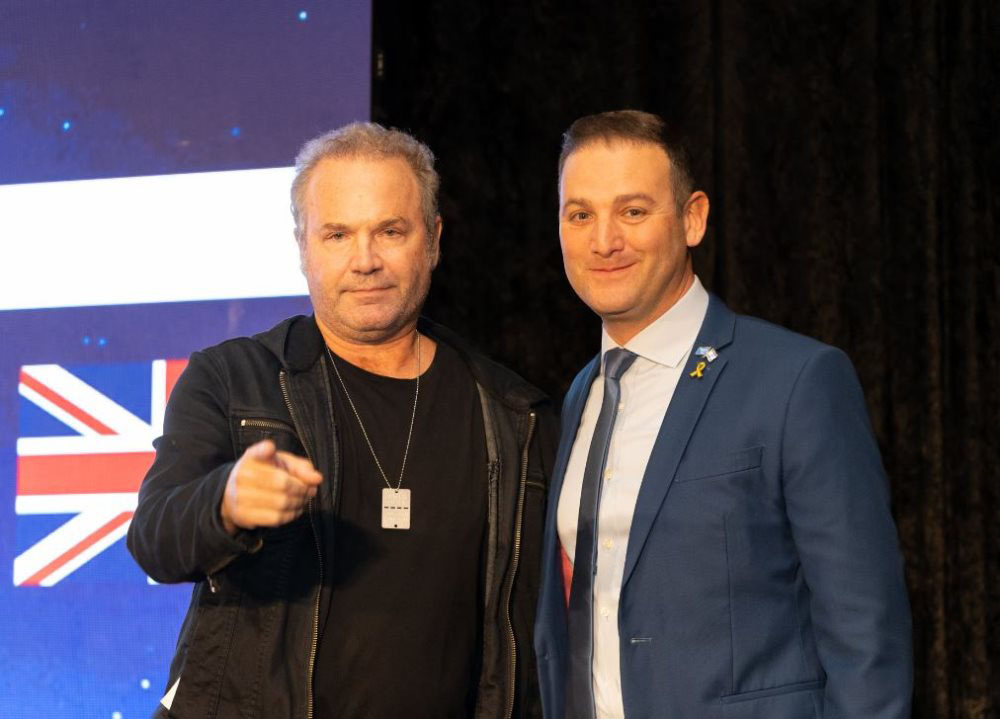
John Ondrasik, who performs under the stage name Five for Fighting, released a new single last January, “OK.” He discussed it with the Journal following the evening session on Mar. 2 of StandWithUs’ Israel in Focus International Conference at the Los Angeles Hilton Airport Hotel.

The music video for “OK” begins with New York City Mayor Eric Adams (D) saying, “We are not alright” and shows images of the Oct. 7 massacre as well as pro-Palestinian protesters celebrating the massacre. In the chorus, Ondrasik — who is not Jewish — sings the haunting words “we are not okay” in his trademark falsetto heard on the hit songs “Superman” and “100 Years.”

“I’m just a guy who sees evil and doesn’t like it,” Ondrasik said. “I’m a guy who loves freedom, I supported our troops — I do a lot of songs with our troops — I see what our troops have died for and I see this country on our campuses becoming this rotted out, antisemitic radical institutions. I just don’t like it. I’m no different than anybody else, I just can write a song and sing it. We all have a role to play.”

He added that “you have to stand up. The first line of that song is, ‘this is a time for choosing.’ There’s no gray area anymore.” The last image in the video is a photo of Martin Luther King, Jr. and the quote “He who accepts evil without protesting against it is really cooperating with it.” “It’s not hard,” Ondrasik said. “It’s funny, sometimes I kind of get offended when people say, ‘Why are you doing this?’ And I understand that it’s a legitimate question, but it shouldn’t be … everybody should be doing this.”

When Israel shared the “OK” video on social media, “I got a quick education on what it means to be Jewish in this world … The vitriol, the death threats and all that stuff … But what I didn’t expect were the thousands of emails from Israelis and Jewish people around the world who really feel abandoned by the arts,” Ondraski said. “They’ve been saying, ‘Where is the arts? Where are the people standing for us? We stand for so many of these other groups under threat, and the arts have been silent.’”

He added that “it’s not about Israel or Jewish people, it’s about common sense and decency and compassion and calling out evil where it exists, which seems to be something that our industry cannot do,” which he said is “a historic shame.”

Ondrasik recalled the 2001 concert organized by former Beatle Paul McCartney at Madison Square Garden in which “every living icon in the music business was there to stand with New York and condemn Osama bin Laden … Where the hell are those people?” he asked. “They’re not 25 being brainwashed on TikTok. So the silence of so many of those — many of them who are Jewish —that was depressing.”

He has talked to some artists who say, “I’m afraid for my family, I don’t want my concerts being protested … That’s all legitimate,” he acknowledged. “I get it. That’s not wrong. I’m experiencing some of that myself. But what I say to them is, ‘You guys, you understand this is the same the same arguments they used in 1938?’ It’s the same arguments. And with each voice we get stronger… and you don’t have to love Israel. If you can just come out and say, ‘Raping women at a concert, kidnapping grandmothers, beheading babies is bad, we condemn that.’ Can’t even say that.” The song is really about the “cultural decay of America and the world where you can’t come out and say that, and that cannot stand,” Ondrasik said.

He is planning to do a “We Are The World”-like international collaboration for “OK.” “It’s all connected,” said Ondrasik. “Hamas is connected to Iran, [which] is connected to [Russian President Vladimir] Putin, who’s frankly connected to the U.N. It’s all the same evil actors.” In the “OK” video, Ondrasik sings the words “evil is on the march” as the video shows images of Putin, Iranian Supreme Leader Ayatollah Ali Khamenei and United Nations Secretary-General Antonio Guterres.

“So, we’re going to do a global version of this song with Ukrainian artists, with Israeli artists, Iranian dissidents to make the point that this is about anti-evil,” Ondrasik continued. “It’s not about what happened 500 years ago somewhere, it’s about simple anti-evil actors, and hopefully that message will be one where the press cannot ignore, but also may inspire other artists who may be on the fence a little bit to join the right side of history. It will be interesting to see who does.”

Ondrasik is partnering with organizations like StandWithUs and the American Jewish Committee (AJC) for this collaboration. “We’re just looking for people to join our mission,” he said. “You can be a singer, you can an influencer, you could be an organization, it could be anybody that wants to make a statement, ‘We are not okay. We understand that, and we stand together to change this.’ So it’ll be interesting to see how far it can go… and then if that accomplishes what we hope it does, then we’ll do some kind of concert.”

He has never been to Israel before, but thinks he’ll be there “very soon.”

Ondrasik’s message to pro-Hamas protesters celebrating the Oct. 7 massacre: “Unfortunately some of them are so far gone it’s like a cult. There’s no message that will get through. But if there are people who have an open mind and open heart, I would just say: ‘What if it was your daughter who was raped at a concert? What if [it was] your baby who’s still kidnapped … what if your grandmother was tortured? Is that something under any circumstance that is acceptable?’ Sadly, many of them will say yes.”

The singer-songwriter called it a “generational battle” and stressed the importance of getting the message out “to the kids.” He alleged that while his “OK” video went viral on X, it hasn’t been shared by TikTok users, and argued that more artists — especially younger artists — need to “push back,” especially on college campuses. “We need to take the fight to the college campuses,” said Ondrasik. “We need to go sing this song on the college campuses and walk through the campuses proudly. I think so many people are on defense, I think we need to go on offense, because we’re in the right.”

Ondrasik, a UCLA alumnus, is “ashamed that I went to this school, and this is a legacy that many alumni feel … we need to go to these schools and we need to hold them accountable and sing these songs and stand with folks who have sanity and put them on notice that we’re not going to accept it. We’ve already lost a few presidents, probably a good idea to lose a few more.”

He has not yet been to a college campus to perform “OK,” but shortly after the interview he claimed to have at least 30 students come up to him and ask if he could perform at their campus. At the end of his address during the plenary to attendees, Ondrasik gave out his phone number so students experiencing hate on their campuses can contact him for support. “It just breaks my heart when I talk to them and they’re 16 years old, 18 years old on the front lines of this historic generational battle,” Ondrasik said. “But you look in their eyes and they’re strong, and they have fortitude, and they have compassion. So tonight’s really given me a lot of hope for the future in a time where there’s a lot of hope in my mind.”

John Ondrasik on New Pro-Israel Single: “I’m Just a Guy Who Sees Evil and Doesn’t Like It” Read More »

Too Soon for Humor?

Since October 7th, the Jewish community has been in mourning. Grief is a narrow-minded emotion, with little room for much else; and certainly no room for humor. And yet, even in the worst of times, people have to laugh; it’s more or less instinctive.

Daniel Gordis wrote about a conversation he had:

We were coming out of Minchah yesterday afternoon, and the sky had darkened considerably in the very short time we’d been inside. .. I said to a friend who was standing next to me, “What’s with the clouds? Is it going to rain? I thought it was supposed to be clear this week.”

“No,” he said, “Cloudy with a chance of war.”

I burst out laughing, as did he. It was hilarious. But also not.

This sort of laughter feels transgressive. We are torn, wondering if it is insensitive to make jokes, both in general, and about this horrible war.  In November, an article in Yediot Achronot asked: Are we allowed to laugh yet?

A quick glance at Jewish sources yields an unequivocal no. Halakha employs a rigid etiquette that separates joy and grief. It is unseemly if mourners are jovial during shiva; the Talmud writes Rav Pappa said…A mourner should not place a young child in their lap because the child will bring them to laughter, and they will be disgraced in the eyes of other people, because they laughed while in mourning. (Moed Katan 26a.) In another passage, the Talmud goes further, requiring everyone to practice self-denial to connect to the communal pain, and says:  Reish Lakish said: It is prohibited for a person to have conjugal relations in years of famine (Taanit 11a.)

Yet these proscriptions don’t always fit ordinary life. (For this reason, later halakhic commentaries often treat these passages as general guidance rather than an absolute religious obligation.) Laughter is found in the darkest moments, and tears at the peak of joy; most people can’t separate their emotions into neat little compartments, to be pulled out at will when needed. As Gordis realized that afternoon, laughter can arrive without an invitation.

“Hogan’s Heroes” was a popular television show when I was young. It was a sitcom about the escapades in a Nazi P.O.W. camp, where the prisoners constantly fooled the hapless Germans. Even as a child, I  was bewildered by the show; in reality the Nazis were brutal and efficient, nothing like the characters on Hogan’s Heroes. Later I learned that four of the characters on the show, including those of the three senior Nazis, were played by Jewish refugees from Europe; the parents of Leon Askin, who played the German General Albert Hans Burkhalter on the show, were murdered in Treblinka. This was even more confounding; how could Jewish refugees play Nazis on TV, just 20 years after the war?

While the line between bad taste and good comedy is elusive, Hogan’s Heroes may have landed on the wrong side of what is appropriate. But perhaps a partial defense of this bizarre show can be offered by Robert Clary, who played Corporal LeBeau, a French P.O.W. Clary was a survivor of Buchenwald, who lost his parents and 10 of his siblings during the Holocaust. When he reflected on his experiences later in life, he said his ability to sing, to laugh, and to entertain enabled him to survive. Yes, a good joke can sometimes be the difference between life and death; and during the Holocaust, many used jokes as a tool of survival.

Several books and articles have been written about Holocaust humor, and a number of the jokes have been preserved. (One example: “Every day in the ghetto is like a holiday. We sleep in a Sukkah, dress up like it’s Purim, and eat like it’s Yom Kippur.”) The most thorough academic study of this phenomenon is Itamar Levin’s Hebrew work “Through the Tears.” In his introduction, Levin writes about the different purposes of humor. Sometimes it is the “weapon of the weak,” who get a measure of retribution by mocking their Nazi tormentors. But the larger purpose was to preserve people’s sanity when insanity was the natural reaction, and to give people hope when everything looked hopeless.

Rabbi Jonathan Sacks once offered a comment critical of Roberto Benigni’s “Life is Beautiful,” a film about how a father saved his son’s life during the Holocaust by making jokes. Rabbi Sacks wrote that he disagreed with the film’s thesis that humor can keep you alive.  After a speech, a Holocaust survivor approached Sacks to correct him on this point. Rabbi Sacks writes:

“You are wrong,” …(he) said to me, and then, he told me his story. He and another prisoner in Auschwitz had become friends. They reached the conclusion that unless they were able to laugh, they would eventually lose the will to live. So they made an agreement. Each of them would look out, every day, for something about which they could laugh. Each night they would share their findings and laugh together. “A sense of humor,” said the survivor, looking me in the eyes, “kept me alive.”

Sacks then realized that these Holocaust jokes could be heroic and life-sustaining. Reflecting on this later, he wrote: “I cannot say I understand such courage, but I found it awe-inspiring.”

The Halakhic proscriptions against joy in times of grief are quite meaningful; they emphasize the moral obligation to mourn the death of a beloved relative. These rules are necessary because sometimes a Shiva house can feel like a party, with copious food and chatter about golf games and vacations.

However, even at the worst of times, joy must never disappear; Hasidic thinkers have stressed how central joy is to one’s religious identity. This emphasis is not just because of joy’s spiritual importance; recognizing the enormous pain Jews carried from years of exile, the Hasidic masters saw happiness and laughter as the way to heal long-standing psychic wounds.

Even Tisha B’Av, the most tragic day on the Jewish calendar, is recast as a time of joy. First, there is the extraordinary explanation of the Chozeh (Seer) of Lublin to the Talmudic phrase “when the month of Av enters, one reduces joy.” This is ordinarily understood as meaning that one must already diminish joy nine days before Tisha B’av. The Chozeh had a dramatic rereading of this text; he read it as meaning that when the dark month of Av arrives, one diminishes the pain of the month by adding joy! This idea was reflected in practice as well. Some Chasidic Jews had the custom to play pranks on each other on Tisha B’Av; oftentimes it was the children throwing berelach, little brambles during Kinot to lighten up the mood. Chasidic leaders felt that the Jews in Eastern Europe had lived with too much distress, and that a painful Tisha B’Av would do more harm than good.

A similar insight is offered regarding the corresponding phrase “when the month of Adar arrives, we increase joy.” The Sefat Emet notes that Adar is the month that is repeated in a leap year, (such as this year,) when there is a doubling of the month of joy. This, he explains, underlines the centrality of joy; and Jews need as much joy as they get.

Purim this year will be different. A tragic war is still ongoing; much like Av, it will be difficult to laugh. Yet at the same time we need to find a way to lift our spirits, to find that double portion of joy that two Adars bring.

I am a big of the Israel sketch comedy show “Eretz Nehederet.” One of the recurring sketches is of Asher Ben Chorin (Yuval Semo), who is a parody of the average Israeli taxi driver who says outlandish things to his passengers. (The passengers are all in on the joke before they enter the car.) One of the segments in November was exceptional. Semo was driving evacuees from the communities near Gaza in his taxi. He started with his ordinary jokes, talking about how being an evacuee is now a “status,” and remarking to one couple, who were being housed in the Royal Beach Hotel, “that when I was on my honeymoon I didn’t go to such a good hotel.” To Tomer and Guy, two young men from Kfar Aza, he says “you should consider moving to somewhere calmer – maybe Dagestan” before declaring that what was really needed “is to rebrand Kfar Aza, and give it a different name – like Neveh Steinman.”

But then the conversations changed in tone. He takes Noa, a young mother of three from Sufa, who explains that her husband went out that morning to defend their Kibbutz and never returned. Yes, there are jokes in their conversation; when he asks Noa how her kids are, she says “annoying – as always.” She explains that her will return to Sufa because it was her husband’s birthplace and home, and that is where they belong. The conversation ends in tears and a hug.

In his conversation with Tomer and Guy, Tomer tells Semo that both his parents, Ram and Lily, were murdered. Semo says that for the first time in 30 years, he is at a loss for words. Tomer continues, and says that his sister said it is almost a month since their parents’ deaths, and Tomer needed to smile; that is why he signed up to be on the show.  And then he adds that it had been his father’s dream to be in Semo’s taxi sketch. The conversation continues on about Tomer’s parents, before ending with Semo wisecracking “Don’t think I’m not going to charge you for this ride.”

From beyond the tears, these gentle jokes honor Ram and Lily; and Tomer and Guy’s smiles carry their legacy. Sometimes, laughter is the right way to grieve; and their tears and smiles combine to leave them stronger.

This Purim we too will laugh and cry; and both the smiles and the tears will honor the legacy of the fallen. Laughter has helped the Jewish people survive. Joy sits at the center of the Jewish soul.

And that is why it is never too soon for Purim, never too soon for a joke.


Rabbi Chaim Steinmetz is the Senior Rabbi of Congregation Kehilath Jeshurun in New York.

Too Soon for Humor? Read More »

What Did Biden Say About Israel at the 2024 State of the Union?

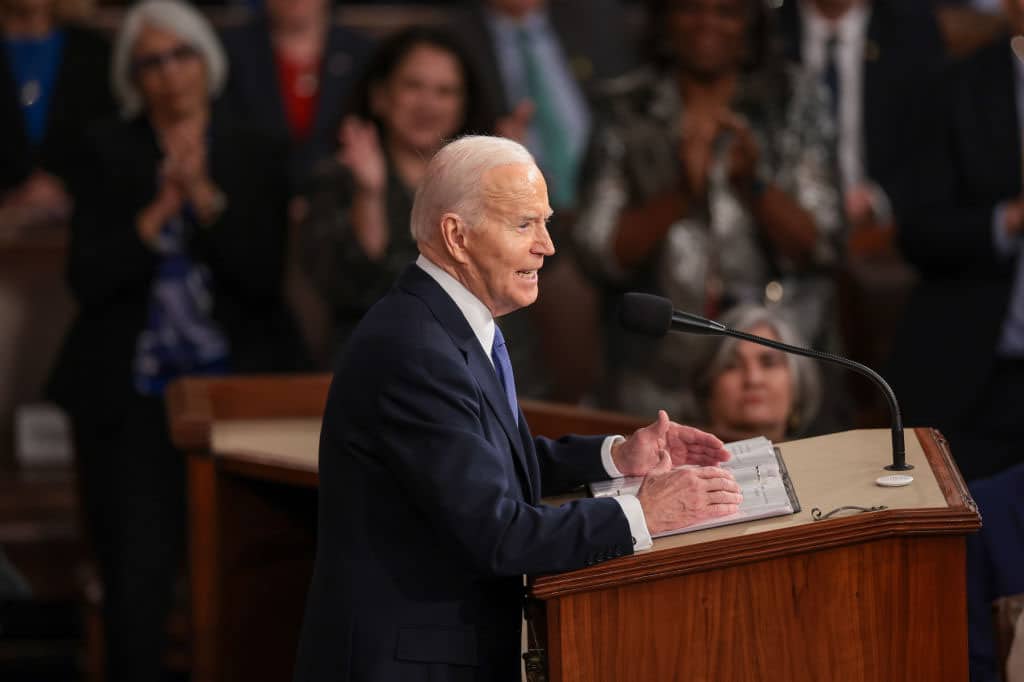
President Joe Biden gave his State of the Union Address Thursday, March 7 in the U.S. Capitol, and opened his remarks with reference to the rise of Naziism.

“In January 1941, President Franklin Roosevelt came to this chamber to speak to the nation. He said, ‘I address you at a moment unprecedented in the history of the Union.’ Hitler was on the march. War was raging in Europe. President Roosevelt’s purpose was to wake up the Congress and alert the American people that this was no ordinary moment.”

Fifty-four minutes later, Biden made his first mention of Israel. He made his overarching viewpoint clear, saying that “Israel has the right to go after Hamas.” He also pointed out that among the nearly 1,000 people in attendance in the House Chamber were families of hostages being held by Hamas. “I pledge to all the families that we will not rest until we bring every one of your loved ones home,” Biden said, drawing applause from the joint session of Congress .

Earlier in the day, excerpts of Biden’s speech were leaked, revealing a plan “directing the U.S. military to lead an emergency mission to establish a temporary pier in the Mediterranean on the coast of Gaza.” In the speech, Biden reiterated that “no U.S. boots will be on the ground” in Israel.

The President also spoke directly to Israel’s leadership about the obligation to minimize civilian casualties as they continue the mission to eliminate Hamas and bring the remaining hostages home safely.

“To the leadership of Israel, I say this: humanitarian assistance cannot be a secondary consideration or a bargaining chip.”

Viewers of Biden’s speech also caught glimpses of members of the House and Senate showing their support for Israel by wearing white stickers with “153” written on them — the number of days since October 7th that hostages from Israel have been in captivity. U.S. Rep. Brad Schneider (D-Ill.) was spotted handing out the stickers to House and Senate Members before the speech. Schneider also wore a steel dog tag around his neck signifying his support to bring the hostages home.


View this post on Instagram


A post shared by Rep. Brad Schneider (@repschneider)

The Journal identified several lawmakers also wearing the 153 sticker, including Rep. Steve Cohen (D-Tenn.), Rep. Gerry Connolly (D-Va.), Rep. Madeleine Dean (D-Pa.), Rep. Josh Gottheimer (D-N.J.), Rep. Jared Moskowitz (D-Fla.), Rep. Tom Suozzi (D-N.Y.), Senator Jon Tester (D-Mont.) and Rep. Debbie Wasserman Schultz (D-Fla.). The Jewish Insider reported about 60 members wore the “153” sticker.

As his guest, Schneider brought Abby Polin, the aunt of Hersh Goldberg-Polin, a 23-year-old abducted by Hamas from the Nova Music Festival on Oct. 7. “It’s been 153 days since Hamas invaded Israel and took 240 hostages, and 143 hostages remain,” Schneider wrote on X. “153 days is 153 days too many; our message tonight is simple: bring the hostages home now.”

Gottheimer brought Adi Alexander, father of hostage Edan, 20, and Jonathan Dekel-Chen, father of hostage Sagui Dekel-Chen.

Speaker of the House Mike Johnson (R-La.) brought as his guest Mia Schem, 21, a French-Israeli hostage held captive by Hamas for over 50 days.

Mia Schem, freed Israeli hostage who was abducted by Hamas, attends President Joe Biden’s State of the Union address (Photo by Anna Moneymaker/Getty Images)

Senator Lindsey Graham (R-S.C.) brought as his guest Ruby Chen, father of American-Israeli hostage Itay, 19.

“Itay is one of the eight Americans still being held hostage in Gaza,” Graham wrote on X.

Senator Joni Ernst (R-Iowa) had Itay’s mother Hagit Chen as her guest. Itay is a dual U.S.-Israeli citizen serving in the Israel Defense Forces. He was abducted from a Nahal Oz military base in southern Israel on October 7th.

Senator Ted Budd (R-N.C.) brought Lucy and Hanna Siegel as his guests. They are family members of Chapel Hill native and Hamas hostage Keith Siegel, 64.

Three Members of the House, Rep. Rashida Tlaib (D-Mich.), Rep. Cori Bush (D-Mo.) and Rep. Summer Lee(D-Penn.) wore Palestinian keffiyehs to the State of the Union. Bush invited Dr. Intimaa Salama, a Palestinian dentist and graduate student at St. Louis University, as a guest. “Thirty-five people in her family have been killed in Gaza,” Bush wrote on Instagram.

Below is a transcript of Biden’s remarks about Israel and the Middle East during his address:

“As we manage challenges at home, we’re also managing crises abroad, including in the Middle East. I know the last five months have been gut wrenching for so many people, for the Israeli people, for the Palestinian people, and so many here in America. This crisis began on October 7th with the massacre by a terrorist group called Hamas. As you all know, 1,200 innocent people, women and girls. Men and boys, slaughtered after enduring sexual violence. The deadliest day for the Jewish people since the Holocaust. And 250 hostages were taken. Here in this chamber tonight are families whose loved ones are still being held by Hamas. I pledge to all the families that we will not rest until we bring every one of your loved ones home.

“We will also work around the clock to bring home Evan and Paul — Americans being unjustly detained by the Russians and others around the world. Israel has the right to go after Hamas. Hamas ended this conflict by releasing hostages. — Laying down arms … could end it by releasing the hostages, laying down arms and surrendering those responsible for October 7th. But Israel has a, excuse me — Israel has an added burden because Hamas hides and operates among the civilian population like cowards — under hospitals, daycare centers, and all the like. Israel also has a fundamental responsibility though to protect innocent civilians in Gaza.

“This war has taken a greater toll on innocent civilians in all previous wars in Gaza combined. More than 30,000 Palestinians have been killed, most of whom are not Hamas, thousands and thousands of innocent women and children, girls and boys also orphaned. Nearly 2 million were Palestinians under bombardment or displacement. Homes destroyed, neighborhoods in rubble, cities in ruin, families without food, water, medicine. It’s heartbreaking. I’ve been working nonstop to establish an immediate ceasefire that would last for six weeks to get all the prisoners released, all the hostages released. We get the hostages home and ease the intolerable humanitarian crisis and build toward an enduring more—something more enduring. The United States has been leading international efforts to get more humanitarian assistance in Gaza. Tonight, I’m directing the U.S. military to lead an emergency mission to establish a temporary pier in the Mediterranean on the coast of Gaza. They can receive large shipments carrying food, water, medicine, and temporary shelters. No U.S. boots will be on the ground. A temporary pier will enable a massive increase in the amount of humanitarian assistance getting into Gaza every day.

“And Israel must do its part. Israel must allow more aid in Gaza, ensure humanitarian workers aren’t caught in the crossfire. They’re announcing they’re going to have a crossing in Northern Gaza. To the leadership of Israel, I say this: humanitarian assistance cannot be a secondary consideration or a bargaining chip. Protecting and saving innocent lives has to be a priority. As we look to the future, the only real solution to the situation is a two-state solution over time.

“And I say this: as a lifelong supporter of Israel my entire career, no one has a stronger record with Israel than I do. I challenge any of you here. I’m the only American President to visit Israel in wartime, but there is no other path that guarantees Israel security and democracy. There is no other path that guarantees that Palestinians can live in peace with peace and dignity. And there’s no other path that guarantees peace between Israel and all of its neighbors, including Saudi Arabia with whom I’ve been talking. Creating stability in the Middle East also means containing a threat posed by Iran. That’s why I built a coalition of more than a dozen countries to defend international shipping and freedom of navigation in the Red Sea. A board of strikes to degrade the Houthis capability and defend U.S. forces in the region. As Commander-in-Chief, I will not hesitate to direct further measures to protect our people and our military personnel.”

What Did Biden Say About Israel at the 2024 State of the Union? Read More »

Celebrate Pi(e) Day with these Treats

March 14, or 3/14 is Pi Day.  PI is a mathematical constant, equal to approximately 3.14159. Get it? It’s the perfect opportunity to enjoy pie and explore new recipes.

“It uses heavenly ingredients, and it is sinfully delicious.” — Sarah Zulauf

Sarah Zulauf’s strawberry-peach pie is gluten- and refined sugar-free. It’s also guilt-free! “I love this sweet and tangy strudel-style pie,” Zulauf told the Journal. “It uses heavenly ingredients, and it is sinfully delicious.”

Zulauf is the founder of Sarah’s Organic Gourmet; her delicious and healthy treats are available at Bibi’s Bakery and Cafe on W. Pico Blvd in Los Angeles. 

Strawberry-Peach Pie

Gluten- and Refined Sugar-Free 

Fruit Mixture
4 cups peaches
2 cups strawberries
4 Tbsp date sugar
1 tsp vanilla
Pinch of salt

Crust
1 cup almond flour
1 cup oat flour
1 cup coconut sugar
1 tsp baking powder
1 stick of butter or Earth Balance vegan butter
pinch of salt
1 egg
1 tsp vanilla

Fruit Mixture:
Chop fruit into bite-size pieces. Put in a bowl. Add remaining ingredients, mix together and set aside.
Crust:
In a medium or large bowl, mix dry ingredients to a crumble consistency. Add egg and vanilla, and mix.
Press half of the mixture into the bottom of a pie pan. Pre bakePrebake in a 350-degree oven until light brown; about 10 – 15 minutes.
Pour fruit mixture into the pie crust. Then, top it with the remaining half of the crust mix, creating a strudel looking top. Bake for 15 minutes.
Serve hot with a scoop of your favorite vanilla ice cream or store in the refrigerator until you are ready to eat it.


Purple Sweet Potato Pie
Little Ferraro Kitchen

Samantha Ferraro grew up in Hawaii, and haupia (coconut in Hawaiian) is one of her favorite flavors, as well as being a popular treat.

Haupia is often served as a thick, Jello-like pudding that is cut into squares,” Ferraro, founder of The Little Ferraro Kitchen and author of the “The Weeknight Mediterranean Cookbook,” told the Journal.

For her Purple Sweet Potato Haupia Pie, Ferraro took a fun twist on sweet potato pie and added the sweet coconut flavor.

When you cut into the purple sweet potato pie, you’ll see the striking layers of the dark purple with the white haupia right on top,” she said. “Not only is it beautiful to look at, but just as delicious or as they say in Hawaii, ‘ono!’”

Purple Sweet Potato Haupia Pie

Yields 2 pies/16 servings

Pie Crust
1 cup unsalted butter, chilled and cut into cubes
2 ½ cups all- purpose flour
½ tsp salt
2 Tbsp sugar
6-8 Tbsp ice cold water

Purple Sweet Potato Layer
3 medium purple sweet potatoes, peeled and cut into chunks
½ cup unsalted butter, melted and slightly cooled
1 12-oz can of evaporated milk
2 eggs
¾ cup sugar
2 tsp vanilla extract
1 tsp cinnamon
1 tsp orange zest optional
pinch of salt

Haupia Layer
1 13.5 ounce can coconut milk (not light)
½ cup water
1/3 cup sugar
1/3 cup cornstarch
Topping
½ cup macadamia nuts finely chopped
½ cup shredded coconut

Preheat oven to 350°F
Make the pie crust:
Add the flour, butter, salt and sugar to a food processor and pulse a few times until the butter looks like small peas. With the motor running, slowly add the cold water, and pulse together until a ball of dough forms.
Divide dough in half and wrap in plastic wrap, forming a smooth round disk. Place dough in the fridge for at least 20 minutes (or freezer for 10-15 minutes). This will be your crusts for both pies.
Make the sweet potato filling:
Boil purple sweet potatoes for about 20 minutes until the potatoes are very soft. Then pour the water out and add potatoes to the (clean) food processor and pulse a few times to puree potatoes.
Add melted butter, evaporated milk, eggs, sugar and flavorings. Process everything together until the mixture becomes a smooth creamy consistency. Set aside.
Roll out pie crust:
Once pie crust is chilled, roll out to about ½ an inch wider than the pie dish you’ll be using. Roll out on a floured surface with a floured rolling pin and fit into a 9 inch pie dish. Crimp the edge of the pie into the desired pattern. Repeat with other dough if making 2 pies.
Bake sweet potato pie:
Pour sweet potato filling into pie shells and bake for 40-45 minutes. You will know the pie is done when the crust is lightly golden brown and you can insert a knife into the potato layer and it comes out clean. If the crust browns too fast, cover with foil and continue baking.
Cool pie to room temperature. Once the pie is done, remove from the oven and allow to cool to room temperature for a few hours. Or place it in the fridge overnight.
Make the haupia layer:
Mix together the sugar and cornstarch in a bowl and set aside. Heat coconut milk and water in a small pot until warm and add the sugar and cornstarch mixture. Whisk together and continue whisking for 5-8 minutes until sugar dissolves and haupia becomes thick, almost the consistency of thick honey. Once ready, pour haupia over the sweet potato layer and top with chopped macadamia nuts and shredded coconut.
Allow the pie to set and chill for several hours, until the haupia layer is cool. Serve and enjoy.

Shaloha! (shalom + aloha)

Celebrate Pi(e) Day with these Treats Read More »

The Diffusion of Discrimination at UC Berkeley

Discrimination against Jewish people is often a symptom of a broader social and moral malaise: Violations of human rights and civil rights that start with Jewish people are unlikely to end there.

At UC Berkeley, where the administration has failed to respect, protect and fulfill the civil and human rights of Jewish faculty, staff and students since the Oct. 7 Hamas massacres and well before then, an additional identity group with legally protected status has faced systemic exclusion and discrimination due to the university’s indifference to their rights: Physically and visually impaired students.

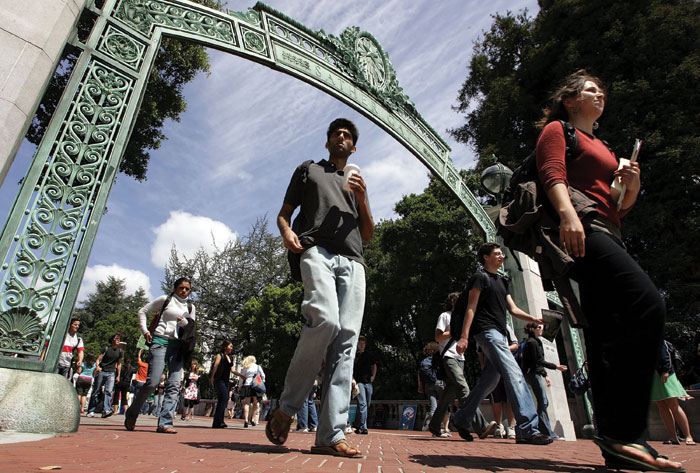
For over a month the university has allowed the obstruction of free passage through Sather Gate; approximately 70% of it has been blocked off by protesters of the war in Gaza. This forces anyone needing to pass through Sather Gate to use two narrow side entrances, creating bottlenecks and severely limiting freedom of movement.  

This causes hardship to individuals who use wheelchairs and other ambulatory devices to enable mobility, individuals who are visually impaired, and individuals with other physical disabilities and limitations who require the normally wide space of Sather Gate to move with safety free of obstacles.

Some of these disabilities are not visible and there should be no expectation that students, faculty and staff need to disclose them to the university or others, or to make special requests, for the university to ensure full unimpeded access to Sather Gate. That is their right  – one repeatedly denied over many weeks after UC Berkeley students, faculty, and staff  expressed concern about this demeaning discriminatory denial of their freedom of movement.

By allowing  the closure of the main portion of Sather Gate, the university is likely in violation of the Americans with Disabilities Act and has been for a very extended and inexcusable period of time.

The violation is not an aberration; it is willful and continuous and its consequences are harmful to a large portion of our university community.

Students – such as Daniel Solomon, a legally blind doctoral candidate who contributed recently to the Jewish News of Northern California  – report that the blocking of Sather Gate means disabled students like him “have been forced to traverse through dirt and puddles.” 

As of the beginning of March the university has taken no meaningful action to reopen the gate for full and free access. The university is obstructing the freedom of movement of a protected class — including the legally blind — whose rights it is legally obligated to protect under federal civil rights law.

There is no moral or legal justification for this policy and the university is likely in violation not only of civil rights and human rights law but also of our UC Berkeley Principles of Community. These are principles university leadership repeatedly cite as fundamental to UC Berkeley and incumbent upon all of us –  students, faculty and staff – to honor.

That obligation also includes the university’s administration and leadership.

The right to protest is protected by our Constitution and the university is obligated to respect it. It is well within its power to ensure that protesters have their rights respected without infringing on the rights of others – including particularly the disabled and physically and visually impaired. Protesters can use the space around Sather Gate to protest without blocking Sather Gate.

As discrimination deepens and becomes more diffuse and extensive at UC Berkeley, harming the rights and welfare of increasing numbers of individuals and minority groups who have legally protected status, all UC Berkeley students, faculty, and staff – whatever their identity, background, and physical and visual ability  – suffer from a decline in safety, welfare and confidence in the integrity of the university’s commitment to protect and respect our rights.

The exclusion of valued members of our university community is unacceptable and an affront to our university’s mission, ethics and legal responsibilities.

The visually and mobility-impaired and physically disabled have the right to be treated with equity and equality, dignity and respect at UC Berkeley and to be included and valued as an integral part of our university.

Discrimination at UC Berkeley is not confined to attacks on Jewish people. It is growing, enabled by a university administration and leadership that insufficiently respects and protects civil rights and human rights.  

Discrimination at UC Berkeley is not confined to attacks on Jewish people. It is growing, enabled by a university administration and leadership that insufficiently respects and protects civil rights and human rights.  

The university-sanctioned and -enabled violations of these civil rights are part of a larger systemic failure of the UC Berkeley administration and its leadership to value and uphold human dignity, equality, diversity, inclusion and equity for all members of our university community without exception.

Such discrimination cannot continue.  It demands immediate correction and reparative action.


Noam Schimmel is a Lecturer in Global Studies with an emphasis on human rights at University of California, Berkeley. 

The Diffusion of Discrimination at UC Berkeley Read More »